

Final Workshop: 10 December 2018, MRC, Vientiane
Peter-John Meynell
Environmental Study of the
Lancang-Mekong Development Plan
Baseline assessment findings – key issues, trends and
drivers
Zone descriptions
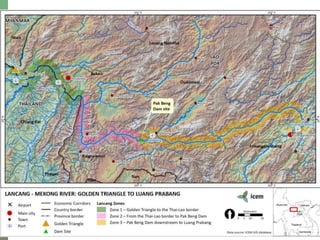
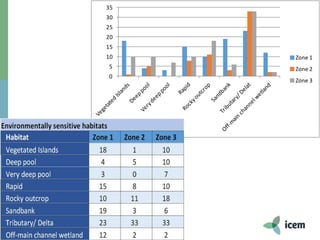
• ZONE 1 - Open flood plain and wide channel with sandy bed and banks
– relatively more developed
– wider channel and sandier with more and larger sand islands and wetlands
– mostly flat terrain
– large alluvial floodplains with cropping or settlements
– fewer rocky outcrops and dangerous areas
• ZONE 2 - Narrow steep channel mainly bed rock with V shaped valley
– narrower, more incised, straighter and rockier
– steep with short steep valleys running perpendicular to the river
– many small tributaries
– less developed with no large towns and has significant forest cover
– more dangerous areas for navigation
– few vegetated islands, sandbanks and wetlands
• ZONE 3 - Multiple rapids and rocky outcrops in broad channel mixed bed rock and
sandy substrate
– relatively narrow and rocky
– steep forested terrain and many dangerous areas
– valleys parallel to the river
– many small tributaries entering
– many deep and very deep pools associated with the river cutting through mountain ridges and
dangerous areas for navigation
– river widens and development increases closer to and including Luang Prabang
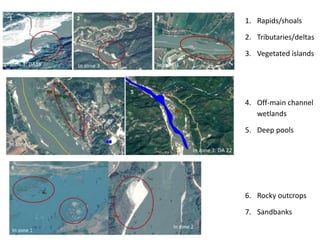
1. Rapids/shoals
2. Tributaries/deltas
3. Vegetated islands
4. Off-main channel
wetlands
5. Deep pools
6. Rocky outcrops
7. Sandbanks
0
5
10
15
20
25
30
35
Zone 1
Zone 2
Zone 3
A ‘fly over’ of the target Mekong River
PJ to show Google Earth Fly-over
KEY BASELINE FINDINGS: BATHYMETRIC
SURVEY (SWIM UNDER)
7
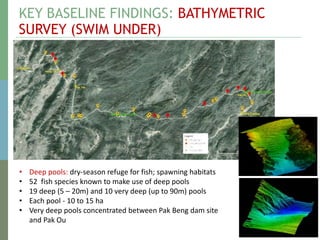
• Deep pools: dry-season refuge for fish; spawning habitats
• 52 fish species known to make use of deep pools
• 19 deep (5 – 20m) and 10 very deep (up to 90m) pools
• Each pool - 10 to 15 ha
• Very deep pools concentrated between Pak Beng dam site
and Pak Ou
KEY BASELINE FINDINGS: HYDROLOGY &
SEDIMENT
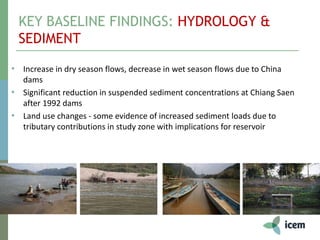
• Increase in dry season flows, decrease in wet season flows due to China
dams
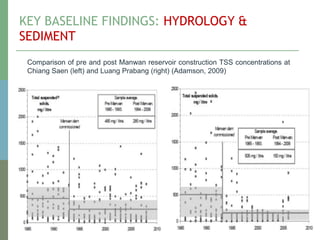
• Significant reduction in suspended sediment concentrations at Chiang Saen
after 1992 dams
• Land use changes - some evidence of increased sediment loads due to
tributary contributions in study zone with implications for reservoir
KEY BASELINE FINDINGS: HYDROLOGY &
SEDIMENT
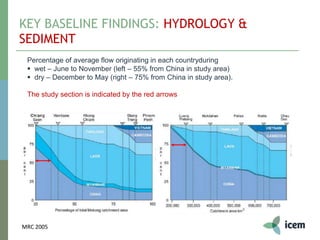
Percentage of average flow originating in each countryduring
 wet – June to November (left – 55% from China in study area)
 dry – December to May (right – 75% from China in study area).
The study section is indicated by the red arrows
MRC 2005
KEY BASELINE FINDINGS: HYDROLOGY &
SEDIMENT
Comparison of pre and post Manwan reservoir construction TSS concentrations at
Chiang Saen (left) and Luang Prabang (right) (Adamson, 2009)
KEY BASELINE FINDINGS:
AQUATIC ECOLOGY
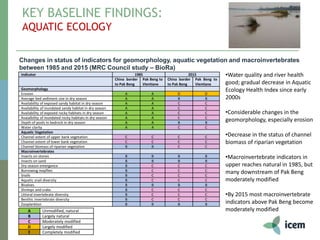
Changes in status of indicators for geomorphology, aquatic vegetation and macroinvertebrates
between 1985 and 2015 (MRC Council study – BioRa)
•Water quality and river health
good; gradual decrease in Aquatic
Ecology Health Index since early
2000s
•Considerable changes in the
geomorphology, especially erosion
•Decrease in the status of channel
biomass of riparian vegetation
•Macroinvertebrate indicators in
upper reaches natural in 1985, but
many downstream of Pak Beng
moderately modified
•By 2015 most macroinvertebrate
indicators above Pak Beng become
moderately modified
Indicator 1985 2015
China border
to Pak Beng
Pak Beng to
Vientiane
China border
to Pak Beng
Pak Beng to
Vientiane
Geomorphology
Erosion A A D D
Average bed sediment size in dry season A A B B
Availability of exposed sandy habitat in dry season A A C C
Availability of inundated sandy habitat in dry season A A C C
Availability of exposed rocky habitats in dry season A A C C
Avaialbility of inundated rocky habitats in dry season A A C C
Depth of pools in bedrock in dry season A A B B
Water clarity A A C C
Aquatic Vegetation
Channel extent of upper bank vegetation C C C C
Channel extent of lower bank vegetation C C C C
Channel biomass of riparian vegetation B B C C
Macroinvertebrates
Insects on stones B B B B
Insects on sand B B B B
Dry season emergence B C C C
Burrowing mayflies B C C C
Snails B C C C
Aquatic snail diversity B C C C
Bivalves B B B B
Shrimps and crabs B C C C
Littoral invertebrate diversity B C C C
Benthic invertebrate diversity B C C C
Zooplankton B B B B
A Unmodified, natural
B Largely natural
C Moderately modified
D Largely modified
E Completely modified
KEY BASELINE FINDINGS: FISH
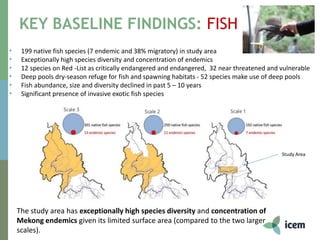
The study area has exceptionally high species diversity and concentration of
Mekong endemics given its limited surface area (compared to the two larger
scales).
• 199 native fish species (7 endemic and 38% migratory) in study area
• Exceptionally high species diversity and concentration of endemics
• 12 species on Red -List as critically endangered and endangered, 32 near threatened and vulnerable
• Deep pools dry-season refuge for fish and spawning habitats - 52 species make use of deep pools
• Fish abundance, size and diversity declined in past 5 – 10 years
• Significant presence of invasive exotic fish species
Study Area
KEY BASELINE FINDINGS: BIRDS
• No endemics
• 7 potentially threatened (limited info)
• 32 extinct
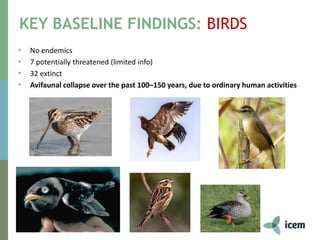
• Avifaunal collapse over the past 100–150 years, due to ordinary human activities
KEY BASELINE FINDINGS:
AMPHIBIANS AND REPTILES
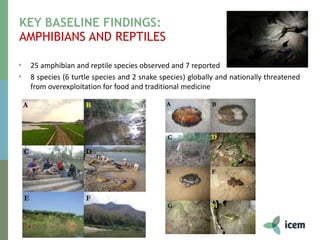
• 25 amphibian and reptile species observed and 7 reported
• 8 species (6 turtle species and 2 snake species) globally and nationally threatened
from overexploitation for food and traditional medicine
KEY BASELINE FINDINGS: NAVIGATION /WATERWAYS
15
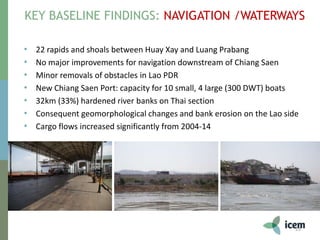
• 22 rapids and shoals between Huay Xay and Luang Prabang
• No major improvements for navigation downstream of Chiang Saen
• Minor removals of obstacles in Lao PDR
• New Chiang Saen Port: capacity for 10 small, 4 large (300 DWT) boats
• 32km (33%) hardened river banks on Thai section
• Consequent geomorphological changes and bank erosion on the Lao side
• Cargo flows increased significantly from 2004-14
KEY BASELINE FINDINGS: SOCIO-ECONOMICS
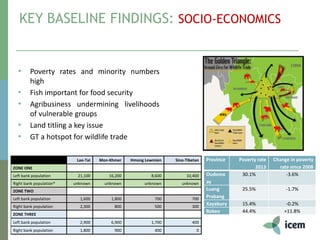
• Poverty rates and minority numbers
high
• Fish important for food security
• Agribusiness undermining livelihoods
of vulnerable groups
• Land titling a key issue
• GT a hotspot for wildlife trade
Lao-Tai Mon-Khmer Hmong Lewmien Sino-Tibetan
ZONE ONE
Left bank population 21,100 16,200 8,600 10,400
Right bank population* unknown unknown unknown unknown
ZONE TWO
Left bank population 1,600 1,800 700 700
Right bank population 2,300 800 500 300
ZONE THREE
Left bank population 2,900 6,900 1,700 400
Right bank population 1,800 900 400 0
Province Poverty rate
2013
Change in poverty
rate since 2008
Oudomx
ay
30.1% -3.6%
Luang
Prabang
25.5% -1.7%
Xayabury 15.4% -0.2%
Bokeo 44.4% +11.8%
Key drivers of change…
Hydrology and sediment
 Upper Mekong dams
 Land clearing and
deforestation
 Embankment developments
 Climate change
Aquatic ecology
 Changes of land use in the
watershed
 Changes in agriculture down to the
river banks
 Increases in urban run-off and
pollution
 Increases in infrastructure
development.
 Navigation improvements
 Increase in navigation traffic
Fish
 Deteriorating water quality
 Declines in benthic fauna and
flora
 Changes in water level
 Increasing fishing pressure
 Decline in algae
Amphibians and reptiles
 Land clearing and
development
 Forest degradation
 Agriculture (banana, rubber,
rice)
 Infrastructure
Birds
 Local hunting pressure
 Dogs and rats
 Disturbance to nests and habitats
Socio-economics
 Annual population growth rates
ranging from 0.38% in Chiang
Rai, up to 2.1% in Bokeo
 Promotion of agri-business is
coming at the expense of the
livelihoods and food security of
poor and vulnerable
communities
 Illegal logging is continuing to
grow
THANK YOU

Presentation 2: Baseline Assessment Findings

  • 1.
    Final Workshop: 10December 2018, MRC, Vientiane Peter-John Meynell Environmental Study of the Lancang-Mekong Development Plan Baseline assessment findings – key issues, trends and drivers
  • 3.
    Zone descriptions • ZONE1 - Open flood plain and wide channel with sandy bed and banks – relatively more developed – wider channel and sandier with more and larger sand islands and wetlands – mostly flat terrain – large alluvial floodplains with cropping or settlements – fewer rocky outcrops and dangerous areas • ZONE 2 - Narrow steep channel mainly bed rock with V shaped valley – narrower, more incised, straighter and rockier – steep with short steep valleys running perpendicular to the river – many small tributaries – less developed with no large towns and has significant forest cover – more dangerous areas for navigation – few vegetated islands, sandbanks and wetlands • ZONE 3 - Multiple rapids and rocky outcrops in broad channel mixed bed rock and sandy substrate – relatively narrow and rocky – steep forested terrain and many dangerous areas – valleys parallel to the river – many small tributaries entering – many deep and very deep pools associated with the river cutting through mountain ridges and dangerous areas for navigation – river widens and development increases closer to and including Luang Prabang
  • 4.
    1. Rapids/shoals 2. Tributaries/deltas 3.Vegetated islands 4. Off-main channel wetlands 5. Deep pools 6. Rocky outcrops 7. Sandbanks
  • 5.
  • 6.
    A ‘fly over’of the target Mekong River PJ to show Google Earth Fly-over
  • 7.
    KEY BASELINE FINDINGS:BATHYMETRIC SURVEY (SWIM UNDER) 7 • Deep pools: dry-season refuge for fish; spawning habitats • 52 fish species known to make use of deep pools • 19 deep (5 – 20m) and 10 very deep (up to 90m) pools • Each pool - 10 to 15 ha • Very deep pools concentrated between Pak Beng dam site and Pak Ou
  • 8.
    KEY BASELINE FINDINGS:HYDROLOGY & SEDIMENT • Increase in dry season flows, decrease in wet season flows due to China dams • Significant reduction in suspended sediment concentrations at Chiang Saen after 1992 dams • Land use changes - some evidence of increased sediment loads due to tributary contributions in study zone with implications for reservoir
  • 9.
    KEY BASELINE FINDINGS:HYDROLOGY & SEDIMENT Percentage of average flow originating in each countryduring  wet – June to November (left – 55% from China in study area)  dry – December to May (right – 75% from China in study area). The study section is indicated by the red arrows MRC 2005
  • 10.
    KEY BASELINE FINDINGS:HYDROLOGY & SEDIMENT Comparison of pre and post Manwan reservoir construction TSS concentrations at Chiang Saen (left) and Luang Prabang (right) (Adamson, 2009)
  • 11.
    KEY BASELINE FINDINGS: AQUATICECOLOGY Changes in status of indicators for geomorphology, aquatic vegetation and macroinvertebrates between 1985 and 2015 (MRC Council study – BioRa) •Water quality and river health good; gradual decrease in Aquatic Ecology Health Index since early 2000s •Considerable changes in the geomorphology, especially erosion •Decrease in the status of channel biomass of riparian vegetation •Macroinvertebrate indicators in upper reaches natural in 1985, but many downstream of Pak Beng moderately modified •By 2015 most macroinvertebrate indicators above Pak Beng become moderately modified Indicator 1985 2015 China border to Pak Beng Pak Beng to Vientiane China border to Pak Beng Pak Beng to Vientiane Geomorphology Erosion A A D D Average bed sediment size in dry season A A B B Availability of exposed sandy habitat in dry season A A C C Availability of inundated sandy habitat in dry season A A C C Availability of exposed rocky habitats in dry season A A C C Avaialbility of inundated rocky habitats in dry season A A C C Depth of pools in bedrock in dry season A A B B Water clarity A A C C Aquatic Vegetation Channel extent of upper bank vegetation C C C C Channel extent of lower bank vegetation C C C C Channel biomass of riparian vegetation B B C C Macroinvertebrates Insects on stones B B B B Insects on sand B B B B Dry season emergence B C C C Burrowing mayflies B C C C Snails B C C C Aquatic snail diversity B C C C Bivalves B B B B Shrimps and crabs B C C C Littoral invertebrate diversity B C C C Benthic invertebrate diversity B C C C Zooplankton B B B B A Unmodified, natural B Largely natural C Moderately modified D Largely modified E Completely modified
  • 12.
    KEY BASELINE FINDINGS:FISH The study area has exceptionally high species diversity and concentration of Mekong endemics given its limited surface area (compared to the two larger scales). • 199 native fish species (7 endemic and 38% migratory) in study area • Exceptionally high species diversity and concentration of endemics • 12 species on Red -List as critically endangered and endangered, 32 near threatened and vulnerable • Deep pools dry-season refuge for fish and spawning habitats - 52 species make use of deep pools • Fish abundance, size and diversity declined in past 5 – 10 years • Significant presence of invasive exotic fish species Study Area
  • 13.
    KEY BASELINE FINDINGS:BIRDS • No endemics • 7 potentially threatened (limited info) • 32 extinct • Avifaunal collapse over the past 100–150 years, due to ordinary human activities
  • 14.
    KEY BASELINE FINDINGS: AMPHIBIANSAND REPTILES • 25 amphibian and reptile species observed and 7 reported • 8 species (6 turtle species and 2 snake species) globally and nationally threatened from overexploitation for food and traditional medicine
  • 15.
    KEY BASELINE FINDINGS:NAVIGATION /WATERWAYS 15 • 22 rapids and shoals between Huay Xay and Luang Prabang • No major improvements for navigation downstream of Chiang Saen • Minor removals of obstacles in Lao PDR • New Chiang Saen Port: capacity for 10 small, 4 large (300 DWT) boats • 32km (33%) hardened river banks on Thai section • Consequent geomorphological changes and bank erosion on the Lao side • Cargo flows increased significantly from 2004-14
  • 16.
    KEY BASELINE FINDINGS:SOCIO-ECONOMICS • Poverty rates and minority numbers high • Fish important for food security • Agribusiness undermining livelihoods of vulnerable groups • Land titling a key issue • GT a hotspot for wildlife trade Lao-Tai Mon-Khmer Hmong Lewmien Sino-Tibetan ZONE ONE Left bank population 21,100 16,200 8,600 10,400 Right bank population* unknown unknown unknown unknown ZONE TWO Left bank population 1,600 1,800 700 700 Right bank population 2,300 800 500 300 ZONE THREE Left bank population 2,900 6,900 1,700 400 Right bank population 1,800 900 400 0 Province Poverty rate 2013 Change in poverty rate since 2008 Oudomx ay 30.1% -3.6% Luang Prabang 25.5% -1.7% Xayabury 15.4% -0.2% Bokeo 44.4% +11.8%
  • 17.
    Key drivers ofchange… Hydrology and sediment  Upper Mekong dams  Land clearing and deforestation  Embankment developments  Climate change Aquatic ecology  Changes of land use in the watershed  Changes in agriculture down to the river banks  Increases in urban run-off and pollution  Increases in infrastructure development.  Navigation improvements  Increase in navigation traffic Fish  Deteriorating water quality  Declines in benthic fauna and flora  Changes in water level  Increasing fishing pressure  Decline in algae Amphibians and reptiles  Land clearing and development  Forest degradation  Agriculture (banana, rubber, rice)  Infrastructure Birds  Local hunting pressure  Dogs and rats  Disturbance to nests and habitats Socio-economics  Annual population growth rates ranging from 0.38% in Chiang Rai, up to 2.1% in Bokeo  Promotion of agri-business is coming at the expense of the livelihoods and food security of poor and vulnerable communities  Illegal logging is continuing to grow
  • 18.

Editor's Notes

  • #3 Wetlands / island terraces concentrated between Chiang Saen and Pak Tha Sand banks located throughout, concentrated between Chiang Saen and Pak Tha Rocky outcrops and tributaries throughout but more numerous downstream of Pak Tha
  • #8 As detailed by Halls et al. (2013), most deep pools are 15 - 20 m deep and have areas of 10 to 15 ha. The deepest pools are 80 - 90 m deep and are found in particular between Huay Xai and Vientiane. 110 pools identified most occur in the section between Pak Tha and Pak Ou, while very deep pools are concentrated between Pak Beng dam site and Pak Ou; Of the 206 fish species recorded in the study zone, 52 are known to make use of deep pools. Among these are 22 species of Cyprinidae (minnows and barbs), 10 species of Pangasiidae (panga catfish) and 3 species of Notopteridae (featherbacks), followed by 1 to 2 species in 14 other families (Figure 3).
  • #9 MRC WQ mon. (3 locations; 2009-2015) WQ appears to be declining since 2011 but still good; MRC Aquatic Health Index (5 locations; 2005-2013) - generally good-excellent except Ban Xiengkok, which has been poor; study field trip macroinvertebrate sampling (13 locations) – river health typically fair;
  • #16 MRC condition surveyed 22 rapids and shoals between Huay Xay and Luang Prabang in 2008 Minor removals of obstacles are reported to have been undertaken in Lao PDR