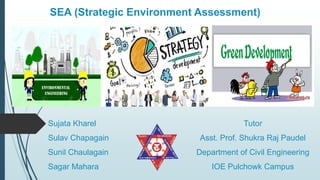
SEA (Strategic Environment Assessment)
Sujata Kharel
Sulav Chapagain
Sunil Chaulagain
Sagar Mahara
Tutor
Asst. Prof. Shukra Raj Paudel
Department of Civil Engineering
IOE Pulchowk Campus
Presentation Outline
1. Introduction to SEA
2. Use of SEA
3. Benefits of SEA
4. SEA and Sustainable Development
5. Procedure of SEA
6. Limitations and Hurdles in SEA
2
1. Introduction to SEA (Strategic
Environment Assessment)
 instruments of assessing plans, programmes and
strategies.
 Development of the country is a desire but it shouldn’t
hinder the environment.
 concept of sustainable development is used
 structuring the community life the way that its members
can enjoy the right to satisfy their needs
 without causing degradation of the nature and
environment as a whole, i.e. without compromising the
right of the future generations to satisfy their own needs.
3
1.1 Definitions of SEA
Evaluating the
environmental impacts of
PPPs (Policy, Plan and
Programme ) and their
alternatives.
- Therivel
SEA is the systematic
process for evaluating the
environmental
consequences of
proposed policy, plan or
programme.
- Sadler and Verheem
Process directed at
providing holistic
understanding of
environment and social
implication of policy
proposal. The intention of
SEA is moving PPP
towards sustainable
outcomes.
- Brown & Therivel
4
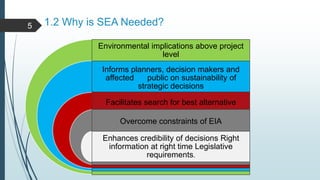
1.2 Why is SEA Needed?
Environmental implications above project
level
Informs planners, decision makers and
affected public on sustainability of
strategic decisions
Facilitates search for best alternative
Overcome constraints of EIA
Enhances credibility of decisions Right
information at right time Legislative
requirements.
5
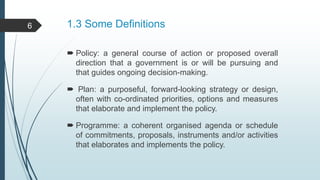
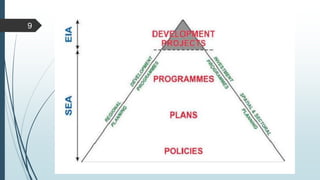
1.3 Some Definitions
 Policy: a general course of action or proposed overall
direction that a government is or will be pursuing and
that guides ongoing decision-making.
 Plan: a purposeful, forward-looking strategy or design,
often with co-ordinated priorities, options and measures
that elaborate and implement the policy.
 Programme: a coherent organised agenda or schedule
of commitments, proposals, instruments and/or activities
that elaborates and implements the policy.
6
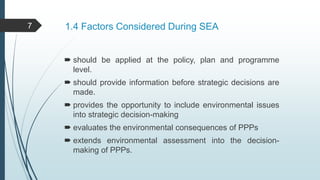
1.4 Factors Considered During SEA
 should be applied at the policy, plan and programme
level.
 should provide information before strategic decisions are
made.
 provides the opportunity to include environmental issues
into strategic decision-making
 evaluates the environmental consequences of PPPs
 extends environmental assessment into the decision-
making of PPPs.
7
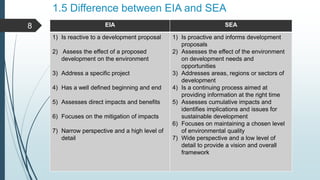
1.5 Difference between EIA and SEA
EIA SEA
1) Is reactive to a development proposal
2) Assess the effect of a proposed
development on the environment
3) Address a specific project
4) Has a well defined beginning and end
5) Assesses direct impacts and benefits
6) Focuses on the mitigation of impacts
7) Narrow perspective and a high level of
detail
1) Is proactive and informs development
proposals
2) Assesses the effect of the environment
on development needs and
opportunities
3) Addresses areas, regions or sectors of
development
4) Is a continuing process aimed at
providing information at the right time
5) Assesses cumulative impacts and
identifies implications and issues for
sustainable development
6) Focuses on maintaining a chosen level
of environmental quality
7) Wide perspective and a low level of
detail to provide a vision and overall
framework
8
9
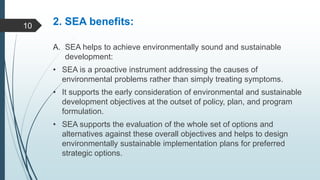
2. SEA benefits:
A. SEA helps to achieve environmentally sound and sustainable
development:
• SEA is a proactive instrument addressing the causes of
environmental problems rather than simply treating symptoms.
• It supports the early consideration of environmental and sustainable
development objectives at the outset of policy, plan, and program
formulation.
• SEA supports the evaluation of the whole set of options and
alternatives against these overall objectives and helps to design
environmentally sustainable implementation plans for preferred
strategic options.
10
2. SEA benefits(contd) :
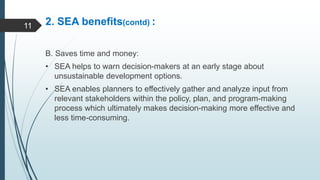
B. Saves time and money:
• SEA helps to warn decision-makers at an early stage about
unsustainable development options.
• SEA enables planners to effectively gather and analyze input from
relevant stakeholders within the policy, plan, and program-making
process which ultimately makes decision-making more effective and
less time-consuming.
11
2. SEA benefits(contd) :
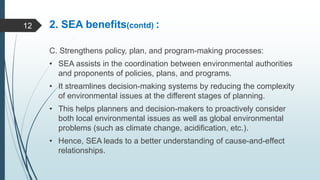
C. Strengthens policy, plan, and program-making processes:
• SEA assists in the coordination between environmental authorities
and proponents of policies, plans, and programs.
• It streamlines decision-making systems by reducing the complexity
of environmental issues at the different stages of planning.
• This helps planners and decision-makers to proactively consider
both local environmental issues as well as global environmental
problems (such as climate change, acidification, etc.).
• Hence, SEA leads to a better understanding of cause-and-effect
relationships.
12
2. SEA benefits(contd) :
D. Improves good governance and public trust in policy, plan and
program making:
• SEA increases overall transparency of strategic decision-making
and helps planners and decision-makers create public trust in the
planning process.
• SEA allows decision-makers to consider the opinions of key
stakeholders early in the planning process.
• Properly undertaken and accountable SEA will enhance the
credibility of policies, plans, and programs and may mobilize the
support of key stakeholders for their implementation.
13
14
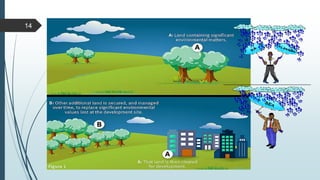
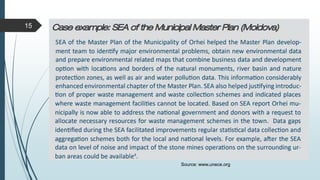
Source: www.unece.org
15
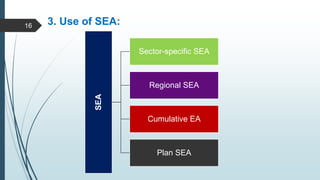
3. Use of SEA:
SEA
Sector-specific SEA
Regional SEA
Cumulative EA
Plan SEA
16
3.1 Use of SEA:
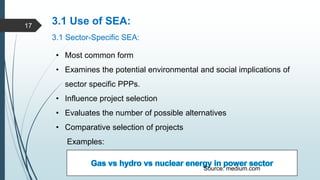
3.1 Sector-Specific SEA:
• Most common form
• Examines the potential environmental and social implications of
sector specific PPPs.
• Influence project selection
• Evaluates the number of possible alternatives
• Comparative selection of projects
Examples:
Source: medium.com
17
3. Use of SEA:
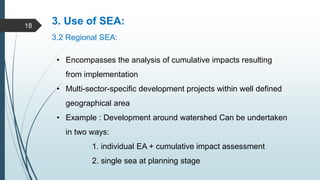
3.2 Regional SEA:
• Encompasses the analysis of cumulative impacts resulting
from implementation
• Multi-sector-specific development projects within well defined
geographical area
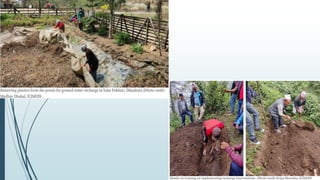
• Example : Development around watershed Can be undertaken
in two ways:
1. individual EA + cumulative impact assessment
2. single sea at planning stage
18
19
3. Use of SEA:
3.3 Cumulative SEA:
• Assessing impacts of currently proposed actions added to
existing development and foreseeable future projects
• No sharp distinction to regional SEA
• Impacts are often well addressed in project- specific EA
20
3. Use of SEA:
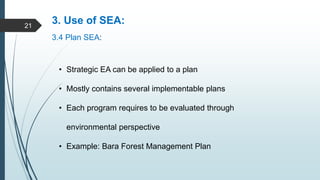
3.4 Plan SEA:
• Strategic EA can be applied to a plan
• Mostly contains several implementable plans
• Each program requires to be evaluated through
environmental perspective
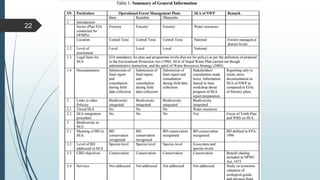
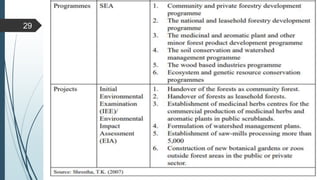
• Example: Bara Forest Management Plan
21
22
23
4. SEA and Sustainable Development
24
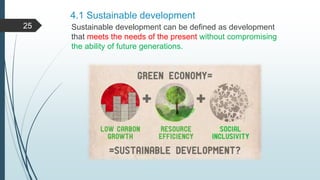
4.1 Sustainable development
Sustainable development can be defined as development
that meets the needs of the present without compromising
the ability of future generations.
25
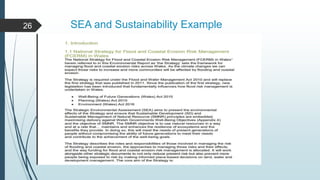
SEA and Sustainability Example
26
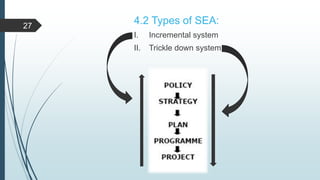
4.2 Types of SEA:
I. Incremental system
II. Trickle down system
27
28
29
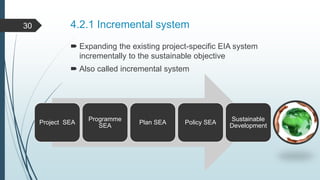
4.2.1 Incremental system
 Expanding the existing project-specific EIA system
incrementally to the sustainable objective
 Also called incremental system
Project SEA
Programme
SEA
Plan SEA Policy SEA
Sustainable
Development
30
 Incremental system goes on expanding its policy
 Incremental systems of SEA are most commonly used at
present.
 The incremental system is widely used; however, the trickle-
down system is more effective
31
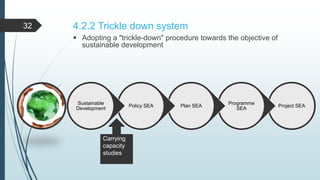
4.2.2 Trickle down system
 Adopting a "trickle-down" procedure towards the objective of
sustainable development
Project SEA
Programme
SEA
Plan SEA
Policy SEA
Sustainable
Development
Carrying
capacity
studies
32
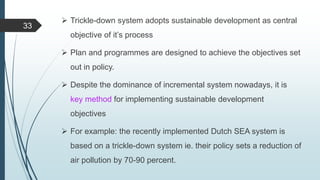
 Trickle-down system adopts sustainable development as central
objective of it’s process
 Plan and programmes are designed to achieve the objectives set
out in policy.
 Despite the dominance of incremental system nowadays, it is
key method for implementing sustainable development
objectives
 For example: the recently implemented Dutch SEA system is
based on a trickle-down system ie. their policy sets a reduction of
air pollution by 70-90 percent.
33
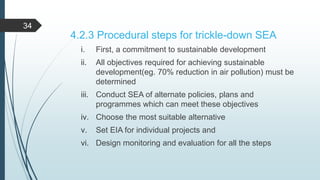
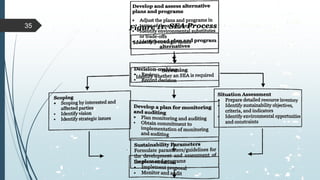
4.2.3 Procedural steps for trickle-down SEA
i. First, a commitment to sustainable development
ii. All objectives required for achieving sustainable
development(eg. 70% reduction in air pollution) must be
determined
iii. Conduct SEA of alternate policies, plans and
programmes which can meet these objectives
iv. Choose the most suitable alternative
v. Set EIA for individual projects and
vi. Design monitoring and evaluation for all the steps
34
35
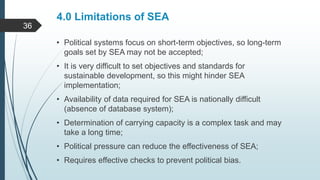
4.0 Limitations of SEA
• Political systems focus on short-term objectives, so long-term
goals set by SEA may not be accepted;
• It is very difficult to set objectives and standards for
sustainable development, so this might hinder SEA
implementation;
• Availability of data required for SEA is nationally difficult
(absence of database system);
• Determination of carrying capacity is a complex task and may
take a long time;
• Political pressure can reduce the effectiveness of SEA;
• Requires effective checks to prevent political bias.
36
5.0 Outcomes of SEA
1. The planning process
2. Baseline context of the planning process
3. The environmental consequences of policy options
4. The arrangements for monitoring and post-approval
analysis of the implementation of the policy, plan or
programme
5. The difficulties and uncertainties
37
6.0 Hurdles to implementing SEA
1. Cost of SEA
2. Uncertainty and vagueness associated with SEA
3. Potential role of SEA in decision making
4. Lack of guidance and training
5. Lack of clear accountability and responsibility
6. Unknown and untested methodologies
38
Bibliography
 Khadka, R.B.,Gorzula S.,Joshi A.R., Guragain S. and Mathema A.B.,
“Environmental Impact Assesment”, School of Environmental Science
and Management (SchEMS) and Institute of Environment and
Development: Research and Capacity Building Initiatives (IED/RCBI),
2013
 Asian Regional Environmental Programme, IUCN Nepal, “EIA Training
Manual for Professionals and Managers”
 www.unece.org
 (https://www.icimod.org/article/adapting-to-water-scarcity-through-
watershed-conservation/)
39

strategic environmental environment SEA-FINAL-presentation-2 .pptx

  • 1.
    SEA (Strategic EnvironmentAssessment) Sujata Kharel Sulav Chapagain Sunil Chaulagain Sagar Mahara Tutor Asst. Prof. Shukra Raj Paudel Department of Civil Engineering IOE Pulchowk Campus
  • 2.
    Presentation Outline 1. Introductionto SEA 2. Use of SEA 3. Benefits of SEA 4. SEA and Sustainable Development 5. Procedure of SEA 6. Limitations and Hurdles in SEA 2
  • 3.
    1. Introduction toSEA (Strategic Environment Assessment)  instruments of assessing plans, programmes and strategies.  Development of the country is a desire but it shouldn’t hinder the environment.  concept of sustainable development is used  structuring the community life the way that its members can enjoy the right to satisfy their needs  without causing degradation of the nature and environment as a whole, i.e. without compromising the right of the future generations to satisfy their own needs. 3
  • 4.
    1.1 Definitions ofSEA Evaluating the environmental impacts of PPPs (Policy, Plan and Programme ) and their alternatives. - Therivel SEA is the systematic process for evaluating the environmental consequences of proposed policy, plan or programme. - Sadler and Verheem Process directed at providing holistic understanding of environment and social implication of policy proposal. The intention of SEA is moving PPP towards sustainable outcomes. - Brown & Therivel 4
  • 5.
    1.2 Why isSEA Needed? Environmental implications above project level Informs planners, decision makers and affected public on sustainability of strategic decisions Facilitates search for best alternative Overcome constraints of EIA Enhances credibility of decisions Right information at right time Legislative requirements. 5
  • 6.
    1.3 Some Definitions Policy: a general course of action or proposed overall direction that a government is or will be pursuing and that guides ongoing decision-making.  Plan: a purposeful, forward-looking strategy or design, often with co-ordinated priorities, options and measures that elaborate and implement the policy.  Programme: a coherent organised agenda or schedule of commitments, proposals, instruments and/or activities that elaborates and implements the policy. 6
  • 7.
    1.4 Factors ConsideredDuring SEA  should be applied at the policy, plan and programme level.  should provide information before strategic decisions are made.  provides the opportunity to include environmental issues into strategic decision-making  evaluates the environmental consequences of PPPs  extends environmental assessment into the decision- making of PPPs. 7
  • 8.
    1.5 Difference betweenEIA and SEA EIA SEA 1) Is reactive to a development proposal 2) Assess the effect of a proposed development on the environment 3) Address a specific project 4) Has a well defined beginning and end 5) Assesses direct impacts and benefits 6) Focuses on the mitigation of impacts 7) Narrow perspective and a high level of detail 1) Is proactive and informs development proposals 2) Assesses the effect of the environment on development needs and opportunities 3) Addresses areas, regions or sectors of development 4) Is a continuing process aimed at providing information at the right time 5) Assesses cumulative impacts and identifies implications and issues for sustainable development 6) Focuses on maintaining a chosen level of environmental quality 7) Wide perspective and a low level of detail to provide a vision and overall framework 8
  • 9.
  • 10.
    2. SEA benefits: A.SEA helps to achieve environmentally sound and sustainable development: • SEA is a proactive instrument addressing the causes of environmental problems rather than simply treating symptoms. • It supports the early consideration of environmental and sustainable development objectives at the outset of policy, plan, and program formulation. • SEA supports the evaluation of the whole set of options and alternatives against these overall objectives and helps to design environmentally sustainable implementation plans for preferred strategic options. 10
  • 11.
    2. SEA benefits(contd): B. Saves time and money: • SEA helps to warn decision-makers at an early stage about unsustainable development options. • SEA enables planners to effectively gather and analyze input from relevant stakeholders within the policy, plan, and program-making process which ultimately makes decision-making more effective and less time-consuming. 11
  • 12.
    2. SEA benefits(contd): C. Strengthens policy, plan, and program-making processes: • SEA assists in the coordination between environmental authorities and proponents of policies, plans, and programs. • It streamlines decision-making systems by reducing the complexity of environmental issues at the different stages of planning. • This helps planners and decision-makers to proactively consider both local environmental issues as well as global environmental problems (such as climate change, acidification, etc.). • Hence, SEA leads to a better understanding of cause-and-effect relationships. 12
  • 13.
    2. SEA benefits(contd): D. Improves good governance and public trust in policy, plan and program making: • SEA increases overall transparency of strategic decision-making and helps planners and decision-makers create public trust in the planning process. • SEA allows decision-makers to consider the opinions of key stakeholders early in the planning process. • Properly undertaken and accountable SEA will enhance the credibility of policies, plans, and programs and may mobilize the support of key stakeholders for their implementation. 13
  • 14.
  • 15.
  • 16.
    3. Use ofSEA: SEA Sector-specific SEA Regional SEA Cumulative EA Plan SEA 16
  • 17.
    3.1 Use ofSEA: 3.1 Sector-Specific SEA: • Most common form • Examines the potential environmental and social implications of sector specific PPPs. • Influence project selection • Evaluates the number of possible alternatives • Comparative selection of projects Examples: Source: medium.com 17
  • 18.
    3. Use ofSEA: 3.2 Regional SEA: • Encompasses the analysis of cumulative impacts resulting from implementation • Multi-sector-specific development projects within well defined geographical area • Example : Development around watershed Can be undertaken in two ways: 1. individual EA + cumulative impact assessment 2. single sea at planning stage 18
  • 19.
  • 20.
    3. Use ofSEA: 3.3 Cumulative SEA: • Assessing impacts of currently proposed actions added to existing development and foreseeable future projects • No sharp distinction to regional SEA • Impacts are often well addressed in project- specific EA 20
  • 21.
    3. Use ofSEA: 3.4 Plan SEA: • Strategic EA can be applied to a plan • Mostly contains several implementable plans • Each program requires to be evaluated through environmental perspective • Example: Bara Forest Management Plan 21
  • 22.
  • 23.
  • 24.
    4. SEA andSustainable Development 24
  • 25.
    4.1 Sustainable development Sustainabledevelopment can be defined as development that meets the needs of the present without compromising the ability of future generations. 25
  • 26.
  • 27.
    4.2 Types ofSEA: I. Incremental system II. Trickle down system 27
  • 28.
  • 29.
  • 30.
    4.2.1 Incremental system Expanding the existing project-specific EIA system incrementally to the sustainable objective  Also called incremental system Project SEA Programme SEA Plan SEA Policy SEA Sustainable Development 30
  • 31.
     Incremental systemgoes on expanding its policy  Incremental systems of SEA are most commonly used at present.  The incremental system is widely used; however, the trickle- down system is more effective 31
  • 32.
    4.2.2 Trickle downsystem  Adopting a "trickle-down" procedure towards the objective of sustainable development Project SEA Programme SEA Plan SEA Policy SEA Sustainable Development Carrying capacity studies 32
  • 33.
     Trickle-down systemadopts sustainable development as central objective of it’s process  Plan and programmes are designed to achieve the objectives set out in policy.  Despite the dominance of incremental system nowadays, it is key method for implementing sustainable development objectives  For example: the recently implemented Dutch SEA system is based on a trickle-down system ie. their policy sets a reduction of air pollution by 70-90 percent. 33
  • 34.
    4.2.3 Procedural stepsfor trickle-down SEA i. First, a commitment to sustainable development ii. All objectives required for achieving sustainable development(eg. 70% reduction in air pollution) must be determined iii. Conduct SEA of alternate policies, plans and programmes which can meet these objectives iv. Choose the most suitable alternative v. Set EIA for individual projects and vi. Design monitoring and evaluation for all the steps 34
  • 35.
  • 36.
    4.0 Limitations ofSEA • Political systems focus on short-term objectives, so long-term goals set by SEA may not be accepted; • It is very difficult to set objectives and standards for sustainable development, so this might hinder SEA implementation; • Availability of data required for SEA is nationally difficult (absence of database system); • Determination of carrying capacity is a complex task and may take a long time; • Political pressure can reduce the effectiveness of SEA; • Requires effective checks to prevent political bias. 36
  • 37.
    5.0 Outcomes ofSEA 1. The planning process 2. Baseline context of the planning process 3. The environmental consequences of policy options 4. The arrangements for monitoring and post-approval analysis of the implementation of the policy, plan or programme 5. The difficulties and uncertainties 37
  • 38.
    6.0 Hurdles toimplementing SEA 1. Cost of SEA 2. Uncertainty and vagueness associated with SEA 3. Potential role of SEA in decision making 4. Lack of guidance and training 5. Lack of clear accountability and responsibility 6. Unknown and untested methodologies 38
  • 39.
    Bibliography  Khadka, R.B.,GorzulaS.,Joshi A.R., Guragain S. and Mathema A.B., “Environmental Impact Assesment”, School of Environmental Science and Management (SchEMS) and Institute of Environment and Development: Research and Capacity Building Initiatives (IED/RCBI), 2013  Asian Regional Environmental Programme, IUCN Nepal, “EIA Training Manual for Professionals and Managers”  www.unece.org  (https://www.icimod.org/article/adapting-to-water-scarcity-through- watershed-conservation/) 39