Types of EIA
Presented by: Ateeq ur Rehman
Roll No. 19061708-020
Presented To. Dr.Muhammad Dawood
Mphill.2nd
Department of Geography
University of Gujrat
Definition
• EIA is "the process of identifying, predicting, evaluating and mitigating the
biophysical, social, and other relevant effects of development proposals prior
to major decisions being taken and commitments made” (IAIA 1999)
• Environmental impact assessment (EIA) can be defined as “the systematic
examination of unintended consequences of a development project or
program, with the view to reduce or mitigate negative impacts and maximize
on positive ones” (EEAA 1996).
Types of EIA
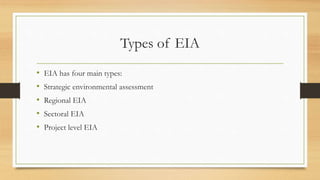
• EIA has four main types:
• Strategic environmental assessment
• Regional EIA
• Sectoral EIA
• Project level EIA
Strategic environmental assessment
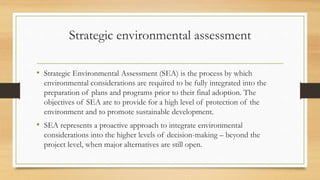
• Strategic Environmental Assessment (SEA) is the process by which
environmental considerations are required to be fully integrated into the
preparation of plans and programs prior to their final adoption. The
objectives of SEA are to provide for a high level of protection of the
environment and to promote sustainable development.
• SEA represents a proactive approach to integrate environmental
considerations into the higher levels of decision-making – beyond the
project level, when major alternatives are still open.
Regional EIA
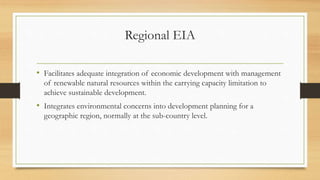
• Facilitates adequate integration of economic development with management
of renewable natural resources within the carrying capacity limitation to
achieve sustainable development.
• Integrates environmental concerns into development planning for a
geographic region, normally at the sub-country level.
Sectoral EIA
• Sectoral Environmental impact assessment helps in addressing specific
environmental problems that may be encountered in planning and
implementing sectoral development projects.
• SEA offers an opportunity for sector-wide environmental analysis before
investment priorities have been determined.
• SEA is most commonly applied in the context of sector investment
programs involving multiple sub-projects.
Project level EIA
• Project level EIA refers to the developmental activity in isolation and the impacts
that it exerts on the receiving environment.
• In many countries in the world where EIA is in place, developmental projects such
as construction of highways and expressways, ports and harbors, hydropower
projects, manufacturing industries, mining projects, etc., undergo an environmental
examination prior to being given clearance to establish and operate.
• Thus, it may not effectively integrate the cumulative effects of the development in a
region.
Eia.ppt

Eia.ppt

  • 2.
    Types of EIA Presentedby: Ateeq ur Rehman Roll No. 19061708-020 Presented To. Dr.Muhammad Dawood Mphill.2nd Department of Geography University of Gujrat
  • 3.
    Definition • EIA is"the process of identifying, predicting, evaluating and mitigating the biophysical, social, and other relevant effects of development proposals prior to major decisions being taken and commitments made” (IAIA 1999) • Environmental impact assessment (EIA) can be defined as “the systematic examination of unintended consequences of a development project or program, with the view to reduce or mitigate negative impacts and maximize on positive ones” (EEAA 1996).
  • 4.
    Types of EIA •EIA has four main types: • Strategic environmental assessment • Regional EIA • Sectoral EIA • Project level EIA
  • 5.
    Strategic environmental assessment •Strategic Environmental Assessment (SEA) is the process by which environmental considerations are required to be fully integrated into the preparation of plans and programs prior to their final adoption. The objectives of SEA are to provide for a high level of protection of the environment and to promote sustainable development. • SEA represents a proactive approach to integrate environmental considerations into the higher levels of decision-making – beyond the project level, when major alternatives are still open.
  • 6.
    Regional EIA • Facilitatesadequate integration of economic development with management of renewable natural resources within the carrying capacity limitation to achieve sustainable development. • Integrates environmental concerns into development planning for a geographic region, normally at the sub-country level.
  • 7.
    Sectoral EIA • SectoralEnvironmental impact assessment helps in addressing specific environmental problems that may be encountered in planning and implementing sectoral development projects. • SEA offers an opportunity for sector-wide environmental analysis before investment priorities have been determined. • SEA is most commonly applied in the context of sector investment programs involving multiple sub-projects.
  • 8.
    Project level EIA •Project level EIA refers to the developmental activity in isolation and the impacts that it exerts on the receiving environment. • In many countries in the world where EIA is in place, developmental projects such as construction of highways and expressways, ports and harbors, hydropower projects, manufacturing industries, mining projects, etc., undergo an environmental examination prior to being given clearance to establish and operate. • Thus, it may not effectively integrate the cumulative effects of the development in a region.