STRATEGIC ENVIRONMENTAL ASSESSMENT
(PRINCIPLES & POTENTIAL)
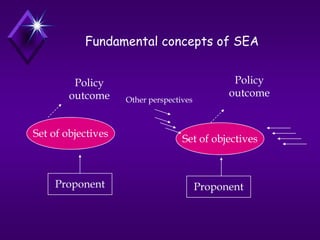
Fundamental concepts of SEA
Policy
outcome
Set of objectives
Proponent
Set of objectives
Proponent
Policy
outcome Other perspectives
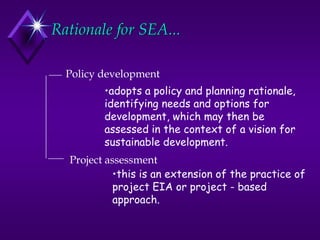
Rationale for SEA...
Policy development
Project assessment
•adopts a policy and planning rationale,
identifying needs and options for
development, which may then be
assessed in the context of a vision for
sustainable development.
•this is an extension of the practice of
project EIA or project - based
approach.
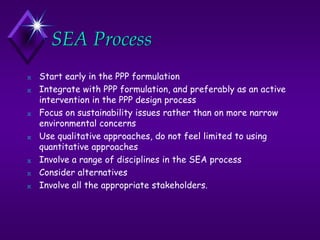
SEA Process
N Start early in the PPP formulation
N Integrate with PPP formulation, and preferably as an active
intervention in the PPP design process
N Focus on sustainability issues rather than on more narrow
environmental concerns
N Use qualitative approaches, do not feel limited to using
quantitative approaches
N Involve a range of disciplines in the SEA process
N Consider alternatives
N Involve all the appropriate stakeholders.
Evolution of the strategic environmental
assessment concept...
N Wood and Djeddour (1992) offered several advantages of
introducing SEA.
N Goodland and Tillman (1995) compare traditional EIA as
Reactive and SEA as Proactive.
N The concept of SEA has been evolving, strongly linked to the
achievement of sustainability and the consideration of
cumulative effects.
N Controversy over the concept of SEA is the use and meaning
of the word ‘strategic’
Forms and applications of
SEA...
Forms
N strategic,
N policy impact assessment,
N regional EA,
N sectoral EA,
N environmental overview,
and
N programmatic EA.
Applications (Scope)
N international treaties,
N privatization,
N transnational corporations,
N structural adjustment operations,
N structural operations programmes
N national budgets
N legislative proposals,
N area - wide or land - use planning,
N transboundary impacts, and
N global issues.
Definitions of SEA...
N the formalised, systematic and comprehensive process of
evaluating the environmental impacts of a policy, plan or
programme and its alternatives, including the preparation of
a written report on the findings of that evaluation, and
using the findings in publicly accountable decision-making
(Therivel et al. 1992).
N a systematic process for evaluating the environmental
consequences of proposed policy, plan, or programme
initiatives in order to ensure they are fully included and
appropriately addressed at the earliest appropriate stage of
decision - making on par with economic and social
considerations (Sadler and Verheem 1996)
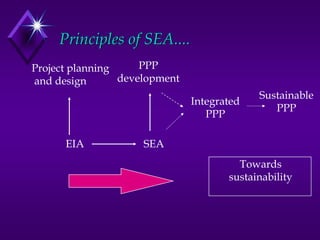
Principles of SEA....
Project planning
and design
PPP
development
EIA SEA
Integrated
PPP
Sustainable
PPP
Towards
sustainability
Why is strategic environmental assessment
important?
N Helps to incorporate sustainability principles in the
policy-making process
N By validating the policy, can improve transparency in
decision-making.
N Provides screening context to lower levels of EA,
particularly project ‘EIA’
N Provides better context for assessment of cumulative
effects
N Current evidence shows that it generally influences
decision-making.
(Source: Partidario, 1997)
Principles of good SEA practice
N Policy framework
N Open and accountable political and organizational systems
and commitment from the relevant organizations
N National and/or institutional sustainability policies and
strategies
N Action plans for sustainable development as benchmarks
to environmental impacts of strategic actions
N Ensure integrated decision making
N Identify criteria and mechanisms to evaluate significance
and determine acceptability against a policy framework
of environmental objectives and standards
(Source: Partidario, 1996)
Principles of good SEA practice
N Institutional framework
N Provision of an institution that will facilitate integrated
decision making
N Establishment of internal and external organizational
frameworks
N Assigning specific responsibilities and accountability for
key decision making points
N Provision of an appropriate regulatory framework
(Source: Partidario, 1996)
Principles of good SEA practice
N Procedural framework
N SEA should be considered an intrinsic element and
applied as early as possible
N Should focus on fundamental elements of policy proposals
N Establish the kind of instruments SEA should apply
N Establish when SEA should be applied
N Be focused and ask right questions when using SEA
N Scope of SEA should be comprehensive
N Public involvement should be a fundamental element in
SEA
N Establish monitoring and follow up programs to track
proposals
(Source: Partidario, 1996)
...Conclusions
N Any SEA process must be simpler, less
technocentric, less factual and
information-dependent, more pro-active
and responsive to certainty contexts, more
flexible and dynamic in its approach
N SEA is a learning process.
Methods of
Strategic Environmental Impact
Assessment
Step 1:Identifying Objectives
Identifying objectives - What SEA aims to achieve ?
Economic - privatization of an industry.
Social - prevention of crime or provision of health
services.
Environmental - impact on flora and fauna.
Cumulative - the provision of low cost accommodation
for a given number of people at minimal economic
and environmental cost.
The time scale and carrying capacity specification is
a must to avoid any hopelessly vague expression.
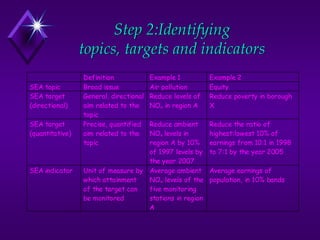
Step 2:Identifying
topics, targets and indicators
Definition Example 1 Example 2
SEA topic Broad issue Air pollution Equity
SEA target
(directional)
General, directional
aim related to the
topic
Reduce levels of
NOx in region A
Reduce poverty in borough
X
SEA target
(quantitative)
Precise, quantified
aim related to the
topic
Reduce ambient
NOx levels in
region A by 10%
of 1997 levels by
the year 2007
Reduce the ratio of
highest:lowest 10% of
earnings from 10:1 in 1998
to 7:1 by the year 2005
SEA indicator Unit of measure by
which attainment
of the target can
be monitored
Average ambient
NOx levels of the
five monitoring
stations in region
A
Average earnings of
population, in 10% bands
Factors influencing the choice of Topics
N Firstly, they are often defined by legislation
N Secondly, different topics are appropriate for
different PPPs.
N Thirdly, the topics can take a narrow biophysical
view of the environment.
N Topics can be subject oriented or they can be
cross-cutting.
Factors influencing the choice of Indicators
N Firstly, a wide range of indicator lists already
exists worldwide
N Secondly, three types of indictors are
distinguished (Pressure indicators, State
indicators, Response indicators)
N Finally, some indicators can be easily measured
whilst others are much more qualitative.
Step 3: Describing the environment and related
constraints
N Environmental requirements and standards
(e.g., international air quality standards, nationally designated areas of nature
conservation or landscape protection)
N Environmental/ sustainability components that are near their
carrying capacity or threshold or the present situation differs
strongly from that in the vision
(e.g., low and erratic rainfall, limited groundwater, mismatch between water
demand and supply)
N Other PPPs
(e.g., requirements to provide a certain number of houses or cope with demand for
energy by a given car)
N Economic or social criteria
(e.g., cost benefit appraisal frameworks)
N Public opinion
(e.g., strong opposition to particular forms of development, and issues of particular
concern to the public)
Step 4: Testing for compatibility and internal
consistency
The next step in SEA would be
to set out a range of ways in which the
PPP objectives could be achieved.
Test if PPP (alternatives) are compatible
with other PPPs, and
Ensure that they are internally
consistent
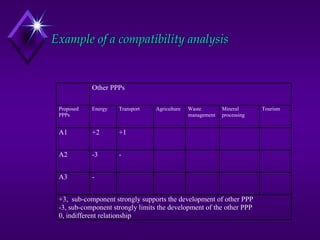
Example of a compatibility analysis
Other PPPs
Proposed
PPPs
Energy Transport Agriculture Waste
management
Mineral
processing
Tourism
A1 +2 +1
A2 -3 -
A3 -
+3, sub-component strongly supports the development of other PPP
-3, sub-component strongly limits the development of the other PPP
0, indifferent relationship
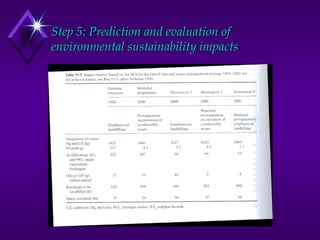
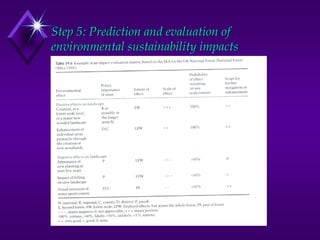
Step 5: Prediction and evaluation of
environmental sustainability impacts
Step 5: Prediction and evaluation of
environmental sustainability impacts
Step 6: Monitoring
N Monitoring of the PPP and linking this information
back to the predictions made in the SEA ensure that
the PPP achieves its objectives and that mitigation
measures proposed in the SEA are implemented.
Step 7: Conclusions
N Be willing to change your mind and
your PPP
N Involve a wide range of people
N do not expect to get it right the first
time

STRATEGIC ENVIRONMENTAL ASSESSMENT (PRINCIPLES & POTENTIAL).pdf

  • 1.
  • 2.
    Fundamental concepts ofSEA Policy outcome Set of objectives Proponent Set of objectives Proponent Policy outcome Other perspectives
  • 3.
    Rationale for SEA... Policydevelopment Project assessment •adopts a policy and planning rationale, identifying needs and options for development, which may then be assessed in the context of a vision for sustainable development. •this is an extension of the practice of project EIA or project - based approach.
  • 4.
    SEA Process N Startearly in the PPP formulation N Integrate with PPP formulation, and preferably as an active intervention in the PPP design process N Focus on sustainability issues rather than on more narrow environmental concerns N Use qualitative approaches, do not feel limited to using quantitative approaches N Involve a range of disciplines in the SEA process N Consider alternatives N Involve all the appropriate stakeholders.
  • 5.
    Evolution of thestrategic environmental assessment concept... N Wood and Djeddour (1992) offered several advantages of introducing SEA. N Goodland and Tillman (1995) compare traditional EIA as Reactive and SEA as Proactive. N The concept of SEA has been evolving, strongly linked to the achievement of sustainability and the consideration of cumulative effects. N Controversy over the concept of SEA is the use and meaning of the word ‘strategic’
  • 6.
    Forms and applicationsof SEA... Forms N strategic, N policy impact assessment, N regional EA, N sectoral EA, N environmental overview, and N programmatic EA. Applications (Scope) N international treaties, N privatization, N transnational corporations, N structural adjustment operations, N structural operations programmes N national budgets N legislative proposals, N area - wide or land - use planning, N transboundary impacts, and N global issues.
  • 7.
    Definitions of SEA... Nthe formalised, systematic and comprehensive process of evaluating the environmental impacts of a policy, plan or programme and its alternatives, including the preparation of a written report on the findings of that evaluation, and using the findings in publicly accountable decision-making (Therivel et al. 1992). N a systematic process for evaluating the environmental consequences of proposed policy, plan, or programme initiatives in order to ensure they are fully included and appropriately addressed at the earliest appropriate stage of decision - making on par with economic and social considerations (Sadler and Verheem 1996)
  • 8.
    Principles of SEA.... Projectplanning and design PPP development EIA SEA Integrated PPP Sustainable PPP Towards sustainability
  • 9.
    Why is strategicenvironmental assessment important? N Helps to incorporate sustainability principles in the policy-making process N By validating the policy, can improve transparency in decision-making. N Provides screening context to lower levels of EA, particularly project ‘EIA’ N Provides better context for assessment of cumulative effects N Current evidence shows that it generally influences decision-making. (Source: Partidario, 1997)
  • 10.
    Principles of goodSEA practice N Policy framework N Open and accountable political and organizational systems and commitment from the relevant organizations N National and/or institutional sustainability policies and strategies N Action plans for sustainable development as benchmarks to environmental impacts of strategic actions N Ensure integrated decision making N Identify criteria and mechanisms to evaluate significance and determine acceptability against a policy framework of environmental objectives and standards (Source: Partidario, 1996)
  • 11.
    Principles of goodSEA practice N Institutional framework N Provision of an institution that will facilitate integrated decision making N Establishment of internal and external organizational frameworks N Assigning specific responsibilities and accountability for key decision making points N Provision of an appropriate regulatory framework (Source: Partidario, 1996)
  • 12.
    Principles of goodSEA practice N Procedural framework N SEA should be considered an intrinsic element and applied as early as possible N Should focus on fundamental elements of policy proposals N Establish the kind of instruments SEA should apply N Establish when SEA should be applied N Be focused and ask right questions when using SEA N Scope of SEA should be comprehensive N Public involvement should be a fundamental element in SEA N Establish monitoring and follow up programs to track proposals (Source: Partidario, 1996)
  • 13.
    ...Conclusions N Any SEAprocess must be simpler, less technocentric, less factual and information-dependent, more pro-active and responsive to certainty contexts, more flexible and dynamic in its approach N SEA is a learning process.
  • 14.
  • 15.
    Step 1:Identifying Objectives Identifyingobjectives - What SEA aims to achieve ? Economic - privatization of an industry. Social - prevention of crime or provision of health services. Environmental - impact on flora and fauna. Cumulative - the provision of low cost accommodation for a given number of people at minimal economic and environmental cost. The time scale and carrying capacity specification is a must to avoid any hopelessly vague expression.
  • 16.
    Step 2:Identifying topics, targetsand indicators Definition Example 1 Example 2 SEA topic Broad issue Air pollution Equity SEA target (directional) General, directional aim related to the topic Reduce levels of NOx in region A Reduce poverty in borough X SEA target (quantitative) Precise, quantified aim related to the topic Reduce ambient NOx levels in region A by 10% of 1997 levels by the year 2007 Reduce the ratio of highest:lowest 10% of earnings from 10:1 in 1998 to 7:1 by the year 2005 SEA indicator Unit of measure by which attainment of the target can be monitored Average ambient NOx levels of the five monitoring stations in region A Average earnings of population, in 10% bands
  • 17.
    Factors influencing thechoice of Topics N Firstly, they are often defined by legislation N Secondly, different topics are appropriate for different PPPs. N Thirdly, the topics can take a narrow biophysical view of the environment. N Topics can be subject oriented or they can be cross-cutting.
  • 18.
    Factors influencing thechoice of Indicators N Firstly, a wide range of indicator lists already exists worldwide N Secondly, three types of indictors are distinguished (Pressure indicators, State indicators, Response indicators) N Finally, some indicators can be easily measured whilst others are much more qualitative.
  • 19.
    Step 3: Describingthe environment and related constraints N Environmental requirements and standards (e.g., international air quality standards, nationally designated areas of nature conservation or landscape protection) N Environmental/ sustainability components that are near their carrying capacity or threshold or the present situation differs strongly from that in the vision (e.g., low and erratic rainfall, limited groundwater, mismatch between water demand and supply) N Other PPPs (e.g., requirements to provide a certain number of houses or cope with demand for energy by a given car) N Economic or social criteria (e.g., cost benefit appraisal frameworks) N Public opinion (e.g., strong opposition to particular forms of development, and issues of particular concern to the public)
  • 20.
    Step 4: Testingfor compatibility and internal consistency The next step in SEA would be to set out a range of ways in which the PPP objectives could be achieved. Test if PPP (alternatives) are compatible with other PPPs, and Ensure that they are internally consistent
  • 21.
    Example of acompatibility analysis Other PPPs Proposed PPPs Energy Transport Agriculture Waste management Mineral processing Tourism A1 +2 +1 A2 -3 - A3 - +3, sub-component strongly supports the development of other PPP -3, sub-component strongly limits the development of the other PPP 0, indifferent relationship
  • 22.
    Step 5: Predictionand evaluation of environmental sustainability impacts
  • 23.
    Step 5: Predictionand evaluation of environmental sustainability impacts
  • 24.
    Step 6: Monitoring NMonitoring of the PPP and linking this information back to the predictions made in the SEA ensure that the PPP achieves its objectives and that mitigation measures proposed in the SEA are implemented.
  • 25.
    Step 7: Conclusions NBe willing to change your mind and your PPP N Involve a wide range of people N do not expect to get it right the first time