STRANGULATION
by Dr m balaji singh
Professor of Forensic Medicine
ACS Medical College and Hospital, Chennai
Courtesy ; Review of
Forensic Medicine andToxicology by
Dr .Gautam Biswas MD,
Text book of Forensic Medicine
andToxicology by Dr. KrishanVij MD LLB
KNIGHT’S FORENSIC PATHOLOGY
Definition
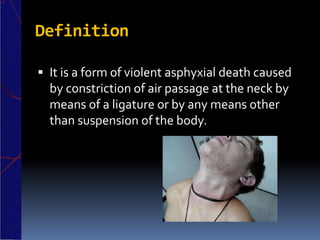
 It is a form of violent asphyxial death caused
by constriction of air passage at the neck by
means of a ligature or by any means other
than suspension of the body.
Classification/ variations
of strangulation
 Ligature strangulation
 Manual strangulation or throttling
 Mugging
 Bansdola
 Garroting

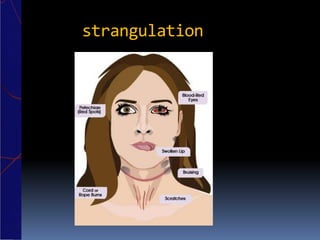
strangulation
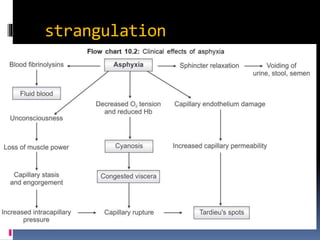
strangulation
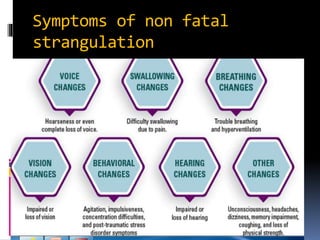
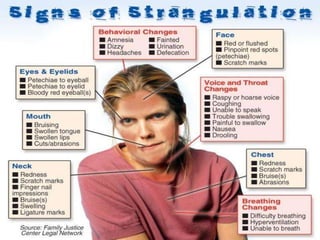
Symptoms of non fatal
strangulation
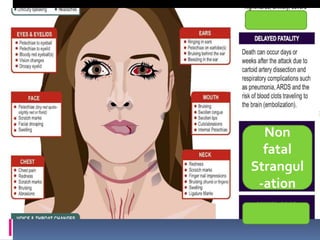
Non
fatal
Strangul
-ation
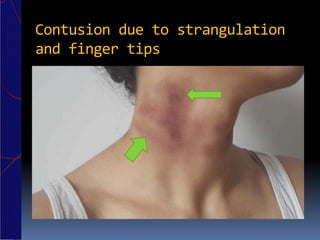
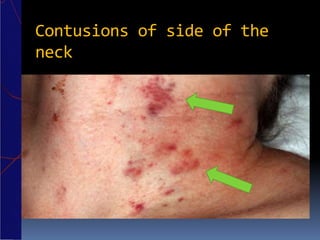
Contusion due to strangulation
and finger tips
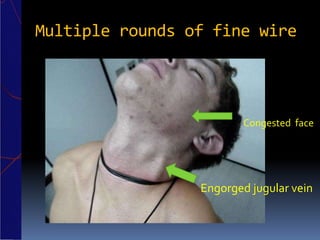
Multiple rounds of fine wire
Engorged jugular vein
Congested face
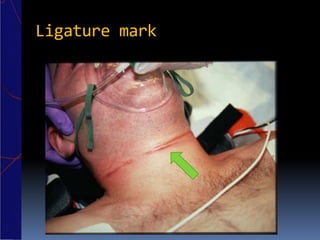
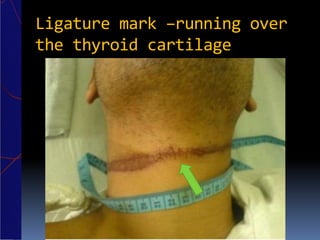
Ligature mark
Contusions of side of the
neck
Ligature mark –running over
the thyroid cartilage
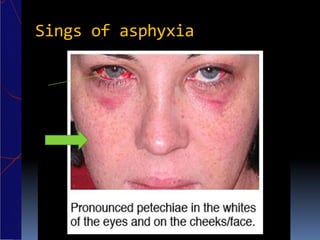
Sings of asphyxia
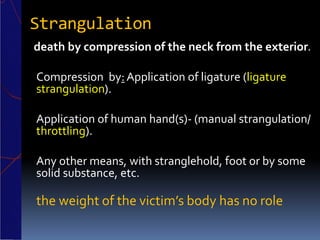
Strangulation
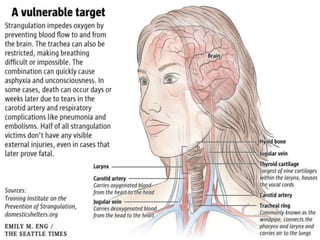
death by compression of the neck from the exterior.
Compression by: Application of ligature (ligature
strangulation).
Application of human hand(s)- (manual strangulation/
throttling).
Any other means, with stranglehold, foot or by some
solid substance, etc.
the weight of the victim’s body has no role
LIGATURE STRANGULATION
 The pressure upon the neck may be affected by
compressing whole or a part of the circumference of the
neck
 Causes of Death
death is not merely due to asphyxiation but a varying
combinations of all the mechanisms involved.
 cardiac inhibition is more common than in hanging, as is
obvious from the anatomy of the neck structures and the
location of the carotid sinus .
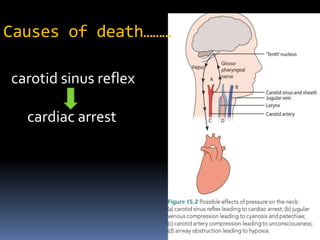
Causes of death………
carotid sinus reflex
cardiac arrest
Causes of death - level of
occlusion in strangulation and in hanging
Airway occlusion
Brouardel- calculated that the force needed to close
the trachea - 15 kg.
direct compression of the larynx or trachea- in
strangulation
root of the tongue is lifted upwards and backwards
against the soft palate and roof of the mouth – in
hanging
Causes of death……
 Occlusion of the neck veins- classic’ signs of
congestion, cyanosis, oedema and petechiae
above the line of constriction.
 external jugular veins are most vulnerable
 Brouardel’s experiments suggest that a ligature
with a tension of 2 kg blocks the jugular return;
Causes of death………
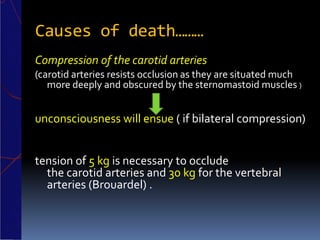
Compression of the carotid arteries
(carotid arteries resists occlusion as they are situated much
more deeply and obscured by the sternomastoid muscles )
unconsciousness will ensue ( if bilateral compression)
tension of 5 kg is necessary to occlude
the carotid arteries and 30 kg for the vertebral
arteries (Brouardel) .
Differences between
Hanging strangulation
-----------------------------------
 Age-More common in
adolescents and young or
elderly adults
-------------------------------------
Nature of death- Mostly
suicidal
 Face- signs of congestion
less marked and petechiae
rare
 Tongue -Swelling and
protrusion is less marked
--------------------------------------------
 No age limit as it can be effected
any age for enmity, rivalry, etc
--------------------------------------------
 Mostly homicidal
 Congested, livid and marked
with petechiae
 Swelling and protrusion is more
marked
--------------------------------------------
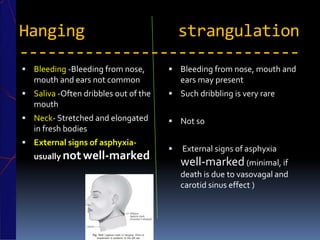
Hanging strangulation
------------------------------
 Bleeding -Bleeding from nose,
mouth and ears not common
 Saliva -Often dribbles out of the
mouth
 Neck- Stretched and elongated
in fresh bodies
 External signs of asphyxia-
usually notwell-marked
 Bleeding from nose, mouth and
ears may present
 Such dribbling is very rare
 Not so
 External signs of asphyxia
well-marked (minimal, if
death is due to vasovagal and
carotid sinus effect )
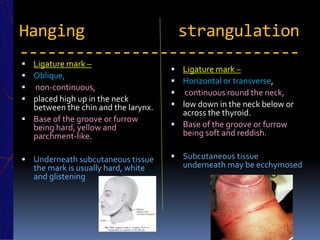
Hanging strangulation
------------------------------
 Ligature mark –
 Oblique,
 non-continuous,
 placed high up in the neck
between the chin and the larynx.
 Base of the groove or furrow
being hard, yellow and
parchment-like.
 Underneath subcutaneous tissue
the mark is usually hard, white
and glistening
 Ligature mark –
 Horizontal or transverse,
 continuous round the neck,
 low down in the neck below or
across the thyroid.
 Base of the groove or furrow
being soft and reddish.
 Subcutaneous tissue
underneath may be ecchymosed
Hanging strangulation
------------------------------
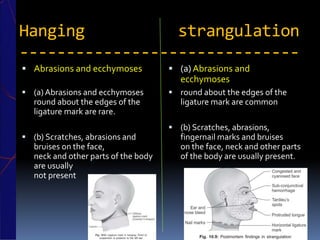
 Abrasions and ecchymoses
 (a)Abrasions and ecchymoses
round about the edges of the
ligature mark are rare.
 (b) Scratches, abrasions and
bruises on the face,
neck and other parts of the body
are usually
not present
 (a) Abrasions and
ecchymoses
 round about the edges of the
ligature mark are common
 (b) Scratches, abrasions,
fingernail marks and bruises
on the face, neck and other parts
of the body are usually present.
Hanging strangulation
------------------------------
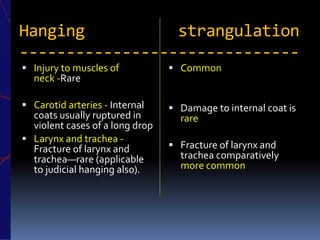
 Injury to muscles of
neck -Rare
 Carotid arteries - Internal
coats usually ruptured in
violent cases of a long drop
 Larynx and trachea -
Fracture of larynx and
trachea—rare (applicable
to judicial hanging also).
 Common
 Damage to internal coat is
rare
 Fracture of larynx and
trachea comparatively
more common
Hanging strangulation
------------------------------
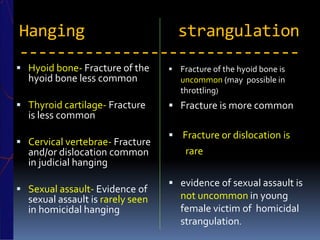
 Hyoid bone- Fracture of the
hyoid bone less common
 Thyroid cartilage- Fracture
is less common
 Cervical vertebrae- Fracture
and/or dislocation common
in judicial hanging
 Sexual assault- Evidence of
sexual assault is rarely seen
in homicidal hanging
 Fracture of the hyoid bone is
uncommon (may possible in
throttling)
 Fracture is more common
 Fracture or dislocation is
rare
 evidence of sexual assault is
not uncommon in young
female victim of homicidal
strangulation.
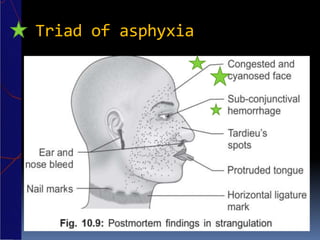
Triad of asphyxia
Autopsy Findings
In majority of cases, general features associated
with the asphyxial type of death are evident with
some demonstration of their local accentuation.
the findings are described as:
1.General appearances—external and internal
2.Local appearances—external and internal
General External Findings
The asphyxial findings will be prominent when sufficient
pressure has been exerted.
strangulation is a slow process,
But hanging is a rapid one.
In deaths due to vagal inhibition, the asphyxial findings will be
least or none at all.
General External Findings………
Frothy blood tinged fluid may exude from the mouth
and nostrils.There may be evidence of passage of
urine/feces and/or seminal emission
Face: It may be swollen and blotchy with scattered petechial
haemorrhages over the eyelids, face, forehead and scalp.
Eyes: Usually suffused and bulging with dilated pupils.
Tongue: Swollen, protruding (the protruded portion may
be dark colored) and sometimes caught between the teeth.
Local(neck)External Findings
The ligature material – ligature mark (pressure furrow ) is
basically a abrasion
depth varies inversely with the width of the constricting
material.
narrower material, the deeper ligature mark
Examples; cords, wires, narrow ropes, chains, twines from the
trees, etc.- cause deeper marks.
softer materials like sarees , scarves, ties, towels, stockings,
strips of bed linen, mufflers, etc.- cause broader and faint marks.
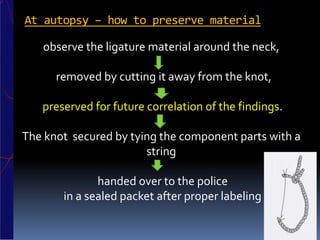
At autopsy – how to preserve material
observe the ligature material around the neck,
removed by cutting it away from the knot,
preserved for future correlation of the findings.
The knot secured by tying the component parts with a
string
handed over to the police
in a sealed packet after proper labeling
Features of ligature
the mark usually is horizontal, across or below the
thyroid cartilage, completely encircling the neck.
Sometimes indistinct at the back of the neck due to thick
musculature .
When fresh, the furrow (groove) may be less conspicuous
than after drying.
The mark is generally yellowish-brown shortly after death
will become dark brown color, dried and parchment like
after some time.
factors influencing the appearance of the
ligature mark
composition and pattern of the ligature material –
patterned abrasion
the pattern better appreciated by examining under
oblique lighting + magnifying lens.
Even flexible stick or cane can act as a ligature if the
ends are pulled back from behind the victim.
Ligature mark may be quite
indistinct or absent.
.  If the ligature material was soft and broad like
saree or yielding type and removed soon
after death
 In homicides, the assailant attacks from
behind, and a U-shaped ligature material
pulling against the front and sides of the neck
of victim- mark is absent on nape of the neck.
Knots and their impressions
The knot may be fixed after each turn or may be
fastened at the end of the turns, imparting
corresponding complexity to the ligature mark on the
skin.
In case of multiple turns around the neck, skin folds
between the adjacent loops may be pinched and
hemorrhagic particularly when the ligature material is
tough and of sinking nature like cords, wires, etc.
Knots and their impressions……
 localized irregular indentations or
abrasions or abraded contusions observed
in ligature mark in case of strangulation.
 But in hanging a gap in ligature mark
is always present underneath the
knot.
Course of ligature around the neck
The ligature may be -indistinct or absent on the nape
of the neck -due to thick musculature at this area.
The mark may be oblique resembling hanging, when
the victim is dragged after being strangled in
recumbent posture .
Period and degree of constriction will
proportionately influence the appearance of the mark
upon the neck.
Gaps in ligature marks due to
long hair ( plait) or clothing, collars or ornaments at the
front may interpose between the ligature and the skin
of the neck.
At times, ligature mark may be interrupted at the front
by the interposition of the victim’s fingers or hand in an
attempt to pull the ligature and frustrate the attempts
of the assailant.
Effect of edema, and decomposition
The ligature may appear to be deeply embedded into
the tissues of the neck due to oedema of the tissues,
which initially might not have been applied so tightly.
The swelling can continue to increase after death
due to decomposition and thus adding to the depth
of the groove.
Other external local findings-
signs of struggle
evidence of abrasions, scratches or abraded
contusions over the face, arms and other parts of
the body of the victim,
If the assailant happens to kneel over the chest of
the victim, bruising of these areas may be present –
Burking.
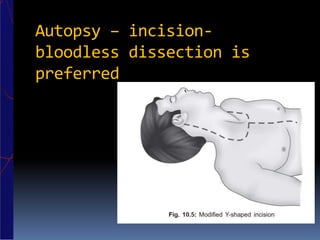
Autopsy – incision-
bloodless dissection is
preferred
General Internal Findings
signs of asphyxia—congestion of the respiratory
tract .
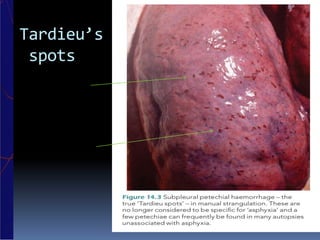
- subpleural petechial haemorrhages
(Tardieu spots),
emphysematous bullae at occasional places.
Other organs may also show congestion.
In case of vagal inhibition, these changes are
absent.
Tardieu’s
spots
Local Internal Findings- contusions
Bruising of the soft tissues of the neck and the muscles –
more common than hanging.
contusions are prominent - rough ligature material +
struggle and resistance.
Bruising of the subcutaneous tissue may present , when even no
ligature mark on the surface of the skin.
Bruising may be minimal when the ligature has
been tightly secured and not removed until circulation
ceases or in case of vagal inhibition.
Injuries to the blood vessels
- this is rare in strangulation.
However, a deeply sunken narrow ligature applied
forcibly may damage the carotids.
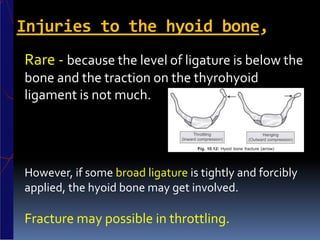
Injuries to the hyoid bone,
Rare - because the level of ligature is below the
bone and the traction on the thyrohyoid
ligament is not much.
However, if some broad ligature is tightly and forcibly
applied, the hyoid bone may get involved.
Fracture may possible in throttling.
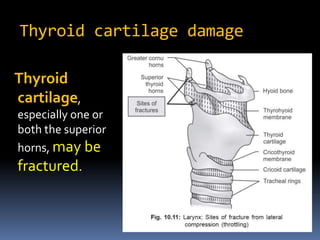
Thyroid cartilage damage
Thyroid
cartilage,
especially one or
both the superior
horns, may be
fractured.
Internal Findings -
 Subcapsular and interstitial thyroid
hemorrhages are common.
 Fracture of cricoid cartilage is less common.
 Rings of trachea may sustain fracture when
considerable force is applied.
Other internal findings
Lungs are congested, edematous with
numerous subpleural petechial hemorrhages.
Brain is congested with petechiae in white
matter.
All other organs are congested.
Medico legal importance of
strangulation
 Strangulation should be assumed to be
homicidal, until the contrary is proved
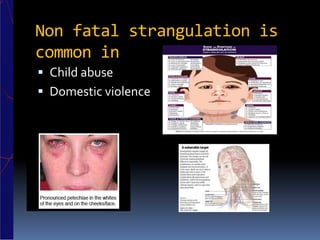
Non fatal strangulation is
common in
 Child abuse
 Domestic violence
Strangulation in domestic
violence
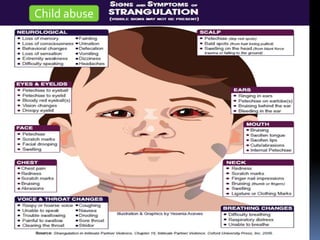
Child abuse
Homicidal strangulation
women- strangulation associated with sexual
intercourse.
„There are two or more firm knots, each on separate
turns of the ligature.
„Abrasions and fingernail marks and torn / disarranged
clothing of the victim indicating that a struggle.
„By spot inspection -The ligature is loosely present
around the neck.
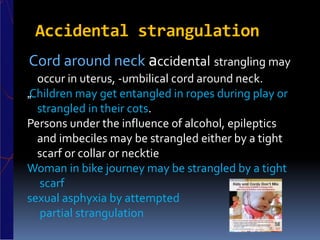
Accidental strangulation
Cord around neck accidental strangling may
occur in uterus, -umbilical cord around neck.
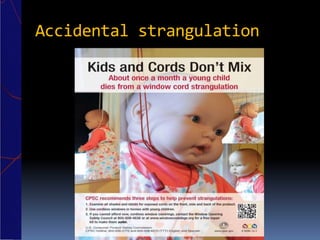
„Children may get entangled in ropes during play or
strangled in their cots.
Persons under the influence of alcohol, epileptics
and imbeciles may be strangled either by a tight
scarf or collar or necktie
Woman in bike journey may be strangled by a tight
scarf
sexual asphyxia by attempted
partial strangulation
Accidental strangulation
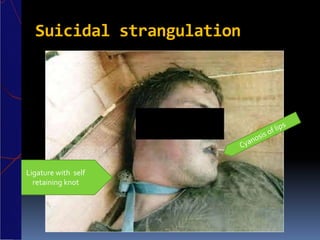
Suicidal strangulation
„Suicide by strangulation is rare,
but not impossible
The victims employ a specific mechanism for
tightening the ligature, but the person can apply a
single or double knot before consciousness is lost.
„In suicidal strangulation, signs of venous congestion
are very well marked ( it is a slow process)
„.
Suicidal strangulation
Ligature with self
retaining knot
Suicidal strangulation……
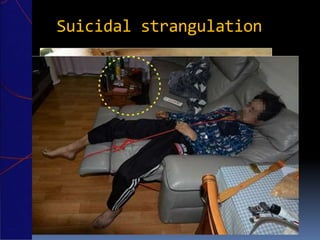
The ligature should be found in situ; body should
not show any signs of violence or marks of struggle.
Laryngeal fractures are rare, and injuries are mild
and often confined to the single ligature mark.
„Detailed examination of the scene and of the
deceased person, along with circumstances leading
to the death should be investigated
Suicide note may present
Suicidal strangulation
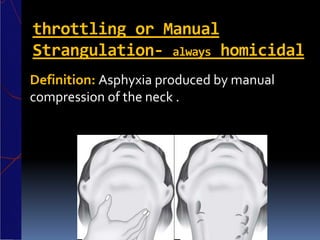
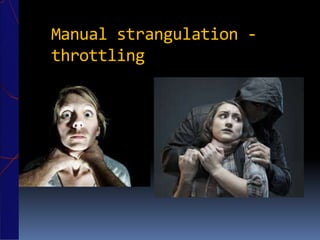
throttling or Manual
Strangulation- always homicidal
Definition: Asphyxia produced by manual
compression of the neck .
Manual strangulation -
throttling
cause of death- in throttling
i. Asphyxia .
ii. Cerebral anoxia - cerebral circulation.
iii. Vagal inhibition- pressure on carotid sinus and
vagus, sympathetic nerves.
About half of the deaths are due to vagal
inhibition.
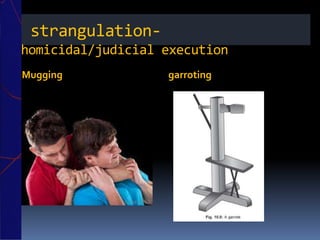
strangulation-
homicidal/judicial execution
Mugging garroting
Thank you

Strangulation a forensic view

  • 1.
    STRANGULATION by Dr mbalaji singh Professor of Forensic Medicine ACS Medical College and Hospital, Chennai Courtesy ; Review of Forensic Medicine andToxicology by Dr .Gautam Biswas MD, Text book of Forensic Medicine andToxicology by Dr. KrishanVij MD LLB KNIGHT’S FORENSIC PATHOLOGY
  • 2.
    Definition  It isa form of violent asphyxial death caused by constriction of air passage at the neck by means of a ligature or by any means other than suspension of the body.
  • 3.
    Classification/ variations of strangulation Ligature strangulation  Manual strangulation or throttling  Mugging  Bansdola  Garroting 
  • 4.
  • 5.
  • 6.
    Symptoms of nonfatal strangulation
  • 7.
  • 8.
    Contusion due tostrangulation and finger tips
  • 9.
    Multiple rounds offine wire Engorged jugular vein Congested face
  • 10.
  • 12.
    Contusions of sideof the neck
  • 13.
    Ligature mark –runningover the thyroid cartilage
  • 14.
  • 15.
    Strangulation death by compressionof the neck from the exterior. Compression by: Application of ligature (ligature strangulation). Application of human hand(s)- (manual strangulation/ throttling). Any other means, with stranglehold, foot or by some solid substance, etc. the weight of the victim’s body has no role
  • 16.
    LIGATURE STRANGULATION  Thepressure upon the neck may be affected by compressing whole or a part of the circumference of the neck  Causes of Death death is not merely due to asphyxiation but a varying combinations of all the mechanisms involved.  cardiac inhibition is more common than in hanging, as is obvious from the anatomy of the neck structures and the location of the carotid sinus .
  • 17.
    Causes of death……… carotidsinus reflex cardiac arrest
  • 18.
    Causes of death- level of occlusion in strangulation and in hanging Airway occlusion Brouardel- calculated that the force needed to close the trachea - 15 kg. direct compression of the larynx or trachea- in strangulation root of the tongue is lifted upwards and backwards against the soft palate and roof of the mouth – in hanging
  • 19.
    Causes of death…… Occlusion of the neck veins- classic’ signs of congestion, cyanosis, oedema and petechiae above the line of constriction.  external jugular veins are most vulnerable  Brouardel’s experiments suggest that a ligature with a tension of 2 kg blocks the jugular return;
  • 20.
    Causes of death……… Compressionof the carotid arteries (carotid arteries resists occlusion as they are situated much more deeply and obscured by the sternomastoid muscles ) unconsciousness will ensue ( if bilateral compression) tension of 5 kg is necessary to occlude the carotid arteries and 30 kg for the vertebral arteries (Brouardel) .
  • 21.
    Differences between Hanging strangulation ----------------------------------- Age-More common in adolescents and young or elderly adults ------------------------------------- Nature of death- Mostly suicidal  Face- signs of congestion less marked and petechiae rare  Tongue -Swelling and protrusion is less marked --------------------------------------------  No age limit as it can be effected any age for enmity, rivalry, etc --------------------------------------------  Mostly homicidal  Congested, livid and marked with petechiae  Swelling and protrusion is more marked --------------------------------------------
  • 22.
    Hanging strangulation ------------------------------  Bleeding-Bleeding from nose, mouth and ears not common  Saliva -Often dribbles out of the mouth  Neck- Stretched and elongated in fresh bodies  External signs of asphyxia- usually notwell-marked  Bleeding from nose, mouth and ears may present  Such dribbling is very rare  Not so  External signs of asphyxia well-marked (minimal, if death is due to vasovagal and carotid sinus effect )
  • 23.
    Hanging strangulation ------------------------------  Ligaturemark –  Oblique,  non-continuous,  placed high up in the neck between the chin and the larynx.  Base of the groove or furrow being hard, yellow and parchment-like.  Underneath subcutaneous tissue the mark is usually hard, white and glistening  Ligature mark –  Horizontal or transverse,  continuous round the neck,  low down in the neck below or across the thyroid.  Base of the groove or furrow being soft and reddish.  Subcutaneous tissue underneath may be ecchymosed
  • 24.
    Hanging strangulation ------------------------------  Abrasionsand ecchymoses  (a)Abrasions and ecchymoses round about the edges of the ligature mark are rare.  (b) Scratches, abrasions and bruises on the face, neck and other parts of the body are usually not present  (a) Abrasions and ecchymoses  round about the edges of the ligature mark are common  (b) Scratches, abrasions, fingernail marks and bruises on the face, neck and other parts of the body are usually present.
  • 25.
    Hanging strangulation ------------------------------  Injuryto muscles of neck -Rare  Carotid arteries - Internal coats usually ruptured in violent cases of a long drop  Larynx and trachea - Fracture of larynx and trachea—rare (applicable to judicial hanging also).  Common  Damage to internal coat is rare  Fracture of larynx and trachea comparatively more common
  • 26.
    Hanging strangulation ------------------------------  Hyoidbone- Fracture of the hyoid bone less common  Thyroid cartilage- Fracture is less common  Cervical vertebrae- Fracture and/or dislocation common in judicial hanging  Sexual assault- Evidence of sexual assault is rarely seen in homicidal hanging  Fracture of the hyoid bone is uncommon (may possible in throttling)  Fracture is more common  Fracture or dislocation is rare  evidence of sexual assault is not uncommon in young female victim of homicidal strangulation.
  • 27.
  • 28.
    Autopsy Findings In majorityof cases, general features associated with the asphyxial type of death are evident with some demonstration of their local accentuation. the findings are described as: 1.General appearances—external and internal 2.Local appearances—external and internal
  • 29.
    General External Findings Theasphyxial findings will be prominent when sufficient pressure has been exerted. strangulation is a slow process, But hanging is a rapid one. In deaths due to vagal inhibition, the asphyxial findings will be least or none at all.
  • 30.
    General External Findings……… Frothyblood tinged fluid may exude from the mouth and nostrils.There may be evidence of passage of urine/feces and/or seminal emission Face: It may be swollen and blotchy with scattered petechial haemorrhages over the eyelids, face, forehead and scalp. Eyes: Usually suffused and bulging with dilated pupils. Tongue: Swollen, protruding (the protruded portion may be dark colored) and sometimes caught between the teeth.
  • 31.
    Local(neck)External Findings The ligaturematerial – ligature mark (pressure furrow ) is basically a abrasion depth varies inversely with the width of the constricting material. narrower material, the deeper ligature mark Examples; cords, wires, narrow ropes, chains, twines from the trees, etc.- cause deeper marks. softer materials like sarees , scarves, ties, towels, stockings, strips of bed linen, mufflers, etc.- cause broader and faint marks.
  • 32.
    At autopsy –how to preserve material observe the ligature material around the neck, removed by cutting it away from the knot, preserved for future correlation of the findings. The knot secured by tying the component parts with a string handed over to the police in a sealed packet after proper labeling
  • 33.
    Features of ligature themark usually is horizontal, across or below the thyroid cartilage, completely encircling the neck. Sometimes indistinct at the back of the neck due to thick musculature . When fresh, the furrow (groove) may be less conspicuous than after drying. The mark is generally yellowish-brown shortly after death will become dark brown color, dried and parchment like after some time.
  • 34.
    factors influencing theappearance of the ligature mark composition and pattern of the ligature material – patterned abrasion the pattern better appreciated by examining under oblique lighting + magnifying lens. Even flexible stick or cane can act as a ligature if the ends are pulled back from behind the victim.
  • 35.
    Ligature mark maybe quite indistinct or absent. .  If the ligature material was soft and broad like saree or yielding type and removed soon after death  In homicides, the assailant attacks from behind, and a U-shaped ligature material pulling against the front and sides of the neck of victim- mark is absent on nape of the neck.
  • 36.
    Knots and theirimpressions The knot may be fixed after each turn or may be fastened at the end of the turns, imparting corresponding complexity to the ligature mark on the skin. In case of multiple turns around the neck, skin folds between the adjacent loops may be pinched and hemorrhagic particularly when the ligature material is tough and of sinking nature like cords, wires, etc.
  • 37.
    Knots and theirimpressions……  localized irregular indentations or abrasions or abraded contusions observed in ligature mark in case of strangulation.  But in hanging a gap in ligature mark is always present underneath the knot.
  • 38.
    Course of ligaturearound the neck The ligature may be -indistinct or absent on the nape of the neck -due to thick musculature at this area. The mark may be oblique resembling hanging, when the victim is dragged after being strangled in recumbent posture . Period and degree of constriction will proportionately influence the appearance of the mark upon the neck.
  • 39.
    Gaps in ligaturemarks due to long hair ( plait) or clothing, collars or ornaments at the front may interpose between the ligature and the skin of the neck. At times, ligature mark may be interrupted at the front by the interposition of the victim’s fingers or hand in an attempt to pull the ligature and frustrate the attempts of the assailant.
  • 40.
    Effect of edema,and decomposition The ligature may appear to be deeply embedded into the tissues of the neck due to oedema of the tissues, which initially might not have been applied so tightly. The swelling can continue to increase after death due to decomposition and thus adding to the depth of the groove.
  • 41.
    Other external localfindings- signs of struggle evidence of abrasions, scratches or abraded contusions over the face, arms and other parts of the body of the victim, If the assailant happens to kneel over the chest of the victim, bruising of these areas may be present – Burking.
  • 42.
    Autopsy – incision- bloodlessdissection is preferred
  • 43.
    General Internal Findings signsof asphyxia—congestion of the respiratory tract . - subpleural petechial haemorrhages (Tardieu spots), emphysematous bullae at occasional places. Other organs may also show congestion. In case of vagal inhibition, these changes are absent.
  • 44.
  • 45.
    Local Internal Findings-contusions Bruising of the soft tissues of the neck and the muscles – more common than hanging. contusions are prominent - rough ligature material + struggle and resistance. Bruising of the subcutaneous tissue may present , when even no ligature mark on the surface of the skin. Bruising may be minimal when the ligature has been tightly secured and not removed until circulation ceases or in case of vagal inhibition.
  • 46.
    Injuries to theblood vessels - this is rare in strangulation. However, a deeply sunken narrow ligature applied forcibly may damage the carotids.
  • 47.
    Injuries to thehyoid bone, Rare - because the level of ligature is below the bone and the traction on the thyrohyoid ligament is not much. However, if some broad ligature is tightly and forcibly applied, the hyoid bone may get involved. Fracture may possible in throttling.
  • 48.
    Thyroid cartilage damage Thyroid cartilage, especiallyone or both the superior horns, may be fractured.
  • 49.
    Internal Findings - Subcapsular and interstitial thyroid hemorrhages are common.  Fracture of cricoid cartilage is less common.  Rings of trachea may sustain fracture when considerable force is applied.
  • 50.
    Other internal findings Lungsare congested, edematous with numerous subpleural petechial hemorrhages. Brain is congested with petechiae in white matter. All other organs are congested.
  • 51.
    Medico legal importanceof strangulation  Strangulation should be assumed to be homicidal, until the contrary is proved
  • 52.
    Non fatal strangulationis common in  Child abuse  Domestic violence
  • 53.
  • 55.
  • 56.
    Homicidal strangulation women- strangulationassociated with sexual intercourse. „There are two or more firm knots, each on separate turns of the ligature. „Abrasions and fingernail marks and torn / disarranged clothing of the victim indicating that a struggle. „By spot inspection -The ligature is loosely present around the neck.
  • 57.
    Accidental strangulation Cord aroundneck accidental strangling may occur in uterus, -umbilical cord around neck. „Children may get entangled in ropes during play or strangled in their cots. Persons under the influence of alcohol, epileptics and imbeciles may be strangled either by a tight scarf or collar or necktie Woman in bike journey may be strangled by a tight scarf sexual asphyxia by attempted partial strangulation
  • 58.
  • 59.
    Suicidal strangulation „Suicide bystrangulation is rare, but not impossible The victims employ a specific mechanism for tightening the ligature, but the person can apply a single or double knot before consciousness is lost. „In suicidal strangulation, signs of venous congestion are very well marked ( it is a slow process) „.
  • 60.
  • 61.
    Suicidal strangulation…… The ligatureshould be found in situ; body should not show any signs of violence or marks of struggle. Laryngeal fractures are rare, and injuries are mild and often confined to the single ligature mark. „Detailed examination of the scene and of the deceased person, along with circumstances leading to the death should be investigated Suicide note may present
  • 62.
  • 63.
    throttling or Manual Strangulation-always homicidal Definition: Asphyxia produced by manual compression of the neck .
  • 64.
  • 65.
    cause of death-in throttling i. Asphyxia . ii. Cerebral anoxia - cerebral circulation. iii. Vagal inhibition- pressure on carotid sinus and vagus, sympathetic nerves. About half of the deaths are due to vagal inhibition.
  • 66.
  • 67.