STRANGULATION
By
M. Satish Chandra
Roll no : 130
Types:
1.Strangulation by ligature
2.Manual strangulation or
Throttling
3.Garroting
4.Mugging
5.Bansdola
Strangulation by ligature
Definition:Form of Asphyxia which is caused from
constriction of the neck by a ligature without suspending
the body.
Cause of death :
■ Asphyxia due to elevation of larynx & tongue closing airway
■ Cerebral anoxia or venous congestion
■ Combined asphyxia & venous congestion
■ Vagal inhibition
■ Rarely fracture dislocation of cervical vertebrae
Postmortem appearance :
External appearance:
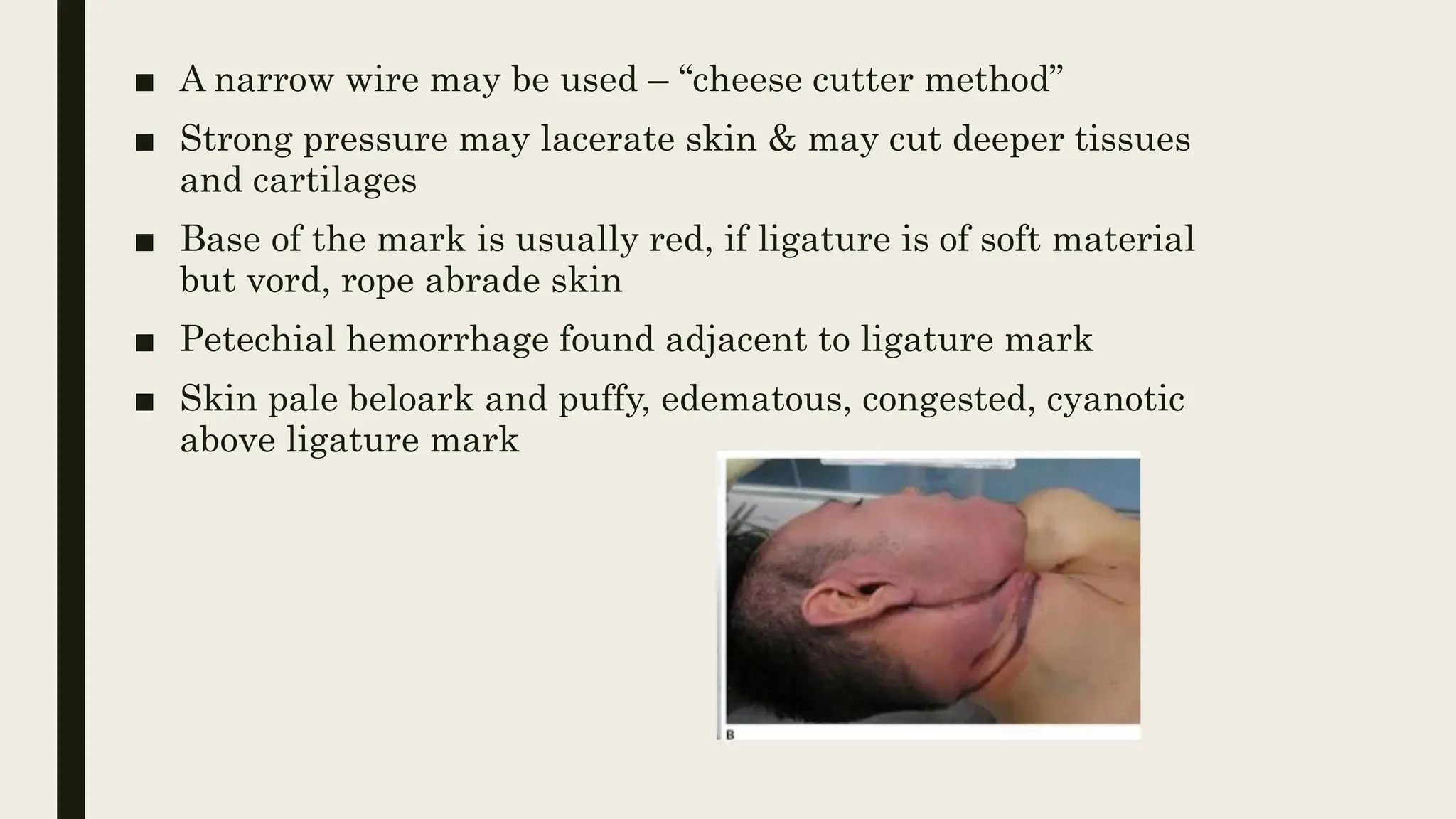
Ligature mark :
■ Well defined & slightly depressed usually at middle or below
thyroid cartilage level
■ Mark completely encircles the neck
■ May be absent on back due to clothing or long hair
■ Mark maybe oblique if victim has been dragged by cord
■ If knot applied wider area of bruising seen at knot region
■ If crossed more then at site of crossing
■ A narrow wire may be used – “cheese cutter method”
■ Strong pressure may lacerate skin & may cut deeper tissues
and cartilages
■ Base of the mark is usually red, if ligature is of soft material
but vord, rope abrade skin
■ Petechial hemorrhage found adjacent to ligature mark
■ Skin pale beloark and puffy, edematous, congested, cyanotic
above ligature mark
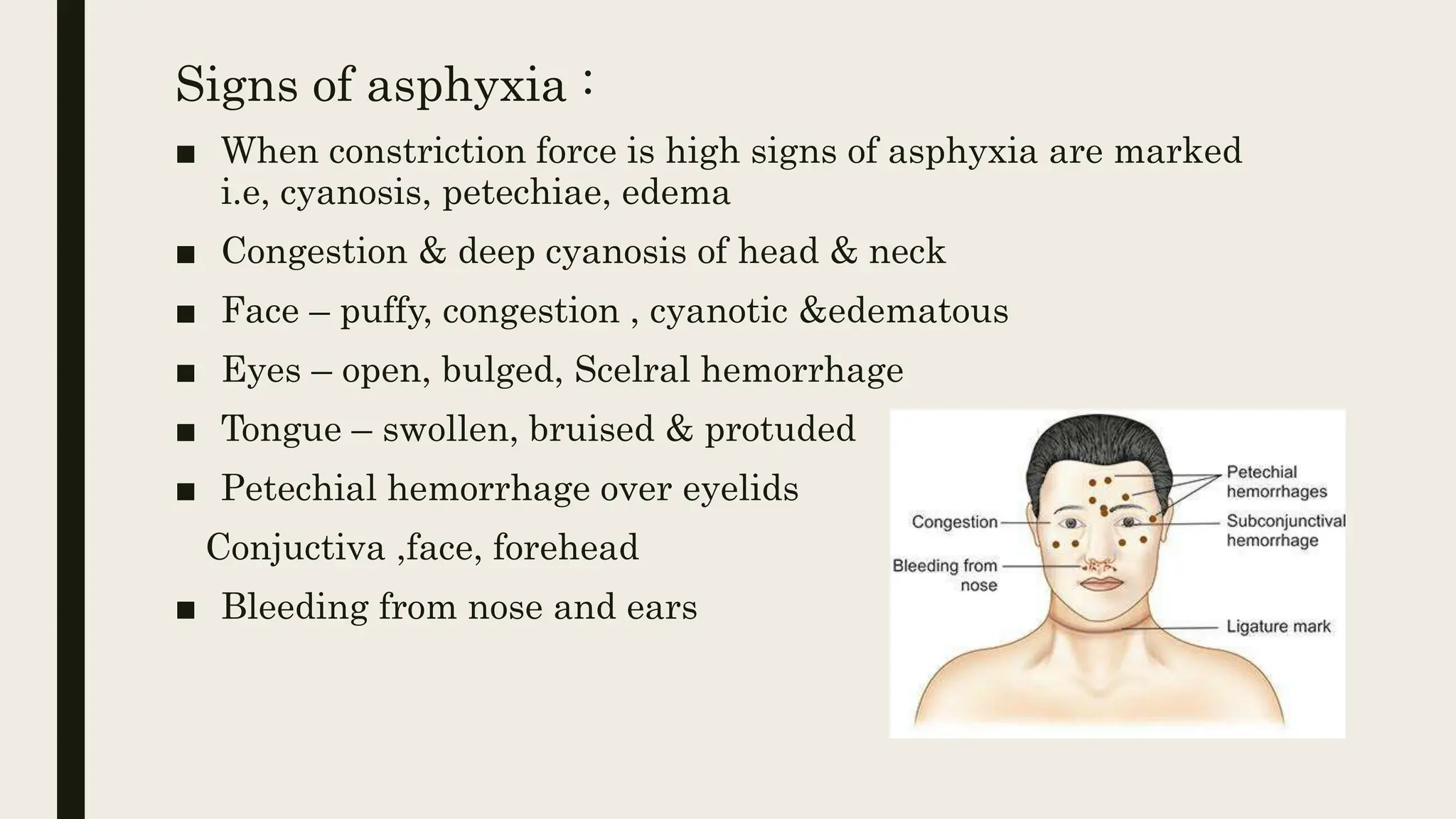
Signs of asphyxia :
■ When constriction force is high signs of asphyxia are marked
i.e, cyanosis, petechiae, edema
■ Congestion & deep cyanosis of head & neck
■ Face – puffy, congestion , cyanotic &edematous
■ Eyes – open, bulged, Scelral hemorrhage
■ Tongue – swollen, bruised & protuded
■ Petechial hemorrhage over eyelids
Conjuctiva ,face, forehead
■ Bleeding from nose and ears
Internal appearance :
■ Severe Engorgment & hemorrhage into tissues in & above the
areas compressed
■ Adjacent muscles are usually lacerated
■ Deep muscles Show bruising
■ Pharynx ,epiglottis, larynx show hemorrhagic infiltration
■ Bruising of tongue & floor of mouth
■ Larynx, trachea &bronchus contained blood stained frothy
mucus
■ Lungs- ecchymoses, subplueral hemorrhage
■ Other organs show venous congestion &hemorrhage
■ Fracture of thyroid cartilage is more common
Medicolegal importance :
■ Most commonly homicide
■ Accindental : children entangled in ropes while
playing, intoxicated person may rests the neck against
a bar
■ Suicidal : rare – cord tied around neck and twisted
tightly
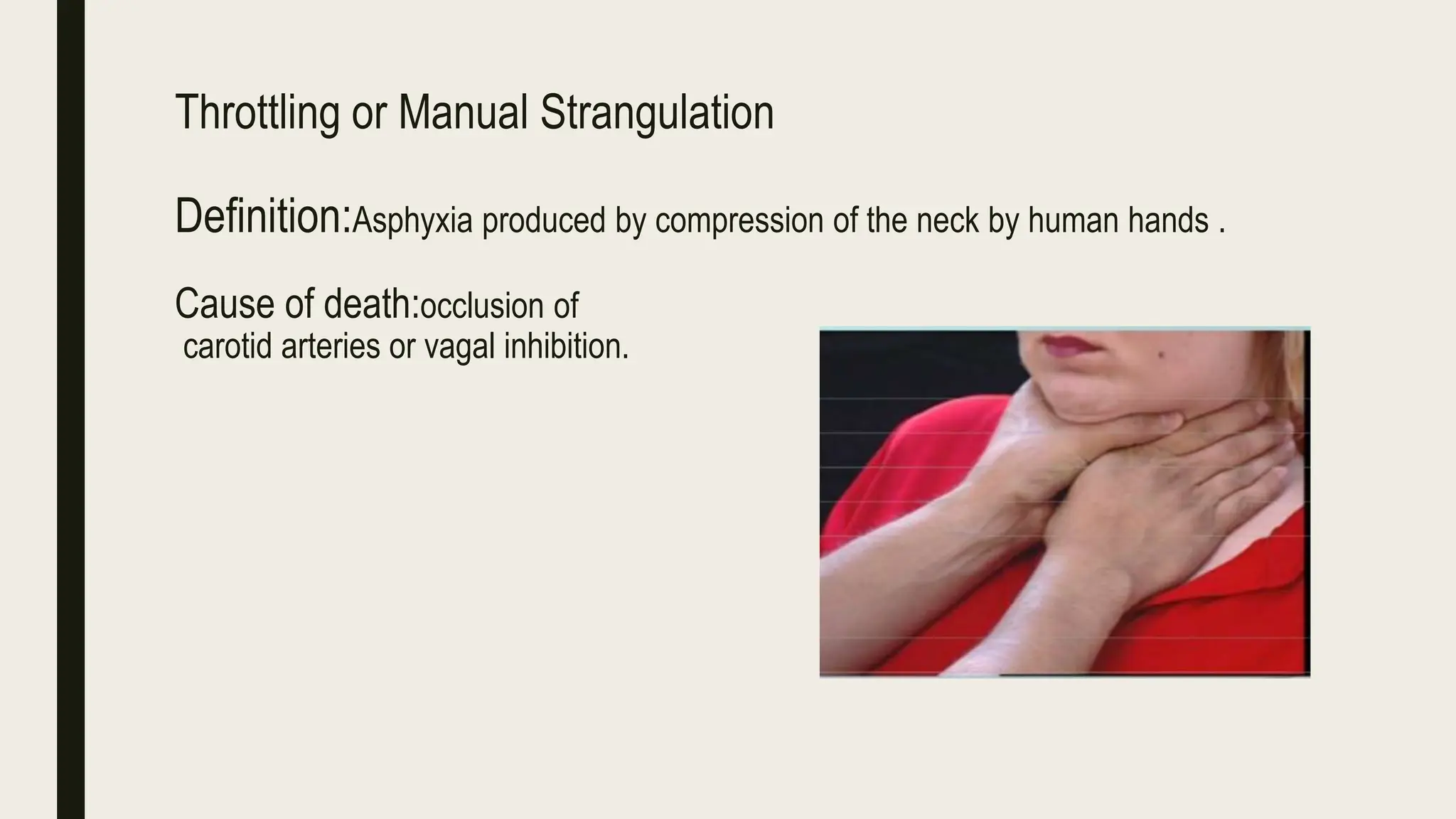
Throttling or Manual Strangulation
Definition:Asphyxia produced by compression of the neck by human hands .
Cause of death:occlusion of
carotid arteries or vagal inhibition.
Postmortem appearances:
■ External:
■ Bruises on neck:
■ The situation and extent of the bruised areas will depend upon
the relative positions of the assiliant and victim,the manner of
grasping neck,degree of pressure exerted.
■ The bruises are produced by the tips or pads of the
fingers.Their shape may be round or oval and of the size of the
digits.
■ When fresh,bruises are soft and red,but after several hours they
appear brown ,dry and parchment like.
■ Finger nail abrasions:
■ If the fingerprints are pressed deeply,the pressure of the nails
produce crescentic marks on the skin
■ They are of two types:1.when the pressure is static(regularly
curved ,comma like) 2.when the nails skid down the
skin(parallel linear lines may be seen).
■ The alleged assiliants should be examined to correlate any
injuries that may have been inflicted on him by the fingernails
of the victim and his fingernail scarpings should be taken.
■ The tongue may or may not be bitten ,but is usually protruded.
Internal:
■ Bruising of neck structure:bruises may be found on the dermis
,superficial fascia ,and in deep fascia ,muscles of thyroid gland.
1.The mark on surface may not exactly correspond with the
internal bruising ,because of motility of skin.
2.Carotid arteries show intimal tear in 10 to 15% cases.
3.Bruises of the laryngeal mucus membrane.
■ Thyroid cartilage:superior horn of thyroid is much more fragile
and fractures much more than greater horn of hyoid bone
1.the body of thyroid cartilage can be broken by a karate blow
to front of neck .
■ Hyoid bone : Fracture of hyoid bone with inward driving of its
distal fragments occur in 30 to 50% cases.
1.fractures of thyroid cartilage and hyoid bone are usually
found in old people with calcified thyroid cartilage and rigidly
ossified bones.
■ Fracture of cricoid cartilage : occurs almost due to
anteroposterior compression of it against the spine
■ Hyoid bone fractures: Classification:
1. Inward compression forces: The fingers of the grasping hand
squeeze the greater horns towards each other ,due to which
the bone may be fractured within one cm of the tip ,posterior
segment is displaced inwards
2. Anteropostrior Compression fracture: In cases of
hanging,Posterior small fragment is displaced outwards.
3. Avulsion fractures
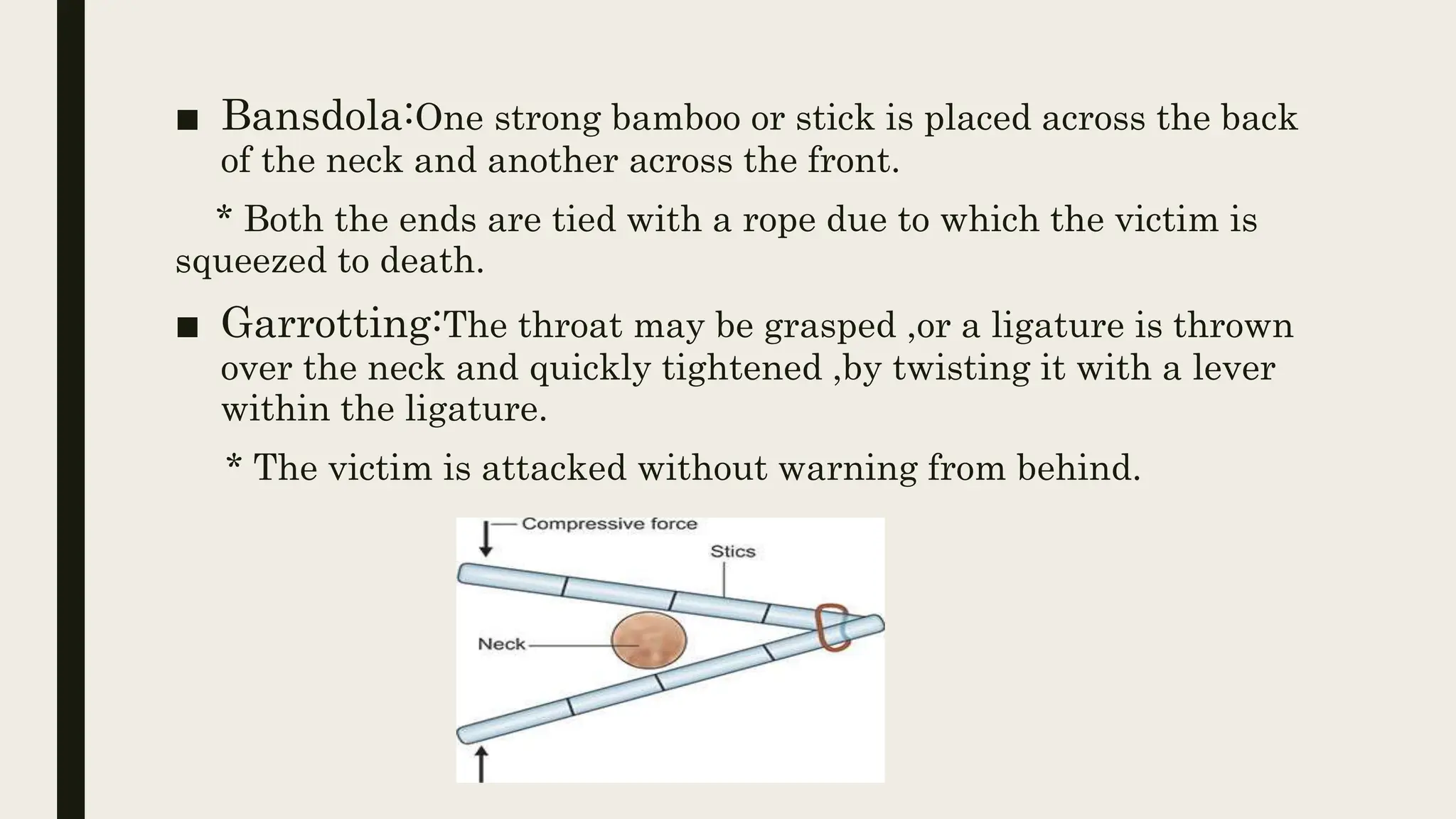
■ Bansdola:One strong bamboo or stick is placed across the back
of the neck and another across the front.
* Both the ends are tied with a rope due to which the victim is
squeezed to death.
■ Garrotting:The throat may be grasped ,or a ligature is thrown
over the neck and quickly tightened ,by twisting it with a lever
within the ligature.
* The victim is attacked without warning from behind.
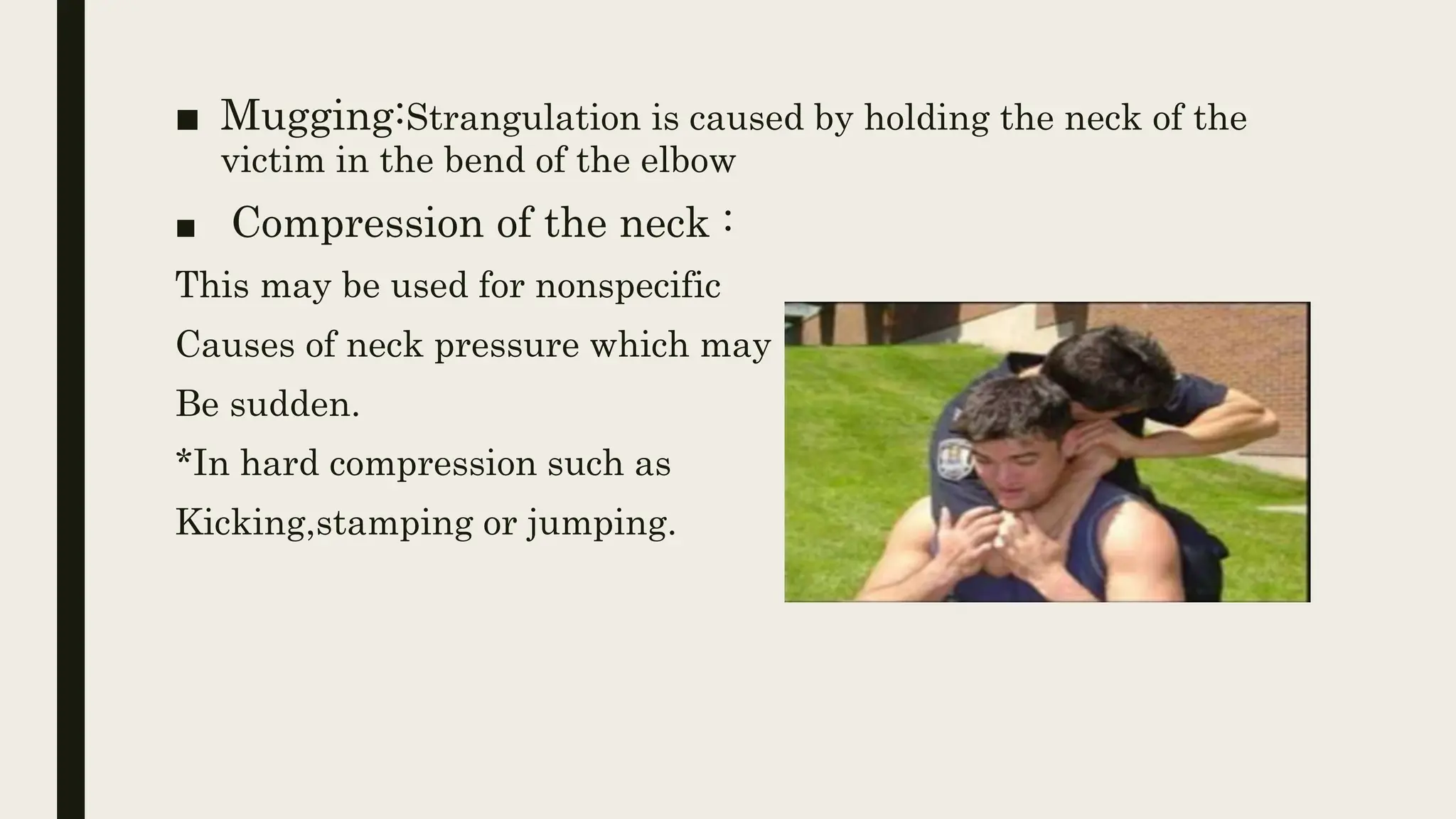
■ Mugging:Strangulation is caused by holding the neck of the
victim in the bend of the elbow
■ Compression of the neck :
This may be used for nonspecific
Causes of neck pressure which may
Be sudden.
*In hard compression such as
Kicking,stamping or jumping.
strangulation and other injuries inFmt.pptx

strangulation and other injuries inFmt.pptx

  • 1.
  • 2.
    Types: 1.Strangulation by ligature 2.Manualstrangulation or Throttling 3.Garroting 4.Mugging 5.Bansdola
  • 3.
    Strangulation by ligature Definition:Formof Asphyxia which is caused from constriction of the neck by a ligature without suspending the body.
  • 4.
    Cause of death: ■ Asphyxia due to elevation of larynx & tongue closing airway ■ Cerebral anoxia or venous congestion ■ Combined asphyxia & venous congestion ■ Vagal inhibition ■ Rarely fracture dislocation of cervical vertebrae
  • 5.
    Postmortem appearance : Externalappearance: Ligature mark : ■ Well defined & slightly depressed usually at middle or below thyroid cartilage level ■ Mark completely encircles the neck ■ May be absent on back due to clothing or long hair ■ Mark maybe oblique if victim has been dragged by cord ■ If knot applied wider area of bruising seen at knot region ■ If crossed more then at site of crossing
  • 6.
    ■ A narrowwire may be used – “cheese cutter method” ■ Strong pressure may lacerate skin & may cut deeper tissues and cartilages ■ Base of the mark is usually red, if ligature is of soft material but vord, rope abrade skin ■ Petechial hemorrhage found adjacent to ligature mark ■ Skin pale beloark and puffy, edematous, congested, cyanotic above ligature mark
  • 7.
    Signs of asphyxia: ■ When constriction force is high signs of asphyxia are marked i.e, cyanosis, petechiae, edema ■ Congestion & deep cyanosis of head & neck ■ Face – puffy, congestion , cyanotic &edematous ■ Eyes – open, bulged, Scelral hemorrhage ■ Tongue – swollen, bruised & protuded ■ Petechial hemorrhage over eyelids Conjuctiva ,face, forehead ■ Bleeding from nose and ears
  • 8.
    Internal appearance : ■Severe Engorgment & hemorrhage into tissues in & above the areas compressed ■ Adjacent muscles are usually lacerated ■ Deep muscles Show bruising ■ Pharynx ,epiglottis, larynx show hemorrhagic infiltration ■ Bruising of tongue & floor of mouth ■ Larynx, trachea &bronchus contained blood stained frothy mucus ■ Lungs- ecchymoses, subplueral hemorrhage ■ Other organs show venous congestion &hemorrhage ■ Fracture of thyroid cartilage is more common
  • 9.
    Medicolegal importance : ■Most commonly homicide ■ Accindental : children entangled in ropes while playing, intoxicated person may rests the neck against a bar ■ Suicidal : rare – cord tied around neck and twisted tightly
  • 10.
    Throttling or ManualStrangulation Definition:Asphyxia produced by compression of the neck by human hands . Cause of death:occlusion of carotid arteries or vagal inhibition.
  • 11.
    Postmortem appearances: ■ External: ■Bruises on neck: ■ The situation and extent of the bruised areas will depend upon the relative positions of the assiliant and victim,the manner of grasping neck,degree of pressure exerted. ■ The bruises are produced by the tips or pads of the fingers.Their shape may be round or oval and of the size of the digits. ■ When fresh,bruises are soft and red,but after several hours they appear brown ,dry and parchment like.
  • 12.
    ■ Finger nailabrasions: ■ If the fingerprints are pressed deeply,the pressure of the nails produce crescentic marks on the skin ■ They are of two types:1.when the pressure is static(regularly curved ,comma like) 2.when the nails skid down the skin(parallel linear lines may be seen). ■ The alleged assiliants should be examined to correlate any injuries that may have been inflicted on him by the fingernails of the victim and his fingernail scarpings should be taken. ■ The tongue may or may not be bitten ,but is usually protruded.
  • 13.
    Internal: ■ Bruising ofneck structure:bruises may be found on the dermis ,superficial fascia ,and in deep fascia ,muscles of thyroid gland. 1.The mark on surface may not exactly correspond with the internal bruising ,because of motility of skin. 2.Carotid arteries show intimal tear in 10 to 15% cases. 3.Bruises of the laryngeal mucus membrane. ■ Thyroid cartilage:superior horn of thyroid is much more fragile and fractures much more than greater horn of hyoid bone 1.the body of thyroid cartilage can be broken by a karate blow to front of neck .
  • 14.
    ■ Hyoid bone: Fracture of hyoid bone with inward driving of its distal fragments occur in 30 to 50% cases. 1.fractures of thyroid cartilage and hyoid bone are usually found in old people with calcified thyroid cartilage and rigidly ossified bones. ■ Fracture of cricoid cartilage : occurs almost due to anteroposterior compression of it against the spine
  • 15.
    ■ Hyoid bonefractures: Classification: 1. Inward compression forces: The fingers of the grasping hand squeeze the greater horns towards each other ,due to which the bone may be fractured within one cm of the tip ,posterior segment is displaced inwards 2. Anteropostrior Compression fracture: In cases of hanging,Posterior small fragment is displaced outwards. 3. Avulsion fractures
  • 16.
    ■ Bansdola:One strongbamboo or stick is placed across the back of the neck and another across the front. * Both the ends are tied with a rope due to which the victim is squeezed to death. ■ Garrotting:The throat may be grasped ,or a ligature is thrown over the neck and quickly tightened ,by twisting it with a lever within the ligature. * The victim is attacked without warning from behind.
  • 17.
    ■ Mugging:Strangulation iscaused by holding the neck of the victim in the bend of the elbow ■ Compression of the neck : This may be used for nonspecific Causes of neck pressure which may Be sudden. *In hard compression such as Kicking,stamping or jumping.