Late Post-Mortem
Changes
Feras AlsulamI (MD)
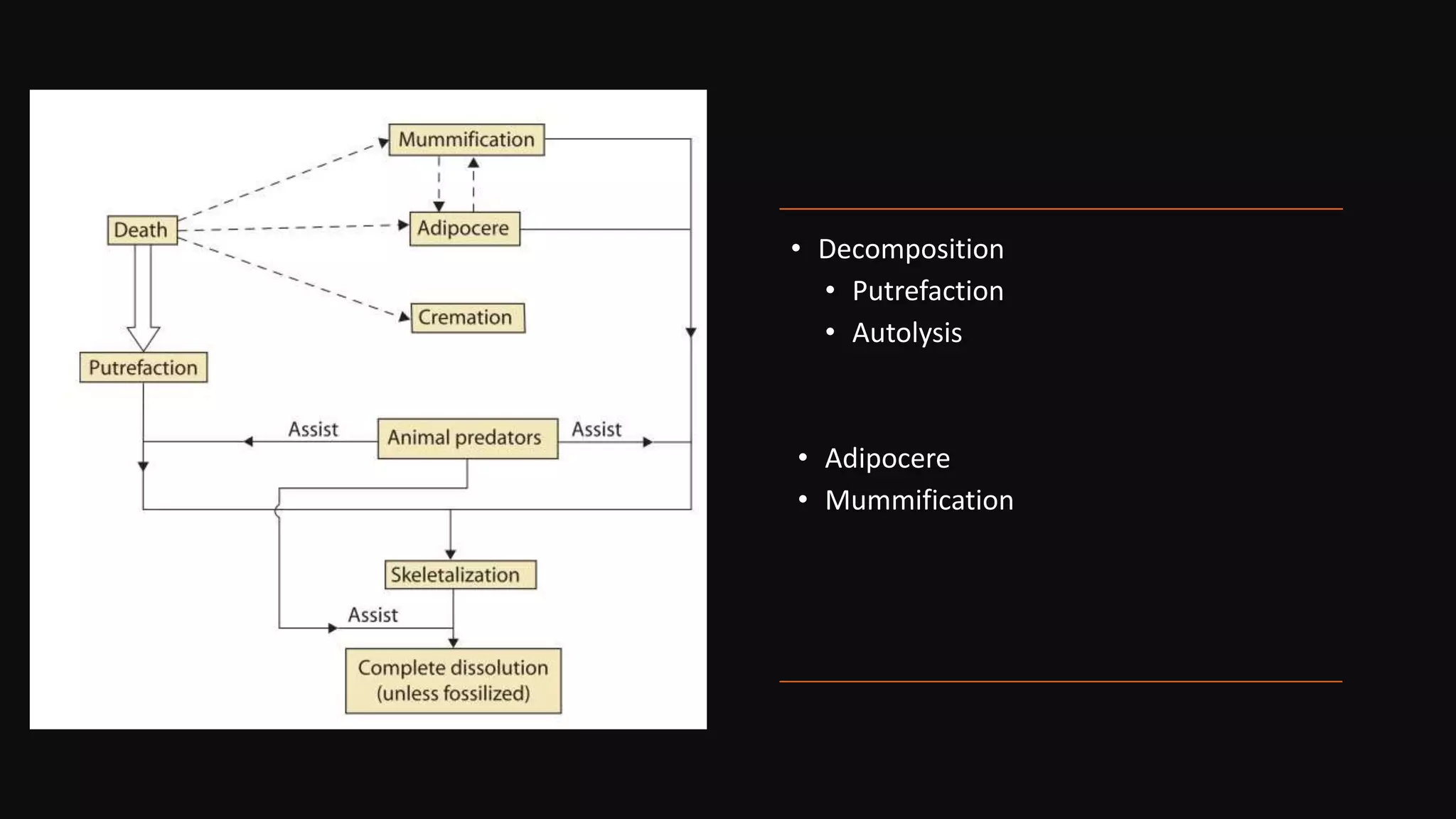
• Decomposition
• Putrefaction
• Autolysis
• Adipocere
• Mummification
Decomposition
• Definition: It is a process by which complex organic body tissue breaks down
into simpler inorganic compounds or elements due to the action of
saprophytic microorganisms or due to autolysis.
• Autolysis: refers to the situation where a body's own enzymes are acting on
itself, causing tissue and cellular destruction.
• After cessation of homeostasis, the natural flora of the body migrates from the
gut to the blood vessels and spreads all over the body. External micro-
organisms enter the body through the alimentary canal, respiratory tract, and
open wounds.
• in an average temperate climate, putrefaction may be expected to begin at
about 3 days in the unrefrigerated corpse.
 Most common organisms:
• Colstridium welchii
• Staphylococcus
• Non-hemolytic streptococcus
• Diptheroids
• proteus
Signs of
Decomposition
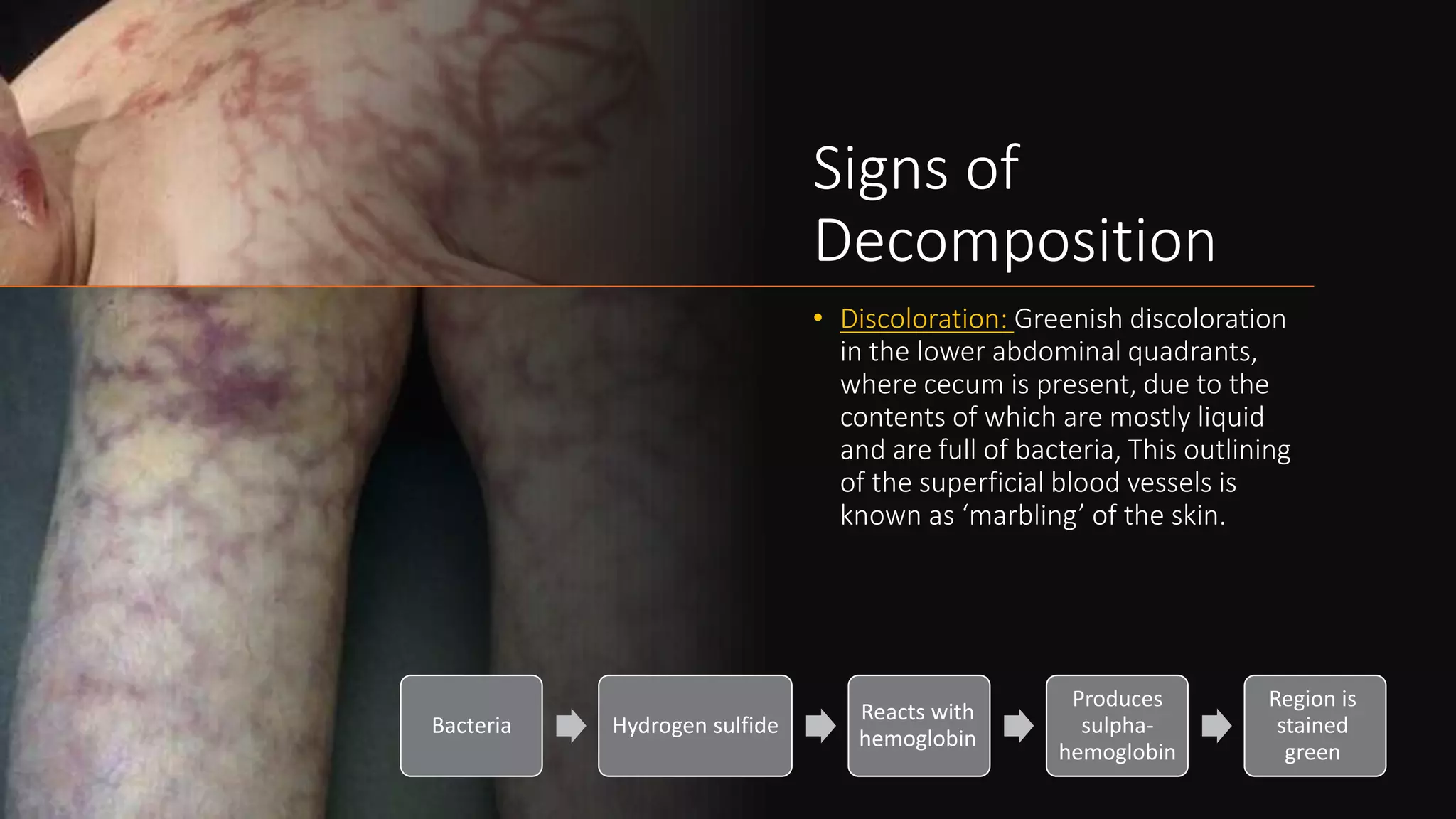
• Discoloration: Greenish discoloration
in the lower abdominal quadrants,
where cecum is present, due to the
contents of which are mostly liquid
and are full of bacteria, This outlining
of the superficial blood vessels is
known as ‘marbling’ of the skin.
Bacteria Hydrogen sulfide
Reacts with
hemoglobin
Produces
sulpha-
hemoglobin
Region is
stained
green
Signs of
Decomposition
• Distension: As the activity of the bacteria
increases, the amount of the putrefactive gases
produced rises.
• These gases cause the distension of the
abdomen, swelling of the face and external
genitalia, and can lead to purging of putrefactive
liquids from the mouth and nostrils referred to as
‘postmortem-purging
• Purging of urine and faeces may occur
due to the intra-abdominal pressure
and, occasionally, a uterine prolapse may
be extruded. from the same cause.
Bloody fluid, which is tissue liquefaction
stained by hemolysis, may leak from any
orifice, especially the mouth, nostrils,
rectum and vagina.
• There are recorded instances of
pregnant females having a macabre
postmortem ‘delivery’ of the fetus.
Signs of
Decomposition
• Degradation: Decomposition causes a
loss of anatomic integrity of skin and
other tissues such as localized peeling of
skin ('skin slippage'), loosening of skin of
hands and feet ('degloving') and
loosening of hair and nails.
• Dissolution: Progressive decomposition
leads to liquefaction and disappearance
of tissues and organs and eventual
skeletonization.
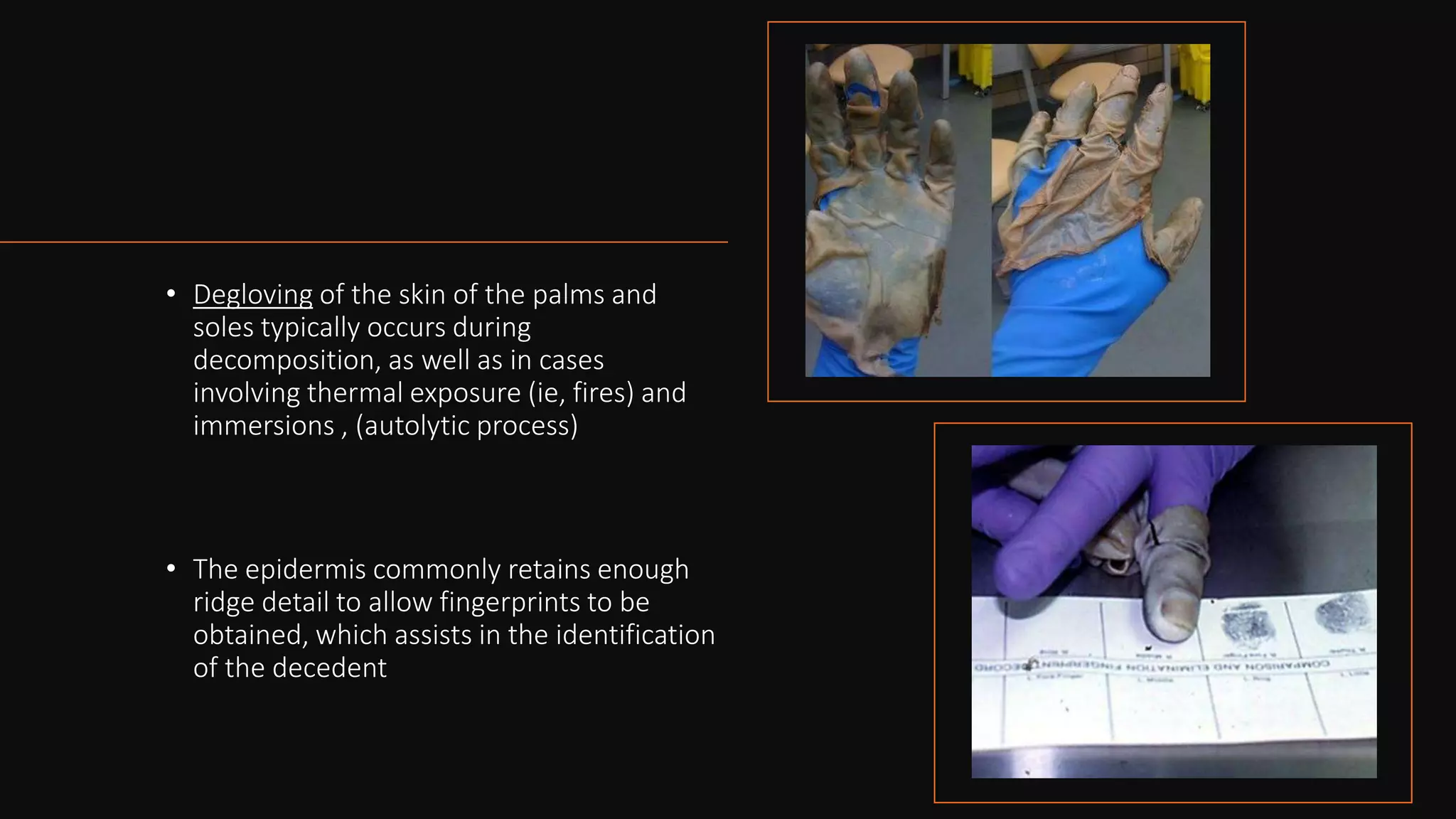
• Degloving of the skin of the palms and
soles typically occurs during
decomposition, as well as in cases
involving thermal exposure (ie, fires) and
immersions , (autolytic process)
• The epidermis commonly retains enough
ridge detail to allow fingerprints to be
obtained, which assists in the identification
of the decedent
External factors
affecting
Decomposition
Tempreature:
• High temperature promotes early
decomposition
• The optimum temperature for
decomposition is 21-38°C. Beyond or before
this range, decomposition occurs at a slower
rate.
• The rate of decomposition is about twice as
rapid in summer as in winter.
Moisture:
• Presence of moisture promotes
decomposition by promoting the growth of
the organisms.
• If the body dries up quickly, putrefaction
ceases and mummification occurs.
External factors
affecting
Decomposition
 Air:
• Free access of air hastens putrefaction, because the
air conveys organisms to the body. Stagnant air
promotes decomposition.
• movement of air retards the process by evaporating
the body fluids and cooling the dead body.
 Clothes:
• Clothing may reduce the rate of decomposition by
preventing invasion of the body by airborne
organisms. In winter, clothing hastens putrefaction
by maintaining body temperature for a longer period
and helping the growth of the microorganisms.
Internal factors
affecting
Decomposition
 Age:
• In stillborn fetuses or infants who are unfed or have not breathed, the process
of decomposition is slow.
 Sex:
• Sex does not have much to influence, but occurs faster in females, because of
its abundant subcutaneous fatty tissue that contains moisture and retains
body heat for a longer period.
 Condition of the body:
• Emaciated body decomposes later than a well nourished bulky, fatty body due
to more fluid content in the latter which promotes growth of microorganisms.
 Cause of death:
• When death is due to infection or septicemia, decomposition is rapid.
Putrefaction is delayed in death due to wasting disease, anemia, or poisoning
by carbolic acid, zinc chloride, strychnine and heavy metal.
• External injury on the body:
• Dead body having external injuries (either antemortem or postmortem) will
decompose earlier, because the injured areas will allow invasion of the body
by bacteria.
Medico-legal Importance
of Putrefaction
• It is the surest sign of death.
• From decomposition changes, time since death can be assessed.
• In advanced decomposition, the identity of the deceased may be impossible.
• In advanced putrefaction, no opinion can be given as to the cause of death, except in
case of poisoning, fractures and firearm injuries.
Maceration
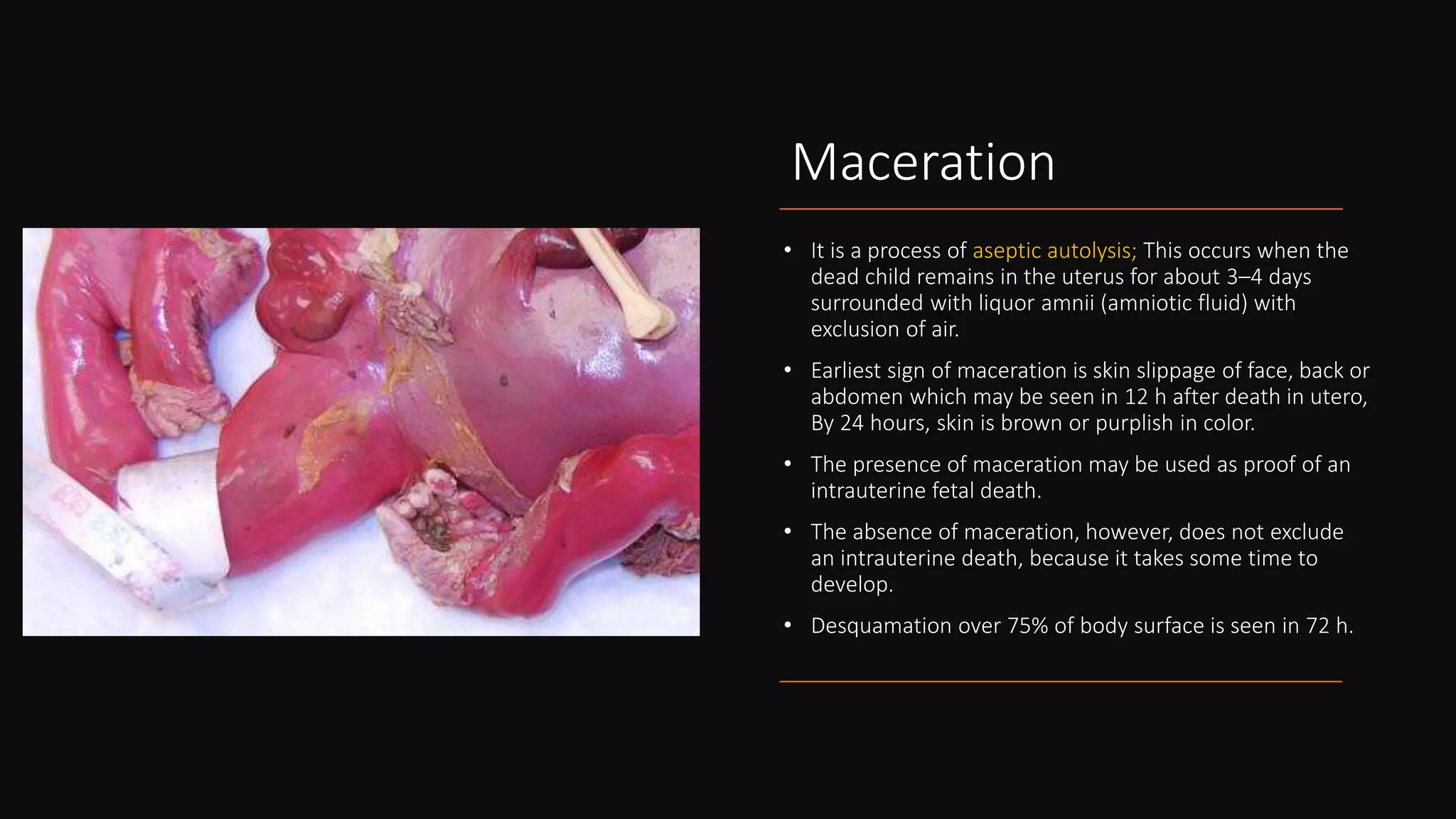
• It is a process of aseptic autolysis; This occurs when the
dead child remains in the uterus for about 3–4 days
surrounded with liquor amnii (amniotic fluid) with
exclusion of air.
• Earliest sign of maceration is skin slippage of face, back or
abdomen which may be seen in 12 h after death in utero,
By 24 hours, skin is brown or purplish in color.
• The presence of maceration may be used as proof of an
intrauterine fetal death.
• The absence of maceration, however, does not exclude
an intrauterine death, because it takes some time to
develop.
• Desquamation over 75% of body surface is seen in 72 h.
Maceration
• the macerated fetus is usually a brownish pink,
rather than the greenish hue of putrefaction.
• The surface is slimy, blistered, desquamating
and sometimes almost jelly-like. The joints are
loose and the cranial plates may be detached
beneath the scalp.
Spalding’s sign: pathognomonic sign of
intra-uterine death.
• There is loss of alignment and overlapping
of fetal skull bones, occurs due to
liquefaction of cerebrum and softening of
ligamentous structures supporting the
vault.
• Usually > 7 days after death
• Another process that commonly occurs in
cases of infant mortality is the postmortem
subcutaneous congealing of fat after the
body is refrigerated, the resultant doughy
consistency of the tissue may simulate a
ligature mark around the neck.
• Adipocere is a chemical change in the body fat, which is
hydrolyzed to a waxy compound similar to soap.
• The need for water means that this process is most
commonly seen in bodies found in wet conditions, (i.e.
any oxygen deprived place, or being submerged in water
or buried in wet ground).
• The point at which adipocere becomes visible to the
naked eye varies greatly, but it has been observed as
early as 3 weeks, though 3 months is a more typical
period.
• Time required for formation: The speed with which
adipocere can develop is variable; it would usually be
expected to take weeks or months, but it is reported
to have occurred in as little as 3 weeks.
• Distribution: It forms at any site where fatty tissue is
present, The face, buttocks, breasts and abdomen are
the most common sites.
Factors influencing
adipocere formation
• Heat: warm, moist and anaerobic environment favors adipocere formation. Heat accelerates, and cold
retards adipocere formation in a body.
• Moisture: Moisture is essential for chemical reactions to occur.
• Bacterial infection: Early activity by anaerobes such as Clostridium perfringens assist in the reaction, as
the bacteria produce lecithinase which facilitates hydrolysis and hydrogenation.
• Built: In obese people , it is formes quickly.
• Age: Fetuses < 7 months do not show adipocere formation.
• Air; Air current retards adiopocere by evaporating fluids of the body and reducing temperature.
• Running water: Adipocere formation is retarded as the electrolytes are washed away from the surface
of the body which is necessary for the change.
• A warm, moist and anaerobic environment favors adipocere formation.
• Adipocere has developed in this person who
was sealed in a barrel containing water and
buried for over 5 years.
• Although waxy, the internal organs resist
putrefaction when converted to adipocere.
• Complete conversion of a body to
adipocere. The body was recovered from a
deep lake 8 years after disappearing in a
boating accident during a heavy storm.
Medico-legal
Importance of adipocere
• Sign of death: It is the surest sign of death.
• Time since death: It gives a rough estimate about the time since death.
• Personal identification: When the process involves the face, the features are well-preserved which
help in identification.
• Recognition of injuries: The cause of death may be determined, since injuries can be recognized.
• Place of disposable of body: Some idea about the place of disposal of the body can be made, since
its formation requires a warm place with high humidity or presence of moisture or water.
Mummification
• Its It is the rapid dehydration/desiccation and
shriveling of the dead body from evaporation
of water, with preservation of natural
appearances and features of the body.
• The entire body loses weight, becomes thin,
stiff, brittle and odorless
• A body may show mummification in certain
parts and adipocere in cheeks, abdomen,
buttocks with mummification of the arms and
legs.
• It varies between 3-12 months or longer.
Mummification
• It begins in the exposed parts of the body, like
face (lips, tip of nose), hands and feet, and
then extends to the entire body including the
internal organs.
• The skin may be translucent due to absorption
of the liquefied subcutaneous fat, its usually
shrunken and contracted, dry, brittle, leathery
and rusty-brown in color, the skin is slightly
stretched across anatomical prominences,.
• Internal organs become shrunken, hard, dark-
brown or black.
Factors altering
Mummification
• Hot environment: As in the deserts.
• Dry atmosphere: mummification cannot occur in
humid conditions.
• Free air movement: it helps in rapid evaporating of
fluid and maintaining colder temperature.
• Contact of the body with absorbing media: a dead
body lying in a shallow grave, in a dry sandy soil
mummifies early, due to absorption of the body
fluids rapidly.
• Poisoning: Chronic arsenic or antimony poisoning
favors the process of mummification.
• Mummification of this homicide victim
occurred after she remained in a secure
bedroom in august in the southeastern
United States for almost 2 weeks with no
air conditioner.
• Mummification preserved the numerous
stab wounds and incised wounds,
allowing accurate postmortem
assessment of her injuries.
• Isolated mummification may be evident in
areas of the body with less tissue mass, such
as the nose, ears, hands, and feet.
References
• Knight’s Forensic Pathology, 4th edition.
• Simpson’s forensic medicine. 13th edition.
• Biswas 2nd edition.
• Shedge R, Krishan K, Warrier V, et al. Postmortem
Changes. [Updated 2020 Jul 27]. In: StatPearls
[Internet]. Treasure Island (FL): StatPearls Publishing;
2020 Jan.
• Keeling J.W. (1987) Macerated stillbirth. In: Keeling J.W.
(eds) Fetal and Neonatal Pathology. Springer, London.
https://doi.org/10.1007/978-1-4471-3523-4_8
• S Erin Presnell, J Scott Denton, Stephen J
Cina. Postmortem changes[Updated: Jul 07, 2020 ]
in:Medscape [Internet].

Late post mortem changes

  • 1.
  • 2.
    • Decomposition • Putrefaction •Autolysis • Adipocere • Mummification
  • 3.
    Decomposition • Definition: Itis a process by which complex organic body tissue breaks down into simpler inorganic compounds or elements due to the action of saprophytic microorganisms or due to autolysis. • Autolysis: refers to the situation where a body's own enzymes are acting on itself, causing tissue and cellular destruction. • After cessation of homeostasis, the natural flora of the body migrates from the gut to the blood vessels and spreads all over the body. External micro- organisms enter the body through the alimentary canal, respiratory tract, and open wounds. • in an average temperate climate, putrefaction may be expected to begin at about 3 days in the unrefrigerated corpse.  Most common organisms: • Colstridium welchii • Staphylococcus • Non-hemolytic streptococcus • Diptheroids • proteus
  • 4.
    Signs of Decomposition • Discoloration:Greenish discoloration in the lower abdominal quadrants, where cecum is present, due to the contents of which are mostly liquid and are full of bacteria, This outlining of the superficial blood vessels is known as ‘marbling’ of the skin. Bacteria Hydrogen sulfide Reacts with hemoglobin Produces sulpha- hemoglobin Region is stained green
  • 5.
    Signs of Decomposition • Distension:As the activity of the bacteria increases, the amount of the putrefactive gases produced rises. • These gases cause the distension of the abdomen, swelling of the face and external genitalia, and can lead to purging of putrefactive liquids from the mouth and nostrils referred to as ‘postmortem-purging
  • 6.
    • Purging ofurine and faeces may occur due to the intra-abdominal pressure and, occasionally, a uterine prolapse may be extruded. from the same cause. Bloody fluid, which is tissue liquefaction stained by hemolysis, may leak from any orifice, especially the mouth, nostrils, rectum and vagina. • There are recorded instances of pregnant females having a macabre postmortem ‘delivery’ of the fetus.
  • 7.
    Signs of Decomposition • Degradation:Decomposition causes a loss of anatomic integrity of skin and other tissues such as localized peeling of skin ('skin slippage'), loosening of skin of hands and feet ('degloving') and loosening of hair and nails. • Dissolution: Progressive decomposition leads to liquefaction and disappearance of tissues and organs and eventual skeletonization.
  • 8.
    • Degloving ofthe skin of the palms and soles typically occurs during decomposition, as well as in cases involving thermal exposure (ie, fires) and immersions , (autolytic process) • The epidermis commonly retains enough ridge detail to allow fingerprints to be obtained, which assists in the identification of the decedent
  • 9.
    External factors affecting Decomposition Tempreature: • Hightemperature promotes early decomposition • The optimum temperature for decomposition is 21-38°C. Beyond or before this range, decomposition occurs at a slower rate. • The rate of decomposition is about twice as rapid in summer as in winter. Moisture: • Presence of moisture promotes decomposition by promoting the growth of the organisms. • If the body dries up quickly, putrefaction ceases and mummification occurs.
  • 10.
    External factors affecting Decomposition  Air: •Free access of air hastens putrefaction, because the air conveys organisms to the body. Stagnant air promotes decomposition. • movement of air retards the process by evaporating the body fluids and cooling the dead body.  Clothes: • Clothing may reduce the rate of decomposition by preventing invasion of the body by airborne organisms. In winter, clothing hastens putrefaction by maintaining body temperature for a longer period and helping the growth of the microorganisms.
  • 11.
    Internal factors affecting Decomposition  Age: •In stillborn fetuses or infants who are unfed or have not breathed, the process of decomposition is slow.  Sex: • Sex does not have much to influence, but occurs faster in females, because of its abundant subcutaneous fatty tissue that contains moisture and retains body heat for a longer period.  Condition of the body: • Emaciated body decomposes later than a well nourished bulky, fatty body due to more fluid content in the latter which promotes growth of microorganisms.  Cause of death: • When death is due to infection or septicemia, decomposition is rapid. Putrefaction is delayed in death due to wasting disease, anemia, or poisoning by carbolic acid, zinc chloride, strychnine and heavy metal. • External injury on the body: • Dead body having external injuries (either antemortem or postmortem) will decompose earlier, because the injured areas will allow invasion of the body by bacteria.
  • 12.
    Medico-legal Importance of Putrefaction •It is the surest sign of death. • From decomposition changes, time since death can be assessed. • In advanced decomposition, the identity of the deceased may be impossible. • In advanced putrefaction, no opinion can be given as to the cause of death, except in case of poisoning, fractures and firearm injuries.
  • 14.
    Maceration • It isa process of aseptic autolysis; This occurs when the dead child remains in the uterus for about 3–4 days surrounded with liquor amnii (amniotic fluid) with exclusion of air. • Earliest sign of maceration is skin slippage of face, back or abdomen which may be seen in 12 h after death in utero, By 24 hours, skin is brown or purplish in color. • The presence of maceration may be used as proof of an intrauterine fetal death. • The absence of maceration, however, does not exclude an intrauterine death, because it takes some time to develop. • Desquamation over 75% of body surface is seen in 72 h.
  • 15.
    Maceration • the maceratedfetus is usually a brownish pink, rather than the greenish hue of putrefaction. • The surface is slimy, blistered, desquamating and sometimes almost jelly-like. The joints are loose and the cranial plates may be detached beneath the scalp.
  • 16.
    Spalding’s sign: pathognomonicsign of intra-uterine death. • There is loss of alignment and overlapping of fetal skull bones, occurs due to liquefaction of cerebrum and softening of ligamentous structures supporting the vault. • Usually > 7 days after death
  • 18.
    • Another processthat commonly occurs in cases of infant mortality is the postmortem subcutaneous congealing of fat after the body is refrigerated, the resultant doughy consistency of the tissue may simulate a ligature mark around the neck.
  • 19.
    • Adipocere isa chemical change in the body fat, which is hydrolyzed to a waxy compound similar to soap. • The need for water means that this process is most commonly seen in bodies found in wet conditions, (i.e. any oxygen deprived place, or being submerged in water or buried in wet ground). • The point at which adipocere becomes visible to the naked eye varies greatly, but it has been observed as early as 3 weeks, though 3 months is a more typical period.
  • 20.
    • Time requiredfor formation: The speed with which adipocere can develop is variable; it would usually be expected to take weeks or months, but it is reported to have occurred in as little as 3 weeks. • Distribution: It forms at any site where fatty tissue is present, The face, buttocks, breasts and abdomen are the most common sites.
  • 21.
    Factors influencing adipocere formation •Heat: warm, moist and anaerobic environment favors adipocere formation. Heat accelerates, and cold retards adipocere formation in a body. • Moisture: Moisture is essential for chemical reactions to occur. • Bacterial infection: Early activity by anaerobes such as Clostridium perfringens assist in the reaction, as the bacteria produce lecithinase which facilitates hydrolysis and hydrogenation. • Built: In obese people , it is formes quickly. • Age: Fetuses < 7 months do not show adipocere formation. • Air; Air current retards adiopocere by evaporating fluids of the body and reducing temperature. • Running water: Adipocere formation is retarded as the electrolytes are washed away from the surface of the body which is necessary for the change. • A warm, moist and anaerobic environment favors adipocere formation.
  • 22.
    • Adipocere hasdeveloped in this person who was sealed in a barrel containing water and buried for over 5 years. • Although waxy, the internal organs resist putrefaction when converted to adipocere.
  • 23.
    • Complete conversionof a body to adipocere. The body was recovered from a deep lake 8 years after disappearing in a boating accident during a heavy storm.
  • 24.
    Medico-legal Importance of adipocere •Sign of death: It is the surest sign of death. • Time since death: It gives a rough estimate about the time since death. • Personal identification: When the process involves the face, the features are well-preserved which help in identification. • Recognition of injuries: The cause of death may be determined, since injuries can be recognized. • Place of disposable of body: Some idea about the place of disposal of the body can be made, since its formation requires a warm place with high humidity or presence of moisture or water.
  • 25.
    Mummification • Its Itis the rapid dehydration/desiccation and shriveling of the dead body from evaporation of water, with preservation of natural appearances and features of the body. • The entire body loses weight, becomes thin, stiff, brittle and odorless • A body may show mummification in certain parts and adipocere in cheeks, abdomen, buttocks with mummification of the arms and legs. • It varies between 3-12 months or longer.
  • 26.
    Mummification • It beginsin the exposed parts of the body, like face (lips, tip of nose), hands and feet, and then extends to the entire body including the internal organs. • The skin may be translucent due to absorption of the liquefied subcutaneous fat, its usually shrunken and contracted, dry, brittle, leathery and rusty-brown in color, the skin is slightly stretched across anatomical prominences,. • Internal organs become shrunken, hard, dark- brown or black.
  • 27.
    Factors altering Mummification • Hotenvironment: As in the deserts. • Dry atmosphere: mummification cannot occur in humid conditions. • Free air movement: it helps in rapid evaporating of fluid and maintaining colder temperature. • Contact of the body with absorbing media: a dead body lying in a shallow grave, in a dry sandy soil mummifies early, due to absorption of the body fluids rapidly. • Poisoning: Chronic arsenic or antimony poisoning favors the process of mummification.
  • 28.
    • Mummification ofthis homicide victim occurred after she remained in a secure bedroom in august in the southeastern United States for almost 2 weeks with no air conditioner. • Mummification preserved the numerous stab wounds and incised wounds, allowing accurate postmortem assessment of her injuries.
  • 29.
    • Isolated mummificationmay be evident in areas of the body with less tissue mass, such as the nose, ears, hands, and feet.
  • 30.
    References • Knight’s ForensicPathology, 4th edition. • Simpson’s forensic medicine. 13th edition. • Biswas 2nd edition. • Shedge R, Krishan K, Warrier V, et al. Postmortem Changes. [Updated 2020 Jul 27]. In: StatPearls [Internet]. Treasure Island (FL): StatPearls Publishing; 2020 Jan. • Keeling J.W. (1987) Macerated stillbirth. In: Keeling J.W. (eds) Fetal and Neonatal Pathology. Springer, London. https://doi.org/10.1007/978-1-4471-3523-4_8 • S Erin Presnell, J Scott Denton, Stephen J Cina. Postmortem changes[Updated: Jul 07, 2020 ] in:Medscape [Internet].

Editor's Notes

  • #4 Putrefaction usually follows the disappearance of rigor mortis, But during the hot season, it may commence before rigor mortis has completely disappeared from the lower extremities. After death, the body's protective functions are absent and its defense barrier is lost. Saprophytic microorganisms which cannot invade the body during life, physical and chemical agents which are present in the environment, all act on the dead body. Further, some body chemicals and enzymes which are helpful in different metabolic processes, in the absence of physiological control after death, start acting adversely Immediately after death, cell membranes become permeable and break down, with release of cytoplasm containing enzymes. • The proteolytic, glycolytic and lipolytic action of ferments causes autodigestion and disintegration of organs, and occurs without bacterial influence. • The earliest autolytic changes occur in parenchymatous and glandular tissues and in the brain. • In adults, such digestion may start before death in cases of intracranial lesions.
  • #6 The gases are produced due to bacterial reductive catalysis and include hydrogen sulfide, ammonia, carbon dioxide, and methane, etc.
  • #12  4 due to the preservative action of these substances on the tissues or their destructive/ inhibitive effects on microorganisms.
  • #16 Macerated stillbirth. Moulding of the head during delivery has produced depression of the frontal bones and elongation of the verticomental diameter, giving an illusion of hydrocephalus.- Dark-red discoloration of exposed dermis. frequently seen over bony prominences. is the result of epidermal loss during or after delivery.
  • #20 - The process needs water which is provided by the body fluids in soft tissue, The chemical reaction essentially involves conversion of unsaturated liquid fats (oleic acid) to saturated solid higher fatty acids.
  • #27 - slight adipocere formation is common in mummification, and perhaps the two are related in that the utilization of body water to hydrolyse fat in turn helps to dehydrate the tissues. The major factor, however, is evaporation from the surface in dry conditions. -The mummified body of an absconder from a mental hospital who was found a year later in a hay barn. The dry environment had inhibited wet decomposition.