STRANGULATION 
Presenter: Tittu Joseph 
Roll No: 92
CONTENTS: 
 Definition 
 Types 
 Throttling 
 Ligature Strangulation 
 Post Mortem Features in Ligature Strangulation 
 Medicolegal Aspects
DEFINITION: 
 Application of external pressure on the neck either by 
bare hands, or by a ligature, or by any other material. 
 It is a form of asphyxia caused by constriction of the 
neck WITHOUT suspending the body. 
TYPES: 
 Strangulation that is effected by a ligature is called 
LIGATURE STRANGULATION, while that which is 
accomplished by bare hands is called MANUAL 
STRANGULATION, or THROTTLING.
MANUAL STRANGULATION 
(THROTTLING): 
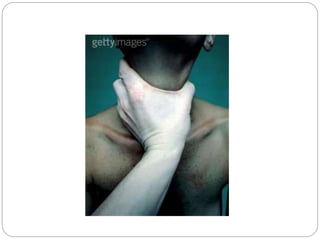
 When hands are used to squeeze or compress the neck. 
 It is always homicidal. At times however, a mild playful tweak 
on the neck has resulted in death from vagal inhibition. 
AUTOPSY FINDINGS: 
 Signs of asphyxia are seen. In addition, the following specific 
findings may be present: 
 Brusing of the neck: 
 Occurs due to the assailant’s fingers grasping the neck. 
 Usually circular, dark red or purple in colour, and are 1-2cm 
in size. 
 If the fingers slide over the skin, elongated marks may be 
seen.
 Abrasions on the neck: 
 Scratches maybe caused by the fingernails of either the 
assailant or the victim. 
 Curved or linear. 
 During autopsy, scrapings from under the fingernails of 
the deceased maybe taken for DNA fingerprinting and 
compared with that of the suspect, because the victim 
may have scratched the assailant in an attempt to ward 
off the attack. 
 INTERNAL APPEARANCES: 
 Tissues of the neck are often markedly contused. 
 Bleeding maybe seens in the strap muscles or platysma. 
 If excessive force has been applied, bleeding from larynx 
may have occurred.
LIGATURE STRANGULATION: 
 Materials used for ligature strangulation can be anything 
from flexible rubber tubing to cloth, or stick, wooden 
planks, belts, wire, rope etc. 
 Usually wound transversely around the neck, sometimes 
with several turns and is often below the level of the 
thyroid cartilage. 
 Intense congestion of the face, bleeding from nose, 
mouth and even ears are characteristic features. 
 Involuntary passage of urine, defecation etc. are more 
common in hanging. 
 In infants, homicidal strangulation maybe brought about 
by winding the umbilical cord around the neck. 
 Variations include BANSDOLA, MUGGING and 
GARROTING.
 Bansdola: 
A wooden pole or rod is placed over the front of, and 
behind the neck. 
 One end of these rods is fastened together by a rope. 
 Other ends when forcefully brought together squuze the 
neck to cause death. 
 Mugging: 
 Brought about by squeezing the neck of the victim in the 
crook of the elbow, or the bend of the knee. 
 Garroting: 
Method of judicial execution in some countries. 
Victim is made to wear a neck collar of metal. Death is 
brought about by tightening the collar. 
 Since there is upward pull, the resulting ligature mark may 
resemble that of hanging.
AUTOPSY FINDINGS OF LIGATURE 
STRANGULATION: 
 Classical and non-specific signs of asphyxia are 
prominent. 
 Tongue is often protruded. 
 Bleeding from the ears or the nose maybe seen. 
 The ligature mark is seen as a depression around the 
neck because of oedema of the tissues above and below 
it. 
 The skin over the mark is dry and hard. The base 
appears pale, while the edges show small abrasions. 
 The width of the mark depends on the ligature used. 
 The pattern of the ligature may get imprinted on the skin 
as imprint abrasion.
 The ligature mark completely encircles the neck in 
strangulation, while in hanging it is absent near the 
point of suspension. 
 The occurrence of a narrow zone of engorgement or 
bruising immediately above and below the groove, 
confirms that the victim was alive at the time when the 
ligature was applied. 
 Even if putrefaction has set in, the ligature mark usually 
remains distinct. 
 Asphyxial component is always more pronounced in 
strangulation, as compared to hanging. 
 Carotid arteries often show transverse intimal tears. 
 Fracture of left or right superior horn of thyroid cartilage 
is a common feature. 
 If more force is applied, there may also be fracture of 
cricoid cartilage and tracheal rings.
MEDICOLEGAL ASPECTS: 
 Strangulation is usually homicidal. 
 Suicidal strangulation is rare, because once anoxia sets 
in, the pressure over the neck gets relaxed. 
 Accidental strangulation is rare, but it may occur when 
clothing such as dupatta, neck band, or cord gets tightly 
drawn around the neck, in an abrupt manner. 
 Pseudostrangulation: 
In the neck of a dead (obese) person or infant, the 
skin folds may sometimes mimic ligature marks, which 
maybe confused with strangulation marks. However, 
dissection will reveal absence of bruising or abrasions.
Strangulation Forensic Medicine

Strangulation Forensic Medicine

  • 1.
  • 2.
    CONTENTS:  Definition  Types  Throttling  Ligature Strangulation  Post Mortem Features in Ligature Strangulation  Medicolegal Aspects
  • 3.
    DEFINITION:  Applicationof external pressure on the neck either by bare hands, or by a ligature, or by any other material.  It is a form of asphyxia caused by constriction of the neck WITHOUT suspending the body. TYPES:  Strangulation that is effected by a ligature is called LIGATURE STRANGULATION, while that which is accomplished by bare hands is called MANUAL STRANGULATION, or THROTTLING.
  • 5.
    MANUAL STRANGULATION (THROTTLING):  When hands are used to squeeze or compress the neck.  It is always homicidal. At times however, a mild playful tweak on the neck has resulted in death from vagal inhibition. AUTOPSY FINDINGS:  Signs of asphyxia are seen. In addition, the following specific findings may be present:  Brusing of the neck:  Occurs due to the assailant’s fingers grasping the neck.  Usually circular, dark red or purple in colour, and are 1-2cm in size.  If the fingers slide over the skin, elongated marks may be seen.
  • 6.
     Abrasions onthe neck:  Scratches maybe caused by the fingernails of either the assailant or the victim.  Curved or linear.  During autopsy, scrapings from under the fingernails of the deceased maybe taken for DNA fingerprinting and compared with that of the suspect, because the victim may have scratched the assailant in an attempt to ward off the attack.  INTERNAL APPEARANCES:  Tissues of the neck are often markedly contused.  Bleeding maybe seens in the strap muscles or platysma.  If excessive force has been applied, bleeding from larynx may have occurred.
  • 8.
    LIGATURE STRANGULATION: Materials used for ligature strangulation can be anything from flexible rubber tubing to cloth, or stick, wooden planks, belts, wire, rope etc.  Usually wound transversely around the neck, sometimes with several turns and is often below the level of the thyroid cartilage.  Intense congestion of the face, bleeding from nose, mouth and even ears are characteristic features.  Involuntary passage of urine, defecation etc. are more common in hanging.  In infants, homicidal strangulation maybe brought about by winding the umbilical cord around the neck.  Variations include BANSDOLA, MUGGING and GARROTING.
  • 9.
     Bansdola: Awooden pole or rod is placed over the front of, and behind the neck.  One end of these rods is fastened together by a rope.  Other ends when forcefully brought together squuze the neck to cause death.  Mugging:  Brought about by squeezing the neck of the victim in the crook of the elbow, or the bend of the knee.  Garroting: Method of judicial execution in some countries. Victim is made to wear a neck collar of metal. Death is brought about by tightening the collar.  Since there is upward pull, the resulting ligature mark may resemble that of hanging.
  • 11.
    AUTOPSY FINDINGS OFLIGATURE STRANGULATION:  Classical and non-specific signs of asphyxia are prominent.  Tongue is often protruded.  Bleeding from the ears or the nose maybe seen.  The ligature mark is seen as a depression around the neck because of oedema of the tissues above and below it.  The skin over the mark is dry and hard. The base appears pale, while the edges show small abrasions.  The width of the mark depends on the ligature used.  The pattern of the ligature may get imprinted on the skin as imprint abrasion.
  • 12.
     The ligaturemark completely encircles the neck in strangulation, while in hanging it is absent near the point of suspension.  The occurrence of a narrow zone of engorgement or bruising immediately above and below the groove, confirms that the victim was alive at the time when the ligature was applied.  Even if putrefaction has set in, the ligature mark usually remains distinct.  Asphyxial component is always more pronounced in strangulation, as compared to hanging.  Carotid arteries often show transverse intimal tears.  Fracture of left or right superior horn of thyroid cartilage is a common feature.  If more force is applied, there may also be fracture of cricoid cartilage and tracheal rings.
  • 13.
    MEDICOLEGAL ASPECTS: Strangulation is usually homicidal.  Suicidal strangulation is rare, because once anoxia sets in, the pressure over the neck gets relaxed.  Accidental strangulation is rare, but it may occur when clothing such as dupatta, neck band, or cord gets tightly drawn around the neck, in an abrupt manner.  Pseudostrangulation: In the neck of a dead (obese) person or infant, the skin folds may sometimes mimic ligature marks, which maybe confused with strangulation marks. However, dissection will reveal absence of bruising or abrasions.