Clinical Anatomy of
Upperlimb Limb..
By :- Hussain Mustansir Madhvaswala
( 1st year , PIHR )
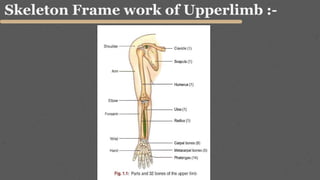
Skeleton Frame work of Upperlimb :-
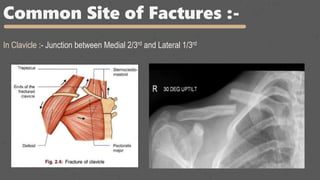
Common Site of Factures :-
In Clavicle :- Junction between Medial 2/3rd and Lateral 1/3rd
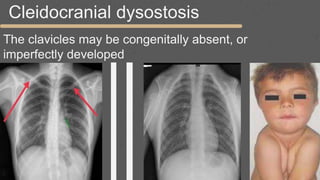
Cleidocranial dysostosis
The clavicles may be congenitally absent, or
imperfectly developed
Winging of
Scapula :-
Paralysis of the serratus anterior causes ‘winging’of the
scapula. The medial border of the bone becomes unduly
prominent, and the arm cannot be abducted beyond 90
degrees
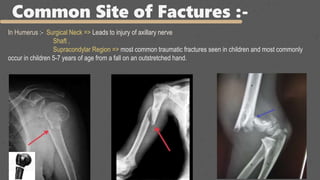
Common Site of Factures :-
In Humerus :- Surgical Neck => Leads to injury of axillary nerve
Shaft ,
Supracondylar Region => most common traumatic fractures seen in children and most commonly
occur in children 5-7 years of age from a fall on an outstretched hand.
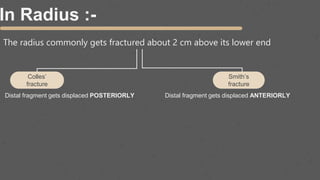
In Radius :-
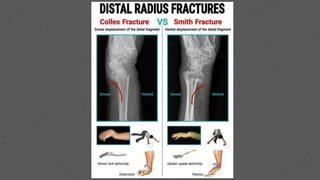
The radius commonly gets fractured about 2 cm above its lower end
Colles’
fracture
Smith’s
fracture
Distal fragment gets displaced ANTERIORLY
Distal fragment gets displaced POSTERIORLY
Ulna :-
• The shaft of the ulna may fracture either alone or along with that of the radius.
• Fracture of the olecranon is common and is Caused by a fall on the point of the
elbow
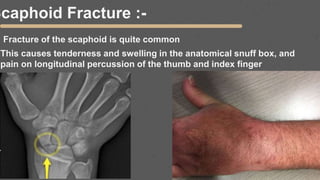
Scaphoid Fracture :-
Fracture of the scaphoid is quite common
This causes tenderness and swelling in the anatomical snuff box, and
pain on longitudinal percussion of the thumb and index finger
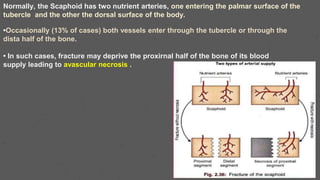
Normally, the Scaphoid has two nutrient arteries, one entering the palmar surface of the
tubercle and the other the dorsal surface of the body.
•Occasionally (13% of cases) both vessels enter through the tubercle or through the
dista half of the bone.
• In such cases, fracture may deprive the proxirnal half of the bone of its blood
supply leading to avascular necrosis .
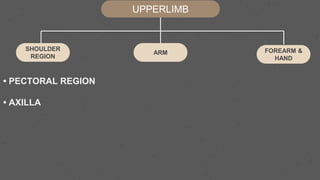
UPPERLIMB
FOREARM &
HAND
ARM
SHOULDER
REGION
• PECTORAL REGION
• AXILLA
ECTORAL REGION :-
Breast Cancer :-
Cancer of the mammary glands is the most comnon cancer in females of all
ages. It is more frequently seen in postmenopausal females due to lack of
oestrogen hormones.
Self-examination of the mammary gland is the only way for early diagnosis and
appropriate treatment.
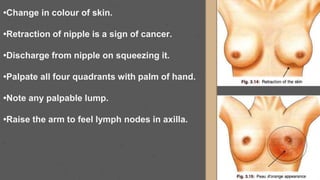
•Change in colour of skin.
•Retraction of nipple is a sign of cancer.
•Discharge from nipple on squeezing it.
•Palpate all four quadrants with palm of hand.
•Note any palpable lump.
•Raise the arm to feel lymph nodes in axilla.
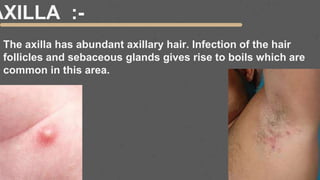
AXILLA :-
The axilla has abundant axillary hair. Infection of the hair
follicles and sebaceous glands gives rise to boils which are
common in this area.
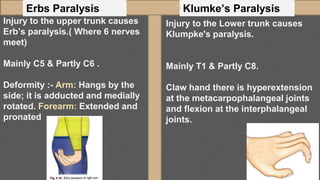
Erbs Paralysis Klumke’s Paralysis
Injury to the upper trunk causes
Erb’s paralysis.( Where 6 nerves
meet)
Mainly C5 & Partly C6 .
Deformity :- Arm: Hangs by the
side; it is adducted and medially
rotated. Forearm: Extended and
pronated
Injury to the Lower trunk causes
Klumpke's paralysis.
Mainly T1 & Partly C8.
Claw hand there is hyperextension
at the metacarpophalangeal joints
and flexion at the interphalangeal
joints.
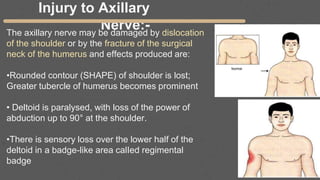
Injury to Axillary
Nerve:-
The axillary nerve may be damaged by dislocation
of the shoulder or by the fracture of the surgical
neck of the humerus and effects produced are:
•Rounded contour (SHAPE) of shoulder is lost;
Greater tubercle of humerus becomes prominent
• Deltoid is paralysed, with loss of the power of
abduction up to 90° at the shoulder.
•There is sensory loss over the lower half of the
deltoid in a badge-like area calIed regimental
badge
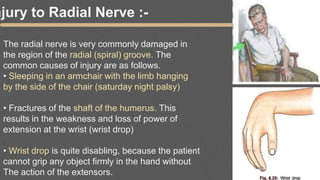
njury to Radial Nerve :-
The radial nerve is very commonly damaged in
the region of the radial (spiral) groove. The
common causes of injury are as follows.
• Sleeping in an armchair with the limb hanging
by the side of the chair (saturday night palsy)
• Fractures of the shaft of the humerus. This
results in the weakness and loss of power of
extension at the wrist (wrist drop)
• Wrist drop is quite disabling, because the patient
cannot grip any object firmly in the hand without
The action of the extensors.
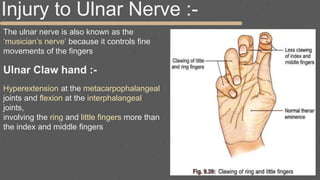
Injury to Ulnar Nerve :-
The ulnar nerve is also known as the
‘musician’s nerve’ because it controls fine
movements of the fingers
Ulnar Claw hand :-
Hyperextension at the metacarpophalangeal
joints and flexion at the interphalangeal
joints,
involving the ring and little fingers more than
the index and middle fingers
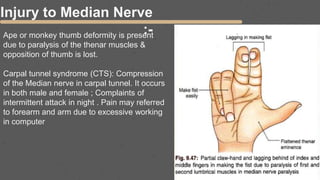
Injury to Median Nerve
:-
Ape or monkey thumb deformity is present
due to paralysis of the thenar muscles &
opposition of thumb is lost.
Carpal tunnel syndrome (CTS): Compression
of the Median nerve in carpal tunnel. It occurs
in both male and female ; Complaints of
intermittent attack in night . Pain may referred
to forearm and arm due to excessive working
in computer
Clinical Significance:-
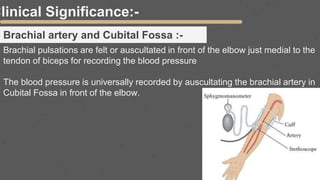
Brachial artery and Cubital Fossa :-
Brachial pulsations are felt or auscultated in front of the elbow just medial to the
tendon of biceps for recording the blood pressure
The blood pressure is universally recorded by auscultating the brachial artery in
Cubital Fossa in front of the elbow.
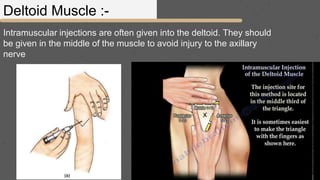
Deltoid Muscle :-
Intramuscular injections are often given into the deltoid. They should
be given in the middle of the muscle to avoid injury to the axillary
nerve
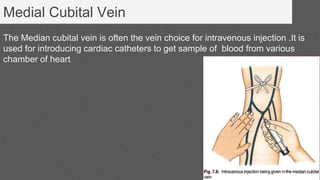
Medial Cubital Vein Muscle :-
The Median cubital vein is often the vein choice for intravenous injection .It is
used for introducing cardiac catheters to get sample of blood from various
chamber of heart
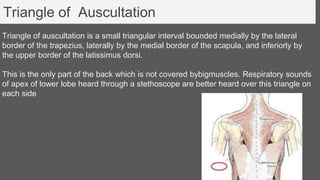
Triangle of Auscultation :-
Triangle of auscultation is a small triangular interval bounded medially by the lateral
border of the trapezius, laterally by the medial border of the scapula, and inferiorly by
the upper border of the latissimus dorsi.
This is the only part of the back which is not covered bybigmuscles. Respiratory sounds
of apex of lower lobe heard through a stethoscope are better heard over this triangle on
each side

Clinical anatomy UPPER LIMB.pptx

  • 1.
    Clinical Anatomy of UpperlimbLimb.. By :- Hussain Mustansir Madhvaswala ( 1st year , PIHR )
  • 2.
    Skeleton Frame workof Upperlimb :-
  • 3.
    Common Site ofFactures :- In Clavicle :- Junction between Medial 2/3rd and Lateral 1/3rd
  • 4.
    Cleidocranial dysostosis The claviclesmay be congenitally absent, or imperfectly developed
  • 5.
    Winging of Scapula :- Paralysisof the serratus anterior causes ‘winging’of the scapula. The medial border of the bone becomes unduly prominent, and the arm cannot be abducted beyond 90 degrees
  • 6.
    Common Site ofFactures :- In Humerus :- Surgical Neck => Leads to injury of axillary nerve Shaft , Supracondylar Region => most common traumatic fractures seen in children and most commonly occur in children 5-7 years of age from a fall on an outstretched hand.
  • 7.
    In Radius :- Theradius commonly gets fractured about 2 cm above its lower end Colles’ fracture Smith’s fracture Distal fragment gets displaced ANTERIORLY Distal fragment gets displaced POSTERIORLY
  • 9.
    Ulna :- • Theshaft of the ulna may fracture either alone or along with that of the radius. • Fracture of the olecranon is common and is Caused by a fall on the point of the elbow
  • 10.
    Scaphoid Fracture :- Fractureof the scaphoid is quite common This causes tenderness and swelling in the anatomical snuff box, and pain on longitudinal percussion of the thumb and index finger
  • 11.
    Normally, the Scaphoidhas two nutrient arteries, one entering the palmar surface of the tubercle and the other the dorsal surface of the body. •Occasionally (13% of cases) both vessels enter through the tubercle or through the dista half of the bone. • In such cases, fracture may deprive the proxirnal half of the bone of its blood supply leading to avascular necrosis .
  • 12.
  • 13.
    ECTORAL REGION :- BreastCancer :- Cancer of the mammary glands is the most comnon cancer in females of all ages. It is more frequently seen in postmenopausal females due to lack of oestrogen hormones. Self-examination of the mammary gland is the only way for early diagnosis and appropriate treatment.
  • 14.
    •Change in colourof skin. •Retraction of nipple is a sign of cancer. •Discharge from nipple on squeezing it. •Palpate all four quadrants with palm of hand. •Note any palpable lump. •Raise the arm to feel lymph nodes in axilla.
  • 15.
    AXILLA :- The axillahas abundant axillary hair. Infection of the hair follicles and sebaceous glands gives rise to boils which are common in this area.
  • 16.
    Erbs Paralysis Klumke’sParalysis Injury to the upper trunk causes Erb’s paralysis.( Where 6 nerves meet) Mainly C5 & Partly C6 . Deformity :- Arm: Hangs by the side; it is adducted and medially rotated. Forearm: Extended and pronated Injury to the Lower trunk causes Klumpke's paralysis. Mainly T1 & Partly C8. Claw hand there is hyperextension at the metacarpophalangeal joints and flexion at the interphalangeal joints.
  • 17.
    Injury to Axillary Nerve:- Theaxillary nerve may be damaged by dislocation of the shoulder or by the fracture of the surgical neck of the humerus and effects produced are: •Rounded contour (SHAPE) of shoulder is lost; Greater tubercle of humerus becomes prominent • Deltoid is paralysed, with loss of the power of abduction up to 90° at the shoulder. •There is sensory loss over the lower half of the deltoid in a badge-like area calIed regimental badge
  • 18.
    njury to RadialNerve :- The radial nerve is very commonly damaged in the region of the radial (spiral) groove. The common causes of injury are as follows. • Sleeping in an armchair with the limb hanging by the side of the chair (saturday night palsy) • Fractures of the shaft of the humerus. This results in the weakness and loss of power of extension at the wrist (wrist drop) • Wrist drop is quite disabling, because the patient cannot grip any object firmly in the hand without The action of the extensors.
  • 19.
    Injury to UlnarNerve :- The ulnar nerve is also known as the ‘musician’s nerve’ because it controls fine movements of the fingers Ulnar Claw hand :- Hyperextension at the metacarpophalangeal joints and flexion at the interphalangeal joints, involving the ring and little fingers more than the index and middle fingers
  • 20.
    Injury to MedianNerve :- Ape or monkey thumb deformity is present due to paralysis of the thenar muscles & opposition of thumb is lost. Carpal tunnel syndrome (CTS): Compression of the Median nerve in carpal tunnel. It occurs in both male and female ; Complaints of intermittent attack in night . Pain may referred to forearm and arm due to excessive working in computer
  • 21.
    Clinical Significance:- Brachial arteryand Cubital Fossa :- Brachial pulsations are felt or auscultated in front of the elbow just medial to the tendon of biceps for recording the blood pressure The blood pressure is universally recorded by auscultating the brachial artery in Cubital Fossa in front of the elbow.
  • 22.
    Deltoid Muscle :- Intramuscularinjections are often given into the deltoid. They should be given in the middle of the muscle to avoid injury to the axillary nerve
  • 23.
    Medial Cubital VeinMuscle :- The Median cubital vein is often the vein choice for intravenous injection .It is used for introducing cardiac catheters to get sample of blood from various chamber of heart
  • 24.
    Triangle of Auscultation:- Triangle of auscultation is a small triangular interval bounded medially by the lateral border of the trapezius, laterally by the medial border of the scapula, and inferiorly by the upper border of the latissimus dorsi. This is the only part of the back which is not covered bybigmuscles. Respiratory sounds of apex of lower lobe heard through a stethoscope are better heard over this triangle on each side