BUILDING STONES
LAKSHMI RAVI CHANDU KOLUSU
BUILDING CONSTRUCTION 01
NATIONAL NSTITUTE OF TECHNOLOGY CALICUT
Stone
a natural, hard substance formed from
minerals and earth material which are
present in rocks.
Rock
the portion of the earth’s crust having no
definite shape and structure
To qualify as a construction material, stone
should have the following qualities:
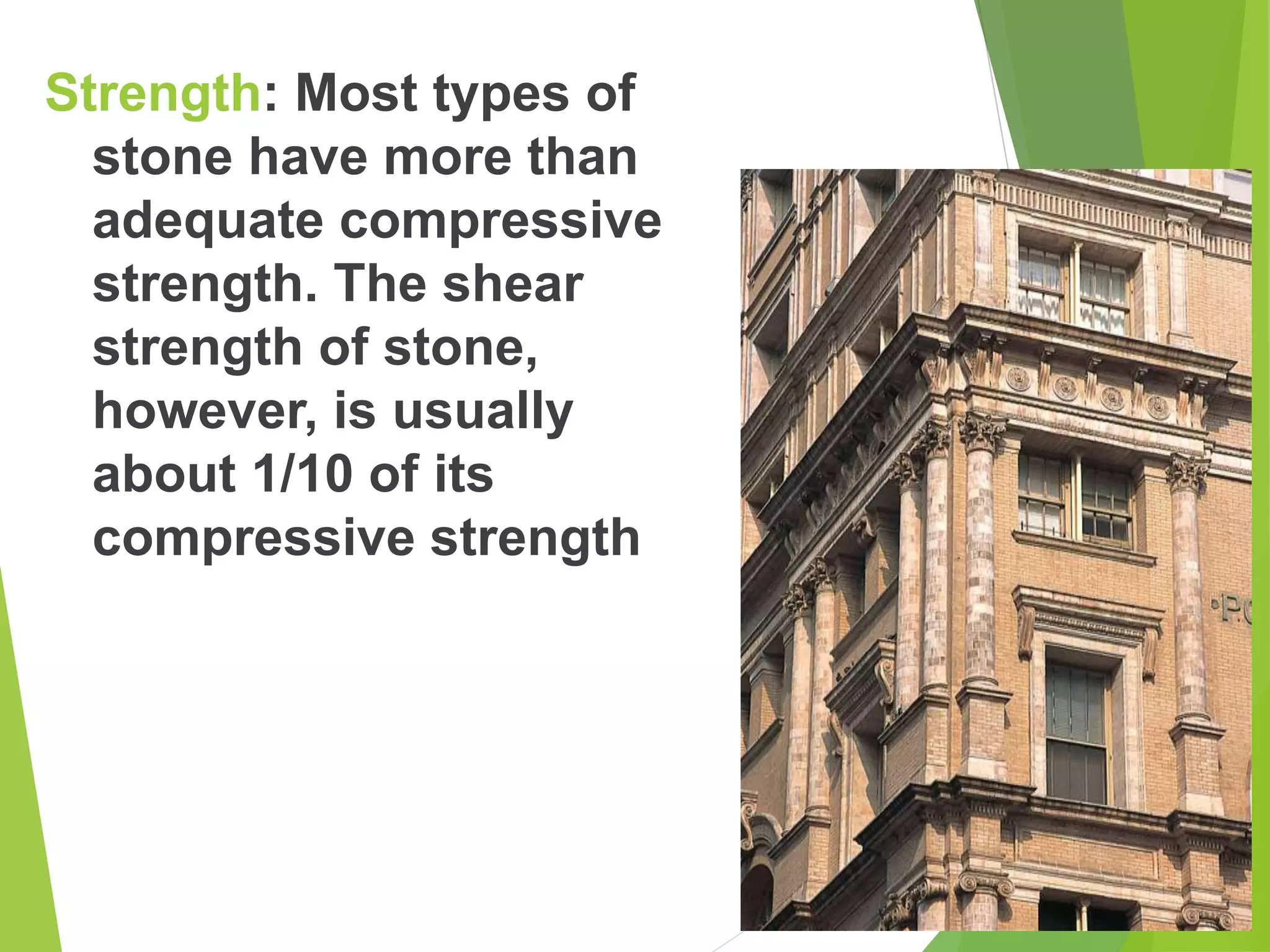
Strength: Most types of
stone have more than
adequate compressive
strength. The shear
strength of stone,
however, is usually
about 1/10 of its
compressive strength
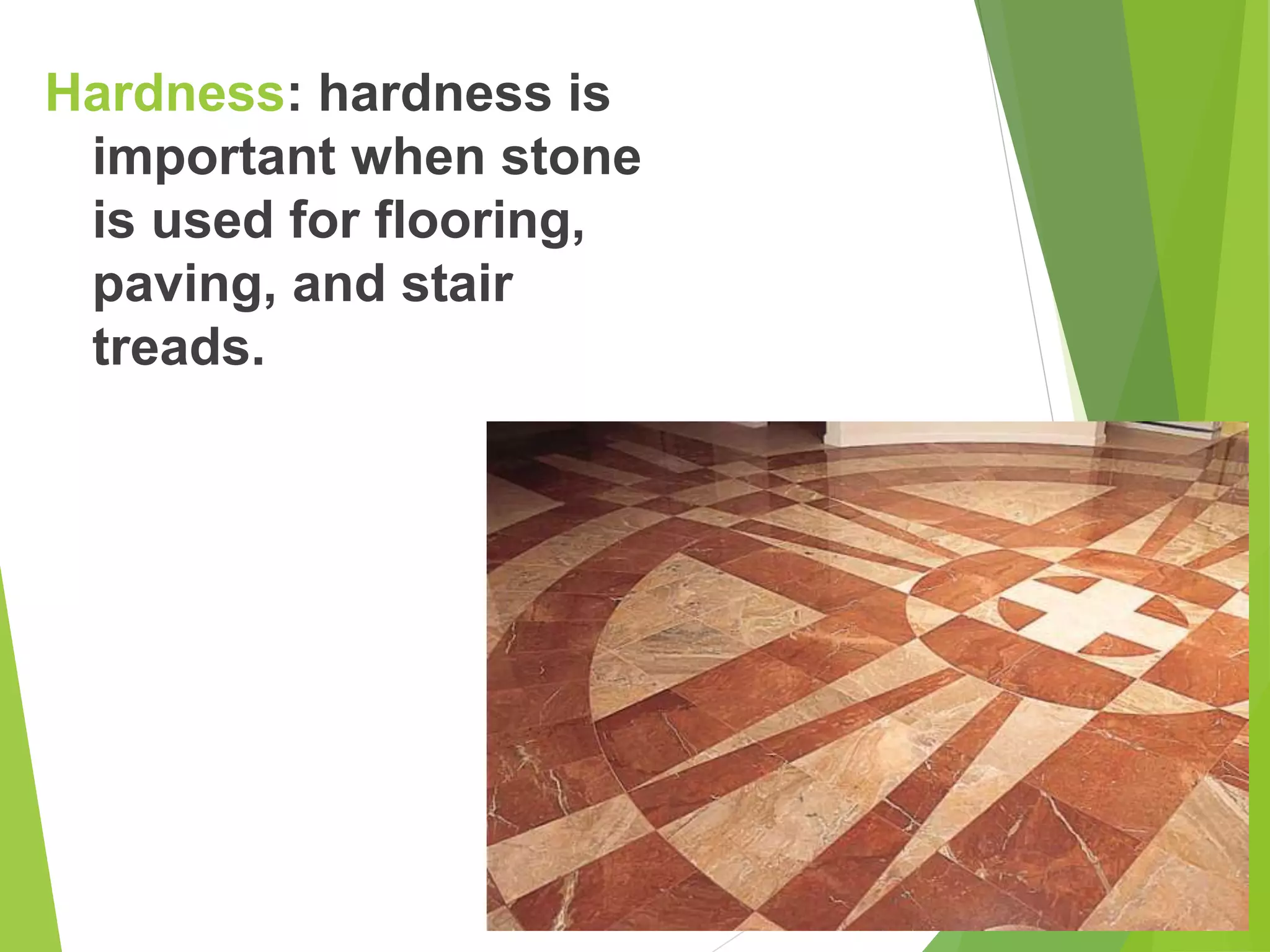
Hardness: hardness is
important when stone
is used for flooring,
paving, and stair
treads.
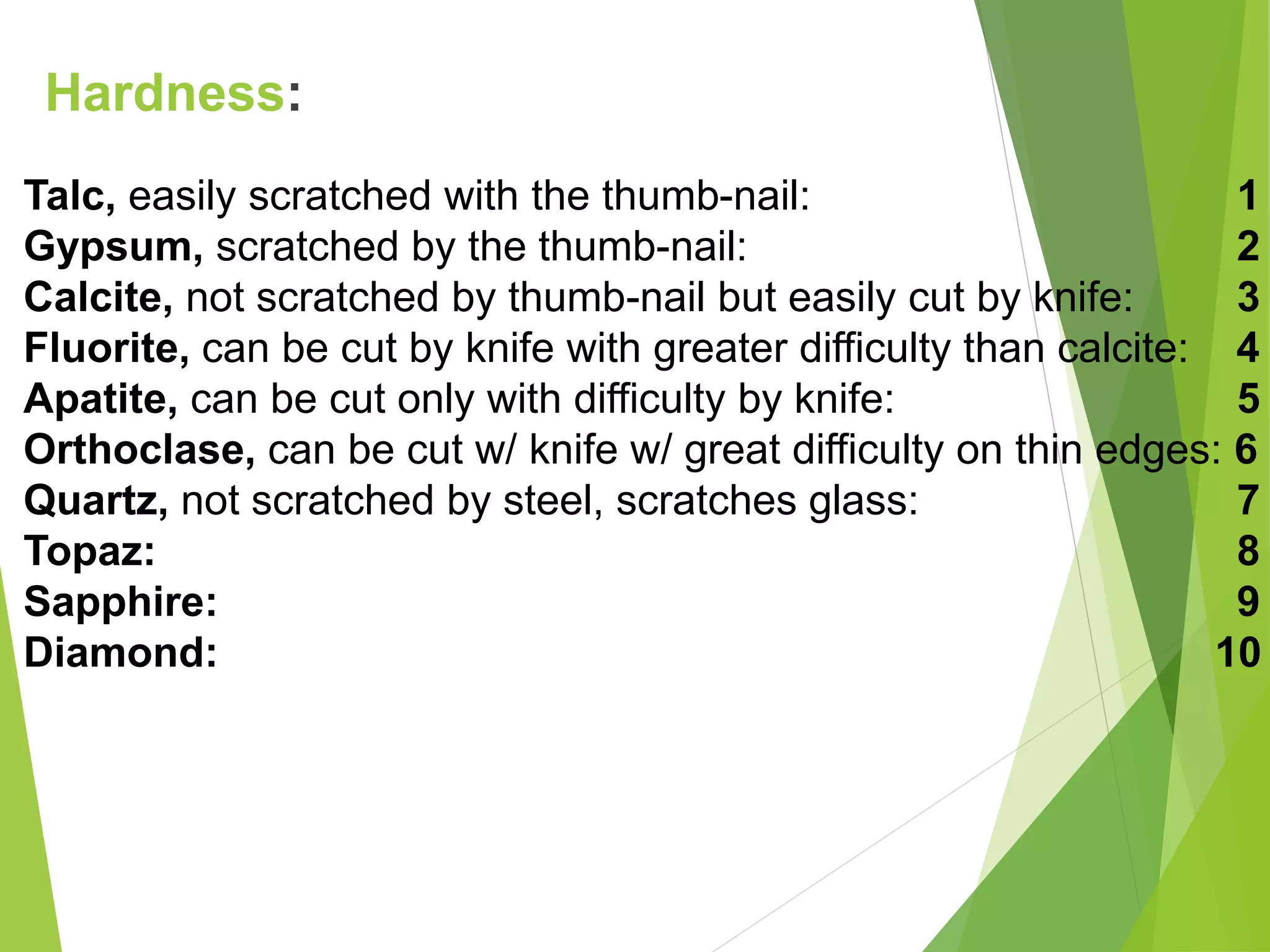
Hardness:
Talc, easily scratched with the thumb-nail: 1
Gypsum, scratched by the thumb-nail: 2
Calcite, not scratched by thumb-nail but easily cut by knife: 3
Fluorite, can be cut by knife with greater difficulty than calcite: 4
Apatite, can be cut only with difficulty by knife: 5
Orthoclase, can be cut w/ knife w/ great difficulty on thin edges: 6
Quartz, not scratched by steel, scratches glass: 7
Topaz: 8
Sapphire: 9
Diamond: 10
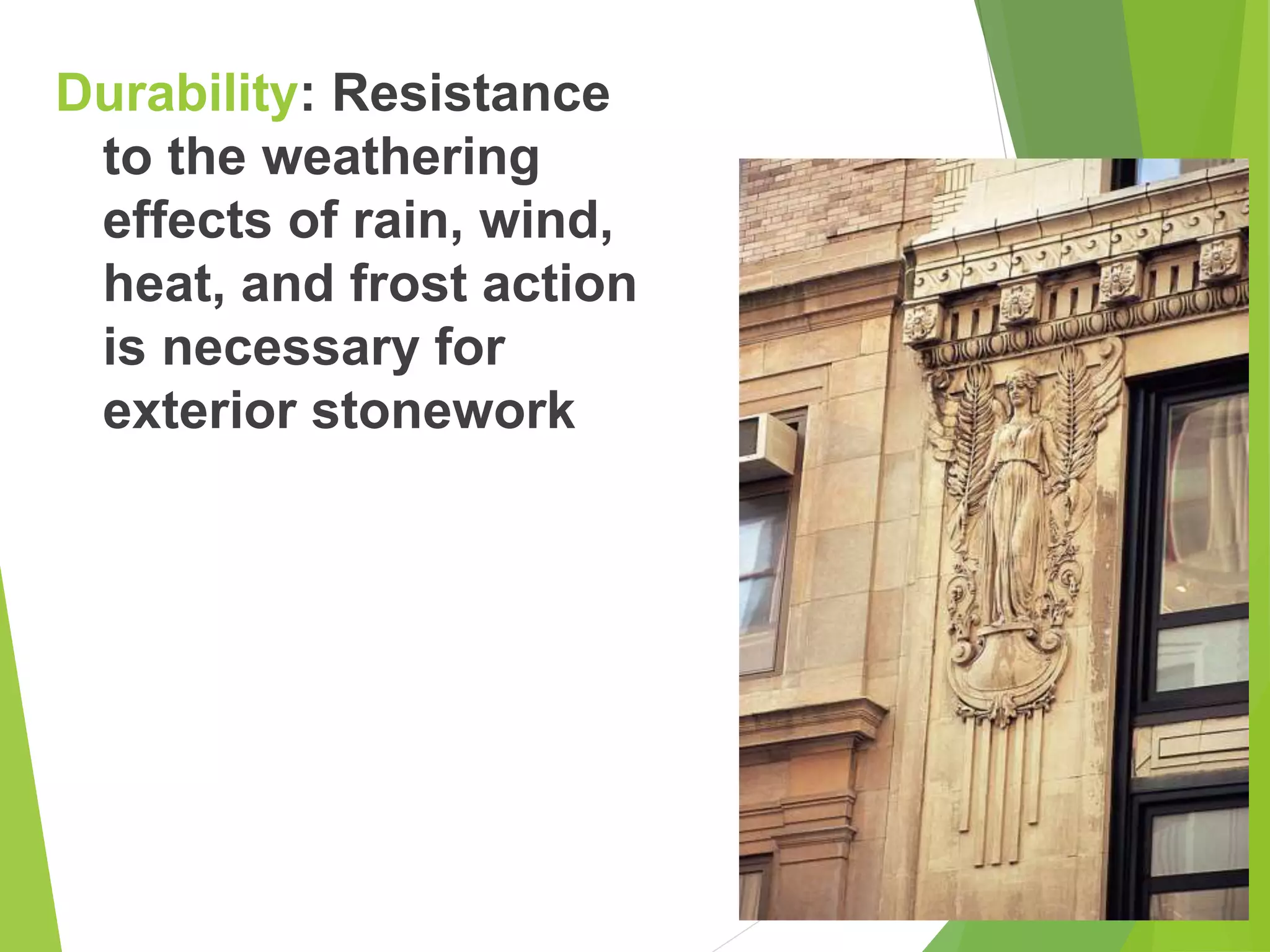
Durability: Resistance
to the weathering
effects of rain, wind,
heat, and frost action
is necessary for
exterior stonework
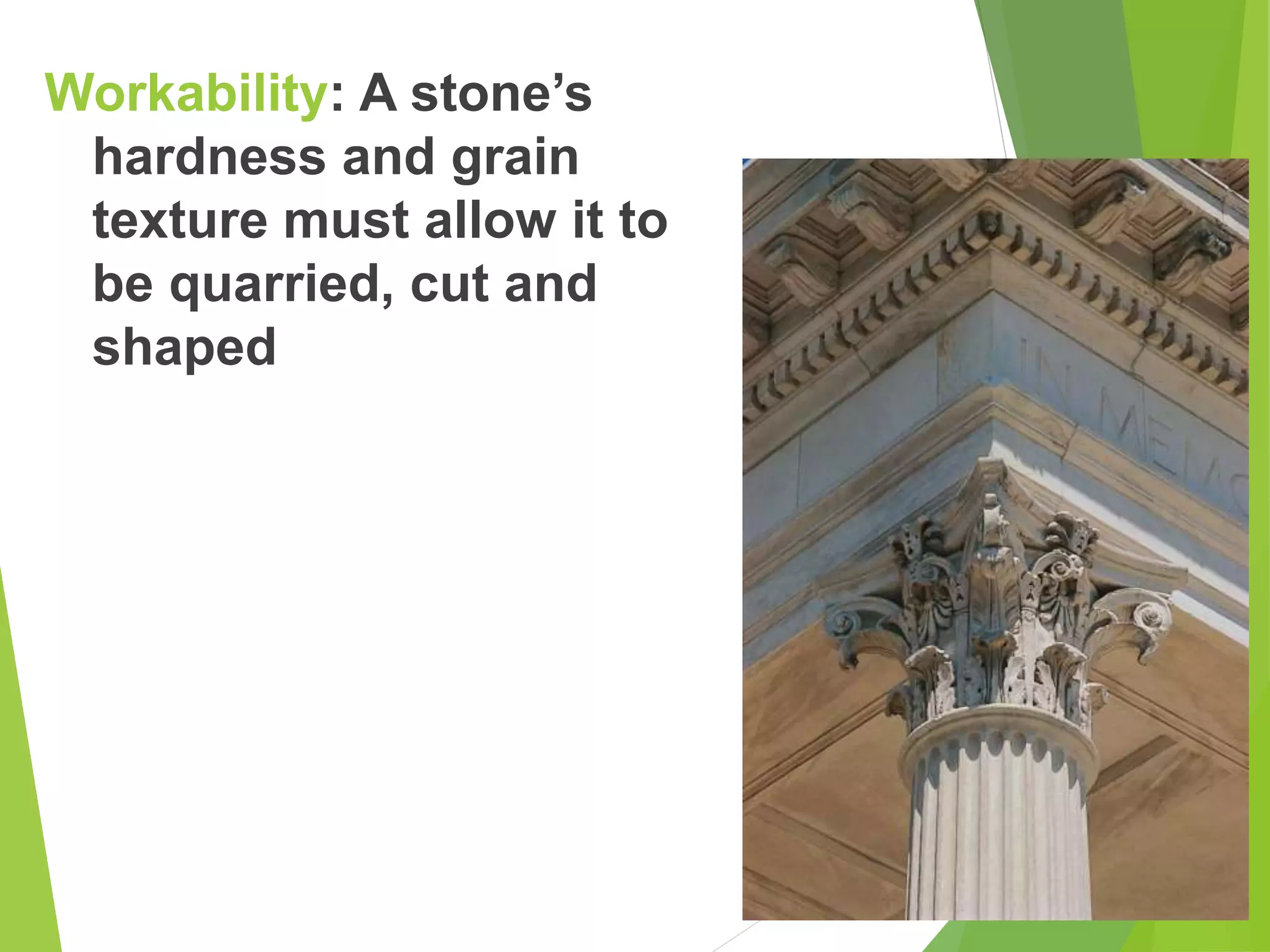
Workability: A stone’s
hardness and grain
texture must allow it to
be quarried, cut and
shaped
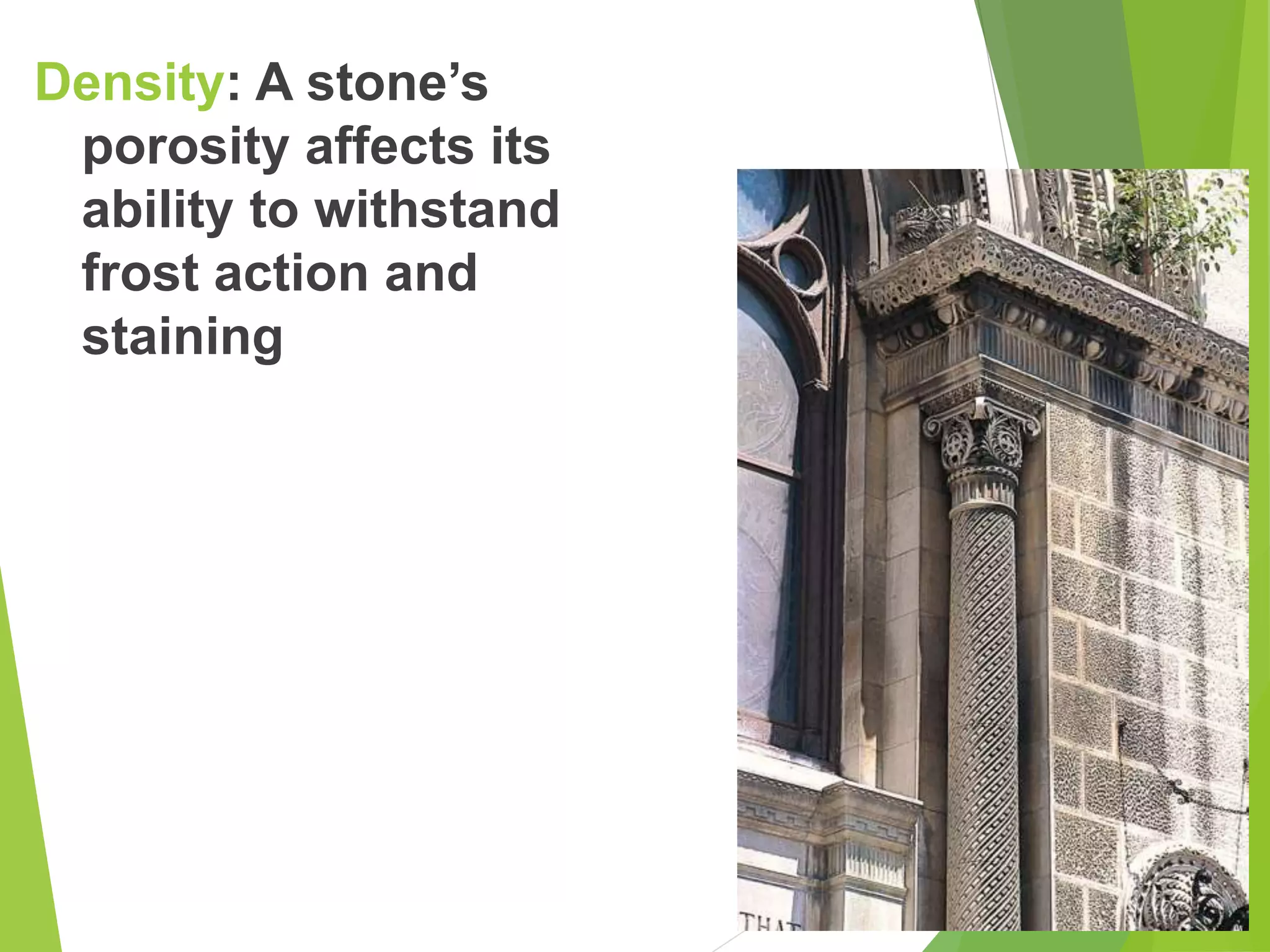
Density: A stone’s
porosity affects its
ability to withstand
frost action and
staining
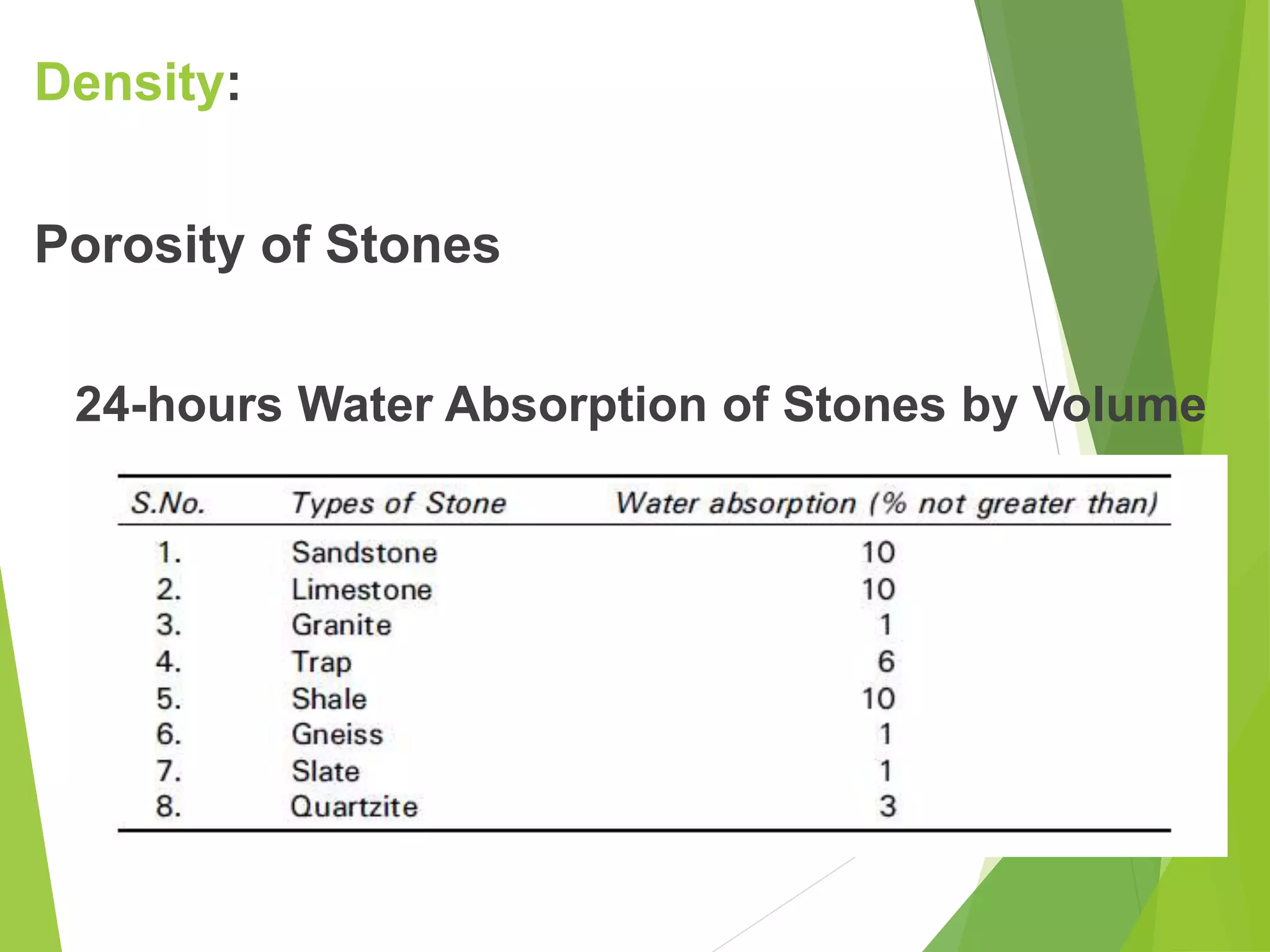
Density:
Porosity of Stones
24-hours Water Absorption of Stones by Volume
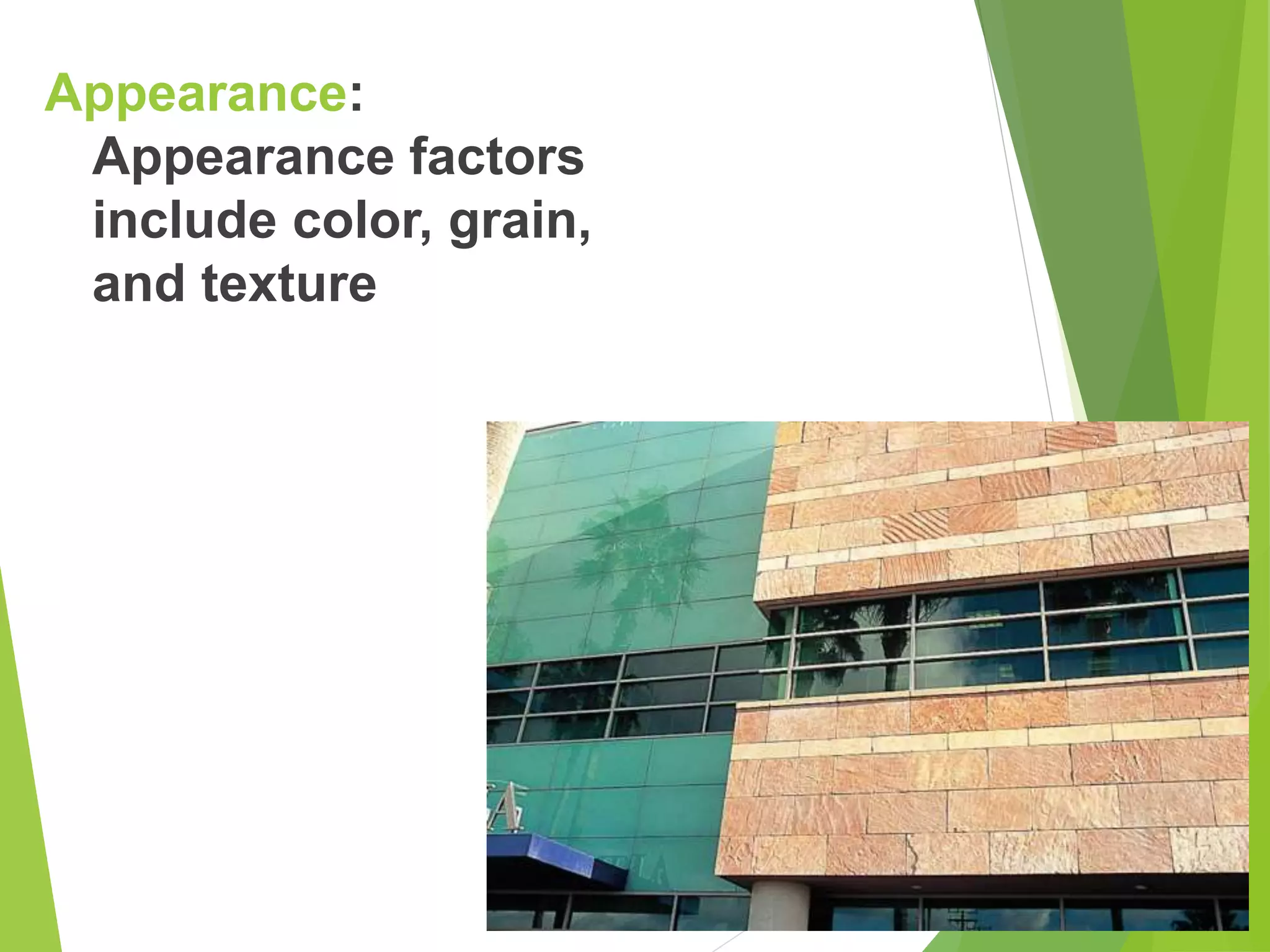
Appearance:
Appearance factors
include color, grain,
and texture
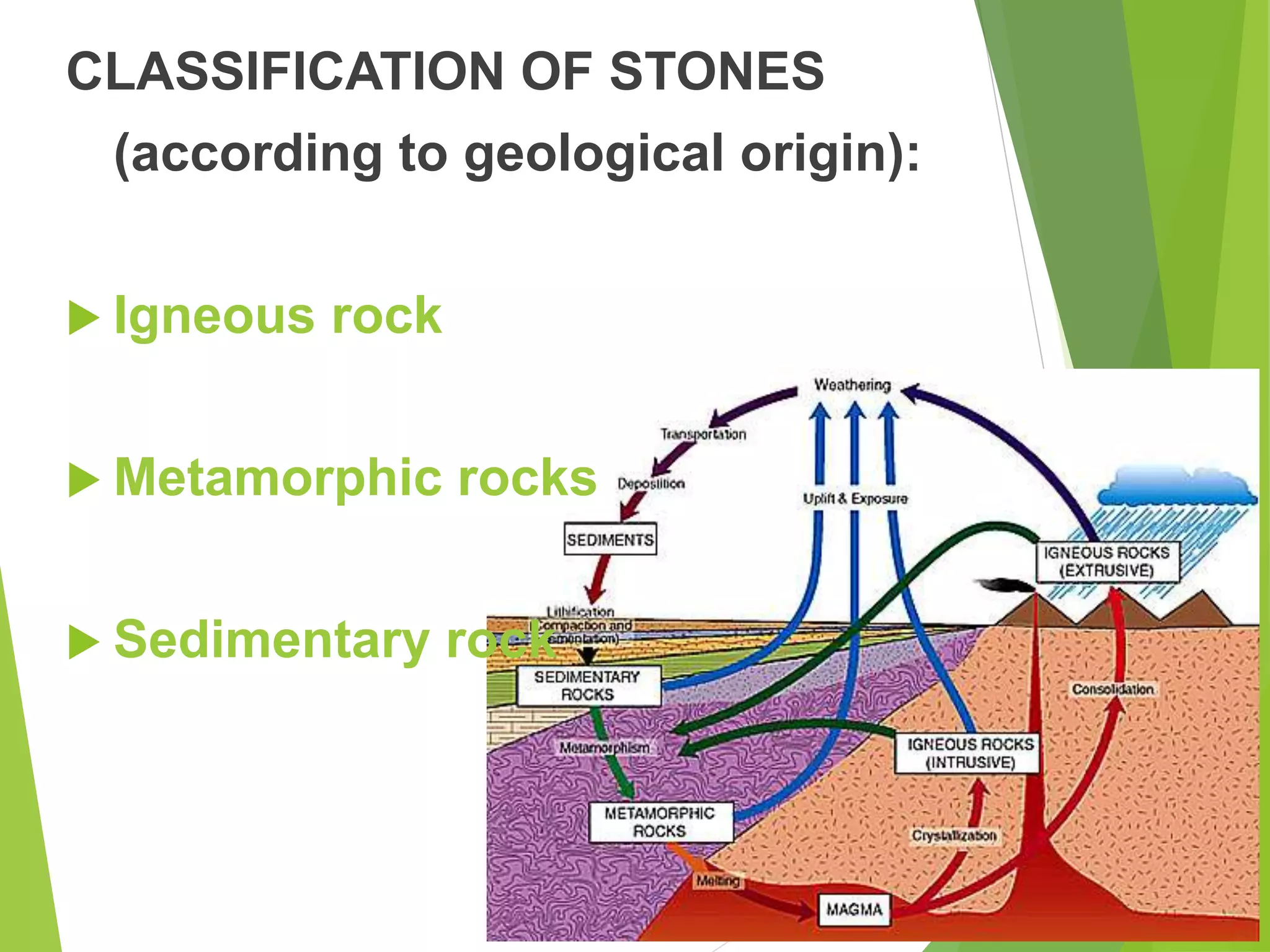
CLASSIFICATION OF STONES
(according to geological origin):
 Igneous rock
 Metamorphic rocks
 Sedimentary rock
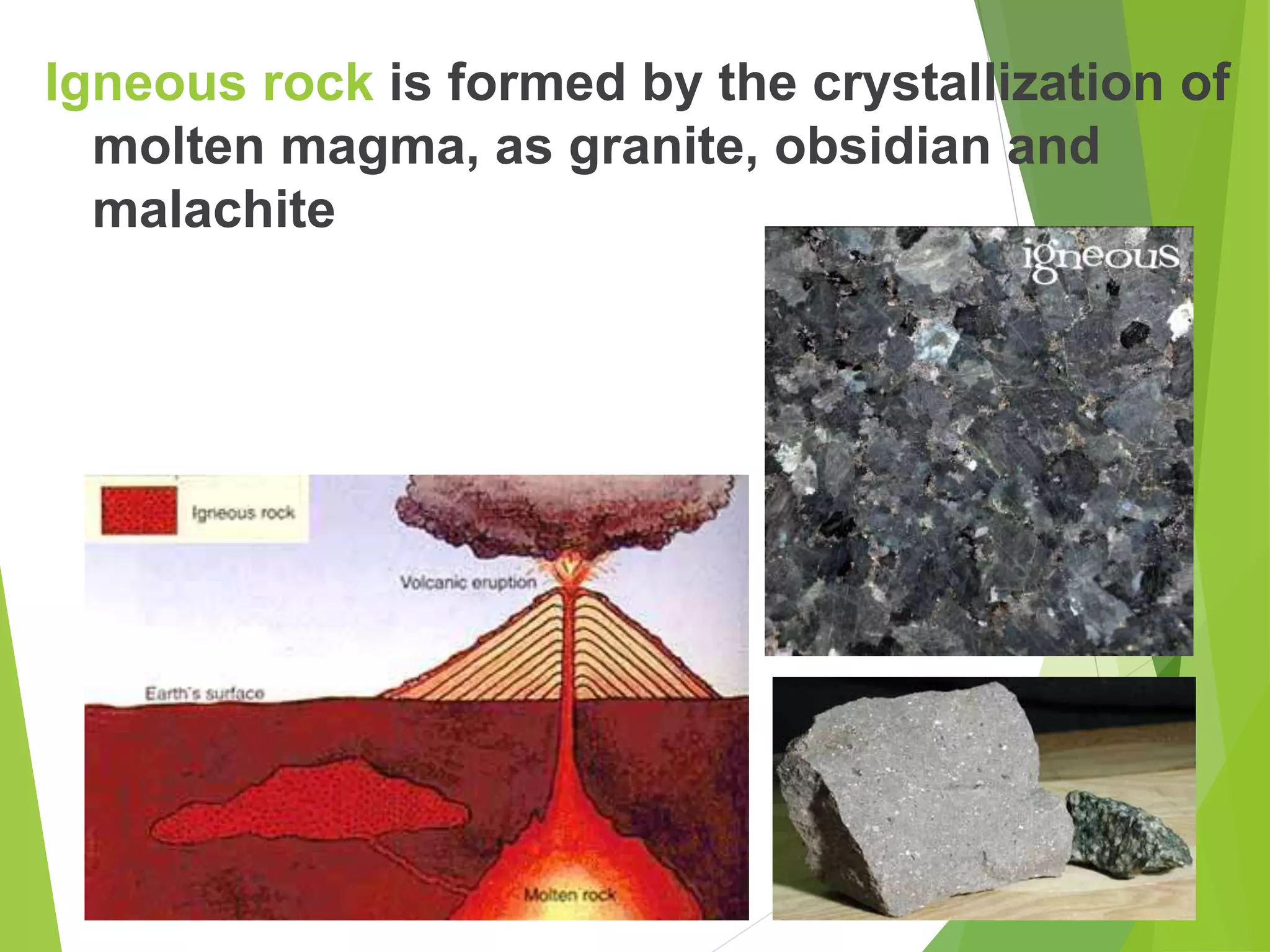
Igneous rock is formed by the crystallization of
molten magma, as granite, obsidian and
malachite
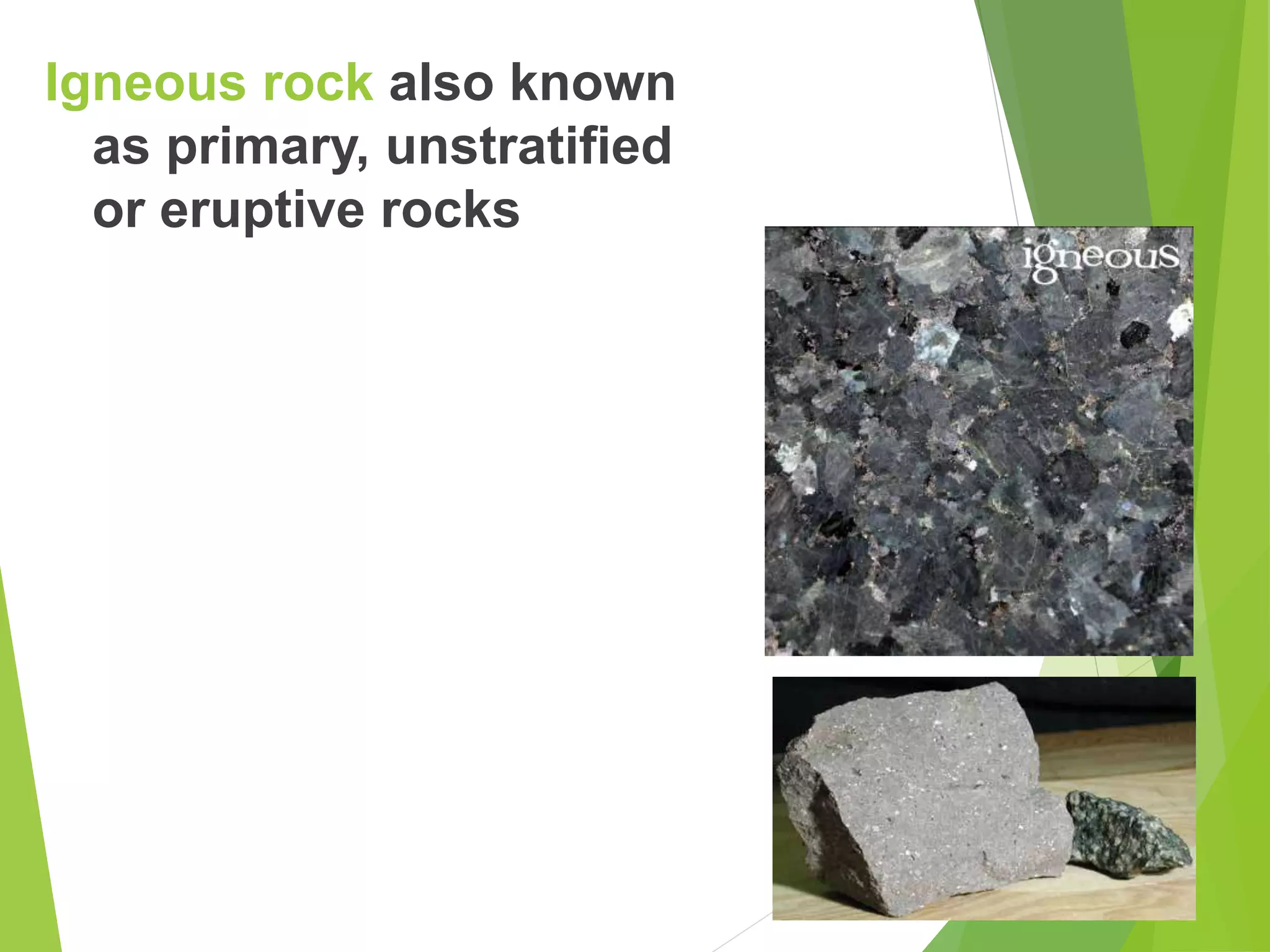
Igneous rock also known
as primary, unstratified
or eruptive rocks
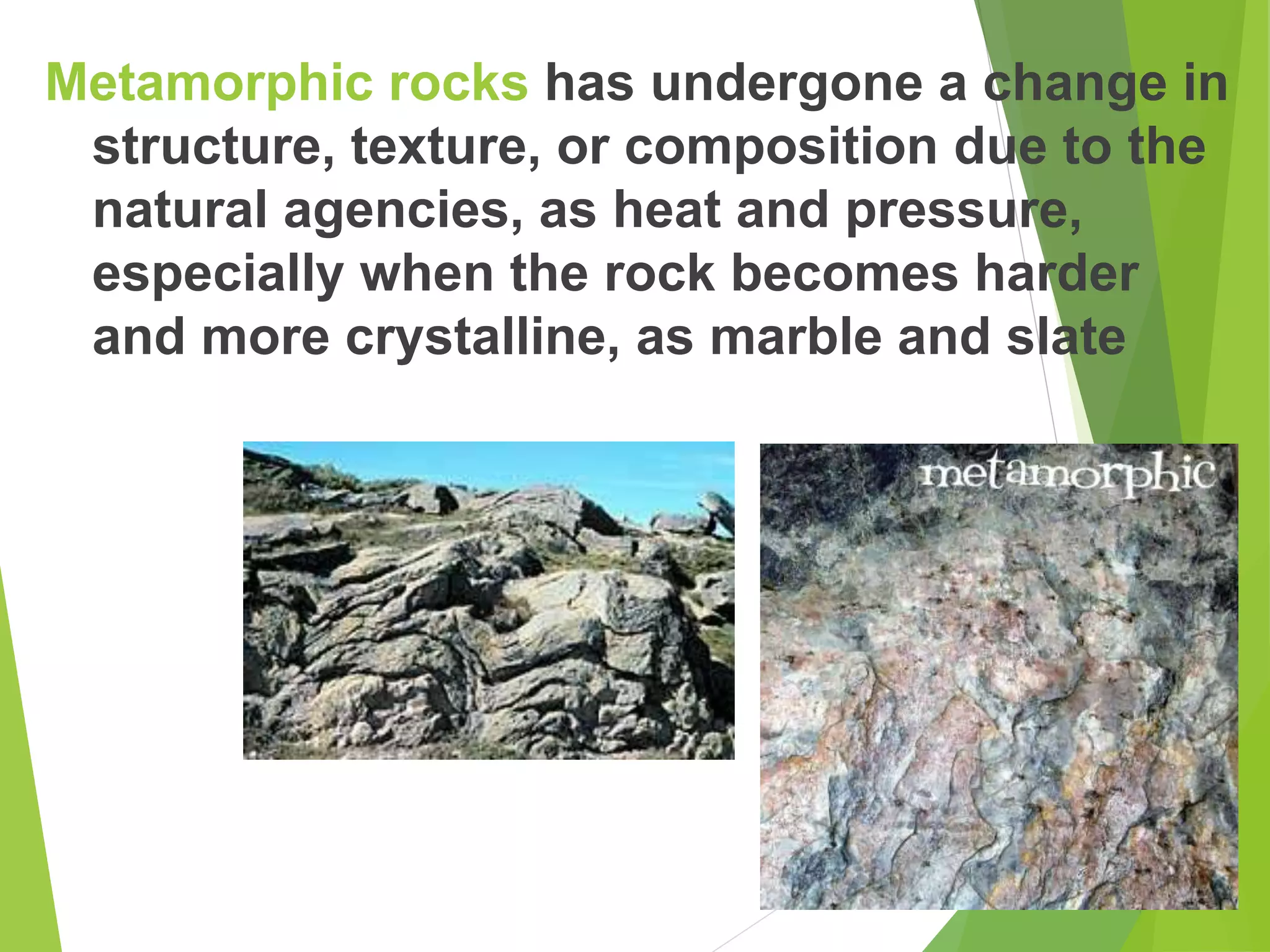
Metamorphic rocks has undergone a change in
structure, texture, or composition due to the
natural agencies, as heat and pressure,
especially when the rock becomes harder
and more crystalline, as marble and slate
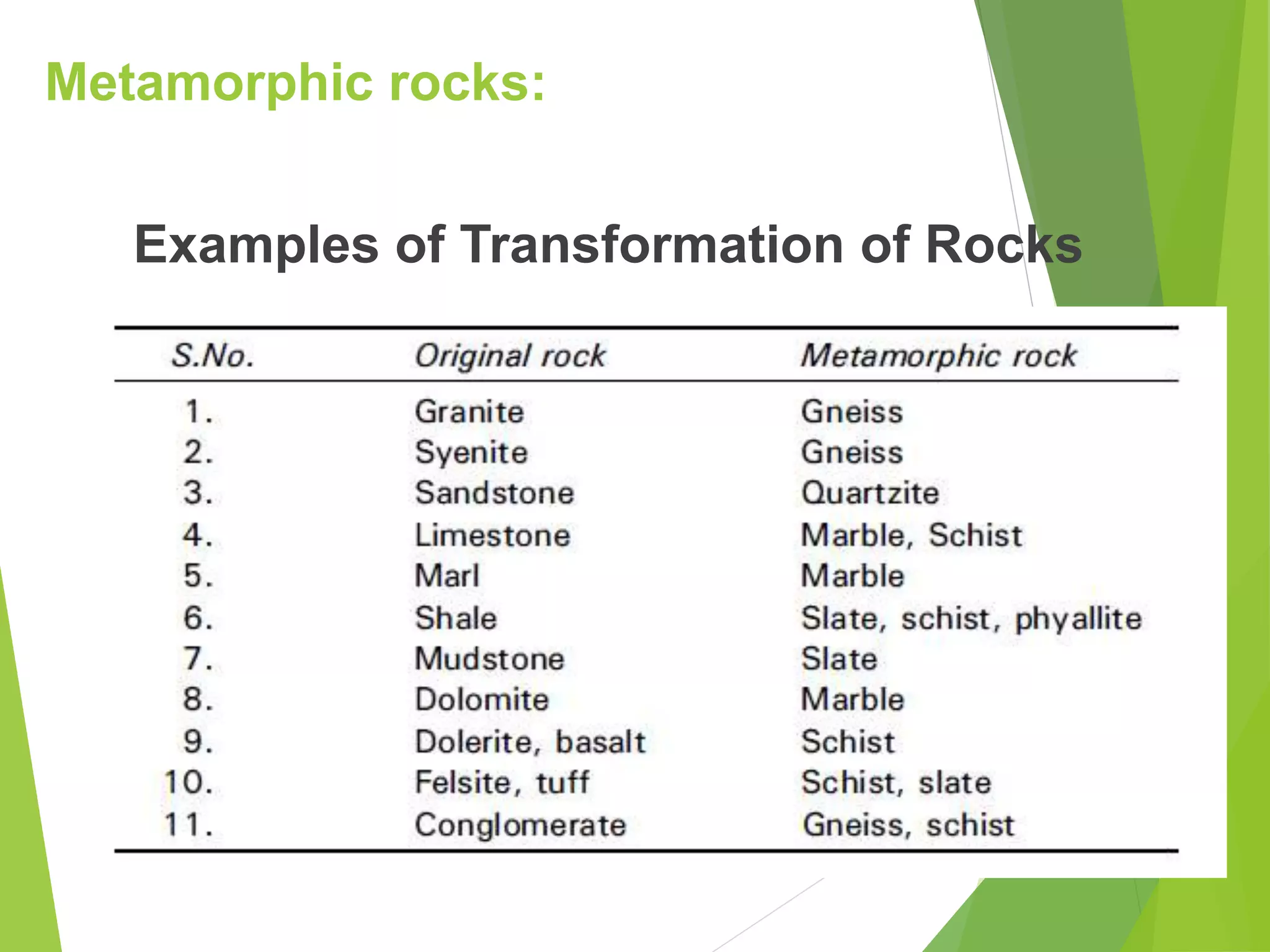
Metamorphic rocks:
Examples of Transformation of Rocks
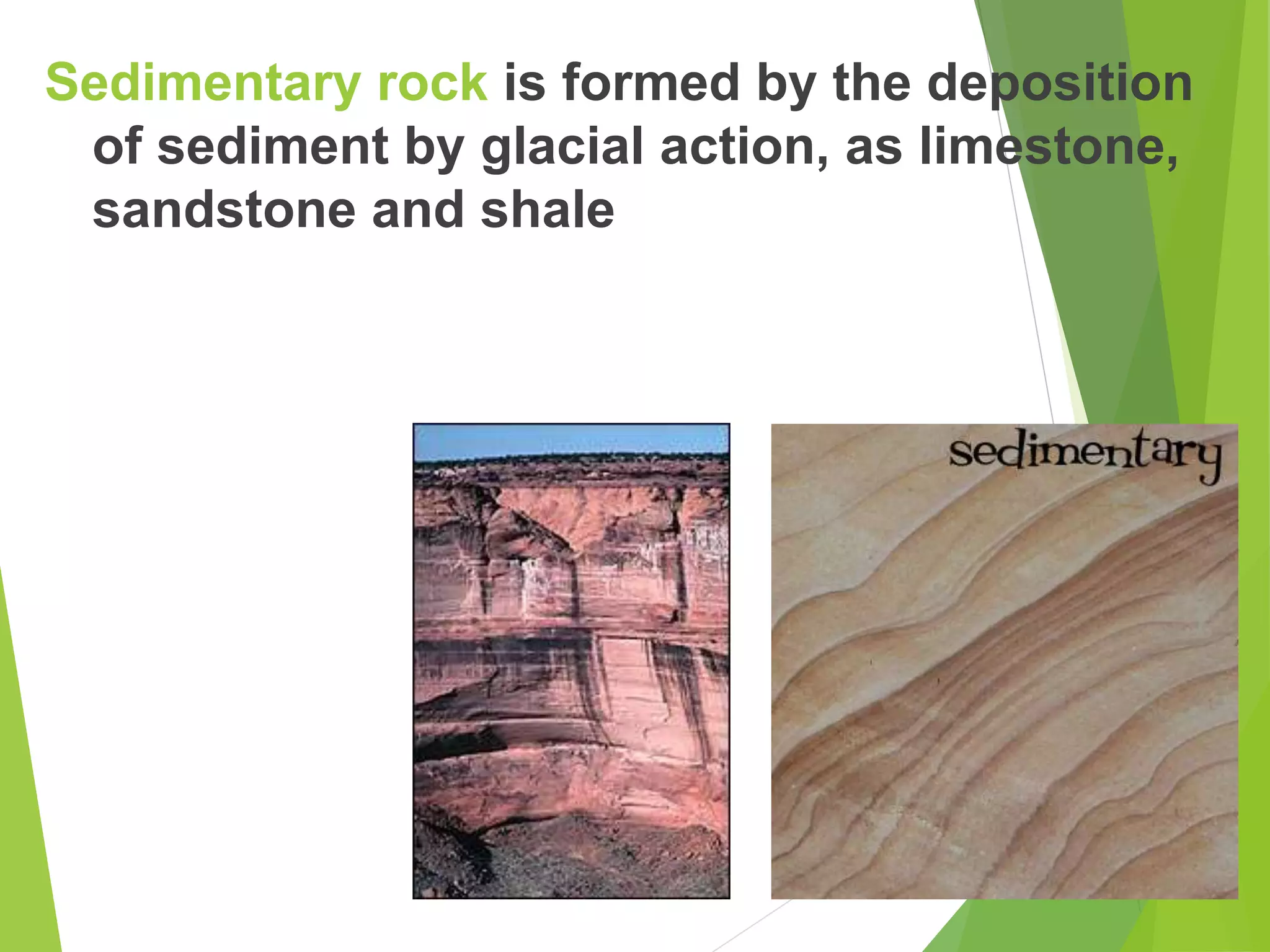
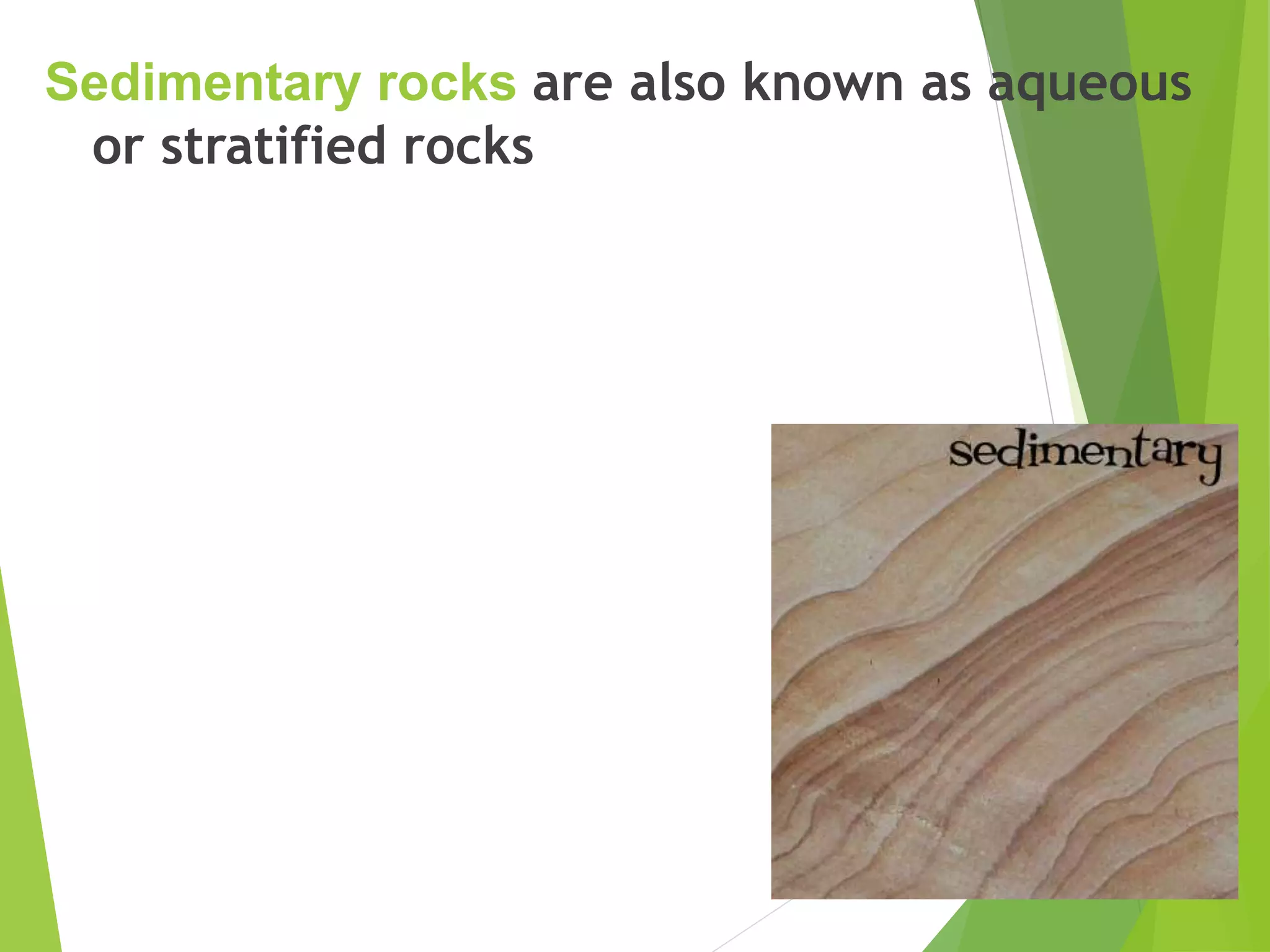
Sedimentary rock is formed by the deposition
of sediment by glacial action, as limestone,
sandstone and shale
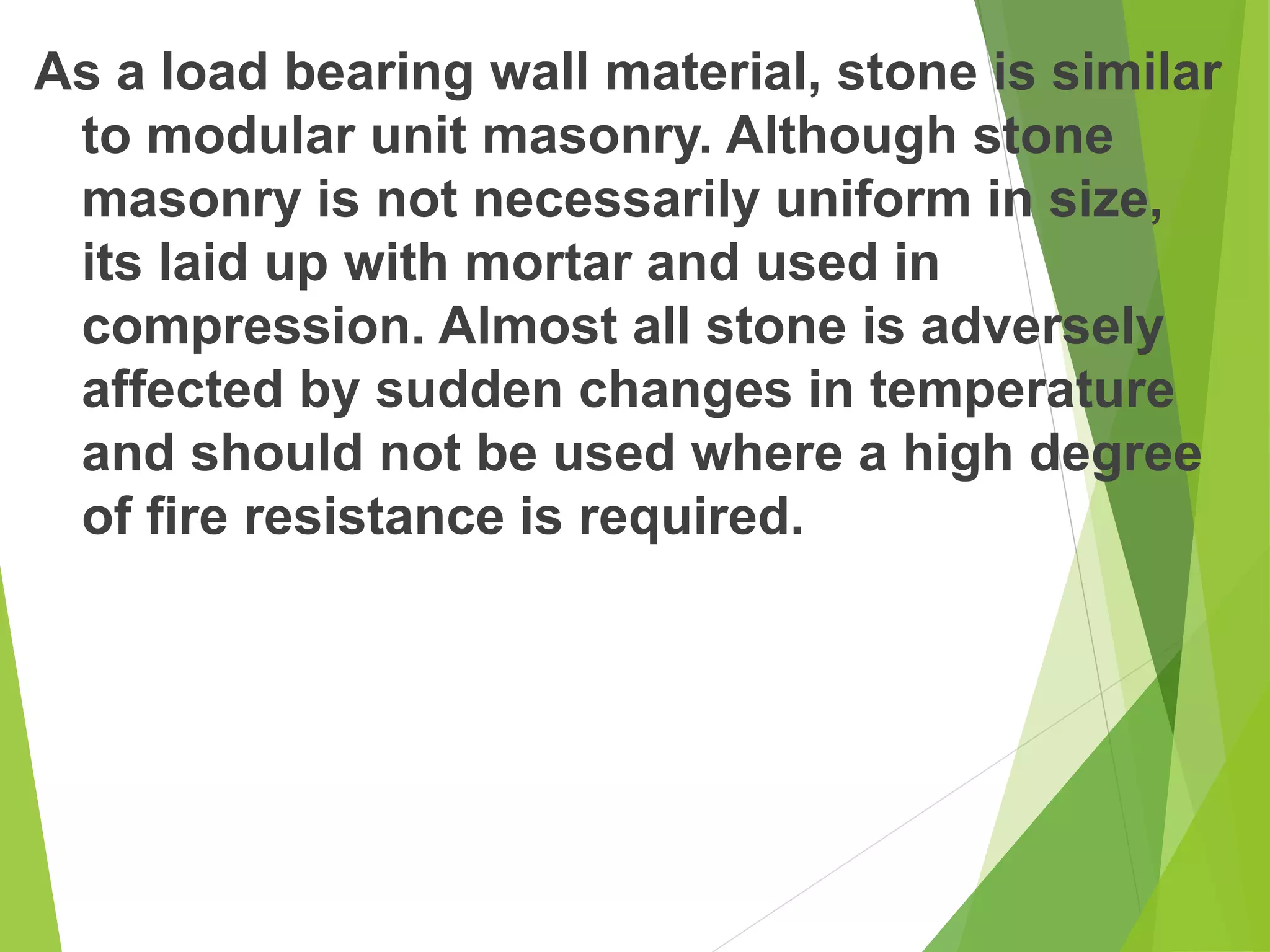
Sedimentary rocks are also known as aqueous
or stratified rocks
As a load bearing wall material, stone is similar
to modular unit masonry. Although stone
masonry is not necessarily uniform in size,
its laid up with mortar and used in
compression. Almost all stone is adversely
affected by sudden changes in temperature
and should not be used where a high degree
of fire resistance is required.
Stone is used in construction in the following
forms:
 Rubble
 Dimension stone
 Flagstone
 Crushed stone
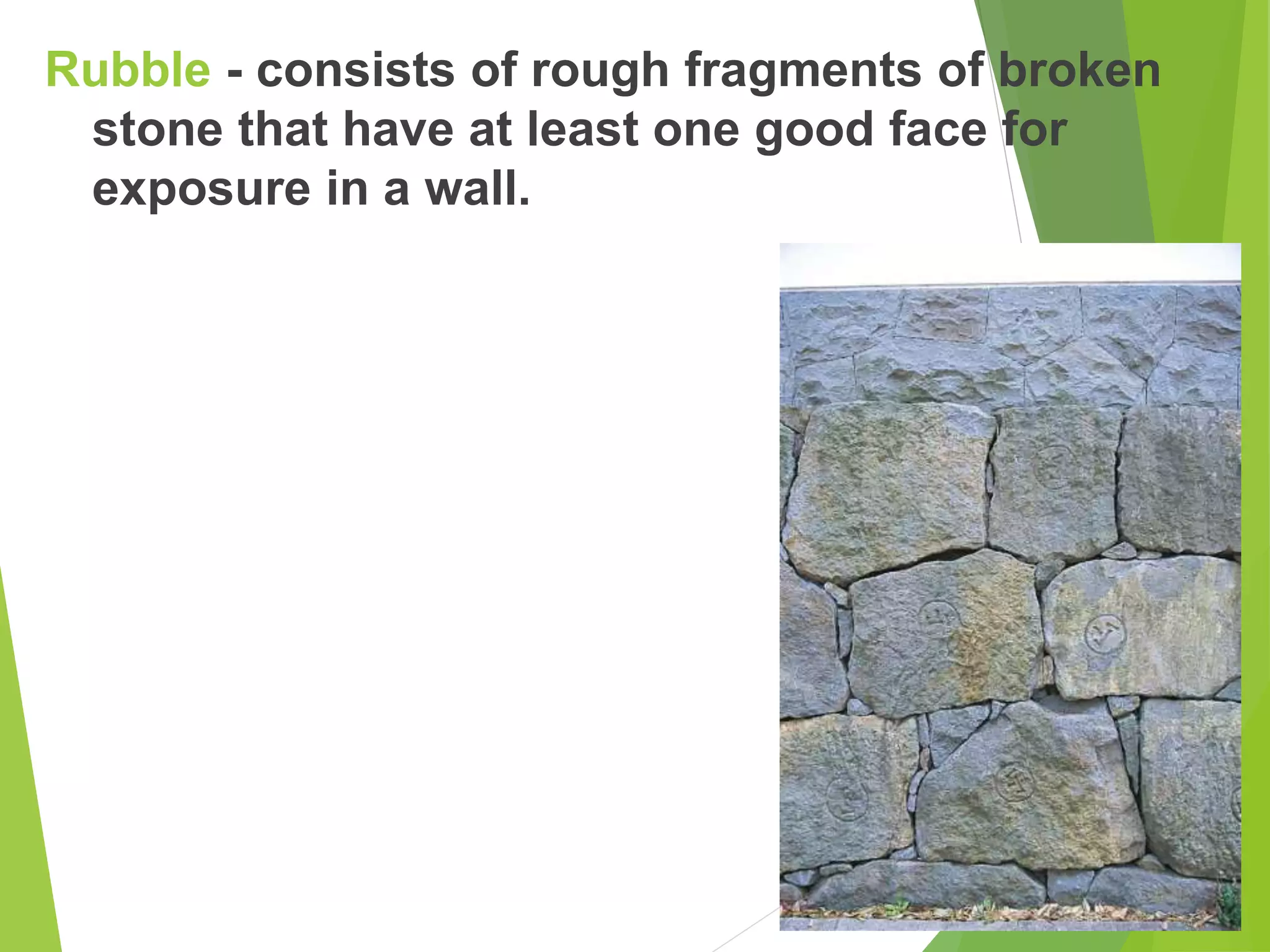
Rubble - consists of rough fragments of broken
stone that have at least one good face for
exposure in a wall.
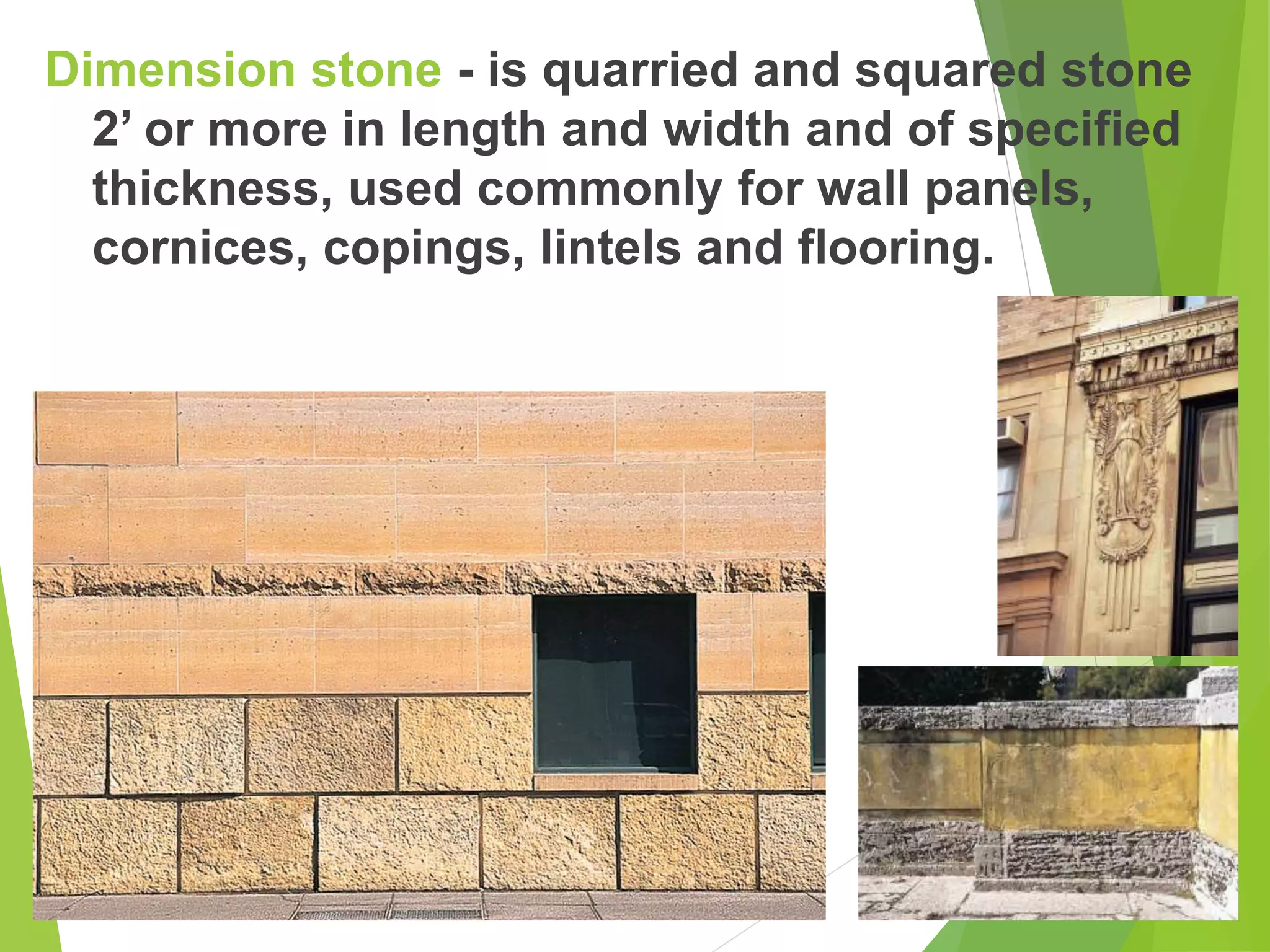
Dimension stone - is quarried and squared stone
2’ or more in length and width and of specified
thickness, used commonly for wall panels,
cornices, copings, lintels and flooring.
Flagstone - refers to flat stone slabs used for
flooring and horizontal surfacing.
Crushed stone - is used as aggregate in concrete
products.
TYPES OF BUILDING STONES
Argillite – formed from
clay, dark blue with faint
shades of green.
Used for:
floor tile
stair threads
coping stones
interior wall base
interior window
stools of exterior
window sills.
TYPES OF BUILDING STONES
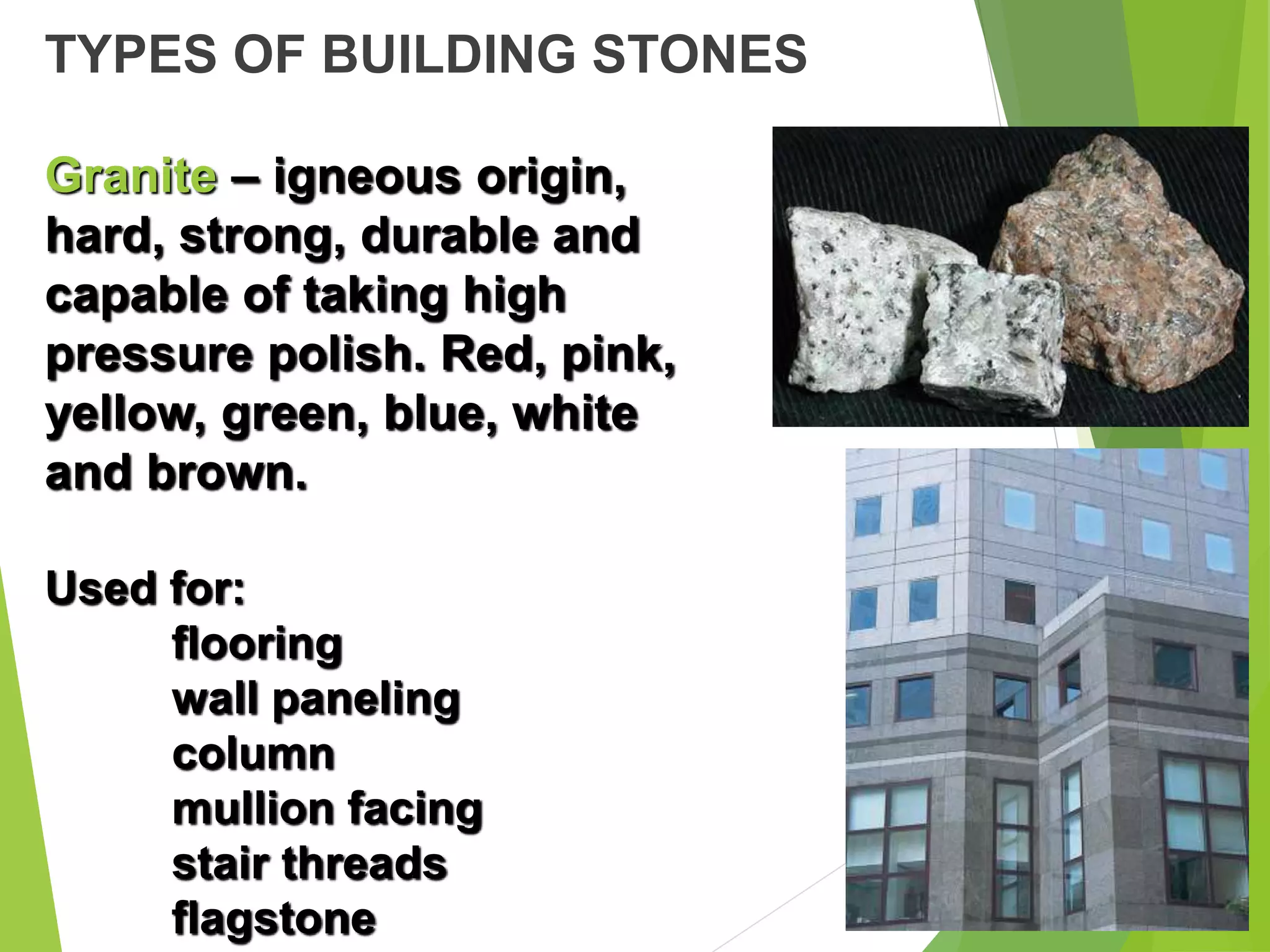
Granite – igneous origin,
hard, strong, durable and
capable of taking high
pressure polish. Red, pink,
yellow, green, blue, white
and brown.
Used for:
flooring
wall paneling
column
mullion facing
stair threads
flagstone
TYPES OF BUILDING STONES
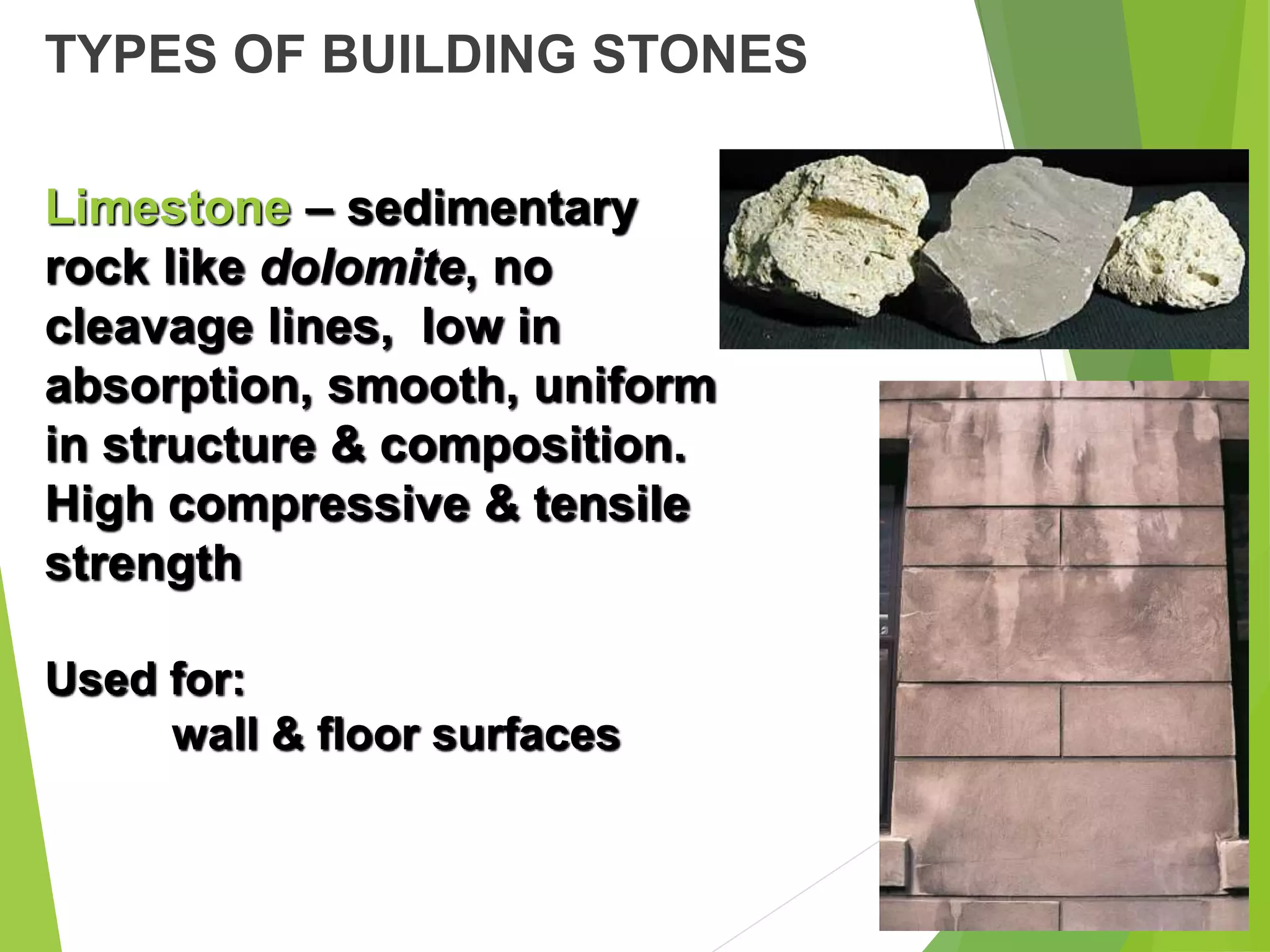
Limestone – sedimentary
rock like dolomite, no
cleavage lines, low in
absorption, smooth, uniform
in structure & composition.
High compressive & tensile
strength
Used for:
wall & floor surfaces
TYPES OF BUILDING STONES
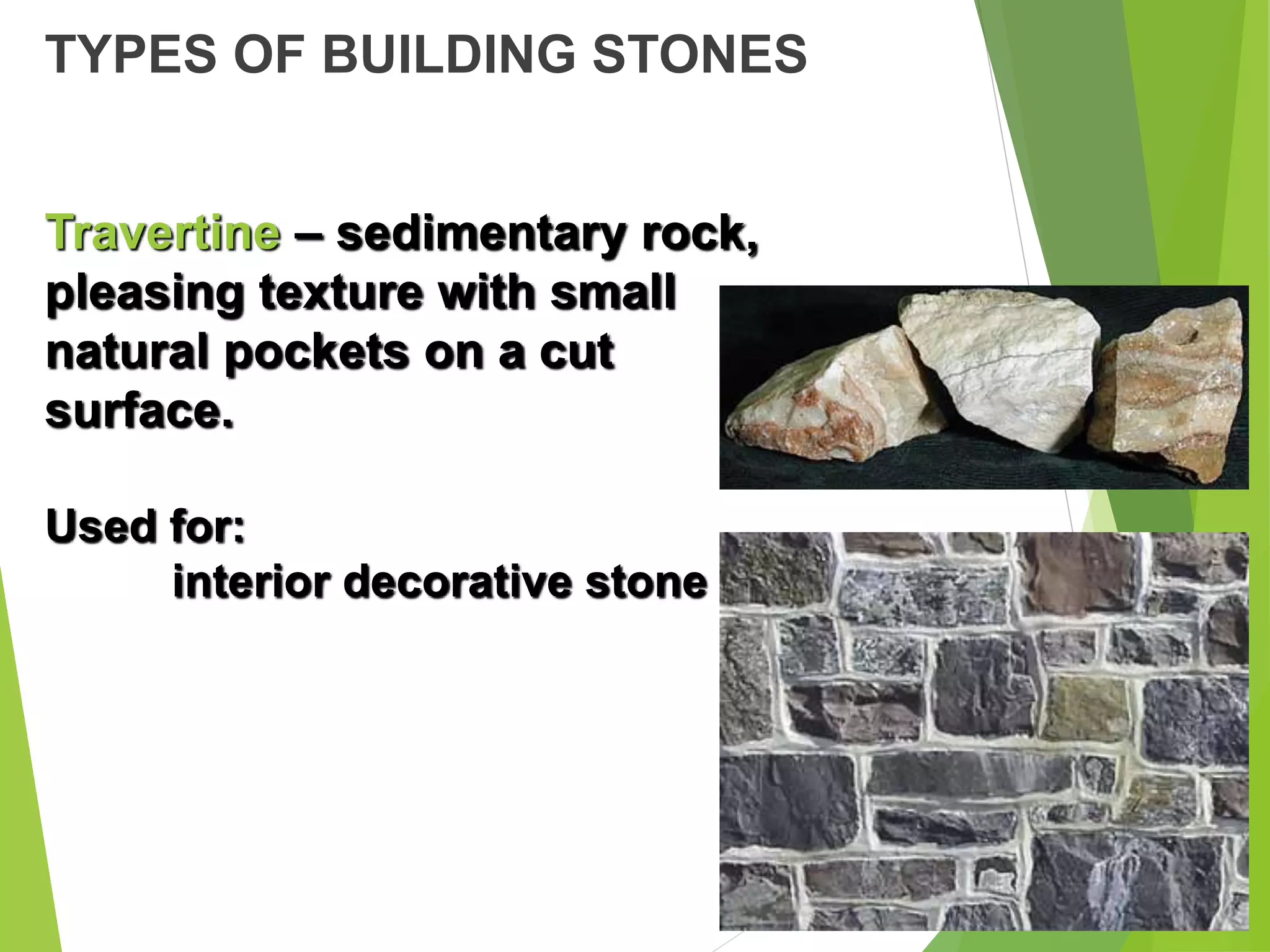
Travertine – sedimentary rock,
pleasing texture with small
natural pockets on a cut
surface.
Used for:
interior decorative stone
TYPES OF BUILDING STONES
Marble – metamorphic rock, a
re crystallized limestone
forming into carrara, parian,
onyx and vermont.
Used for:
flooring
wall & column facing
TYPES OF BUILDING STONES
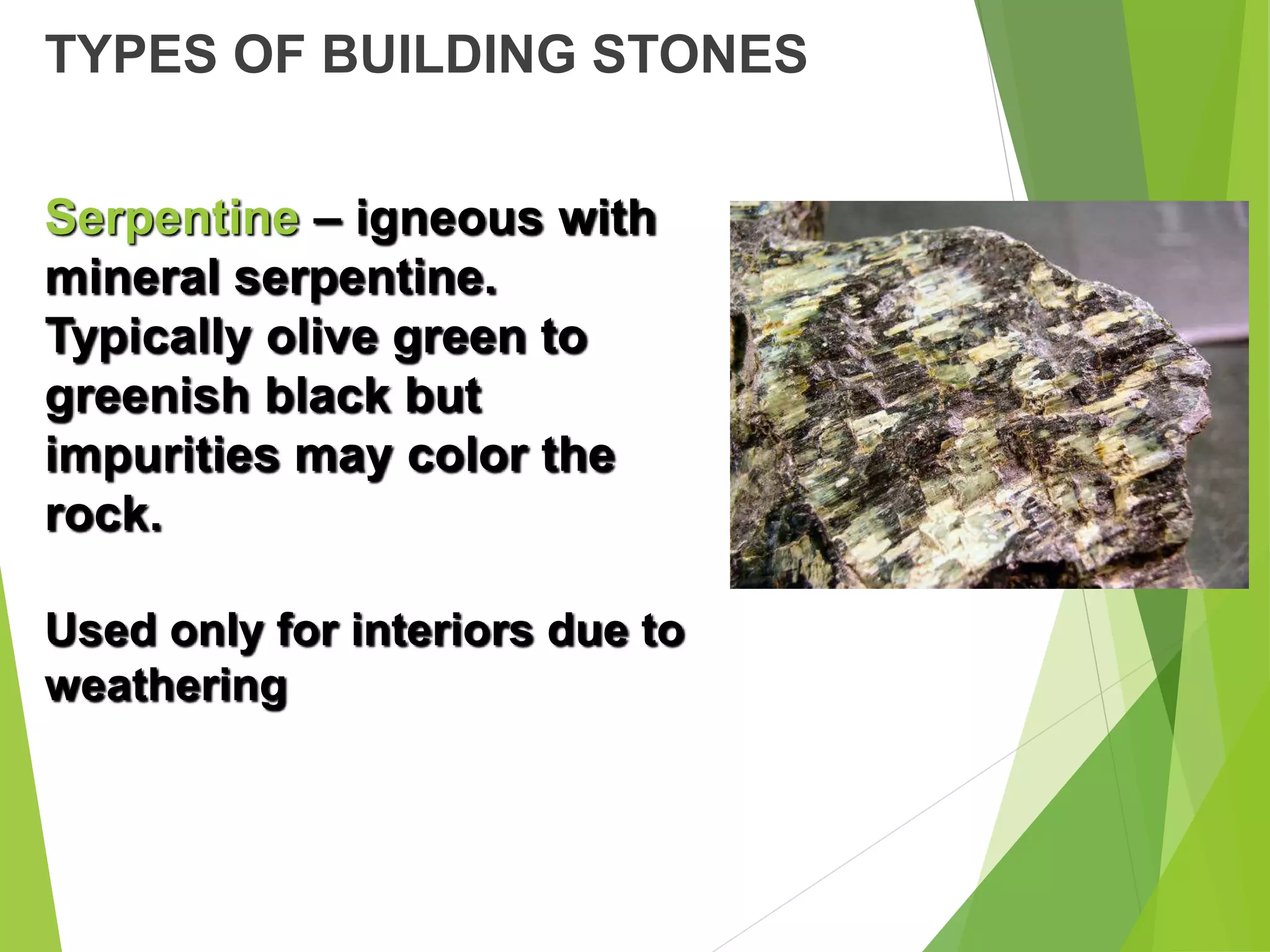
Serpentine – igneous with
mineral serpentine.
Typically olive green to
greenish black but
impurities may color the
rock.
Used only for interiors due to
weathering
TYPES OF BUILDING STONES
Sandstone – class of
rock of cemented silica
grains with texture
ranging from very fine
to very coarse. Colors
vary from buff, red and
light brown. Porous
where as 30% of
volume composed of
pores
TYPES OF BUILDING STONES
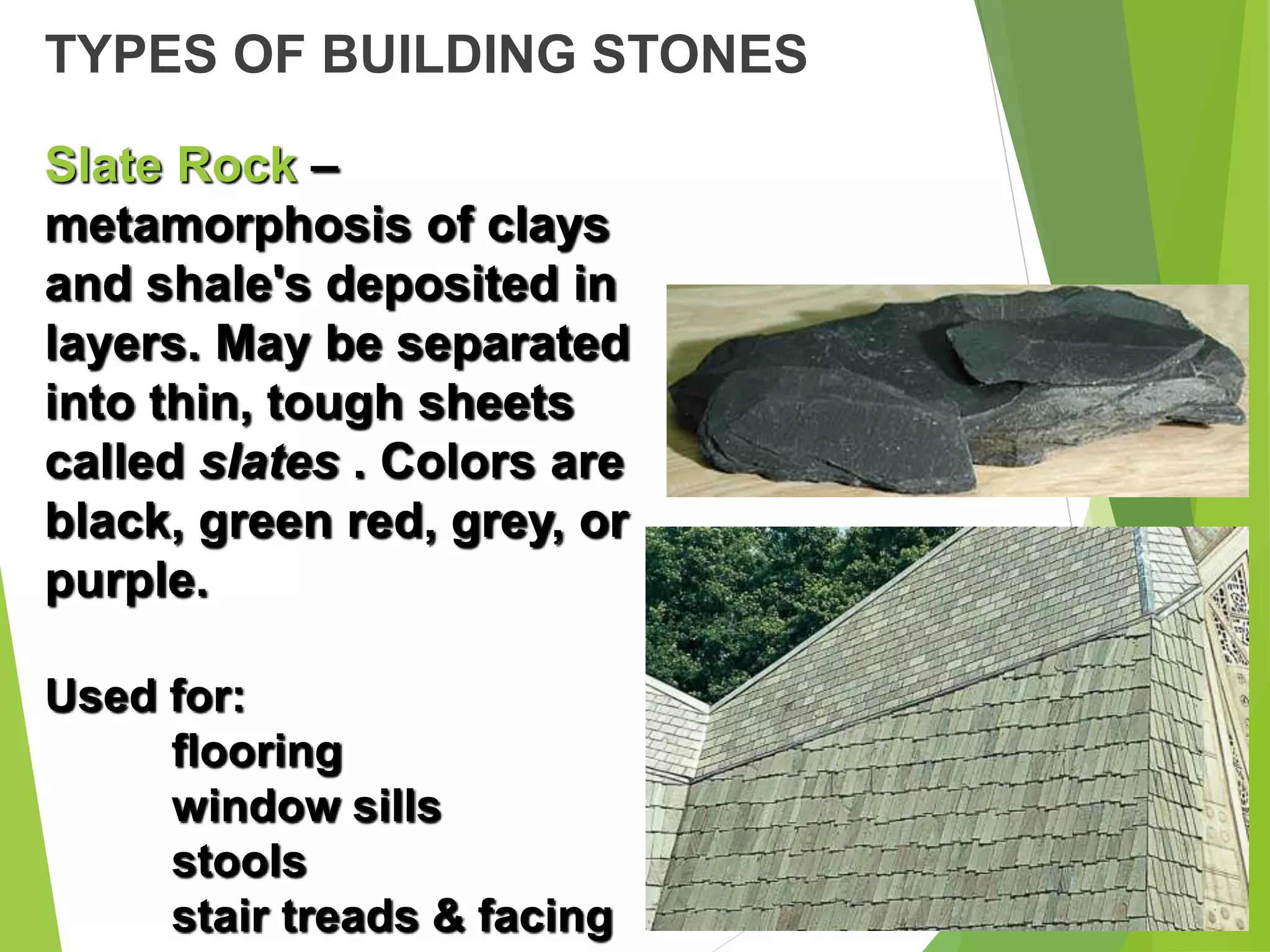
Slate Rock –
metamorphosis of clays
and shale's deposited in
layers. May be separated
into thin, tough sheets
called slates . Colors are
black, green red, grey, or
purple.
Used for:
flooring
window sills
stools
stair treads & facing
STONE CONSTRUCTION
Largely used as facing for building material with steel and
concrete frames.
Application Categories :
1. Paneling
2. Ashlars
3. Rubblework
4. Trim
 Running Bond - a
masonry bond formed
when all units are laid in
stretcher position, with
a half-unit overlap
Paneling – thin slabs of stone cut to dimension
and thickness to cover back up walls and
provide finished exterior
 Stack Bond - a masonry
bond formed when there
is no overlapping of all
units and all horizontal
& vertical joints are
aligned
Paneling – thin slabs of stone cut to dimension
and thickness to cover back up walls and
provide finished exterior
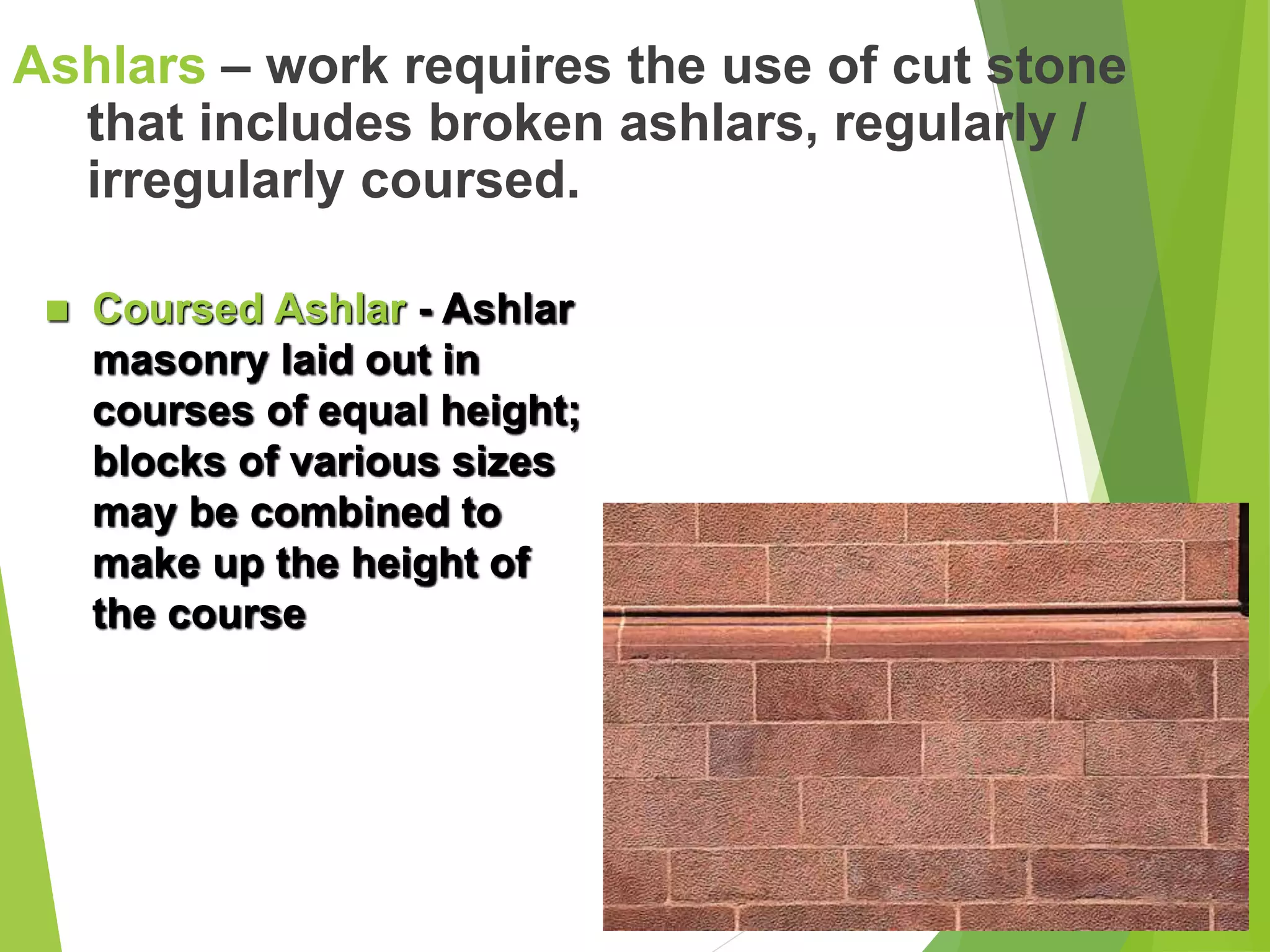
Ashlars – work requires the use of cut stone
that includes broken ashlars, regularly /
irregularly coursed.
 Coursed Ashlar - Ashlar
masonry laid out in
courses of equal height;
blocks of various sizes
may be combined to
make up the height of
the course
Ashlars – work requires the use of cut stone
that includes broken ashlars, regularly /
irregularly coursed.
 Random Ashlar - Ashlar
masonry laid without
regular courses but with
an overall effect of
horizontal orientation
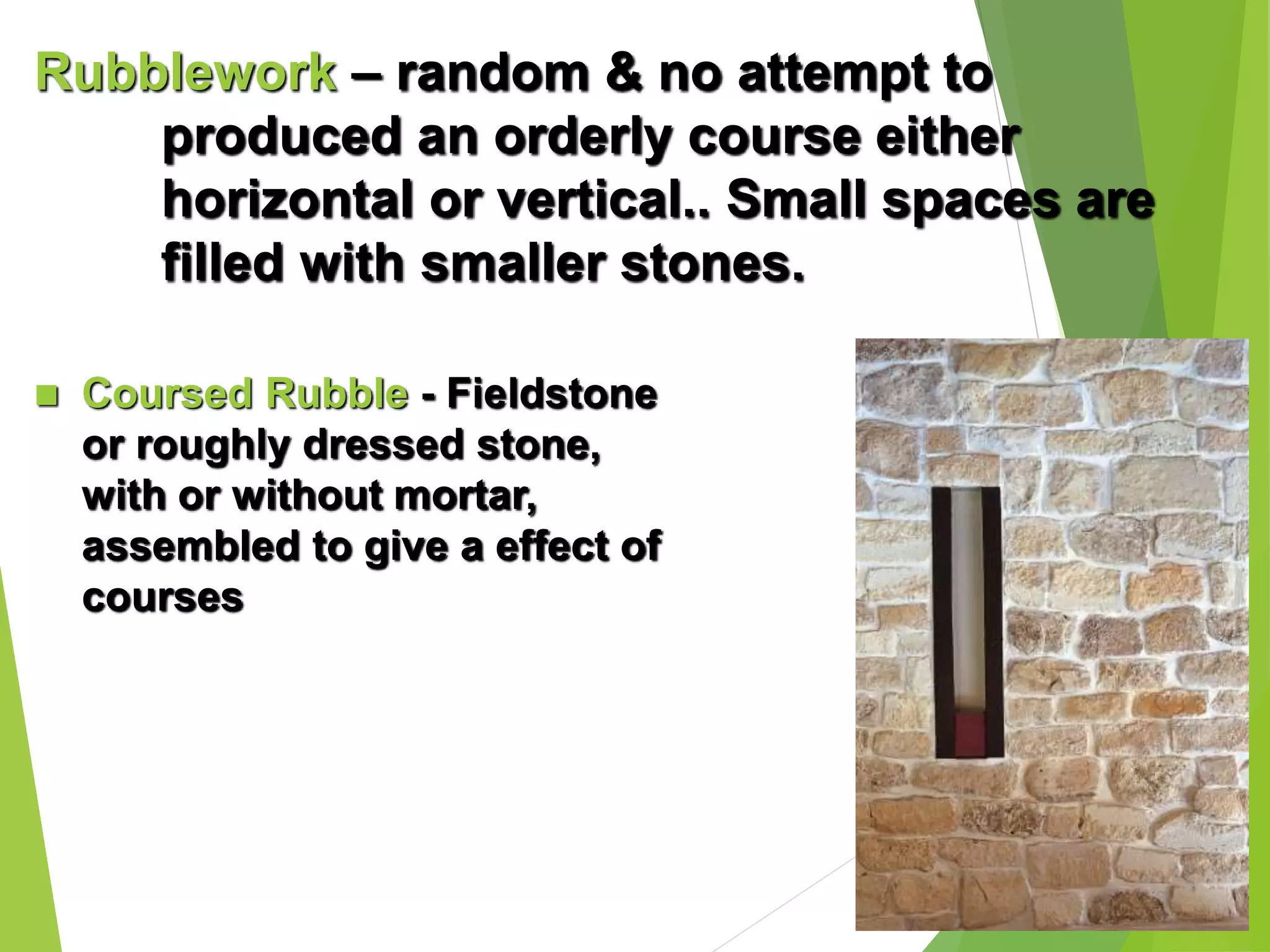
Rubblework – random & no attempt to
produced an orderly course either
horizontal or vertical.. Small spaces are
filled with smaller stones.
 Coursed Rubble - Fieldstone
or roughly dressed stone,
with or without mortar,
assembled to give a effect of
courses
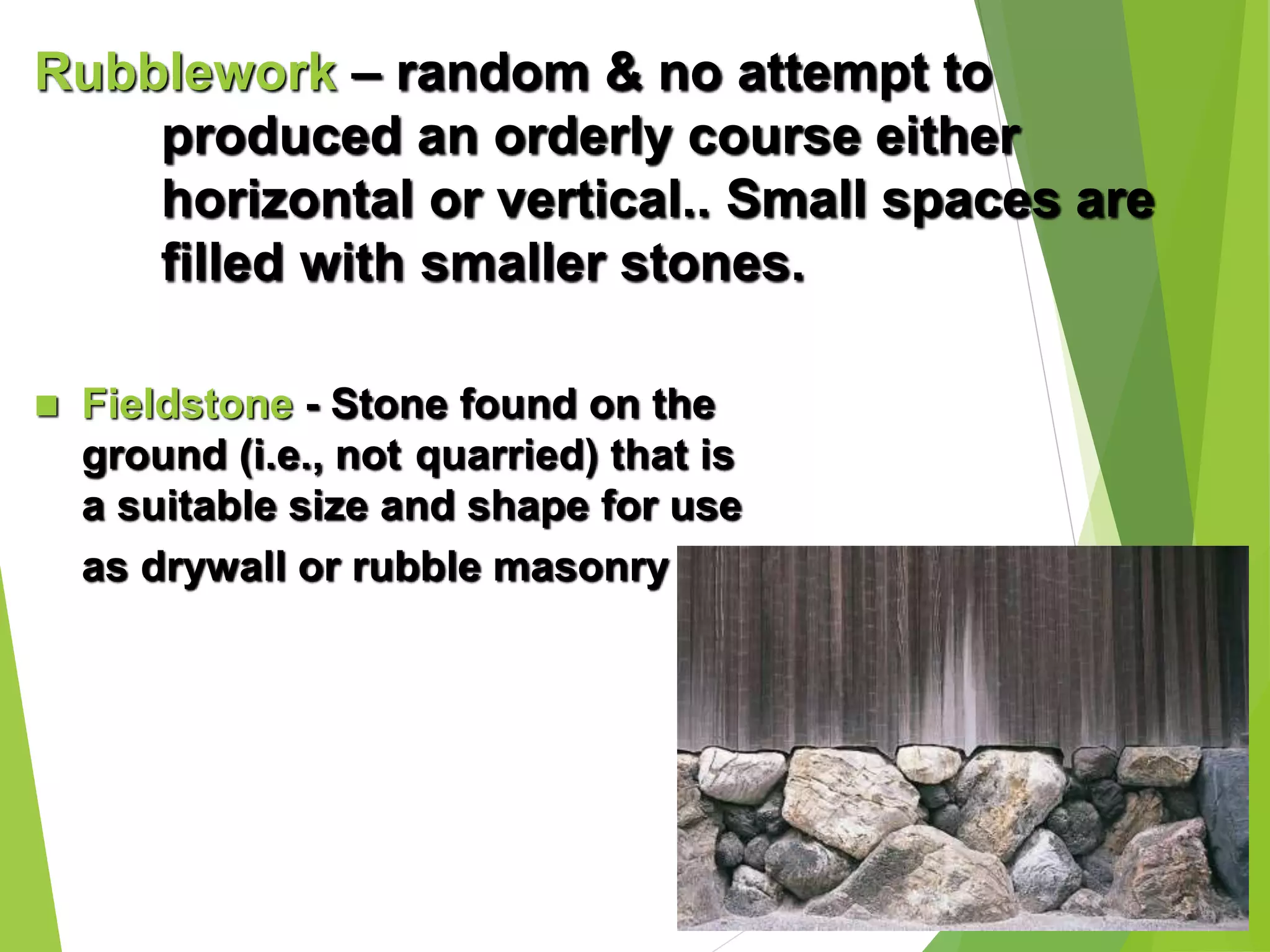
Rubblework – random & no attempt to
produced an orderly course either
horizontal or vertical.. Small spaces are
filled with smaller stones.
 Fieldstone - Stone found on the
ground (i.e., not quarried) that is
a suitable size and shape for use
as drywall or rubble masonry
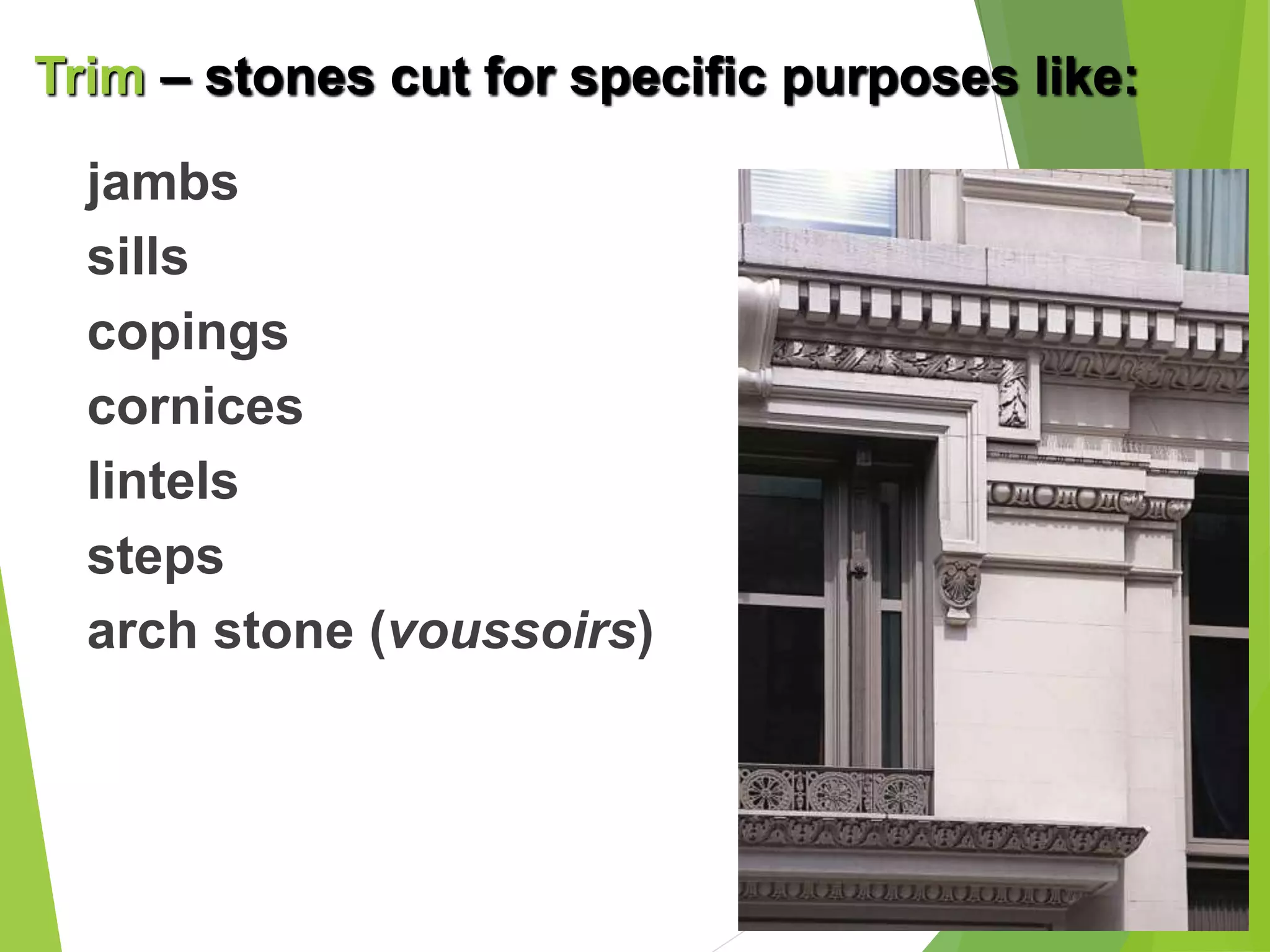
jambs
sills
copings
cornices
lintels
steps
arch stone (voussoirs)
Trim – stones cut for specific purposes like:
Stone Finish
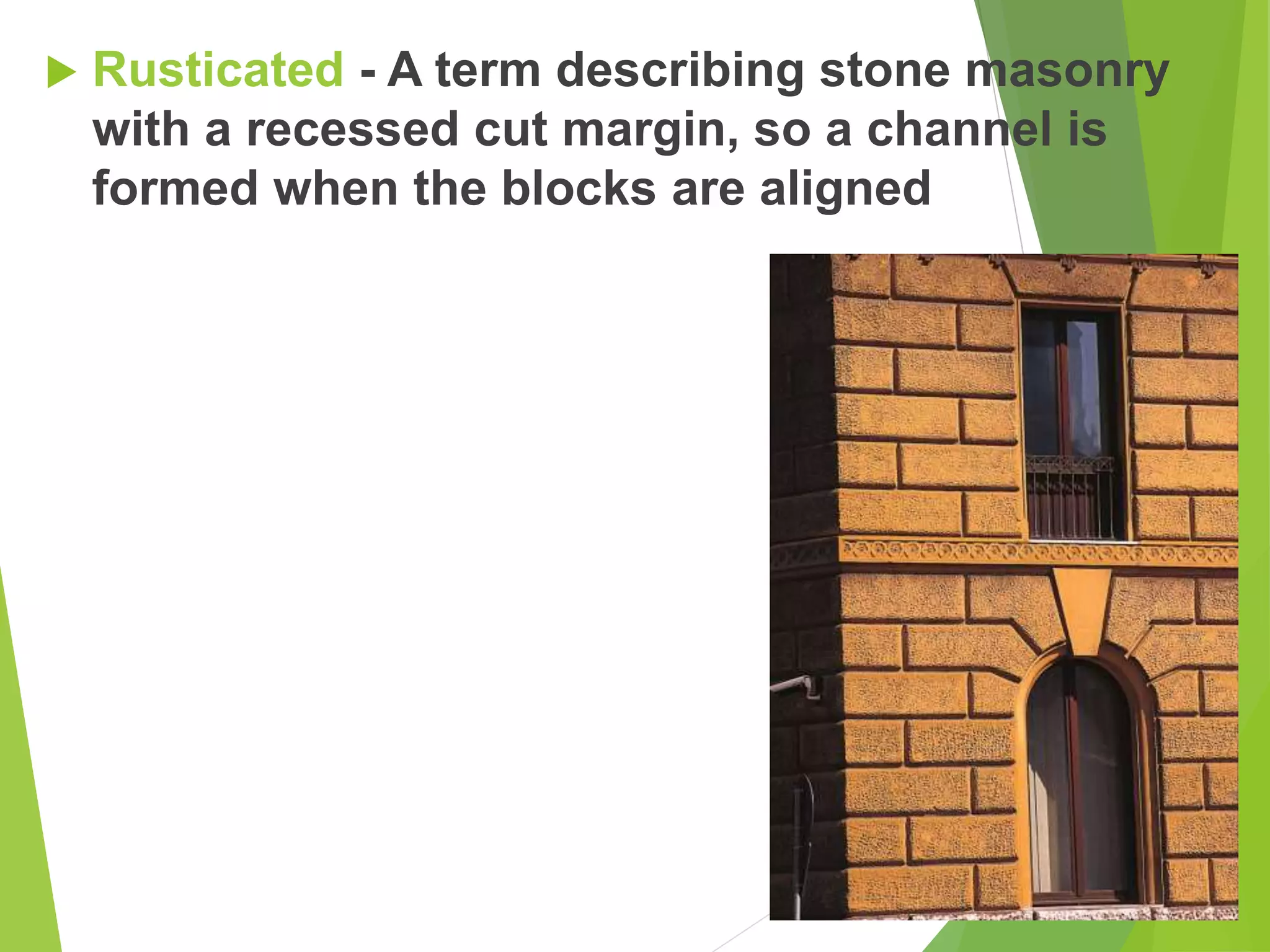
 Rusticated - A term describing stone masonry
with a recessed cut margin, so a channel is
formed when the blocks are aligned
 Sand Finish - A stone finish that is granular and
moderately smooth, varying with the
characteristics of the specific stone
 Sawn Face - A term describing stone exhibiting
the marks left by the saw used to cut it
 Rock Face - A stone finish with emphasized
face-plane shifts and rough corners,
exaggerating the natural look of the stone
 Split Face - A stone finish exhibiting the natural
quarry texture resulting from splitting the stone
Stone Pavers
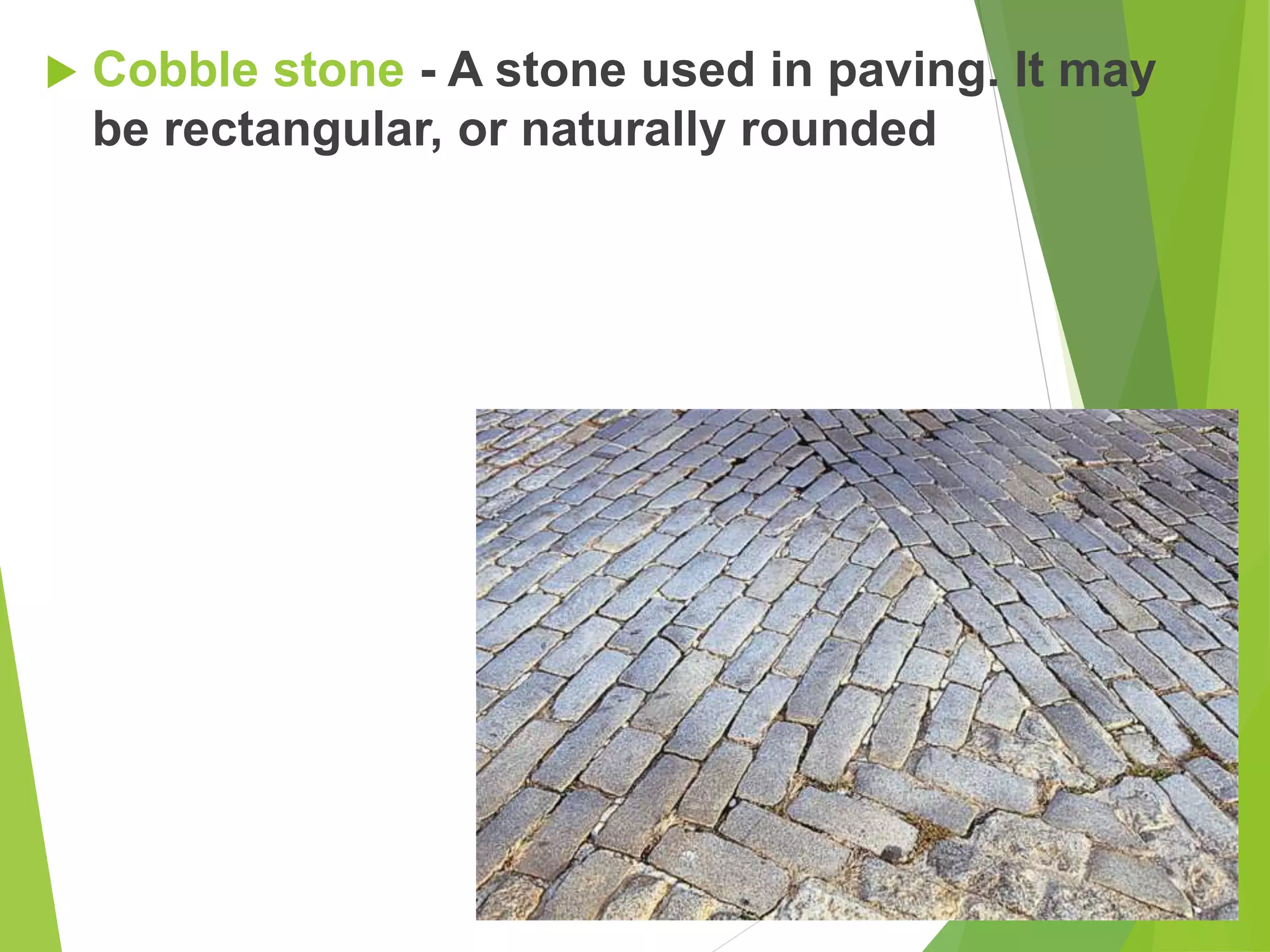
 Cobble stone - A stone used in paving. It may
be rectangular, or naturally rounded
 Durex Blocks - Roughly cubed, usually granite
blocks used for paving

BUILDING STONES

  • 1.
    BUILDING STONES LAKSHMI RAVICHANDU KOLUSU BUILDING CONSTRUCTION 01 NATIONAL NSTITUTE OF TECHNOLOGY CALICUT
  • 2.
    Stone a natural, hardsubstance formed from minerals and earth material which are present in rocks. Rock the portion of the earth’s crust having no definite shape and structure
  • 3.
    To qualify asa construction material, stone should have the following qualities:
  • 4.
    Strength: Most typesof stone have more than adequate compressive strength. The shear strength of stone, however, is usually about 1/10 of its compressive strength
  • 5.
    Hardness: hardness is importantwhen stone is used for flooring, paving, and stair treads.
  • 6.
    Hardness: Talc, easily scratchedwith the thumb-nail: 1 Gypsum, scratched by the thumb-nail: 2 Calcite, not scratched by thumb-nail but easily cut by knife: 3 Fluorite, can be cut by knife with greater difficulty than calcite: 4 Apatite, can be cut only with difficulty by knife: 5 Orthoclase, can be cut w/ knife w/ great difficulty on thin edges: 6 Quartz, not scratched by steel, scratches glass: 7 Topaz: 8 Sapphire: 9 Diamond: 10
  • 7.
    Durability: Resistance to theweathering effects of rain, wind, heat, and frost action is necessary for exterior stonework
  • 8.
    Workability: A stone’s hardnessand grain texture must allow it to be quarried, cut and shaped
  • 9.
    Density: A stone’s porosityaffects its ability to withstand frost action and staining
  • 10.
    Density: Porosity of Stones 24-hoursWater Absorption of Stones by Volume
  • 11.
  • 12.
    CLASSIFICATION OF STONES (accordingto geological origin):  Igneous rock  Metamorphic rocks  Sedimentary rock
  • 13.
    Igneous rock isformed by the crystallization of molten magma, as granite, obsidian and malachite
  • 14.
    Igneous rock alsoknown as primary, unstratified or eruptive rocks
  • 15.
    Metamorphic rocks hasundergone a change in structure, texture, or composition due to the natural agencies, as heat and pressure, especially when the rock becomes harder and more crystalline, as marble and slate
  • 16.
    Metamorphic rocks: Examples ofTransformation of Rocks
  • 17.
    Sedimentary rock isformed by the deposition of sediment by glacial action, as limestone, sandstone and shale
  • 18.
    Sedimentary rocks arealso known as aqueous or stratified rocks
  • 19.
    As a loadbearing wall material, stone is similar to modular unit masonry. Although stone masonry is not necessarily uniform in size, its laid up with mortar and used in compression. Almost all stone is adversely affected by sudden changes in temperature and should not be used where a high degree of fire resistance is required.
  • 20.
    Stone is usedin construction in the following forms:  Rubble  Dimension stone  Flagstone  Crushed stone
  • 21.
    Rubble - consistsof rough fragments of broken stone that have at least one good face for exposure in a wall.
  • 22.
    Dimension stone -is quarried and squared stone 2’ or more in length and width and of specified thickness, used commonly for wall panels, cornices, copings, lintels and flooring.
  • 23.
    Flagstone - refersto flat stone slabs used for flooring and horizontal surfacing.
  • 24.
    Crushed stone -is used as aggregate in concrete products.
  • 25.
    TYPES OF BUILDINGSTONES Argillite – formed from clay, dark blue with faint shades of green. Used for: floor tile stair threads coping stones interior wall base interior window stools of exterior window sills.
  • 26.
    TYPES OF BUILDINGSTONES Granite – igneous origin, hard, strong, durable and capable of taking high pressure polish. Red, pink, yellow, green, blue, white and brown. Used for: flooring wall paneling column mullion facing stair threads flagstone
  • 27.
    TYPES OF BUILDINGSTONES Limestone – sedimentary rock like dolomite, no cleavage lines, low in absorption, smooth, uniform in structure & composition. High compressive & tensile strength Used for: wall & floor surfaces
  • 28.
    TYPES OF BUILDINGSTONES Travertine – sedimentary rock, pleasing texture with small natural pockets on a cut surface. Used for: interior decorative stone
  • 29.
    TYPES OF BUILDINGSTONES Marble – metamorphic rock, a re crystallized limestone forming into carrara, parian, onyx and vermont. Used for: flooring wall & column facing
  • 30.
    TYPES OF BUILDINGSTONES Serpentine – igneous with mineral serpentine. Typically olive green to greenish black but impurities may color the rock. Used only for interiors due to weathering
  • 31.
    TYPES OF BUILDINGSTONES Sandstone – class of rock of cemented silica grains with texture ranging from very fine to very coarse. Colors vary from buff, red and light brown. Porous where as 30% of volume composed of pores
  • 32.
    TYPES OF BUILDINGSTONES Slate Rock – metamorphosis of clays and shale's deposited in layers. May be separated into thin, tough sheets called slates . Colors are black, green red, grey, or purple. Used for: flooring window sills stools stair treads & facing
  • 33.
    STONE CONSTRUCTION Largely usedas facing for building material with steel and concrete frames. Application Categories : 1. Paneling 2. Ashlars 3. Rubblework 4. Trim
  • 34.
     Running Bond- a masonry bond formed when all units are laid in stretcher position, with a half-unit overlap Paneling – thin slabs of stone cut to dimension and thickness to cover back up walls and provide finished exterior
  • 35.
     Stack Bond- a masonry bond formed when there is no overlapping of all units and all horizontal & vertical joints are aligned Paneling – thin slabs of stone cut to dimension and thickness to cover back up walls and provide finished exterior
  • 36.
    Ashlars – workrequires the use of cut stone that includes broken ashlars, regularly / irregularly coursed.  Coursed Ashlar - Ashlar masonry laid out in courses of equal height; blocks of various sizes may be combined to make up the height of the course
  • 37.
    Ashlars – workrequires the use of cut stone that includes broken ashlars, regularly / irregularly coursed.  Random Ashlar - Ashlar masonry laid without regular courses but with an overall effect of horizontal orientation
  • 38.
    Rubblework – random& no attempt to produced an orderly course either horizontal or vertical.. Small spaces are filled with smaller stones.  Coursed Rubble - Fieldstone or roughly dressed stone, with or without mortar, assembled to give a effect of courses
  • 39.
    Rubblework – random& no attempt to produced an orderly course either horizontal or vertical.. Small spaces are filled with smaller stones.  Fieldstone - Stone found on the ground (i.e., not quarried) that is a suitable size and shape for use as drywall or rubble masonry
  • 40.
  • 41.
  • 42.
     Rusticated -A term describing stone masonry with a recessed cut margin, so a channel is formed when the blocks are aligned
  • 43.
     Sand Finish- A stone finish that is granular and moderately smooth, varying with the characteristics of the specific stone
  • 44.
     Sawn Face- A term describing stone exhibiting the marks left by the saw used to cut it
  • 45.
     Rock Face- A stone finish with emphasized face-plane shifts and rough corners, exaggerating the natural look of the stone
  • 46.
     Split Face- A stone finish exhibiting the natural quarry texture resulting from splitting the stone
  • 47.
  • 48.
     Cobble stone- A stone used in paving. It may be rectangular, or naturally rounded
  • 49.
     Durex Blocks- Roughly cubed, usually granite blocks used for paving