Chapter 3
Stereochemistry
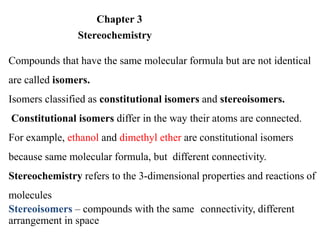
Compounds that have the same molecular formula but are not identical
are called isomers.
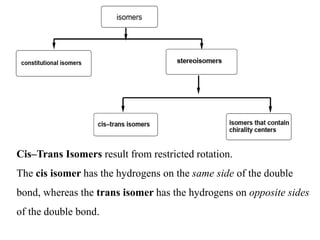
Isomers classified as constitutional isomers and stereoisomers.
Constitutional isomers differ in the way their atoms are connected.
For example, ethanol and dimethyl ether are constitutional isomers
because same molecular formula, but different connectivity.
Stereochemistry refers to the 3-dimensional properties and reactions of
molecules
Stereoisomers – compounds with the same connectivity, different
arrangement in space
Cis–Trans Isomers result from restricted rotation.
The cis isomer has the hydrogens on the same side of the double
bond, whereas the trans isomer has the hydrogens on opposite sides
of the double bond.
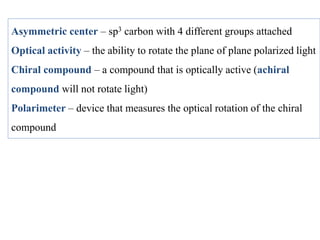
Asymmetric center – sp3 carbon with 4 different groups attached
Optical activity – the ability to rotate the plane of plane polarized light
Chiral compound – a compound that is optically active (achiral
compound will not rotate light)
Polarimeter – device that measures the optical rotation of the chiral
compound
Chirality Center
Carbon has four different groups attached
Chirality: An object with a right-handed and a left-handed form is said to be
chiral eg. hands, feet, gloves, and shoes .
A chiral object has a nonsuperimposable mirror image.
Achiral: objects that are not chiral are said to be achiral. An achiral
object has a superimposable mirror image. Some other achiral objects
would be a table, a fork, and a glass.
Asymmetric Carbons, Chirality Centers, and Stereocenters
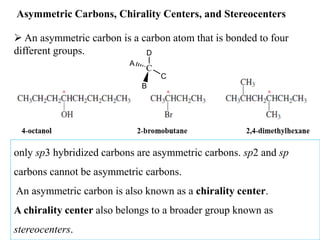
 An asymmetric carbon is a carbon atom that is bonded to four
different groups.
only sp3 hybridized carbons are asymmetric carbons. sp2 and sp
carbons cannot be asymmetric carbons.
An asymmetric carbon is also known as a chirality center.
A chirality center also belongs to a broader group known as
stereocenters.
C
B
A
D
C
Isomers with One Asymmetric Carbon
A compound with one asymmetric carbon, such as 2-bromobutane,
can exist as two different stereoisomers. i.e. R and S
Nonsuperimposable mirror-image
molecules are called enantiomers.
Each of the enantiomers is chiral.
achiral
A molecule that has a superimposable mirror image (i.e., they are
identical molecules), mentally rotate the achiral molecule clockwise.
Enantiomers – stereoisomers that are non-superimposible mirror
images, only properties that differ are direction (+ or -) of optical
rotation
Enantiomers can be drawn using either perspective formulas or
Fischer projections.
Perspective formulas show two of the bonds in the plane of the
paper, one bond as a solid wedge out of the paper, and the fourth
bond as a hatched wedge behind the paper.
Drawing enantioners
Fischer projection shows by using to perpendicular lines.
horizontal lines represent the bonds projected toward the viewer,
and vertical lines represent the bonds that extend back from the
plane of the paper away from the viewer.
The carbon chain always is drawn vertically with C-1 at the top
of the chain.
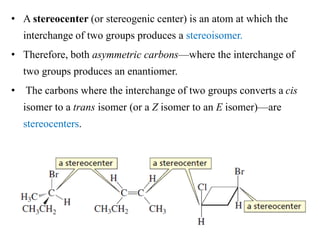
• A stereocenter (or stereogenic center) is an atom at which the
interchange of two groups produces a stereoisomer.
• Therefore, both asymmetric carbons—where the interchange of
two groups produces an enantiomer.
• The carbons where the interchange of two groups converts a cis
isomer to a trans isomer (or a Z isomer to an E isomer)—are
stereocenters.
The R,S System of Nomenclature
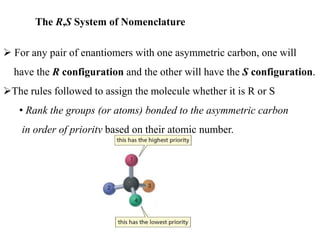
 For any pair of enantiomers with one asymmetric carbon, one will
have the R configuration and the other will have the S configuration.
The rules followed to assign the molecule whether it is R or S
• Rank the groups (or atoms) bonded to the asymmetric carbon
in order of priority based on their atomic number.
• Orient the molecule so that the group (or atom) with the lowest
priority (4) is directed away from you.
Example
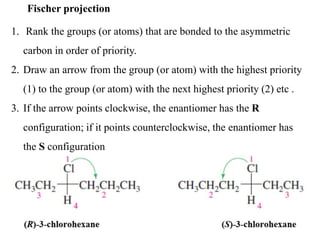
Fischer projection
1. Rank the groups (or atoms) that are bonded to the asymmetric
carbon in order of priority.
2. Draw an arrow from the group (or atom) with the highest priority
(1) to the group (or atom) with the next highest priority (2) etc .
3. If the arrow points clockwise, the enantiomer has the R
configuration; if it points counterclockwise, the enantiomer has
the S configuration
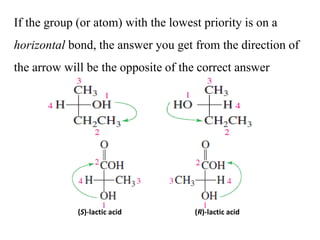
If the group (or atom) with the lowest priority is on a
horizontal bond, the answer you get from the direction of
the arrow will be the opposite of the correct answer
(S)-lactic acid (R)-lactic acid
Indicate whether each of the following structures has the R or the S
configuration:
Properties of enantiomers
 they have the same boiling point, same melting point and same
solubility. One of the properties that enantiomers do not share is
the way they interact with polarized light (different optical rotation).
 An achiral compound does not rotate the plane of polarization. It is
optically inactive.
If one enantiomer rotates the plane of polarization clockwise, its
mirror image will rotate the plane of polarization exactly the same
amount counterclockwise.
Optical Activity
 A mixture of equal amounts of two enantiomers is called a
racemic mixture or a racemate.
 Racemic mixtures do not rotate the plane of polarized light.
 They are optically inactive because for every molecule in a
racemic mixture that rotates the plane of polarization in one
direction, there is a mirror-image molecule that rotates the plane in
the opposite direction.
As a result, the light emerges from a racemic mixture with its
plane of polarization unchanged.
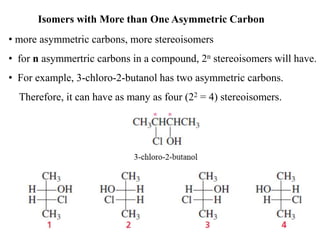
Isomers with More than One Asymmetric Carbon
• more asymmetric carbons, more stereoisomers
• for n asymmertric carbons in a compound, 2n stereoisomers will have.
• For example, 3-chloro-2-butanol has two asymmetric carbons.
Therefore, it can have as many as four (22 = 4) stereoisomers.
Diastereomers – stereoisomers that are not mirror images;
different compounds with different physical properties
Stereoisomers 1 and 3 are not identical, and they are not mirror
images. Such stereoisomers are called diastereomers.
Numbers 1 and 4, 2 and 3, and 2 and 4 are also diastereomers.
Diastereomers are stereoisomers that are not enantiomers.
Meso Compounds
each compound with two asymmetric carbons has four stereoisomers.
However, some compounds with two asymmetric carbons have only
three stereoisomers. An example of a compound with two asymmetric
carbons that has only three stereoisomers is 2,3-dibromobutane.
Stereoisomer 1 is called a meso compound. Even though it is
asymmetric carbons
 it is an achiral molecule
 it is superimposable on its mirror image.
 optically inactive.
 has plane of symmetry
PROBLEM :
1. Which of the following compounds has a stereoisomer that is a meso compound?
a. 2,3-dimethylbutane e. 1,4-dimethylcyclohexane
b. 3,4-dimethylhexane f. 1,2-dimethylcyclohexane
c. 2-bromo-3-methylpentane g. 3,4-diethylhexane
d. 1,3-dimethylcyclohexane h. 1-bromo-2-methylcyclohexane
2. Draw all the stereoisomers for each of the following compounds:
a. 1-bromo-2-methylbutane h. 2,4-dichloropentane
b. 1-chloro-3-methylpentane i. 2,4-dichloroheptane
c. 2-methyl-1-propanol j. 1,2-dichlorocyclobutane
d. 2-bromo-1-butanol k. 1,3-dichlorocyclohexane
e. 3-chloro-3-methylpentane l. 1,4-dichlorocyclohexane
f. 3-bromo-2-butanol m. 1-bromo-2-chlorocyclobutane
g. 3,4-dichlorohexane n. 1-bromo-3-chlorocyclobutane

3. chapter 3 stereochemistry.pdf

  • 1.
    Chapter 3 Stereochemistry Compounds thathave the same molecular formula but are not identical are called isomers. Isomers classified as constitutional isomers and stereoisomers. Constitutional isomers differ in the way their atoms are connected. For example, ethanol and dimethyl ether are constitutional isomers because same molecular formula, but different connectivity. Stereochemistry refers to the 3-dimensional properties and reactions of molecules Stereoisomers – compounds with the same connectivity, different arrangement in space
  • 2.
    Cis–Trans Isomers resultfrom restricted rotation. The cis isomer has the hydrogens on the same side of the double bond, whereas the trans isomer has the hydrogens on opposite sides of the double bond.
  • 4.
    Asymmetric center –sp3 carbon with 4 different groups attached Optical activity – the ability to rotate the plane of plane polarized light Chiral compound – a compound that is optically active (achiral compound will not rotate light) Polarimeter – device that measures the optical rotation of the chiral compound
  • 5.
    Chirality Center Carbon hasfour different groups attached Chirality: An object with a right-handed and a left-handed form is said to be chiral eg. hands, feet, gloves, and shoes . A chiral object has a nonsuperimposable mirror image.
  • 6.
    Achiral: objects thatare not chiral are said to be achiral. An achiral object has a superimposable mirror image. Some other achiral objects would be a table, a fork, and a glass.
  • 7.
    Asymmetric Carbons, ChiralityCenters, and Stereocenters  An asymmetric carbon is a carbon atom that is bonded to four different groups. only sp3 hybridized carbons are asymmetric carbons. sp2 and sp carbons cannot be asymmetric carbons. An asymmetric carbon is also known as a chirality center. A chirality center also belongs to a broader group known as stereocenters. C B A D C
  • 9.
    Isomers with OneAsymmetric Carbon A compound with one asymmetric carbon, such as 2-bromobutane, can exist as two different stereoisomers. i.e. R and S Nonsuperimposable mirror-image molecules are called enantiomers. Each of the enantiomers is chiral.
  • 10.
    achiral A molecule thathas a superimposable mirror image (i.e., they are identical molecules), mentally rotate the achiral molecule clockwise.
  • 11.
    Enantiomers – stereoisomersthat are non-superimposible mirror images, only properties that differ are direction (+ or -) of optical rotation Enantiomers can be drawn using either perspective formulas or Fischer projections. Perspective formulas show two of the bonds in the plane of the paper, one bond as a solid wedge out of the paper, and the fourth bond as a hatched wedge behind the paper. Drawing enantioners
  • 12.
    Fischer projection showsby using to perpendicular lines. horizontal lines represent the bonds projected toward the viewer, and vertical lines represent the bonds that extend back from the plane of the paper away from the viewer. The carbon chain always is drawn vertically with C-1 at the top of the chain.
  • 13.
    • A stereocenter(or stereogenic center) is an atom at which the interchange of two groups produces a stereoisomer. • Therefore, both asymmetric carbons—where the interchange of two groups produces an enantiomer. • The carbons where the interchange of two groups converts a cis isomer to a trans isomer (or a Z isomer to an E isomer)—are stereocenters.
  • 14.
    The R,S Systemof Nomenclature  For any pair of enantiomers with one asymmetric carbon, one will have the R configuration and the other will have the S configuration. The rules followed to assign the molecule whether it is R or S • Rank the groups (or atoms) bonded to the asymmetric carbon in order of priority based on their atomic number.
  • 15.
    • Orient themolecule so that the group (or atom) with the lowest priority (4) is directed away from you. Example
  • 16.
    Fischer projection 1. Rankthe groups (or atoms) that are bonded to the asymmetric carbon in order of priority. 2. Draw an arrow from the group (or atom) with the highest priority (1) to the group (or atom) with the next highest priority (2) etc . 3. If the arrow points clockwise, the enantiomer has the R configuration; if it points counterclockwise, the enantiomer has the S configuration
  • 17.
    If the group(or atom) with the lowest priority is on a horizontal bond, the answer you get from the direction of the arrow will be the opposite of the correct answer (S)-lactic acid (R)-lactic acid
  • 18.
    Indicate whether eachof the following structures has the R or the S configuration:
  • 19.
    Properties of enantiomers they have the same boiling point, same melting point and same solubility. One of the properties that enantiomers do not share is the way they interact with polarized light (different optical rotation).  An achiral compound does not rotate the plane of polarization. It is optically inactive. If one enantiomer rotates the plane of polarization clockwise, its mirror image will rotate the plane of polarization exactly the same amount counterclockwise. Optical Activity
  • 20.
     A mixtureof equal amounts of two enantiomers is called a racemic mixture or a racemate.  Racemic mixtures do not rotate the plane of polarized light.  They are optically inactive because for every molecule in a racemic mixture that rotates the plane of polarization in one direction, there is a mirror-image molecule that rotates the plane in the opposite direction. As a result, the light emerges from a racemic mixture with its plane of polarization unchanged.
  • 21.
    Isomers with Morethan One Asymmetric Carbon • more asymmetric carbons, more stereoisomers • for n asymmertric carbons in a compound, 2n stereoisomers will have. • For example, 3-chloro-2-butanol has two asymmetric carbons. Therefore, it can have as many as four (22 = 4) stereoisomers.
  • 22.
    Diastereomers – stereoisomersthat are not mirror images; different compounds with different physical properties Stereoisomers 1 and 3 are not identical, and they are not mirror images. Such stereoisomers are called diastereomers. Numbers 1 and 4, 2 and 3, and 2 and 4 are also diastereomers. Diastereomers are stereoisomers that are not enantiomers.
  • 23.
    Meso Compounds each compoundwith two asymmetric carbons has four stereoisomers. However, some compounds with two asymmetric carbons have only three stereoisomers. An example of a compound with two asymmetric carbons that has only three stereoisomers is 2,3-dibromobutane.
  • 24.
    Stereoisomer 1 iscalled a meso compound. Even though it is asymmetric carbons  it is an achiral molecule  it is superimposable on its mirror image.  optically inactive.  has plane of symmetry
  • 25.
    PROBLEM : 1. Whichof the following compounds has a stereoisomer that is a meso compound? a. 2,3-dimethylbutane e. 1,4-dimethylcyclohexane b. 3,4-dimethylhexane f. 1,2-dimethylcyclohexane c. 2-bromo-3-methylpentane g. 3,4-diethylhexane d. 1,3-dimethylcyclohexane h. 1-bromo-2-methylcyclohexane 2. Draw all the stereoisomers for each of the following compounds: a. 1-bromo-2-methylbutane h. 2,4-dichloropentane b. 1-chloro-3-methylpentane i. 2,4-dichloroheptane c. 2-methyl-1-propanol j. 1,2-dichlorocyclobutane d. 2-bromo-1-butanol k. 1,3-dichlorocyclohexane e. 3-chloro-3-methylpentane l. 1,4-dichlorocyclohexane f. 3-bromo-2-butanol m. 1-bromo-2-chlorocyclobutane g. 3,4-dichlorohexane n. 1-bromo-3-chlorocyclobutane