What ARE stem cells??
In the 1960's two Canadian scientists,
Ernest McCullough and JamesTill,
discovered that all living tissue
stemmed
from a single cell,
hence the term
stem cell.
Stem Cells and The Future Of Regenerative Medicine (Paperback) Institute of Medicine
(Corporate Author) (Washington, DC: National Academies Press, 2002).
What Are Stem Cells?
Stem cells are the raw material from which
all of the body’s mature, differentiated cells
are made. Stem cells give rise to brain
cells, nerve cells, heart cells, pancreatic
cells, etc.
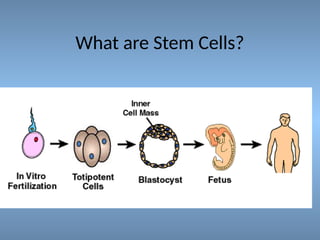
What are Stem Cells?
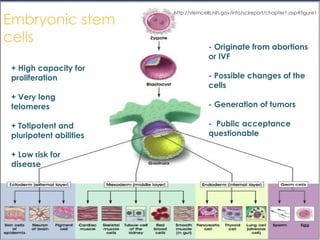
http://stemcells.nih.gov/info/scireport/chapter1.asp#figure1
+ High capacity for
proliferation
+ Very long
telomeres
+ Totipotent and
pluripotent abilities
+ Low risk for
disease
Embryonic stem
cells
- Originate from abortions
or IVF
- Possible changes of the
cells
- Generation of tumors
- Public acceptance
questionable
What Do Stem Cells Do?
10 million cells die in your body every minute
of every day.
Your own stem cells replace them so you can
continue living.
This is what stem cells do for a living.
6650-0018-002
What Do Stem Cells Do?
• Reduce Inflammation
• Reduce pain
• Differentiation into tissue
• Home in on injury sites
• Induce healing-regeneration
6650-0019-001
What are Stem Cells?
Stem Cells are Primitive cells present in almost
every tissue:
• Self Renewing
• Able to become different tissue types
• Trophic Factories – Growth Factors
6650-0018-002
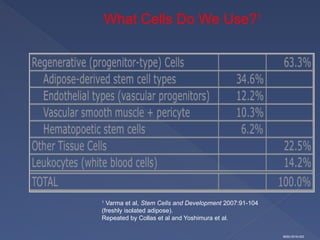
What Cells Do We Use?1
1
Varma et al, Stem Cells and Development 2007:91-104
(freshly isolated adipose).
Repeated by Collas et al and Yoshimura et al.
6650-0018-002
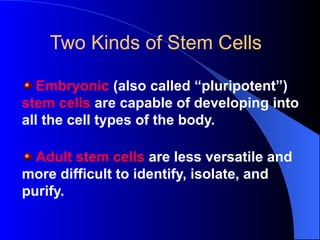
Two Kinds of Stem Cells
Embryonic (also called “pluripotent”)
stem cells are capable of developing into
all the cell types of the body.
Adult stem cells are less versatile and
more difficult to identify, isolate, and
purify.
All Stem Cells Are Important
• All stem cells can help scientists learn how cells
regenerate or repair injured cells, tissues and
organs.
• Scientists need both types of stem cells for their
research.
• Each cell type can help inform scientists on how
we develop and how some diseases affect our cells.
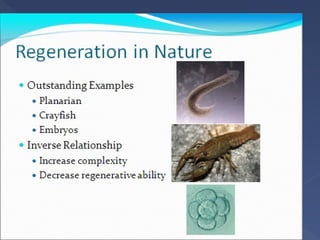
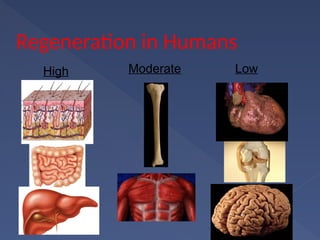
Regeneration in Humans
High Moderate Low
Why stem cell?
The following stem cell characterisics make
them good candidate for cell based
therapies:
1-potential to be harvested from patients.
2-High capacity of proliferation in culture.
3-Ease of manipulation to replace existing
non functioning genes via gene transfer
methods.
4-Ability to migrate to host’s target tissues.
5-Ability to integrate into host tissues.
Stem cells have 4 main
properties:
1-Unspecialized.
2- Self renewal.
3-Potency :Stem cells are either:
Totipotent (e.g. fertilized ova).
Pleuripotent(e.g. ES cells, EC cells and EG cells , the last two are less
desirable for research).
Multipotent (e.g. tissue stem cells).
Unipotent (e.g. hepatocytes, skin and corneal stem cells).
4-Robust repopulation (functional, long term tissue reconstitution).
And moreover the flexibility in expressing these characteristics and serial
transplantability should be feasible
.Cells that fulfill all these criteria are called "actual stem cells." The cells that
possess these capabilities but do not express them are named "potential
stem cells." (Potten and Loeffler, 1990 and Dabeva et al., 2003).
Why is Stem Cell Research So Important to All
of Us?
Stem cells allow us to study how organisms grow
and develop over time.
Stem cells can replace diseased or damaged cells
that can not heal or renew themselves.
We can test different substances (drugs and
chemicals) on stem cells.
We can get a better understanding of our
“genetic machinery.”
Why stem cells?
Shortage of donor organs for transplantation
Fountain of youth
Replace damaged cells with fresh ones
Rejection by the immune system
Our cells obtained and proliferated
Emerging technologies that could be useful to
learn more about the human body and disease
What’s So Special About Stem
Cells?
They have the potential to replace cell tissue that has
been damaged or destroyed by severe illnesses.
They can replicate themselves over and over for a very
long time.
Understanding how stem cells develop into healthy and
diseased cells will assist the search for cures.
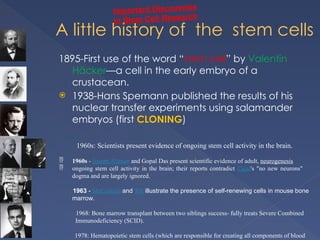
A little history of the stem cells
1895-First use of the word “stem cell” by Valentin
Häcker—a cell in the early embryo of a
crustacean.
 1938-Hans Spemann published the results of his
nuclear transfer experiments using salamander
embryos (first CLONING)
1960s: Scientists present evidence of ongoing stem cell activity in the brain.
 1960s - Joseph Altman and Gopal Das present scientific evidence of adult, neurogenesis
 ongoing stem cell activity in the brain; their reports contradict Cajal's "no new neurons"
dogma and are largely ignored.
1963 - McCulloch and Till illustrate the presence of self-renewing cells in mouse bone
marrow.
1968: Bone marrow transplant between two siblings success- fully treats Severe Combined
Immunodeficiency (SCID).
1978: Hematopoietic stem cells (which are responsible for creating all components of blood
Important Discoveries
in Stem Cell Research
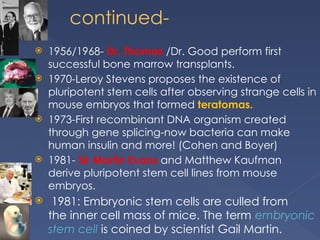
continued-
 1956/1968- Dr. Thomas /Dr. Good perform first
successful bone marrow transplants.
 1970-Leroy Stevens proposes the existence of
pluripotent stem cells after observing strange cells in
mouse embryos that formed teratomas.
 1973-First recombinant DNA organism created
through gene splicing-now bacteria can make
human insulin and more! (Cohen and Boyer)
 1981- Sir Martin Evans and Matthew Kaufman
derive pluripotent stem cell lines from mouse
embryos.
 1981: Embryonic stem cells are culled from
the inner cell mass of mice. The term embryonic
stem cell is coined by scientist Gail Martin.
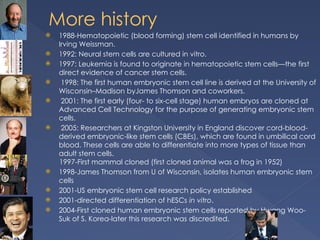
More history
 1988-Hematopoietic (blood forming) stem cell identified in humans by
Irving Weissman.
 1992: Neural stem cells are cultured in vitro.
 1997: Leukemia is found to originate in hematopoietic stem cells—the first
direct evidence of cancer stem cells.
 1998: The first human embryonic stem cell line is derived at the University of
Wisconsin–Madison byJames Thomson and coworkers.
 2001: The first early (four- to six-cell stage) human embryos are cloned at
Advanced Cell Technology for the purpose of generating embryonic stem
cells.
 2005: Researchers at Kingston University in England discover cord-blood-
derived embryonic-like stem cells (CBEs), which are found in umbilical cord
blood. These cells are able to differentiate into more types of tissue than
adult stem cells.
1997-First mammal cloned (first cloned animal was a frog in 1952)
 1998-James Thomson from U of Wisconsin, isolates human embryonic stem
cells
 2001-US embryonic stem cell research policy established
 2001-directed differentiation of hESCs in vitro.
 2004-First cloned human embryonic stem cells reported by Hwang Woo-
Suk of S. Korea-later this research was discredited.
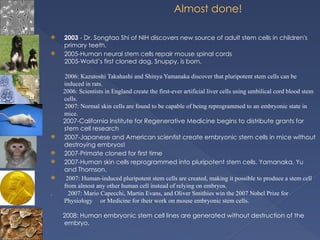
Almost done!
 2003 - Dr. Songtao Shi of NIH discovers new source of adult stem cells in children's
primary teeth.
 2005-Human neural stem cells repair mouse spinal cords
2005-World’s first cloned dog, Snuppy, is born.
2006: Kazutoshi Takahashi and Shinya Yamanaka discover that pluripotent stem cells can be
induced in rats.
2006: Scientists in England create the first-ever artificial liver cells using umbilical cord blood stem
cells.
2007: Normal skin cells are found to be capable of being reprogrammed to an embryonic state in
mice.
2007-California Institute for Regenerative Medicine begins to distribute grants for
stem cell research
 2007-Japanese and American scientist create embryonic stem cells in mice without
destroying embryos!
 2007-Primate cloned for first time
 2007-Human skin cells reprogrammed into pluripotent stem cells. Yamanaka, Yu
and Thomson.
 2007: Human-induced pluripotent stem cells are created, making it possible to produce a stem cell
from almost any other human cell instead of relying on embryos.
. 2007: Mario Capecchi, Martin Evans, and Oliver Smithies win the 2007 Nobel Prize for
Physiology or Medicine for their work on mouse embryonic stem cells.
2008: Human embryonic stem cell lines are generated without destruction of the
embryo.
Possible Uses of Stem Cell
Technology
 Repair of defective cell types
(Type 1 diabetes, Parkinson’s
disease, heart disease, nerve
damage)
 Replace tissues/organs?
 Study of embryology and
diseases
 Development of new drugs
Cell-Based Therapy
If your skin was burned in
an accident, there would
be layers of skin cells that
die. Using stem cell
techniques, scientists could
take a skin cell from another
area on your body or stem
cell and grow new plates of
skin tissue in a lab tissue
culture dish to regenerate
new skin cells for you.
QuickTime™ and a
TIFF (Uncompressed) decompressor
are needed to see this picture.
http://biodidac.bio.uottawa.ca/thumbnails/filedet.htm?File_name=HUMN164B&File_type=GIF
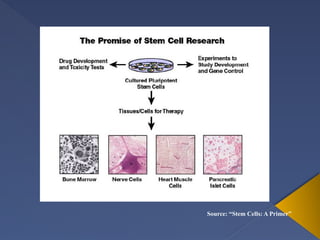
Source: “Stem Cells: A Primer”
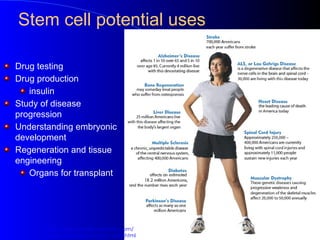
Stem cell potential uses
Drug testing
Drug production
insulin
Study of disease
progression
Understanding embryonic
development
Regeneration and tissue
engineering
Organs for transplant
http://www.cordbloodbank.com/
future_potential_of_stem_cells.html
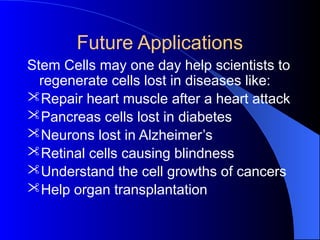
Future Applications
Stem Cells may one day help scientists to
regenerate cells lost in diseases like:
Repair heart muscle after a heart attack
Pancreas cells lost in diabetes
Neurons lost in Alzheimer’s
Retinal cells causing blindness
Understand the cell growths of cancers
Help organ transplantation
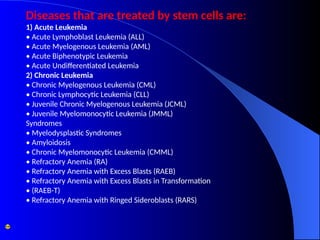
Diseases that are treated by stem cells are:
1) Acute Leukemia
• Acute Lymphoblast Leukemia (ALL)
• Acute Myelogenous Leukemia (AML)
• Acute Biphenotypic Leukemia
• Acute Undifferentiated Leukemia
2) Chronic Leukemia
• Chronic Myelogenous Leukemia (CML)
• Chronic Lymphocytic Leukemia (CLL)
• Juvenile Chronic Myelogenous Leukemia (JCML)
• Juvenile Myelomonocytic Leukemia (JMML)
Syndromes
• Myelodysplastic Syndromes
• Amyloidosis
• Chronic Myelomonocytic Leukemia (CMML)
• Refractory Anemia (RA)
• Refractory Anemia with Excess Blasts (RAEB)
• Refractory Anemia with Excess Blasts in Transformation
• (RAEB-T)
• Refractory Anemia with Ringed Sideroblasts (RARS)
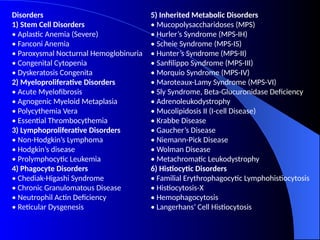
Disorders
1) Stem Cell Disorders
• Aplastic Anemia (Severe)
• Fanconi Anemia
• Paroxysmal Nocturnal Hemoglobinuria
• Congenital Cytopenia
• Dyskeratosis Congenita
2) Myeloproliferative Disorders
• Acute Myelofibrosis
• Agnogenic Myeloid Metaplasia
• Polycythemia Vera
• Essential Thrombocythemia
3) Lymphoproliferative Disorders
• Non-Hodgkin’s Lymphoma
• Hodgkin’s disease
• Prolymphocytic Leukemia
4) Phagocyte Disorders
• Chediak-Higashi Syndrome
• Chronic Granulomatous Disease
• Neutrophil Actin Deficiency
• Reticular Dysgenesis
5) Inherited Metabolic Disorders
• Mucopolysaccharidoses (MPS)
• Hurler’s Syndrome (MPS-IH)
• Scheie Syndrome (MPS-IS)
• Hunter’s Syndrome (MPS-II)
• Sanfilippo Syndrome (MPS-III)
• Morquio Syndrome (MPS-IV)
• Maroteaux-Lamy Syndrome (MPS-VI)
• Sly Syndrome, Beta-Glucuronidase Deficiency
• Adrenoleukodystrophy
• Mucolipidosis II (I-cell Disease)
• Krabbe Disease
• Gaucher’s Disease
• Niemann-Pick Disease
• Wolman Disease
• Metachromatic Leukodystrophy
6) Histiocytic Disorders
• Familial Erythrophagocytic Lymphohistiocytosis
• Histiocytosis-X
• Hemophagocytosis
• Langerhans’ Cell Histiocytosis
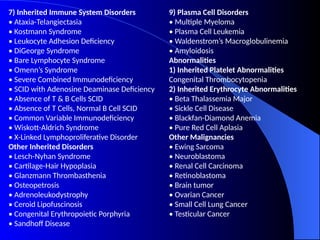
7) Inherited Immune System Disorders
• Ataxia-Telangiectasia
• Kostmann Syndrome
• Leukocyte Adhesion Deficiency
• DiGeorge Syndrome
• Bare Lymphocyte Syndrome
• Omenn’s Syndrome
• Severe Combined Immunodeficiency
• SCID with Adenosine Deaminase Deficiency
• Absence of T & B Cells SCID
• Absence of T Cells, Normal B Cell SCID
• Common Variable Immunodeficiency
• Wiskott-Aldrich Syndrome
• X-Linked Lymphoproliferative Disorder
Other Inherited Disorders
• Lesch-Nyhan Syndrome
• Cartilage-Hair Hypoplasia
• Glanzmann Thrombasthenia
• Osteopetrosis
• Adrenoleukodystrophy
• Ceroid Lipofuscinosis
• Congenital Erythropoietic Porphyria
• Sandhoff Disease
9) Plasma Cell Disorders
• Multiple Myeloma
• Plasma Cell Leukemia
• Waldenstrom’s Macroglobulinemia
• Amyloidosis
Abnormalities
1) Inherited Platelet Abnormalities
Congenital Thrombocytopenia
2) Inherited Erythrocyte Abnormalities
• Beta Thalassemia Major
• Sickle Cell Disease
• Blackfan-Diamond Anemia
• Pure Red Cell Aplasia
Other Malignancies
• Ewing Sarcoma
• Neuroblastoma
• Renal Cell Carcinoma
• Retinoblastoma
• Brain tumor
• Ovarian Cancer
• Small Cell Lung Cancer
• Testicular Cancer
What Human Diseases are Currently
Being Treated with Stem Cells?
• Parkinson’s Disease
• Leukemia (Bone Marrow Transplants)
• Skin Grafts resulting from severe burns
Stem Cell Therapy has the Potential to:
• Regenerate tissues/organs
• Cure diseases like diabetes, multiple sclerosis, etc.
Scientific Stem Cell Challenges
• Stem cells represents a very small fraction of cells in
tissue.
• Isolate a small number of stem cells (finding a needle in a
haystack).
• Expand the number of stem cells for research and clinical
applications.
• Maintain genetic stability in culture and in recipient.
• Culture media has to be free of animal protein.
• Deliver cells to tissue of interest.
• Stem cells have to be functional.
• Avoid or restrict tissue rejection.
Opportunities
• All stem cell technologies provide
opportunities in
– model development
– target identification and development
– screening for novel therapeutics
– developmental biology
– Regenerative Medicine

stem cell technology and it's application, ethical issues in detail

  • 1.
  • 2.
    In the 1960'stwo Canadian scientists, Ernest McCullough and JamesTill, discovered that all living tissue stemmed from a single cell, hence the term stem cell. Stem Cells and The Future Of Regenerative Medicine (Paperback) Institute of Medicine (Corporate Author) (Washington, DC: National Academies Press, 2002).
  • 3.
    What Are StemCells? Stem cells are the raw material from which all of the body’s mature, differentiated cells are made. Stem cells give rise to brain cells, nerve cells, heart cells, pancreatic cells, etc.
  • 4.
  • 5.
    http://stemcells.nih.gov/info/scireport/chapter1.asp#figure1 + High capacityfor proliferation + Very long telomeres + Totipotent and pluripotent abilities + Low risk for disease Embryonic stem cells - Originate from abortions or IVF - Possible changes of the cells - Generation of tumors - Public acceptance questionable
  • 6.
    What Do StemCells Do? 10 million cells die in your body every minute of every day. Your own stem cells replace them so you can continue living. This is what stem cells do for a living. 6650-0018-002
  • 7.
    What Do StemCells Do? • Reduce Inflammation • Reduce pain • Differentiation into tissue • Home in on injury sites • Induce healing-regeneration 6650-0019-001
  • 8.
    What are StemCells? Stem Cells are Primitive cells present in almost every tissue: • Self Renewing • Able to become different tissue types • Trophic Factories – Growth Factors 6650-0018-002
  • 9.
    What Cells DoWe Use?1 1 Varma et al, Stem Cells and Development 2007:91-104 (freshly isolated adipose). Repeated by Collas et al and Yoshimura et al. 6650-0018-002
  • 10.
    Two Kinds ofStem Cells Embryonic (also called “pluripotent”) stem cells are capable of developing into all the cell types of the body. Adult stem cells are less versatile and more difficult to identify, isolate, and purify.
  • 11.
    All Stem CellsAre Important • All stem cells can help scientists learn how cells regenerate or repair injured cells, tissues and organs. • Scientists need both types of stem cells for their research. • Each cell type can help inform scientists on how we develop and how some diseases affect our cells.
  • 13.
  • 14.
    Why stem cell? Thefollowing stem cell characterisics make them good candidate for cell based therapies: 1-potential to be harvested from patients. 2-High capacity of proliferation in culture. 3-Ease of manipulation to replace existing non functioning genes via gene transfer methods. 4-Ability to migrate to host’s target tissues. 5-Ability to integrate into host tissues.
  • 15.
    Stem cells have4 main properties: 1-Unspecialized. 2- Self renewal. 3-Potency :Stem cells are either: Totipotent (e.g. fertilized ova). Pleuripotent(e.g. ES cells, EC cells and EG cells , the last two are less desirable for research). Multipotent (e.g. tissue stem cells). Unipotent (e.g. hepatocytes, skin and corneal stem cells). 4-Robust repopulation (functional, long term tissue reconstitution). And moreover the flexibility in expressing these characteristics and serial transplantability should be feasible .Cells that fulfill all these criteria are called "actual stem cells." The cells that possess these capabilities but do not express them are named "potential stem cells." (Potten and Loeffler, 1990 and Dabeva et al., 2003).
  • 16.
    Why is StemCell Research So Important to All of Us? Stem cells allow us to study how organisms grow and develop over time. Stem cells can replace diseased or damaged cells that can not heal or renew themselves. We can test different substances (drugs and chemicals) on stem cells. We can get a better understanding of our “genetic machinery.”
  • 17.
    Why stem cells? Shortageof donor organs for transplantation Fountain of youth Replace damaged cells with fresh ones Rejection by the immune system Our cells obtained and proliferated Emerging technologies that could be useful to learn more about the human body and disease
  • 18.
    What’s So SpecialAbout Stem Cells? They have the potential to replace cell tissue that has been damaged or destroyed by severe illnesses. They can replicate themselves over and over for a very long time. Understanding how stem cells develop into healthy and diseased cells will assist the search for cures.
  • 19.
    A little historyof the stem cells 1895-First use of the word “stem cell” by Valentin Häcker—a cell in the early embryo of a crustacean.  1938-Hans Spemann published the results of his nuclear transfer experiments using salamander embryos (first CLONING) 1960s: Scientists present evidence of ongoing stem cell activity in the brain.  1960s - Joseph Altman and Gopal Das present scientific evidence of adult, neurogenesis  ongoing stem cell activity in the brain; their reports contradict Cajal's "no new neurons" dogma and are largely ignored. 1963 - McCulloch and Till illustrate the presence of self-renewing cells in mouse bone marrow. 1968: Bone marrow transplant between two siblings success- fully treats Severe Combined Immunodeficiency (SCID). 1978: Hematopoietic stem cells (which are responsible for creating all components of blood Important Discoveries in Stem Cell Research
  • 20.
    continued-  1956/1968- Dr.Thomas /Dr. Good perform first successful bone marrow transplants.  1970-Leroy Stevens proposes the existence of pluripotent stem cells after observing strange cells in mouse embryos that formed teratomas.  1973-First recombinant DNA organism created through gene splicing-now bacteria can make human insulin and more! (Cohen and Boyer)  1981- Sir Martin Evans and Matthew Kaufman derive pluripotent stem cell lines from mouse embryos.  1981: Embryonic stem cells are culled from the inner cell mass of mice. The term embryonic stem cell is coined by scientist Gail Martin.
  • 21.
    More history  1988-Hematopoietic(blood forming) stem cell identified in humans by Irving Weissman.  1992: Neural stem cells are cultured in vitro.  1997: Leukemia is found to originate in hematopoietic stem cells—the first direct evidence of cancer stem cells.  1998: The first human embryonic stem cell line is derived at the University of Wisconsin–Madison byJames Thomson and coworkers.  2001: The first early (four- to six-cell stage) human embryos are cloned at Advanced Cell Technology for the purpose of generating embryonic stem cells.  2005: Researchers at Kingston University in England discover cord-blood- derived embryonic-like stem cells (CBEs), which are found in umbilical cord blood. These cells are able to differentiate into more types of tissue than adult stem cells. 1997-First mammal cloned (first cloned animal was a frog in 1952)  1998-James Thomson from U of Wisconsin, isolates human embryonic stem cells  2001-US embryonic stem cell research policy established  2001-directed differentiation of hESCs in vitro.  2004-First cloned human embryonic stem cells reported by Hwang Woo- Suk of S. Korea-later this research was discredited.
  • 22.
    Almost done!  2003- Dr. Songtao Shi of NIH discovers new source of adult stem cells in children's primary teeth.  2005-Human neural stem cells repair mouse spinal cords 2005-World’s first cloned dog, Snuppy, is born. 2006: Kazutoshi Takahashi and Shinya Yamanaka discover that pluripotent stem cells can be induced in rats. 2006: Scientists in England create the first-ever artificial liver cells using umbilical cord blood stem cells. 2007: Normal skin cells are found to be capable of being reprogrammed to an embryonic state in mice. 2007-California Institute for Regenerative Medicine begins to distribute grants for stem cell research  2007-Japanese and American scientist create embryonic stem cells in mice without destroying embryos!  2007-Primate cloned for first time  2007-Human skin cells reprogrammed into pluripotent stem cells. Yamanaka, Yu and Thomson.  2007: Human-induced pluripotent stem cells are created, making it possible to produce a stem cell from almost any other human cell instead of relying on embryos. . 2007: Mario Capecchi, Martin Evans, and Oliver Smithies win the 2007 Nobel Prize for Physiology or Medicine for their work on mouse embryonic stem cells. 2008: Human embryonic stem cell lines are generated without destruction of the embryo.
  • 23.
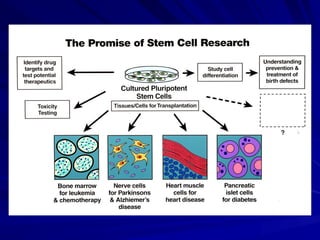
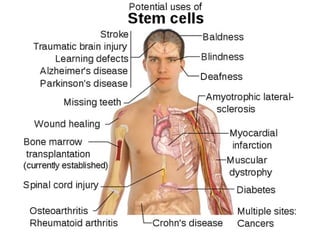
    Possible Uses ofStem Cell Technology  Repair of defective cell types (Type 1 diabetes, Parkinson’s disease, heart disease, nerve damage)  Replace tissues/organs?  Study of embryology and diseases  Development of new drugs
  • 24.
    Cell-Based Therapy If yourskin was burned in an accident, there would be layers of skin cells that die. Using stem cell techniques, scientists could take a skin cell from another area on your body or stem cell and grow new plates of skin tissue in a lab tissue culture dish to regenerate new skin cells for you. QuickTime™ and a TIFF (Uncompressed) decompressor are needed to see this picture. http://biodidac.bio.uottawa.ca/thumbnails/filedet.htm?File_name=HUMN164B&File_type=GIF
  • 25.
  • 28.
    Stem cell potentialuses Drug testing Drug production insulin Study of disease progression Understanding embryonic development Regeneration and tissue engineering Organs for transplant http://www.cordbloodbank.com/ future_potential_of_stem_cells.html
  • 29.
    Future Applications Stem Cellsmay one day help scientists to regenerate cells lost in diseases like: Repair heart muscle after a heart attack Pancreas cells lost in diabetes Neurons lost in Alzheimer’s Retinal cells causing blindness Understand the cell growths of cancers Help organ transplantation
  • 30.
    Diseases that aretreated by stem cells are: 1) Acute Leukemia • Acute Lymphoblast Leukemia (ALL) • Acute Myelogenous Leukemia (AML) • Acute Biphenotypic Leukemia • Acute Undifferentiated Leukemia 2) Chronic Leukemia • Chronic Myelogenous Leukemia (CML) • Chronic Lymphocytic Leukemia (CLL) • Juvenile Chronic Myelogenous Leukemia (JCML) • Juvenile Myelomonocytic Leukemia (JMML) Syndromes • Myelodysplastic Syndromes • Amyloidosis • Chronic Myelomonocytic Leukemia (CMML) • Refractory Anemia (RA) • Refractory Anemia with Excess Blasts (RAEB) • Refractory Anemia with Excess Blasts in Transformation • (RAEB-T) • Refractory Anemia with Ringed Sideroblasts (RARS)
  • 31.
    Disorders 1) Stem CellDisorders • Aplastic Anemia (Severe) • Fanconi Anemia • Paroxysmal Nocturnal Hemoglobinuria • Congenital Cytopenia • Dyskeratosis Congenita 2) Myeloproliferative Disorders • Acute Myelofibrosis • Agnogenic Myeloid Metaplasia • Polycythemia Vera • Essential Thrombocythemia 3) Lymphoproliferative Disorders • Non-Hodgkin’s Lymphoma • Hodgkin’s disease • Prolymphocytic Leukemia 4) Phagocyte Disorders • Chediak-Higashi Syndrome • Chronic Granulomatous Disease • Neutrophil Actin Deficiency • Reticular Dysgenesis 5) Inherited Metabolic Disorders • Mucopolysaccharidoses (MPS) • Hurler’s Syndrome (MPS-IH) • Scheie Syndrome (MPS-IS) • Hunter’s Syndrome (MPS-II) • Sanfilippo Syndrome (MPS-III) • Morquio Syndrome (MPS-IV) • Maroteaux-Lamy Syndrome (MPS-VI) • Sly Syndrome, Beta-Glucuronidase Deficiency • Adrenoleukodystrophy • Mucolipidosis II (I-cell Disease) • Krabbe Disease • Gaucher’s Disease • Niemann-Pick Disease • Wolman Disease • Metachromatic Leukodystrophy 6) Histiocytic Disorders • Familial Erythrophagocytic Lymphohistiocytosis • Histiocytosis-X • Hemophagocytosis • Langerhans’ Cell Histiocytosis
  • 32.
    7) Inherited ImmuneSystem Disorders • Ataxia-Telangiectasia • Kostmann Syndrome • Leukocyte Adhesion Deficiency • DiGeorge Syndrome • Bare Lymphocyte Syndrome • Omenn’s Syndrome • Severe Combined Immunodeficiency • SCID with Adenosine Deaminase Deficiency • Absence of T & B Cells SCID • Absence of T Cells, Normal B Cell SCID • Common Variable Immunodeficiency • Wiskott-Aldrich Syndrome • X-Linked Lymphoproliferative Disorder Other Inherited Disorders • Lesch-Nyhan Syndrome • Cartilage-Hair Hypoplasia • Glanzmann Thrombasthenia • Osteopetrosis • Adrenoleukodystrophy • Ceroid Lipofuscinosis • Congenital Erythropoietic Porphyria • Sandhoff Disease 9) Plasma Cell Disorders • Multiple Myeloma • Plasma Cell Leukemia • Waldenstrom’s Macroglobulinemia • Amyloidosis Abnormalities 1) Inherited Platelet Abnormalities Congenital Thrombocytopenia 2) Inherited Erythrocyte Abnormalities • Beta Thalassemia Major • Sickle Cell Disease • Blackfan-Diamond Anemia • Pure Red Cell Aplasia Other Malignancies • Ewing Sarcoma • Neuroblastoma • Renal Cell Carcinoma • Retinoblastoma • Brain tumor • Ovarian Cancer • Small Cell Lung Cancer • Testicular Cancer
  • 33.
    What Human Diseasesare Currently Being Treated with Stem Cells? • Parkinson’s Disease • Leukemia (Bone Marrow Transplants) • Skin Grafts resulting from severe burns Stem Cell Therapy has the Potential to: • Regenerate tissues/organs • Cure diseases like diabetes, multiple sclerosis, etc.
  • 34.
    Scientific Stem CellChallenges • Stem cells represents a very small fraction of cells in tissue. • Isolate a small number of stem cells (finding a needle in a haystack). • Expand the number of stem cells for research and clinical applications. • Maintain genetic stability in culture and in recipient. • Culture media has to be free of animal protein. • Deliver cells to tissue of interest. • Stem cells have to be functional. • Avoid or restrict tissue rejection.
  • 35.
    Opportunities • All stemcell technologies provide opportunities in – model development – target identification and development – screening for novel therapeutics – developmental biology – Regenerative Medicine

Editor's Notes

  • #6 Simple explanation for what adult stem cells are doing every day in every body.
  • #7 These are the five main mechanisms of action of adult stem cells. We usually think of differentiation into tissue as the first and most important mechanism, and it is important, but maybe not the most dominant.
  • #8 These are the three major distinctions of what define stem cells.
  • #9 Contrary to the older press and literature, approximately 1/3 of the nucleated cells derived from a sample of fat are stem cells. There are also over 28% of the cells that are regenerative progenitor type cells with the ability to provide growth factors and assist in healing. This is over 1000X more concentrated than bone marrow and is the reason you use the cells fresh, without need for cell culture. However, if you run out of fresh or frozen cells, you can grow additional doses from a small retention sample kept on all patients.
  • #23 In theory, stem cell technology could be used to produce replaceable tissues or organs. Defective tissues/organs could be repaired using healthy cells. Stem cells are particularly attractive to use in diseases where only one cell type is defective such as DM 1 where the pancreatic beta cell (insulin) is absent; Parkinson’s disease where the dopaminergic brain cells are decreased; and heart disease where the heart muscle cell has been damaged. It would also be possible to genetically engineer stem cells to accomplish activities that they would not ordinarily be programmed to do. Part of this engineering could involve the delivery of chemotherapeutic agents for treatment of cancers and tumors. This has already proven to be possible in the animal model.