presented by
Aakifah Amreen H.E
4 th Sem MSc (BT)
Media formulation
Content
● Introduction
● Characteristic of an ideal media
● Media formulation
● Types of media
● Natural media
● Synthetic media
● Essential component of media
● Reference
Introduction
The medium composition is as critical to product yield as high producing
strains of microorganisms. The medium not only provides the nutrients needed for
microbial growth but also for metabolite production.
The growth medium meant for the cultivation of a production strain and
subsequent production of either microbial cells or a biochemical product is
referred to as a production or fermentation
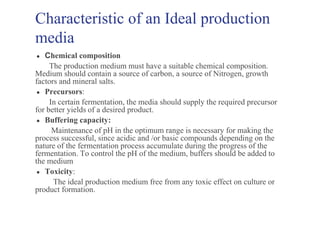
Characteristic of an Ideal production
media
● Chemical composition
The production medium must have a suitable chemical composition.
Medium should contain a source of carbon, a source of Nitrogen, growth
factors and mineral salts.
● Precursors:
In certain fermentation, the media should supply the required precursor
for better yields of a desired product.
● Buffering capacity:
Maintenance of pH in the optimum range is necessary for making the
process successful, since acidic and /or basic compounds depending on the
nature of the fermentation process accumulate during the progress of the
fermentation. To control the pH of the medium, buffers should be added to
the medium
● Toxicity:
The ideal production medium free from any toxic effect on culture or
product formation.
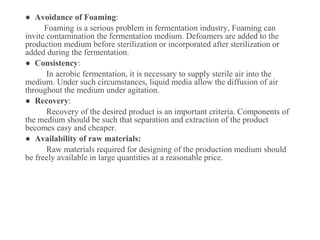
● Avoidance of Foaming:
Foaming is a serious problem in fermentation industry, Foaming can
invite contamination the fermentation medium. Defoamers are added to the
production medium before sterilization or incorporated after sterilization or
added during the fermentation.
● Consistency:
In aerobic fermentation, it is necessary to supply sterile air into the
medium. Under such circumstances, liquid media allow the diffusion of air
throughout the medium under agitation.
● Recovery:
Recovery of the desired product is an important criteria. Components of
the medium should be such that separation and extraction of the product
becomes easy and cheaper.
● Availability of raw materials:
Raw materials required for designing of the production medium should
be freely available in large quantities at a reasonable price.
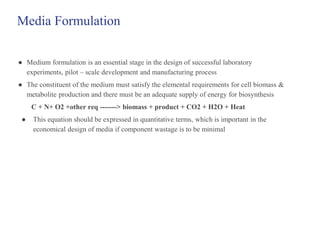
Media Formulation
● Medium formulation is an essential stage in the design of successful laboratory
experiments, pilot – scale development and manufacturing process
● The constituent of the medium must satisfy the elemental requirements for cell biomass &
metabolite production and there must be an adequate supply of energy for biosynthesis
C + N+ O2 +other req -------> biomass + product + CO2 + H2O + Heat
● This equation should be expressed in quantitative terms, which is important in the
economical design of media if component wastage is to be minimal
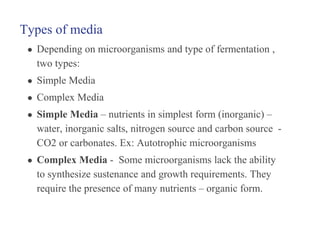
Types of media
● Depending on microorganisms and type of fermentation ,
two types:
● Simple Media
● Complex Media
● Simple Media – nutrients in simplest form (inorganic) –
water, inorganic salts, nitrogen source and carbon source -
CO2 or carbonates. Ex: Autotrophic microorganisms
● Complex Media - Some microorganisms lack the ability
to synthesize sustenance and growth requirements. They
require the presence of many nutrients – organic form.
Natural media
● Crude Media
● Contains crude or ill defined sources of nutrients
● They provide excess of both nutrients and growth factors
● Assumed that the media does not contain metals or inorganic
salts that might be toxic to the organisms or its product
formation
● Constituents for fermentation media, particularly crude
media are obtained from a range of sources
● Ex: soya bean meal, black strap molasses, corn step liquor
etc.,
Advantages
● Byproducts of agriculture wastes - the cheapest source
● They are inexpensive
● Anions and cations are present in sufficient quantities
Disadvantages
● Major requirements such as phosphate, sulfate, magnesium and ammonium ions can
be met by adding potassium phosphate, magnesium sulfate, ammonium sulfate or
phosphate
Synthetic media
● Medium of choice
● All the medium constituents are known – specifically defined
● Every constituent is a pure compound, exact amounts incorporated are known
● Ex: inorganic salts, water, purified sugar, ammonium or nitrate compound or
amino acid to supply nitrogen
Advantage
● Concentration of any one component can be varied because the chemical
structure and amount of every component is known
● Individual components can be easily added or deleted that allows the
redesigning of the medium – for maximum yeild
● Allows to study the metabolic process leading to product formation
● Less foaming because no use of proteins
● Purification and recovery easy
Disadvantages
● Media expensive – pure ingredients
● Yields – low
● Stress on the microorganism as the fermentation conditions may not be
normally associated with the microorganism
Essential components of media
WATER
Microorganisms live in aqueous environment
Media should usually contain 70-90%
Water should supply trace minerals such as copper, Mo, Zinc,
Boron etc., in minute quantities
Water - for making up media, cleaning of equipment and
recovery process, cooling and steam production
RAW MATERIALS
● Agricultural wastes - large quantities
● Wastes have high biological demand so can minimize pollution
● Wastes contain a large amount of unused protein and carbohydrate
sources
● Calorific value of wastes is recoverable
● Agricultural wastes are renewable
● Little cost is involved in recovering wastes
● Agricultural wastes are not a part of human food chain and thus no
competition
Energy sources
• Energy comes either from oxidation of medium
components or from light.
• Most industrial microorganism are chemo-organotrophs,
therefore the commonest source of energy will be the
carbon (CHO), lipids & protein.
• Some micro-organisms can also use hydrocarbons or
methanol as carbon & energy sources.
Carbon source
Factor influencing the choice of carbon source:
● Rate at which the C source is metabolized can often influence the formation of biomass or
production of primary or secondary metabolites.
● Fast growth due to high concentrations of rapidly metabolized sugars is often associated with
low productivity of secondary metabolites.
● Some use less readily metabolized sugar i.e lactose but many process need continuous or
semi continuous supply of sugar.
● The purity of the C source may also affect the choice of substance.
● The method of media preparation, particularly sterilization may affect the suitability of CHO
for individual fermentation process.
Sources of carbon
● Saccharine Materials
● Starchy Materials
● Cellulosic Materials
● Hydrocarbon and Vegetable oils
Saccharine materials
Molasses, Fruit juices and cheese whey
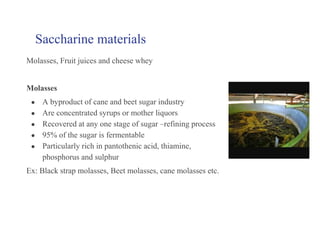
Molasses
● A byproduct of cane and beet sugar industry
● Are concentrated syrups or mother liquors
● Recovered at any one stage of sugar –refining process
● 95% of the sugar is fermentable
● Particularly rich in pantothenic acid, thiamine,
phosphorus and sulphur
Ex: Black strap molasses, Beet molasses, cane molasses etc.
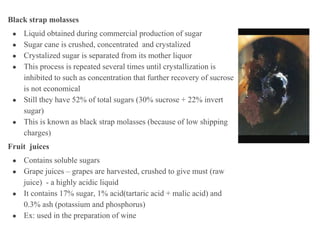
Black strap molasses
● Liquid obtained during commercial production of sugar
● Sugar cane is crushed, concentrated and crystalized
● Crystalized sugar is separated from its mother liquor
● This process is repeated several times until crystallization is
inhibited to such as concentration that further recovery of sucrose
is not economical
● Still they have 52% of total sugars (30% sucrose + 22% invert
sugar)
● This is known as black strap molasses (because of low shipping
charges)
Fruit juices
● Contains soluble sugars
● Grape juices – grapes are harvested, crushed to give must (raw
juice) - a highly acidic liquid
● It contains 17% sugar, 1% acid(tartaric acid + malic acid) and
0.3% ash (potassium and phosphorus)
● Ex: used in the preparation of wine
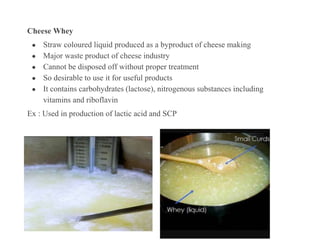
Cheese Whey
● Straw coloured liquid produced as a byproduct of cheese making
● Major waste product of cheese industry
● Cannot be disposed off without proper treatment
● So desirable to use it for useful products
● It contains carbohydrates (lactose), nitrogenous substances including
vitamins and riboflavin
Ex : Used in production of lactic acid and SCP
Starchy material
● Are in the form of cereals and roots
● Starches require pretreatment to bring about the conversion to fermentable sugars
● Done by using enzymatic or chemical treatment
Cereals – wheat, rice, maize etc.,
Roots and tubers – potatoes, tapioca
Cellulosic materials
● Are complex carbohydrate materials
● Made up of repeating units of β – glucose (2 – cellobiose, 1000- 10,000 units -
cellulose)
● Needs pretreatment
1. SULFITE WASTE LIQUOR
2. WOOD MOLASSES
3. RICE STRAW
Sulfite waste liquor
● It is the spent sulfite liquor from the paper- pulping industry
● It is the fluid remaining after wood is digested to cellulose pulp with calcium
bisulphite under heat and pressure during paper manufacture
● It contains 10-12% solids of which sugars make up about 20%, so it’s a total of
2% sugar
● Thus it is a dilute sugar solution
● However, relative amounts of sugar present in sulfite waste liquor depends on the
wood digested
● Used in the production of ethanol by Saccharomyces cerevisiae
Wood molasses
● Acid hydrolysis of wood cellulose
● 65 – 85% of fermentable sugars
● Process - wood hydrolyzed with 0.5% H2SO4 and at a temperature of 150-
185˚C, liquid left over is wood molasses
● From saw dust, molasses are prepared, that contains 4-5% of reducing sugars
with an overall yield of 45-55%
● From conifers – 85% hexoses and 15% pentose
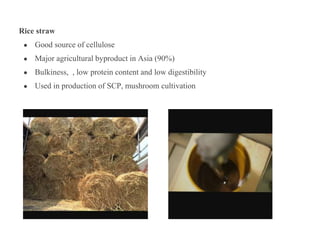
Rice straw
● Good source of cellulose
● Major agricultural byproduct in Asia (90%)
● Bulkiness, , low protein content and low digestibility
● Used in production of SCP, mushroom cultivation
Hydrocarbons and vegetable oils
● Mixture of hydrogen and carbon
● Relatively cheap
● Gas oil and paraffin
● Used in the production of SCP
Vegetable oils
vegetable seeds – remove oil (deoiling)
Vegetables oils used as C substrates, particularly for their content of the fatty acid,
oleic, linoleci and linolenic acid b/c of cost are competitive with those of CHO.
● Oleic or non – drying – olive and ground nut oil
● Linoleic or seni – drying type: Ex: maize, sunflower and cotton seed oils
● Linolenic or drying type: Ex: linseed and soya bean
Nitrogen source
Sources of nitrogen
● Corn steep liquor
● Soya bean meal
● Pharmamedia
Corn steep liquor
● Used steep water resulting from the steeping of corn during the manufacture
of starch, gluten and other corn products
● When subjected to concentration, it has 50% solids and the concentrate is
called corn steep liquor
● Used in production of Penicillin and other fungal antibiotics
Soya bean meal
● Material left after deoiling of the soyabean seeds
● Contains 8% w/w nitrogen – complex, not readily available for
microorganisms
● Streptomycin production
Pharma Media
● Clean, yellow, finely ground powder prepared from the embryo of cotton
seed
● Contains 56% w/w protein, 24% carbohydrates, 5% oil and 5% ash
● Used in production of tetracycline
Reference
● Stanbury P. F, Whitaker A and Hall S. J (1997), principles of fermentation
technology, Elsevier science Ltd, Aditya books (P) Ltd, New Delhi
● A. H Pat, (2005),industrial microbiology, Macmillan, India Ltd, New Delhi

Media formulati aa wps office

  • 1.
    presented by Aakifah AmreenH.E 4 th Sem MSc (BT) Media formulation
  • 2.
    Content ● Introduction ● Characteristicof an ideal media ● Media formulation ● Types of media ● Natural media ● Synthetic media ● Essential component of media ● Reference
  • 3.
    Introduction The medium compositionis as critical to product yield as high producing strains of microorganisms. The medium not only provides the nutrients needed for microbial growth but also for metabolite production. The growth medium meant for the cultivation of a production strain and subsequent production of either microbial cells or a biochemical product is referred to as a production or fermentation
  • 5.
    Characteristic of anIdeal production media ● Chemical composition The production medium must have a suitable chemical composition. Medium should contain a source of carbon, a source of Nitrogen, growth factors and mineral salts. ● Precursors: In certain fermentation, the media should supply the required precursor for better yields of a desired product. ● Buffering capacity: Maintenance of pH in the optimum range is necessary for making the process successful, since acidic and /or basic compounds depending on the nature of the fermentation process accumulate during the progress of the fermentation. To control the pH of the medium, buffers should be added to the medium ● Toxicity: The ideal production medium free from any toxic effect on culture or product formation.
  • 6.
    ● Avoidance ofFoaming: Foaming is a serious problem in fermentation industry, Foaming can invite contamination the fermentation medium. Defoamers are added to the production medium before sterilization or incorporated after sterilization or added during the fermentation. ● Consistency: In aerobic fermentation, it is necessary to supply sterile air into the medium. Under such circumstances, liquid media allow the diffusion of air throughout the medium under agitation. ● Recovery: Recovery of the desired product is an important criteria. Components of the medium should be such that separation and extraction of the product becomes easy and cheaper. ● Availability of raw materials: Raw materials required for designing of the production medium should be freely available in large quantities at a reasonable price.
  • 7.
    Media Formulation ● Mediumformulation is an essential stage in the design of successful laboratory experiments, pilot – scale development and manufacturing process ● The constituent of the medium must satisfy the elemental requirements for cell biomass & metabolite production and there must be an adequate supply of energy for biosynthesis C + N+ O2 +other req -------> biomass + product + CO2 + H2O + Heat ● This equation should be expressed in quantitative terms, which is important in the economical design of media if component wastage is to be minimal
  • 8.
    Types of media ●Depending on microorganisms and type of fermentation , two types: ● Simple Media ● Complex Media ● Simple Media – nutrients in simplest form (inorganic) – water, inorganic salts, nitrogen source and carbon source - CO2 or carbonates. Ex: Autotrophic microorganisms ● Complex Media - Some microorganisms lack the ability to synthesize sustenance and growth requirements. They require the presence of many nutrients – organic form.
  • 9.
    Natural media ● CrudeMedia ● Contains crude or ill defined sources of nutrients ● They provide excess of both nutrients and growth factors ● Assumed that the media does not contain metals or inorganic salts that might be toxic to the organisms or its product formation ● Constituents for fermentation media, particularly crude media are obtained from a range of sources ● Ex: soya bean meal, black strap molasses, corn step liquor etc.,
  • 10.
    Advantages ● Byproducts ofagriculture wastes - the cheapest source ● They are inexpensive ● Anions and cations are present in sufficient quantities Disadvantages ● Major requirements such as phosphate, sulfate, magnesium and ammonium ions can be met by adding potassium phosphate, magnesium sulfate, ammonium sulfate or phosphate
  • 11.
    Synthetic media ● Mediumof choice ● All the medium constituents are known – specifically defined ● Every constituent is a pure compound, exact amounts incorporated are known ● Ex: inorganic salts, water, purified sugar, ammonium or nitrate compound or amino acid to supply nitrogen
  • 12.
    Advantage ● Concentration ofany one component can be varied because the chemical structure and amount of every component is known ● Individual components can be easily added or deleted that allows the redesigning of the medium – for maximum yeild ● Allows to study the metabolic process leading to product formation ● Less foaming because no use of proteins ● Purification and recovery easy Disadvantages ● Media expensive – pure ingredients ● Yields – low ● Stress on the microorganism as the fermentation conditions may not be normally associated with the microorganism
  • 13.
    Essential components ofmedia WATER Microorganisms live in aqueous environment Media should usually contain 70-90% Water should supply trace minerals such as copper, Mo, Zinc, Boron etc., in minute quantities Water - for making up media, cleaning of equipment and recovery process, cooling and steam production
  • 14.
    RAW MATERIALS ● Agriculturalwastes - large quantities ● Wastes have high biological demand so can minimize pollution ● Wastes contain a large amount of unused protein and carbohydrate sources ● Calorific value of wastes is recoverable ● Agricultural wastes are renewable ● Little cost is involved in recovering wastes ● Agricultural wastes are not a part of human food chain and thus no competition
  • 15.
    Energy sources • Energycomes either from oxidation of medium components or from light. • Most industrial microorganism are chemo-organotrophs, therefore the commonest source of energy will be the carbon (CHO), lipids & protein. • Some micro-organisms can also use hydrocarbons or methanol as carbon & energy sources.
  • 16.
    Carbon source Factor influencingthe choice of carbon source: ● Rate at which the C source is metabolized can often influence the formation of biomass or production of primary or secondary metabolites. ● Fast growth due to high concentrations of rapidly metabolized sugars is often associated with low productivity of secondary metabolites. ● Some use less readily metabolized sugar i.e lactose but many process need continuous or semi continuous supply of sugar. ● The purity of the C source may also affect the choice of substance. ● The method of media preparation, particularly sterilization may affect the suitability of CHO for individual fermentation process. Sources of carbon ● Saccharine Materials ● Starchy Materials ● Cellulosic Materials ● Hydrocarbon and Vegetable oils
  • 17.
    Saccharine materials Molasses, Fruitjuices and cheese whey Molasses ● A byproduct of cane and beet sugar industry ● Are concentrated syrups or mother liquors ● Recovered at any one stage of sugar –refining process ● 95% of the sugar is fermentable ● Particularly rich in pantothenic acid, thiamine, phosphorus and sulphur Ex: Black strap molasses, Beet molasses, cane molasses etc.
  • 18.
    Black strap molasses ●Liquid obtained during commercial production of sugar ● Sugar cane is crushed, concentrated and crystalized ● Crystalized sugar is separated from its mother liquor ● This process is repeated several times until crystallization is inhibited to such as concentration that further recovery of sucrose is not economical ● Still they have 52% of total sugars (30% sucrose + 22% invert sugar) ● This is known as black strap molasses (because of low shipping charges) Fruit juices ● Contains soluble sugars ● Grape juices – grapes are harvested, crushed to give must (raw juice) - a highly acidic liquid ● It contains 17% sugar, 1% acid(tartaric acid + malic acid) and 0.3% ash (potassium and phosphorus) ● Ex: used in the preparation of wine
  • 19.
    Cheese Whey ● Strawcoloured liquid produced as a byproduct of cheese making ● Major waste product of cheese industry ● Cannot be disposed off without proper treatment ● So desirable to use it for useful products ● It contains carbohydrates (lactose), nitrogenous substances including vitamins and riboflavin Ex : Used in production of lactic acid and SCP
  • 20.
    Starchy material ● Arein the form of cereals and roots ● Starches require pretreatment to bring about the conversion to fermentable sugars ● Done by using enzymatic or chemical treatment Cereals – wheat, rice, maize etc., Roots and tubers – potatoes, tapioca Cellulosic materials ● Are complex carbohydrate materials ● Made up of repeating units of β – glucose (2 – cellobiose, 1000- 10,000 units - cellulose) ● Needs pretreatment 1. SULFITE WASTE LIQUOR 2. WOOD MOLASSES 3. RICE STRAW
  • 21.
    Sulfite waste liquor ●It is the spent sulfite liquor from the paper- pulping industry ● It is the fluid remaining after wood is digested to cellulose pulp with calcium bisulphite under heat and pressure during paper manufacture ● It contains 10-12% solids of which sugars make up about 20%, so it’s a total of 2% sugar ● Thus it is a dilute sugar solution ● However, relative amounts of sugar present in sulfite waste liquor depends on the wood digested ● Used in the production of ethanol by Saccharomyces cerevisiae Wood molasses ● Acid hydrolysis of wood cellulose ● 65 – 85% of fermentable sugars ● Process - wood hydrolyzed with 0.5% H2SO4 and at a temperature of 150- 185˚C, liquid left over is wood molasses ● From saw dust, molasses are prepared, that contains 4-5% of reducing sugars with an overall yield of 45-55% ● From conifers – 85% hexoses and 15% pentose
  • 22.
    Rice straw ● Goodsource of cellulose ● Major agricultural byproduct in Asia (90%) ● Bulkiness, , low protein content and low digestibility ● Used in production of SCP, mushroom cultivation
  • 23.
    Hydrocarbons and vegetableoils ● Mixture of hydrogen and carbon ● Relatively cheap ● Gas oil and paraffin ● Used in the production of SCP Vegetable oils vegetable seeds – remove oil (deoiling) Vegetables oils used as C substrates, particularly for their content of the fatty acid, oleic, linoleci and linolenic acid b/c of cost are competitive with those of CHO. ● Oleic or non – drying – olive and ground nut oil ● Linoleic or seni – drying type: Ex: maize, sunflower and cotton seed oils ● Linolenic or drying type: Ex: linseed and soya bean
  • 24.
    Nitrogen source Sources ofnitrogen ● Corn steep liquor ● Soya bean meal ● Pharmamedia Corn steep liquor ● Used steep water resulting from the steeping of corn during the manufacture of starch, gluten and other corn products ● When subjected to concentration, it has 50% solids and the concentrate is called corn steep liquor ● Used in production of Penicillin and other fungal antibiotics
  • 25.
    Soya bean meal ●Material left after deoiling of the soyabean seeds ● Contains 8% w/w nitrogen – complex, not readily available for microorganisms ● Streptomycin production Pharma Media ● Clean, yellow, finely ground powder prepared from the embryo of cotton seed ● Contains 56% w/w protein, 24% carbohydrates, 5% oil and 5% ash ● Used in production of tetracycline
  • 26.
    Reference ● Stanbury P.F, Whitaker A and Hall S. J (1997), principles of fermentation technology, Elsevier science Ltd, Aditya books (P) Ltd, New Delhi ● A. H Pat, (2005),industrial microbiology, Macmillan, India Ltd, New Delhi