STEM
CELLS
By Uxía
Cosmed
Peralejo
1. DEFINITION
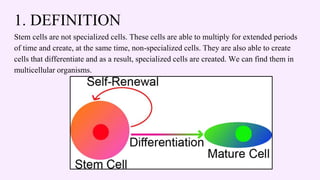
Stem cells are not specialized cells. These cells are able to multiply for extended periods
of time and create, at the same time, non-specialized cells. They are also able to create
cells that differentiate and as a result, specialized cells are created. We can find them in
multicellular organisms.
2. TYPES
Depending on its ability to create different types of cells are classified in:
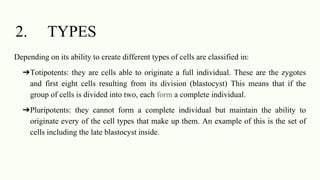
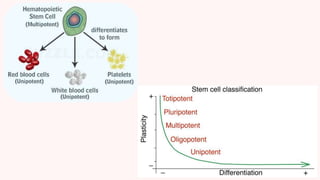
➔Totipotents: they are cells able to originate a full individual. These are the zygotes
and first eight cells resulting from its division (blastocyst) This means that if the
group of cells is divided into two, each form a complete individual.
➔Pluripotents: they cannot form a complete individual but maintain the ability to
originate every of the cell types that make up them. An example of this is the set of
cells including the late blastocyst inside.
➔Multipotents: there are some cells that keep some ability to create some types of
cells. These are called adult cells, somatic stem or stem cells from tissues. For
example, in the bone marrow, there are cells that can transform into red blood cells,
different types of white blood cells and platelets
➔Oligopotents: some adult stem cells can only create one or a few types of cells. A few
examples are stem cells of skin or nerve tissue.
➔Unipotents: they are cells that can be differentiated along only a lineage. They can be
found in adult tissues. An unipotent stem cell has the lower potential of
differentiation. This means that the cell has the ability to differentiate into a single
type of cell or tissue.
3. CLASSIFICATION
Second where come from stem cells may be:
➔Embryonic cells: are those that are obtained from a human embryo of four or five
days old. It is in the development stage called a blastocyst. They should be removed
in the state of blastocyst through the placement of the inner cell mass of the blastocyst
in a culture dish that contains a nutrient-rich broth. In the absence of stimulation
necessary to differentiate, they begin to divide and replicate themselves, while
maintaining their ability to become in any type of cell in the human body. Finally,
these undifferentiated cells can be stimulated to create specialized cells.
➔ The stem adult cells or somatic stem cells: exist throughout the body after embryonic
development and are among the different types of tissue, such as brain, bone marrow,
blood, blood vessels, muscles, skin and liver. They can be divided or auto-renew
themselves indefinitely, which allows them to generate different types of cells from
the original organ, or even regenerate the original organ completely. Adult stem cells
are limited in their ability to regenerate based on their tissue of origin. However, there
is an evidence that they can be divided into other types of cells. It is believed that an
adult stem cell is an undifferentiated cell that lies between cells in a tissue or organ
that you can renew and can differentiate to produce some or all of the main types of
specialized cells of the tissue or organ. The main adult functions of stem cells in a
living organism are to maintain and repair the tissue in which are found. The scientists
also use the term, somatic stem cells. Unlike embryonic stem cells, which is already
known their origin, the origin of adult stem cells in some mature tissues is still under
investigation.
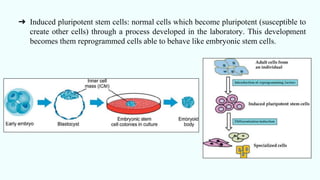
➔ Induced pluripotent stem cells: normal cells which become pluripotent (susceptible to
create other cells) through a process developed in the laboratory. This development
becomes them reprogrammed cells able to behave like embryonic stem cells.
4. USING
The main function of stem cells is to repair damaged tissues, by replacing cells which
were killed by new ones.
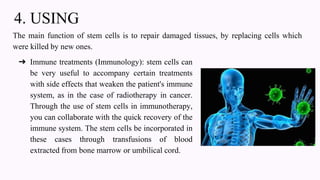
➔ Immune treatments (Immunology): stem cells can
be very useful to accompany certain treatments
with side effects that weaken the patient's immune
system, as in the case of radiotherapy in cancer.
Through the use of stem cells in immunotherapy,
you can collaborate with the quick recovery of the
immune system. The stem cells be incorporated in
these cases through transfusions of blood
extracted from bone marrow or umbilical cord.
➔Genetic treatment (gene therapy): through the transfusion of stem cells some genetic
diseases can combated. For this purpose the donor must be compatible with the
patient (usually it only happens with close patient relatives). This transplantation is
used mostly in vitro pregnancy, to counteract or correct a mutation (new genes which
are incorporated may in theory work correctly and remedy the disease that was
caused by the malfunction of the individual cells).
5. BENEFITS Y CONTROVERSY
The main benefits are:
➔Ideal candidates for medical tests: since the embryos are kept in a permanent early
development state. They are alive without a host body in which to develop although
they may never become fully human. However, since they are alive, the tests can be
conducted in different ways and this is a great advantage
➔Research of certain diseases: cancer, spinal cord injuries, diabetes, Parkinson's,
Alzheimer's and schizophrenia may benefit from this research.
➔Not tested on humans or animals: according to PETA, more than 70 million animals
are killed, blinded or are injured in other ways by the medical tests that performed
them each year. Research with embryonic stem cells will help to reduce this
number.
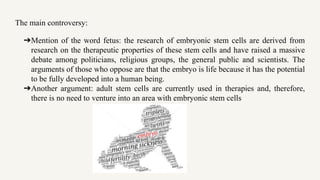
The main controversy:
➔Mention of the word fetus: the research of embryonic stem cells are derived from
research on the therapeutic properties of these stem cells and have raised a massive
debate among politicians, religious groups, the general public and scientists. The
arguments of those who oppose are that the embryo is life because it has the potential
to be fully developed into a human being.
➔Another argument: adult stem cells are currently used in therapies and, therefore,
there is no need to venture into an area with embryonic stem cells
6. SOLUTIONS
There are two new treatments from embryonic stem cells would avoid the destruction of
the fetus, either by:
➔ Obtaining embryonic stem cells without destroying the fetus
➔ Obtaining embryonic stem cells without the creation of a fetus.
Another solution is the use of induced pluripotent stem cells: which consists in the use of
stem cells that do not come from an embryo. Since they are created on the basis of somatic
cells that are extracted from the same patient, this allows to avoid them one of the biggest
problems presented by the use of stem cells in medicine, immune rejection. Since they are
the own individual cells there is no risk that your body reject them.
7.FUTURE USING
Mainly there is one treatment with views of future:
➔ Regenerative treatments (regenerative medicine): in this case stem cells help the
formation of new tissue or organs. This implementation of stem cells is still very
incipient and experimental. However, it is believed that it might reside healing
fractures of bone type and the improvement of heart disease caused by
malformations.
7. CURRENT NEWS
A Japanese Man Just Got Another Person's Stem Cells Transplanted in His Eye:
http://www.sciencealert.com/a-japanese-man-just-received-first-ever-donor-stem-cell-
transplant-in-his-eye
Stem Cells Reduce Lung Inflammation and Damage in Mouse Model of COPD and Cystic
Fibrosis:
https://lungdiseasenews.com/2017/04/03/study-shows-potential-of-stem-cell-therapy-to-
treat-lung-disease/
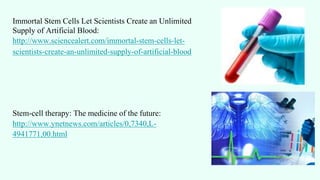
Immortal Stem Cells Let Scientists Create an Unlimited
Supply of Artificial Blood:
http://www.sciencealert.com/immortal-stem-cells-let-
scientists-create-an-unlimited-supply-of-artificial-blood
Stem-cell therapy: The medicine of the future:
http://www.ynetnews.com/articles/0,7340,L-
4941771,00.html

#SciChallenge2017

  • 1.
  • 2.
    1. DEFINITION Stem cellsare not specialized cells. These cells are able to multiply for extended periods of time and create, at the same time, non-specialized cells. They are also able to create cells that differentiate and as a result, specialized cells are created. We can find them in multicellular organisms.
  • 3.
    2. TYPES Depending onits ability to create different types of cells are classified in: ➔Totipotents: they are cells able to originate a full individual. These are the zygotes and first eight cells resulting from its division (blastocyst) This means that if the group of cells is divided into two, each form a complete individual. ➔Pluripotents: they cannot form a complete individual but maintain the ability to originate every of the cell types that make up them. An example of this is the set of cells including the late blastocyst inside.
  • 5.
    ➔Multipotents: there aresome cells that keep some ability to create some types of cells. These are called adult cells, somatic stem or stem cells from tissues. For example, in the bone marrow, there are cells that can transform into red blood cells, different types of white blood cells and platelets ➔Oligopotents: some adult stem cells can only create one or a few types of cells. A few examples are stem cells of skin or nerve tissue. ➔Unipotents: they are cells that can be differentiated along only a lineage. They can be found in adult tissues. An unipotent stem cell has the lower potential of differentiation. This means that the cell has the ability to differentiate into a single type of cell or tissue.
  • 7.
    3. CLASSIFICATION Second wherecome from stem cells may be: ➔Embryonic cells: are those that are obtained from a human embryo of four or five days old. It is in the development stage called a blastocyst. They should be removed in the state of blastocyst through the placement of the inner cell mass of the blastocyst in a culture dish that contains a nutrient-rich broth. In the absence of stimulation necessary to differentiate, they begin to divide and replicate themselves, while maintaining their ability to become in any type of cell in the human body. Finally, these undifferentiated cells can be stimulated to create specialized cells.
  • 8.
    ➔ The stemadult cells or somatic stem cells: exist throughout the body after embryonic development and are among the different types of tissue, such as brain, bone marrow, blood, blood vessels, muscles, skin and liver. They can be divided or auto-renew themselves indefinitely, which allows them to generate different types of cells from the original organ, or even regenerate the original organ completely. Adult stem cells are limited in their ability to regenerate based on their tissue of origin. However, there is an evidence that they can be divided into other types of cells. It is believed that an adult stem cell is an undifferentiated cell that lies between cells in a tissue or organ that you can renew and can differentiate to produce some or all of the main types of specialized cells of the tissue or organ. The main adult functions of stem cells in a living organism are to maintain and repair the tissue in which are found. The scientists also use the term, somatic stem cells. Unlike embryonic stem cells, which is already known their origin, the origin of adult stem cells in some mature tissues is still under investigation.
  • 9.
    ➔ Induced pluripotentstem cells: normal cells which become pluripotent (susceptible to create other cells) through a process developed in the laboratory. This development becomes them reprogrammed cells able to behave like embryonic stem cells.
  • 10.
    4. USING The mainfunction of stem cells is to repair damaged tissues, by replacing cells which were killed by new ones. ➔ Immune treatments (Immunology): stem cells can be very useful to accompany certain treatments with side effects that weaken the patient's immune system, as in the case of radiotherapy in cancer. Through the use of stem cells in immunotherapy, you can collaborate with the quick recovery of the immune system. The stem cells be incorporated in these cases through transfusions of blood extracted from bone marrow or umbilical cord.
  • 11.
    ➔Genetic treatment (genetherapy): through the transfusion of stem cells some genetic diseases can combated. For this purpose the donor must be compatible with the patient (usually it only happens with close patient relatives). This transplantation is used mostly in vitro pregnancy, to counteract or correct a mutation (new genes which are incorporated may in theory work correctly and remedy the disease that was caused by the malfunction of the individual cells).
  • 12.
    5. BENEFITS YCONTROVERSY The main benefits are: ➔Ideal candidates for medical tests: since the embryos are kept in a permanent early development state. They are alive without a host body in which to develop although they may never become fully human. However, since they are alive, the tests can be conducted in different ways and this is a great advantage ➔Research of certain diseases: cancer, spinal cord injuries, diabetes, Parkinson's, Alzheimer's and schizophrenia may benefit from this research. ➔Not tested on humans or animals: according to PETA, more than 70 million animals are killed, blinded or are injured in other ways by the medical tests that performed them each year. Research with embryonic stem cells will help to reduce this number.
  • 13.
    The main controversy: ➔Mentionof the word fetus: the research of embryonic stem cells are derived from research on the therapeutic properties of these stem cells and have raised a massive debate among politicians, religious groups, the general public and scientists. The arguments of those who oppose are that the embryo is life because it has the potential to be fully developed into a human being. ➔Another argument: adult stem cells are currently used in therapies and, therefore, there is no need to venture into an area with embryonic stem cells
  • 14.
    6. SOLUTIONS There aretwo new treatments from embryonic stem cells would avoid the destruction of the fetus, either by: ➔ Obtaining embryonic stem cells without destroying the fetus ➔ Obtaining embryonic stem cells without the creation of a fetus. Another solution is the use of induced pluripotent stem cells: which consists in the use of stem cells that do not come from an embryo. Since they are created on the basis of somatic cells that are extracted from the same patient, this allows to avoid them one of the biggest problems presented by the use of stem cells in medicine, immune rejection. Since they are the own individual cells there is no risk that your body reject them.
  • 15.
    7.FUTURE USING Mainly thereis one treatment with views of future: ➔ Regenerative treatments (regenerative medicine): in this case stem cells help the formation of new tissue or organs. This implementation of stem cells is still very incipient and experimental. However, it is believed that it might reside healing fractures of bone type and the improvement of heart disease caused by malformations.
  • 16.
    7. CURRENT NEWS AJapanese Man Just Got Another Person's Stem Cells Transplanted in His Eye: http://www.sciencealert.com/a-japanese-man-just-received-first-ever-donor-stem-cell- transplant-in-his-eye Stem Cells Reduce Lung Inflammation and Damage in Mouse Model of COPD and Cystic Fibrosis: https://lungdiseasenews.com/2017/04/03/study-shows-potential-of-stem-cell-therapy-to- treat-lung-disease/
  • 17.
    Immortal Stem CellsLet Scientists Create an Unlimited Supply of Artificial Blood: http://www.sciencealert.com/immortal-stem-cells-let- scientists-create-an-unlimited-supply-of-artificial-blood Stem-cell therapy: The medicine of the future: http://www.ynetnews.com/articles/0,7340,L- 4941771,00.html