ASSIGNMENT ON CONCRETE
JOINTS IN BUILDINGS
SUBMITTED TO –
AR.RICHA GUPTA
SUBMITTED BY- DEVESH TRIPA
B – ARCH 4TH YEAR
CONSTRUCTION AND MATERIALS
INTRODUCTION
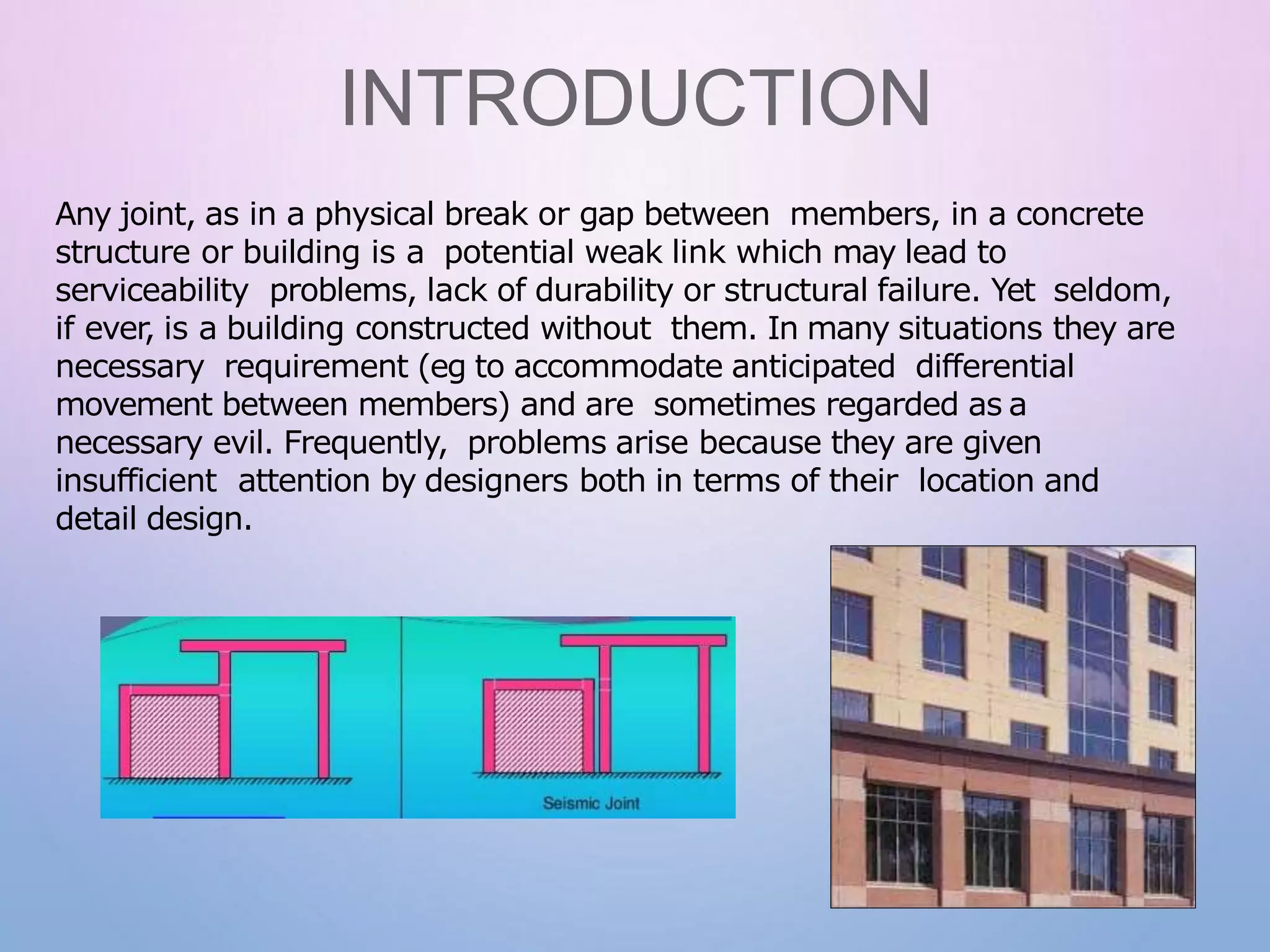
Any joint, as in a physical break or gap between members, in a concrete
structure or building is a potential weak link which may lead to
serviceability problems, lack of durability or structural failure. Yet seldom,
if ever, is a building constructed without them. In many situations they are
necessary requirement (eg to accommodate anticipated differential
movement between members) and are sometimes regarded as a
necessary evil. Frequently, problems arise because they are given
insufficient attention by designers both in terms of their location and
detail design.
 Construction Joints
 Expansion Joints
 Contraction Joints
 Isolation Joints
TYPES OF JOINTS IN
CONSTRUCTION
CONSTRUCTION JOINTS
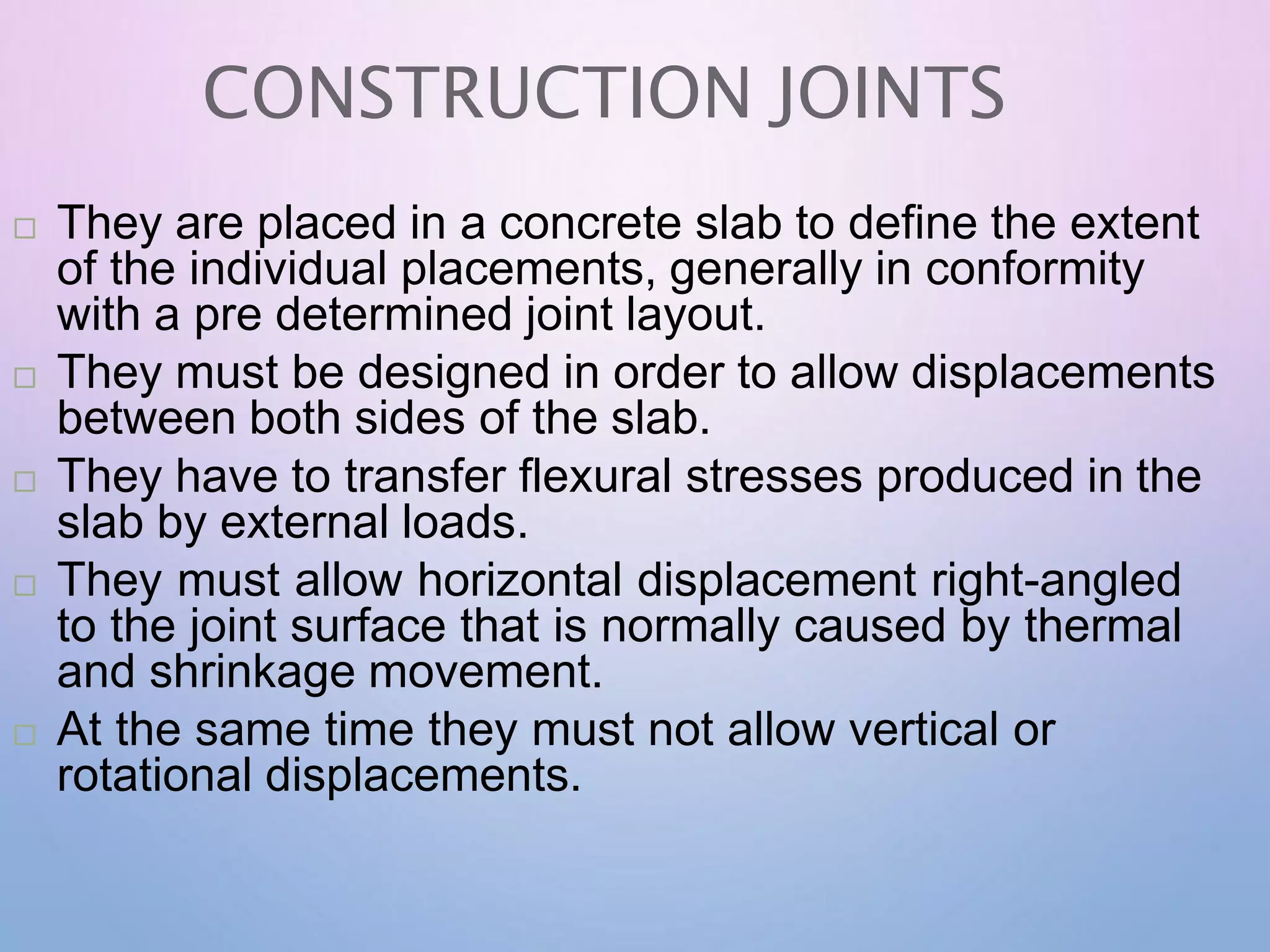
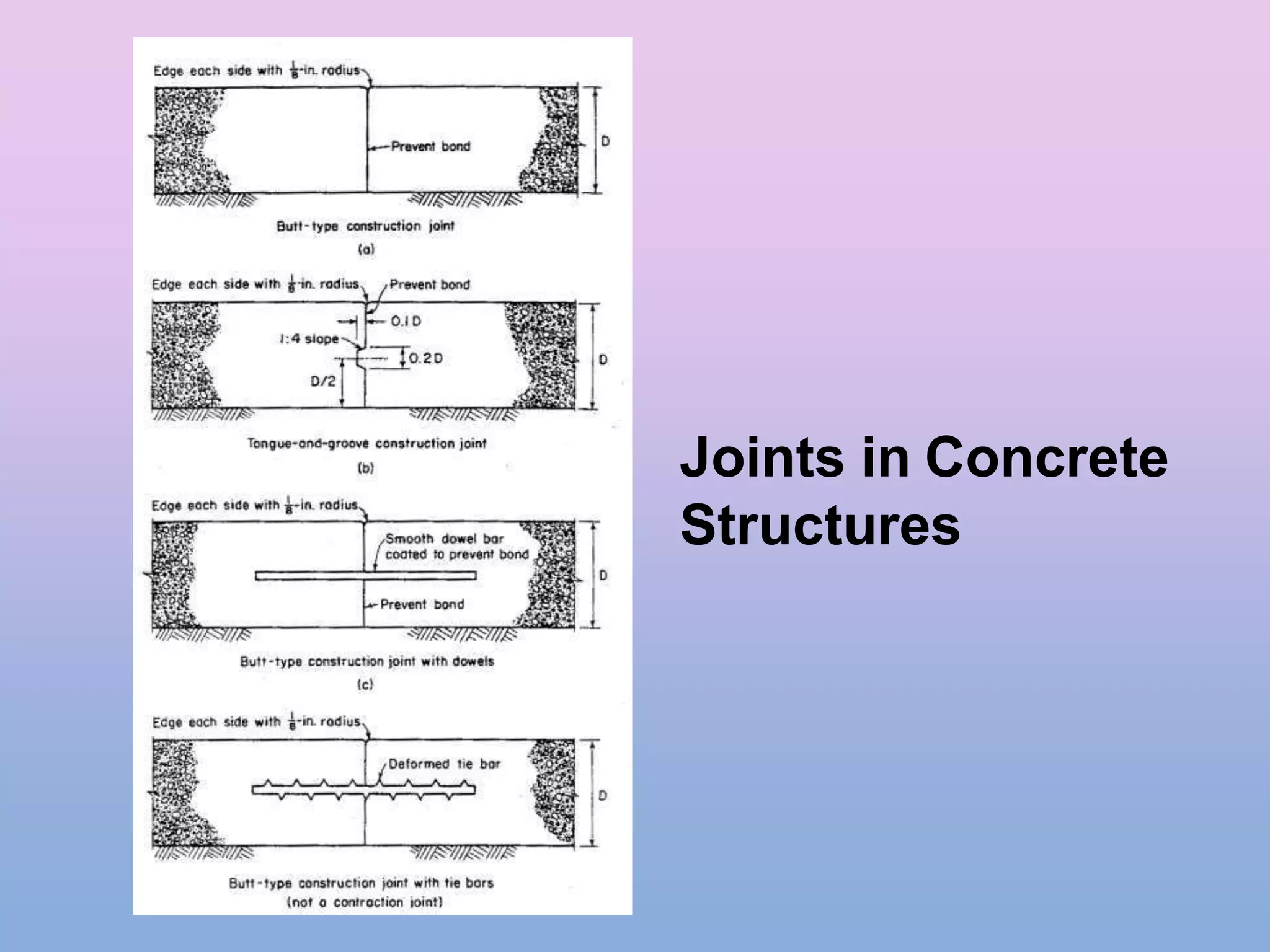
 They are placed in a concrete slab to define the extent
of the individual placements, generally in conformity
with a pre determined joint layout.
 They must be designed in order to allow displacements
between both sides of the slab.
 They have to transfer flexural stresses produced in the
slab by external loads.
 They must allow horizontal displacement right-angled
to the joint surface that is normally caused by thermal
and shrinkage movement.
 At the same time they must not allow vertical or
rotational displacements.
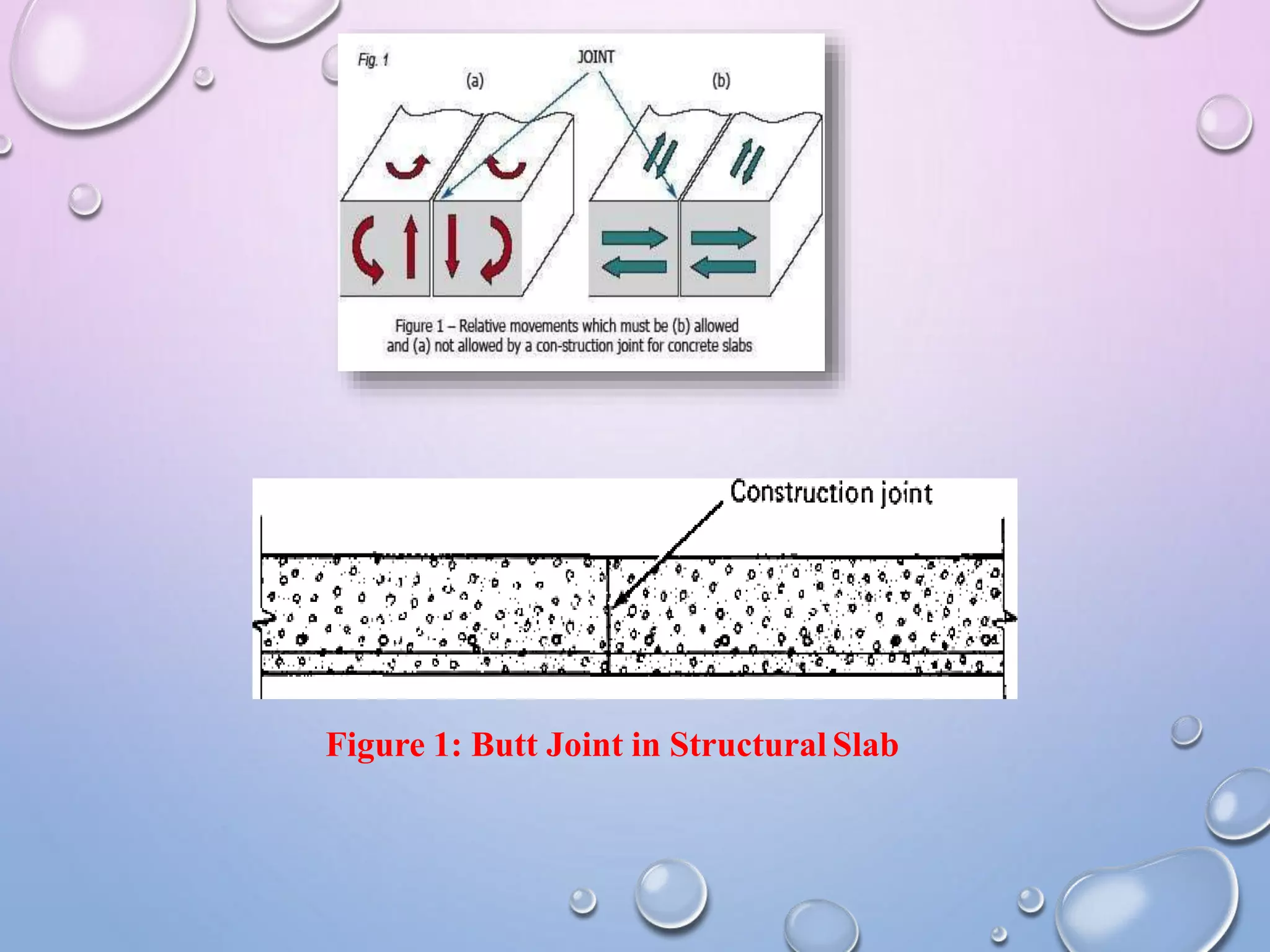
Figure 1: Butt Joint in Structural Slab
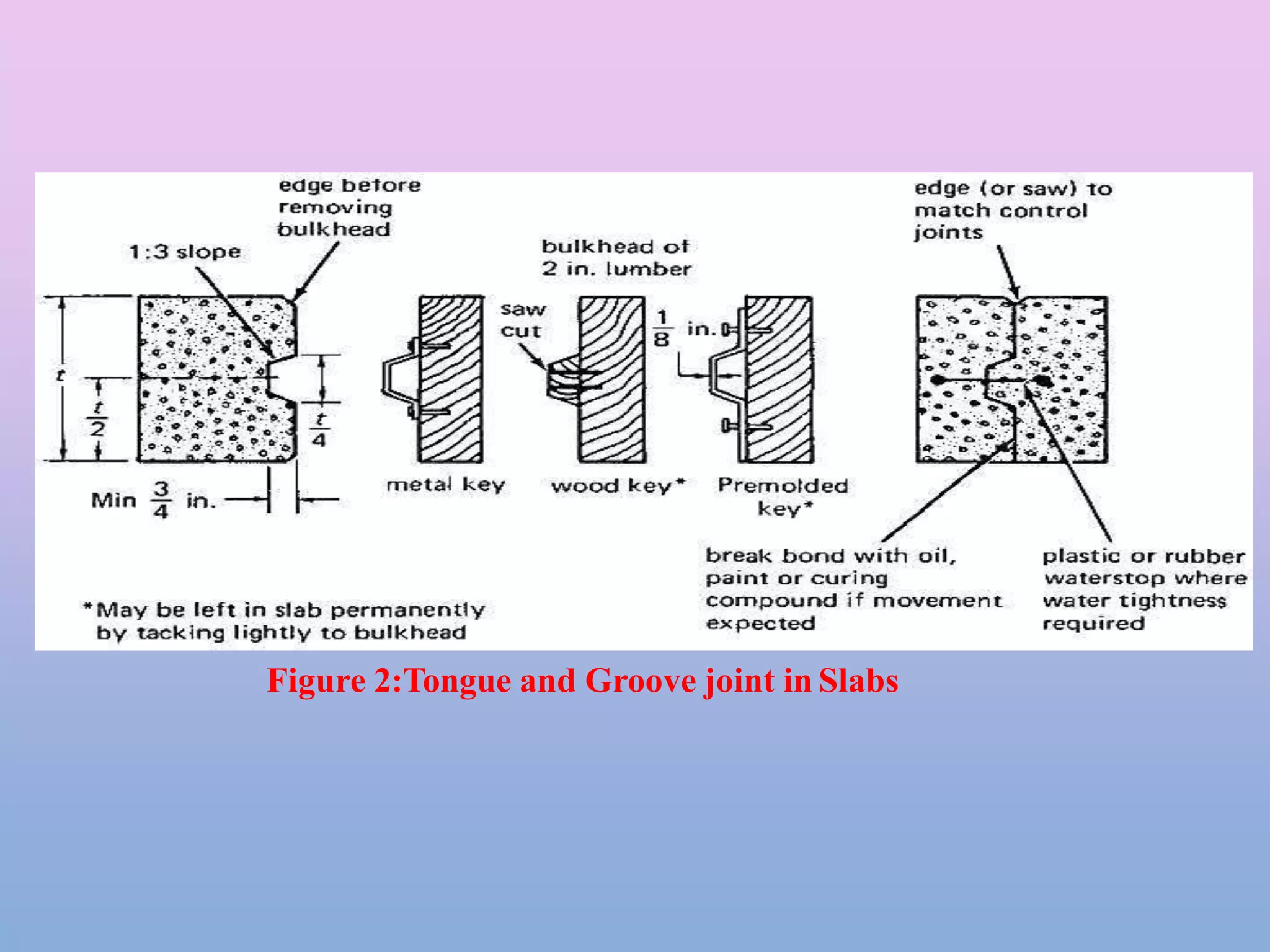
Figure 2:Tongue and Groove joint in Slabs
Joints in Concrete
Structures
EXPANSION JOINTS
 They are placed in concrete to prevent expansive
cracks formed due to temperature change.
 Concrete undergoes expansion due to high
temperature when in a confined boundary which
leads to cracks.
 Expansion joints are provided in slabs, pavements,
buildings, bridges, sidewalks, railway tracks, piping
systems, ships, and other structures.
 This article emphases on need of expansion joint in
concrete, characteristics of expansion joints, types of
expansion joint and installation of expansion joints.
CRACKS DEVELOPED DUE TO
EXPANSION OF
CONCRETE.
Figure 3 :Joints related to shapes of
Building
NEED OF EXPANSION JOINT IN
CONCRETE
 Concrete moves during expansion and shrinkage, due to
which the structural elements shift slightly.
 To prevent harmful effects due to concrete movement,
several expansion joints are incorporated in concrete
construction, including foundations, walls, roof
expansion joints, and paving slabs.
 These joints need to be carefully designed, located, and
installed.
 If a slab is positioned continuously on surfaces
exceeding one face, an expansion joint will be necessary
to reduce stresses.
 Concrete sealer may be used for the filling of gaps
produced by cracks.
CHARACTERISTICS OF
EXPANSION JOINTS
 They permits thermal contraction and expansion
without inducing stresses into the elements.
 It is designed to absorb safely the expansion and
contraction of several construction materials, absorb
vibrations, and permit soil movements due to
earthquakes or ground settlement.
 They are normally located between sections of
bridges, paving slabs, railway tracks, and piping
systems.
 They are incorporated to endure the stresses.
 It is simply a disconnection between segments of the
same materials.
 In the concrete block construction, they are expressed
as control joints.
LOCATION OF EXPANSION
JOINT
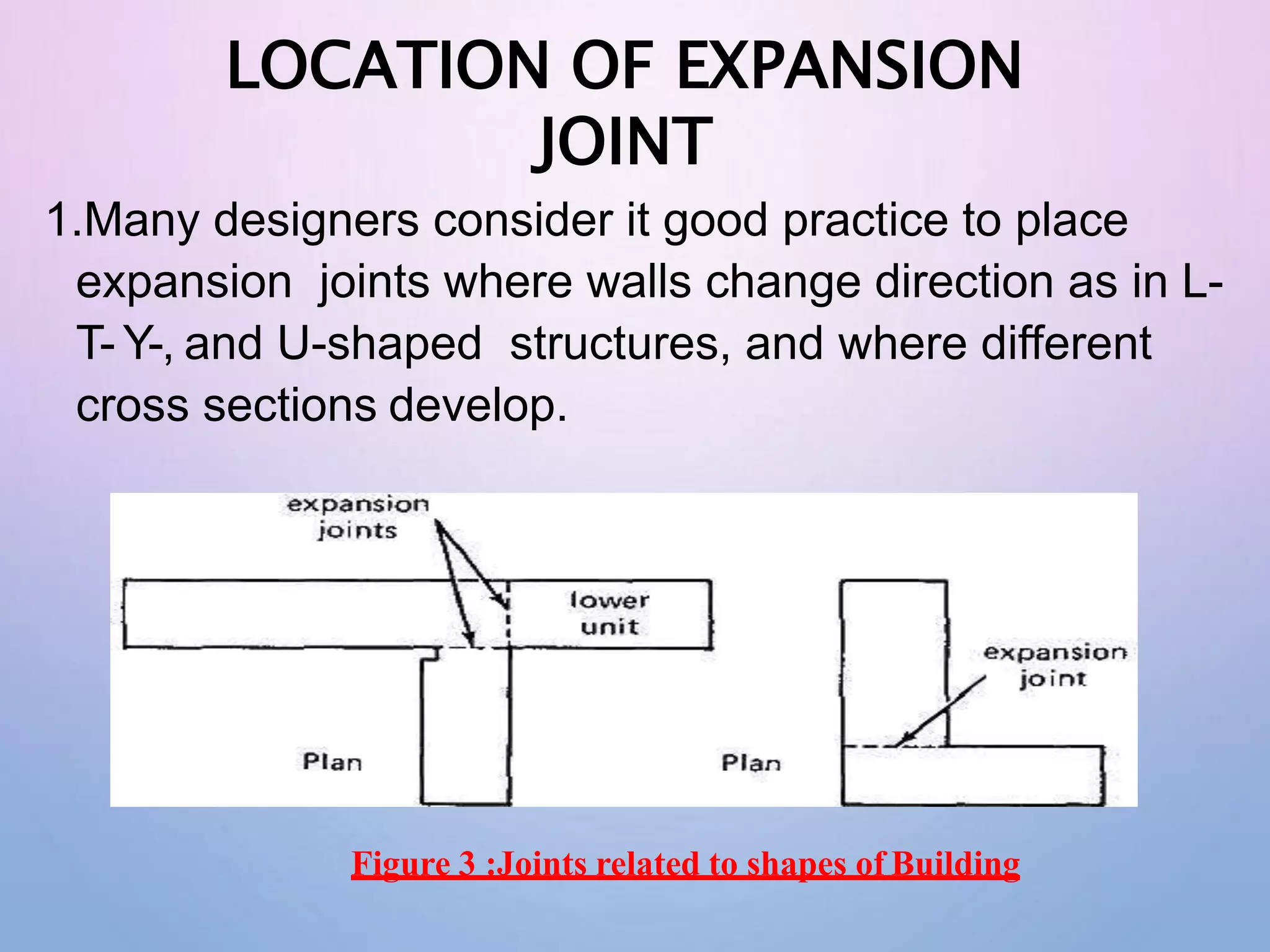
1.Many designers consider it good practice to place
expansion joints where walls change direction as in L-
T- Y-, and U-shaped structures, and where different
cross sections develop.
Figure 3 :Joints related to shapes of Building
2. Expansion joints may be necessary at the junction of
tall and short buildings (Fig.4) to avoid distress due to
differential settlements
3. When expansion joints are required in nonrectangular
structures,they should always be located at places where
the plan or elevation dimensions change radically.
Figure 4 :Joints related to shapes of Building
4. The simplest expansion joint is one on a column
line with double columns.
Figure 5 :Joints related to shapes of Building
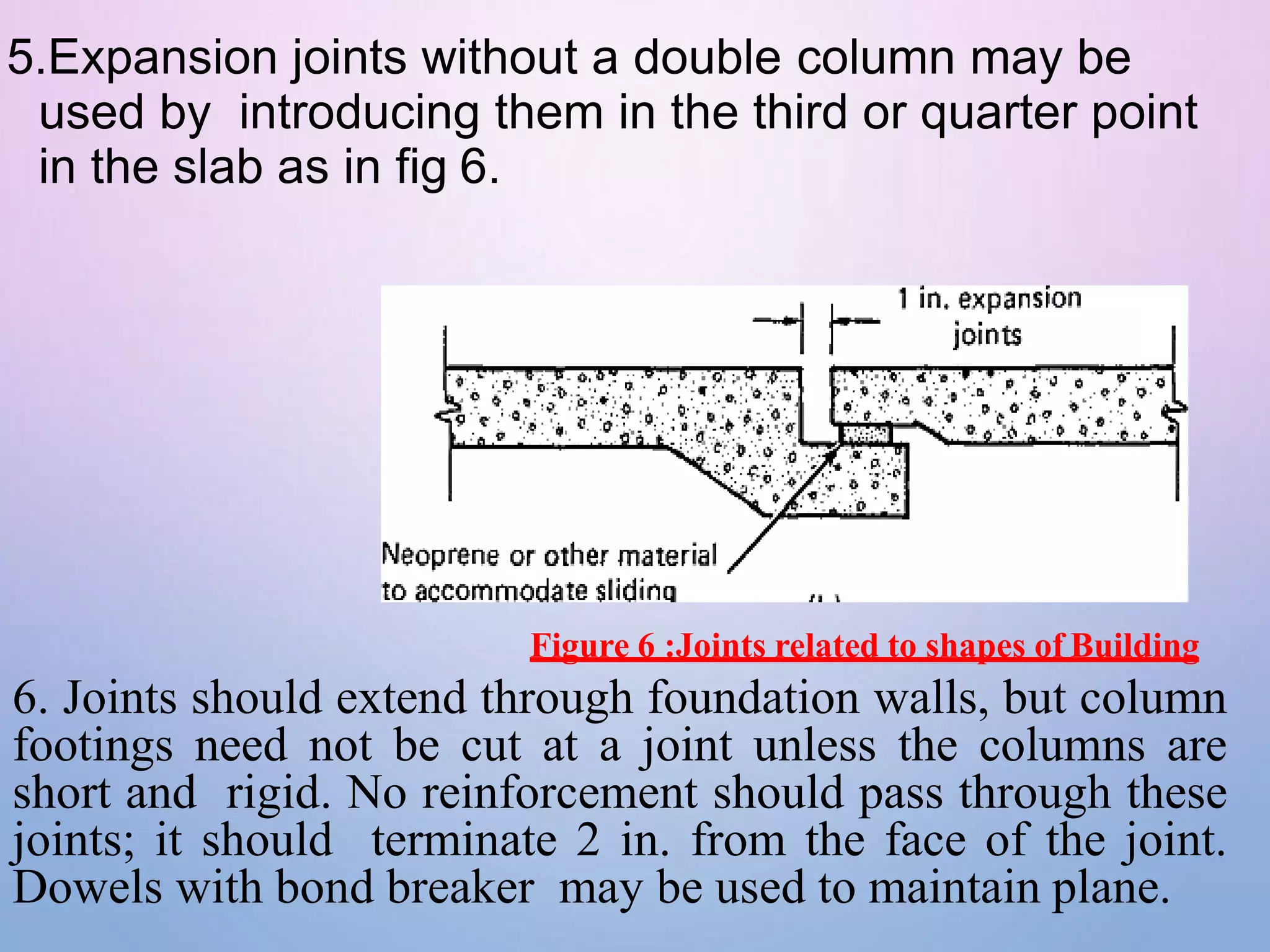
5.Expansion joints without a double column may be
used by introducing them in the third or quarter point
in the slab as in fig 6.
Figure 6 :Joints related to shapes of Building
6. Joints should extend through foundation walls, but column
footings need not be cut at a joint unless the columns are
short and rigid. No reinforcement should pass through these
joints; it should terminate 2 in. from the face of the joint.
Dowels with bond breaker may be used to maintain plane.
INSTALLATION OF EXPANSION
JOINTS
 The depth of an expansion joint is usually one
fourth of the slab thickness, or more if necessary.
 The expansion joint gap depends on the type of
slab, like floating slab floor, vehicle pavement,
sidewalk, or monolithic slab foundation.
 It is also influenced by the slab dimensions, type
of concrete, and the reinforcing materials being
used.
 Cracks in concrete may occur at the expansion
joints due to improper concrete mix or curing.
 These conditions cause shrinkage between the
expansion joints and cracks can be formed.
Pre-Concrete Installation
 When the site is prepared for the concrete pouring
and the provisioning of the expansion joints in
slabs are made prior to the placing of concrete.
 An individual expansion joint is created by the
insertion of a flexible material that runs along the
joint length.
After Concrete Installation
 Once the concrete is set, suitable tools are used
for making grooves in the poured concrete for
placing of the joint materials.
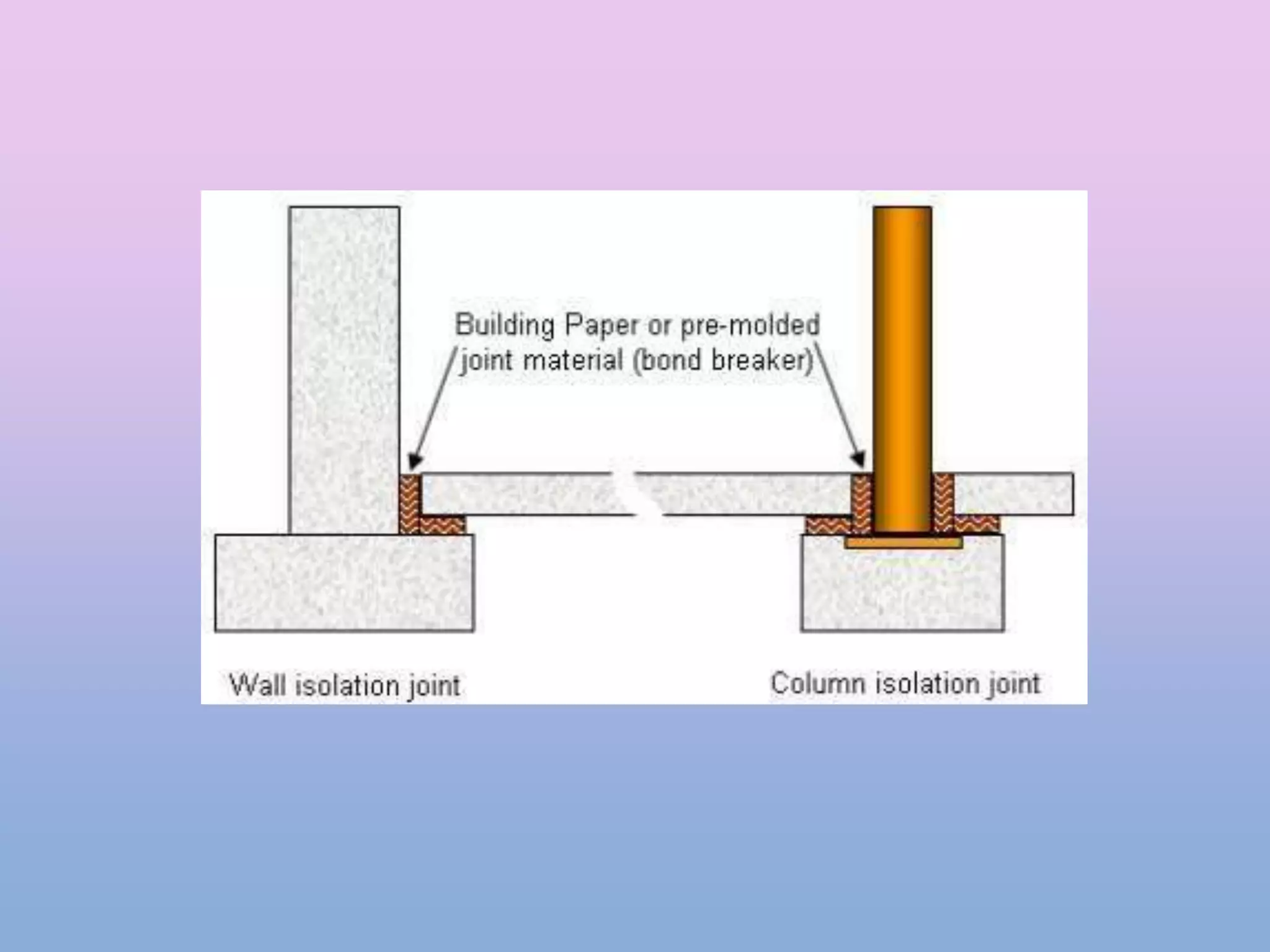
ISOLATION JOINTS
 The joints provided to accommodate the expansion of
adjacent parts in a building are known as expansion
joints.
 They allow movement to occur between a concrete
slab and adjoining columns and walls of a building.
 They are provided to separate new concrete from
existing or adjacent construction, which might expand
and contract differently or experience different soil
settlement or other movement.
 If the fresh concrete were not separated from these
elements by an isolation joint, a crack could form
where the two meet.
 The should be 1/4 in. to 1/2 in. wide, and filled with a
molded fiber, cork, or rubber strip that is set 1/4 in.
below the surface.
CONTRACTION
JOINTS
CONTRACTION
JOINTS
• A contraction joint is formed by creating a plane of weakness. Some,
or all, of the reinforcement may be terminated on either side of the
plane. Some contraction joints, termed “partial contraction joints,”
allow a portion of the steel to pass through the joint. These joints,
however, are used primarily in water-retaining structures.
• Contraction joints consist of a region with a reduced concrete cross
section and reduced reinforcement. The concrete cross section should
be reduced by a minimum of 25 percent to ensure that the section is
weak enough for a crack to form
CONTRACTION JOINTS
• In terms of reinforcement, there are two types of contraction joints
1. Full contraction joints (ACI 350R).
2. Partial contraction joints (ACI 350R).
• Full contraction joints:
Full Contraction joints are constructed with a complete break in
reinforcement at the joint. Reinforcement is stopped about 2 in.
from the joint and a bond breaker placed between successive
placements at construction joints.
• Partial contraction joints:
A portion of the reinforcement passes through the joint in partial
contraction joints. Partial contraction joints are also used in liquid
containment structures.
CONTRACTION
JOINTS
• Water stoppers can be used to ensure water tightness in full and
partial contraction.
• Contraction and expansion joints within a structure should pass
through the entire structure in one plane. If the joints are not aligned,
movement at a joint may induce cracking in an un-jointed portion of
the structure until the crack intercepts another joint.
LOCATION OF CONTRACTION
JOINTS
• Table 1.1 shows recommendations for contraction joint spacing.
• Recommended spacing's vary from 15 to 30 ft (4.6 to 9.2 m) and
from one to three times the wall height.
• The Portland Cement Association (1982) recommends that
contraction joints be placed at openings in walls, as illustrated in Fig.
3.1. Sometimes this may not be possible.
CONTRACTION JOINT
SPACING
LOCATION OF CONTRACTION
JOINT
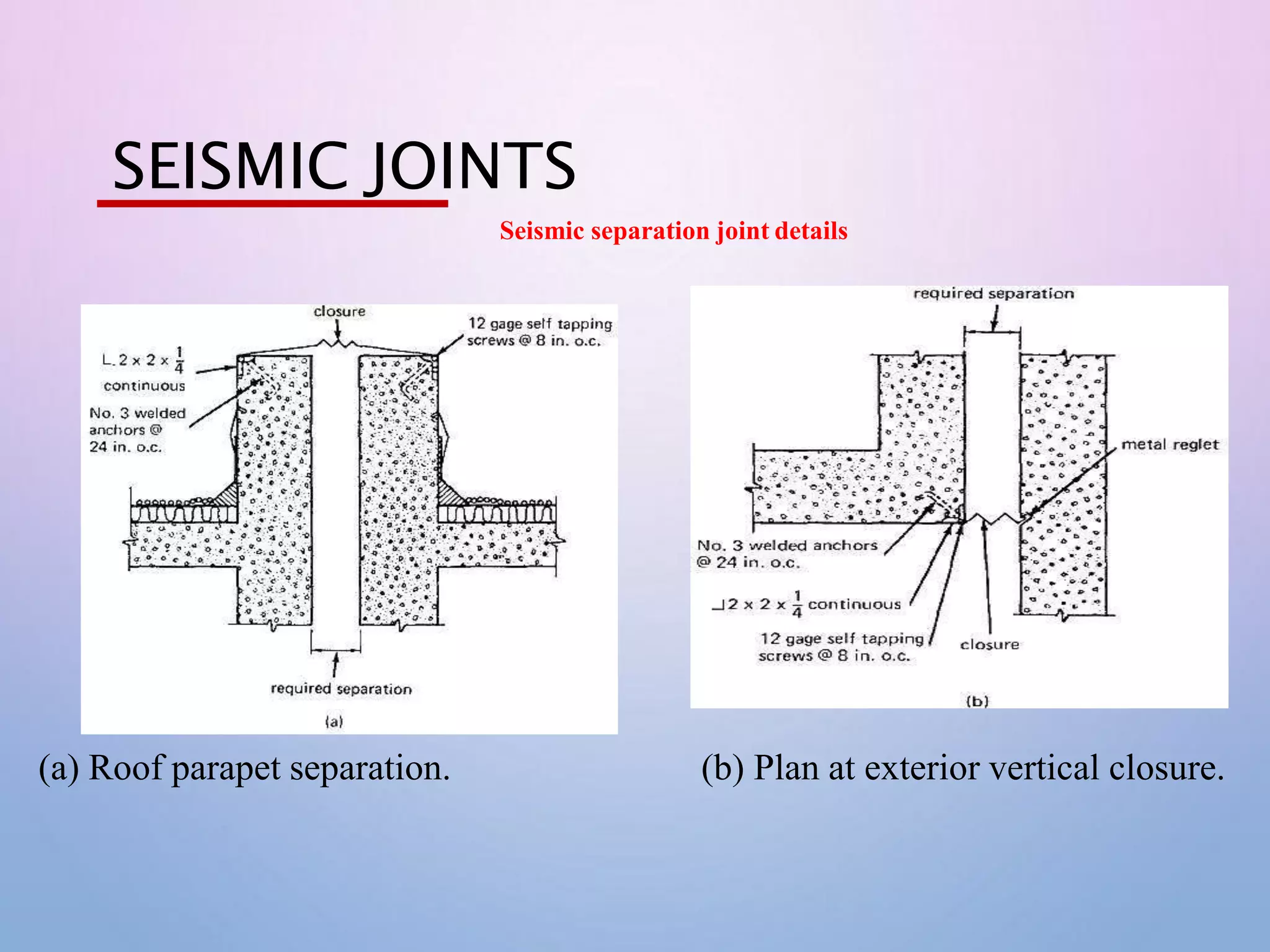
SEISMIC JOINTS
• Seismic joints are wide expansion joints provide to separate portions
of buildings dissimilar in mass and in stiffness. The seismic joint
coverage must allow movement, and be architecturally acceptable.
• The width of a seismic joint should be equal to the sum of the total
deflections at the level involved from the base of the two buildings,
but not less than the arbitrary rule of 1 in. for the first 20 ft of height
above the ground, plus 1/2 in. for each 10 ft additional height.
• The determination of these deflections will be the summation of the
story drift in addition to the building's flexural deflection to the level
involved. Shear wall buildings, being much stiffer, need a seismic
joint only ,say, half as wide, since the earthquake oscillations of shear
wall buildings will be much smaller than those of framed buildings.
SEISMIC JOINTS
(a) Roof parapet separation. (b) Plan at exterior vertical closure.
Seismic separation joint details
SEISMIC JOINTS
• Nonsymmetrical configuration with reentrant corners (e.g., L-or H-
shaped buildings) are particularly susceptible to destructive torsional
effects. Primary damage often occurs at the reentrant corners.
• Allowing separate building masses to vibrate independently by using
seismic separator joints that allow free movement to occur generally
improves structural performance.
THANK YOU….

Joints ppt devesh

  • 1.
    ASSIGNMENT ON CONCRETE JOINTSIN BUILDINGS SUBMITTED TO – AR.RICHA GUPTA SUBMITTED BY- DEVESH TRIPA B – ARCH 4TH YEAR CONSTRUCTION AND MATERIALS
  • 2.
    INTRODUCTION Any joint, asin a physical break or gap between members, in a concrete structure or building is a potential weak link which may lead to serviceability problems, lack of durability or structural failure. Yet seldom, if ever, is a building constructed without them. In many situations they are necessary requirement (eg to accommodate anticipated differential movement between members) and are sometimes regarded as a necessary evil. Frequently, problems arise because they are given insufficient attention by designers both in terms of their location and detail design.
  • 3.
     Construction Joints Expansion Joints  Contraction Joints  Isolation Joints TYPES OF JOINTS IN CONSTRUCTION
  • 4.
    CONSTRUCTION JOINTS  Theyare placed in a concrete slab to define the extent of the individual placements, generally in conformity with a pre determined joint layout.  They must be designed in order to allow displacements between both sides of the slab.  They have to transfer flexural stresses produced in the slab by external loads.  They must allow horizontal displacement right-angled to the joint surface that is normally caused by thermal and shrinkage movement.  At the same time they must not allow vertical or rotational displacements.
  • 5.
    Figure 1: ButtJoint in Structural Slab
  • 6.
    Figure 2:Tongue andGroove joint in Slabs
  • 7.
  • 8.
    EXPANSION JOINTS  Theyare placed in concrete to prevent expansive cracks formed due to temperature change.  Concrete undergoes expansion due to high temperature when in a confined boundary which leads to cracks.  Expansion joints are provided in slabs, pavements, buildings, bridges, sidewalks, railway tracks, piping systems, ships, and other structures.  This article emphases on need of expansion joint in concrete, characteristics of expansion joints, types of expansion joint and installation of expansion joints.
  • 9.
    CRACKS DEVELOPED DUETO EXPANSION OF CONCRETE. Figure 3 :Joints related to shapes of Building
  • 10.
    NEED OF EXPANSIONJOINT IN CONCRETE  Concrete moves during expansion and shrinkage, due to which the structural elements shift slightly.  To prevent harmful effects due to concrete movement, several expansion joints are incorporated in concrete construction, including foundations, walls, roof expansion joints, and paving slabs.  These joints need to be carefully designed, located, and installed.  If a slab is positioned continuously on surfaces exceeding one face, an expansion joint will be necessary to reduce stresses.  Concrete sealer may be used for the filling of gaps produced by cracks.
  • 11.
    CHARACTERISTICS OF EXPANSION JOINTS They permits thermal contraction and expansion without inducing stresses into the elements.  It is designed to absorb safely the expansion and contraction of several construction materials, absorb vibrations, and permit soil movements due to earthquakes or ground settlement.  They are normally located between sections of bridges, paving slabs, railway tracks, and piping systems.  They are incorporated to endure the stresses.  It is simply a disconnection between segments of the same materials.  In the concrete block construction, they are expressed as control joints.
  • 12.
    LOCATION OF EXPANSION JOINT 1.Manydesigners consider it good practice to place expansion joints where walls change direction as in L- T- Y-, and U-shaped structures, and where different cross sections develop. Figure 3 :Joints related to shapes of Building
  • 13.
    2. Expansion jointsmay be necessary at the junction of tall and short buildings (Fig.4) to avoid distress due to differential settlements 3. When expansion joints are required in nonrectangular structures,they should always be located at places where the plan or elevation dimensions change radically. Figure 4 :Joints related to shapes of Building
  • 14.
    4. The simplestexpansion joint is one on a column line with double columns. Figure 5 :Joints related to shapes of Building
  • 15.
    5.Expansion joints withouta double column may be used by introducing them in the third or quarter point in the slab as in fig 6. Figure 6 :Joints related to shapes of Building 6. Joints should extend through foundation walls, but column footings need not be cut at a joint unless the columns are short and rigid. No reinforcement should pass through these joints; it should terminate 2 in. from the face of the joint. Dowels with bond breaker may be used to maintain plane.
  • 16.
    INSTALLATION OF EXPANSION JOINTS The depth of an expansion joint is usually one fourth of the slab thickness, or more if necessary.  The expansion joint gap depends on the type of slab, like floating slab floor, vehicle pavement, sidewalk, or monolithic slab foundation.  It is also influenced by the slab dimensions, type of concrete, and the reinforcing materials being used.  Cracks in concrete may occur at the expansion joints due to improper concrete mix or curing.  These conditions cause shrinkage between the expansion joints and cracks can be formed.
  • 17.
    Pre-Concrete Installation  Whenthe site is prepared for the concrete pouring and the provisioning of the expansion joints in slabs are made prior to the placing of concrete.  An individual expansion joint is created by the insertion of a flexible material that runs along the joint length. After Concrete Installation  Once the concrete is set, suitable tools are used for making grooves in the poured concrete for placing of the joint materials.
  • 18.
    ISOLATION JOINTS  Thejoints provided to accommodate the expansion of adjacent parts in a building are known as expansion joints.  They allow movement to occur between a concrete slab and adjoining columns and walls of a building.  They are provided to separate new concrete from existing or adjacent construction, which might expand and contract differently or experience different soil settlement or other movement.  If the fresh concrete were not separated from these elements by an isolation joint, a crack could form where the two meet.  The should be 1/4 in. to 1/2 in. wide, and filled with a molded fiber, cork, or rubber strip that is set 1/4 in. below the surface.
  • 20.
  • 21.
    CONTRACTION JOINTS • A contractionjoint is formed by creating a plane of weakness. Some, or all, of the reinforcement may be terminated on either side of the plane. Some contraction joints, termed “partial contraction joints,” allow a portion of the steel to pass through the joint. These joints, however, are used primarily in water-retaining structures. • Contraction joints consist of a region with a reduced concrete cross section and reduced reinforcement. The concrete cross section should be reduced by a minimum of 25 percent to ensure that the section is weak enough for a crack to form
  • 22.
    CONTRACTION JOINTS • Interms of reinforcement, there are two types of contraction joints 1. Full contraction joints (ACI 350R). 2. Partial contraction joints (ACI 350R). • Full contraction joints: Full Contraction joints are constructed with a complete break in reinforcement at the joint. Reinforcement is stopped about 2 in. from the joint and a bond breaker placed between successive placements at construction joints. • Partial contraction joints: A portion of the reinforcement passes through the joint in partial contraction joints. Partial contraction joints are also used in liquid containment structures.
  • 23.
    CONTRACTION JOINTS • Water stopperscan be used to ensure water tightness in full and partial contraction. • Contraction and expansion joints within a structure should pass through the entire structure in one plane. If the joints are not aligned, movement at a joint may induce cracking in an un-jointed portion of the structure until the crack intercepts another joint.
  • 24.
    LOCATION OF CONTRACTION JOINTS •Table 1.1 shows recommendations for contraction joint spacing. • Recommended spacing's vary from 15 to 30 ft (4.6 to 9.2 m) and from one to three times the wall height. • The Portland Cement Association (1982) recommends that contraction joints be placed at openings in walls, as illustrated in Fig. 3.1. Sometimes this may not be possible.
  • 25.
  • 26.
  • 27.
    SEISMIC JOINTS • Seismicjoints are wide expansion joints provide to separate portions of buildings dissimilar in mass and in stiffness. The seismic joint coverage must allow movement, and be architecturally acceptable. • The width of a seismic joint should be equal to the sum of the total deflections at the level involved from the base of the two buildings, but not less than the arbitrary rule of 1 in. for the first 20 ft of height above the ground, plus 1/2 in. for each 10 ft additional height. • The determination of these deflections will be the summation of the story drift in addition to the building's flexural deflection to the level involved. Shear wall buildings, being much stiffer, need a seismic joint only ,say, half as wide, since the earthquake oscillations of shear wall buildings will be much smaller than those of framed buildings.
  • 28.
    SEISMIC JOINTS (a) Roofparapet separation. (b) Plan at exterior vertical closure. Seismic separation joint details
  • 29.
    SEISMIC JOINTS • Nonsymmetricalconfiguration with reentrant corners (e.g., L-or H- shaped buildings) are particularly susceptible to destructive torsional effects. Primary damage often occurs at the reentrant corners. • Allowing separate building masses to vibrate independently by using seismic separator joints that allow free movement to occur generally improves structural performance.
  • 31.