Cast Iron 
Created 
BY
Contents : 
 History of Cast iron 
 Introduction of Cast iron 
 Types of Cast iron 
 Properties of Cast iron 
 Advantages of Cast iron 
 Limitations of Cast iron 
 Application of Cast iron
HISTORY OF CAST IRON : 
 Cast iron has its earliest origins in China between 700 and 800 BC and in Europe it 
was first known in the 14th century. 
 Until this period ancient furnaces could not reach sufficiently high temperatures. 
 The use of this newly discovered form of iron varied from simple tools to a complex 
chain suspension bridge erected approximately 56 A.D. 
 Cast iron was not produced in mass quantity until fourteenth century A.D. 
 In 1325 A.D. water driven bellows were introduced which allowed for a greater draft to 
be fed to the pit, thus increasing temperatures.
 The next significant development in cast iron was the first use of coke 
in 1730 by an English founder named Darby. 
 Coke could be used more efficiently than coal, thus lowering the cost 
and time necessary to yield a final product. 
 In 1885 Turner added ferrosilicon to white iron to produce stronger 
gray iron castings. 
 In the later 20th century the major use of cast irons consisted of 
pipes, thermal containment units, and certain machine or building 
entities which were necessary to absorb continuous vibrations.
Introduction of Cast iron : 
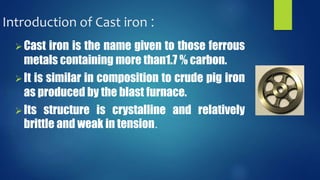
 Cast iron is the name given to those ferrous 
metals containing more than1.7 % carbon. 
 It is similar in composition to crude pig iron 
as produced by the blast furnace. 
 Its structure is crystalline and relatively 
brittle and weak in tension.
COMPOSTION OF CAST IRON : 
 Carbon - 2.5 to 3.7% 
 Silicon - 1.0 to 3.0% 
 Manganese - 0.5 to 1.0% 
Phosphorus - 0.1 to 0.9% 
 Sulphur - 0.07 to 0.10%
CLASSIFICATIONS OF CAST IRON : 
There are Four Types Of Cast Iron . 
They are:- 
1.WHITE CAST IRON 
2.GRAY CAST IRON 
3.DUCTILE (NODULAR) CAST IRON 
4.MALLEABLE CAST IRON
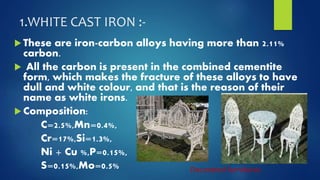
1.WHITE CAST IRON :- 
 These are iron-carbon alloys having more than 2.11% 
carbon. 
 All the carbon is present in the combined cementite 
form, which makes the fracture of these alloys to have 
dull and white colour, and that is the reason of their 
name as white irons. 
Composition: 
C=2.5%,Mn=0.4%, 
Cr=17%,Si=1.3%, 
Ni + Cu %,P=0.15%, 
S=0.15%,Mo=0.5% Decorated furnitures
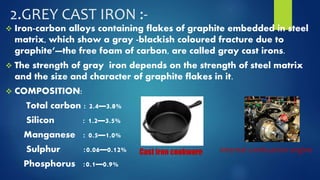
2.GREY CAST IRON :- 
 Iron-carbon alloys containing flakes of graphite embedded in steel 
matrix, which show a gray -blackish coloured fracture due to 
graphite’—the free foam of carbon, are called gray cast irons. 
 The strength of gray iron depends on the strength of steel matrix 
and the size and character of graphite flakes in it. 
 COMPOSITION: 
Total carbon : 2.4—3.8% 
Silicon : 1.2—3.5% 
Manganese : 0.5—1.0% 
Sulphur :0.06—0.12% 
Phosphorus :0.1—0.9% 
Cast iron cookware Internal combustion engine
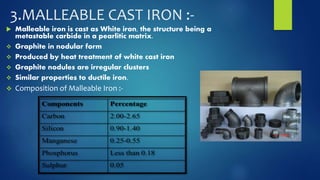
3.MALLEABLE CAST IRON :- 
 Malleable iron is cast as White iron, the structure being a 
metastable carbide in a pearlitic matrix. 
 Graphite in nodular form 
 Produced by heat treatment of white cast iron 
 Graphite nodules are irregular clusters 
 Similar properties to ductile iron. 
 Composition of Malleable Iron :-
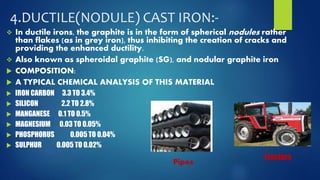
4.DUCTILE(NODULE) CAST IRON:- 
 In ductile irons, the graphite is in the form of spherical nodules rather 
than flakes (as in grey iron), thus inhibiting the creation of cracks and 
providing the enhanced ductility. 
 Also known as spheroidal graphite (SG), and nodular graphite iron 
 COMPOSITION: 
 A TYPICAL CHEMICAL ANALYSIS OF THIS MATERIAL 
 IRON CARBON 3.3 TO 3.4% 
 SILICON 2.2 TO 2.8% 
 MANGANESE 0.1 TO 0.5% 
 MAGNESIUM 0.03 TO 0.05% 
 PHOSPHORUS 0.005 TO 0.04% 
 SULPHUR 0.005 TO 0.02% 
Tracters 
Pipes
PROPERTIES OF CAST IRON : 
 It is strong in compression but weak in tension. 
 The tensile and compressive strength of cast iron of average quality is 
150N/mm²and 600N/mm² resp. 
 It does not rust easily. 
 If placed in salt water, it becomes soft. 
 low melting point 
 Good fluidity 
 It is hard but it is brittle also. 
 It is not ductile hence it cannot be adopted to absorb shocks and impacts. 
 Its melting temperature is about 1250⁰C. 
 It shrinks on cooling.
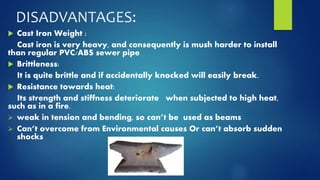
DISADVANTAGES: 
 Cast Iron Weight : 
Cast iron is very heavy, and consequently is mush harder to install 
than regular PVC/ABS sewer pipe 
 Brittleness: 
It is quite brittle and if accidentally knocked will easily break. 
 Resistance towards heat: 
Its strength and stiffness deteriorate when subjected to high heat, 
such as in a fire. 
 weak in tension and bending, so can’t be used as beams 
 Can’t overcome from Environmental causes Or can’t absorb sudden 
shocks
ADVANTAGES OF CAST IRON :- 
• Good castability (low Tm, good fluidility) 
• Good machinability (graphite cast irons) 
• Antivibration properties 
• Low stress concentration 
• Sensibility
APPLICATIONS OF CAST IRON: 
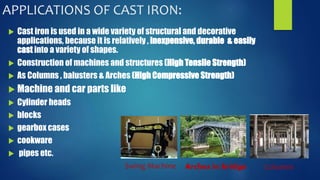
 Cast iron is used in a wide variety of structural and decorative 
applications, because it is relatively , inexpensive, durable & easily 
cast into a variety of shapes. 
 Construction of machines and structures (High Tensile Strength) 
 As Columns , balusters & Arches (High Compressive Strength) 
 Machine and car parts like 
 Cylinder heads 
 blocks 
 gearbox cases 
 cookware 
 pipes etc. 
Swing Machine Arches in bridge Columns
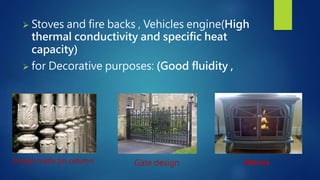
 Stoves and fire backs , Vehicles engine(High 
thermal conductivity and specific heat 
capacity) 
 for Decorative purposes: (Good fluidity , 
Design made on column Gate design Stoves
CAST IRON

CAST IRON

  • 1.
  • 2.
    Contents : History of Cast iron  Introduction of Cast iron  Types of Cast iron  Properties of Cast iron  Advantages of Cast iron  Limitations of Cast iron  Application of Cast iron
  • 3.
    HISTORY OF CASTIRON :  Cast iron has its earliest origins in China between 700 and 800 BC and in Europe it was first known in the 14th century.  Until this period ancient furnaces could not reach sufficiently high temperatures.  The use of this newly discovered form of iron varied from simple tools to a complex chain suspension bridge erected approximately 56 A.D.  Cast iron was not produced in mass quantity until fourteenth century A.D.  In 1325 A.D. water driven bellows were introduced which allowed for a greater draft to be fed to the pit, thus increasing temperatures.
  • 4.
     The nextsignificant development in cast iron was the first use of coke in 1730 by an English founder named Darby.  Coke could be used more efficiently than coal, thus lowering the cost and time necessary to yield a final product.  In 1885 Turner added ferrosilicon to white iron to produce stronger gray iron castings.  In the later 20th century the major use of cast irons consisted of pipes, thermal containment units, and certain machine or building entities which were necessary to absorb continuous vibrations.
  • 5.
    Introduction of Castiron :  Cast iron is the name given to those ferrous metals containing more than1.7 % carbon.  It is similar in composition to crude pig iron as produced by the blast furnace.  Its structure is crystalline and relatively brittle and weak in tension.
  • 6.
    COMPOSTION OF CASTIRON :  Carbon - 2.5 to 3.7%  Silicon - 1.0 to 3.0%  Manganese - 0.5 to 1.0% Phosphorus - 0.1 to 0.9%  Sulphur - 0.07 to 0.10%
  • 7.
    CLASSIFICATIONS OF CASTIRON : There are Four Types Of Cast Iron . They are:- 1.WHITE CAST IRON 2.GRAY CAST IRON 3.DUCTILE (NODULAR) CAST IRON 4.MALLEABLE CAST IRON
  • 8.
    1.WHITE CAST IRON:-  These are iron-carbon alloys having more than 2.11% carbon.  All the carbon is present in the combined cementite form, which makes the fracture of these alloys to have dull and white colour, and that is the reason of their name as white irons. Composition: C=2.5%,Mn=0.4%, Cr=17%,Si=1.3%, Ni + Cu %,P=0.15%, S=0.15%,Mo=0.5% Decorated furnitures
  • 9.
    2.GREY CAST IRON:-  Iron-carbon alloys containing flakes of graphite embedded in steel matrix, which show a gray -blackish coloured fracture due to graphite’—the free foam of carbon, are called gray cast irons.  The strength of gray iron depends on the strength of steel matrix and the size and character of graphite flakes in it.  COMPOSITION: Total carbon : 2.4—3.8% Silicon : 1.2—3.5% Manganese : 0.5—1.0% Sulphur :0.06—0.12% Phosphorus :0.1—0.9% Cast iron cookware Internal combustion engine
  • 10.
    3.MALLEABLE CAST IRON:-  Malleable iron is cast as White iron, the structure being a metastable carbide in a pearlitic matrix.  Graphite in nodular form  Produced by heat treatment of white cast iron  Graphite nodules are irregular clusters  Similar properties to ductile iron.  Composition of Malleable Iron :-
  • 11.
    4.DUCTILE(NODULE) CAST IRON:-  In ductile irons, the graphite is in the form of spherical nodules rather than flakes (as in grey iron), thus inhibiting the creation of cracks and providing the enhanced ductility.  Also known as spheroidal graphite (SG), and nodular graphite iron  COMPOSITION:  A TYPICAL CHEMICAL ANALYSIS OF THIS MATERIAL  IRON CARBON 3.3 TO 3.4%  SILICON 2.2 TO 2.8%  MANGANESE 0.1 TO 0.5%  MAGNESIUM 0.03 TO 0.05%  PHOSPHORUS 0.005 TO 0.04%  SULPHUR 0.005 TO 0.02% Tracters Pipes
  • 12.
    PROPERTIES OF CASTIRON :  It is strong in compression but weak in tension.  The tensile and compressive strength of cast iron of average quality is 150N/mm²and 600N/mm² resp.  It does not rust easily.  If placed in salt water, it becomes soft.  low melting point  Good fluidity  It is hard but it is brittle also.  It is not ductile hence it cannot be adopted to absorb shocks and impacts.  Its melting temperature is about 1250⁰C.  It shrinks on cooling.
  • 13.
    DISADVANTAGES:  CastIron Weight : Cast iron is very heavy, and consequently is mush harder to install than regular PVC/ABS sewer pipe  Brittleness: It is quite brittle and if accidentally knocked will easily break.  Resistance towards heat: Its strength and stiffness deteriorate when subjected to high heat, such as in a fire.  weak in tension and bending, so can’t be used as beams  Can’t overcome from Environmental causes Or can’t absorb sudden shocks
  • 14.
    ADVANTAGES OF CASTIRON :- • Good castability (low Tm, good fluidility) • Good machinability (graphite cast irons) • Antivibration properties • Low stress concentration • Sensibility
  • 15.
    APPLICATIONS OF CASTIRON:  Cast iron is used in a wide variety of structural and decorative applications, because it is relatively , inexpensive, durable & easily cast into a variety of shapes.  Construction of machines and structures (High Tensile Strength)  As Columns , balusters & Arches (High Compressive Strength)  Machine and car parts like  Cylinder heads  blocks  gearbox cases  cookware  pipes etc. Swing Machine Arches in bridge Columns
  • 16.
     Stoves andfire backs , Vehicles engine(High thermal conductivity and specific heat capacity)  for Decorative purposes: (Good fluidity , Design made on column Gate design Stoves