Stainless
Steel
Presented By:
Muhammad Hassam (IM-114)
Syed Taha Ahmed (IM-096)
Syed Zia Uddin Nizami (IM-103)
Faisal Siddique Awan (IM-118)
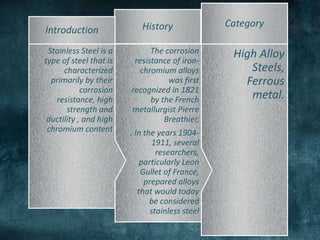
High Alloy
Steels,
Ferrous
metal.
Category
The corrosion
resistance of iron-
chromium alloys
was first
recognized in 1821
by the French
metallurgist Pierre
Breathier,
. In the years 1904-
1911, several
researchers,
particularly Leon
Gullet of France,
prepared alloys
that would today
be considered
stainless steel
.
History
Stainless Steel is a
type of steel that is
characterized
primarily by their
corrosion
resistance, high
strength and
ductility , and high
chromium content
Introduction
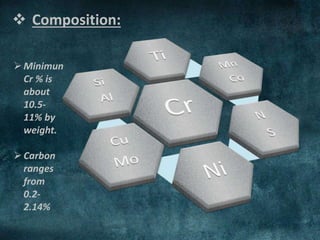
 Composition:
Minimun
Cr % is
about
10.5-
11% by
weight.
Carbon
ranges
from
0.2-
2.14%
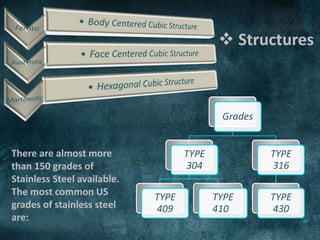
Austenitic
(200 and 300 series)
Ferrite
(400 series)
Martensitic (400 and
500 series)
Precipitation-
hardening (PH)
Duplex
structure
T
y
p
e
s
 Structures
Grades
TYPE
304
TYPE
409
TYPE
410
TYPE
316
TYPE
430
There are almost more
than 150 grades of
Stainless Steel available.
The most common US
grades of stainless steel
are:
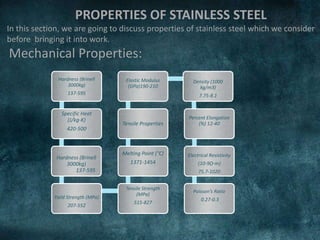
Hardness (Brinell
3000kg)
137-595
Specific Heat
(J/kg-K)
420-500
Hardness (Brinell
3000kg)
137-595
Yield Strength (MPa)
207-552
Tensile Strength
(MPa)
515-827
Melting Point (°C)
1371-1454
Tensile Properties
Elastic Modulus
(GPa)190-210
Density (1000
kg/m3)
7.75-8.1
Percent Elongation
(%) 12-40
Electrical Resistivity
(10-9ῼ-m)
75.7-1020
Poisson's Ratio
0.27-0.3
PROPERTIES OF STAINLESS STEEL
In this section, we are going to discuss properties of stainless steel which we consider
before bringing it into work.
Mechanical Properties:
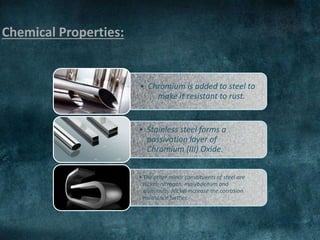
Chemical Properties:
• Chromium is added to steel to
make it resistant to rust.
• Stainless steel forms a
passivation layer of
Chromium (III) Oxide.
•The other minor constituents of steel are
nickel, nitrogen, molybdenum and
aluminum. Nickel increase the corrosion
resistance further.
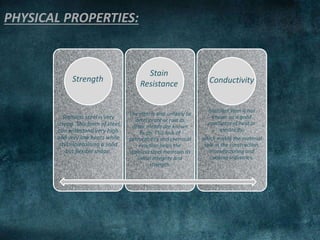
PHYSICAL PROPERTIES:
Stainless steel is very
strong. This form of steel
can withstand very high
and very low heats while
still maintaining a solid
but flexible shape.
The steel is also unlikely to
deteriorate or rust as
other metals are known
to do. This lack of
permeability and chemical
reaction helps the
stainless steel maintain its
initial integrity and
strength.
Stainless steel is not
known as a good
conductor of heat or
electricity,
which makes the material
safe in the construction,
manufacturing and
cooking industries.
Strength
Stain
Resistance Conductivity
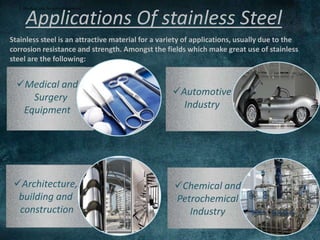
Applications Of stainless Steel
Stainless steel is an attractive material for a variety of applications, usually due to the
corrosion resistance and strength. Amongst the fields which make great use of stainless
steel are the following:
I. Medical and Surgery Equipment:
Medical and
Surgery
Equipment
Automotive
Industry
Chemical and
Petrochemical
Industry
Architecture,
building and
construction
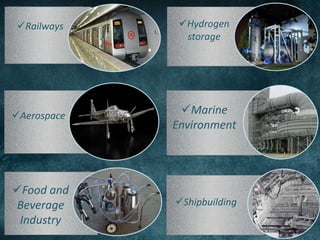
Railways Hydrogen
storage
Aerospace
En
Marine
Environment
Food and
Beverage
Industry
EnShipbuilding
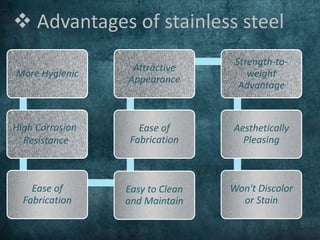
 Advantages of stainless steel
More Hygienic
Ease of
Fabrication
Easy to Clean
and Maintain
Ease of
Fabrication
Attractive
Appearance
Strength-to-
weight
Advantage
Aesthetically
Pleasing
Won't Discolor
or Stain
High Corrosion
Resistance
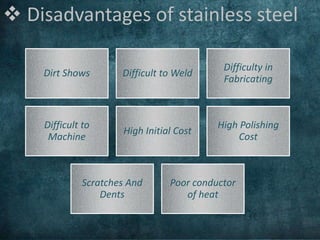
 Disadvantages of stainless steel
Dirt Shows Difficult to Weld
Difficulty in
Fabricating
Difficult to
Machine
High Initial Cost
High Polishing
Cost
Scratches And
Dents
Poor conductor
of heat
Thank You

Stainless steel

  • 1.
    Stainless Steel Presented By: Muhammad Hassam(IM-114) Syed Taha Ahmed (IM-096) Syed Zia Uddin Nizami (IM-103) Faisal Siddique Awan (IM-118)
  • 2.
    High Alloy Steels, Ferrous metal. Category The corrosion resistanceof iron- chromium alloys was first recognized in 1821 by the French metallurgist Pierre Breathier, . In the years 1904- 1911, several researchers, particularly Leon Gullet of France, prepared alloys that would today be considered stainless steel . History Stainless Steel is a type of steel that is characterized primarily by their corrosion resistance, high strength and ductility , and high chromium content Introduction
  • 3.
     Composition: Minimun Cr %is about 10.5- 11% by weight. Carbon ranges from 0.2- 2.14%
  • 4.
    Austenitic (200 and 300series) Ferrite (400 series) Martensitic (400 and 500 series) Precipitation- hardening (PH) Duplex structure T y p e s
  • 5.
     Structures Grades TYPE 304 TYPE 409 TYPE 410 TYPE 316 TYPE 430 There arealmost more than 150 grades of Stainless Steel available. The most common US grades of stainless steel are:
  • 6.
    Hardness (Brinell 3000kg) 137-595 Specific Heat (J/kg-K) 420-500 Hardness(Brinell 3000kg) 137-595 Yield Strength (MPa) 207-552 Tensile Strength (MPa) 515-827 Melting Point (°C) 1371-1454 Tensile Properties Elastic Modulus (GPa)190-210 Density (1000 kg/m3) 7.75-8.1 Percent Elongation (%) 12-40 Electrical Resistivity (10-9ῼ-m) 75.7-1020 Poisson's Ratio 0.27-0.3 PROPERTIES OF STAINLESS STEEL In this section, we are going to discuss properties of stainless steel which we consider before bringing it into work. Mechanical Properties:
  • 7.
    Chemical Properties: • Chromiumis added to steel to make it resistant to rust. • Stainless steel forms a passivation layer of Chromium (III) Oxide. •The other minor constituents of steel are nickel, nitrogen, molybdenum and aluminum. Nickel increase the corrosion resistance further.
  • 8.
    PHYSICAL PROPERTIES: Stainless steelis very strong. This form of steel can withstand very high and very low heats while still maintaining a solid but flexible shape. The steel is also unlikely to deteriorate or rust as other metals are known to do. This lack of permeability and chemical reaction helps the stainless steel maintain its initial integrity and strength. Stainless steel is not known as a good conductor of heat or electricity, which makes the material safe in the construction, manufacturing and cooking industries. Strength Stain Resistance Conductivity
  • 9.
    Applications Of stainlessSteel Stainless steel is an attractive material for a variety of applications, usually due to the corrosion resistance and strength. Amongst the fields which make great use of stainless steel are the following: I. Medical and Surgery Equipment: Medical and Surgery Equipment Automotive Industry Chemical and Petrochemical Industry Architecture, building and construction
  • 10.
  • 11.
     Advantages ofstainless steel More Hygienic Ease of Fabrication Easy to Clean and Maintain Ease of Fabrication Attractive Appearance Strength-to- weight Advantage Aesthetically Pleasing Won't Discolor or Stain High Corrosion Resistance
  • 12.
     Disadvantages ofstainless steel Dirt Shows Difficult to Weld Difficulty in Fabricating Difficult to Machine High Initial Cost High Polishing Cost Scratches And Dents Poor conductor of heat
  • 13.

Editor's Notes

  • #2 For more than 20 years, Duarte has developed presentations…
  • #12 To view this presentation, first, turn up your volume and second, launch the self-running slide show.
  • #13 To view this presentation, first, turn up your volume and second, launch the self-running slide show.