1
MODULE – 5
ALLOY & SPECIAL STEELS
Rahul Kumar
KIIT UNIVERSITY
2
General Categories of Alloy Steels
 Carbon and Alloy Steels
 Stainless Steel
 Tool and Die Steels
 Cast Steels (Crucible Steels)
3
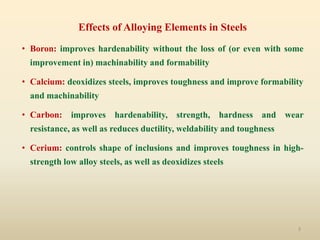
Effects of Alloying Elements in Steels
• Boron: improves hardenability without the loss of (or even with some
improvement in) machinability and formability
• Calcium: deoxidizes steels, improves toughness and improve formability
and machinability
• Carbon: improves hardenability, strength, hardness and wear
resistance, as well as reduces ductility, weldability and toughness
• Cerium: controls shape of inclusions and improves toughness in high-
strength low alloy steels, as well as deoxidizes steels
4
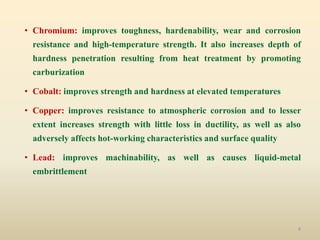
• Chromium: improves toughness, hardenability, wear and corrosion
resistance and high-temperature strength. It also increases depth of
hardness penetration resulting from heat treatment by promoting
carburization
• Cobalt: improves strength and hardness at elevated temperatures
• Copper: improves resistance to atmospheric corrosion and to lesser
extent increases strength with little loss in ductility, as well as also
adversely affects hot-working characteristics and surface quality
• Lead: improves machinability, as well as causes liquid-metal
embrittlement
5
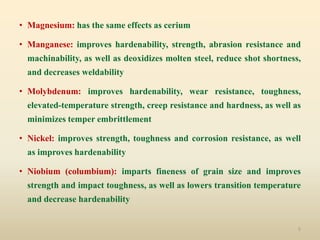
• Magnesium: has the same effects as cerium
• Manganese: improves hardenability, strength, abrasion resistance and
machinability, as well as deoxidizes molten steel, reduce shot shortness,
and decreases weldability
• Molybdenum: improves hardenability, wear resistance, toughness,
elevated-temperature strength, creep resistance and hardness, as well as
minimizes temper embrittlement
• Nickel: improves strength, toughness and corrosion resistance, as well
as improves hardenability
• Niobium (columbium): imparts fineness of grain size and improves
strength and impact toughness, as well as lowers transition temperature
and decrease hardenability
6
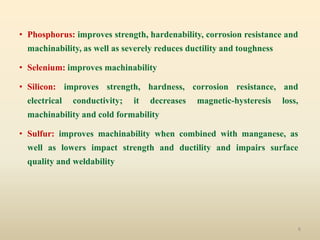
• Phosphorus: improves strength, hardenability, corrosion resistance and
machinability, as well as severely reduces ductility and toughness
• Selenium: improves machinability
• Silicon: improves strength, hardness, corrosion resistance, and
electrical conductivity; it decreases magnetic-hysteresis loss,
machinability and cold formability
• Sulfur: improves machinability when combined with manganese, as
well as lowers impact strength and ductility and impairs surface
quality and weldability
7
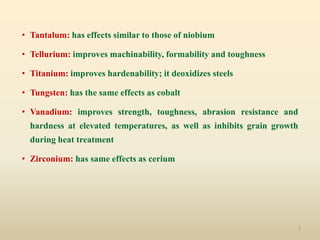
• Tantalum: has effects similar to those of niobium
• Tellurium: improves machinability, formability and toughness
• Titanium: improves hardenability; it deoxidizes steels
• Tungsten: has the same effects as cobalt
• Vanadium: improves strength, toughness, abrasion resistance and
hardness at elevated temperatures, as well as inhibits grain growth
during heat treatment
• Zirconium: has same effects as cerium
8
1. Carbon and Alloy Steels
• carbon and alloying steels are the most commonly used metals
• structural makeup and controlled processing of these steels make
them suitable for many different functions
• basic product shapes include plate, sheet, bar, wire, tube, castings,
and forgings
• increasing % of alloying elements in steels, increases properties they
impart (different elements are added to give different properties
• elements pass on properties such as hardenability, strength, hardness,
toughness, wear resistance, etc
• some properties are beneficial while others are detrimental
9
Carbon Steels
• also known as plain carbon steels
• group by % of carbon content (weight basis)
• higher the carbon content greater the hardness, strength and wear
resistance after heat treatment
• soft, tough, easily machined, welded & case hardened
• designation: e.g. 1040 steel - 0.40 wt % C
• types:
Low-carbon steel (mild steels)
Medium-carbon steel
High-carbon steel
10
Low-carbon steel (mild steels)
• has less than 0.30 % carbon
• used in everyday industrial products like bolts, nuts, sheet, plate and
tubes
Medium-carbon steel
• has 0.30% to 0.60 % carbon
• used for jobs requiring higher strength such as machinery, automotive
equipment parts, and metalworking equipment
High-carbon steel
• has more than 0.60 % carbon
• used parts that require the highest strength, hardness and wear
resistance
• once manufactured they are heat treated and tempered
11
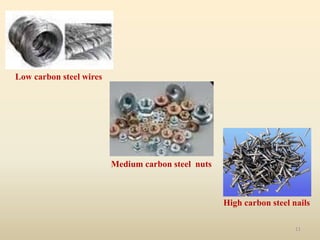
High carbon steel nails
Low carbon steel wires
Medium carbon steel nuts
12
Alloy Steels
• contain significant amounts of alloying elements
• expensive
Types of Alloy Steels
• High strength low alloy steels (HSLA)
• Microalloyed steels
• Nanoalloyed steels
• Bearing steels
• Cold forming steels
• Chained steels
13
High-Strength, Low-Alloy Steels (HSLA Steels)
• developed to improve the ratio of strength to weight
• commonly used in automobile bodies and in transportation industry
(reduced weight makes for better fuel economy)
Microalloyed Steels
• provide superior properties without the use of heat treating
• when cooled carefully these steels develop enhanced and consistent
strength
Nanoalloyed Steels
• have extremely small grain size (10-100 nm)
• Since their synthesis is done at atomic level their properties can be
controlled specifically
14
15
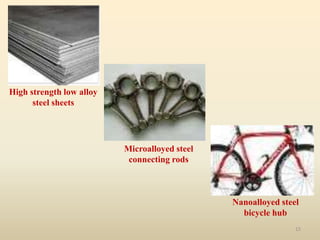
High strength low alloy
steel sheets
Microalloyed steel
connecting rods
Nanoalloyed steel
bicycle hub
16
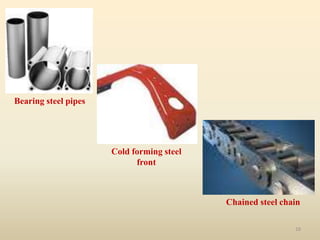
Bearing steel pipes
Cold forming steel
front
Chained steel chain
17
2. Stainless Steels
• primarily know for their corrosion resistance, high strength, and
ductility and chromium content
• reason for name stainless is due to the fact that in presence of oxygen,
steel develops a thin, hard, adherent film of chromium
• Even if surface is scratched, protective film is rebuilt through
passivation
• for passivation to occur, there needs to be minimum chromium content
of 10 to 12 % by weight
18
• tend to have lower carbon content since increased carbon content
lowers the corrosion resistance of stainless steels
• since carbon reacts with chromium, it decreases the available
chromium content which is needed for developing protective film
• using stainless steel as reinforcing bars, has become a new trend in
concrete structures such as highways buildings and bridges
• more beneficial than carbon steels because it is resistant to corrosion
from road salts and the concrete itself
19
Applications Products of Stainless Steels
20
3. Tool and Die Steels
• generally alloyed steels
• medium to high carbon
• up to 25% total alloying elements
• design for high strength, impact toughness and wear resistance at
normal and elevated temperatures
• used at temperatures up to 600°C
• specialty steels – very expensive
• quench and tempered
• very clean steels
• applications like dies, drills, cutting blades, hot working dies, etc
21
Desirable Properties of Tool Steels
• Hardness - Resistance to Deforming & Flattening
• Toughness - Resistance to Breakage & Chipping
• Wear - Resistance to Abrasion & Erosion
• Corrosion - Resistance to Rusting and Pitting
22
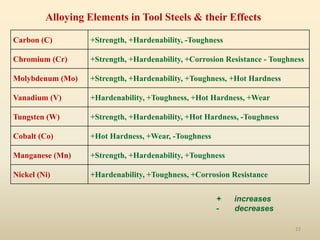
Alloying Elements in Tool Steels & their Effects
Carbon (C) +Strength, +Hardenability, -Toughness
Chromium (Cr) +Strength, +Hardenability, +Corrosion Resistance - Toughness
Molybdenum (Mo) +Strength, +Hardenability, +Toughness, +Hot Hardness
Vanadium (V) +Hardenability, +Toughness, +Hot Hardness, +Wear
Tungsten (W) +Strength, +Hardenability, +Hot Hardness, -Toughness
Cobalt (Co) +Hot Hardness, +Wear, -Toughness
Manganese (Mn) +Strength, +Hardenability, +Toughness
Nickel (Ni) +Hardenability, +Toughness, +Corrosion Resistance
+ increases
- decreases
23
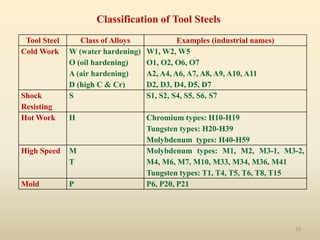
Classification of Tool Steels
Tool Steel Class of Alloys Examples (industrial names)
Cold Work W (water hardening)
O (oil hardening)
A (air hardening)
D (high C & Cr)
W1, W2, W5
O1, O2, O6, O7
A2, A4, A6, A7, A8, A9, A10, A11
D2, D3, D4, D5, D7
Shock
Resisting
S S1, S2, S4, S5, S6, S7
Hot Work H Chromium types: H10-H19
Tungsten types: H20-H39
Molybdenum types: H40-H59
High Speed M
T
Molybdenum types: M1, M2, M3-1, M3-2,
M4, M6, M7, M10, M33, M34, M36, M41
Tungsten types: T1, T4, T5, T6, T8, T15
Mold P P6, P20, P21
24
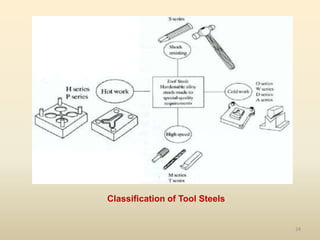
Classification of Tool Steels
25
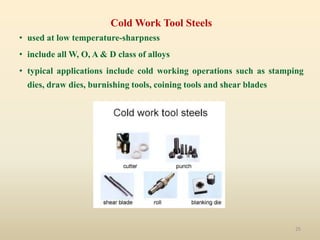
Cold Work Tool Steels
• used at low temperature-sharpness
• include all W, O, A & D class of alloys
• typical applications include cold working operations such as stamping
dies, draw dies, burnishing tools, coining tools and shear blades
26
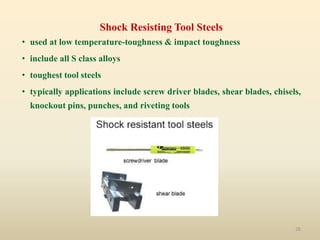
Shock Resisting Tool Steels
• used at low temperature-toughness & impact toughness
• include all S class alloys
• toughest tool steels
• typically applications include screw driver blades, shear blades, chisels,
knockout pins, punches, and riveting tools
27
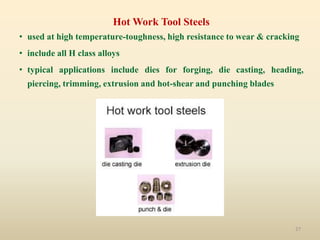
Hot Work Tool Steels
• used at high temperature-toughness, high resistance to wear & cracking
• include all H class alloys
• typical applications include dies for forging, die casting, heading,
piercing, trimming, extrusion and hot-shear and punching blades
28
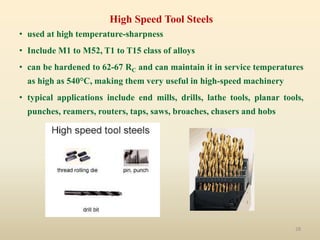
High Speed Tool Steels
• used at high temperature-sharpness
• Include M1 to M52, T1 to T15 class of alloys
• can be hardened to 62-67 RC and can maintain it in service temperatures
as high as 540°C, making them very useful in high-speed machinery
• typical applications include end mills, drills, lathe tools, planar tools,
punches, reamers, routers, taps, saws, broaches, chasers and hobs
29
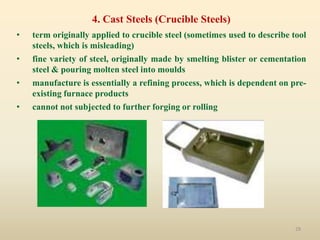
4. Cast Steels (Crucible Steels)
• term originally applied to crucible steel (sometimes used to describe tool
steels, which is misleading)
• fine variety of steel, originally made by smelting blister or cementation
steel & pouring molten steel into moulds
• manufacture is essentially a refining process, which is dependent on pre-
existing furnace products
• cannot not subjected to further forging or rolling

Module5steels 141120085043-conversion-gate01 2

  • 1.
    1 MODULE – 5 ALLOY& SPECIAL STEELS Rahul Kumar KIIT UNIVERSITY
  • 2.
    2 General Categories ofAlloy Steels  Carbon and Alloy Steels  Stainless Steel  Tool and Die Steels  Cast Steels (Crucible Steels)
  • 3.
    3 Effects of AlloyingElements in Steels • Boron: improves hardenability without the loss of (or even with some improvement in) machinability and formability • Calcium: deoxidizes steels, improves toughness and improve formability and machinability • Carbon: improves hardenability, strength, hardness and wear resistance, as well as reduces ductility, weldability and toughness • Cerium: controls shape of inclusions and improves toughness in high- strength low alloy steels, as well as deoxidizes steels
  • 4.
    4 • Chromium: improvestoughness, hardenability, wear and corrosion resistance and high-temperature strength. It also increases depth of hardness penetration resulting from heat treatment by promoting carburization • Cobalt: improves strength and hardness at elevated temperatures • Copper: improves resistance to atmospheric corrosion and to lesser extent increases strength with little loss in ductility, as well as also adversely affects hot-working characteristics and surface quality • Lead: improves machinability, as well as causes liquid-metal embrittlement
  • 5.
    5 • Magnesium: hasthe same effects as cerium • Manganese: improves hardenability, strength, abrasion resistance and machinability, as well as deoxidizes molten steel, reduce shot shortness, and decreases weldability • Molybdenum: improves hardenability, wear resistance, toughness, elevated-temperature strength, creep resistance and hardness, as well as minimizes temper embrittlement • Nickel: improves strength, toughness and corrosion resistance, as well as improves hardenability • Niobium (columbium): imparts fineness of grain size and improves strength and impact toughness, as well as lowers transition temperature and decrease hardenability
  • 6.
    6 • Phosphorus: improvesstrength, hardenability, corrosion resistance and machinability, as well as severely reduces ductility and toughness • Selenium: improves machinability • Silicon: improves strength, hardness, corrosion resistance, and electrical conductivity; it decreases magnetic-hysteresis loss, machinability and cold formability • Sulfur: improves machinability when combined with manganese, as well as lowers impact strength and ductility and impairs surface quality and weldability
  • 7.
    7 • Tantalum: haseffects similar to those of niobium • Tellurium: improves machinability, formability and toughness • Titanium: improves hardenability; it deoxidizes steels • Tungsten: has the same effects as cobalt • Vanadium: improves strength, toughness, abrasion resistance and hardness at elevated temperatures, as well as inhibits grain growth during heat treatment • Zirconium: has same effects as cerium
  • 8.
    8 1. Carbon andAlloy Steels • carbon and alloying steels are the most commonly used metals • structural makeup and controlled processing of these steels make them suitable for many different functions • basic product shapes include plate, sheet, bar, wire, tube, castings, and forgings • increasing % of alloying elements in steels, increases properties they impart (different elements are added to give different properties • elements pass on properties such as hardenability, strength, hardness, toughness, wear resistance, etc • some properties are beneficial while others are detrimental
  • 9.
    9 Carbon Steels • alsoknown as plain carbon steels • group by % of carbon content (weight basis) • higher the carbon content greater the hardness, strength and wear resistance after heat treatment • soft, tough, easily machined, welded & case hardened • designation: e.g. 1040 steel - 0.40 wt % C • types: Low-carbon steel (mild steels) Medium-carbon steel High-carbon steel
  • 10.
    10 Low-carbon steel (mildsteels) • has less than 0.30 % carbon • used in everyday industrial products like bolts, nuts, sheet, plate and tubes Medium-carbon steel • has 0.30% to 0.60 % carbon • used for jobs requiring higher strength such as machinery, automotive equipment parts, and metalworking equipment High-carbon steel • has more than 0.60 % carbon • used parts that require the highest strength, hardness and wear resistance • once manufactured they are heat treated and tempered
  • 11.
    11 High carbon steelnails Low carbon steel wires Medium carbon steel nuts
  • 12.
    12 Alloy Steels • containsignificant amounts of alloying elements • expensive Types of Alloy Steels • High strength low alloy steels (HSLA) • Microalloyed steels • Nanoalloyed steels • Bearing steels • Cold forming steels • Chained steels
  • 13.
    13 High-Strength, Low-Alloy Steels(HSLA Steels) • developed to improve the ratio of strength to weight • commonly used in automobile bodies and in transportation industry (reduced weight makes for better fuel economy) Microalloyed Steels • provide superior properties without the use of heat treating • when cooled carefully these steels develop enhanced and consistent strength Nanoalloyed Steels • have extremely small grain size (10-100 nm) • Since their synthesis is done at atomic level their properties can be controlled specifically
  • 14.
  • 15.
    15 High strength lowalloy steel sheets Microalloyed steel connecting rods Nanoalloyed steel bicycle hub
  • 16.
    16 Bearing steel pipes Coldforming steel front Chained steel chain
  • 17.
    17 2. Stainless Steels •primarily know for their corrosion resistance, high strength, and ductility and chromium content • reason for name stainless is due to the fact that in presence of oxygen, steel develops a thin, hard, adherent film of chromium • Even if surface is scratched, protective film is rebuilt through passivation • for passivation to occur, there needs to be minimum chromium content of 10 to 12 % by weight
  • 18.
    18 • tend tohave lower carbon content since increased carbon content lowers the corrosion resistance of stainless steels • since carbon reacts with chromium, it decreases the available chromium content which is needed for developing protective film • using stainless steel as reinforcing bars, has become a new trend in concrete structures such as highways buildings and bridges • more beneficial than carbon steels because it is resistant to corrosion from road salts and the concrete itself
  • 19.
  • 20.
    20 3. Tool andDie Steels • generally alloyed steels • medium to high carbon • up to 25% total alloying elements • design for high strength, impact toughness and wear resistance at normal and elevated temperatures • used at temperatures up to 600°C • specialty steels – very expensive • quench and tempered • very clean steels • applications like dies, drills, cutting blades, hot working dies, etc
  • 21.
    21 Desirable Properties ofTool Steels • Hardness - Resistance to Deforming & Flattening • Toughness - Resistance to Breakage & Chipping • Wear - Resistance to Abrasion & Erosion • Corrosion - Resistance to Rusting and Pitting
  • 22.
    22 Alloying Elements inTool Steels & their Effects Carbon (C) +Strength, +Hardenability, -Toughness Chromium (Cr) +Strength, +Hardenability, +Corrosion Resistance - Toughness Molybdenum (Mo) +Strength, +Hardenability, +Toughness, +Hot Hardness Vanadium (V) +Hardenability, +Toughness, +Hot Hardness, +Wear Tungsten (W) +Strength, +Hardenability, +Hot Hardness, -Toughness Cobalt (Co) +Hot Hardness, +Wear, -Toughness Manganese (Mn) +Strength, +Hardenability, +Toughness Nickel (Ni) +Hardenability, +Toughness, +Corrosion Resistance + increases - decreases
  • 23.
    23 Classification of ToolSteels Tool Steel Class of Alloys Examples (industrial names) Cold Work W (water hardening) O (oil hardening) A (air hardening) D (high C & Cr) W1, W2, W5 O1, O2, O6, O7 A2, A4, A6, A7, A8, A9, A10, A11 D2, D3, D4, D5, D7 Shock Resisting S S1, S2, S4, S5, S6, S7 Hot Work H Chromium types: H10-H19 Tungsten types: H20-H39 Molybdenum types: H40-H59 High Speed M T Molybdenum types: M1, M2, M3-1, M3-2, M4, M6, M7, M10, M33, M34, M36, M41 Tungsten types: T1, T4, T5, T6, T8, T15 Mold P P6, P20, P21
  • 24.
  • 25.
    25 Cold Work ToolSteels • used at low temperature-sharpness • include all W, O, A & D class of alloys • typical applications include cold working operations such as stamping dies, draw dies, burnishing tools, coining tools and shear blades
  • 26.
    26 Shock Resisting ToolSteels • used at low temperature-toughness & impact toughness • include all S class alloys • toughest tool steels • typically applications include screw driver blades, shear blades, chisels, knockout pins, punches, and riveting tools
  • 27.
    27 Hot Work ToolSteels • used at high temperature-toughness, high resistance to wear & cracking • include all H class alloys • typical applications include dies for forging, die casting, heading, piercing, trimming, extrusion and hot-shear and punching blades
  • 28.
    28 High Speed ToolSteels • used at high temperature-sharpness • Include M1 to M52, T1 to T15 class of alloys • can be hardened to 62-67 RC and can maintain it in service temperatures as high as 540°C, making them very useful in high-speed machinery • typical applications include end mills, drills, lathe tools, planar tools, punches, reamers, routers, taps, saws, broaches, chasers and hobs
  • 29.
    29 4. Cast Steels(Crucible Steels) • term originally applied to crucible steel (sometimes used to describe tool steels, which is misleading) • fine variety of steel, originally made by smelting blister or cementation steel & pouring molten steel into moulds • manufacture is essentially a refining process, which is dependent on pre- existing furnace products • cannot not subjected to further forging or rolling