STEALTHTECHNOLOGYFOR
AIRBORNESYSTEMS
Submitted by
NIRMAL S
S8MB
?Stealth
“Cautious and surreptitious
action or movement.”
(noun)
OXFORD DICTIONARY
2
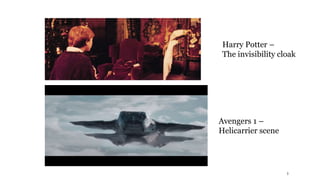
Harry Potter –
The invisibility cloak
Avengers 1 –
Helicarrier scene
3
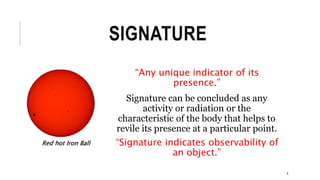
SIGNATURE
“Any unique indicator of its
presence.”
Signature can be concluded as any
activity or radiation or the
characteristic of the body that helps to
revile its presence at a particular point.
“Signature indicates observability of
an object.”
Red hot Iron Ball
4
“Oh divine art of subtlety and secrecy! Through you we
learn to be invisible, through you inaudible and hence
we can hold the enemy’s fate in our hands.”
Sun Tzu – Chinese General, The Art of War, c.490 B.C.
The concept of stealth is not new. Being able to operate
without the knowledge of the enemy has always been a goal
of military technology and tactics.
Stealth technology = LOT (Low Observability
Technology)
5
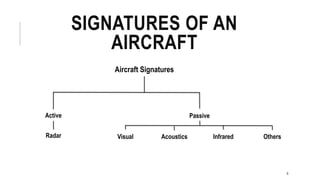
SIGNATURES OF AN
AIRCRAFT
Active Passive
Aircraft Signatures
Radar Visual Acoustics Infrared Others
6
SIGNATURE
Active signatures are produced when the enemy illuminates the
aircraft with some signal, and uses the characteristic of the
reflected signal to obtain necessary information. Passive signatures
are produced because of the signals emitted by the aircraft as an
inevitable consequence of its existence and mission.
Not all signature are equally important for all vehicles.
Underwater warfare  acoustic signature.
Land combat  visual, infra-red and acoustic
signatures.
Air combat  radar and (to a lesser extent)
infrared bands. 7
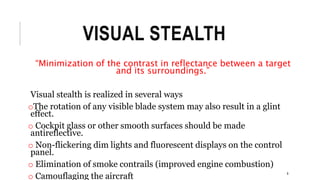
VISUAL STEALTH
“Minimization of the contrast in reflectance between a target
and its surroundings.”
Visual stealth is realized in several ways
oThe rotation of any visible blade system may also result in a glint
effect.
o Cockpit glass or other smooth surfaces should be made
antireflective.
o Non-flickering dim lights and fluorescent displays on the control
panel.
o Elimination of smoke contrails (improved engine combustion)
o Camouflaging the aircraft 8
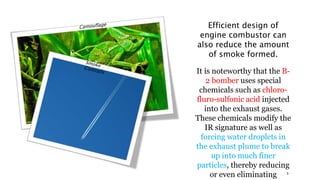
Efficient design of
engine combustor can
also reduce the amount
of smoke formed.
It is noteworthy that the B-
2 bomber uses special
chemicals such as chloro-
fluro-sulfonic acid injected
into the exhaust gases.
These chemicals modify the
IR signature as well as
forcing water droplets in
the exhaust plume to break
up into much finer
particles, thereby reducing
or even eliminating 9
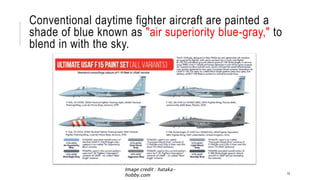
Conventional daytime fighter aircraft are painted a
shade of blue known as "air superiority blue-gray," to
blend in with the sky.
10
Image credit : hataka-
hobby.com
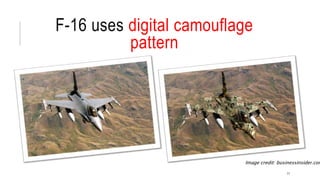
F-16 uses digital camouflage
pattern
11
Image credit: businessinsider.com
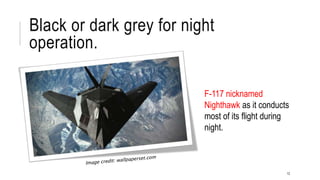
Black or dark grey for night
operation.
F-117 nicknamed
Nighthawk as it conducts
most of its flight during
night.
12
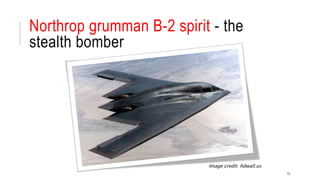
Northrop grumman B-2 spirit - the
stealth bomber
13
Image credit: hdwall.us
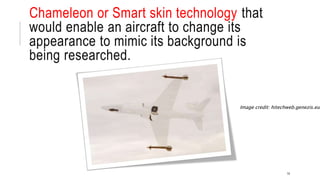
Chameleon or Smart skin technology that
would enable an aircraft to change its
appearance to mimic its background is
being researched.
14
Image credit: hitechweb.genezis.eu
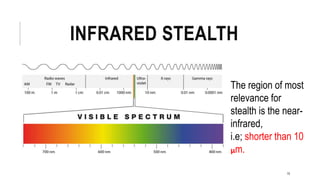
INFRARED STEALTH
The region of most
relevance for
stealth is the near-
infrared,
i.e; shorter than 10
μm.
15
16
The actual wavelength is related to the absolute temperature
of an emitter. The wavelength associated with the spectral
radiant emission of a black body is given by Wien's
displacement law as
λ =
𝟐𝟖𝟗𝟑
𝑻
μm , where T is the absolute temperature (K).
“Thus the wavelength of the peak emissions from an
aircraft flying at Mach 2 in the stratosphere will be
around 7 μm, while that from the exhaust plume will be
about 4 μm.” [ 8 ]
The energy radiated is also directly proportional to the fourth
power of absolute temperature. (Stephan’s law)
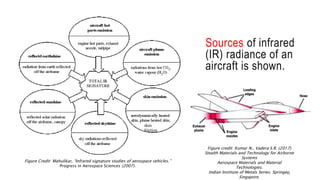
Sources of infrared
(IR) radiance of an
aircraft is shown.
17
Figure Credit: Mahulikar, “Infrared signature studies of aerospace vehicles.”
Progress in Aerospace Sciences (2007).
Figure credit: Kumar N., Vadera S.R. (2017)
Stealth Materials and Technology for Airborne
Systems
Aerospace Materials and Material
Technologies.
Indian Institute of Metals Series. Springer,
Singapore.
skin
friction
,
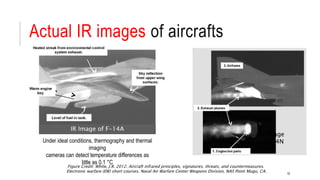
Actual IR images of aircrafts
IR Image of F-14A
IR Image
of F-4NUnder ideal conditions, thermography and thermal
imaging
cameras can detect temperature differences as
little as 0.1 °C
18
Figure Credit: White, J.R. 2012. Aircraft infrared principles, signatures, threats, and countermeasures.
Electronic warfare (EW) short courses. Naval Air Warfare Center Weapons Division, NAS Point Mugu, CA.
IR detectors identify an aircraft by discriminating its IR
radiation with that of the background; hence it is
desirable to have an IR emission from the aircraft close
to the background radiation.
The amount of incident IR radiation in the detector’s band
depends upon
o The amount of radiation emitted by the source
o Its position with respect to the detector, and
o The amount of radiation that is attenuated (absorbed and
scattered) by the atmosphere on its way to the detector.
Hence the only operation that remains is to control the IR
intensity emitted by the source. 19
Passive stealth measures
o Use a high bypass ratio (BPR) engine to mix in cold air to reduce exhaust
temperature.
o Cool aircraft engines
o Placing engine exhaust ducts over the wings hide the hot engine parts and
the exhaust plume, to a large extent from ground based IR detectors, as in
the case of B-2 bomber.
o Embedding the engines inside the fuselage or wings, thereby screening
them from the external surfaces - This is done in stealth aircraft like the B-
2, F-22 and the JSF.
o Baffling of exhaust gases
o Extra shielding of hot parts
20
oMixing of cool air with hot exhausts before emission
o Application of special coatings to hot spots to absorb and diffuse heat
over larger areas
oFlying at lower speeds (Limit maximum supersonic speed to reduce IR
signature due to kinetic heating.)
o Using surface paints is liable to reduce emissions from the aircraft’s
skin
o Increase cooling of the outer skin of the engine bay or insulation to
reduce temperature of the airframe skin.
o Use two-dimensional nozzles (which increase the surface area of the
exhaust plume) or ejector nozzles (which mix in ambient air) to
increase the rate of cooling.
o Use a curved jet pipe to mask the hot turbine stages.
21
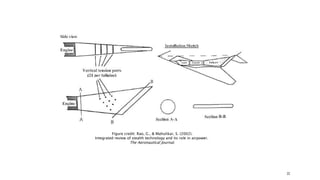
22
Figure credit: Rao, G., & Mahulikar, S. (2002).
Integrated review of stealth technology and its role in airpower.
The Aeronautical Journal.
Active stealth measures
This basically involves infrared jamming and the launching
of infrared decoy flares. This is particularly important for
combat helicopters, which fly at low altitudes and relatively
low speeds and have to avoid heat-seeking weapons.
23
RADAR STEALTH
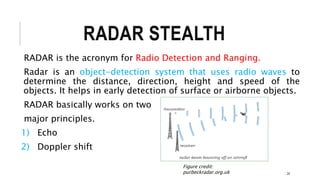
RADAR is the acronym for Radio Detection and Ranging.
Radar is an object-detection system that uses radio waves to
determine the distance, direction, height and speed of the
objects. It helps in early detection of surface or airborne objects.
RADAR basically works on two
major principles.
1) Echo
2) Doppler shift
24
Figure credit:
purbeckradar.org.uk
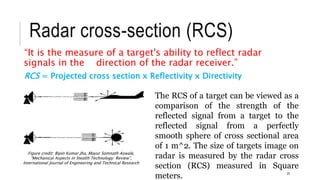
Radar cross-section (RCS)
“It is the measure of a target's ability to reflect radar
signals in the direction of the radar receiver.”
The RCS of a target can be viewed as a
comparison of the strength of the
reflected signal from a target to the
reflected signal from a perfectly
smooth sphere of cross sectional area
of 1 m^2. The size of targets image on
radar is measured by the radar cross
section (RCS) measured in Square
meters. 25
Figure credit: Bipin Kumar Jha, Mayur Somnath Aswale,
“Mechanical Aspects in Stealth Technology: Review”,
International Journal of Engineering and Technical Research
RCS = Projected cross section x Reflectivity x Directivity
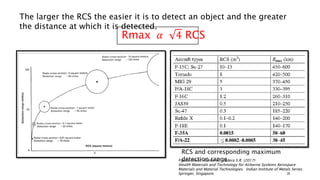
The larger the RCS the easier it is to detect an object and the greater
the distance at which it is detected.
RCS and corresponding maximum
detection range
26
Figure credit: Kumar N., Vadera S.R. (2017)
Stealth Materials and Technology for Airborne Systems Aerospace
Materials and Material Technologies. Indian Institute of Metals Series.
Springer, Singapore.
Rmax 𝛼 4 RCS
27
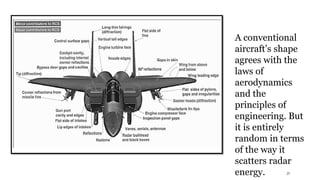
A conventional
aircraft’s shape
agrees with the
laws of
aerodynamics
and the
principles of
engineering. But
it is entirely
random in terms
of the way it
scatters radar
energy.
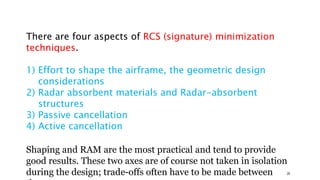
There are four aspects of RCS (signature) minimization
techniques.
1) Effort to shape the airframe, the geometric design
considerations
2) Radar absorbent materials and Radar-absorbent
structures
3) Passive cancellation
4) Active cancellation
Shaping and RAM are the most practical and tend to provide
good results. These two axes are of course not taken in isolation
during the design; trade-offs often have to be made between 28
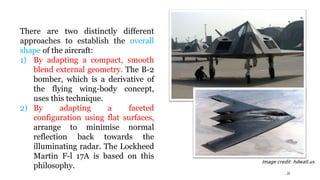
There are two distinctly different
approaches to establish the overall
shape of the aircraft:
1) By adapting a compact, smooth
blend external geometry. The B-2
bomber, which is a derivative of
the flying wing-body concept,
uses this technique.
2) By adapting a faceted
configuration using flat surfaces,
arrange to minimise normal
reflection back towards the
illuminating radar. The Lockheed
Martin F-l 17A is based on this
philosophy.
29
Image credit: hdwall.us
Geometric modifications for stealth
aircraft
1) Minimize the overall size of the aircraft.
2) Shielded (coated) cockpits.
3) Avoid flat or re-entrant surfaces likely to be vertical to the incoming
radiation, for example, having a V-shaped tail instead of vertical tail.
4) A clean external geometry without protuberances and gaps. Hence, bury the
engines within the wing or fuselage. Internal fuel tanks, weapons and other
stores.
5) Intake cavities must be minimized, since they make it impossible to reduce
radar reflections from objects and surfaces inside the cavities. So appropriate
shaping of the intake lips and inlet ducts (S-shaped curve) should be done.
6) Retro-reflective right angles on the empennage are eliminated to avoid
causing the cat's eye effect. 30
31
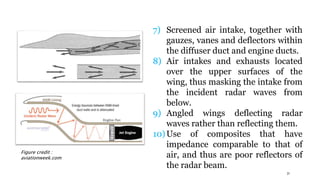
Figure credit :
aviationweek.com
7) Screened air intake, together with
gauzes, vanes and deflectors within
the diffuser duct and engine ducts.
8) Air intakes and exhausts located
over the upper surfaces of the
wing, thus masking the intake from
the incident radar waves from
below.
9) Angled wings deflecting radar
waves rather than reflecting them.
10)Use of composites that have
impedance comparable to that of
air, and thus are poor reflectors of
the radar beam.
Radar-absorbing materials
(RAMS)
Materials that are capable of attenuating the reflection
of microwaves are known as radar-absorbing
materials (RAMs).
They can do this in two main ways:
1) By being absorbed into a material that converts the
microwave energy into another form of energy such as
heat; and
2) By destructive interference.
32
33
An ideal RAM is required to have properties such as
1) strong microwave absorption properties over a broad
frequency range;
2) to be thin and lightweight, especially for aircraft;
3) simple coating-layer structures and easy processing.
Types of RAMs
According to their interactions with radar waves RAMs are generally
classified into :
1) Magnetic absorbers
2) Dielectric absorbers
The absorption in magnetic absorbers is due to the magnetic hysteresis
effect, which is obtained when particles like ferrites are used as fillers in a
polymeric (paint/coating) matrix. On the other hand, absorption in
dielectric materials depends on the ohmic loss of energy achieved by fillers
like carbon, graphite, conducting polymers, or metal particles or powders
in a polymeric matrix.
Nanostructured RAMs have received growing interest because they absorb
more microwave radiation compared with their bulk or micro-sized 34
Radar absorbing structures
(RAS)
Aircraft structures made out of Radar absorbing
materials
is called Radar absorbing structures (RAS).
Composites come into greater focus when considering radar-absorbing
structures (RAS). Reinforced plastic materials are known for their
unique combination of low weight with high strength, stiffness and
fatigue resistance.
An actual RAS usually refers to a resin-based composite structure,
typically made from carbon fibre reinforced plastics (CFRPs). The
combination of structural composites with RAMs can also be used.
35
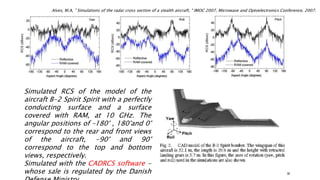
Simulated RCS of the model of the
aircraft B-2 Spirit Spirit with a perfectly
conducting surface and a surface
covered with RAM, at 10 GHz. The
angular positions of –180° , 180°and 0°
correspond to the rear and front views
of the aircraft, -90° and 90°
correspond to the top and bottom
views, respectively.
Simulated with the CADRCS software -
whose sale is regulated by the Danish 36
Alves, M.A, " Simulations of the radar cross section of a stealth aircraft, " IMOC 2007, Microwave and Optoelectronics Conference, 2007.
37
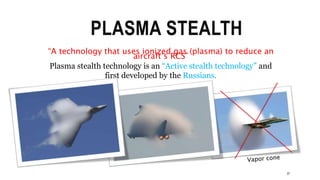
PLASMA STEALTH
“A technology that uses ionized gas (plasma) to reduce an
aircraft’s RCS”
Plasma stealth technology is an “Active stealth technology” and
first developed by the Russians.
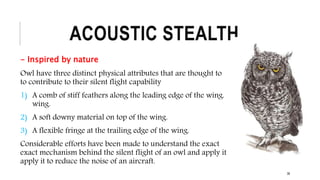
ACOUSTIC STEALTH
- Inspired by nature
Owl have three distinct physical attributes that are thought to
to contribute to their silent flight capability
1) A comb of stiff feathers along the leading edge of the wing.
wing.
2) A soft downy material on top of the wing.
3) A flexible fringe at the trailing edge of the wing.
Considerable efforts have been made to understand the exact
exact mechanism behind the silent flight of an owl and apply it
apply it to reduce the noise of an aircraft.
38
39
Trade-off
Advantages
vs
Disadvantage
s
REFERENCE
Journal Papers and Books
1.Kumar N., Vadera S.R. (2017) Stealth Materials and Technology for Airborne Systems. In:
Prasad N., Wanhill R. (eds) Aerospace Materials and Material Technologies. Indian
Institute of Metals Series. Springer, Singapore.
2. Alves, M.A, " Simulations of the radar cross section of a stealth aircraft, " IMOC 2007,
Microwave and Optoelectronics Conference, 2007.
3. Bipin Kumar Jha, Mayur Somnath Aswale, “Mechanical Aspects in Stealth Technology:
Review”, International Journal of Engineering and Technical Research (Volume-4, Issue-
4, April 2016)
4. Mahulikar, Shripad & Sonawane, Dr Hemant & Gangoli Rao, Arvind. (2007). Infrared
signature studies of aerospace vehicles. Progress in Aerospace Sciences. 43. 218-245.
10.1016/j.paerosci.2007.06.002.
5. Sharad kumar, Shashank mishra, Shashank gupta, “Stealth technology: the fight against
radar”, International Journal of Advances in Electronics and Computer Science (Volume-
1, Issue-2, Dec.-2014) 40
REFERENCE
6) V.K. Saxena (2012): Stealth and Counter-stealth Some Emerging Thoughts and
Continuing Debates, Journal of Defence Studies, Vol-6, Issue-3
7) White, J.R. 2012. Aircraft infrared principles, signatures, threats, and
countermeasures. Electronic warfare (EW) short courses. Naval Air Warfare Center
Weapons Division, NAS Point Mugu, CA.
8) Howe DD. Introduction to the Basic Technology of Stealth Aircraft: Part 1—Basic
Considerations and Aircraft Self-Emitted Signals (Passive Considerations). ASME. J. Eng.
Gas Turbines Power. 1991;113(1):75-79. doi:10.1115/1.2906533.
9) Rao, G., & Mahulikar, S. (2002). Integrated review of stealth technology and its role in
airpower. The Aeronautical Journal (1968), 106(1066), 629-642.
doi:10.1017/S0001924000011702
41
REFERENCE
Websites and Blogs
1.http://www.defense-aerospace.com
2.https://science.howstuffworks.com
3. https://www.theatlantic.com/technology/archive/2018/01/how-to-take-a-picture-of-the-
stealth-bomber-over-the-rose-bowl/549545/
4. http://www.popularmechanics.com/military/aviation/a14435997/new-stealth-drone-has-
no-moving-surfaces-at-all/
5. https://arstechnica.com/tech-policy/2017/12/stealth-turns-40-looking-back-at-the-
first-flight-of-have-blue/
6. http://aviationweek.com/defense/inside-infrared-and-future-stealth-technology
7. http://hataka-hobby.com/products/ultimate-usaf-f15-paint-set-all-variants/
42
43

Stealth Technology for Airborne System

  • 1.
  • 2.
    ?Stealth “Cautious and surreptitious actionor movement.” (noun) OXFORD DICTIONARY 2
  • 3.
    Harry Potter – Theinvisibility cloak Avengers 1 – Helicarrier scene 3
  • 4.
    SIGNATURE “Any unique indicatorof its presence.” Signature can be concluded as any activity or radiation or the characteristic of the body that helps to revile its presence at a particular point. “Signature indicates observability of an object.” Red hot Iron Ball 4
  • 5.
    “Oh divine artof subtlety and secrecy! Through you we learn to be invisible, through you inaudible and hence we can hold the enemy’s fate in our hands.” Sun Tzu – Chinese General, The Art of War, c.490 B.C. The concept of stealth is not new. Being able to operate without the knowledge of the enemy has always been a goal of military technology and tactics. Stealth technology = LOT (Low Observability Technology) 5
  • 6.
    SIGNATURES OF AN AIRCRAFT ActivePassive Aircraft Signatures Radar Visual Acoustics Infrared Others 6
  • 7.
    SIGNATURE Active signatures areproduced when the enemy illuminates the aircraft with some signal, and uses the characteristic of the reflected signal to obtain necessary information. Passive signatures are produced because of the signals emitted by the aircraft as an inevitable consequence of its existence and mission. Not all signature are equally important for all vehicles. Underwater warfare  acoustic signature. Land combat  visual, infra-red and acoustic signatures. Air combat  radar and (to a lesser extent) infrared bands. 7
  • 8.
    VISUAL STEALTH “Minimization ofthe contrast in reflectance between a target and its surroundings.” Visual stealth is realized in several ways oThe rotation of any visible blade system may also result in a glint effect. o Cockpit glass or other smooth surfaces should be made antireflective. o Non-flickering dim lights and fluorescent displays on the control panel. o Elimination of smoke contrails (improved engine combustion) o Camouflaging the aircraft 8
  • 9.
    Efficient design of enginecombustor can also reduce the amount of smoke formed. It is noteworthy that the B- 2 bomber uses special chemicals such as chloro- fluro-sulfonic acid injected into the exhaust gases. These chemicals modify the IR signature as well as forcing water droplets in the exhaust plume to break up into much finer particles, thereby reducing or even eliminating 9
  • 10.
    Conventional daytime fighteraircraft are painted a shade of blue known as "air superiority blue-gray," to blend in with the sky. 10 Image credit : hataka- hobby.com
  • 11.
    F-16 uses digitalcamouflage pattern 11 Image credit: businessinsider.com
  • 12.
    Black or darkgrey for night operation. F-117 nicknamed Nighthawk as it conducts most of its flight during night. 12
  • 13.
    Northrop grumman B-2spirit - the stealth bomber 13 Image credit: hdwall.us
  • 14.
    Chameleon or Smartskin technology that would enable an aircraft to change its appearance to mimic its background is being researched. 14 Image credit: hitechweb.genezis.eu
  • 15.
    INFRARED STEALTH The regionof most relevance for stealth is the near- infrared, i.e; shorter than 10 μm. 15
  • 16.
    16 The actual wavelengthis related to the absolute temperature of an emitter. The wavelength associated with the spectral radiant emission of a black body is given by Wien's displacement law as λ = 𝟐𝟖𝟗𝟑 𝑻 μm , where T is the absolute temperature (K). “Thus the wavelength of the peak emissions from an aircraft flying at Mach 2 in the stratosphere will be around 7 μm, while that from the exhaust plume will be about 4 μm.” [ 8 ] The energy radiated is also directly proportional to the fourth power of absolute temperature. (Stephan’s law)
  • 17.
    Sources of infrared (IR)radiance of an aircraft is shown. 17 Figure Credit: Mahulikar, “Infrared signature studies of aerospace vehicles.” Progress in Aerospace Sciences (2007). Figure credit: Kumar N., Vadera S.R. (2017) Stealth Materials and Technology for Airborne Systems Aerospace Materials and Material Technologies. Indian Institute of Metals Series. Springer, Singapore. skin friction ,
  • 18.
    Actual IR imagesof aircrafts IR Image of F-14A IR Image of F-4NUnder ideal conditions, thermography and thermal imaging cameras can detect temperature differences as little as 0.1 °C 18 Figure Credit: White, J.R. 2012. Aircraft infrared principles, signatures, threats, and countermeasures. Electronic warfare (EW) short courses. Naval Air Warfare Center Weapons Division, NAS Point Mugu, CA.
  • 19.
    IR detectors identifyan aircraft by discriminating its IR radiation with that of the background; hence it is desirable to have an IR emission from the aircraft close to the background radiation. The amount of incident IR radiation in the detector’s band depends upon o The amount of radiation emitted by the source o Its position with respect to the detector, and o The amount of radiation that is attenuated (absorbed and scattered) by the atmosphere on its way to the detector. Hence the only operation that remains is to control the IR intensity emitted by the source. 19
  • 20.
    Passive stealth measures oUse a high bypass ratio (BPR) engine to mix in cold air to reduce exhaust temperature. o Cool aircraft engines o Placing engine exhaust ducts over the wings hide the hot engine parts and the exhaust plume, to a large extent from ground based IR detectors, as in the case of B-2 bomber. o Embedding the engines inside the fuselage or wings, thereby screening them from the external surfaces - This is done in stealth aircraft like the B- 2, F-22 and the JSF. o Baffling of exhaust gases o Extra shielding of hot parts 20
  • 21.
    oMixing of coolair with hot exhausts before emission o Application of special coatings to hot spots to absorb and diffuse heat over larger areas oFlying at lower speeds (Limit maximum supersonic speed to reduce IR signature due to kinetic heating.) o Using surface paints is liable to reduce emissions from the aircraft’s skin o Increase cooling of the outer skin of the engine bay or insulation to reduce temperature of the airframe skin. o Use two-dimensional nozzles (which increase the surface area of the exhaust plume) or ejector nozzles (which mix in ambient air) to increase the rate of cooling. o Use a curved jet pipe to mask the hot turbine stages. 21
  • 22.
    22 Figure credit: Rao,G., & Mahulikar, S. (2002). Integrated review of stealth technology and its role in airpower. The Aeronautical Journal.
  • 23.
    Active stealth measures Thisbasically involves infrared jamming and the launching of infrared decoy flares. This is particularly important for combat helicopters, which fly at low altitudes and relatively low speeds and have to avoid heat-seeking weapons. 23
  • 24.
    RADAR STEALTH RADAR isthe acronym for Radio Detection and Ranging. Radar is an object-detection system that uses radio waves to determine the distance, direction, height and speed of the objects. It helps in early detection of surface or airborne objects. RADAR basically works on two major principles. 1) Echo 2) Doppler shift 24 Figure credit: purbeckradar.org.uk
  • 25.
    Radar cross-section (RCS) “Itis the measure of a target's ability to reflect radar signals in the direction of the radar receiver.” The RCS of a target can be viewed as a comparison of the strength of the reflected signal from a target to the reflected signal from a perfectly smooth sphere of cross sectional area of 1 m^2. The size of targets image on radar is measured by the radar cross section (RCS) measured in Square meters. 25 Figure credit: Bipin Kumar Jha, Mayur Somnath Aswale, “Mechanical Aspects in Stealth Technology: Review”, International Journal of Engineering and Technical Research RCS = Projected cross section x Reflectivity x Directivity
  • 26.
    The larger theRCS the easier it is to detect an object and the greater the distance at which it is detected. RCS and corresponding maximum detection range 26 Figure credit: Kumar N., Vadera S.R. (2017) Stealth Materials and Technology for Airborne Systems Aerospace Materials and Material Technologies. Indian Institute of Metals Series. Springer, Singapore. Rmax 𝛼 4 RCS
  • 27.
    27 A conventional aircraft’s shape agreeswith the laws of aerodynamics and the principles of engineering. But it is entirely random in terms of the way it scatters radar energy.
  • 28.
    There are fouraspects of RCS (signature) minimization techniques. 1) Effort to shape the airframe, the geometric design considerations 2) Radar absorbent materials and Radar-absorbent structures 3) Passive cancellation 4) Active cancellation Shaping and RAM are the most practical and tend to provide good results. These two axes are of course not taken in isolation during the design; trade-offs often have to be made between 28
  • 29.
    There are twodistinctly different approaches to establish the overall shape of the aircraft: 1) By adapting a compact, smooth blend external geometry. The B-2 bomber, which is a derivative of the flying wing-body concept, uses this technique. 2) By adapting a faceted configuration using flat surfaces, arrange to minimise normal reflection back towards the illuminating radar. The Lockheed Martin F-l 17A is based on this philosophy. 29 Image credit: hdwall.us
  • 30.
    Geometric modifications forstealth aircraft 1) Minimize the overall size of the aircraft. 2) Shielded (coated) cockpits. 3) Avoid flat or re-entrant surfaces likely to be vertical to the incoming radiation, for example, having a V-shaped tail instead of vertical tail. 4) A clean external geometry without protuberances and gaps. Hence, bury the engines within the wing or fuselage. Internal fuel tanks, weapons and other stores. 5) Intake cavities must be minimized, since they make it impossible to reduce radar reflections from objects and surfaces inside the cavities. So appropriate shaping of the intake lips and inlet ducts (S-shaped curve) should be done. 6) Retro-reflective right angles on the empennage are eliminated to avoid causing the cat's eye effect. 30
  • 31.
    31 Figure credit : aviationweek.com 7)Screened air intake, together with gauzes, vanes and deflectors within the diffuser duct and engine ducts. 8) Air intakes and exhausts located over the upper surfaces of the wing, thus masking the intake from the incident radar waves from below. 9) Angled wings deflecting radar waves rather than reflecting them. 10)Use of composites that have impedance comparable to that of air, and thus are poor reflectors of the radar beam.
  • 32.
    Radar-absorbing materials (RAMS) Materials thatare capable of attenuating the reflection of microwaves are known as radar-absorbing materials (RAMs). They can do this in two main ways: 1) By being absorbed into a material that converts the microwave energy into another form of energy such as heat; and 2) By destructive interference. 32
  • 33.
    33 An ideal RAMis required to have properties such as 1) strong microwave absorption properties over a broad frequency range; 2) to be thin and lightweight, especially for aircraft; 3) simple coating-layer structures and easy processing.
  • 34.
    Types of RAMs Accordingto their interactions with radar waves RAMs are generally classified into : 1) Magnetic absorbers 2) Dielectric absorbers The absorption in magnetic absorbers is due to the magnetic hysteresis effect, which is obtained when particles like ferrites are used as fillers in a polymeric (paint/coating) matrix. On the other hand, absorption in dielectric materials depends on the ohmic loss of energy achieved by fillers like carbon, graphite, conducting polymers, or metal particles or powders in a polymeric matrix. Nanostructured RAMs have received growing interest because they absorb more microwave radiation compared with their bulk or micro-sized 34
  • 35.
    Radar absorbing structures (RAS) Aircraftstructures made out of Radar absorbing materials is called Radar absorbing structures (RAS). Composites come into greater focus when considering radar-absorbing structures (RAS). Reinforced plastic materials are known for their unique combination of low weight with high strength, stiffness and fatigue resistance. An actual RAS usually refers to a resin-based composite structure, typically made from carbon fibre reinforced plastics (CFRPs). The combination of structural composites with RAMs can also be used. 35
  • 36.
    Simulated RCS ofthe model of the aircraft B-2 Spirit Spirit with a perfectly conducting surface and a surface covered with RAM, at 10 GHz. The angular positions of –180° , 180°and 0° correspond to the rear and front views of the aircraft, -90° and 90° correspond to the top and bottom views, respectively. Simulated with the CADRCS software - whose sale is regulated by the Danish 36 Alves, M.A, " Simulations of the radar cross section of a stealth aircraft, " IMOC 2007, Microwave and Optoelectronics Conference, 2007.
  • 37.
    37 PLASMA STEALTH “A technologythat uses ionized gas (plasma) to reduce an aircraft’s RCS” Plasma stealth technology is an “Active stealth technology” and first developed by the Russians.
  • 38.
    ACOUSTIC STEALTH - Inspiredby nature Owl have three distinct physical attributes that are thought to to contribute to their silent flight capability 1) A comb of stiff feathers along the leading edge of the wing. wing. 2) A soft downy material on top of the wing. 3) A flexible fringe at the trailing edge of the wing. Considerable efforts have been made to understand the exact exact mechanism behind the silent flight of an owl and apply it apply it to reduce the noise of an aircraft. 38
  • 39.
  • 40.
    REFERENCE Journal Papers andBooks 1.Kumar N., Vadera S.R. (2017) Stealth Materials and Technology for Airborne Systems. In: Prasad N., Wanhill R. (eds) Aerospace Materials and Material Technologies. Indian Institute of Metals Series. Springer, Singapore. 2. Alves, M.A, " Simulations of the radar cross section of a stealth aircraft, " IMOC 2007, Microwave and Optoelectronics Conference, 2007. 3. Bipin Kumar Jha, Mayur Somnath Aswale, “Mechanical Aspects in Stealth Technology: Review”, International Journal of Engineering and Technical Research (Volume-4, Issue- 4, April 2016) 4. Mahulikar, Shripad & Sonawane, Dr Hemant & Gangoli Rao, Arvind. (2007). Infrared signature studies of aerospace vehicles. Progress in Aerospace Sciences. 43. 218-245. 10.1016/j.paerosci.2007.06.002. 5. Sharad kumar, Shashank mishra, Shashank gupta, “Stealth technology: the fight against radar”, International Journal of Advances in Electronics and Computer Science (Volume- 1, Issue-2, Dec.-2014) 40
  • 41.
    REFERENCE 6) V.K. Saxena(2012): Stealth and Counter-stealth Some Emerging Thoughts and Continuing Debates, Journal of Defence Studies, Vol-6, Issue-3 7) White, J.R. 2012. Aircraft infrared principles, signatures, threats, and countermeasures. Electronic warfare (EW) short courses. Naval Air Warfare Center Weapons Division, NAS Point Mugu, CA. 8) Howe DD. Introduction to the Basic Technology of Stealth Aircraft: Part 1—Basic Considerations and Aircraft Self-Emitted Signals (Passive Considerations). ASME. J. Eng. Gas Turbines Power. 1991;113(1):75-79. doi:10.1115/1.2906533. 9) Rao, G., & Mahulikar, S. (2002). Integrated review of stealth technology and its role in airpower. The Aeronautical Journal (1968), 106(1066), 629-642. doi:10.1017/S0001924000011702 41
  • 42.
    REFERENCE Websites and Blogs 1.http://www.defense-aerospace.com 2.https://science.howstuffworks.com 3.https://www.theatlantic.com/technology/archive/2018/01/how-to-take-a-picture-of-the- stealth-bomber-over-the-rose-bowl/549545/ 4. http://www.popularmechanics.com/military/aviation/a14435997/new-stealth-drone-has- no-moving-surfaces-at-all/ 5. https://arstechnica.com/tech-policy/2017/12/stealth-turns-40-looking-back-at-the- first-flight-of-have-blue/ 6. http://aviationweek.com/defense/inside-infrared-and-future-stealth-technology 7. http://hataka-hobby.com/products/ultimate-usaf-f15-paint-set-all-variants/ 42
  • 43.