Vijay Kumar
Professor
Mechanical Engineering
Chitkara University
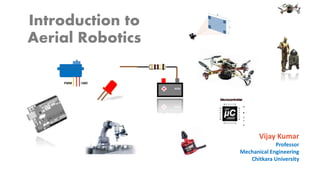
Introduction to
Aerial Robotics
V. K. Jadon, Prof., Mechanical Engineering, Chitkara University
Aerial Robotics
Robotics is an engineering discipline dealing with the
design, construction, and operation of robots.
Robotics Industry Association (RIA) defines robots as a
re-programmable, multi functional manipulator designed
to move material, parts, tools or specialized devices
through variable programmed motion for a variety of tasks
An aerial robot is a system capable of sustained flight with
no direct human control and able to perform a specific task
V. K. Jadon, Prof., Mechanical Engineering, Chitkara University
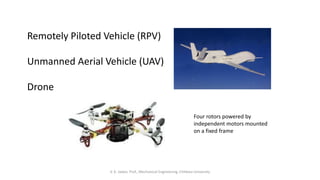
Remotely Piloted Vehicle (RPV)
Unmanned Aerial Vehicle (UAV)
Drone
Four rotors powered by
independent motors mounted
on a fixed frame
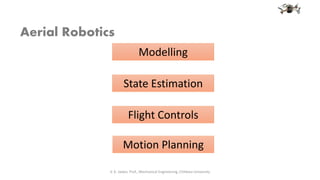
Modelling
State Estimation
Flight Controls
Motion Planning
Aerial Robotics
V. K. Jadon, Prof., Mechanical Engineering, Chitkara University
Dynamics Model
It is a complex mathematic process that heavily depends on the good
understanding of
V. K. Jadon, Prof., Mechanical Engineering, Chitkara University
Frame Rotations, Representations and Coordinate Systems
Rigid Body Dynamics Modelling
Derivation of Aerodynamic Forces
How do we write a dynamic model of any system?
Why do we need a model?
Why do we need a dynamic model?
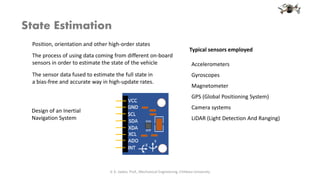
The process of using data coming from different on-board
sensors in order to estimate the state of the vehicle Accelerometers
Gyroscopes
Magnetometer
GPS (Global Positioning System)
Camera systems
LiDAR (Light Detection And Ranging)
Design of an Inertial
Navigation System
State Estimation
V. K. Jadon, Prof., Mechanical Engineering, Chitkara University
Position, orientation and other high-order states
The sensor data fused to estimate the full state in
a bias-free and accurate way in high-update rates.
Typical sensors employed
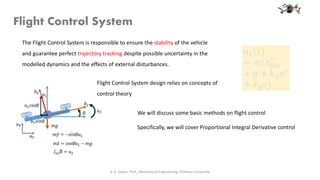
The Flight Control System is responsible to ensure the stability of the vehicle
and guarantee perfect trajectory tracking despite possible uncertainty in the
modelled dynamics and the effects of external disturbances.
We will discuss some basic methods on flight control
Specifically, we will cover Proportional Integral Derivative control
Flight Control System
V. K. Jadon, Prof., Mechanical Engineering, Chitkara University
Flight Control System design relies on concepts of
control theory
𝑢1 𝑡
= 𝑚(𝑧 𝑑𝑒𝑠
′′
+ 𝑔 + 𝑘 𝑑 𝑒′
+ 𝑘 𝑝 𝑒)
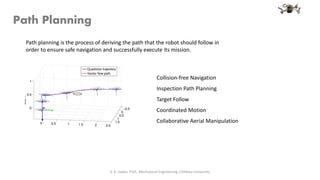
Collision-free Navigation
Inspection Path Planning
Target Follow
Coordinated Motion
Collaborative Aerial Manipulation
Path Planning
V. K. Jadon, Prof., Mechanical Engineering, Chitkara University
Path planning is the process of deriving the path that the robot should follow in
order to ensure safe navigation and successfully execute its mission.
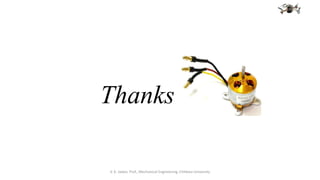
Thanks
V. K. Jadon, Prof., Mechanical Engineering, Chitkara University

Aerial Robotics

  • 1.
    Vijay Kumar Professor Mechanical Engineering ChitkaraUniversity Introduction to Aerial Robotics
  • 2.
    V. K. Jadon,Prof., Mechanical Engineering, Chitkara University Aerial Robotics Robotics is an engineering discipline dealing with the design, construction, and operation of robots. Robotics Industry Association (RIA) defines robots as a re-programmable, multi functional manipulator designed to move material, parts, tools or specialized devices through variable programmed motion for a variety of tasks An aerial robot is a system capable of sustained flight with no direct human control and able to perform a specific task
  • 3.
    V. K. Jadon,Prof., Mechanical Engineering, Chitkara University Remotely Piloted Vehicle (RPV) Unmanned Aerial Vehicle (UAV) Drone Four rotors powered by independent motors mounted on a fixed frame
  • 4.
    Modelling State Estimation Flight Controls MotionPlanning Aerial Robotics V. K. Jadon, Prof., Mechanical Engineering, Chitkara University
  • 5.
    Dynamics Model It isa complex mathematic process that heavily depends on the good understanding of V. K. Jadon, Prof., Mechanical Engineering, Chitkara University Frame Rotations, Representations and Coordinate Systems Rigid Body Dynamics Modelling Derivation of Aerodynamic Forces How do we write a dynamic model of any system? Why do we need a model? Why do we need a dynamic model?
  • 6.
    The process ofusing data coming from different on-board sensors in order to estimate the state of the vehicle Accelerometers Gyroscopes Magnetometer GPS (Global Positioning System) Camera systems LiDAR (Light Detection And Ranging) Design of an Inertial Navigation System State Estimation V. K. Jadon, Prof., Mechanical Engineering, Chitkara University Position, orientation and other high-order states The sensor data fused to estimate the full state in a bias-free and accurate way in high-update rates. Typical sensors employed
  • 7.
    The Flight ControlSystem is responsible to ensure the stability of the vehicle and guarantee perfect trajectory tracking despite possible uncertainty in the modelled dynamics and the effects of external disturbances. We will discuss some basic methods on flight control Specifically, we will cover Proportional Integral Derivative control Flight Control System V. K. Jadon, Prof., Mechanical Engineering, Chitkara University Flight Control System design relies on concepts of control theory 𝑢1 𝑡 = 𝑚(𝑧 𝑑𝑒𝑠 ′′ + 𝑔 + 𝑘 𝑑 𝑒′ + 𝑘 𝑝 𝑒)
  • 8.
    Collision-free Navigation Inspection PathPlanning Target Follow Coordinated Motion Collaborative Aerial Manipulation Path Planning V. K. Jadon, Prof., Mechanical Engineering, Chitkara University Path planning is the process of deriving the path that the robot should follow in order to ensure safe navigation and successfully execute its mission.
  • 9.
    Thanks V. K. Jadon,Prof., Mechanical Engineering, Chitkara University