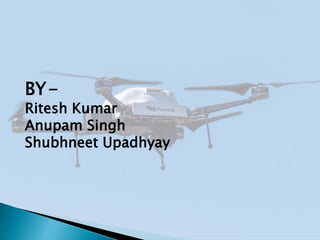
(UNMANNED AERIAL VEHICLE)
INTRODUCTION
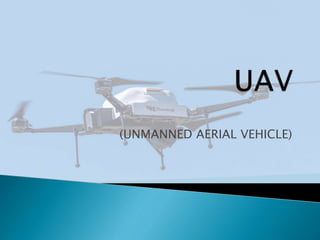
An unmanned aerial vehicle (UAV), known as a
drone, is an aircraft without a human pilot.
Drone stands for Dynamic Remotely Operated
Navigation Equipment.
Its flight is either controlled autonomous by
computers or under the remote control of a pilot on the
ground.
HISTORY
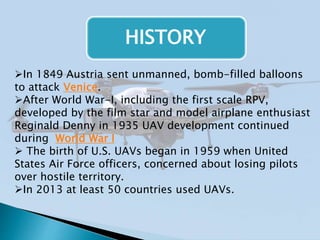
In 1849 Austria sent unmanned, bomb-filled balloons
to attack Venice.
After World War-I, including the first scale RPV,
developed by the film star and model airplane enthusiast
Reginald Denny in 1935 UAV development continued
during World War I
 The birth of U.S. UAVs began in 1959 when United
States Air Force officers, concerned about losing pilots
over hostile territory.
In 2013 at least 50 countries used UAVs.
UAV IS A SYSTEM
COCKPIT
TRANSPORTABLE GROUND CONTROL
UNMANNED AIRCRAFT
SUB-SYSTEM OF UAV’S
COMMUNICATIONS
Operates on ultra high frequency
Communicates with ku-band system
Operates with uplink frequencies from 15.15 to 15.35
GHz and downlink frequency 14.40 GHz to 14.83 GHz
NAVIGATION
Avionics use satellite based system such as GPS and
WAAS
It calculates position automatically
MONITORING
 Includes GPS system
 High resolution video camera
 Super high resolution still camera
COLLISION AVOIDANCE SYSTEM
 Use traffic and collision system
 Smaller aircraft use simple traffic alerting system
 Aircraft use ground proximity warning system
WEATHER SYSTEM
 Use weather radar and lighting detector system
EMERGINGTRENDSINUAVMARKET TREND A
TREND B
TREND C
TREND D
TREND E
MISSION REQUIREMENTS - UAV
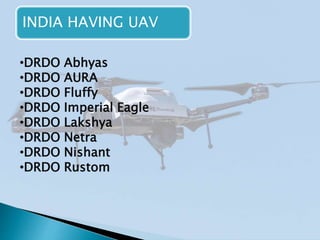
INDIA HAVING UAV
•DRDO Abhyas
•DRDO AURA
•DRDO Fluffy
•DRDO Imperial Eagle
•DRDO Lakshya
•DRDO Netra
•DRDO Nishant
•DRDO Rustom
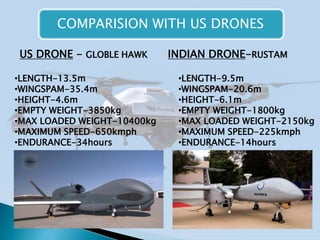
COMPARISION WITH US DRONES
US DRONE - GLOBLE HAWK INDIAN DRONE-RUSTAM
•LENGTH-13.5m
•WINGSPAM-35.4m
•HEIGHT-4.6m
•EMPTY WEIGHT-3850kg
•MAX LOADED WEIGHT-10400kg
•MAXIMUM SPEED-650kmph
•ENDURANCE-34hours
•LENGTH-9.5m
•WINGSPAM-20.6m
•HEIGHT-6.1m
•EMPTY WEIGHT-1800kg
•MAX LOADED WEIGHT-2150kg
•MAXIMUM SPEED-225kmph
•ENDURANCE-14hours
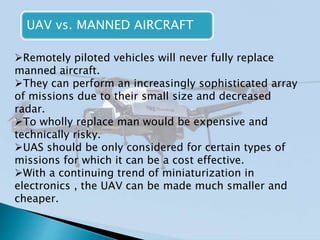
UAV vs. MANNED AIRCRAFT
Remotely piloted vehicles will never fully replace
manned aircraft.
They can perform an increasingly sophisticated array
of missions due to their small size and decreased
radar.
To wholly replace man would be expensive and
technically risky.
UAS should be only considered for certain types of
missions for which it can be a cost effective.
With a continuing trend of miniaturization in
electronics , the UAV can be made much smaller and
cheaper.
USES OF UAV
 IN COUNTER TERRORISM ACTIVITY
 IN OIL, GAS AND MINERALEXPLORATION & PRODUCTION
IN TRANSPORT
IN SCIENTIFIC RESEARCH
IN ARMED ATTACKS
IN SEARCH & RESCUE:
ADVANTAGES
Does not contain, or need, a qualified pilot on board.
Can enter environments that are dangerous to human
life.
Reduces the exposure risk of the aircraft operator.
Performing visual or thermal imaging of a region.
Measuring cell phone, radio, or, TV coverage over any
terrain.
Can be programmed to complete the mission
autonomously even when contact with its GCS is lost.
DISADVANTAGES
Immoral
Civilian casualties
Angers many people in foreign countries(infringe upon
sovereignty)
Can be hacked or given viruses
Too small for transportation of materials
Low resistance to weather
Cannot refuel in flight
If contact is lost with the ground station, the vehicle may
be lost.
CONCLUSION
Unmanned Aerial Vehicles are an exciting field in the
world of aviation, with new discoveries . Over the next
16 years, UAVs will become a significant component of
military, civil, and perhaps even commercial aviation.
However, the very dynamic nature of the field also
creates a significant amount of uncertainty. The wide
range of UAV physical and performance characteristics,
many of which will be very unlike any current aircraft,
will place additional challenges on an air traffic
management system.
BY-
Ritesh Kumar
Anupam Singh
Shubhneet Upadhyay
UAV

UAV

  • 1.
  • 2.
    INTRODUCTION An unmanned aerialvehicle (UAV), known as a drone, is an aircraft without a human pilot. Drone stands for Dynamic Remotely Operated Navigation Equipment. Its flight is either controlled autonomous by computers or under the remote control of a pilot on the ground.
  • 3.
    HISTORY In 1849 Austriasent unmanned, bomb-filled balloons to attack Venice. After World War-I, including the first scale RPV, developed by the film star and model airplane enthusiast Reginald Denny in 1935 UAV development continued during World War I  The birth of U.S. UAVs began in 1959 when United States Air Force officers, concerned about losing pilots over hostile territory. In 2013 at least 50 countries used UAVs.
  • 4.
    UAV IS ASYSTEM COCKPIT TRANSPORTABLE GROUND CONTROL
  • 5.
  • 6.
    SUB-SYSTEM OF UAV’S COMMUNICATIONS Operateson ultra high frequency Communicates with ku-band system Operates with uplink frequencies from 15.15 to 15.35 GHz and downlink frequency 14.40 GHz to 14.83 GHz NAVIGATION Avionics use satellite based system such as GPS and WAAS It calculates position automatically
  • 7.
    MONITORING  Includes GPSsystem  High resolution video camera  Super high resolution still camera COLLISION AVOIDANCE SYSTEM  Use traffic and collision system  Smaller aircraft use simple traffic alerting system  Aircraft use ground proximity warning system WEATHER SYSTEM  Use weather radar and lighting detector system
  • 8.
    EMERGINGTRENDSINUAVMARKET TREND A TRENDB TREND C TREND D TREND E
  • 9.
  • 10.
    INDIA HAVING UAV •DRDOAbhyas •DRDO AURA •DRDO Fluffy •DRDO Imperial Eagle •DRDO Lakshya •DRDO Netra •DRDO Nishant •DRDO Rustom
  • 11.
    COMPARISION WITH USDRONES US DRONE - GLOBLE HAWK INDIAN DRONE-RUSTAM •LENGTH-13.5m •WINGSPAM-35.4m •HEIGHT-4.6m •EMPTY WEIGHT-3850kg •MAX LOADED WEIGHT-10400kg •MAXIMUM SPEED-650kmph •ENDURANCE-34hours •LENGTH-9.5m •WINGSPAM-20.6m •HEIGHT-6.1m •EMPTY WEIGHT-1800kg •MAX LOADED WEIGHT-2150kg •MAXIMUM SPEED-225kmph •ENDURANCE-14hours
  • 12.
    UAV vs. MANNEDAIRCRAFT Remotely piloted vehicles will never fully replace manned aircraft. They can perform an increasingly sophisticated array of missions due to their small size and decreased radar. To wholly replace man would be expensive and technically risky. UAS should be only considered for certain types of missions for which it can be a cost effective. With a continuing trend of miniaturization in electronics , the UAV can be made much smaller and cheaper.
  • 13.
    USES OF UAV IN COUNTER TERRORISM ACTIVITY  IN OIL, GAS AND MINERALEXPLORATION & PRODUCTION IN TRANSPORT IN SCIENTIFIC RESEARCH IN ARMED ATTACKS IN SEARCH & RESCUE:
  • 14.
    ADVANTAGES Does not contain,or need, a qualified pilot on board. Can enter environments that are dangerous to human life. Reduces the exposure risk of the aircraft operator. Performing visual or thermal imaging of a region. Measuring cell phone, radio, or, TV coverage over any terrain. Can be programmed to complete the mission autonomously even when contact with its GCS is lost.
  • 15.
    DISADVANTAGES Immoral Civilian casualties Angers manypeople in foreign countries(infringe upon sovereignty) Can be hacked or given viruses Too small for transportation of materials Low resistance to weather Cannot refuel in flight If contact is lost with the ground station, the vehicle may be lost.
  • 16.
    CONCLUSION Unmanned Aerial Vehiclesare an exciting field in the world of aviation, with new discoveries . Over the next 16 years, UAVs will become a significant component of military, civil, and perhaps even commercial aviation. However, the very dynamic nature of the field also creates a significant amount of uncertainty. The wide range of UAV physical and performance characteristics, many of which will be very unlike any current aircraft, will place additional challenges on an air traffic management system.
  • 17.