Space Robotics
Contents :-
1. Introduction
2. What is Space Robotics
3. Importance
4. Area of application
5. Advantages and Disadvantages
6. Challenges in design and Testing
7. Structure of space Robots
8. Discription of Subsystems
9. Conclusion
INTRODUCTION :-
 Space Robot is a system with a mechanical body, using computer
as its brain. Integrating the sensors and actuators built into the
mechanical body, the motions are realised with the computer
software to execute the desired task. Robots are more flexible in
terms of ability to perform new tasks or to carry out complex
sequence of motion than other categories of automated
manufacturing equipment. Today there is lot of interest in this
field and a separate branch of technology ‘robotics’ has emerged.
It is concerned with all problems of robot design, development and
applications.
What is Space Robotics?
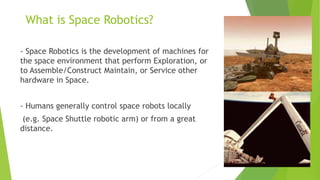
- Space Robotics is the development of machines for
the space environment that perform Exploration, or
to Assemble/Construct Maintain, or Service other
hardware in Space.
- Humans generally control space robots locally
(e.g. Space Shuttle robotic arm) or from a great
distance.
Importance
 Perform tasks less expensively,
Sooner.
 less risk or more delicate
"touch" than with human astronauts
 Go where people can’t go (within reason), and for long durations
 Space is a hazardous environment
 Access to space is expensive
 Robots don't need to return to Earth (which can be very costly)
Areas of Application
 In-orbit positioning and assembly: For deployment of satellite and for
assembly of modules to satellite/space station.
 Maintenance: For removal and replacement of faulty
modules/packages.
 Resupply: For supply of equipment, materials for experimentation in
space lab and for the resupply of fuel.
Advantages
 Space robots do not need to eat, drink or sleep and they can do tasks that
have a risk.
 The robot was built to replace the human work is done.
 The robot used in space because there are no conditions for human life.
 Space robot technology is very advanced.
Disadvantages
 A robot can brake down or you could loss control of it.
 Refueling is not that easy.
 Maintenance of Space Robots gets very difficult.
 Cost is a big deal for maintenance and repairing of space robots.
Challenges In Design And Testing
 Robots developed for space applications will be significantly different
from their counter part in ground. Space robots have to satisfy unique
requirements to operate in zero ‘g’ conditions (lack of gravity), in
vacuum and in high thermal gradients, and far away from earth. The
phenomenon of zero gravity effects physical action and mechanism
performance. The vacuum and thermal conditions of space influence
material and sensor performance. The degree of remoteness of the
operator may vary from a few meters to millions of kilometers. The
principle effect of distance is the time delay in command
communication and its repercussions on the action of the arms. The
details are discussed below.
1. ZERO ‘g’ EFFECT ON DESIGN.
2. VACUUM EFFECT AND THERMAL EFFECT.
3. SPACE MODULAR MANIPULATORS :-
a. Extreme Thermal Conditions.
b. High Reliability Requirements.
c. Dynamic Performance and
Continued
Structure of Space Robots
The robot consists of two arms i.e. an upper arm and a lower arm.
The upper arm is fixed to the base and has rotational DOF about pitch
and yaw axis. The lower arm is connected to the upper arm by a rotary
joint about the pitch axis. So it enable positioning of the end effector at
any required point in the work space. A three-roll wrist mechanism at the
end of the lower arm is used to orient the end effector about any axis.
An end effector connected to the wrist performs the required functions
of the hand. Motors through a drive circuit drive the joint of the arm and
wrist. Angular encoders at each joint control the motion about each axis.
The end effector is driven by a motor and a pressure sensor/strain
gauges on the fingers are used to control the grasping force on the job.
Description of Subsystems
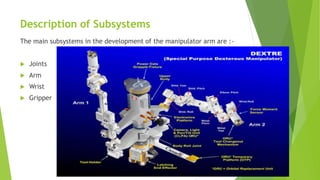
The main subsystems in the development of the manipulator arm are :-
 Joints
 Arm
 Wrist
 Gripper
Conclusion
In the future, robotics will make it possible for billions of people to have
lives of leisure instead of the current preoccupation with material needs.
There are hundreds of millions who are now fascinated by space but do
not have the means to explore it. For them space robotics will throw
open the door to explore and experience the universe.
Space robotics

Space robotics

  • 1.
  • 2.
    Contents :- 1. Introduction 2.What is Space Robotics 3. Importance 4. Area of application 5. Advantages and Disadvantages 6. Challenges in design and Testing 7. Structure of space Robots 8. Discription of Subsystems 9. Conclusion
  • 3.
    INTRODUCTION :-  SpaceRobot is a system with a mechanical body, using computer as its brain. Integrating the sensors and actuators built into the mechanical body, the motions are realised with the computer software to execute the desired task. Robots are more flexible in terms of ability to perform new tasks or to carry out complex sequence of motion than other categories of automated manufacturing equipment. Today there is lot of interest in this field and a separate branch of technology ‘robotics’ has emerged. It is concerned with all problems of robot design, development and applications.
  • 4.
    What is SpaceRobotics? - Space Robotics is the development of machines for the space environment that perform Exploration, or to Assemble/Construct Maintain, or Service other hardware in Space. - Humans generally control space robots locally (e.g. Space Shuttle robotic arm) or from a great distance.
  • 5.
    Importance  Perform tasksless expensively, Sooner.  less risk or more delicate "touch" than with human astronauts  Go where people can’t go (within reason), and for long durations  Space is a hazardous environment  Access to space is expensive  Robots don't need to return to Earth (which can be very costly)
  • 6.
    Areas of Application In-orbit positioning and assembly: For deployment of satellite and for assembly of modules to satellite/space station.  Maintenance: For removal and replacement of faulty modules/packages.  Resupply: For supply of equipment, materials for experimentation in space lab and for the resupply of fuel.
  • 7.
    Advantages  Space robotsdo not need to eat, drink or sleep and they can do tasks that have a risk.  The robot was built to replace the human work is done.  The robot used in space because there are no conditions for human life.  Space robot technology is very advanced. Disadvantages  A robot can brake down or you could loss control of it.  Refueling is not that easy.  Maintenance of Space Robots gets very difficult.  Cost is a big deal for maintenance and repairing of space robots.
  • 8.
    Challenges In DesignAnd Testing  Robots developed for space applications will be significantly different from their counter part in ground. Space robots have to satisfy unique requirements to operate in zero ‘g’ conditions (lack of gravity), in vacuum and in high thermal gradients, and far away from earth. The phenomenon of zero gravity effects physical action and mechanism performance. The vacuum and thermal conditions of space influence material and sensor performance. The degree of remoteness of the operator may vary from a few meters to millions of kilometers. The principle effect of distance is the time delay in command communication and its repercussions on the action of the arms. The details are discussed below.
  • 9.
    1. ZERO ‘g’EFFECT ON DESIGN. 2. VACUUM EFFECT AND THERMAL EFFECT. 3. SPACE MODULAR MANIPULATORS :- a. Extreme Thermal Conditions. b. High Reliability Requirements. c. Dynamic Performance and Continued
  • 10.
    Structure of SpaceRobots The robot consists of two arms i.e. an upper arm and a lower arm. The upper arm is fixed to the base and has rotational DOF about pitch and yaw axis. The lower arm is connected to the upper arm by a rotary joint about the pitch axis. So it enable positioning of the end effector at any required point in the work space. A three-roll wrist mechanism at the end of the lower arm is used to orient the end effector about any axis. An end effector connected to the wrist performs the required functions of the hand. Motors through a drive circuit drive the joint of the arm and wrist. Angular encoders at each joint control the motion about each axis. The end effector is driven by a motor and a pressure sensor/strain gauges on the fingers are used to control the grasping force on the job.
  • 11.
    Description of Subsystems Themain subsystems in the development of the manipulator arm are :-  Joints  Arm  Wrist  Gripper
  • 12.
    Conclusion In the future,robotics will make it possible for billions of people to have lives of leisure instead of the current preoccupation with material needs. There are hundreds of millions who are now fascinated by space but do not have the means to explore it. For them space robotics will throw open the door to explore and experience the universe.