Objectives :-
To know some information about :-
 Stars appears to move from east to west
in the sky
 Some other members of the solar system
 Constellations
STARS APPEARS TO MOVE FROM
EAST TO WEST IN THE SKY
When we are seated in a moving train, the nearby trees and
buildings appear to move in the backward direction. Actually
the trees and buildings do not move. Our Earth rotates from
East to West on its axis, so the stars appears to move from East
to West. It is for the same reason, the Sun appears to rise in the
East and set in the West. However, the Sun actually does not
change its position.
The units of measuring distance in the
universe :-
The distances in the universes are very large. ‘Kilometre’ is an extremely
small and inconvenient unit to express such large distances. The extremely
large distances between the heavenly bodies like the stars and planets are
expressed another unit known as light year.
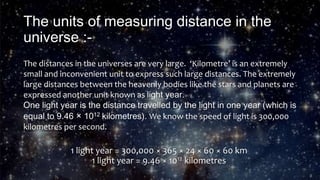
One light year is the distance travelled by the light in one year (which is
equal to 9.46 × 10¹² kilometres). We know the speed of light is 300,000
kilometres per second.
1 light year = 300,000 × 365 × 24 × 60 × 60 km
1 light year = 9.46 × 10¹² kilometres
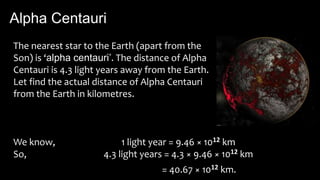
Alpha Centauri
The nearest star to the Earth (apart from the
Son) is ‘alpha centauri’. The distance of Alpha
Centauri is 4.3 light years away from the Earth.
Let find the actual distance of Alpha Centauri
from the Earth in kilometres.
We know,
So,
1 light year = 9.46 × 10¹² km
4.3 light years = 4.3 × 9.46 × 1012 km
= 40.67 × 10¹² km.
SOME OTHER MEMBERS OF THE
SOLAR SYSTEM
There are some other bodies which revolve
around the Sun. let us learn about some of them
:
1. asteroids
2. Comet
3. Meteors
4. Meteoroids
5. meteorites
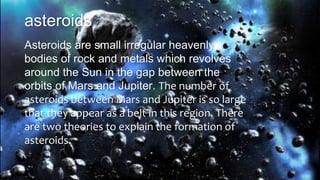
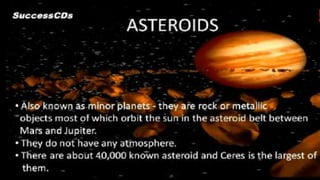
asteroids
Asteroids are small irregular heavenly
bodies of rock and metals which revolves
around the Sun in the gap between the
orbits of Mars and Jupiter. The number of
asteroids between Mars and Jupiter is so large
that they appear as a belt in this region. There
are two theories to explain the formation of
asteroids.
a) Some scientists think that asteroids are pieces of materials that
failed to come together to form a planet when the solar system was
being formed.
b) Some scientists believe that asteroids are the pieces of a large planet
that went close to Jupiter and was broken up by its gravitational
pull.
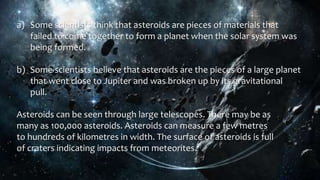
Asteroids can be seen through large telescopes. There may be as
many as 100,000 asteroids. Asteroids can measure a few metres
to hundreds of kilometres in width. The surface of asteroids is full
of craters indicating impacts from meteorites.
‱ The tail of a comet always point away from the sun.
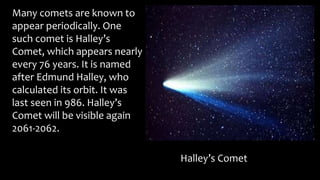
Many comets are known to
appear periodically. One
such comet is Halley’s
Comet, which appears nearly
every 76 years. It is named
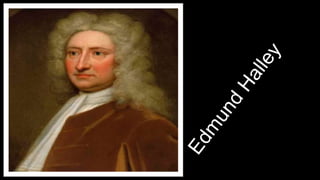
after Edmund Halley, who
calculated its orbit. It was
last seen in 986. Halley’s
Comet will be visible again
2061-2062.
Halley’s Comet
METEOROIDS
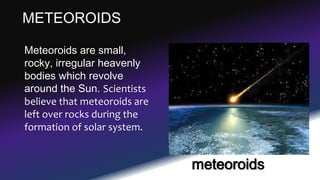
Meteoroids are small,
rocky, irregular heavenly
bodies which revolve
around the Sun. Scientists
believe that meteoroids are
left over rocks during the
formation of solar system.
meteoroids
Meteors
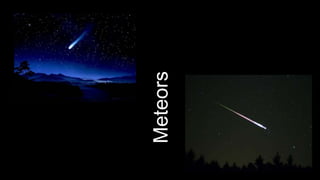
When the meteoroids come very close to a planet such as the
Earth, Earth’s gravitation pulls them in. as they enter the Earth’s
atmosphere, they get heated because of friction with the air and
starts burning and emitting light. Meteors are burning
meteoroids which we see as a bright streak of light that flashes
for a moment across the sky. Meteors are also called as shooting
stars. The material of meteors burns up completely before it
reaches the surface of the Earth.
Meteors
Meteorites
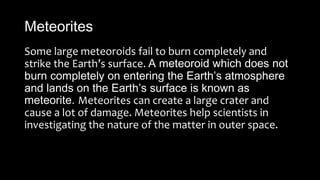
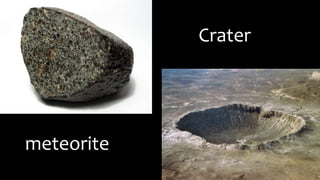
Some large meteoroids fail to burn completely and
strike the Earth’s surface. A meteoroid which does not
burn completely on entering the Earth’s atmosphere
and lands on the Earth’s surface is known as
meteorite. Meteorites can create a large crater and
cause a lot of damage. Meteorites help scientists in
investigating the nature of the matter in outer space.
Crater
meteorite
Constellations
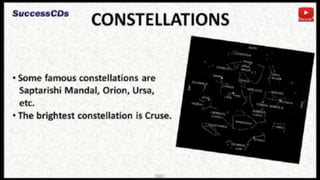
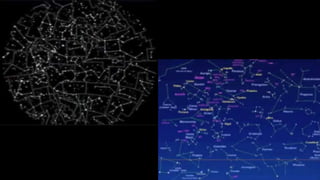
We see thousands of stars on a clear night sky. Many of
stars appear in groups forming patterns. Such patterns
contains objects or figures. The stars which appear in
the form recognisable shapes and patterns are known
as constellations. So far 88 constellations have been
recognised and named.
1. Each constellation has been assigned a name
signifying an animal, a human being or any other
object which it appears to resemble.
2. The constellations appear to move in the sky from
East to West because the Earth rotates on its axis
from West to East.
3. The shape of constellation remains the same of this
heavenly body.
We shall now describe some important constellations in
detail, one by one.

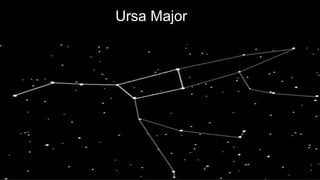
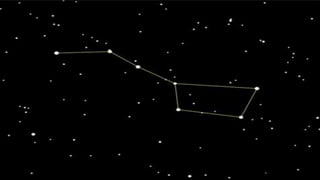
Ursa Major (or Great Beer Constellation
1. It is one of the most famous constellations which can be
seen clearly in April in summer season in the Northern part
of the sky at night.
2. It is also known as ‘big dipper’, the Great Bear or the
Saptarishi (Indian name).
3. There are seven prominent stars in this constellation which
form the shape of a dipper. There are three stars in the
handle of the ladle and four in its bowl.
4. Ursa Major is also called Great Bear
because the seven bright stars of Ursa Major
along with several other fainter stars form a
pattern resembling a bear.
5. We can locate the Pole Star with the help
of Ursa Major. On a clear moonless night
during early summer, we can identify Ursa
Major in the Northern part of the sky. We look
at the two brightest stars at the end of Ursa
Major.
6. If we observe Ursa Major, 3-4 time at an interval
of 2 to hours, we will find that Ursa Major moves
around the Pole Star. In fact, all the stars appears
to revolve around the Pole Star.
7. The Pole Star appears stationary as seen from
the Earth because it lies close to the axis of
rotation of the Earth.
Ursa Major
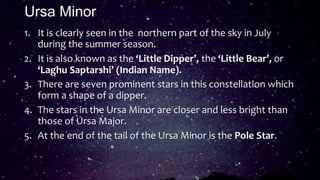
Ursa Minor
1. It is clearly seen in the northern part of the sky in July
during the summer season.
2. It is also known as the ‘Little Dipper’, the ‘Little Bear’, or
‘Laghu Saptarshi’ (Indian Name).
3. There are seven prominent stars in this constellation which
form a shape of a dipper.
4. The stars in the Ursa Minor are closer and less bright than
those of Ursa Major.
5. At the end of the tail of the Ursa Minor is the Pole Star.
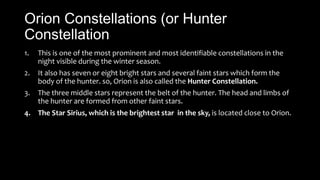
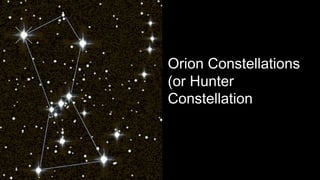
Orion Constellations (or Hunter
Constellation
1. This is one of the most prominent and most identifiable constellations in the
night visible during the winter season.
2. It also has seven or eight bright stars and several faint stars which form the
body of the hunter. so, Orion is also called the Hunter Constellation.
3. The three middle stars represent the belt of the hunter. The head and limbs of
the hunter are formed from other faint stars.
4. The Star Sirius, which is the brightest star in the sky, is located close to Orion.
Orion Constellations
(or Hunter
Constellation
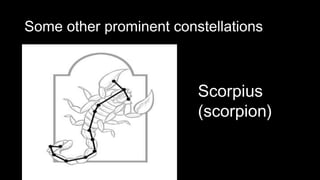
Some other prominent constellations
Scorpius
(scorpion)
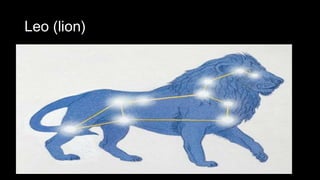
Leo (lion)
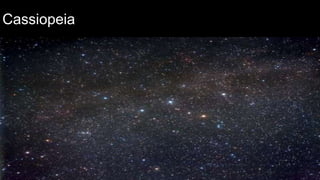
Cassiopeia
Done by :-
Group B

Stars and the solar system

  • 2.
    Objectives :- To knowsome information about :-  Stars appears to move from east to west in the sky  Some other members of the solar system  Constellations
  • 3.
    STARS APPEARS TOMOVE FROM EAST TO WEST IN THE SKY When we are seated in a moving train, the nearby trees and buildings appear to move in the backward direction. Actually the trees and buildings do not move. Our Earth rotates from East to West on its axis, so the stars appears to move from East to West. It is for the same reason, the Sun appears to rise in the East and set in the West. However, the Sun actually does not change its position.
  • 4.
    The units ofmeasuring distance in the universe :- The distances in the universes are very large. ‘Kilometre’ is an extremely small and inconvenient unit to express such large distances. The extremely large distances between the heavenly bodies like the stars and planets are expressed another unit known as light year. One light year is the distance travelled by the light in one year (which is equal to 9.46 × 10¹² kilometres). We know the speed of light is 300,000 kilometres per second. 1 light year = 300,000 × 365 × 24 × 60 × 60 km 1 light year = 9.46 × 10¹² kilometres
  • 5.
    Alpha Centauri The neareststar to the Earth (apart from the Son) is ‘alpha centauri’. The distance of Alpha Centauri is 4.3 light years away from the Earth. Let find the actual distance of Alpha Centauri from the Earth in kilometres. We know, So, 1 light year = 9.46 × 10¹² km 4.3 light years = 4.3 × 9.46 × 1012 km = 40.67 × 10¹² km.
  • 6.
    SOME OTHER MEMBERSOF THE SOLAR SYSTEM There are some other bodies which revolve around the Sun. let us learn about some of them : 1. asteroids 2. Comet 3. Meteors 4. Meteoroids 5. meteorites
  • 7.
    asteroids Asteroids are smallirregular heavenly bodies of rock and metals which revolves around the Sun in the gap between the orbits of Mars and Jupiter. The number of asteroids between Mars and Jupiter is so large that they appear as a belt in this region. There are two theories to explain the formation of asteroids.
  • 8.
    a) Some scientiststhink that asteroids are pieces of materials that failed to come together to form a planet when the solar system was being formed. b) Some scientists believe that asteroids are the pieces of a large planet that went close to Jupiter and was broken up by its gravitational pull. Asteroids can be seen through large telescopes. There may be as many as 100,000 asteroids. Asteroids can measure a few metres to hundreds of kilometres in width. The surface of asteroids is full of craters indicating impacts from meteorites.
  • 11.
    ‱ The tailof a comet always point away from the sun.
  • 12.
    Many comets areknown to appear periodically. One such comet is Halley’s Comet, which appears nearly every 76 years. It is named after Edmund Halley, who calculated its orbit. It was last seen in 986. Halley’s Comet will be visible again 2061-2062. Halley’s Comet
  • 14.
    METEOROIDS Meteoroids are small, rocky,irregular heavenly bodies which revolve around the Sun. Scientists believe that meteoroids are left over rocks during the formation of solar system. meteoroids
  • 15.
    Meteors When the meteoroidscome very close to a planet such as the Earth, Earth’s gravitation pulls them in. as they enter the Earth’s atmosphere, they get heated because of friction with the air and starts burning and emitting light. Meteors are burning meteoroids which we see as a bright streak of light that flashes for a moment across the sky. Meteors are also called as shooting stars. The material of meteors burns up completely before it reaches the surface of the Earth.
  • 16.
  • 17.
    Meteorites Some large meteoroidsfail to burn completely and strike the Earth’s surface. A meteoroid which does not burn completely on entering the Earth’s atmosphere and lands on the Earth’s surface is known as meteorite. Meteorites can create a large crater and cause a lot of damage. Meteorites help scientists in investigating the nature of the matter in outer space.
  • 18.
  • 19.
    Constellations We see thousandsof stars on a clear night sky. Many of stars appear in groups forming patterns. Such patterns contains objects or figures. The stars which appear in the form recognisable shapes and patterns are known as constellations. So far 88 constellations have been recognised and named.
  • 20.
    1. Each constellationhas been assigned a name signifying an animal, a human being or any other object which it appears to resemble. 2. The constellations appear to move in the sky from East to West because the Earth rotates on its axis from West to East. 3. The shape of constellation remains the same of this heavenly body. We shall now describe some important constellations in detail, one by one.
  • 23.
    Ursa Major (orGreat Beer Constellation 1. It is one of the most famous constellations which can be seen clearly in April in summer season in the Northern part of the sky at night. 2. It is also known as ‘big dipper’, the Great Bear or the Saptarishi (Indian name). 3. There are seven prominent stars in this constellation which form the shape of a dipper. There are three stars in the handle of the ladle and four in its bowl.
  • 24.
    4. Ursa Majoris also called Great Bear because the seven bright stars of Ursa Major along with several other fainter stars form a pattern resembling a bear. 5. We can locate the Pole Star with the help of Ursa Major. On a clear moonless night during early summer, we can identify Ursa Major in the Northern part of the sky. We look at the two brightest stars at the end of Ursa Major.
  • 25.
    6. If weobserve Ursa Major, 3-4 time at an interval of 2 to hours, we will find that Ursa Major moves around the Pole Star. In fact, all the stars appears to revolve around the Pole Star. 7. The Pole Star appears stationary as seen from the Earth because it lies close to the axis of rotation of the Earth.
  • 26.
  • 27.
    Ursa Minor 1. Itis clearly seen in the northern part of the sky in July during the summer season. 2. It is also known as the ‘Little Dipper’, the ‘Little Bear’, or ‘Laghu Saptarshi’ (Indian Name). 3. There are seven prominent stars in this constellation which form a shape of a dipper. 4. The stars in the Ursa Minor are closer and less bright than those of Ursa Major. 5. At the end of the tail of the Ursa Minor is the Pole Star.
  • 29.
    Orion Constellations (orHunter Constellation 1. This is one of the most prominent and most identifiable constellations in the night visible during the winter season. 2. It also has seven or eight bright stars and several faint stars which form the body of the hunter. so, Orion is also called the Hunter Constellation. 3. The three middle stars represent the belt of the hunter. The head and limbs of the hunter are formed from other faint stars. 4. The Star Sirius, which is the brightest star in the sky, is located close to Orion.
  • 30.
  • 31.
    Some other prominentconstellations Scorpius (scorpion)
  • 32.
  • 33.
  • 34.