Our Universe
INDEX 
• Astronomy 
• The Moon and its Phases 
• Stars 
• Constellations 
• The Solar System 
• Other Celestial Objects in the Solar System 
• Galaxies And The Universe
Astronomy 
• Astronomy is the scientific study of celestial 
objects 
• Scientists who pursue Astronomy are called 
Astronomers 
• It Should Not be confused With Astrology(The 
study of the positions and motions of celestial bodies in the 
belief that they have an influence on the course of natural 
earthly occurrences and human affairs)
The Moon 
• The moon is the most prominent celestial 
object in the night. It is not a luminous Body, It 
reflects the light of the Sun 
• It is a natural satellite of the Earth 
• The Distance of moon from Earth is 384,400 
Km
Phases Of Moon 
• The Changes In the Shape of the Moon as 
Observed from the sun from earth are known 
as Phases of Moon 
• The Moon Has 4 Phases – Full Moon, Half 
Moon, Crescent Moon And New Moon
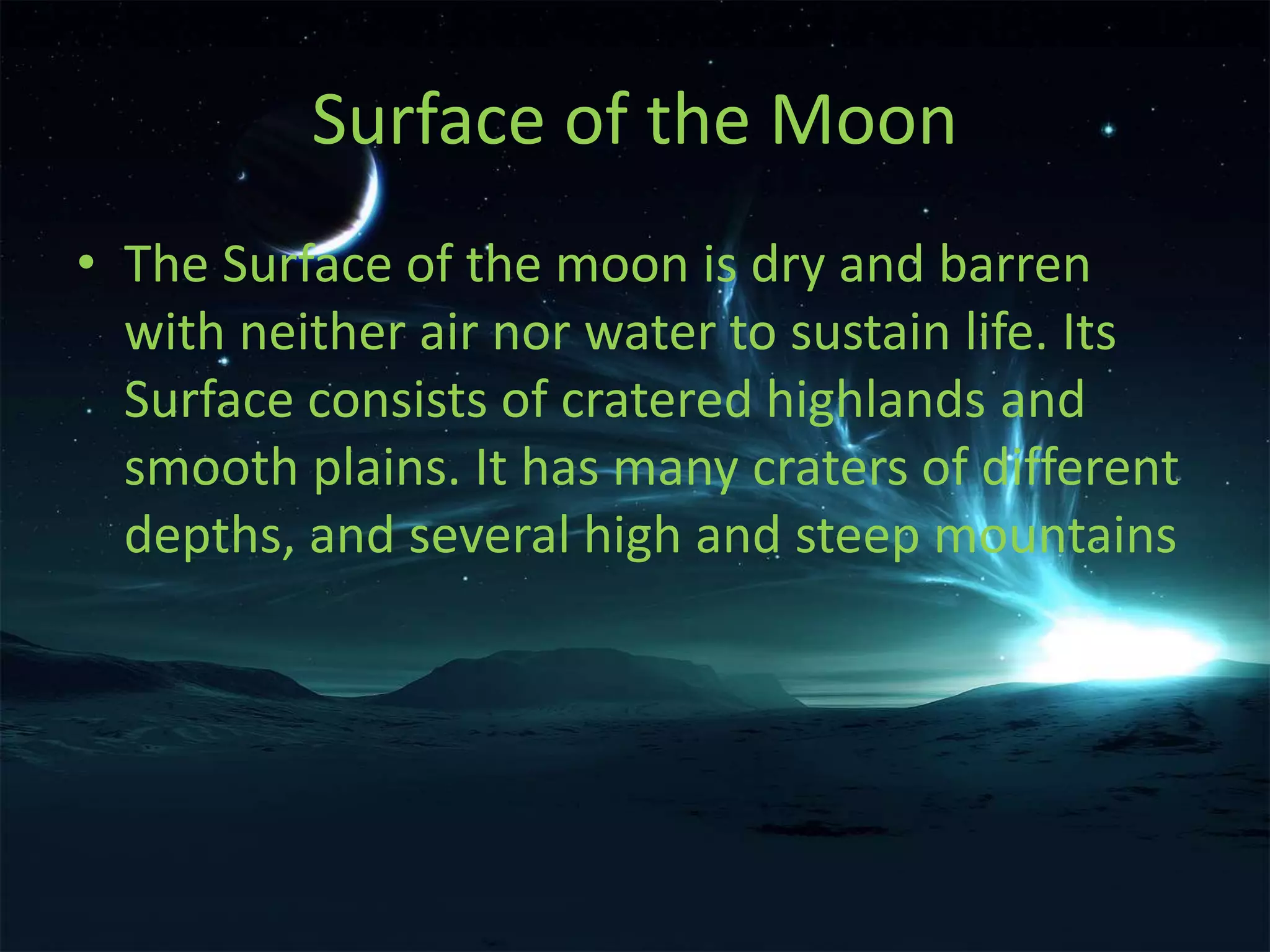
Surface of the Moon 
• The Surface of the moon is dry and barren 
with neither air nor water to sustain life. Its 
Surface consists of cratered highlands and 
smooth plains. It has many craters of different 
depths, and several high and steep mountains
Stars 
• A star is a massive, luminous sphere of plasma 
held together by its own gravity. The nearest 
star to Earth is the Sun, which is the source of 
most of the planet's energy. Some other stars 
are visible from Earth during the night, 
appearing as a multitude of fixed luminous 
points due to their immense distance
Constellations
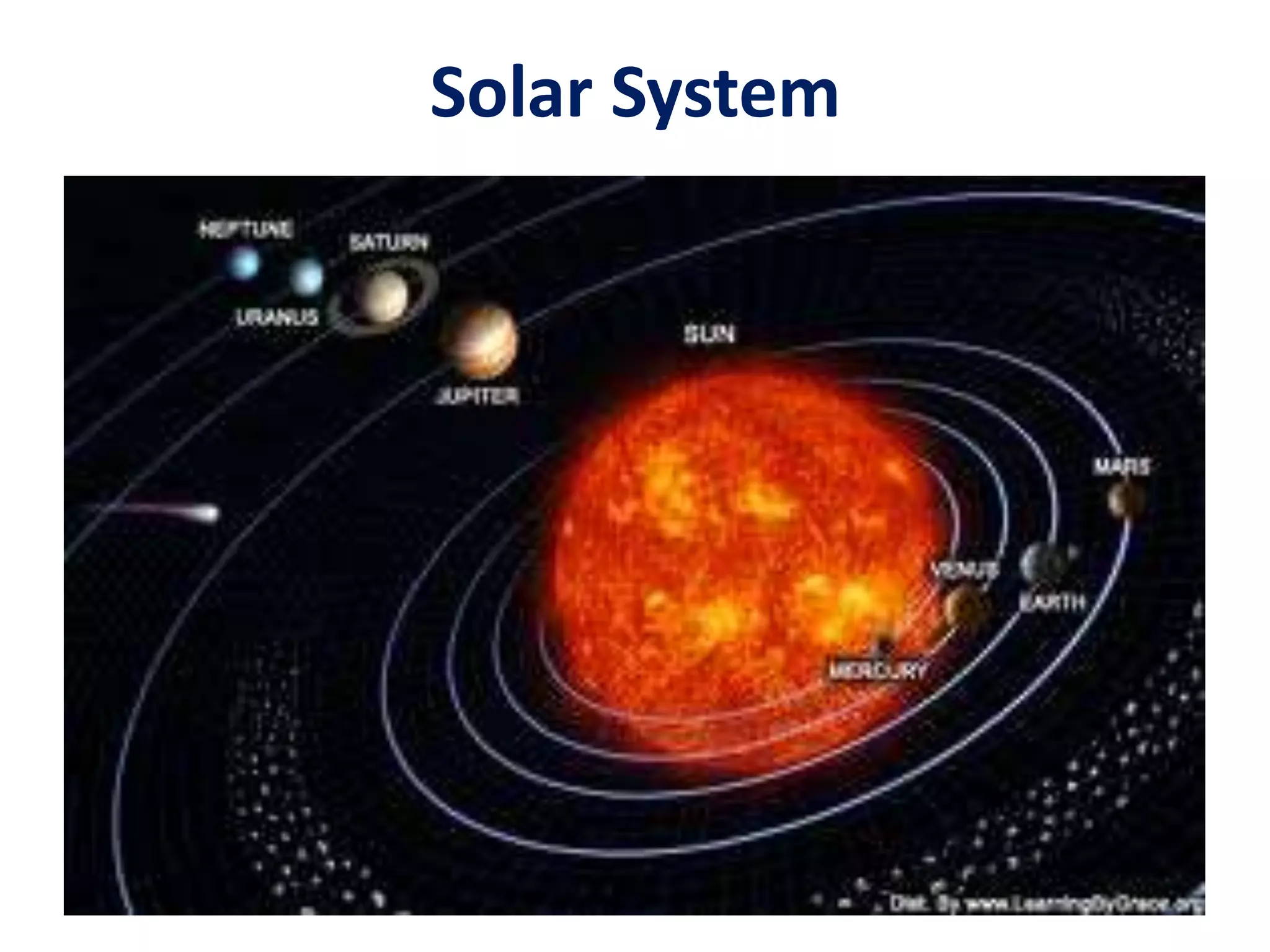
What is Solar System 
• The Sun, its planets and all the objects moving 
around them collectively are called Solar 
System. 
• The Solar System is entirely dependent on Sun 
& the only one which is self- luminous i.e 
which has its own light. 
• Rest of the planets reflect the light received 
from Sun
Solar System
Sun –Star of the Solar System 
• It ‘s the heaviest 
among solar system 
• It is a ball of hot 
burning gases. 
• It is the nearest star to 
the earth. 
• The light from the Sun 
takes appx. 8 minutes 
to reach Earth.
Planets
Planets 
• Planet word comes from Greek ,which means wandering 
star. 
• Planets are heavenly bodies ,which revolve around the Sun 
in elliptical orbits. 
• Earlier it was considered there were 9 planets in Solar 
system but lately one planet called Pluto was de-classified 
from being a planet. 
• All planets fall in 2 groups 
Inner Planets: Mercury , Venus, Mars and Earth are called 
inner planets. 
Outer Planets: These are Jupiter , Saturn, Uranus, Neptune
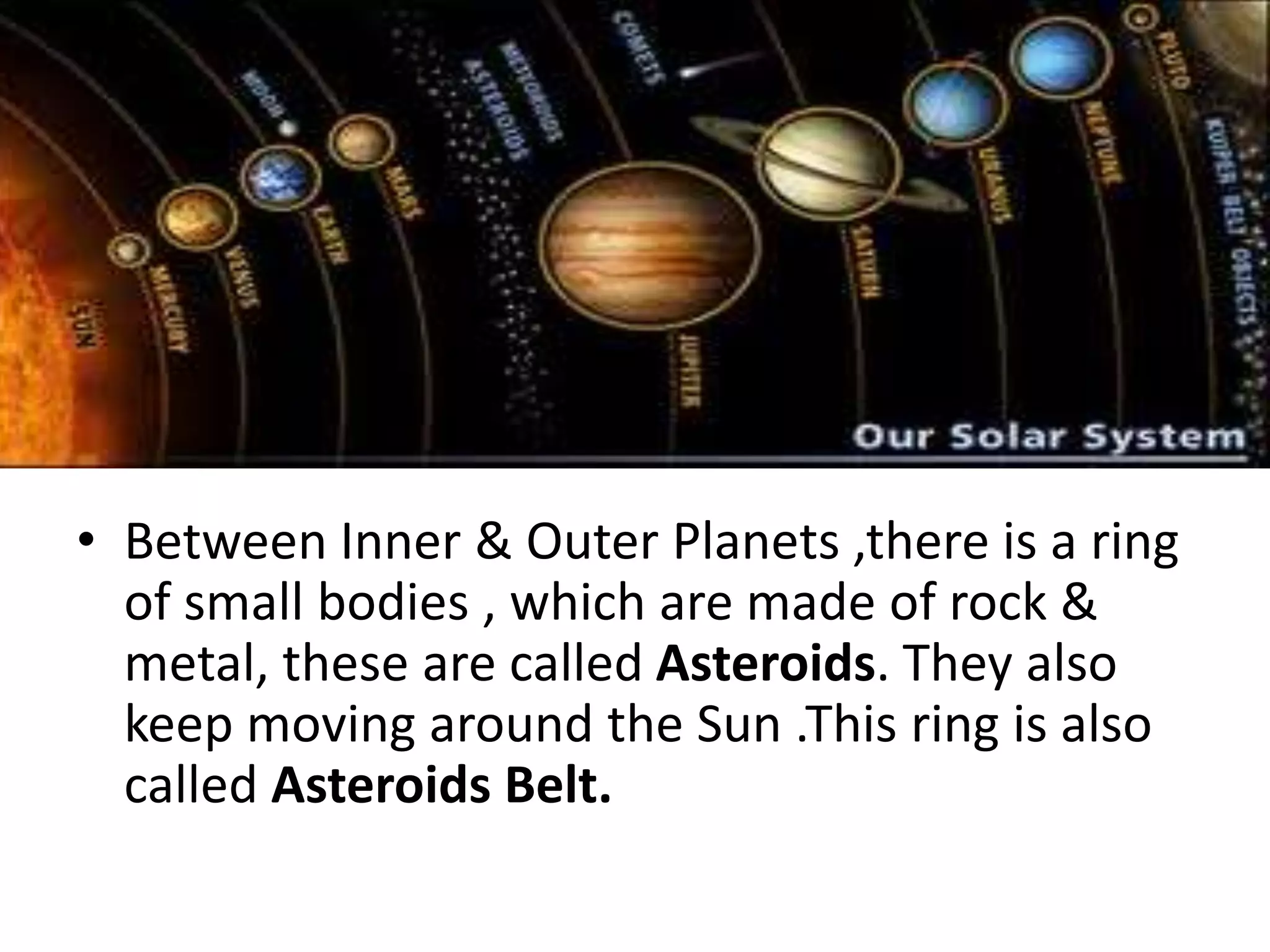
• Between Inner & Outer Planets ,there is a ring 
of small bodies , which are made of rock & 
metal, these are called Asteroids. They also 
keep moving around the Sun .This ring is also 
called Asteroids Belt.
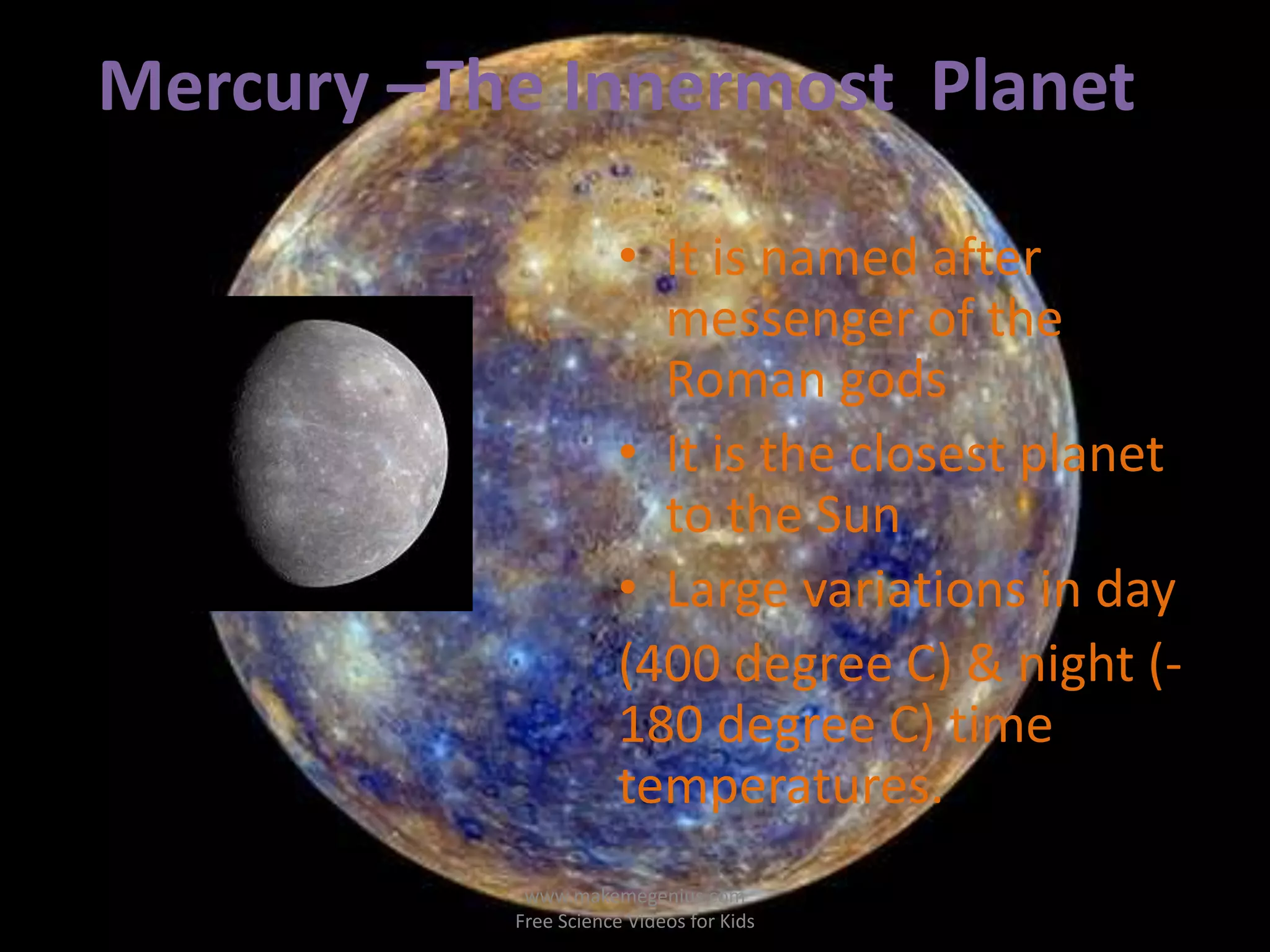
Mercury –The Innermost Planet 
• It is named after 
messenger of the 
Roman gods 
• It is the closest planet 
to the Sun 
• Large variations in day 
(400 degree C) & night (- 
180 degree C) time 
temperatures. 
www.makemegenius.com 
Free Science Videos for Kids
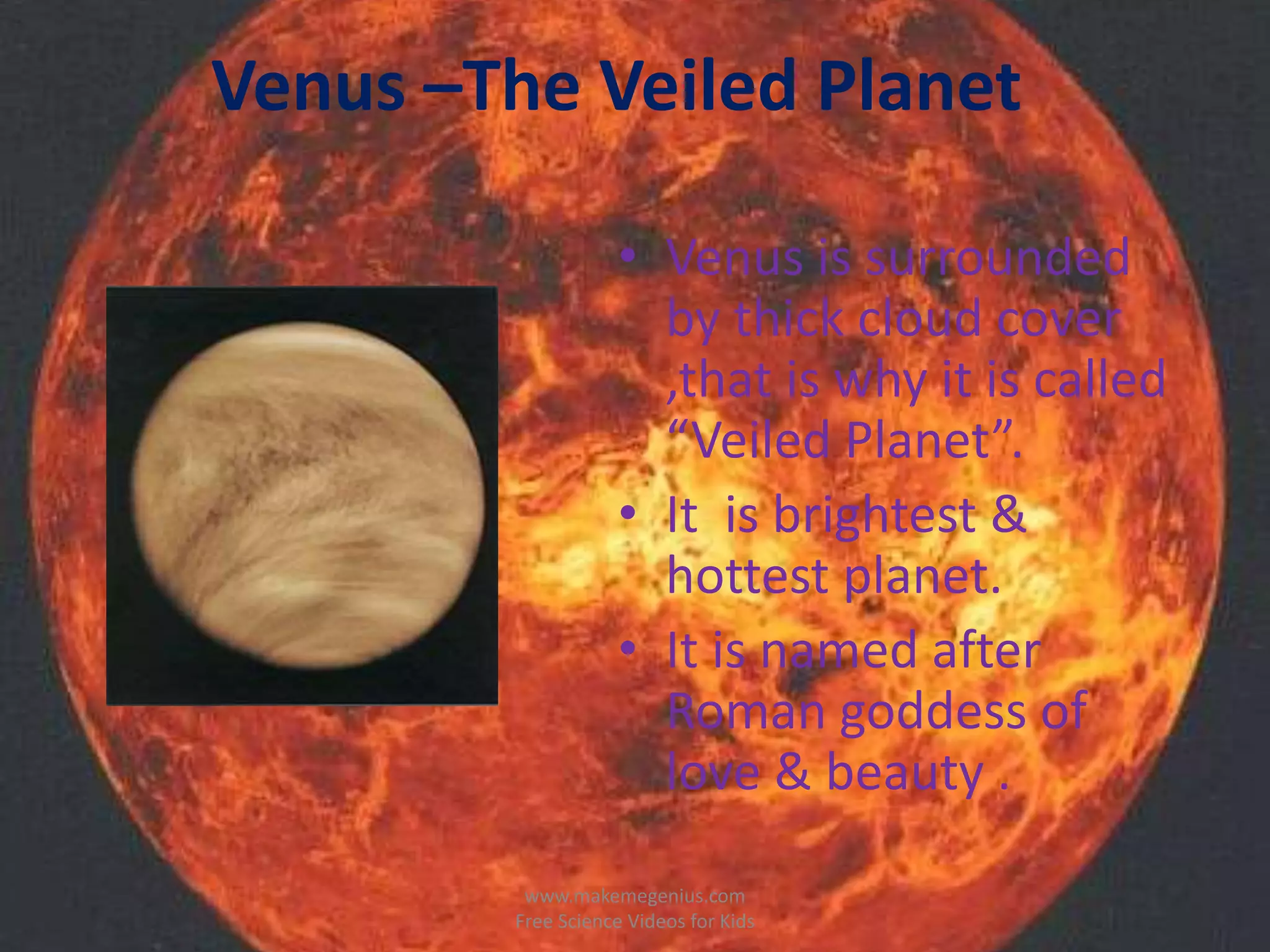
Venus –The Veiled Planet 
• Venus is surrounded 
by thick cloud cover 
,that is why it is called 
“Veiled Planet”. 
• It is brightest & 
hottest planet. 
• It is named after 
Roman goddess of 
love & beauty . 
www.makemegenius.com 
Free Science Videos for Kids
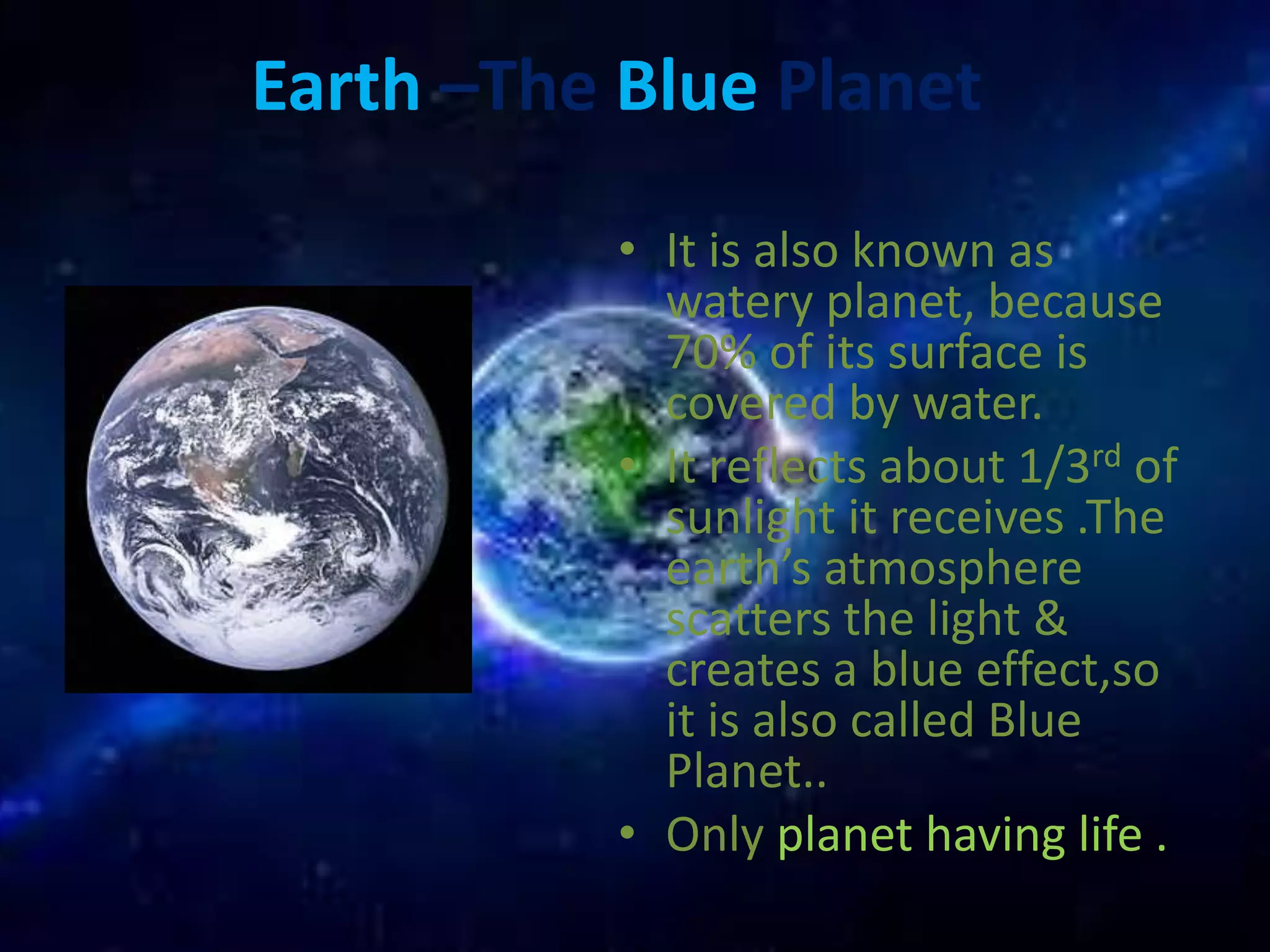
Earth –The Blue Planet 
• It is also known as 
watery planet, because 
70% of its surface is 
covered by water. 
• It reflects about 1/3rd of 
sunlight it receives .The 
earth’s atmosphere 
scatters the light & 
creates a blue effect,so 
it is also called Blue 
Planet.. 
• Only planet having life .
Earth –The Blue Planet 
• It orbits the Sun once in about 365 Earth days. 
• It rotates about its own axis, thus creating day & 
night. It takes 24 hours to do that. 
• It revolves around sun, due to its tilt ,seasons are 
created. 
• Due to gravity, the layer of gases remain attached 
to it (which is known as atmosphere), it prevents 
too much heat or UV rays from Sun reaching 
earth. 
• Moon is the only satellite of the Earth.
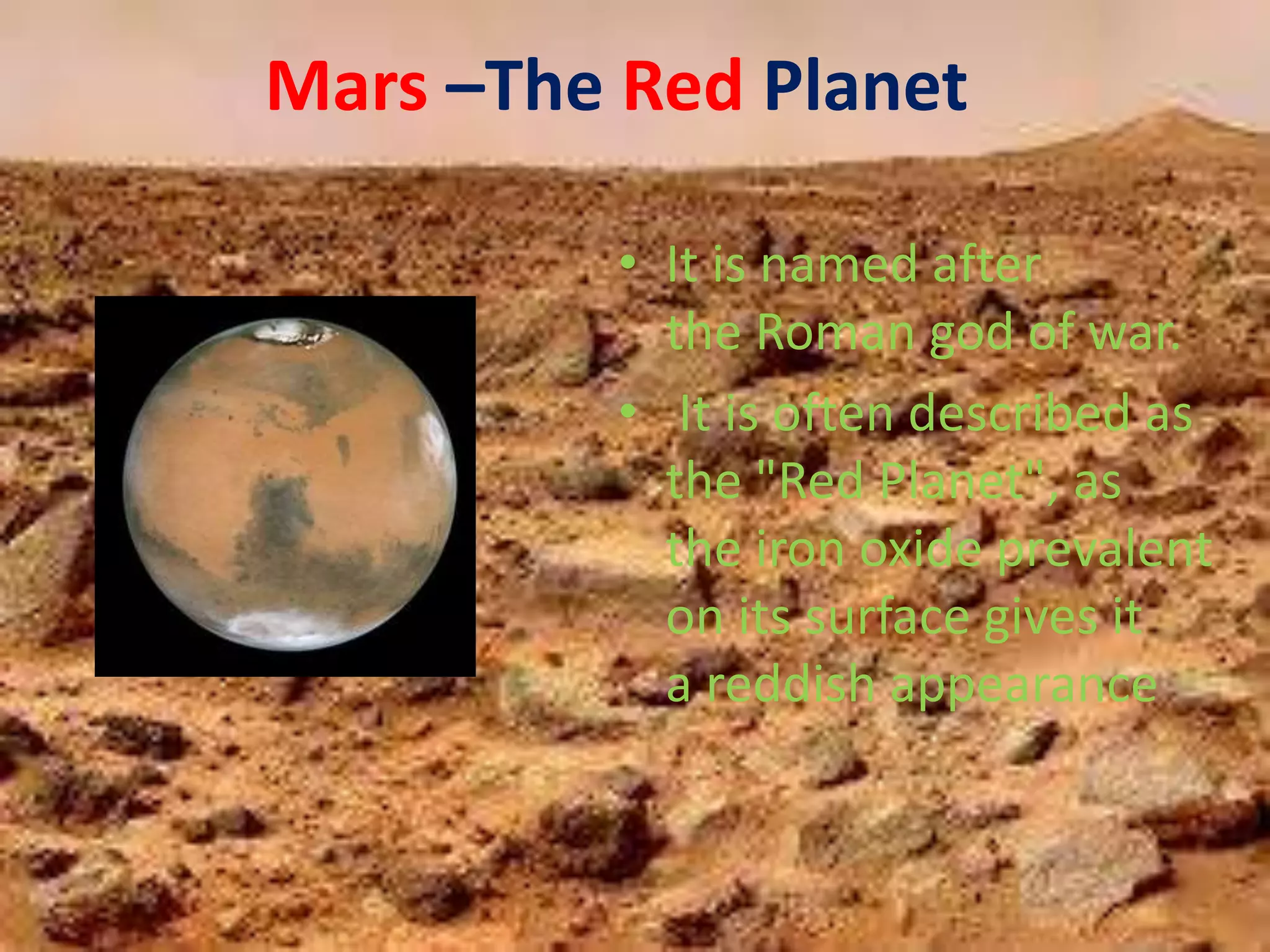
Mars –The Red Planet 
• It is named after 
the Roman god of war. 
• It is often described as 
the "Red Planet", as 
the iron oxide prevalent 
on its surface gives it 
a reddish appearance
Jupiter –The Giant Planet 
• It is named after 
the Roman god Jupiter 
(ruler of Roman gods) 
• Jupiter is the largest 
planet within the Solar 
System 
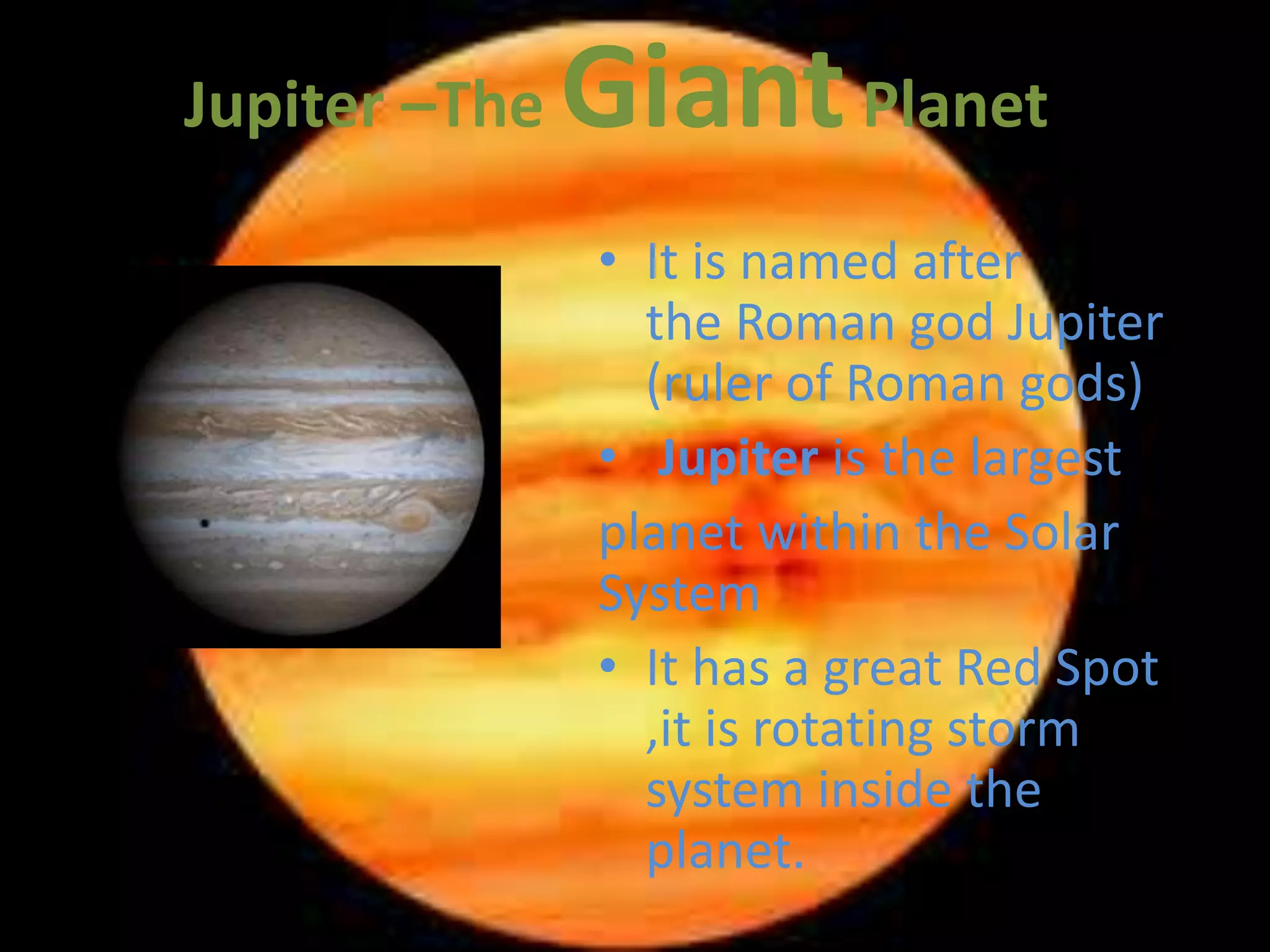
• It has a great Red Spot 
,it is rotating storm 
system inside the 
planet.
Jupiter –The Giant Planet 
• Jupiter rotates faster than any other planet. 
• It completes one rotation in 10 hours 
• Jupiter has a faint ring system, these rings 
appear to be made of dust. 
• This is also a windy planet as the fast rotation 
causes high winds. 
• It has 16 planets.
Saturn –The Jewel Planet 
• Saturn is the 
sixth planet from 
the Sun and the second 
largest planet in 
the Solar System, 
after Jupiter. 
• It is named after 
the Roman god Saturn 
• Saturn is classified as 
a gas giant planet 
It is the most beautiful planet in solar system because of its spectacular rings
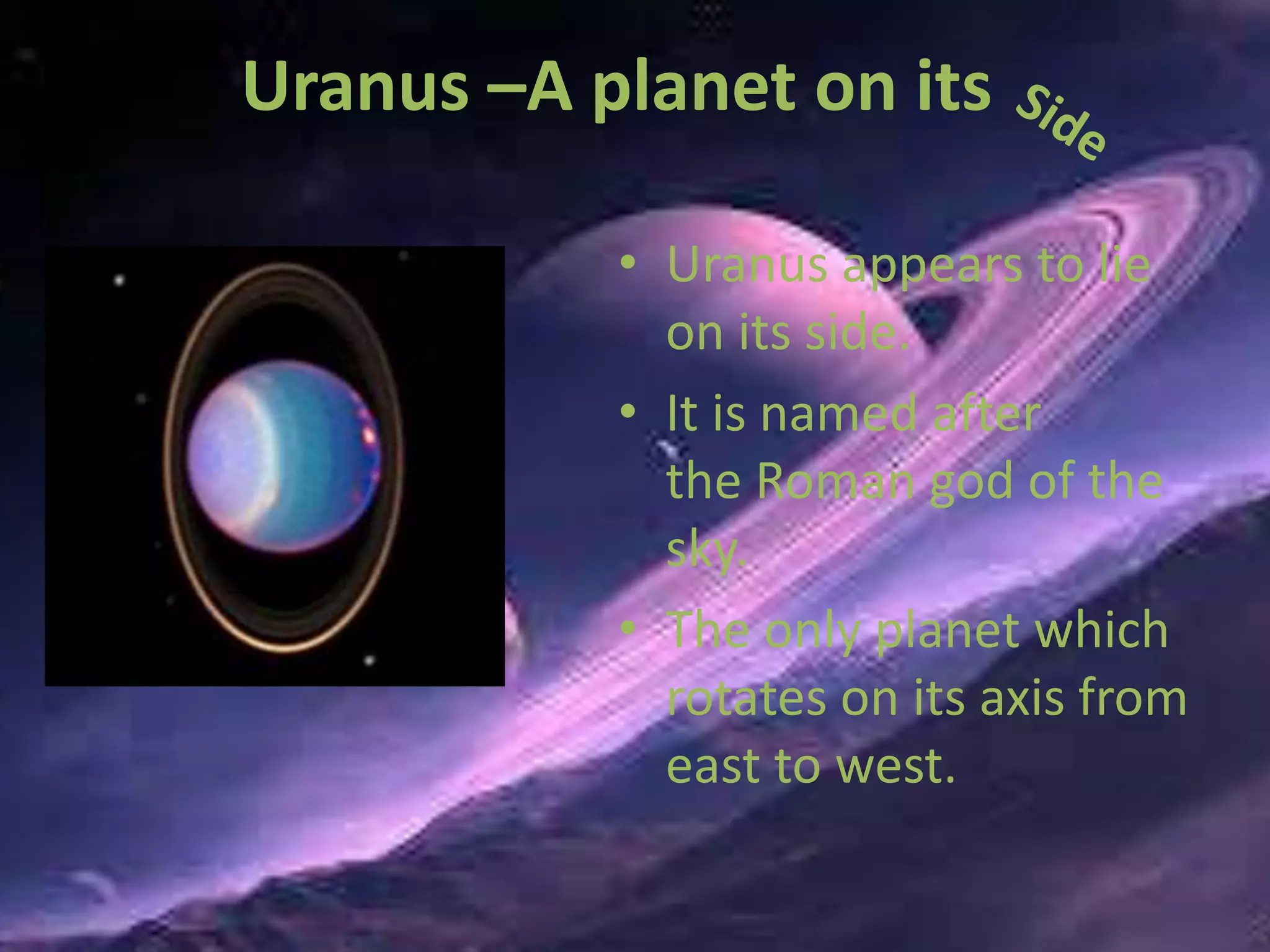
Uranus –A planet on its 
• Uranus appears to lie 
on its side. 
• It is named after 
the Roman god of the 
sky. 
• The only planet which 
rotates on its axis from 
east to west.
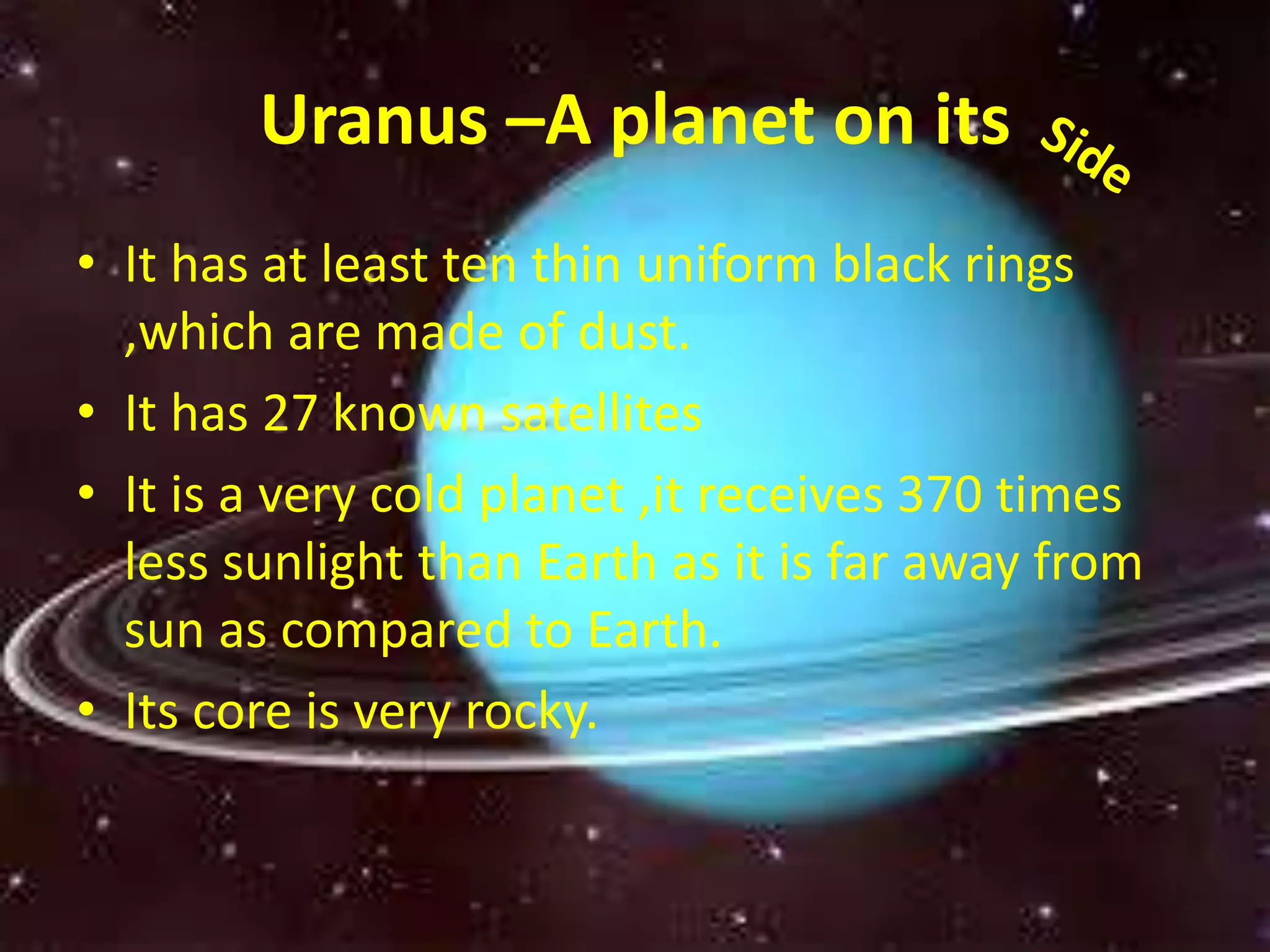
Uranus –A planet on its 
• It has at least ten thin uniform black rings 
,which are made of dust. 
• It has 27 known satellites 
• It is a very cold planet ,it receives 370 times 
less sunlight than Earth as it is far away from 
sun as compared to Earth. 
• Its core is very rocky.
Neptune –The Last Giant 
• Most distant gas 
planet. 
• It is named after 
the Roman god of the 
sea . 
• Most windy planet
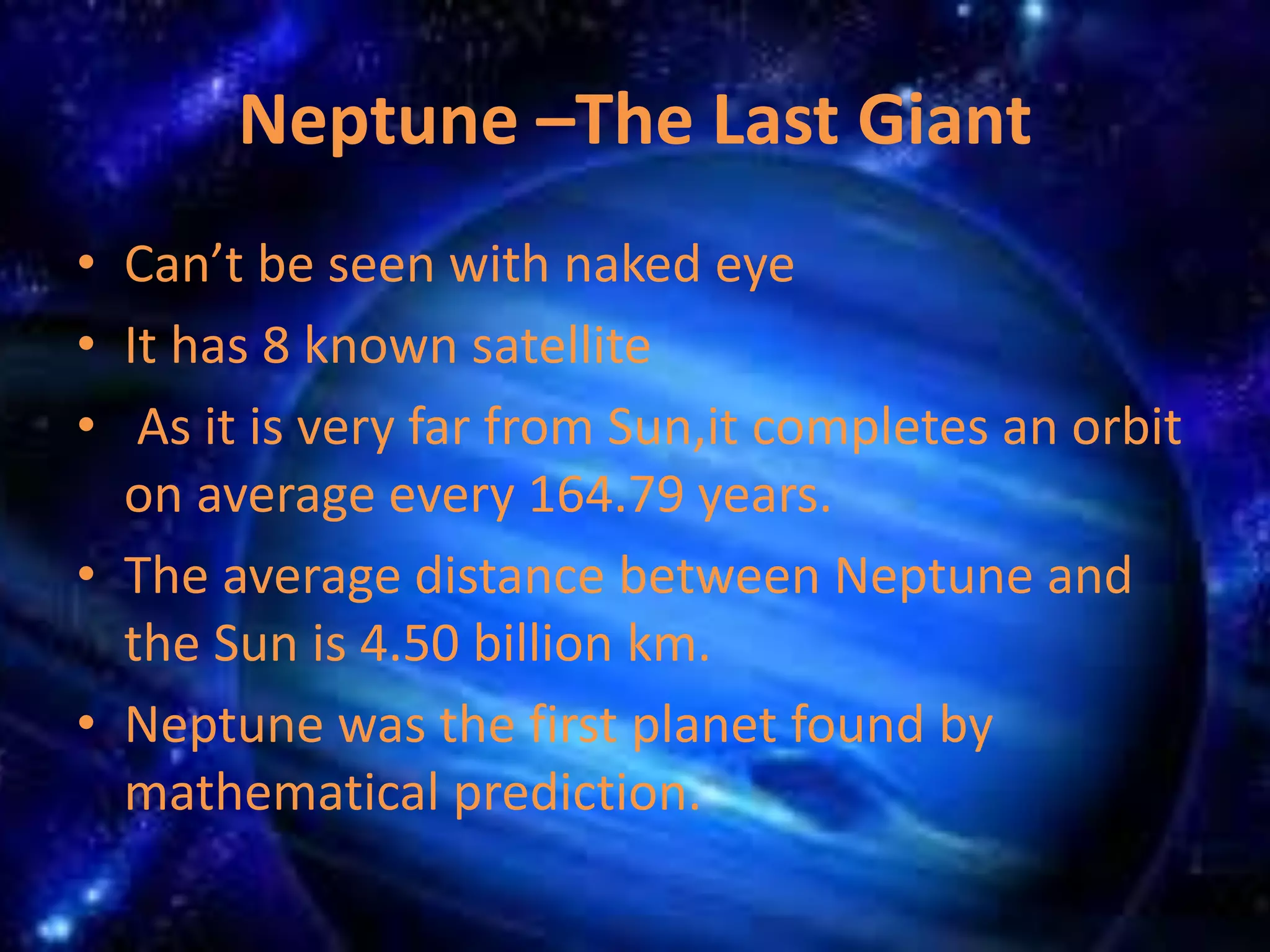
Neptune –The Last Giant 
• Can’t be seen with naked eye 
• It has 8 known satellite 
• As it is very far from Sun,it completes an orbit 
on average every 164.79 years. 
• The average distance between Neptune and 
the Sun is 4.50 billion km. 
• Neptune was the first planet found by 
mathematical prediction.
Gagandeep

Gagandeep

  • 1.
  • 2.
    INDEX • Astronomy • The Moon and its Phases • Stars • Constellations • The Solar System • Other Celestial Objects in the Solar System • Galaxies And The Universe
  • 3.
    Astronomy • Astronomyis the scientific study of celestial objects • Scientists who pursue Astronomy are called Astronomers • It Should Not be confused With Astrology(The study of the positions and motions of celestial bodies in the belief that they have an influence on the course of natural earthly occurrences and human affairs)
  • 4.
    The Moon •The moon is the most prominent celestial object in the night. It is not a luminous Body, It reflects the light of the Sun • It is a natural satellite of the Earth • The Distance of moon from Earth is 384,400 Km
  • 5.
    Phases Of Moon • The Changes In the Shape of the Moon as Observed from the sun from earth are known as Phases of Moon • The Moon Has 4 Phases – Full Moon, Half Moon, Crescent Moon And New Moon
  • 6.
    Surface of theMoon • The Surface of the moon is dry and barren with neither air nor water to sustain life. Its Surface consists of cratered highlands and smooth plains. It has many craters of different depths, and several high and steep mountains
  • 7.
    Stars • Astar is a massive, luminous sphere of plasma held together by its own gravity. The nearest star to Earth is the Sun, which is the source of most of the planet's energy. Some other stars are visible from Earth during the night, appearing as a multitude of fixed luminous points due to their immense distance
  • 8.
  • 9.
    What is SolarSystem • The Sun, its planets and all the objects moving around them collectively are called Solar System. • The Solar System is entirely dependent on Sun & the only one which is self- luminous i.e which has its own light. • Rest of the planets reflect the light received from Sun
  • 10.
  • 11.
    Sun –Star ofthe Solar System • It ‘s the heaviest among solar system • It is a ball of hot burning gases. • It is the nearest star to the earth. • The light from the Sun takes appx. 8 minutes to reach Earth.
  • 12.
  • 13.
    Planets • Planetword comes from Greek ,which means wandering star. • Planets are heavenly bodies ,which revolve around the Sun in elliptical orbits. • Earlier it was considered there were 9 planets in Solar system but lately one planet called Pluto was de-classified from being a planet. • All planets fall in 2 groups Inner Planets: Mercury , Venus, Mars and Earth are called inner planets. Outer Planets: These are Jupiter , Saturn, Uranus, Neptune
  • 14.
    • Between Inner& Outer Planets ,there is a ring of small bodies , which are made of rock & metal, these are called Asteroids. They also keep moving around the Sun .This ring is also called Asteroids Belt.
  • 15.
    Mercury –The InnermostPlanet • It is named after messenger of the Roman gods • It is the closest planet to the Sun • Large variations in day (400 degree C) & night (- 180 degree C) time temperatures. www.makemegenius.com Free Science Videos for Kids
  • 16.
    Venus –The VeiledPlanet • Venus is surrounded by thick cloud cover ,that is why it is called “Veiled Planet”. • It is brightest & hottest planet. • It is named after Roman goddess of love & beauty . www.makemegenius.com Free Science Videos for Kids
  • 17.
    Earth –The BluePlanet • It is also known as watery planet, because 70% of its surface is covered by water. • It reflects about 1/3rd of sunlight it receives .The earth’s atmosphere scatters the light & creates a blue effect,so it is also called Blue Planet.. • Only planet having life .
  • 18.
    Earth –The BluePlanet • It orbits the Sun once in about 365 Earth days. • It rotates about its own axis, thus creating day & night. It takes 24 hours to do that. • It revolves around sun, due to its tilt ,seasons are created. • Due to gravity, the layer of gases remain attached to it (which is known as atmosphere), it prevents too much heat or UV rays from Sun reaching earth. • Moon is the only satellite of the Earth.
  • 19.
    Mars –The RedPlanet • It is named after the Roman god of war. • It is often described as the "Red Planet", as the iron oxide prevalent on its surface gives it a reddish appearance
  • 20.
    Jupiter –The GiantPlanet • It is named after the Roman god Jupiter (ruler of Roman gods) • Jupiter is the largest planet within the Solar System • It has a great Red Spot ,it is rotating storm system inside the planet.
  • 21.
    Jupiter –The GiantPlanet • Jupiter rotates faster than any other planet. • It completes one rotation in 10 hours • Jupiter has a faint ring system, these rings appear to be made of dust. • This is also a windy planet as the fast rotation causes high winds. • It has 16 planets.
  • 22.
    Saturn –The JewelPlanet • Saturn is the sixth planet from the Sun and the second largest planet in the Solar System, after Jupiter. • It is named after the Roman god Saturn • Saturn is classified as a gas giant planet It is the most beautiful planet in solar system because of its spectacular rings
  • 23.
    Uranus –A planeton its • Uranus appears to lie on its side. • It is named after the Roman god of the sky. • The only planet which rotates on its axis from east to west.
  • 24.
    Uranus –A planeton its • It has at least ten thin uniform black rings ,which are made of dust. • It has 27 known satellites • It is a very cold planet ,it receives 370 times less sunlight than Earth as it is far away from sun as compared to Earth. • Its core is very rocky.
  • 25.
    Neptune –The LastGiant • Most distant gas planet. • It is named after the Roman god of the sea . • Most windy planet
  • 26.
    Neptune –The LastGiant • Can’t be seen with naked eye • It has 8 known satellite • As it is very far from Sun,it completes an orbit on average every 164.79 years. • The average distance between Neptune and the Sun is 4.50 billion km. • Neptune was the first planet found by mathematical prediction.