
Stars And The Solar System
Have you ever seen a clear cloudless night . You see that
a large number of bright stars in the sky . We are not
able to see such beautiful scene in cities
Question 1- Why the village sky was so different fromthe night sky in big
cities ?
Answer = The village sky was so different
from the night sky in big cities due to
bright light , smoke and dust , the sky in
big cities is rarely clear.
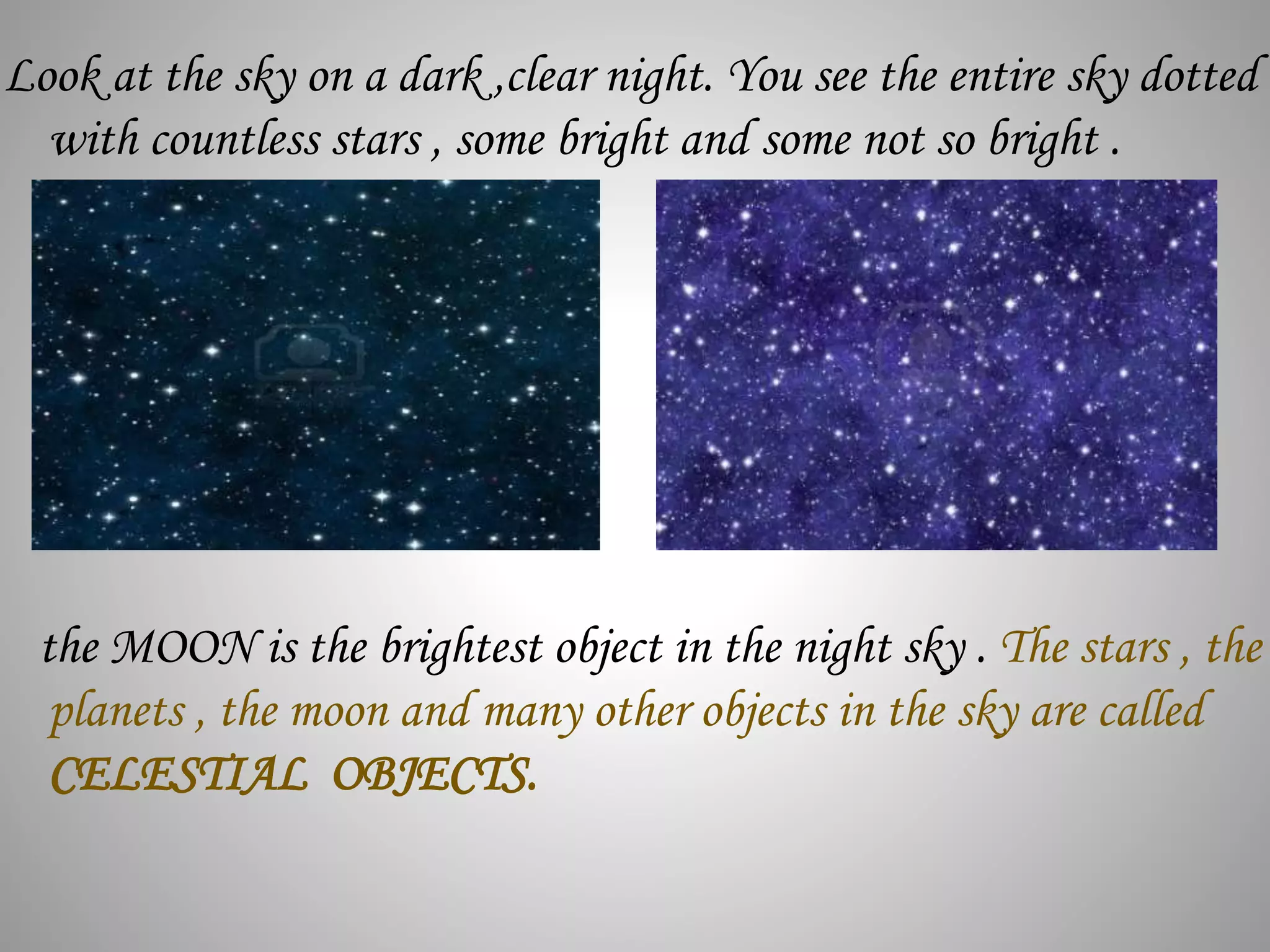
Look at the sky on a dark ,clear night. You see the entire sky dotted
with countless stars , some bright and some not so bright .
the MOON is the brightest object in the night sky . The stars , the
planets , the moon and many other objects in the sky are called
CELESTIAL OBJECTS.
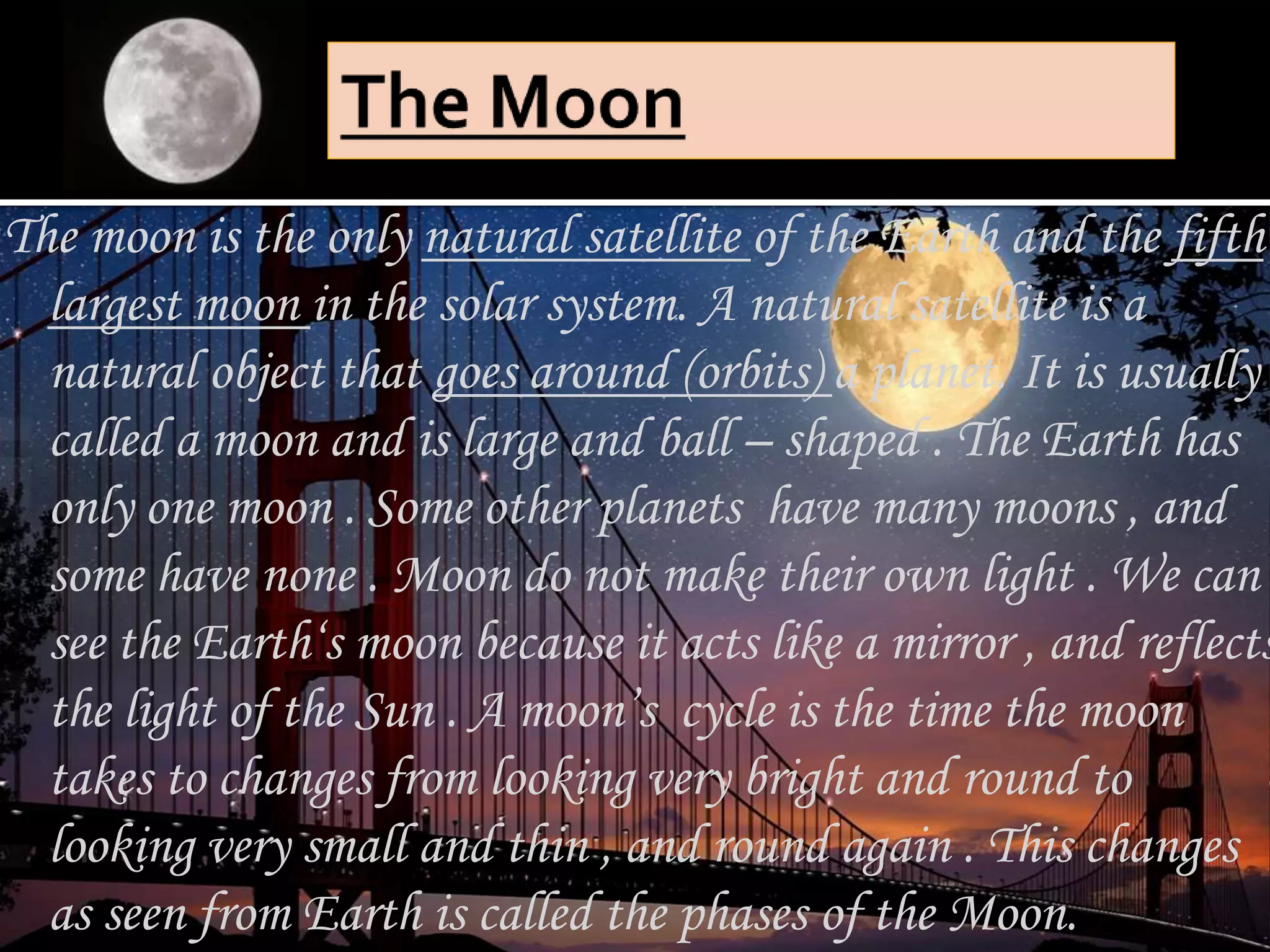
The moon is the only natural satellite of the Earth and the fifth
largest moon in the solar system. A natural satellite is a
natural object that goes around (orbits) a planet. It is usually
called a moon and is large and ball – shaped . The Earth has
only one moon . Some other planets have many moons , and
some have none . Moon do not make their own light . We can
see the Earth‘s moon because it acts like a mirror , and reflects
the light of the Sun . A moon’s cycle is the time the moon
takes to changes from looking very bright and round to
looking very small and thin , and round again . This changes
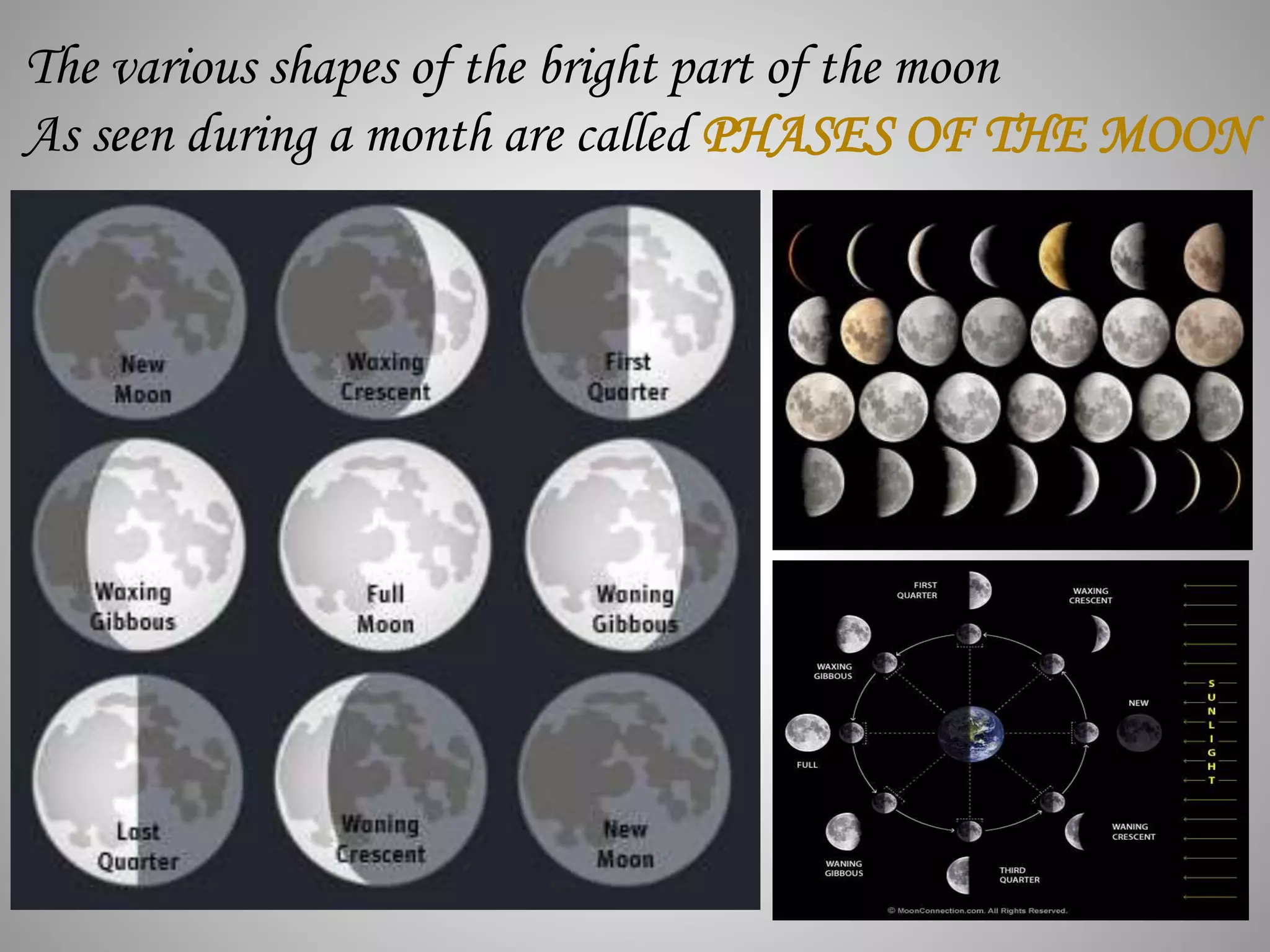
as seen from Earth is called the phases of the Moon.
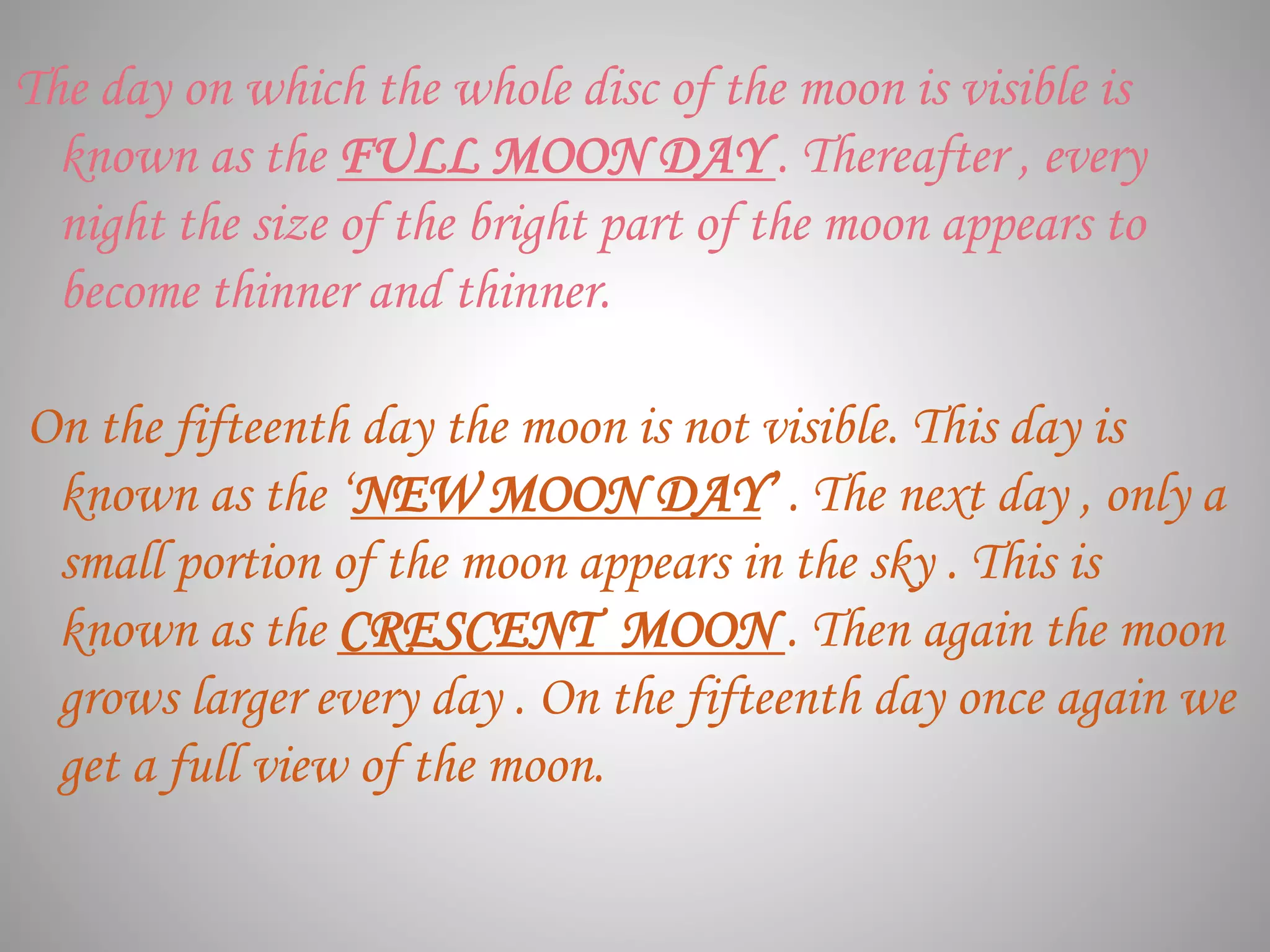
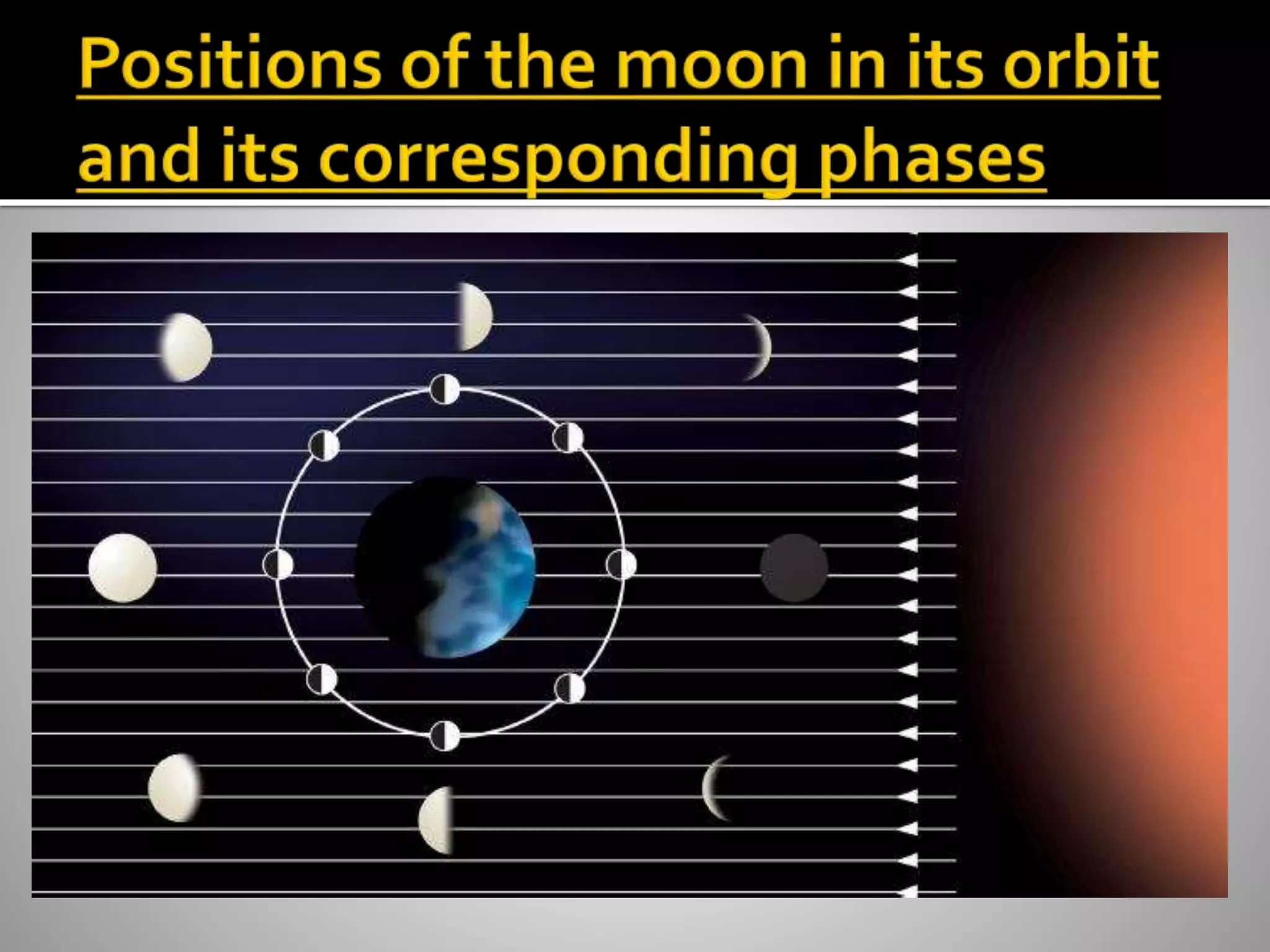
The day on which the whole disc of the moon is visible is
known as the FULL MOON DAY . Thereafter , every
night the size of the bright part of the moon appears to
become thinner and thinner.
On the fifteenth day the moon is not visible. This day is
known as the ‘NEW MOON DAY’ . The next day , only a
small portion of the moon appears in the sky . This is
known as the CRESCENT MOON . Then again the moon
grows larger every day . On the fifteenth day once again we
get a full view of the moon.
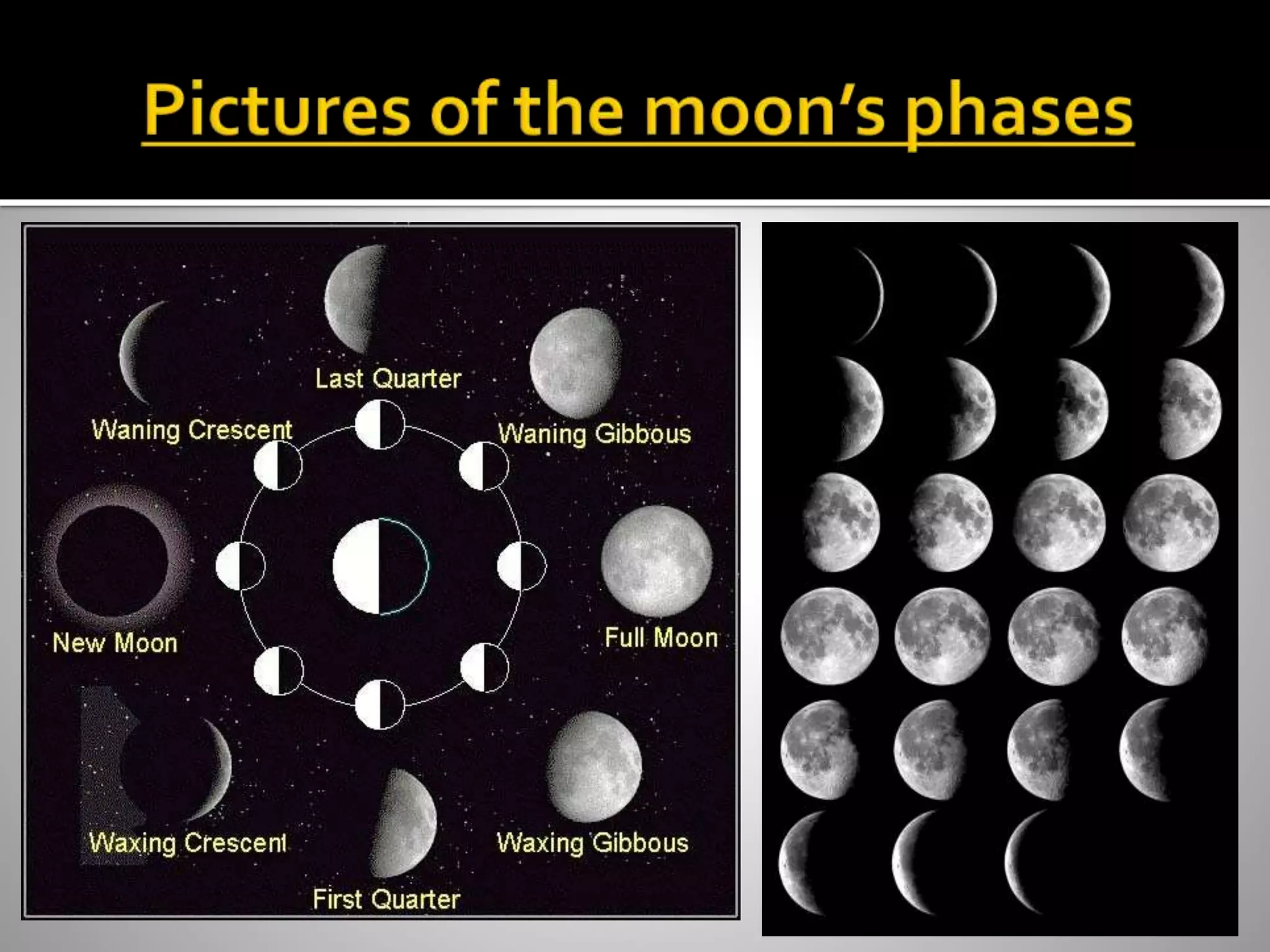
The various shapes of the bright part of the moon
As seen during a month are called PHASES OF THE MOON
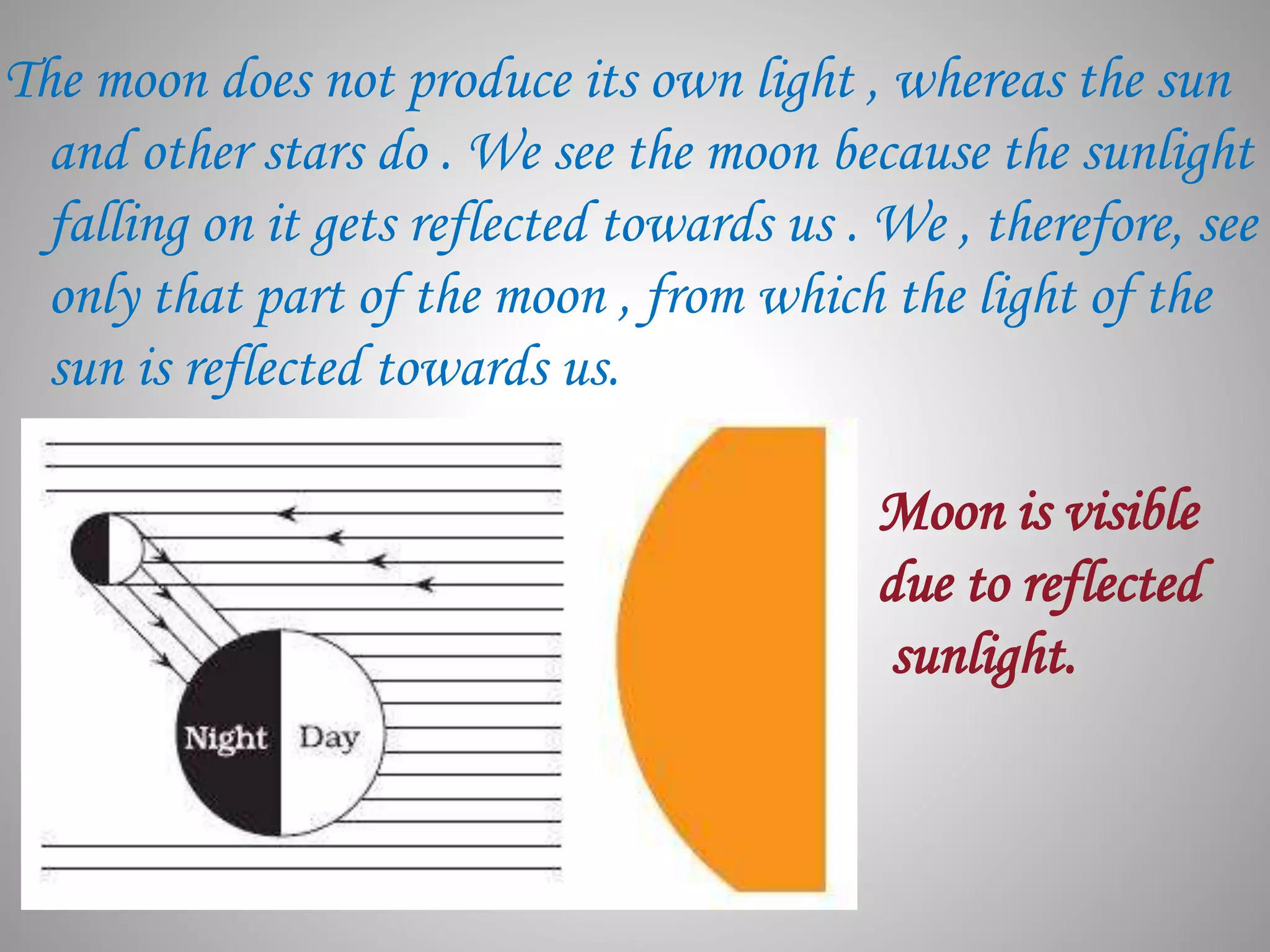
The moon does not produce its own light , whereas the sun
and other stars do . We see the moon because the sunlight
falling on it gets reflected towards us . We , therefore, see
only that part of the moon , from which the light of the
sun is reflected towards us.
Moon is visible
due to reflected
sunlight.
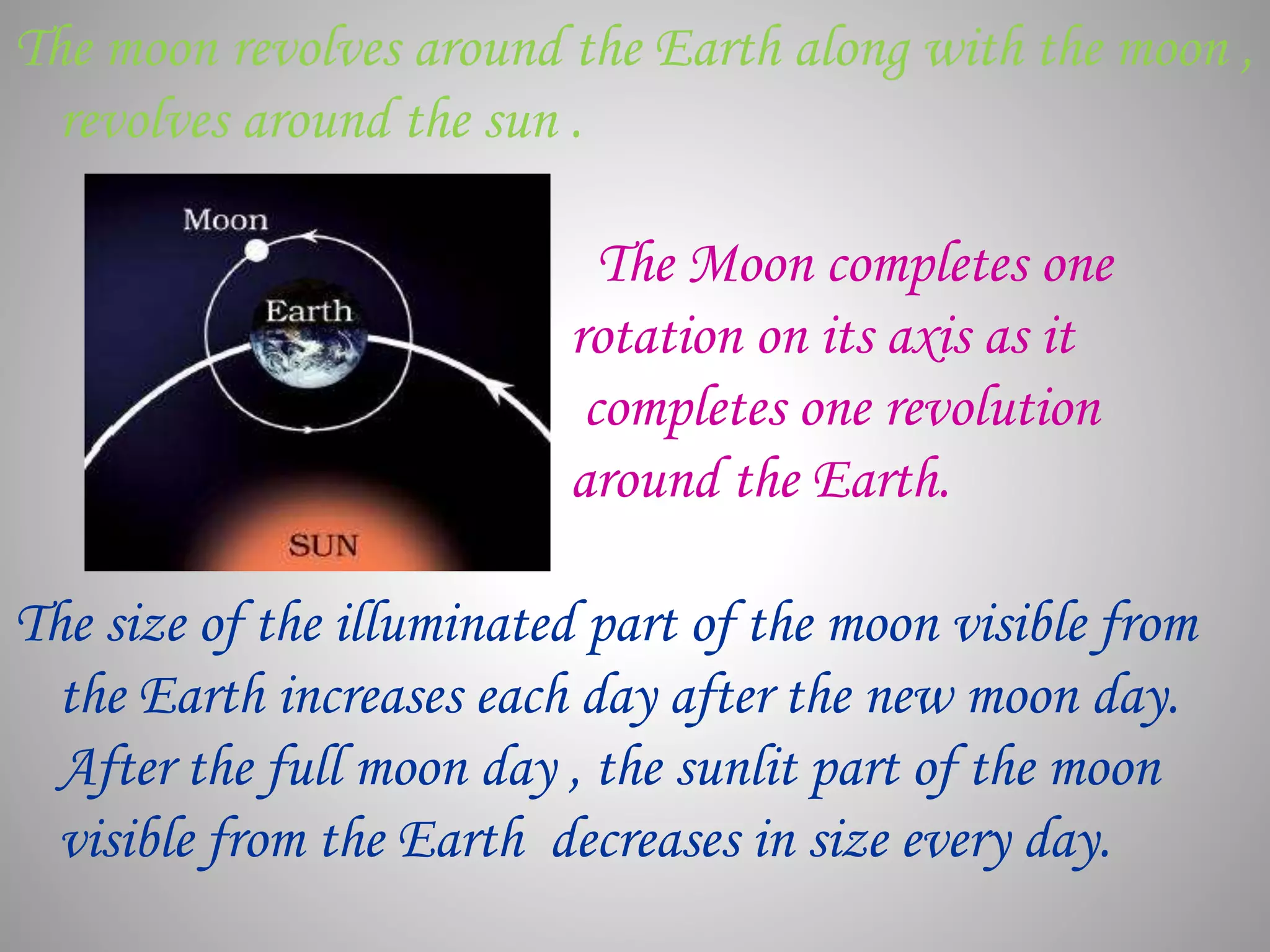
The moon revolves around the Earth along with the moon ,
revolves around the sun .
The Moon completes one
rotation on its axis as it
completes one revolution
around the Earth.
The size of the illuminated part of the moon visible from
the Earth increases each day after the new moon day.
After the full moon day , the sunlit part of the moon
visible from the Earth decreases in size every day.
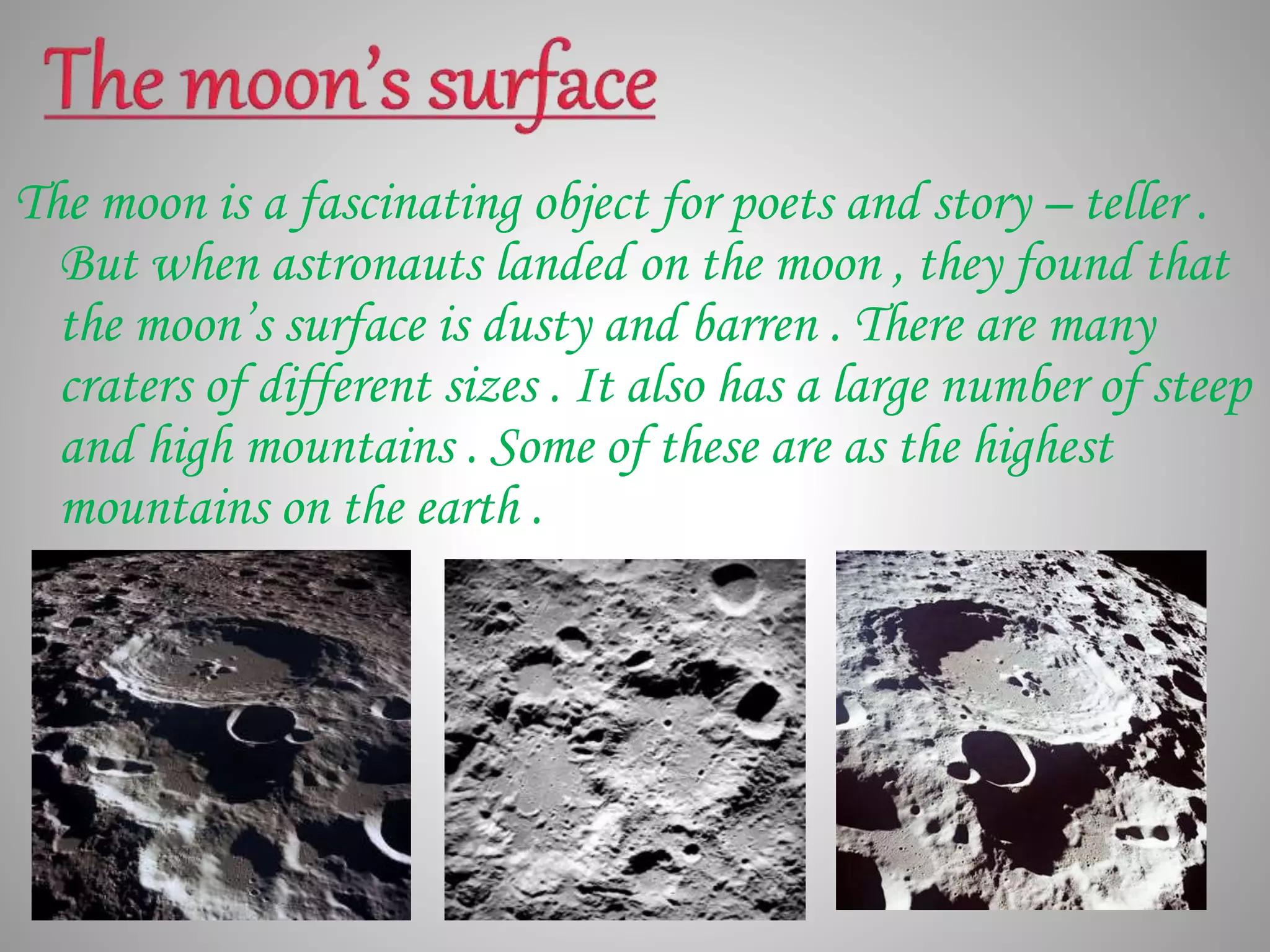
The moon is a fascinating object for poets and story – teller .
But when astronauts landed on the moon , they found that
the moon’s surface is dusty and barren . There are many
craters of different sizes . It also has a large number of steep
and high mountains . Some of these are as the highest
mountains on the earth .
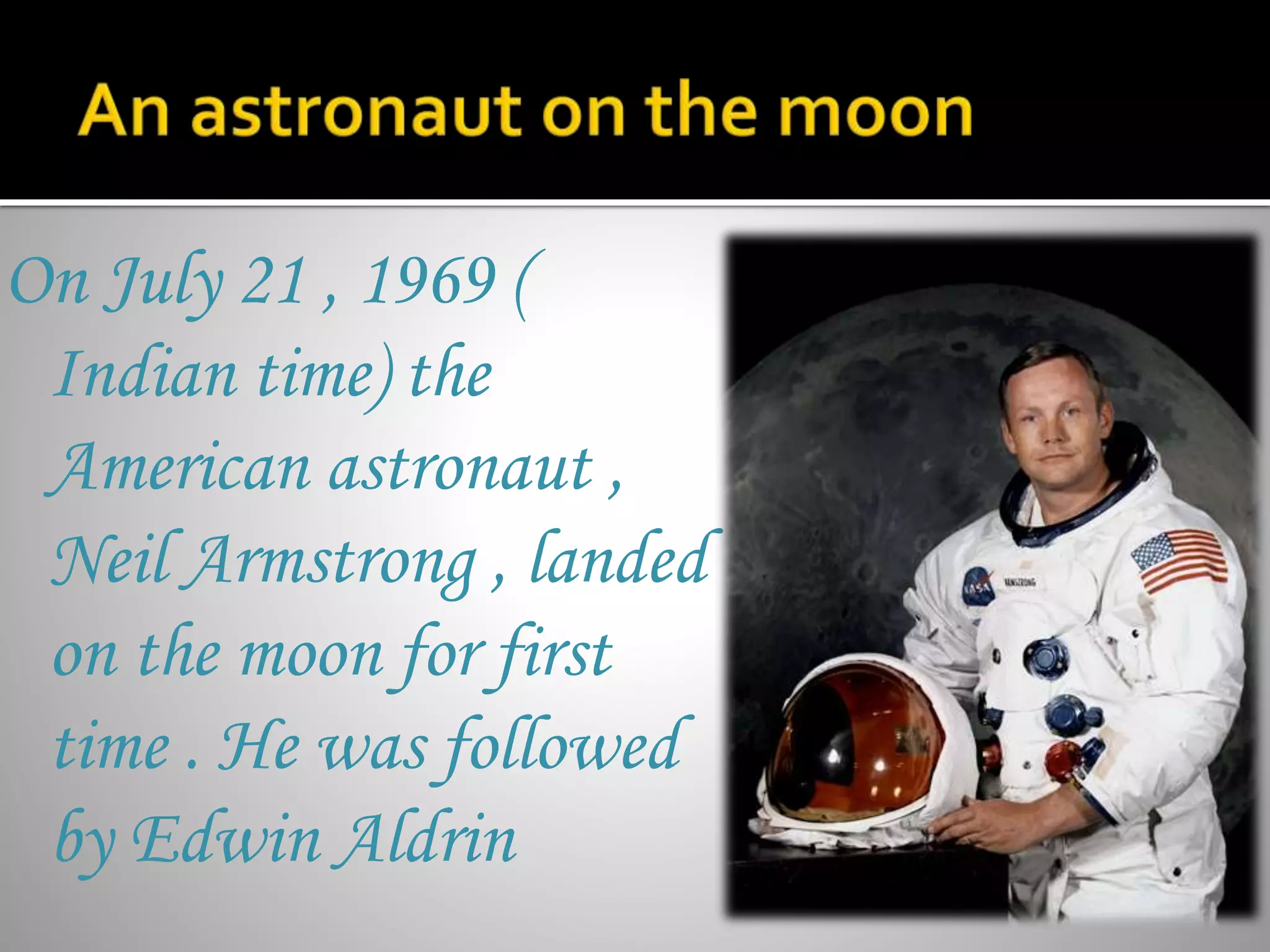
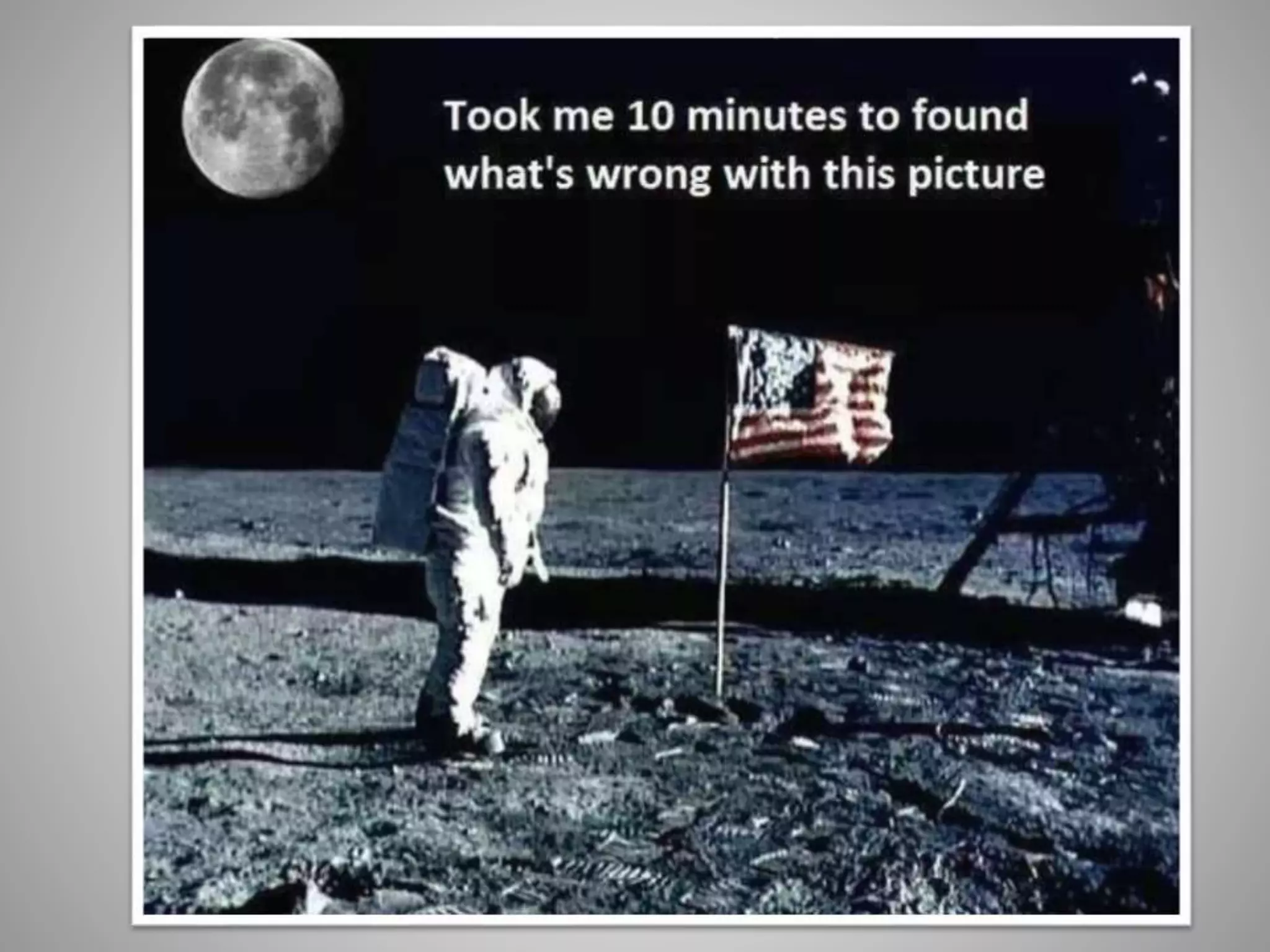
On July 21 , 1969 (
Indian time) the
American astronaut ,
Neil Armstrong , landed
on the moon for first
time . He was followed
by Edwin Aldrin
There is a large number of stars in the sky .
On a dark night and from a place away
from a big city . All the stars equally look
bright . In fact , stars emit light of their
own . The sun is also a star . Which
appears bigger , a football placed near you
, or a football placed at a distance of 100
m . The stars are millions of times farther
away than the Sun. therefore , the stars
appear to us like points
The Sun is nearly 150,000,000 kilometers ( 150 millions
kilometers ) away from the Earth .
The next nearest star is Alpha Centauri . It is at a distance
of about 40,000,000,000,000 km from the Earth . Some
stars are even further away .
Such large distance are expressed in another unit known as
Light Year. It is the distance travelled by light in one
year . Remember that the speed of light is about 300,000
km per second . Thus, the distance of the sun from the
Earth may be said to be about 8 Light minutes. The
distance of Alpha Centauri is about 4.3 light years .
The stars are present in the sky during the day – time also .
They are not visible to us because of the bright sunlight .
The stars appears to move from east to west . A star which rises
in the east in the evening , sets in the west in the early morning
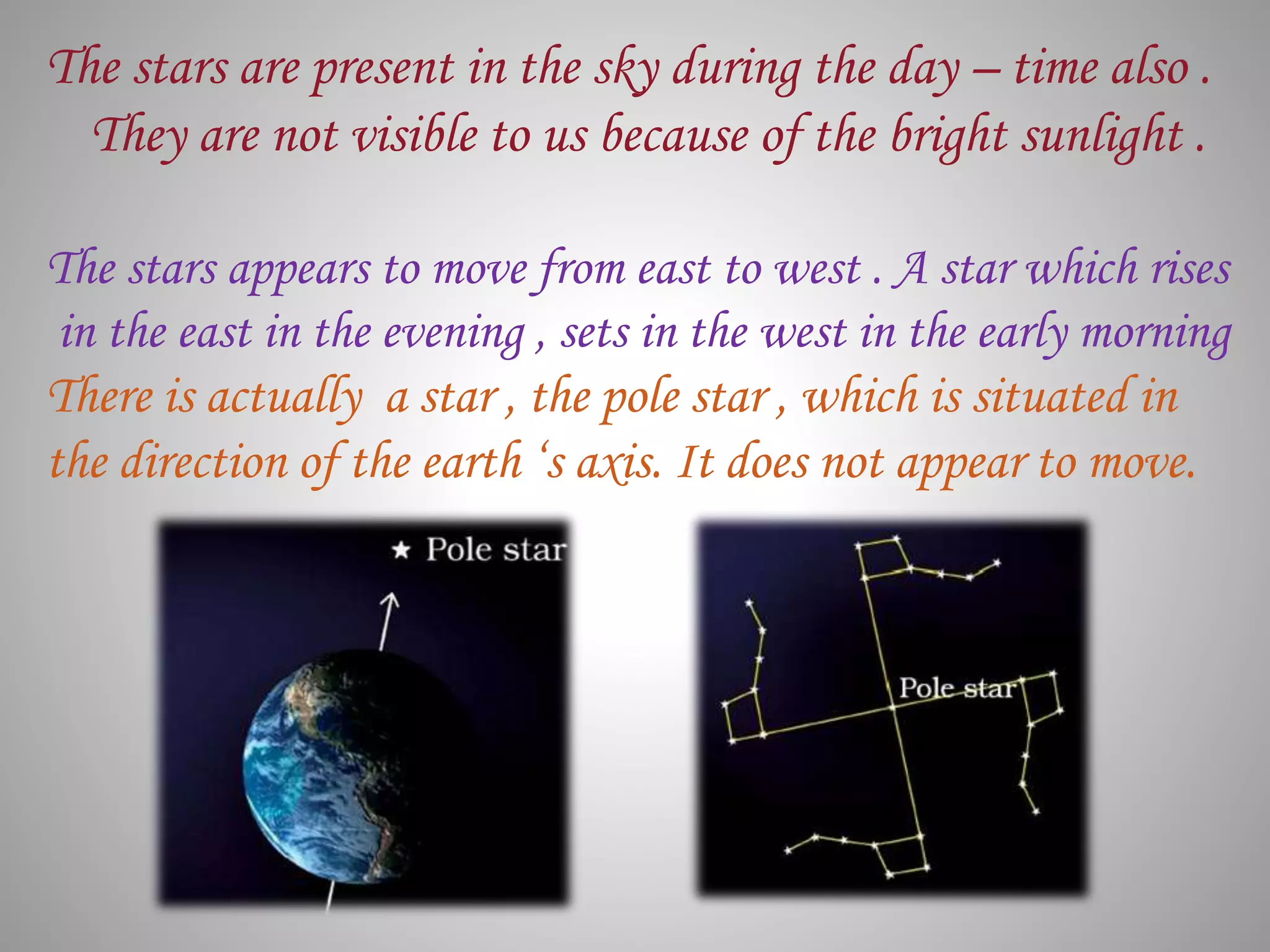
There is actually a star , the pole star , which is situated in
the direction of the earth ‘s axis. It does not appear to move.
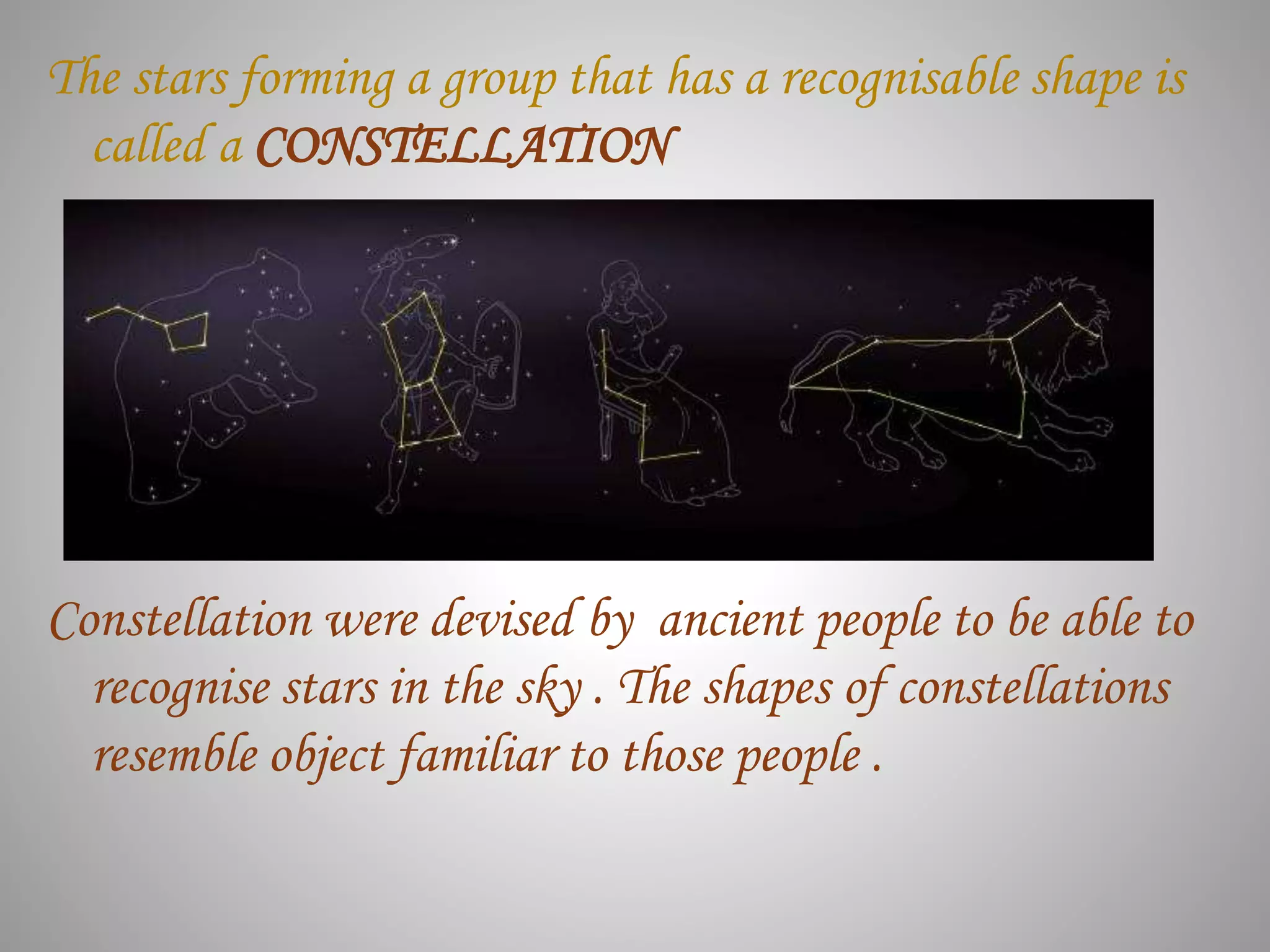
The stars forming a group that has a recognisable shape is
called a CONSTELLATION
Constellation were devised by ancient people to be able to
recognise stars in the sky . The shapes of constellations
resemble object familiar to those people .
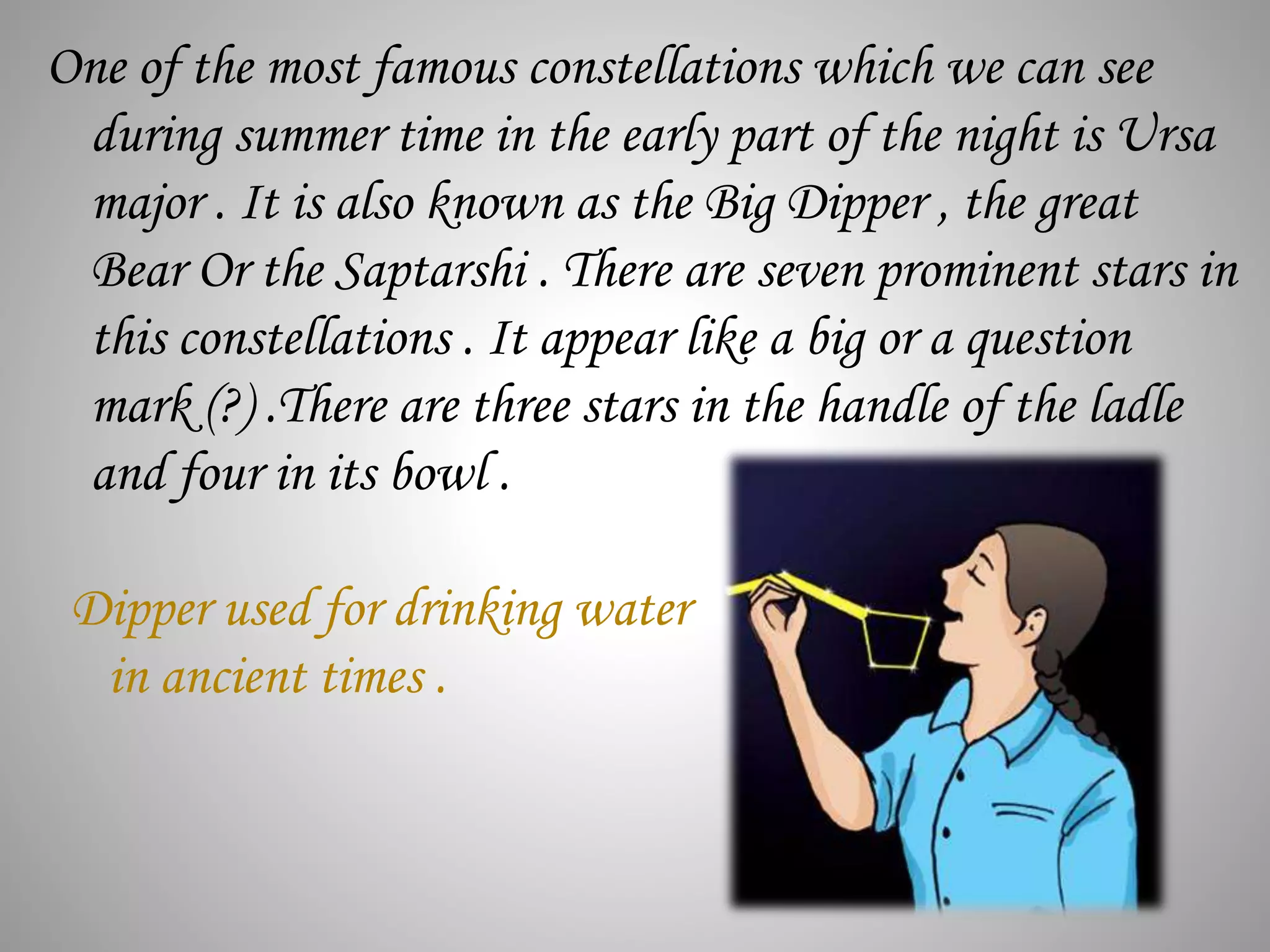
One of the most famous constellations which we can see
during summer time in the early part of the night is Ursa
major . It is also known as the Big Dipper , the great
Bear Or the Saptarshi . There are seven prominent stars in
this constellations . It appear like a big or a question
mark (?) .There are three stars in the handle of the ladle
and four in its bowl .
Dipper used for drinking water
in ancient times .
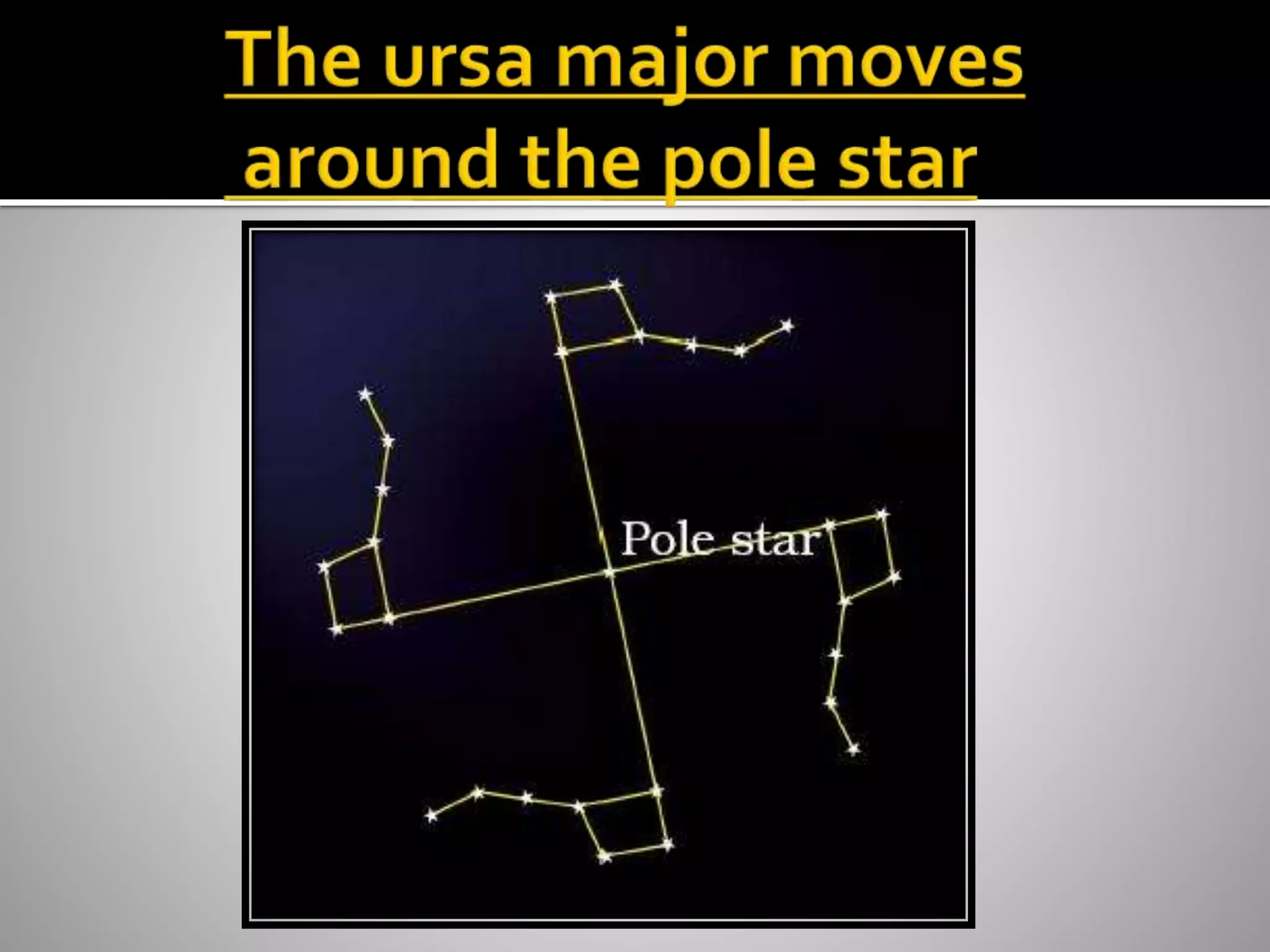
observe great bear constellations for a few hours . Do you find any
change in its shape ? Do you find any change in its position ?
You will observe that the shape of the constellations remains
the same. You will also find that the constellations appears
to move in the sky from east to west .
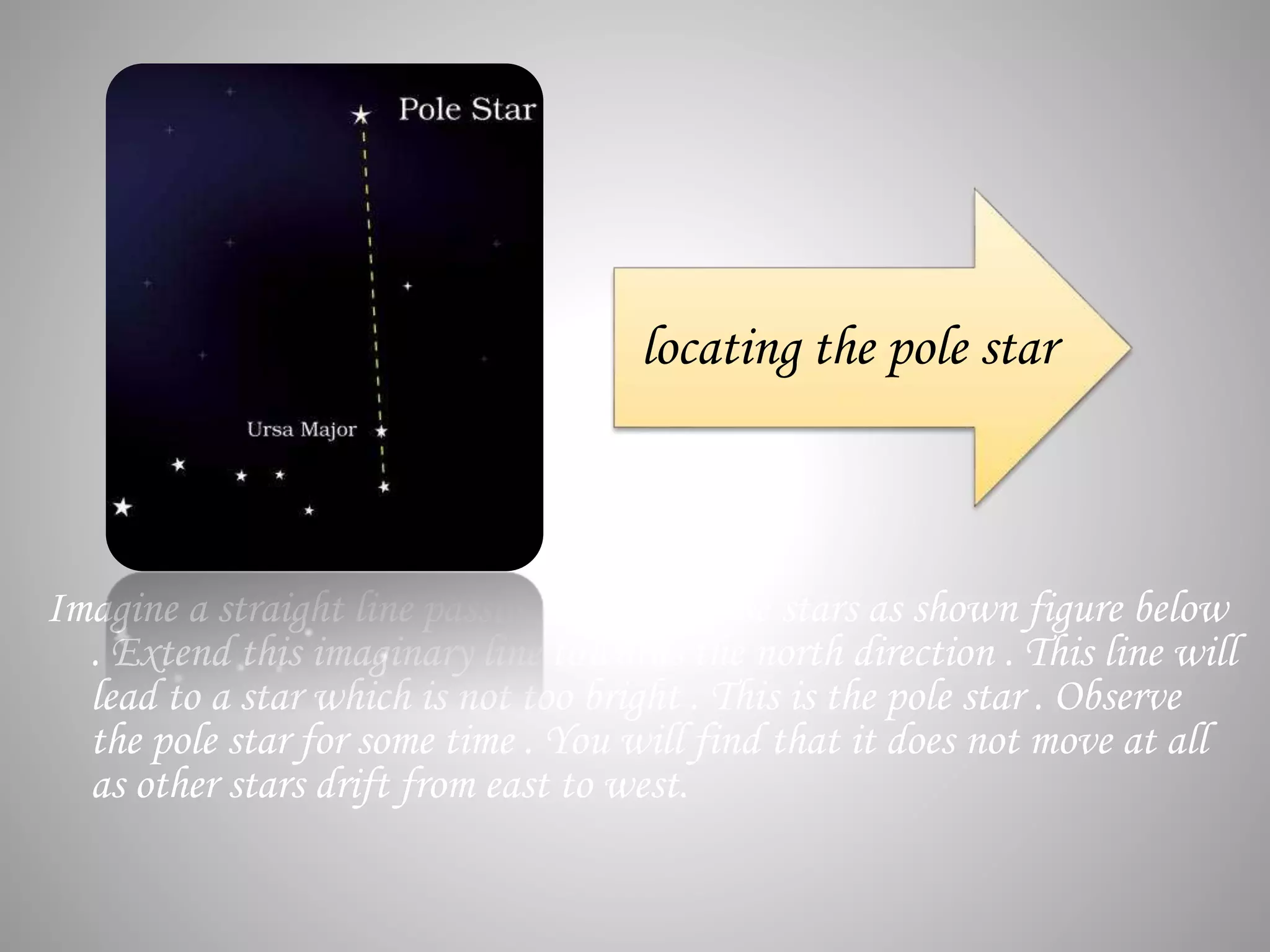
Imagine a straight line passing through these stars as shown figure below
. Extend this imaginary line towards the north direction . This line will
lead to a star which is not too bright . This is the pole star . Observe
the pole star for some time . You will find that it does not move at all
as other stars drift from east to west.
locating the pole star
The pole star is not visible from southern hemisphere . Some
of the northern constellations like ursa Major may also not
be visible from some points in the southern hemisphere .
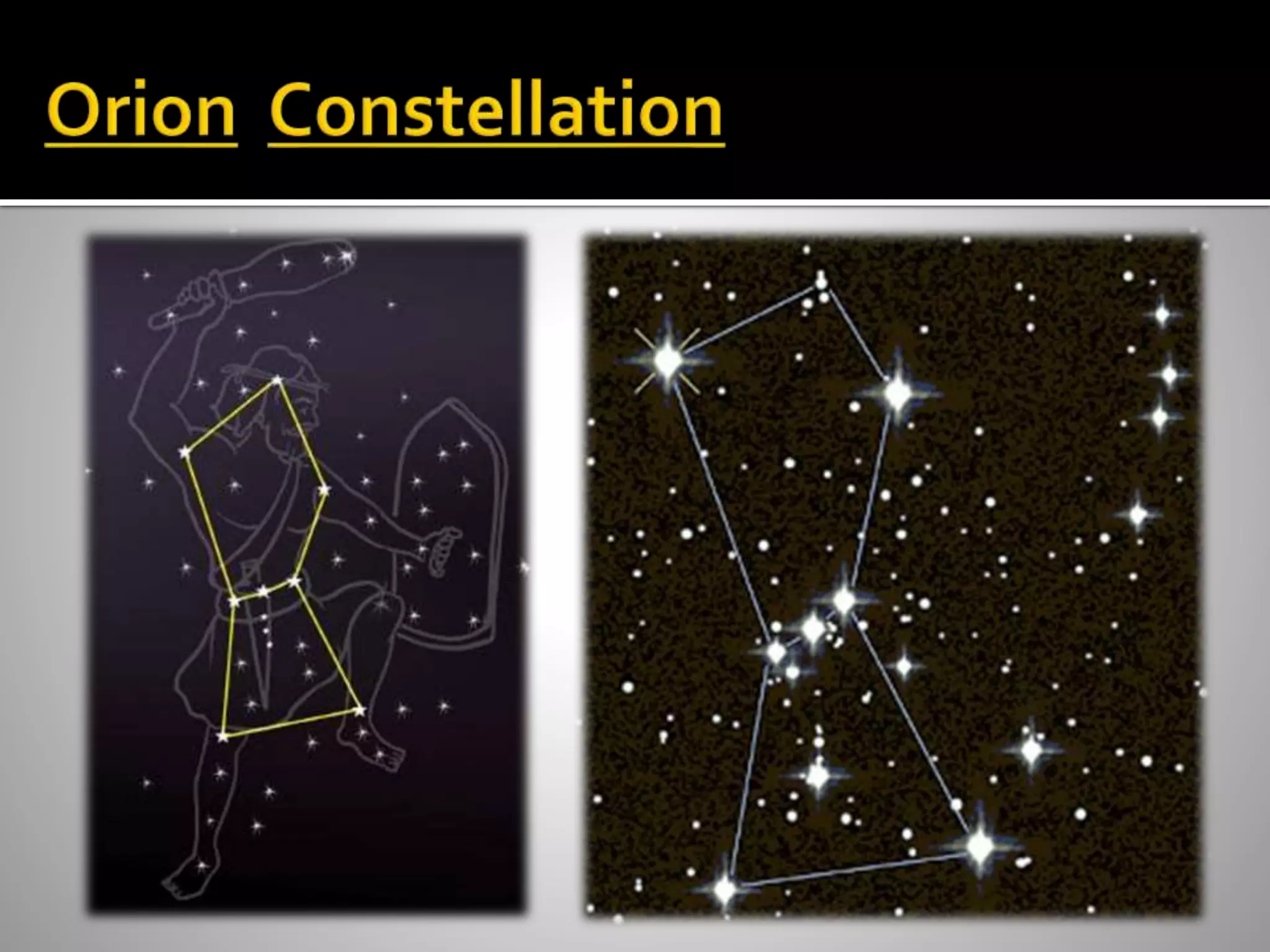
Orion is another well – known constellation that can be
seen during winter in the late evenings . It is one of the
most magnificent constellations in the sky . It also has
Seven or eight bright stars . Orion is also called the Hunter .
The three middle stars represent the belt of the hunter . The
Four bright stars appear to be arranged in the form of a
Quadrilateral .
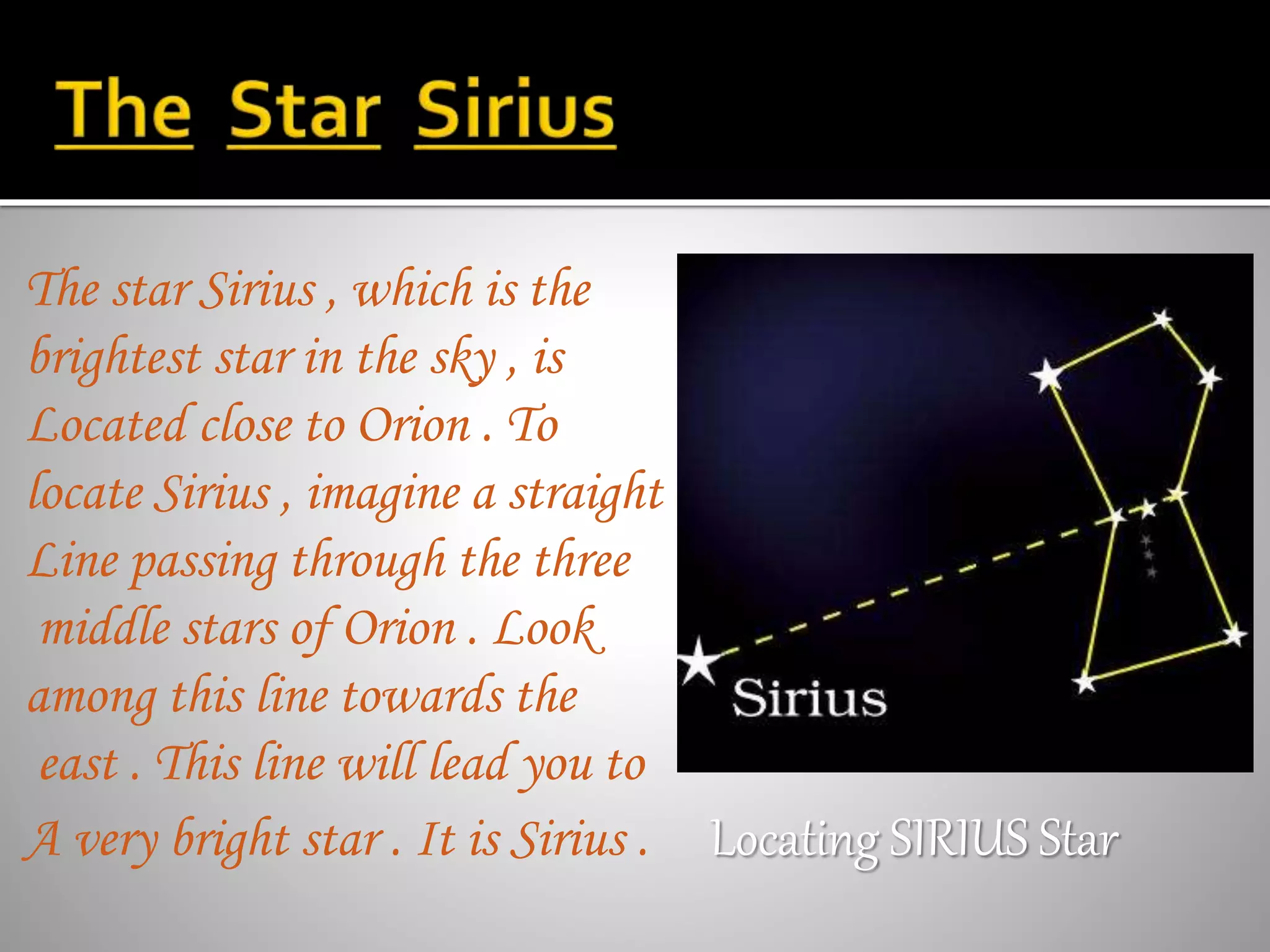
The star Sirius , which is the
brightest star in the sky , is
Located close to Orion . To
locate Sirius , imagine a straight
Line passing through the three
middle stars of Orion . Look
among this line towards the
east . This line will lead you to
A very bright star . It is Sirius . Locating SIRIUS Star
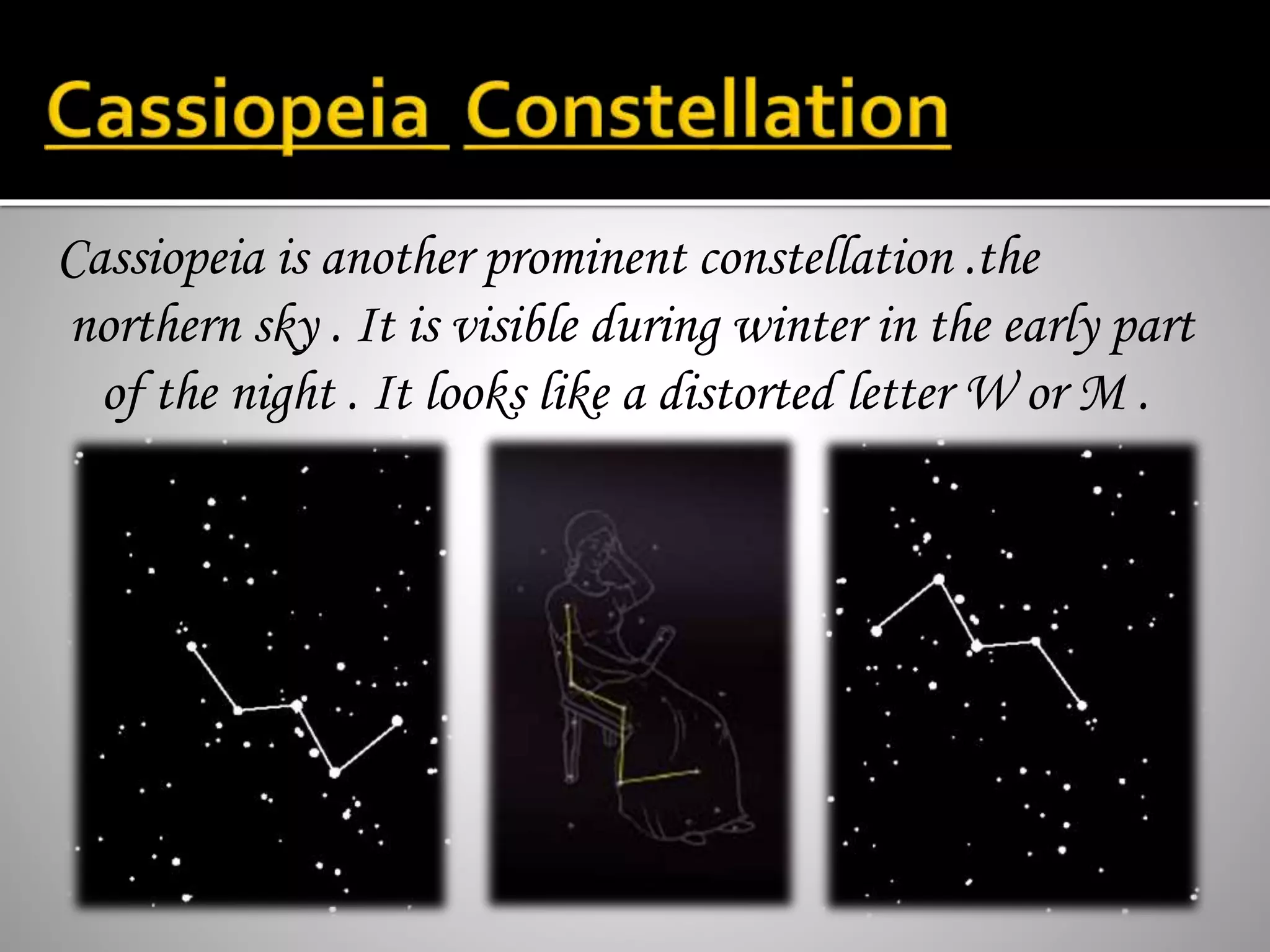
Cassiopeia is another prominent constellation .the
northern sky . It is visible during winter in the early part
of the night . It looks like a distorted letter W or M .
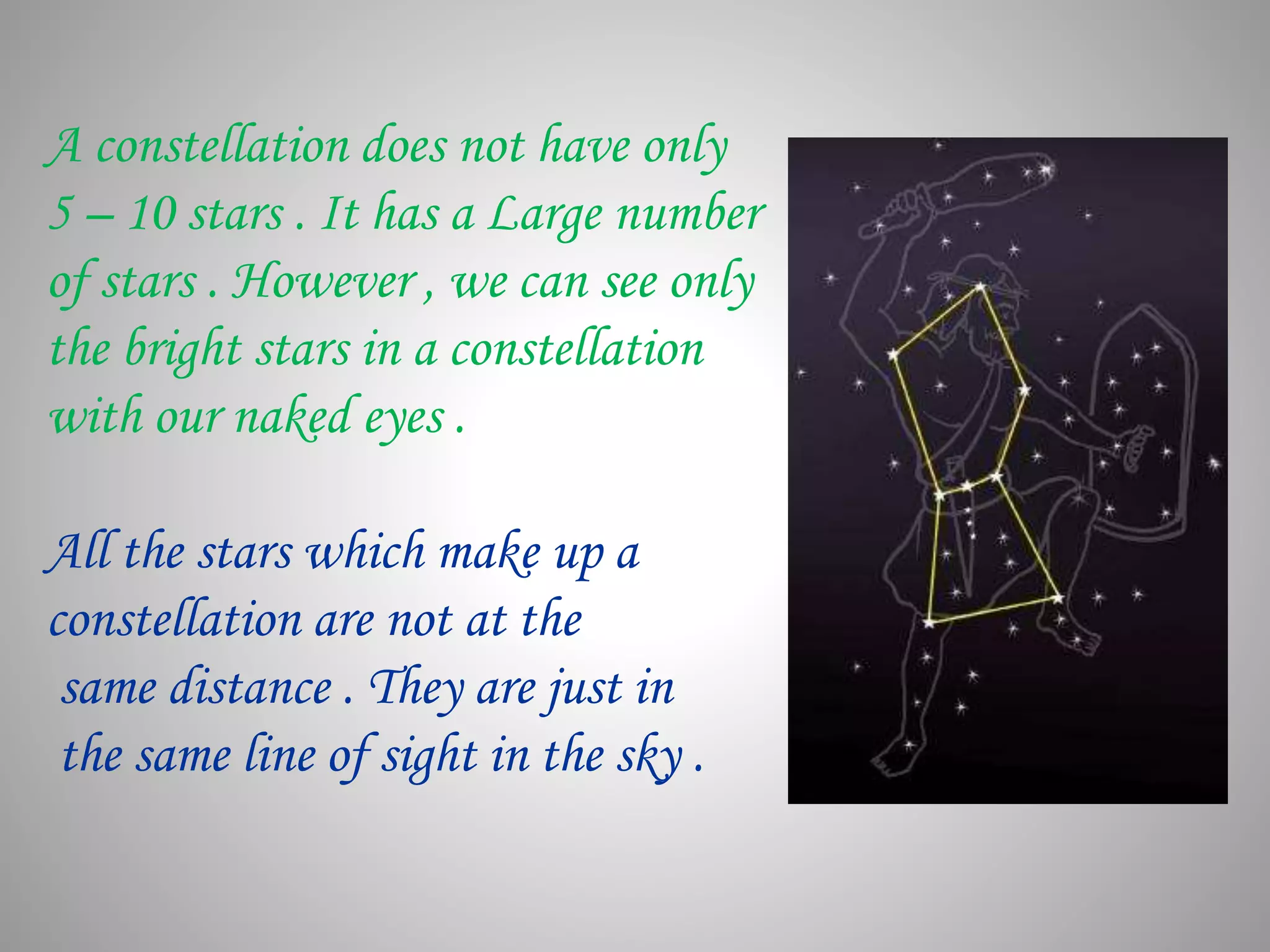
A constellation does not have only
5 – 10 stars . It has a Large number
of stars . However , we can see only
the bright stars in a constellation
with our naked eyes .
All the stars which make up a
constellation are not at the
same distance . They are just in
the same line of sight in the sky .
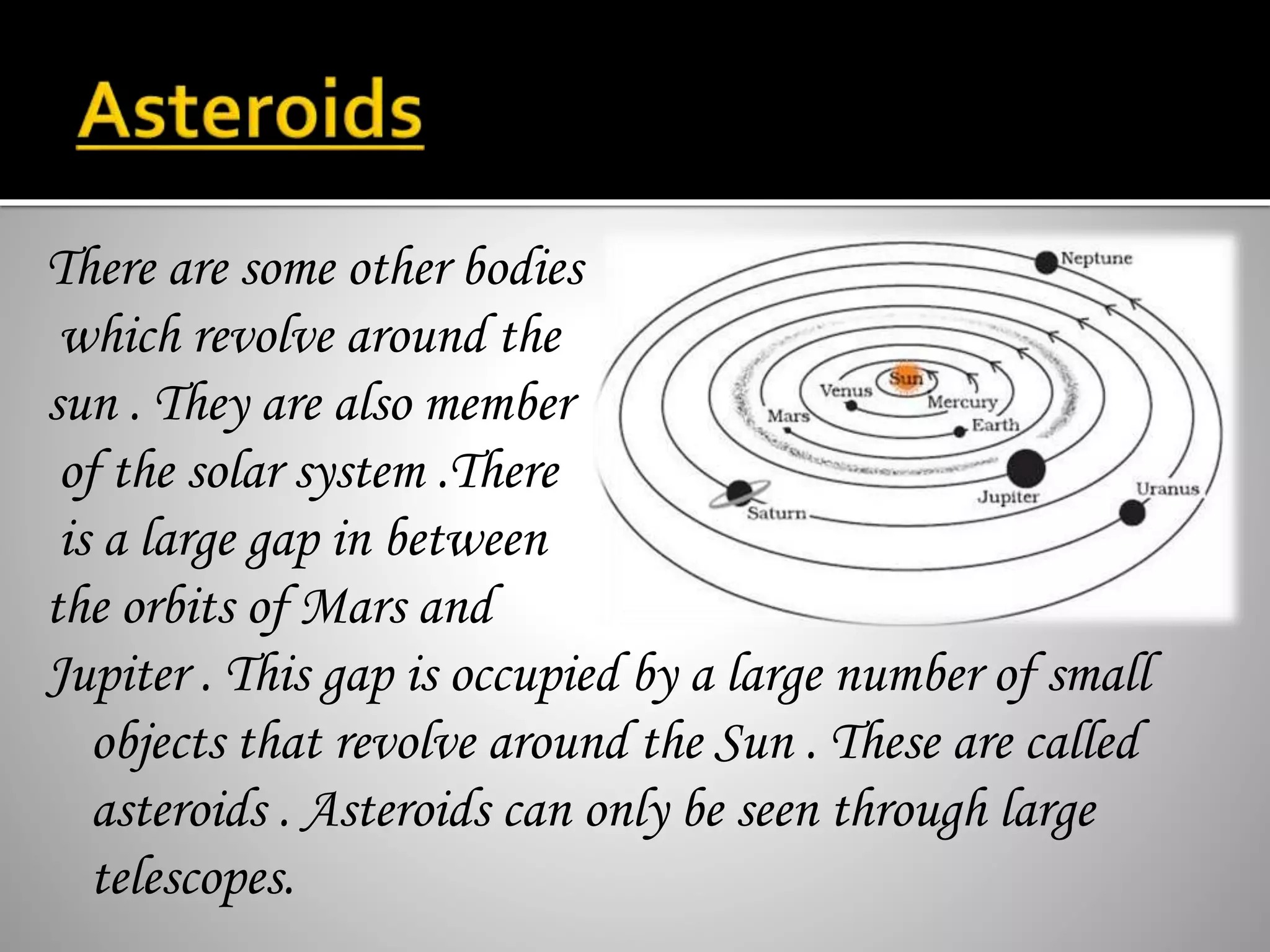
The sun and the celestial bodies which revolve around it
form the solar system . It consists of large number of bodies
such as planets , comets , asteroids and meteors . The
Gravitational attraction between the sun and these objects
Keeps them revolving around it . The Earth , as you know ,
Revolves around the sun . The eight planets in their order of
distance from the Sun are : Mercury , Venus , Earth , mars ,
Jupiter , Saturn , Uranus and Neptune .
Till 2006 there were nine planets in the solar system . Pluto
Was the farthest planet from the sun .
In 2006 , the International Astronomical union ( IAU )
Adopted a new definition of a planet . Pluto does not fit
This definition. It is no longer a planet of the solar system .
The Pluto
The sun is the nearest star from us . It is continuously
Emitting huge amounts of heat and light . The sun is the
Source of almost all energy on the Earth . In fact , the sun
Is the main source of heat and light for all the planets .
The planets look like stars , but they do not have light of
Their own . They merely reflect the sunlight that falls on
Them . Can you distinguish between planets and stars ?
The simplest method of identifying planets from stars is
That stars twinkle , whereas planets do not . Also the
Planets keep changing their position with respect to the
stars .
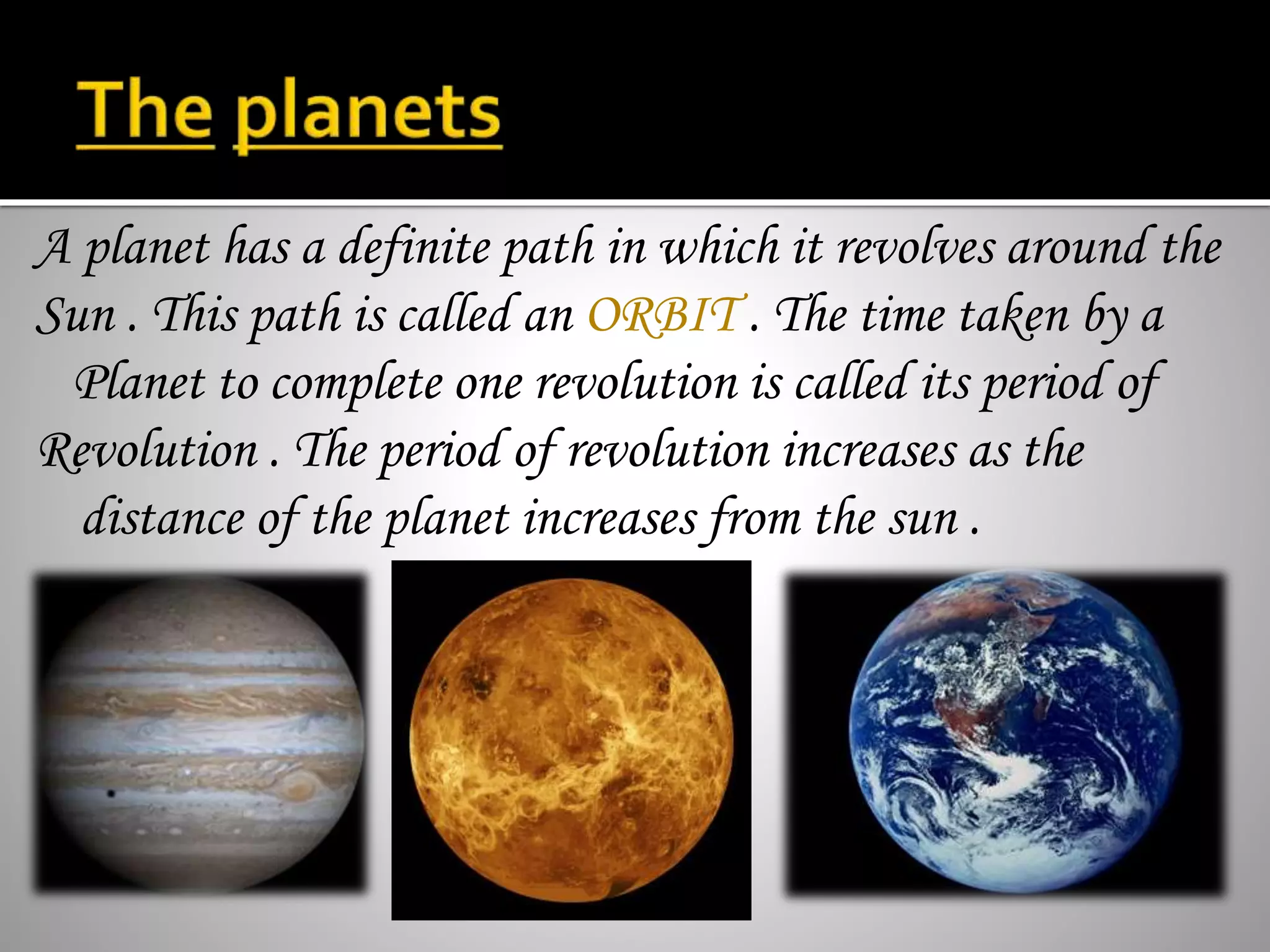
A planet has a definite path in which it revolves around the
Sun . This path is called an ORBIT . The time taken by a
Planet to complete one revolution is called its period of
Revolution . The period of revolution increases as the
distance of the planet increases from the sun .
Beside revolving around the sun , a planet also rotates on
its own axis like a top . The time taken by a planet to
complete one rotation is called its period of rotation .
Some planets are known to have
moons/satellites revolving around
another celestial body is called its
satellite .
The Earth can be said to be a satellite of the Sun , though
generally we call it a planet of the Sun . We use the term
satellite for the bodies revolving around planets . Moon is
a satellite of the Earth .
There are many man – made satellites revolving round the
Earth . These are called artificial satellites .
The natural satellite The man – made satellite
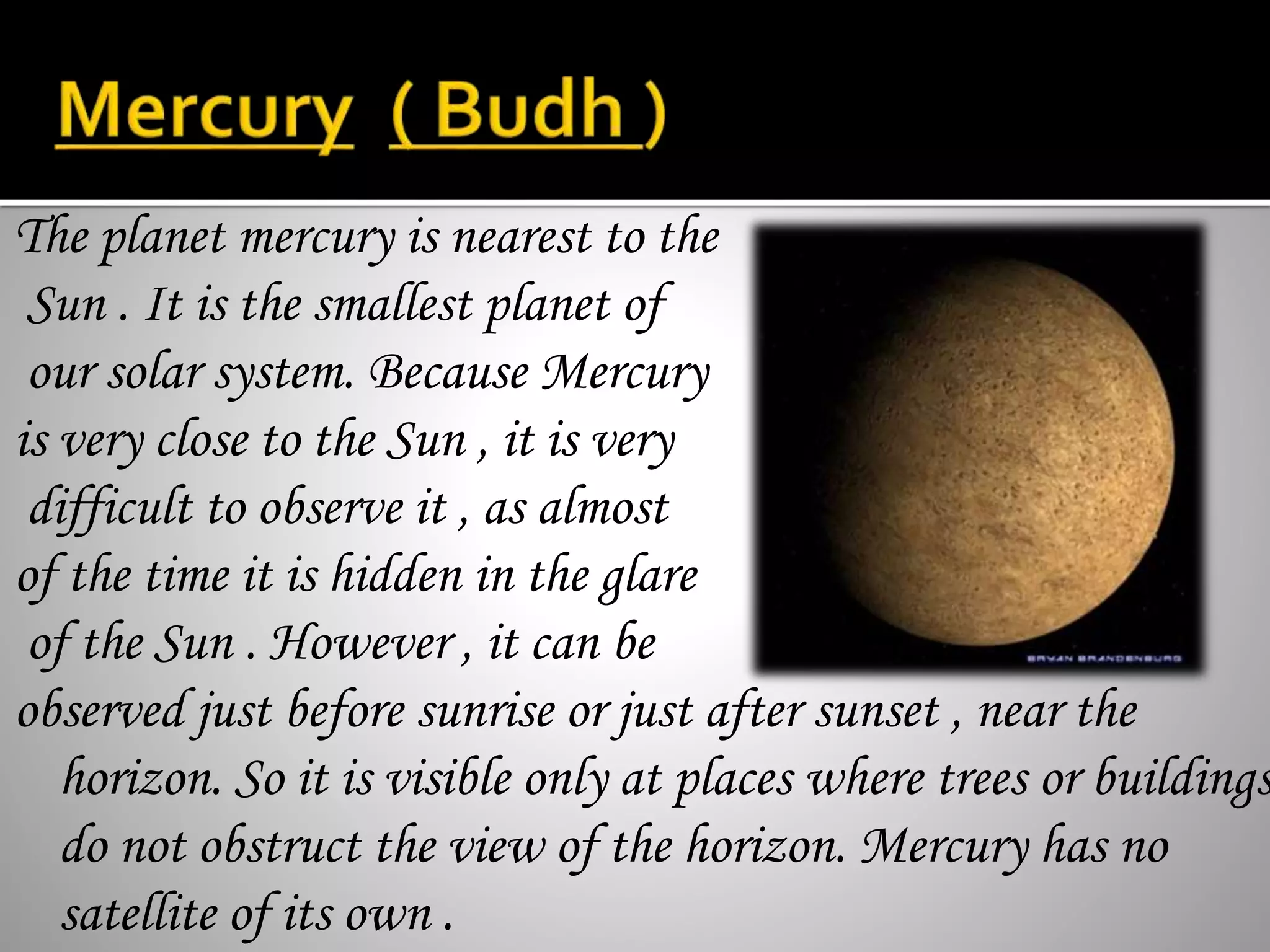
The planet mercury is nearest to the
Sun . It is the smallest planet of
our solar system. Because Mercury
is very close to the Sun , it is very
difficult to observe it , as almost
of the time it is hidden in the glare
of the Sun . However , it can be
observed just before sunrise or just after sunset , near the
horizon. So it is visible only at places where trees or buildings
do not obstruct the view of the horizon. Mercury has no
satellite of its own .
Venus is earth’s nearest planetary
neighbour . It is the brightest planet
in the night sky . Sometimes Venus
appear in the eastern sky before
sunrise . It appear in the western
sky just after sunset . Therefore it
is often called a morning or an evening star , although it is
not a star .
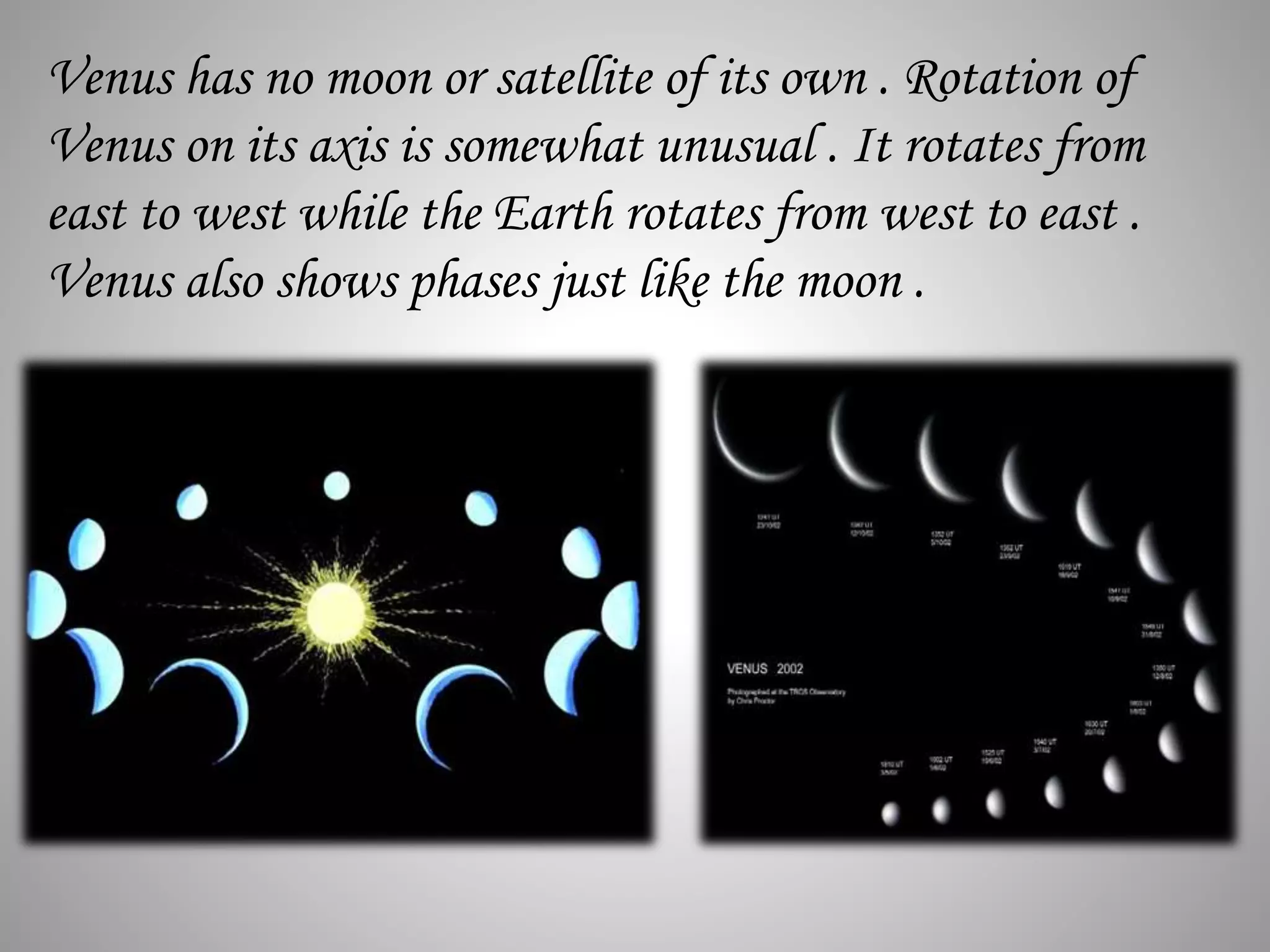
Venus has no moon or satellite of its own . Rotation of
Venus on its axis is somewhat unusual . It rotates from
east to west while the Earth rotates from west to east .
Venus also shows phases just like the moon .
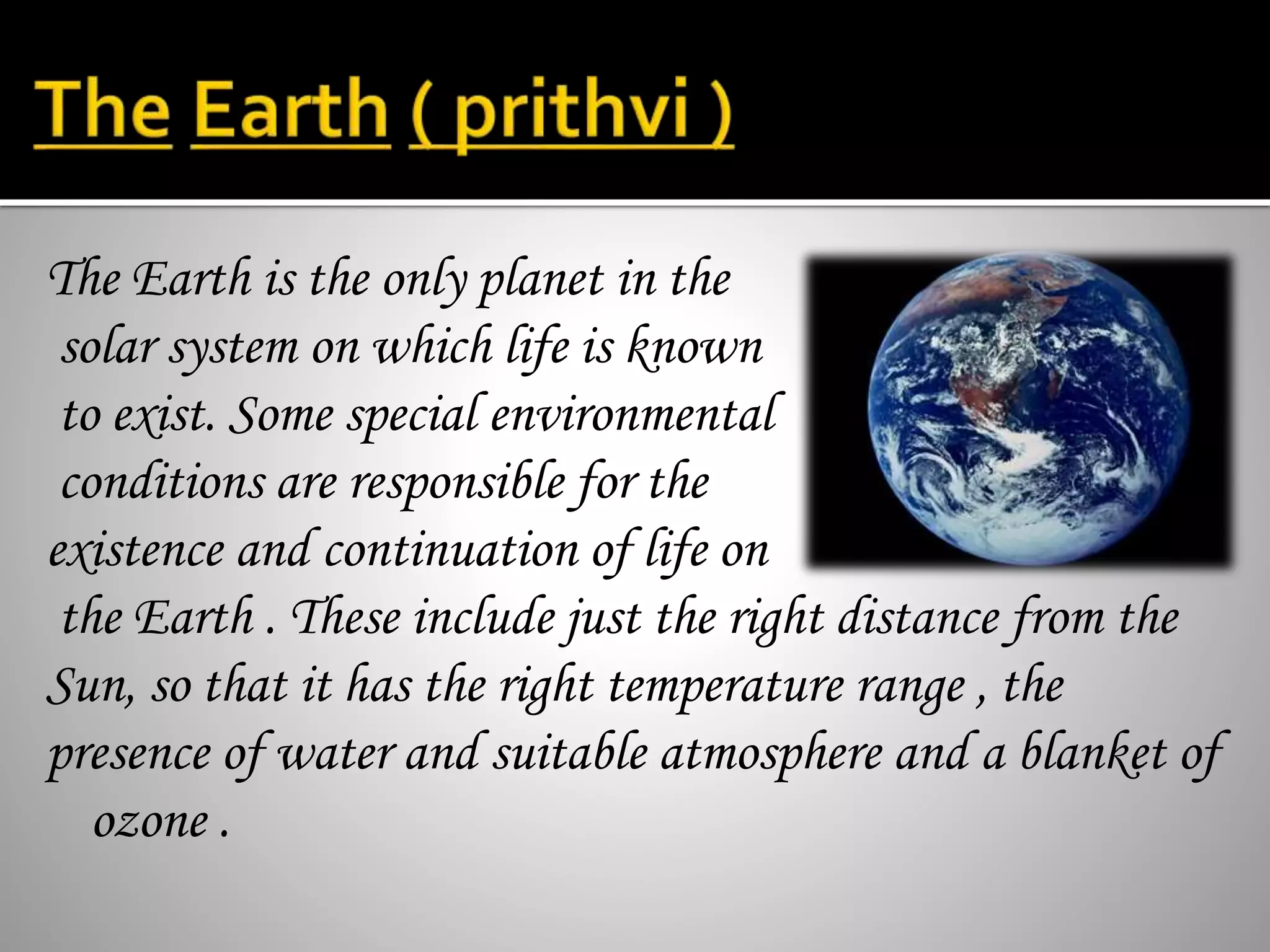
The Earth is the only planet in the
solar system on which life is known
to exist. Some special environmental
conditions are responsible for the
existence and continuation of life on
the Earth . These include just the right distance from the
Sun, so that it has the right temperature range , the
presence of water and suitable atmosphere and a blanket of
ozone .
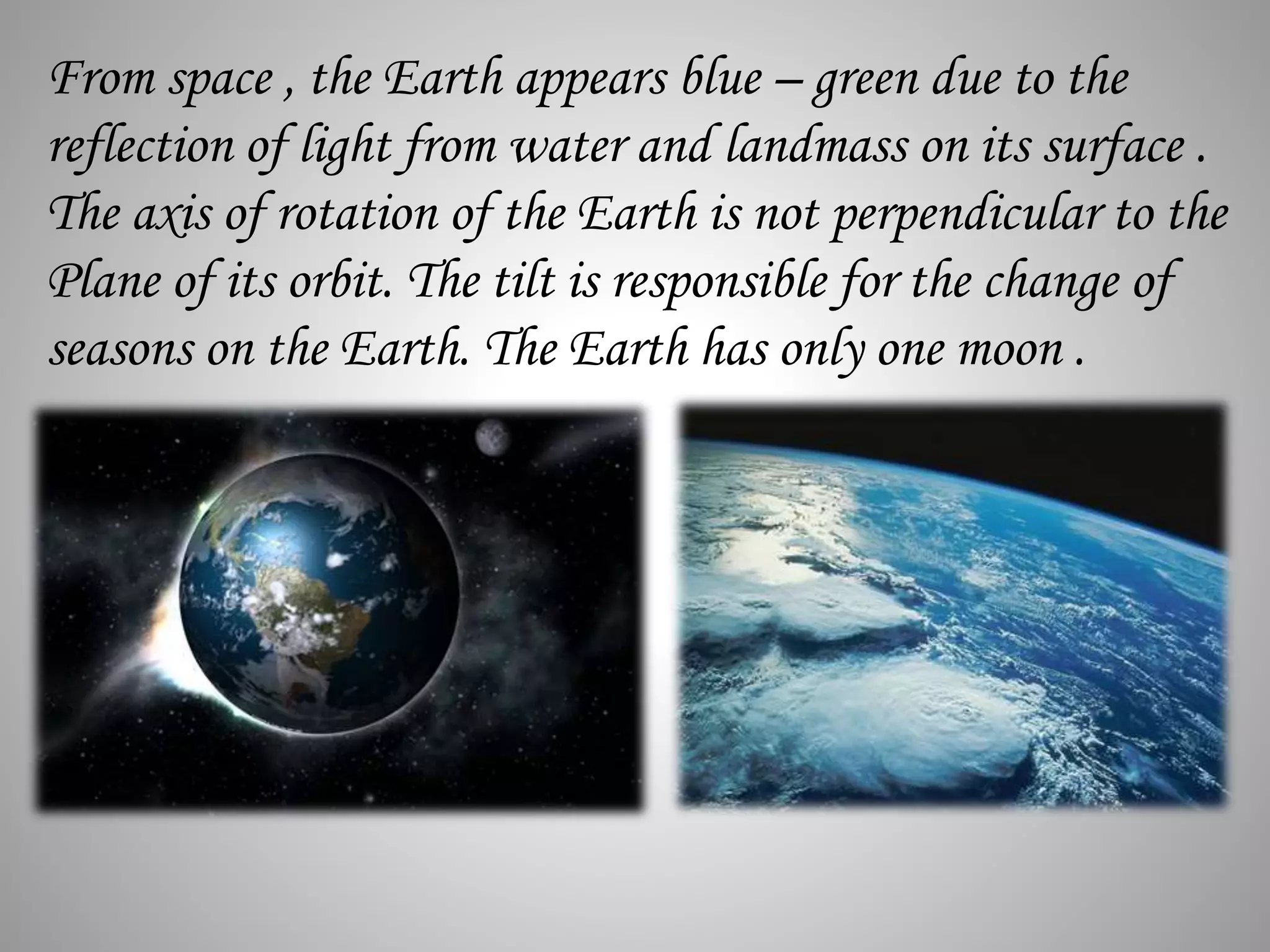
From space , the Earth appears blue – green due to the
reflection of light from water and landmass on its surface .
The axis of rotation of the Earth is not perpendicular to the
Plane of its orbit. The tilt is responsible for the change of
seasons on the Earth. The Earth has only one moon .
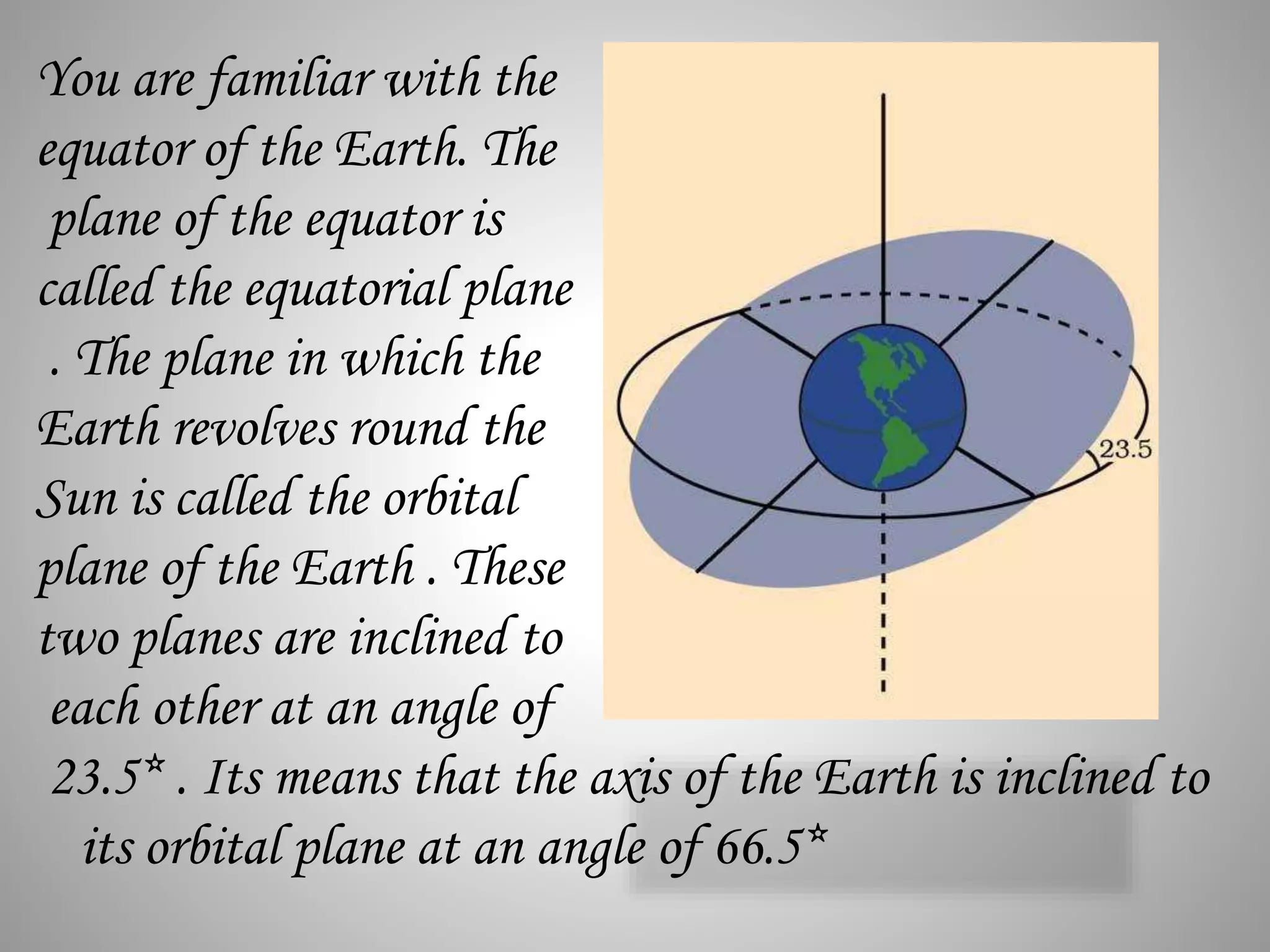
You are familiar with the
equator of the Earth. The
plane of the equator is
called the equatorial plane
. The plane in which the
Earth revolves round the
Sun is called the orbital
plane of the Earth . These
two planes are inclined to
each other at an angle of
23.5* . Its means that the axis of the Earth is inclined to
its orbital plane at an angle of 66.5*
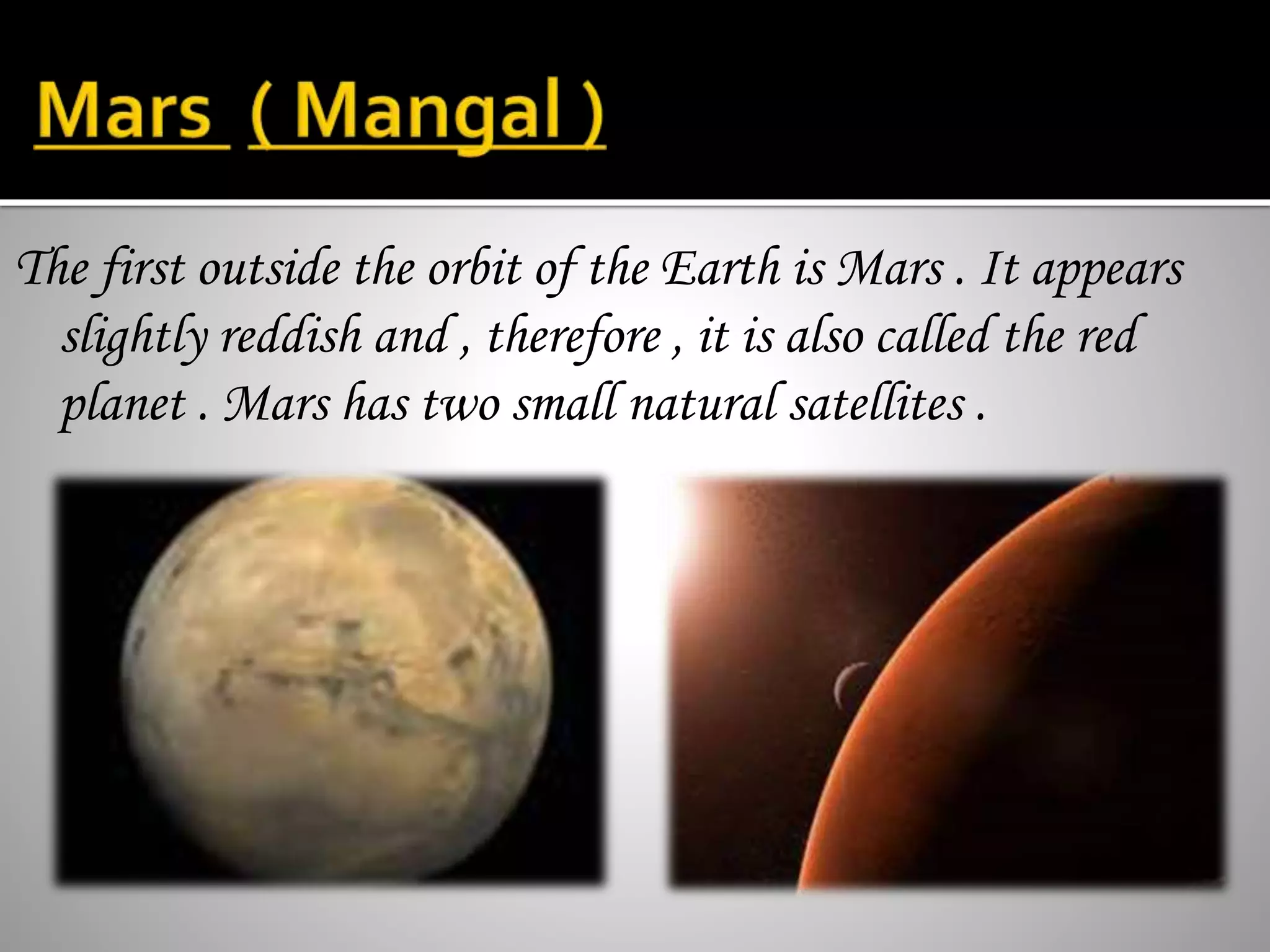
The first outside the orbit of the Earth is Mars . It appears
slightly reddish and , therefore , it is also called the red
planet . Mars has two small natural satellites .
Jupiter is the largest planet of the solar system. It is so large
That about 1300 earths can be placed inside this giant
planet. However , the mass of Jupiter is about 318 times
That of our Earth. It rotates very rapidly on its axis.
Jupiter has a large number of satellites. It also has faint
rings around it . You can easily recognize Jupiter as it
appears quite bright in the sky . If you observe it with the
help of a telescope , you can also see four of its large moons .
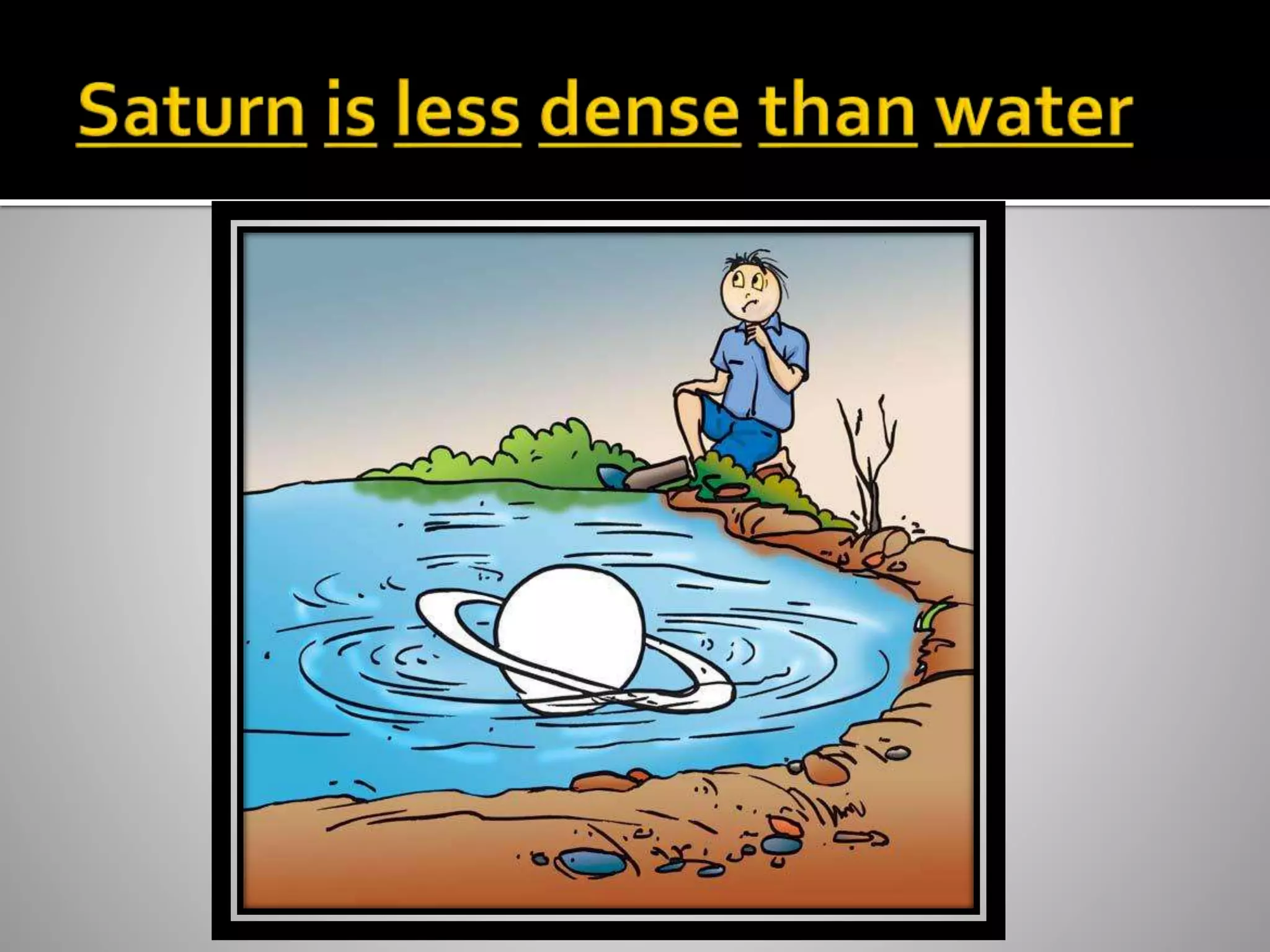
Beyond Jupiter is Saturn which
appears yellowish in colour
. What makes it unique in the
solar system is its beautiful Rings
. These rings are not visible with
the naked eye . You can observe
them with a small telescope . Saturn also has
A large number of satellites . One interesting thing about
Saturn is that it is the least dense among all the planets .
Its density is less than that of water .
These are the outermost planets of the solar system . They
can be seen only with the help of large telescopes . Like
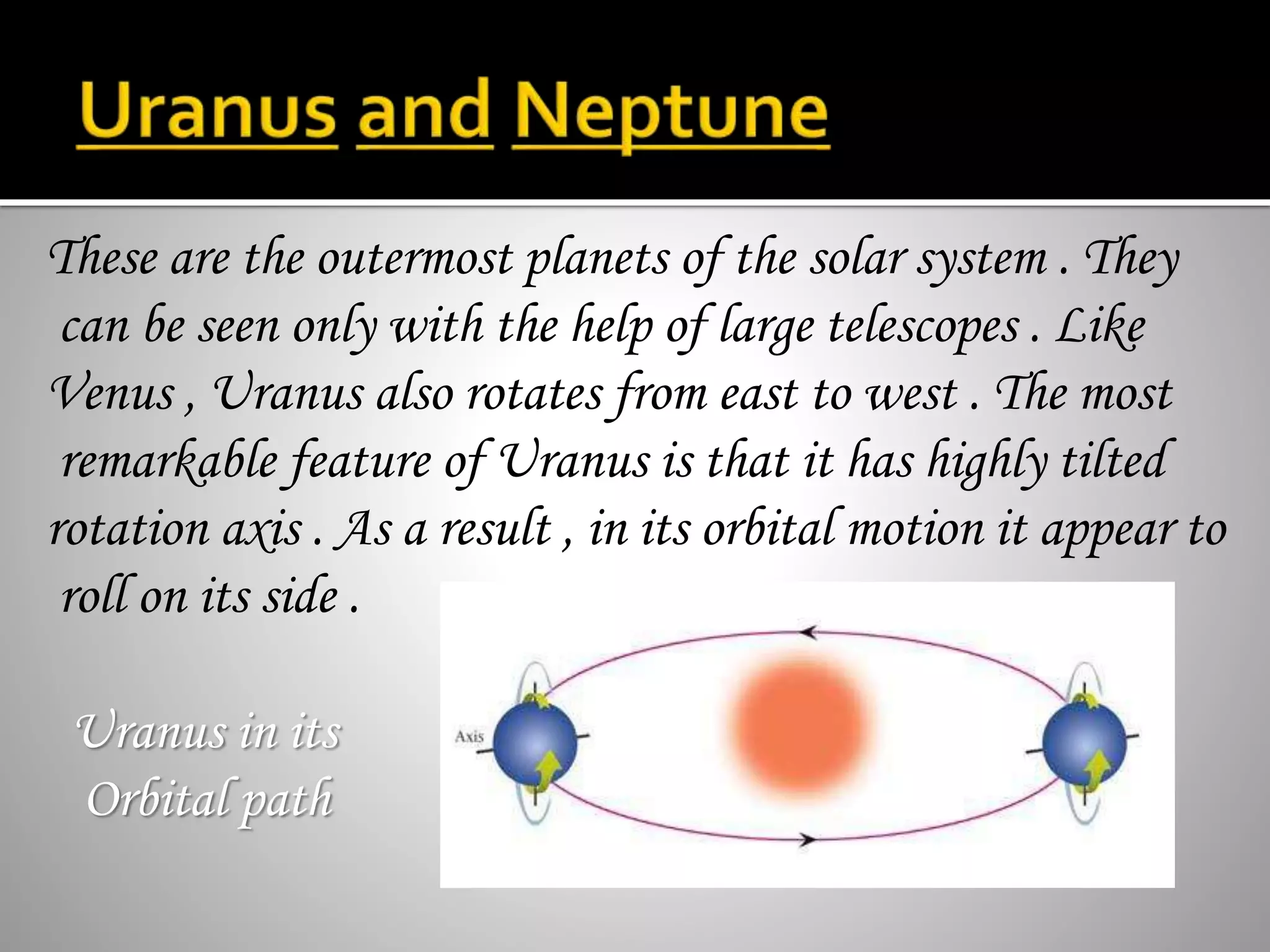
Venus , Uranus also rotates from east to west . The most
remarkable feature of Uranus is that it has highly tilted
rotation axis . As a result , in its orbital motion it appear to
roll on its side .
Uranus in its
Orbital path
The first four planets , Mercury , Venus, Earth and Mars
are much nearer the Sun than the other four .They are
called the inner planets . The inner planets have very
few moons.
The planets outside the orbit of Mars , namely Jupiter ,
Saturn , Uranus and Neptune are much farther off than
the inner planets . They are called the outer planets .
They have a ring system around them . The outer planets
have large number of moons.
There are some other bodies
which revolve around the
sun . They are also member
of the solar system .There
is a large gap in between
the orbits of Mars and
Jupiter . This gap is occupied by a large number of small
objects that revolve around the Sun . These are called
asteroids . Asteroids can only be seen through large
telescopes.
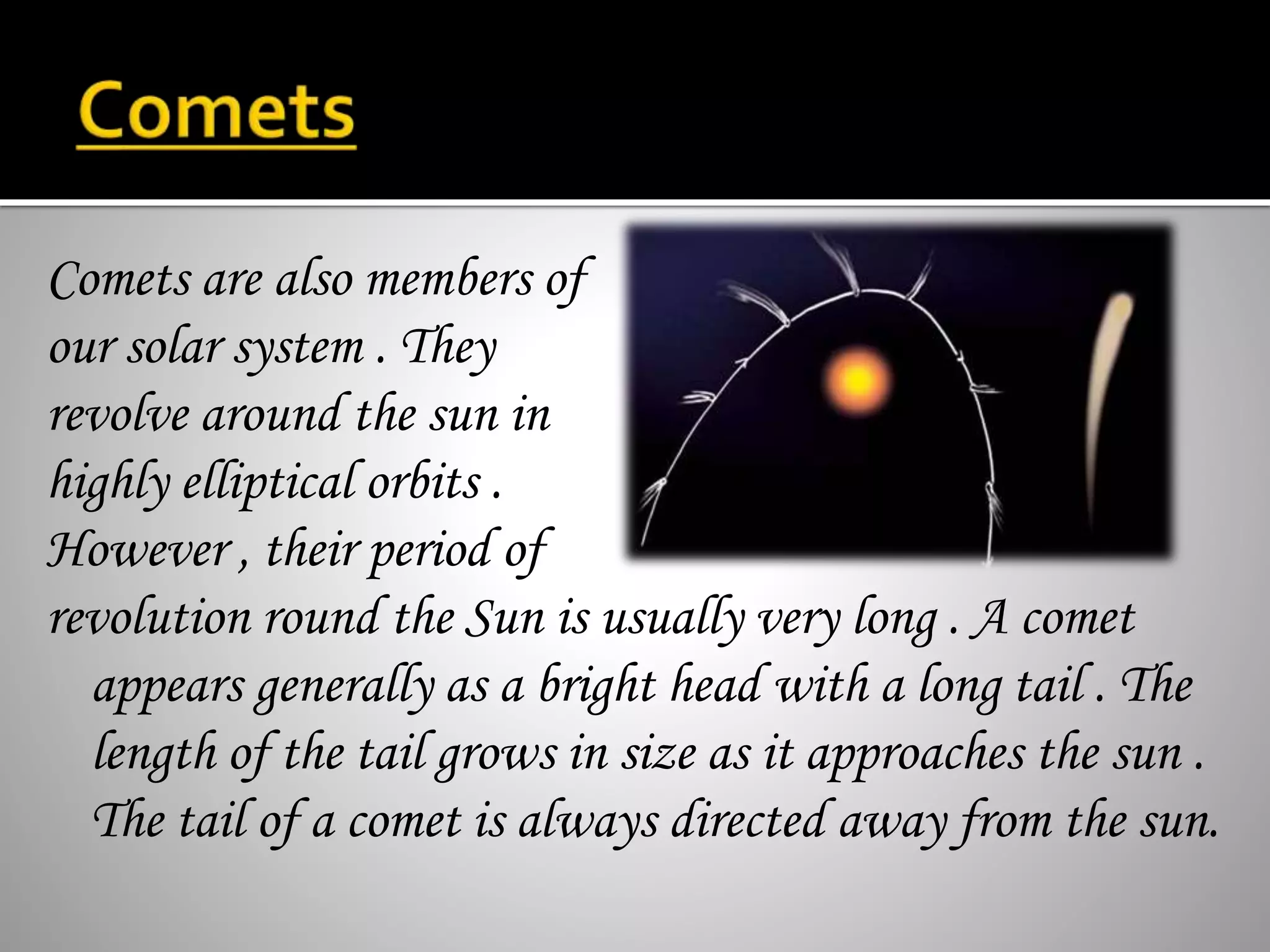
Comets are also members of
our solar system . They
revolve around the sun in
highly elliptical orbits .
However , their period of
revolution round the Sun is usually very long . A comet
appears generally as a bright head with a long tail . The
length of the tail grows in size as it approaches the sun .
The tail of a comet is always directed away from the sun.
At night , when the sky is clear and the moo is not there ,
you may sometimes see bright streaks of light of light in
the sky . These are commonly known as shooting stars ,
although they are not stars . They are called meteors . A
meteor is usually a small object that occasionally enters
the earth‘s atmosphere . At that time it has a very high
speed . The friction due to the atmosphere heat it up. It
glows and evaporates quickly . That is why the bright
steak lasts for a very short time .
Some meteors are large and so they can reach the Earth
before they evaporate completely . The body that reaches
the Earth is called a meteorite . Meteorites help scientist
in the investigation the nature of the material from
which the solar system was formed .
When the earth crosses the tail of a comet , swarms of
meteors are seen . These are known as meteor showers
occur at regular intervals each years .
Made by :-
Sanket .s

Stars & the Solar System

  • 1.
    Stars And TheSolar System
  • 2.
    Have you everseen a clear cloudless night . You see that a large number of bright stars in the sky . We are not able to see such beautiful scene in cities Question 1- Why the village sky was so different fromthe night sky in big cities ? Answer = The village sky was so different from the night sky in big cities due to bright light , smoke and dust , the sky in big cities is rarely clear.
  • 3.
    Look at thesky on a dark ,clear night. You see the entire sky dotted with countless stars , some bright and some not so bright . the MOON is the brightest object in the night sky . The stars , the planets , the moon and many other objects in the sky are called CELESTIAL OBJECTS.
  • 4.
    The moon isthe only natural satellite of the Earth and the fifth largest moon in the solar system. A natural satellite is a natural object that goes around (orbits) a planet. It is usually called a moon and is large and ball – shaped . The Earth has only one moon . Some other planets have many moons , and some have none . Moon do not make their own light . We can see the Earth‘s moon because it acts like a mirror , and reflects the light of the Sun . A moon’s cycle is the time the moon takes to changes from looking very bright and round to looking very small and thin , and round again . This changes as seen from Earth is called the phases of the Moon.
  • 5.
    The day onwhich the whole disc of the moon is visible is known as the FULL MOON DAY . Thereafter , every night the size of the bright part of the moon appears to become thinner and thinner. On the fifteenth day the moon is not visible. This day is known as the ‘NEW MOON DAY’ . The next day , only a small portion of the moon appears in the sky . This is known as the CRESCENT MOON . Then again the moon grows larger every day . On the fifteenth day once again we get a full view of the moon.
  • 6.
    The various shapesof the bright part of the moon As seen during a month are called PHASES OF THE MOON
  • 8.
    The moon doesnot produce its own light , whereas the sun and other stars do . We see the moon because the sunlight falling on it gets reflected towards us . We , therefore, see only that part of the moon , from which the light of the sun is reflected towards us. Moon is visible due to reflected sunlight.
  • 10.
    The moon revolvesaround the Earth along with the moon , revolves around the sun . The Moon completes one rotation on its axis as it completes one revolution around the Earth. The size of the illuminated part of the moon visible from the Earth increases each day after the new moon day. After the full moon day , the sunlit part of the moon visible from the Earth decreases in size every day.
  • 11.
    The moon isa fascinating object for poets and story – teller . But when astronauts landed on the moon , they found that the moon’s surface is dusty and barren . There are many craters of different sizes . It also has a large number of steep and high mountains . Some of these are as the highest mountains on the earth .
  • 12.
    On July 21, 1969 ( Indian time) the American astronaut , Neil Armstrong , landed on the moon for first time . He was followed by Edwin Aldrin
  • 14.
    There is alarge number of stars in the sky . On a dark night and from a place away from a big city . All the stars equally look bright . In fact , stars emit light of their own . The sun is also a star . Which appears bigger , a football placed near you , or a football placed at a distance of 100 m . The stars are millions of times farther away than the Sun. therefore , the stars appear to us like points
  • 15.
    The Sun isnearly 150,000,000 kilometers ( 150 millions kilometers ) away from the Earth . The next nearest star is Alpha Centauri . It is at a distance of about 40,000,000,000,000 km from the Earth . Some stars are even further away . Such large distance are expressed in another unit known as Light Year. It is the distance travelled by light in one year . Remember that the speed of light is about 300,000 km per second . Thus, the distance of the sun from the Earth may be said to be about 8 Light minutes. The distance of Alpha Centauri is about 4.3 light years .
  • 16.
    The stars arepresent in the sky during the day – time also . They are not visible to us because of the bright sunlight . The stars appears to move from east to west . A star which rises in the east in the evening , sets in the west in the early morning There is actually a star , the pole star , which is situated in the direction of the earth ‘s axis. It does not appear to move.
  • 17.
    The stars forminga group that has a recognisable shape is called a CONSTELLATION Constellation were devised by ancient people to be able to recognise stars in the sky . The shapes of constellations resemble object familiar to those people .
  • 18.
    One of themost famous constellations which we can see during summer time in the early part of the night is Ursa major . It is also known as the Big Dipper , the great Bear Or the Saptarshi . There are seven prominent stars in this constellations . It appear like a big or a question mark (?) .There are three stars in the handle of the ladle and four in its bowl . Dipper used for drinking water in ancient times .
  • 19.
    observe great bearconstellations for a few hours . Do you find any change in its shape ? Do you find any change in its position ? You will observe that the shape of the constellations remains the same. You will also find that the constellations appears to move in the sky from east to west .
  • 20.
    Imagine a straightline passing through these stars as shown figure below . Extend this imaginary line towards the north direction . This line will lead to a star which is not too bright . This is the pole star . Observe the pole star for some time . You will find that it does not move at all as other stars drift from east to west. locating the pole star
  • 22.
    The pole staris not visible from southern hemisphere . Some of the northern constellations like ursa Major may also not be visible from some points in the southern hemisphere . Orion is another well – known constellation that can be seen during winter in the late evenings . It is one of the most magnificent constellations in the sky . It also has Seven or eight bright stars . Orion is also called the Hunter . The three middle stars represent the belt of the hunter . The Four bright stars appear to be arranged in the form of a Quadrilateral .
  • 24.
    The star Sirius, which is the brightest star in the sky , is Located close to Orion . To locate Sirius , imagine a straight Line passing through the three middle stars of Orion . Look among this line towards the east . This line will lead you to A very bright star . It is Sirius . Locating SIRIUS Star
  • 25.
    Cassiopeia is anotherprominent constellation .the northern sky . It is visible during winter in the early part of the night . It looks like a distorted letter W or M .
  • 26.
    A constellation doesnot have only 5 – 10 stars . It has a Large number of stars . However , we can see only the bright stars in a constellation with our naked eyes . All the stars which make up a constellation are not at the same distance . They are just in the same line of sight in the sky .
  • 27.
    The sun andthe celestial bodies which revolve around it form the solar system . It consists of large number of bodies such as planets , comets , asteroids and meteors . The Gravitational attraction between the sun and these objects Keeps them revolving around it . The Earth , as you know , Revolves around the sun . The eight planets in their order of distance from the Sun are : Mercury , Venus , Earth , mars , Jupiter , Saturn , Uranus and Neptune .
  • 29.
    Till 2006 therewere nine planets in the solar system . Pluto Was the farthest planet from the sun . In 2006 , the International Astronomical union ( IAU ) Adopted a new definition of a planet . Pluto does not fit This definition. It is no longer a planet of the solar system . The Pluto
  • 30.
    The sun isthe nearest star from us . It is continuously Emitting huge amounts of heat and light . The sun is the Source of almost all energy on the Earth . In fact , the sun Is the main source of heat and light for all the planets .
  • 31.
    The planets looklike stars , but they do not have light of Their own . They merely reflect the sunlight that falls on Them . Can you distinguish between planets and stars ? The simplest method of identifying planets from stars is That stars twinkle , whereas planets do not . Also the Planets keep changing their position with respect to the stars .
  • 32.
    A planet hasa definite path in which it revolves around the Sun . This path is called an ORBIT . The time taken by a Planet to complete one revolution is called its period of Revolution . The period of revolution increases as the distance of the planet increases from the sun .
  • 33.
    Beside revolving aroundthe sun , a planet also rotates on its own axis like a top . The time taken by a planet to complete one rotation is called its period of rotation . Some planets are known to have moons/satellites revolving around another celestial body is called its satellite .
  • 34.
    The Earth canbe said to be a satellite of the Sun , though generally we call it a planet of the Sun . We use the term satellite for the bodies revolving around planets . Moon is a satellite of the Earth . There are many man – made satellites revolving round the Earth . These are called artificial satellites . The natural satellite The man – made satellite
  • 35.
    The planet mercuryis nearest to the Sun . It is the smallest planet of our solar system. Because Mercury is very close to the Sun , it is very difficult to observe it , as almost of the time it is hidden in the glare of the Sun . However , it can be observed just before sunrise or just after sunset , near the horizon. So it is visible only at places where trees or buildings do not obstruct the view of the horizon. Mercury has no satellite of its own .
  • 36.
    Venus is earth’snearest planetary neighbour . It is the brightest planet in the night sky . Sometimes Venus appear in the eastern sky before sunrise . It appear in the western sky just after sunset . Therefore it is often called a morning or an evening star , although it is not a star .
  • 37.
    Venus has nomoon or satellite of its own . Rotation of Venus on its axis is somewhat unusual . It rotates from east to west while the Earth rotates from west to east . Venus also shows phases just like the moon .
  • 38.
    The Earth isthe only planet in the solar system on which life is known to exist. Some special environmental conditions are responsible for the existence and continuation of life on the Earth . These include just the right distance from the Sun, so that it has the right temperature range , the presence of water and suitable atmosphere and a blanket of ozone .
  • 39.
    From space ,the Earth appears blue – green due to the reflection of light from water and landmass on its surface . The axis of rotation of the Earth is not perpendicular to the Plane of its orbit. The tilt is responsible for the change of seasons on the Earth. The Earth has only one moon .
  • 40.
    You are familiarwith the equator of the Earth. The plane of the equator is called the equatorial plane . The plane in which the Earth revolves round the Sun is called the orbital plane of the Earth . These two planes are inclined to each other at an angle of 23.5* . Its means that the axis of the Earth is inclined to its orbital plane at an angle of 66.5*
  • 41.
    The first outsidethe orbit of the Earth is Mars . It appears slightly reddish and , therefore , it is also called the red planet . Mars has two small natural satellites .
  • 42.
    Jupiter is thelargest planet of the solar system. It is so large That about 1300 earths can be placed inside this giant planet. However , the mass of Jupiter is about 318 times That of our Earth. It rotates very rapidly on its axis. Jupiter has a large number of satellites. It also has faint rings around it . You can easily recognize Jupiter as it appears quite bright in the sky . If you observe it with the help of a telescope , you can also see four of its large moons .
  • 44.
    Beyond Jupiter isSaturn which appears yellowish in colour . What makes it unique in the solar system is its beautiful Rings . These rings are not visible with the naked eye . You can observe them with a small telescope . Saturn also has A large number of satellites . One interesting thing about Saturn is that it is the least dense among all the planets . Its density is less than that of water .
  • 46.
    These are theoutermost planets of the solar system . They can be seen only with the help of large telescopes . Like Venus , Uranus also rotates from east to west . The most remarkable feature of Uranus is that it has highly tilted rotation axis . As a result , in its orbital motion it appear to roll on its side . Uranus in its Orbital path
  • 47.
    The first fourplanets , Mercury , Venus, Earth and Mars are much nearer the Sun than the other four .They are called the inner planets . The inner planets have very few moons. The planets outside the orbit of Mars , namely Jupiter , Saturn , Uranus and Neptune are much farther off than the inner planets . They are called the outer planets . They have a ring system around them . The outer planets have large number of moons.
  • 48.
    There are someother bodies which revolve around the sun . They are also member of the solar system .There is a large gap in between the orbits of Mars and Jupiter . This gap is occupied by a large number of small objects that revolve around the Sun . These are called asteroids . Asteroids can only be seen through large telescopes.
  • 49.
    Comets are alsomembers of our solar system . They revolve around the sun in highly elliptical orbits . However , their period of revolution round the Sun is usually very long . A comet appears generally as a bright head with a long tail . The length of the tail grows in size as it approaches the sun . The tail of a comet is always directed away from the sun.
  • 50.
    At night ,when the sky is clear and the moo is not there , you may sometimes see bright streaks of light of light in the sky . These are commonly known as shooting stars , although they are not stars . They are called meteors . A meteor is usually a small object that occasionally enters the earth‘s atmosphere . At that time it has a very high speed . The friction due to the atmosphere heat it up. It glows and evaporates quickly . That is why the bright steak lasts for a very short time .
  • 51.
    Some meteors arelarge and so they can reach the Earth before they evaporate completely . The body that reaches the Earth is called a meteorite . Meteorites help scientist in the investigation the nature of the material from which the solar system was formed . When the earth crosses the tail of a comet , swarms of meteors are seen . These are known as meteor showers occur at regular intervals each years .
  • 52.