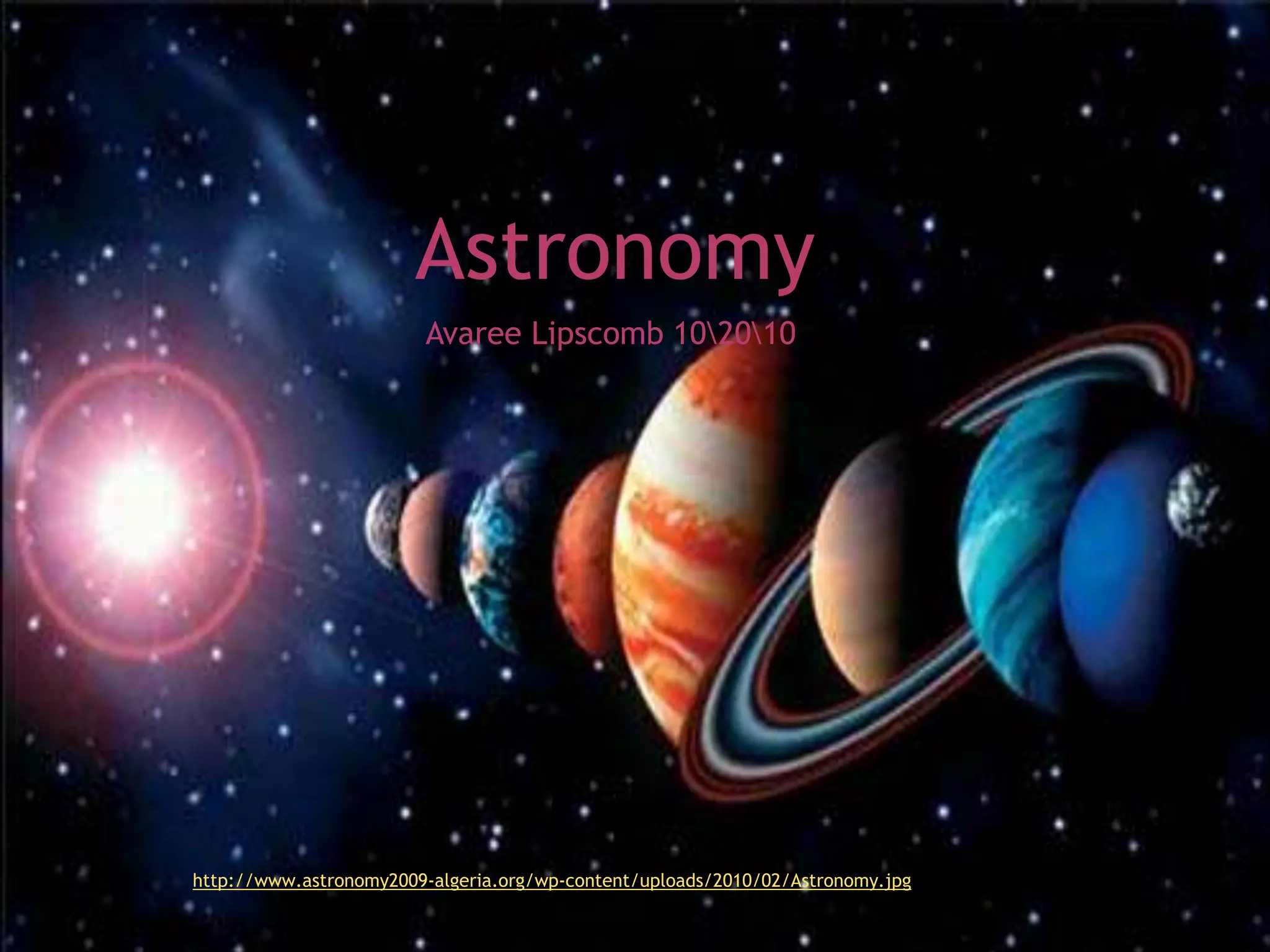
Astronomy
                        Avaree Lipscomb 102010


http://www.astronomy2009-algeria.org/wp-content/uploads/2010/02/Astronomy.jpg
Slide 3 .Oscillating theory/objective 1a
Slide 4 . Big Bang and steady state/objective 1b
Slide 5 . Distances in space/objective 2
Slide 6 . What are used to investigate the universe?/objective 3
Slide 7 . Electromagnetic spectrum/objective 4
Slide 8 . Doppler Effect/objective 5
Slide 9 . Galaxies/objective 6
Slide 10 . Milky Way/objective 7
Slide 11 . H.R. Diagram/objective 8
Slide 12 .Newton’s Law of Universal Gravitation/objective 9
Slide 13 .Constellations/objective 10
1


          A big bang will occur and then it will expand to a certain spot and
           then it will come back together again .
          The expansion rate moves at a very fast pace .
          Formed 13.7 billion years ago


                                                                       g
http://scienceblogs.com/startswithabang/upload/2009/06/makin/big-bang.jp
1b


 Believers of the big      This theory was
  bang theory believe        developed in 1948
  that there was only       Believes that the
  one huge explosive         universe formed 13.7
  which scatter all the      years ago
  parts of the universe     Steady state says that
  all over the place and
                             there is new matter
  from the effect it is      being formed while
  still spreading apart.     the universe expands.
 Still believes the
  universe was formed
  13.7 billion years
2


    Parallax is a apparent displacement from I different position.
    A light year is what is used to measure distances in space , a light
     year is how much distance light travels in a year.
    A Cepheid is a member of a class of variable stars.
    Parsec is a unit of length equaled to just under 31 trillion
     kilometers or 206205 AU or 3.26 light years.


http://sci.esa.int/science-e-media/img/20/parallax2.gif
3


             The Hubble telescope is a space telescope that was sent to orbit
              in space in 1990. The battery time prediction has past but it is
              still taking photos.
             The spectroscope is used by astronomers to look at star and see if
              hydrogen is in a star. It is a instrument used to measure the
              properties in light.
             The Apollo spacecraft was designed to take people safely to the
              moon and back. It was also the first spacecraft to do this. The
              voyager spacecraft was launched in 1977 to go to space and
              successfully complete missions.


http://www.dailyhotnews.org/wp-content/uploads/2010/04/hubble-telescope-752865.jpg
4


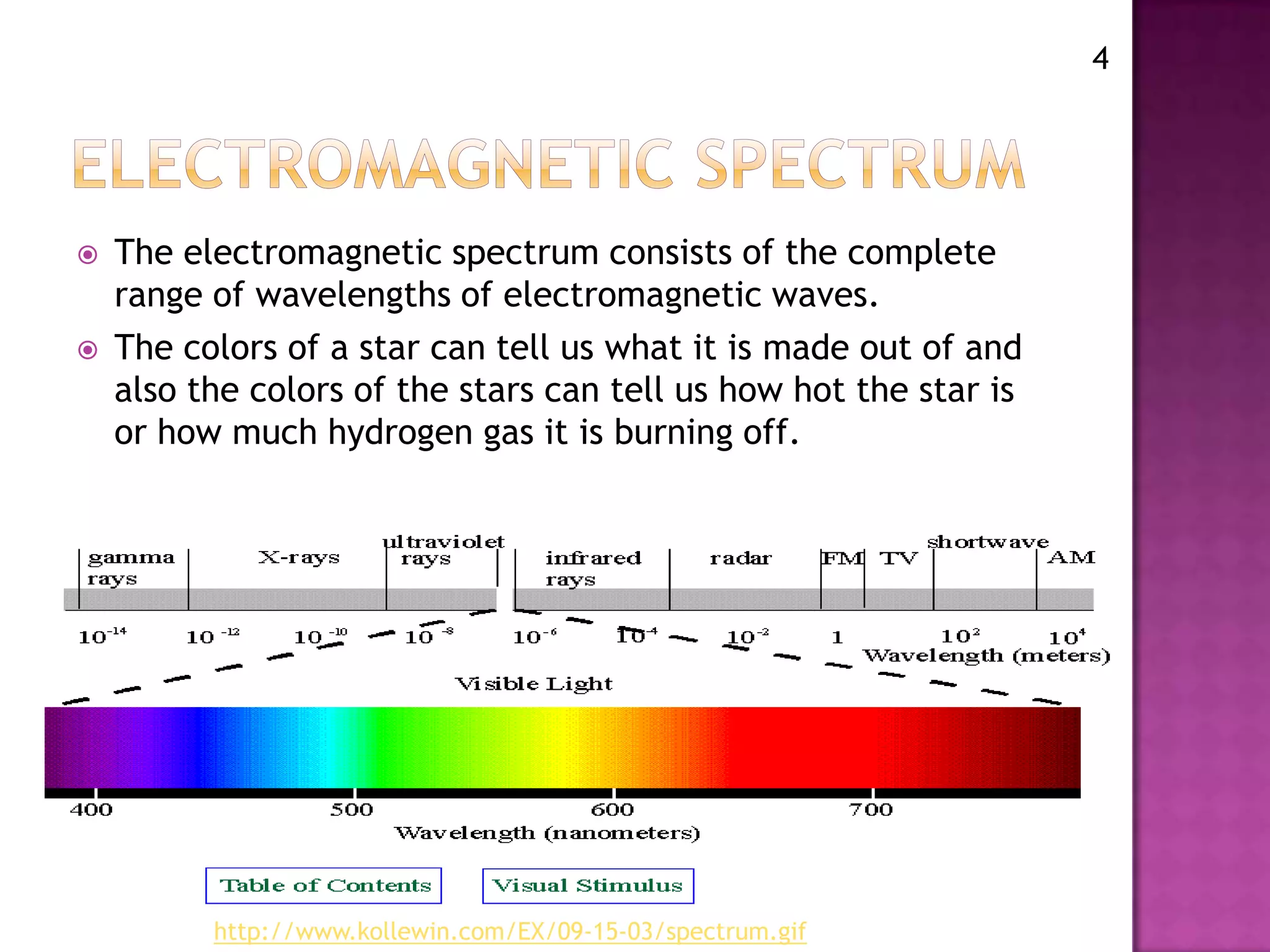
   The electromagnetic spectrum consists of the complete
    range of wavelengths of electromagnetic waves.
   The colors of a star can tell us what it is made out of and
    also the colors of the stars can tell us how hot the star is
    or how much hydrogen gas it is burning off.


          http://www.kollewin.com/EX/09-15-03/spectrum.gif
5


             The Doppler Effect is the change in the frequency of a wave for
              an observer moving relative to the source of the wave.
             The Doppler shift shows that the galaxies are moving away from
              each other , and this supports the Big Bang theory.
               How the stars and galaxies appear shows red shift and blue shift.


http://mail.colonial.net/~hkaiter/astronomyimagesB/Doppler_effect_diagrammatic.png
6


   A galaxy is a group of billion of stars kept together by gravity.
   Elliptical- have an elliptical appearance from no matter what
    angle you look at it.
   Spiral- these galaxies are rotating disks of stars.
   Irregular- can differ have really no special shape just a lot of
    stars bunched together.


             http://www.astro.ljmu.ac.uk/courses/phys134/pic/cosmo/3gals.jpg
7


   The Milky Way is the galaxy we live in.
   On earth stars in the Milky Way appear closer than they
    are.
   The Milky Way is a barred spiral galaxy, the Milky Way is
    about 13.2 billion years old, it is believed to be carrying
    about 200 billion stars.


                          http://www.myviewsandreviews.com/wp-content/uploads/2010/01/Under-The-Milky-Way-Tonight.jpg
8


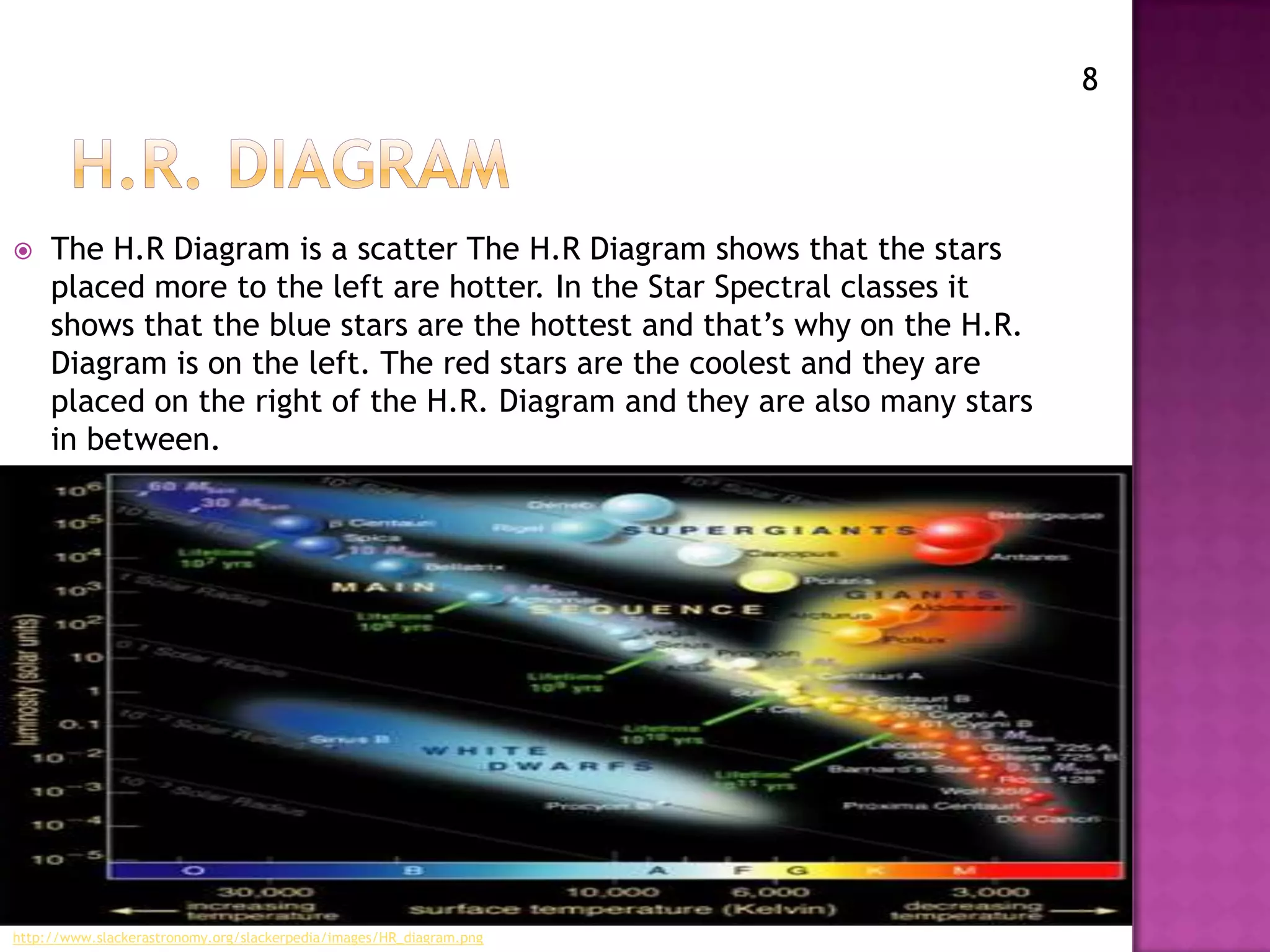
    The H.R Diagram is a scatter The H.R Diagram shows that the stars
     placed more to the left are hotter. In the Star Spectral classes it
     shows that the blue stars are the hottest and that’s why on the H.R.
     Diagram is on the left. The red stars are the coolest and they are
     placed on the right of the H.R. Diagram and they are also many stars
     in between.


http://www.slackerastronomy.org/slackerpedia/images/HR_diagram.png
9


    Newton’s Law of Universal Gravitation explains how the
     earth and the rest of the solar system stays in orbit.
    Newton’s Law of Gravitation states that every massive
     particle in the universe attracts every other massive
     particle with a force which is directly proportional to the
     product of their masses and inversely proportional to the
     square of the distance between them.


http://scienceblogs.com/startswithabang/upload/2009/07/meet_our_second_moon/400px-
NewtonsLawOfUniversalGravitation.svg.png
10


             In modern astronomy, a constellation is an internationally defined
              area of the celestial sphere.
             Constellation’s are patterns made by connecting a line from star
              to star in the sky.
             Some constellation’s never rise or set and those are called
              circumpolar constellation’s.
             All the rest of the constellations are seasonal constellation’s you
              can see them better in certain seasons because of the rotation of
              the earth.


http://my.execpc.com/60/B3/culp/astronomy/fig/LittleDipper.gif   http://startswithabang.com/wp-content/uploads/2008/07/bigdipper.gif
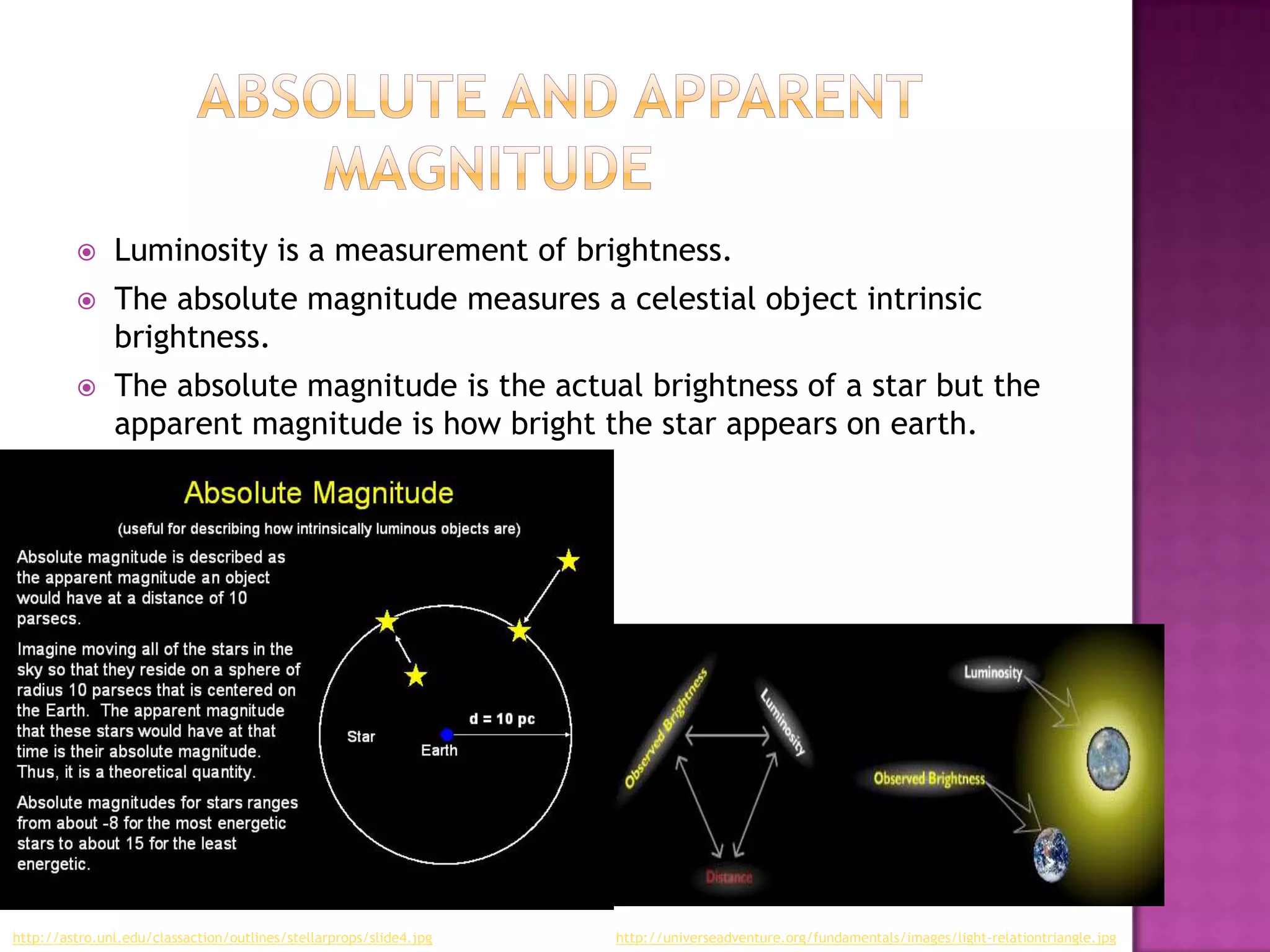
     Luminosity is a measurement of brightness.
              The absolute magnitude measures a celestial object intrinsic
               brightness.
              The absolute magnitude is the actual brightness of a star but the
               apparent magnitude is how bright the star appears on earth.


http://astro.unl.edu/classaction/outlines/stellarprops/slide4.jpg   http://universeadventure.org/fundamentals/images/light-relationtriangle.jpg
   Objective 1 : http://www.allaboutcreation.org/oscillating-universe-theory-faq.htm
   Objective 1 : http://en.wikipedia.org/wiki/Big_Bang
   Objective 1: http://en.wikipedia.org/wiki/Steady_State_theory
   Objective 2 : http://en.wikipedia.org/wiki/Parallax
   Objective 2 : http://en.wikipedia.org/wiki/Parsec
   Objective 2 : http://en.wikipedia.org/wiki/Cepheid_variable
   Objective 3 : http://en.wikipedia.org/wiki/Hubble_Space_Telescope
   Objective 3 : http://en.wikipedia.org/wiki/Spectroscope
   Objective 3 : http://en.wikipedia.org/wiki/Apollo_spacecraft
   Objective 3: http://en.wikipedia.org/wiki/Voyager_spacecraft
   Objective 4: http://en.wikipedia.org/wiki/Electromagnetic_spectrum
   Objective 5: http://en.wikipedia.org/wiki/Doppler_effect
   Objective 6: http://en.wikipedia.org/wiki/Galaxy
   Objective 7: http://en.wikipedia.org/wiki/Galaxy
   Objective 7: http://en.wikipedia.org/wiki/Milky_Way#Size
   Objective 8: http://hyperphysics.phy-astr.gsu.edu/hbase/starlog/staspe.html
   Objective 9: http://en.wikipedia.org/wiki/Newton%27s_law_of_universal_gravitation
   Objective 10: http://en.wikipedia.org/wiki/Constellation
   Objective 11: http://en.wikipedia.org/wiki/Absolute_magnitude#Apparent_magnitude

Astronmy

  • 1.
    Astronomy Avaree Lipscomb 102010 http://www.astronomy2009-algeria.org/wp-content/uploads/2010/02/Astronomy.jpg
  • 2.
    Slide 3 .Oscillatingtheory/objective 1a Slide 4 . Big Bang and steady state/objective 1b Slide 5 . Distances in space/objective 2 Slide 6 . What are used to investigate the universe?/objective 3 Slide 7 . Electromagnetic spectrum/objective 4 Slide 8 . Doppler Effect/objective 5 Slide 9 . Galaxies/objective 6 Slide 10 . Milky Way/objective 7 Slide 11 . H.R. Diagram/objective 8 Slide 12 .Newton’s Law of Universal Gravitation/objective 9 Slide 13 .Constellations/objective 10
  • 3.
    1  A big bang will occur and then it will expand to a certain spot and then it will come back together again .  The expansion rate moves at a very fast pace .  Formed 13.7 billion years ago g http://scienceblogs.com/startswithabang/upload/2009/06/makin/big-bang.jp
  • 4.
    1b  Believers ofthe big  This theory was bang theory believe developed in 1948 that there was only  Believes that the one huge explosive universe formed 13.7 which scatter all the years ago parts of the universe  Steady state says that all over the place and there is new matter from the effect it is being formed while still spreading apart. the universe expands.  Still believes the universe was formed 13.7 billion years
  • 5.
    2  Parallax is a apparent displacement from I different position.  A light year is what is used to measure distances in space , a light year is how much distance light travels in a year.  A Cepheid is a member of a class of variable stars.  Parsec is a unit of length equaled to just under 31 trillion kilometers or 206205 AU or 3.26 light years. http://sci.esa.int/science-e-media/img/20/parallax2.gif
  • 6.
    3  The Hubble telescope is a space telescope that was sent to orbit in space in 1990. The battery time prediction has past but it is still taking photos.  The spectroscope is used by astronomers to look at star and see if hydrogen is in a star. It is a instrument used to measure the properties in light.  The Apollo spacecraft was designed to take people safely to the moon and back. It was also the first spacecraft to do this. The voyager spacecraft was launched in 1977 to go to space and successfully complete missions. http://www.dailyhotnews.org/wp-content/uploads/2010/04/hubble-telescope-752865.jpg
  • 7.
    4  The electromagnetic spectrum consists of the complete range of wavelengths of electromagnetic waves.  The colors of a star can tell us what it is made out of and also the colors of the stars can tell us how hot the star is or how much hydrogen gas it is burning off. http://www.kollewin.com/EX/09-15-03/spectrum.gif
  • 8.
    5  The Doppler Effect is the change in the frequency of a wave for an observer moving relative to the source of the wave.  The Doppler shift shows that the galaxies are moving away from each other , and this supports the Big Bang theory.  How the stars and galaxies appear shows red shift and blue shift. http://mail.colonial.net/~hkaiter/astronomyimagesB/Doppler_effect_diagrammatic.png
  • 9.
    6  A galaxy is a group of billion of stars kept together by gravity.  Elliptical- have an elliptical appearance from no matter what angle you look at it.  Spiral- these galaxies are rotating disks of stars.  Irregular- can differ have really no special shape just a lot of stars bunched together. http://www.astro.ljmu.ac.uk/courses/phys134/pic/cosmo/3gals.jpg
  • 10.
    7  The Milky Way is the galaxy we live in.  On earth stars in the Milky Way appear closer than they are.  The Milky Way is a barred spiral galaxy, the Milky Way is about 13.2 billion years old, it is believed to be carrying about 200 billion stars. http://www.myviewsandreviews.com/wp-content/uploads/2010/01/Under-The-Milky-Way-Tonight.jpg
  • 11.
    8  The H.R Diagram is a scatter The H.R Diagram shows that the stars placed more to the left are hotter. In the Star Spectral classes it shows that the blue stars are the hottest and that’s why on the H.R. Diagram is on the left. The red stars are the coolest and they are placed on the right of the H.R. Diagram and they are also many stars in between. http://www.slackerastronomy.org/slackerpedia/images/HR_diagram.png
  • 12.
    9  Newton’s Law of Universal Gravitation explains how the earth and the rest of the solar system stays in orbit.  Newton’s Law of Gravitation states that every massive particle in the universe attracts every other massive particle with a force which is directly proportional to the product of their masses and inversely proportional to the square of the distance between them. http://scienceblogs.com/startswithabang/upload/2009/07/meet_our_second_moon/400px- NewtonsLawOfUniversalGravitation.svg.png
  • 13.
    10  In modern astronomy, a constellation is an internationally defined area of the celestial sphere.  Constellation’s are patterns made by connecting a line from star to star in the sky.  Some constellation’s never rise or set and those are called circumpolar constellation’s.  All the rest of the constellations are seasonal constellation’s you can see them better in certain seasons because of the rotation of the earth. http://my.execpc.com/60/B3/culp/astronomy/fig/LittleDipper.gif http://startswithabang.com/wp-content/uploads/2008/07/bigdipper.gif
  • 14.
    Luminosity is a measurement of brightness.  The absolute magnitude measures a celestial object intrinsic brightness.  The absolute magnitude is the actual brightness of a star but the apparent magnitude is how bright the star appears on earth. http://astro.unl.edu/classaction/outlines/stellarprops/slide4.jpg http://universeadventure.org/fundamentals/images/light-relationtriangle.jpg
  • 15.
    Objective 1 : http://www.allaboutcreation.org/oscillating-universe-theory-faq.htm  Objective 1 : http://en.wikipedia.org/wiki/Big_Bang  Objective 1: http://en.wikipedia.org/wiki/Steady_State_theory  Objective 2 : http://en.wikipedia.org/wiki/Parallax  Objective 2 : http://en.wikipedia.org/wiki/Parsec  Objective 2 : http://en.wikipedia.org/wiki/Cepheid_variable  Objective 3 : http://en.wikipedia.org/wiki/Hubble_Space_Telescope  Objective 3 : http://en.wikipedia.org/wiki/Spectroscope  Objective 3 : http://en.wikipedia.org/wiki/Apollo_spacecraft  Objective 3: http://en.wikipedia.org/wiki/Voyager_spacecraft  Objective 4: http://en.wikipedia.org/wiki/Electromagnetic_spectrum  Objective 5: http://en.wikipedia.org/wiki/Doppler_effect  Objective 6: http://en.wikipedia.org/wiki/Galaxy  Objective 7: http://en.wikipedia.org/wiki/Galaxy  Objective 7: http://en.wikipedia.org/wiki/Milky_Way#Size  Objective 8: http://hyperphysics.phy-astr.gsu.edu/hbase/starlog/staspe.html  Objective 9: http://en.wikipedia.org/wiki/Newton%27s_law_of_universal_gravitation  Objective 10: http://en.wikipedia.org/wiki/Constellation  Objective 11: http://en.wikipedia.org/wiki/Absolute_magnitude#Apparent_magnitude