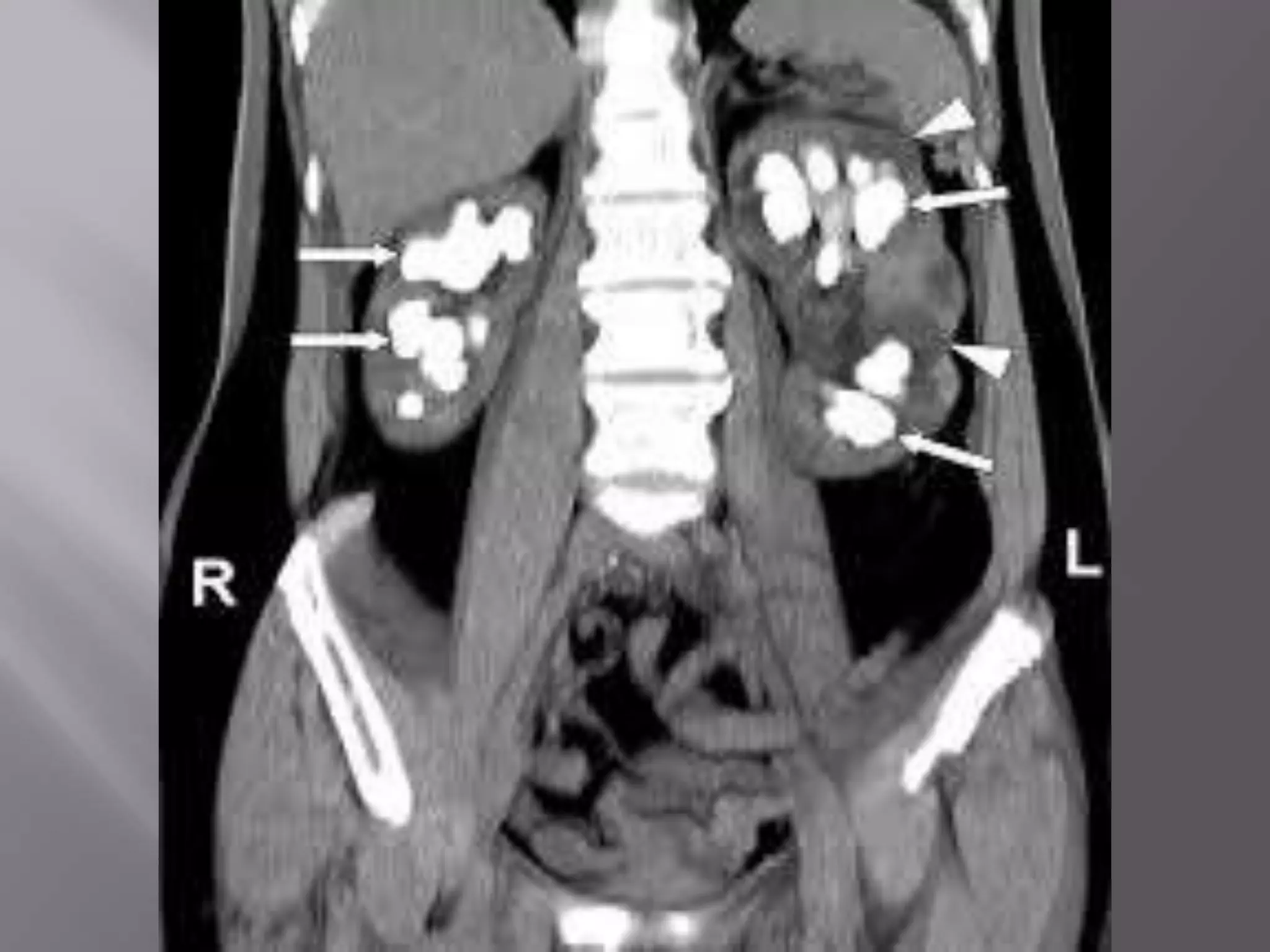
This document discusses staghorn calculi, which are large branched kidney stones that fill the renal pelvis and calyces. It describes the composition of staghorn stones as struvite or a mixture of calcium and apatite. The document outlines the chemical process by which urease-producing bacterial infections lead to the formation of struvite stones. It discusses evaluation, risk factors, treatment options including percutaneous nephrolithotomy or shockwave lithotripsy, and the limited role of chemolytic therapy for managing large staghorn calculi.



![ Infection stones are composed primarily of
magnesium ammonium phosphate hexahydrate
(MgNH4PO4 • 6H2O) but may in addition contain
calcium phosphate in the form of carbonate apatite
(Ca10[PO4]6 • CO3).
A Swedish geologist discovered magnesium
ammonium phosphate in guano and named it
“struvite” after his mentor, naturalist H. C. G. von
Struve](https://image.slidesharecdn.com/staghorncalculi-151226121005/75/Staghorn-calculi-5-2048.jpg)