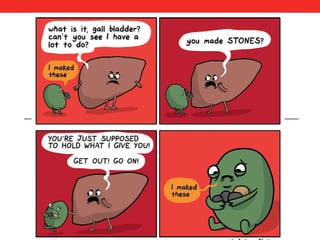
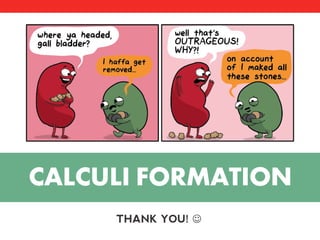
CALCULI FORMATION
Bonifacio | Bueno | Burton | Busa | Cariaga
FEU NRMF Medicine 1-C
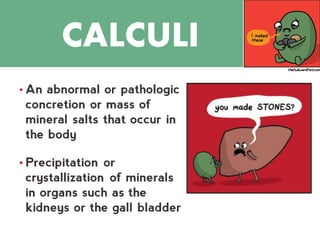
CALCULI
• An abnormal or pathologic
concretion or mass of
mineral salts that occur in
the body
• Precipitation or
crystallization of minerals
in organs such as the
kidneys or the gall bladder
CALCULI
FORMATION
CALCULI
FORMATION
GALLSTONE
FORMATION
FORMATION
GALLSTONE
FORMATION
CALCULI
GALLSTONES
• Cholesterol stones
• Most common
• Form when amount of cholesterol exceeds or
supersaturates capacity of bile
• Pigment stones
• From crystallization of calcium bilirubinate
• May indicate infection
• Black or brown
TYPES OF CALCULI
CALCULI
RENAL STONES
• Calcium stones
• Most common renal stones
• Contain Ca, PO4, oxalate
• Caused by excessive Ca in the body
• Hyperparathyroidism
TYPES OF CALCULI
CALCULI
• Uric acid
• Formed due to
• Low urine output
• High protein diet
• Increased alcohol
intake
• Struvite
• Affect more women
than men
• May accompany
renal infections
TYPES OF CALCULI
RENAL STONES
CALCULI
RENAL STONES
• Cystine
• Rare
• Typically occur in individuals with family
history of cystinuria
TYPES OF CALCULI
CALCULI
GALLSTONES: Cholesterol
• Supersaturation of bile with cholesterol
• Intestinal hypomotility
• Excess in pro-nucleation factors, deficiency of
anti-nucleation factors
• Hypersecretion of mucus in the gall bladder
PROMOTING
FACTORS
CALCULI
GALLSTONES: Pigment
• Elevated levels of unconjugated bilirubin in the
blood
• Hemolytic diseases
• Severe ileal dysfunction
• Intestinal hypomotility
• Infection of the biliary tree
• Bacteria (E. coli)
• Parasite (Ascaris lumbricoides)
• Fungi (Ophiocordyceps sinensi)
PROMOTING
FACTORS
CALCULI
RENAL STONES
• Slow urine flow
• Damaged urinary tract lining
• Absence of inhibitory proteins
(nephrocalcin, Tamm-Horsfall protein,
uropontin)
• Intake of medication
• Dehydration
PROMOTING
FACTORS
CALCULI
RENAL STONES
• Urine pH
• Acidic pH: favour precipitation and formation
of uric acid stones and cystine stones
• Alkaline pH: CaPO4 stones and struvite
stones
PROMOTING
FACTORS
CALCULI
RENAL STONES
• Sufficient consumption of water
• Decreased protein intake
• Reduced sodium consumption
• Frequent drinking of water
PREVENTIVE
FACTORS
CALCULI
RENAL STONES
• Normal concentration of urine elements
• Normal urine parameters (volume, pH,
etc)
• Presence of inhibitory proteins (Tamm-
Horsfall protein, nephrocalcin, uropontin)
• Prevention of urine stasis (timely and
sufficient voiding)
PREVENTIVE
FACTORS
CALCULI
GALLSTONES
• Normal composition of gall bladder
contents
• Low-fat, low-cholesterol diet
• High fiber intake
• Decreased sugar consumption
• Physical exertion/exercise
PREVENTIVE
FACTORS
CALCULI
CHOLELITHIASIS UROLITHIASIS
Increasing age Middle aged (35-45)
Female gender Male gender
Gall bladder stasis Urinary stasis
Pregnancy Geography
Diet, obesity, physical inactivity Diet, obesity
Ethnicity Nationality
Cirrhosis History of cystinuria
Family history Family history of nephrolithiasis
Ileal disease, ileal resection Chronic UTI
Medications Dehydration
Rapid weight loss
RISK FACTORS
CALCULI
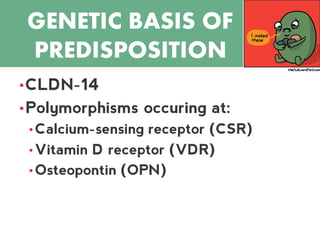
•CLDN-14
•Polymorphisms occuring at:
• Calcium-sensing receptor (CSR)
• Vitamin D receptor (VDR)
• Osteopontin (OPN)
GENETIC BASIS OF
PREDISPOSITION
CALCULI
GALLSTONES
• Pulsating, propagating pain that disappears
shortly after it begins
• Pain in the upper right portion of the abdomen
• Pain immediately below the area of the breast
• Pain in the right shoulder
• Referred pain
CLINICAL
MANIFESTATIONS
CALCULI
RENAL STONES
• Severe pain in the back and sides of the
abdomen, just below the ribs
• May spread to groin area
• In the case of an infection, symptoms include
nausea or vomiting, fever, and chills
CLINICAL
MANIFESTATIONS
CALCULI
RENAL STONES
CLINICAL
MANIFESTATIONS
• Painful urination
• Hematuria or pink, red, or
brown urine with a foul
odour
• Changes in the voiding
pattern
• Small amounts of urine
may be voided at a time.
CALCULI
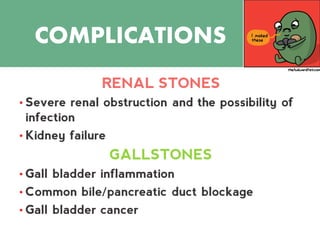
RENAL STONES
• Severe renal obstruction and the possibility of
infection
• Kidney failure
GALLSTONES
• Gall bladder inflammation
• Common bile/pancreatic duct blockage
• Gall bladder cancer
COMPLICATIONS
CALCULI
RENAL STONES
• Urine examination
• Hematuria
• Pyuria
• BUN, creatinine, and electrolytes
• Abdominal ultrasound
• Intravenous pyelogram (IVP)
LAB DIAGNOSIS
CALCULI
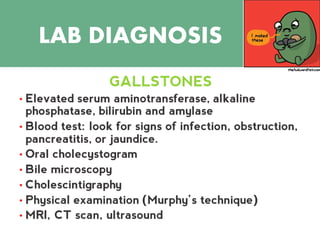
GALLSTONES
• Elevated serum aminotransferase, alkaline
phosphatase, bilirubin and amylase
• Blood test: look for signs of infection, obstruction,
pancreatitis, or jaundice.
• Oral cholecystogram
• Bile microscopy
• Cholescintigraphy
• Physical examination (Murphy’s technique)
• MRI, CT scan, ultrasound
LAB DIAGNOSIS
CALCULI
GALLSTONES
DIAGNOSIS
CALCULI
GALLSTONES
•Administration of Ursodiol
•Contact distribution therapy
• Use organic solvent methyl tert-butyl
ether (MTBE)
•Surgical removal
TREATMENT
CALCULI
RENAL STONES
• Extracorporal shockwave lithotripsy
(ESWL)
• Percutaneous nephrolithotomy
• Ureteroscopy
• Open surgery
• Medication
TREATMENT
CALCULI
RENAL STONES
TREATMENT
Etiology Intervention Dosage/Recommendation
URIC ACID
Normal 24-h uric acid
levels, but urine pH
<5.5
Alkali-citrate preparations
(preferred)
Potassium citrate:40-60 mEq
of citrate in 24 h (divided
doses)
Sodium-based preparations Sodium bicarbonate: 1, 300
mg bid
CYSTINE
Genetic:
Autosomal
Recessive
Restrict dietary methionine
(sulfur) intake
Limit meat, eggs dairy
products, legumes, grains
Alkali-citrate preparations Potassium citrate: 40-60 mEq
of citrate in 24h (divided
doses)
CALCULI
RENAL STONES
TREATMENT
Etiology Intervention Dosage/Recommendation
CYSTINE
Genetic:
Autosomal
Recessive
Sodium-based preparations Sodium bicarbonate: 1, 300mg
bid
Thiol-binders α-mercaptopropionylglycine
(tiopronin): 200-300md tid
(up to 1, 000mg in 24h)
D-penicillamine: 250mg qd;
gradually titrate to 2, 000mg
in 24h
Captopril: 50mg tid (not
preferred)
CALCULI
RENAL STONES
TREATMENT
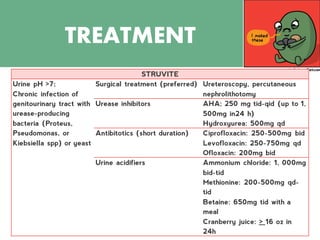
STRUVITE
Urine pH >7;
Chronic infection of
genitourinary tract with
urease-producing
bacteria (Proteus,
Pseudomonas, or
Kiebsiella spp) or yeast
Surgical treatment (preferred) Ureteroscopy, percutaneous
nephrolithotomy
Urease inhibitors AHA; 250 mg tid-qid (up to 1,
500mg in24 h)
Hydroxyurea: 500mg qd
Antibitotics (short duration) Ciprofloxacin: 250-500mg bid
Levofloxacin: 250-750mg qd
Ofloxacin: 200mg bid
Urine acidifiers Ammonium chloride: 1, 000mg
bid-tid
Methionine: 200-500mg qd-
tid
Betaine: 650mg tid with a
meal
Cranberry juice: > 16 oz in
24h
CALCULI FORMATION
THANK YOU! 

Calculi Formation

  • 1.
    CALCULI FORMATION Bonifacio |Bueno | Burton | Busa | Cariaga FEU NRMF Medicine 1-C
  • 2.
    CALCULI • An abnormalor pathologic concretion or mass of mineral salts that occur in the body • Precipitation or crystallization of minerals in organs such as the kidneys or the gall bladder CALCULI
  • 3.
  • 4.
  • 5.
  • 6.
    CALCULI GALLSTONES • Cholesterol stones •Most common • Form when amount of cholesterol exceeds or supersaturates capacity of bile • Pigment stones • From crystallization of calcium bilirubinate • May indicate infection • Black or brown TYPES OF CALCULI
  • 7.
    CALCULI RENAL STONES • Calciumstones • Most common renal stones • Contain Ca, PO4, oxalate • Caused by excessive Ca in the body • Hyperparathyroidism TYPES OF CALCULI
  • 8.
    CALCULI • Uric acid •Formed due to • Low urine output • High protein diet • Increased alcohol intake • Struvite • Affect more women than men • May accompany renal infections TYPES OF CALCULI RENAL STONES
  • 9.
    CALCULI RENAL STONES • Cystine •Rare • Typically occur in individuals with family history of cystinuria TYPES OF CALCULI
  • 10.
    CALCULI GALLSTONES: Cholesterol • Supersaturationof bile with cholesterol • Intestinal hypomotility • Excess in pro-nucleation factors, deficiency of anti-nucleation factors • Hypersecretion of mucus in the gall bladder PROMOTING FACTORS
  • 11.
    CALCULI GALLSTONES: Pigment • Elevatedlevels of unconjugated bilirubin in the blood • Hemolytic diseases • Severe ileal dysfunction • Intestinal hypomotility • Infection of the biliary tree • Bacteria (E. coli) • Parasite (Ascaris lumbricoides) • Fungi (Ophiocordyceps sinensi) PROMOTING FACTORS
  • 12.
    CALCULI RENAL STONES • Slowurine flow • Damaged urinary tract lining • Absence of inhibitory proteins (nephrocalcin, Tamm-Horsfall protein, uropontin) • Intake of medication • Dehydration PROMOTING FACTORS
  • 13.
    CALCULI RENAL STONES • UrinepH • Acidic pH: favour precipitation and formation of uric acid stones and cystine stones • Alkaline pH: CaPO4 stones and struvite stones PROMOTING FACTORS
  • 14.
    CALCULI RENAL STONES • Sufficientconsumption of water • Decreased protein intake • Reduced sodium consumption • Frequent drinking of water PREVENTIVE FACTORS
  • 15.
    CALCULI RENAL STONES • Normalconcentration of urine elements • Normal urine parameters (volume, pH, etc) • Presence of inhibitory proteins (Tamm- Horsfall protein, nephrocalcin, uropontin) • Prevention of urine stasis (timely and sufficient voiding) PREVENTIVE FACTORS
  • 16.
    CALCULI GALLSTONES • Normal compositionof gall bladder contents • Low-fat, low-cholesterol diet • High fiber intake • Decreased sugar consumption • Physical exertion/exercise PREVENTIVE FACTORS
  • 17.
    CALCULI CHOLELITHIASIS UROLITHIASIS Increasing ageMiddle aged (35-45) Female gender Male gender Gall bladder stasis Urinary stasis Pregnancy Geography Diet, obesity, physical inactivity Diet, obesity Ethnicity Nationality Cirrhosis History of cystinuria Family history Family history of nephrolithiasis Ileal disease, ileal resection Chronic UTI Medications Dehydration Rapid weight loss RISK FACTORS
  • 18.
    CALCULI •CLDN-14 •Polymorphisms occuring at: •Calcium-sensing receptor (CSR) • Vitamin D receptor (VDR) • Osteopontin (OPN) GENETIC BASIS OF PREDISPOSITION
  • 19.
    CALCULI GALLSTONES • Pulsating, propagatingpain that disappears shortly after it begins • Pain in the upper right portion of the abdomen • Pain immediately below the area of the breast • Pain in the right shoulder • Referred pain CLINICAL MANIFESTATIONS
  • 20.
    CALCULI RENAL STONES • Severepain in the back and sides of the abdomen, just below the ribs • May spread to groin area • In the case of an infection, symptoms include nausea or vomiting, fever, and chills CLINICAL MANIFESTATIONS
  • 21.
    CALCULI RENAL STONES CLINICAL MANIFESTATIONS • Painfulurination • Hematuria or pink, red, or brown urine with a foul odour • Changes in the voiding pattern • Small amounts of urine may be voided at a time.
  • 22.
    CALCULI RENAL STONES • Severerenal obstruction and the possibility of infection • Kidney failure GALLSTONES • Gall bladder inflammation • Common bile/pancreatic duct blockage • Gall bladder cancer COMPLICATIONS
  • 23.
    CALCULI RENAL STONES • Urineexamination • Hematuria • Pyuria • BUN, creatinine, and electrolytes • Abdominal ultrasound • Intravenous pyelogram (IVP) LAB DIAGNOSIS
  • 24.
    CALCULI GALLSTONES • Elevated serumaminotransferase, alkaline phosphatase, bilirubin and amylase • Blood test: look for signs of infection, obstruction, pancreatitis, or jaundice. • Oral cholecystogram • Bile microscopy • Cholescintigraphy • Physical examination (Murphy’s technique) • MRI, CT scan, ultrasound LAB DIAGNOSIS
  • 25.
  • 26.
    CALCULI GALLSTONES •Administration of Ursodiol •Contactdistribution therapy • Use organic solvent methyl tert-butyl ether (MTBE) •Surgical removal TREATMENT
  • 27.
    CALCULI RENAL STONES • Extracorporalshockwave lithotripsy (ESWL) • Percutaneous nephrolithotomy • Ureteroscopy • Open surgery • Medication TREATMENT
  • 28.
    CALCULI RENAL STONES TREATMENT Etiology InterventionDosage/Recommendation URIC ACID Normal 24-h uric acid levels, but urine pH <5.5 Alkali-citrate preparations (preferred) Potassium citrate:40-60 mEq of citrate in 24 h (divided doses) Sodium-based preparations Sodium bicarbonate: 1, 300 mg bid CYSTINE Genetic: Autosomal Recessive Restrict dietary methionine (sulfur) intake Limit meat, eggs dairy products, legumes, grains Alkali-citrate preparations Potassium citrate: 40-60 mEq of citrate in 24h (divided doses)
  • 29.
    CALCULI RENAL STONES TREATMENT Etiology InterventionDosage/Recommendation CYSTINE Genetic: Autosomal Recessive Sodium-based preparations Sodium bicarbonate: 1, 300mg bid Thiol-binders α-mercaptopropionylglycine (tiopronin): 200-300md tid (up to 1, 000mg in 24h) D-penicillamine: 250mg qd; gradually titrate to 2, 000mg in 24h Captopril: 50mg tid (not preferred)
  • 30.
    CALCULI RENAL STONES TREATMENT STRUVITE Urine pH>7; Chronic infection of genitourinary tract with urease-producing bacteria (Proteus, Pseudomonas, or Kiebsiella spp) or yeast Surgical treatment (preferred) Ureteroscopy, percutaneous nephrolithotomy Urease inhibitors AHA; 250 mg tid-qid (up to 1, 500mg in24 h) Hydroxyurea: 500mg qd Antibitotics (short duration) Ciprofloxacin: 250-500mg bid Levofloxacin: 250-750mg qd Ofloxacin: 200mg bid Urine acidifiers Ammonium chloride: 1, 000mg bid-tid Methionine: 200-500mg qd- tid Betaine: 650mg tid with a meal Cranberry juice: > 16 oz in 24h
  • 32.