Definition of SelectionThe process of collecting and evaluating information about an individual in order to extend an offer of employment. Such employment could be either a first position for a new employee or a different position for a current employee. The selection process is performed under legal and environmental constraints and addresses the future interests of the organization and of the individual.
7.
The Value inStudying Selection Future developments in selection will be based on what is previously known about the field. The techniques and measurement instruments used in individual selection may likely continue to be used in team-based selection. Selection will still be based on measurement principles—rules about how to assign numbers to work activities and to individuals. While the philosophy of work may change, the legal environment for selection decisions will not change as fast or as radically.
8.
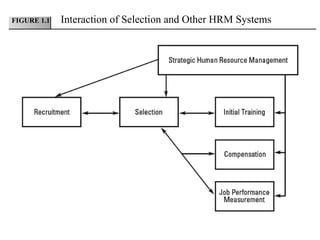
Selection and StrategicHRM Strategic Human Resource Management (SHRM) Activities that align the number of employees and their performance with the goals of the firm Requires that the human resource (HR) systems of the firm are coordinated and interact smoothly with one another. Forecasting HR Future labor demand Future labor supply Aligning demand to supply
9.
FIGURE 1. 1 Interaction of Selection and Other HRM Systems
10.
Selection and RecruitmentPurposes of Recruitment To develop an appropriate number of applicants (e.g., ten for each open position) while keeping costs reasonable. To meet the organization’s legal and social obligations regarding the demographic composition of its workforce. To help increase the success rate of the selection process by reducing the percentage of applicants who are either poorly qualified or have the wrong skills.
TABLE 1. 1 Recruitment Sources Advertising Associations and Unions Colleges and Secondary Schools Employee Referral Programs Employment Agencies Walk-ins Internet Job Posting Review of Employee Files
14.
Using the Internetfor Recruiting Use individuals who know your firm Keep in touch with current and former employees Develop a recruiting website Create a dedicated job information/career center site Find the best active candidates Search specialized job board for recruits Find passive candidates Identify potential applicants employed by other firms
15.
Factors in Choosinga Recruiting Source Nature of the Job External Image of the Company Current Employee Attitudes Demographic Mix of Applicants
16.
Content of RecruitingMessages Realistic Job Preview Avoids creating unfulfilled job expectations May reduce subsequent employee turnover Is “a right thing to do” Specificity and Detail in Company Information Can favorably influence applicant’s perception Helps applicant in self-selection decision to become an applicant, stay in the recruitment process, or to remove themselves from further consideration.
17.
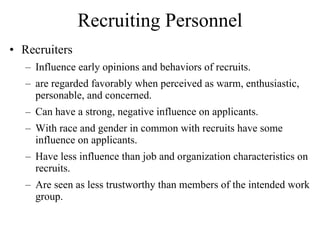
Recruiting Personnel RecruitersInfluence early opinions and behaviors of recruits. are regarded favorably when perceived as warm, enthusiastic, personable, and concerned. Can have a strong, negative influence on applicants. With race and gender in common with recruits have some influence on applicants. Have less influence than job and organization characteristics on recruits. Are seen as less trustworthy than members of the intended work group.
FIGURE 1.3 Stepsin the Development of a Selection Program Job Analysis Identification of Relevant Job Performance Dimensions Identification of Knowledge, Skills, and Abilities (KSAs) Necessary for Job Development of Assessment Devices to Measure KSAs Validation of Assessment Devices 1. Content 2. Criterion Use of Assessment Devices in the Processing of Applicants Spring
28.
Developing a SelectionProgram Job Analysis Information Job analysis Gathering of information about a job in an organization The tasks, results (products or services) equipment, material used, and environment (working conditions, hazards, work schedule, etc.) that characterize the job Purposes of information Inform applicants about the nature and demands of the job Provide a database for the other steps in the developmental process
29.
Developing a SelectionProgram (cont’d) Identifying Relevant Job Performance Measures What determines how job performance is measured and what level of performance is regarded as successful? Physical outputs Interactions with customers Contributions to team efforts What length of time (performance interval) to measure?
30.
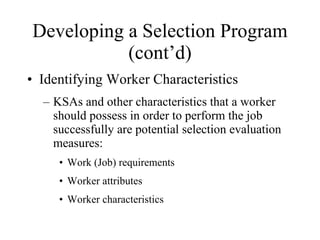
Developing a SelectionProgram (cont’d) Identifying Worker Characteristics KSAs and other characteristics that a worker should possess in order to perform the job successfully are potential selection evaluation measures: Work (Job) requirements Worker attributes Worker characteristics
31.
Developing a SelectionProgram (cont’d) Development of Selection Devices Device must measure the KSAs identified as needed for the job. Device must able to differentiate among applicants. Validation Procedures Empirical validation A representative sample of individuals and correlation measures of how well the individuals are performing the job. Content validation Systematically taking data (the judgments of workers and managers), and using them to determine the relationship between the selection test and job performance.
32.
FIGURE 1.3 Stepsin the Development of a Selection Program Job Analysis Identification of Relevant Job Performance Dimensions Identification of Knowledge, Skills, and Abilities (KSAs) Necessary for Job Development of Assessment Devices to Measure KSAs Validation of Assessment Devices 1. Content 2. Criterion Use of Assessment Devices in the Processing of Applicants
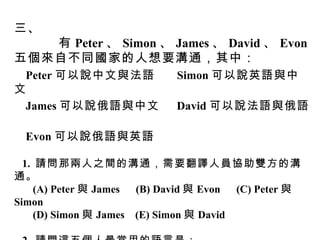
三、 有 Peter、 Simon 、 James 、 David 、 Evon 五個來自不同國家的人想要溝通,其中: Peter 可以說中文與法語 Simon 可以說英語與中文 James 可以說俄語與中文 David 可以說法語與俄語 Evon 可以說俄語與英語 1. 請問那兩人之間的溝通,需要翻譯人員協助雙方的溝通。 (A) Peter 與 James (B) David 與 Evon (C) Peter 與 Simon (D) Simon 與 James (E) Simon 與 David 2. 請問這五個人最常用的語言是: (A) 中文與法語 (B) 中文與俄語 (C) 法語與俄語 (D) 英語與法語 (E) 英語與俄語
Job Applications andRésumés Employment applications are a low-cost way to gather basic data from many applicants. Employment applications provide several types of information: Contact information Work experience Educational background Applicant’s signature Résumés are the usual way applicants introduce themselves to a potential employer. Organizations typically use them as a basis for deciding which candidates to investigate further. Résumés are most valid when the content of the résumé is evaluated in terms of the elements of a job description. 資料來源: Noe et.al ( 2004 )
65.
References and BackgroundChecks References are not always an unbiased source of information. Applicants provide the name and phone numbers of references. Organizations typically check references after it has determined that the applicant is a finalist for the job. Background checks are a way to verify that applicants are as they represent themselves to be. Verifying credentials and conducting background checks is more complicated when candidates are not U.S. citizens. 資料來源: Noe et.al ( 2004 )
Employment Tests Two broad categories of employment tests are: Aptitude tests: assess how well a person can learn or acquire skills and abilities Achievement tests: measure a person’s existing knowledge and skills Other types of employment tests include: Physical ability tests: Evaluates muscular tension, power, endurance, flexibility, balance, and coordination Personality tests: Finds applicants who have desired personality traits 資料來源: Noe et.al ( 2004 )
68.
Employment Tests Othertypes of employment tests include: Integrity tests: Weeds out dishonest employees Drug testing and medical examinations: Ensures that candidates meet physical job requirements and will not be impaired on the job Cognitive ability tests: Designed to measure such mental abilities as: Verbal skills Quantitative skills Reasoning ability 資料來源: Noe et.al ( 2004 )
69.
The Big FiveDimensions of Personality 資料來源: Greenberg ( 2005 )
70.
Interviewing Techniques Nondirectiveinterview: the interviewer has great discretion in choosing questions to ask. Structured interview: uses a set of established questions. Situational interview: the interviewer describes a situation likely to arise and asks the candidate to describe how he or she would handle it Behavior description interview: the interviewer asks the candidate to describe how he or she handled a type of situation in the past Face-to-face interview: one candidate, one interviewer. Panel interview: several organizational members interview each candidate Computerized interview: candidate responds to questions presented by the computer 資料來源: Noe et.al ( 2004 )
Advantages and Disadvantagesof Interviewing Advantages Can provide evidence of communication and interpersonal skills Can gain insight into candidates’ personality and interpersonal style Disadvantages Can be unreliable Low on validity Costly Subjective Can be biased 資料來源: Noe et.al ( 2004 )
Current Issues inSelection Broadly Defined Team-Based Jobs Emphasize KSAs necessary for teamwork Emphasize interpersonal skills and use of incumbent team members in the selection of new members Describe jobs in terms of processes rather than specific job activities Work analysis methods should allow for considerable flexibility as job incumbents and organization change The Growth Of Small Business Large organizations have been reducing the number of employees, while small businesses have been increasing their numbers
重要參考資料 Muchinsky, P.M. (2008). Psychology applied to work (9 th ed.). Pacific Grove, CA: Brooks/Cole Publishing Co. Greenberg,J. ( 2004 ) . Managing Behavior in Organizations (4 th ed.). New Jersey: Pearson Prentice Hall. Gatewood, R.D. & Feild, H.S. (2008). Human Resource Selection (6 th ed.). Orlando, Fl: The Dryden Press. Noe, R. A., Hollenbeck. J. R., Gerhart. B. G., & Wright, P. M. ( 2004 ) . Fundamental of Human Resource Management .New York: McGraw-Hill.
![單元二 「員工招募與甄選」 王榮春 104 人力銀行研發中心協理 國立政治大學工商心理學博士 東吳大學、北教大、國防大學 心理相關系所兼任助理教授 [email_address] 課程重點 一、招募 v.s 甄選 二、招募的管道與吸引人才的方法 三、人才甄選評鑑的核心概念: FIT 四、確認人才甄選評鑑的條件: ASKVIP 五、人才甄選評鑑工具的發展與運用 六、人才甄選評鑑時的常用工具與方法 七、人才甄選評鑑工具實作與討論 八、甄選決策的方法](https://image.slidesharecdn.com/random-100418070359-phpapp01/85/slide-1-320.jpg)

![「員工招募與甄選」 王榮春 104 人力銀行研發中心協理 國立政治大學工商心理學博士 東吳大學、北教大、國防大學 心理相關系所兼任助理教授 [email_address] 課程重點 一、招募 v.s 甄選 二、招募的管道與吸引人才的方法 三、人才甄選評鑑的核心概念: FIT 四、確認人才甄選評鑑的條件: ASKVIP 五、人才甄選評鑑工具的發展與運用 六、人才甄選評鑑時的常用工具與方法 七、人才甄選評鑑工具實作與討論 八、甄選決策的方法](https://image.slidesharecdn.com/random-100418070359-phpapp01/85/slide-3-320.jpg)
![王榮春 104 人力銀行研發中心協理 國立政治大學工商心理學博士 東吳大學、北教大、國防大學 心理相關系所兼任助理教授 [email_address] 「員工招募與甄選」 課程重點 一、招募 v.s 甄選 二、招募的管道與吸引人才的方法 三、人才甄選評鑑的核心概念: FIT 四、確認人才甄選評鑑的條件: ASKVIP 五、人才甄選評鑑工具的發展與運用 六、人才甄選評鑑時的常用工具與方法 七、人才甄選評鑑工具實作與討論 八、甄選決策的方法](https://image.slidesharecdn.com/random-100418070359-phpapp01/85/slide-4-320.jpg)




![王榮春 104 人力銀行研發中心協理 國立政治大學工商心理學博士 東吳大學、北教大、國防大學 心理相關系所兼任助理教授 [email_address] 「員工招募與甄選」 課程重點 一、招募 v.s 甄選 二、招募的管道與吸引人才的方法 三、人才甄選評鑑的核心概念: FIT 四、確認人才甄選評鑑的條件: ASKVIP 五、人才甄選評鑑工具的發展與運用 六、人才甄選評鑑時的常用工具與方法 七、人才甄選評鑑工具實作與討論 八、甄選決策的方法](https://image.slidesharecdn.com/random-100418070359-phpapp01/85/slide-12-320.jpg)




![王榮春 104 人力銀行研發中心協理 國立政治大學工商心理學博士 東吳大學、北教大、國防大學 心理相關系所兼任助理教授 [email_address] 「員工招募與甄選」 課程重點 一、招募 v.s 甄選 二、招募的管道與吸引人才的方法 三、人才甄選評鑑的核心概念: FIT 四、確認人才甄選評鑑的條件: ASKVIP 五、人才甄選評鑑工具的發展與運用 六、人才甄選評鑑時的常用工具與方法 七、人才甄選評鑑工具實作與討論 八、甄選決策的方法](https://image.slidesharecdn.com/random-100418070359-phpapp01/85/slide-21-320.jpg)

![王榮春 104 人力銀行研發中心協理 國立政治大學工商心理學博士 東吳大學、北教大、國防大學 心理相關系所兼任助理教授 [email_address] 「員工招募與甄選」 課程重點 一、招募 v.s 甄選 二、招募的管道與吸引人才的方法 三、人才甄選評鑑的核心概念: FIT 四、確認人才甄選評鑑的條件: ASKVIP 五、人才甄選評鑑工具的發展與運用 六、人才甄選評鑑時的常用工具與方法 七、人才甄選評鑑工具實作與討論 八、甄選決策的方法](https://image.slidesharecdn.com/random-100418070359-phpapp01/85/slide-23-320.jpg)


![王榮春 104 人力銀行研發中心協理 國立政治大學工商心理學博士 東吳大學、北教大、國防大學 心理相關系所兼任助理教授 [email_address] 「員工招募與甄選」 課程重點 一、招募 v.s 甄選 二、招募的管道與吸引人才的方法 三、人才甄選評鑑的核心概念: FIT 四、確認人才甄選評鑑的條件: ASKVIP 五、人才甄選評鑑工具的發展與運用 六、人才甄選評鑑時的常用工具與方法 七、人才甄選評鑑工具實作與討論 八、甄選決策的方法](https://image.slidesharecdn.com/random-100418070359-phpapp01/85/slide-26-320.jpg)







![王榮春 104 人力銀行研發中心協理 國立政治大學工商心理學博士 東吳大學、北教大、國防大學 心理相關系所兼任助理教授 [email_address] 「員工招募與甄選」 課程重點 一、招募 v.s 甄選 二、招募的管道與吸引人才的方法 三、人才甄選評鑑的核心概念: FIT 四、確認人才甄選評鑑的條件: ASKVIP 五、人才甄選評鑑工具的發展與運用 六、人才甄選評鑑時的常用工具與方法 七、人才甄選評鑑工具實作與討論 八、甄選決策的方法](https://image.slidesharecdn.com/random-100418070359-phpapp01/85/slide-51-320.jpg)






![王榮春 104 人力銀行研發中心協理 國立政治大學工商心理學博士 東吳大學、北教大、國防大學 心理相關系所兼任助理教授 [email_address] 「員工招募與甄選」 課程重點 一、招募 v.s 甄選 二、招募的管道與吸引人才的方法 三、人才甄選評鑑的核心概念: FIT 四、確認人才甄選評鑑的條件: ASKVIP 五、人才甄選評鑑工具的發展與運用 六、人才甄選評鑑時的常用工具與方法 七、人才甄選評鑑工具實作與討論 八、甄選決策的方法](https://image.slidesharecdn.com/random-100418070359-phpapp01/85/slide-79-320.jpg)

![王榮春 104 人力銀行研發中心協理 國立政治大學工商心理學博士 東吳大學、北教大、國防大學 心理相關系所兼任助理教授 [email_address] 「員工招募與甄選」 課程重點 一、招募 v.s 甄選 二、招募的管道與吸引人才的方法 三、人才甄選評鑑的核心概念: FIT 四、確認人才甄選評鑑的條件: ASKVIP 五、人才甄選評鑑工具的發展與運用 六、人才甄選評鑑時的常用工具與方法 七、人才甄選評鑑工具實作與討論 八、甄選決策的方法](https://image.slidesharecdn.com/random-100418070359-phpapp01/85/slide-81-320.jpg)


