1
Parallel ComputingParallel Computing
vsvs
Distributed ComputingDistributed Computing
2
Parallel v.s. Distributed
Systems
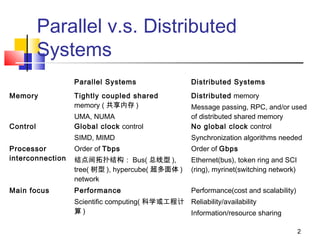
Parallel Systems Distributed Systems
Memory Tightly coupled shared
memory ( 共享内存 )
UMA, NUMA
Distributed memory
Message passing, RPC, and/or used
of distributed shared memory
Control Global clock control
SIMD, MIMD
No global clock control
Synchronization algorithms needed
Processor
interconnection
Order of Tbps
结点间拓扑结构: Bus( 总线型 ),
tree( 树型 ), hypercube( 超多面体 )
network
Order of Gbps
Ethernet(bus), token ring and SCI
(ring), myrinet(switching network)
Main focus Performance
Scientific computing( 科学或工程计
算 )
Performance(cost and scalability)
Reliability/availability
Information/resource sharing
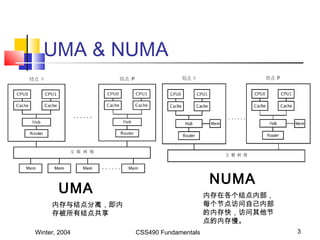
UMA & NUMA
Winter, 2004 CSS490 Fundamentals 3
UMA
内存与结点分离,即内
存被所有结点共享
NUMA
内存在各个结点内部,
每个节点访问自己内部
的内存快,访问其他节
点的内存慢。
Winter, 2004 CSS490 Fundamentals 4
Milestones in Distributed
Computing Systems
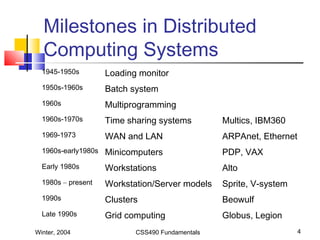
1945-1950s Loading monitor
1950s-1960s Batch system
1960s Multiprogramming
1960s-1970s Time sharing systems Multics, IBM360
1969-1973 WAN and LAN ARPAnet, Ethernet
1960s-early1980s Minicomputers PDP, VAX
Early 1980s Workstations Alto
1980s – present Workstation/Server models Sprite, V-system
1990s Clusters Beowulf
Late 1990s Grid computing Globus, Legion
Winter, 2004 CSS490 Fundamentals 5
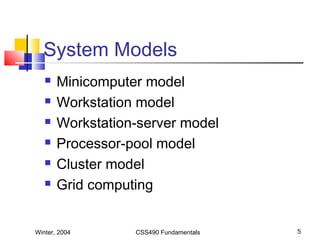
System Models
 Minicomputer model
 Workstation model
 Workstation-server model
 Processor-pool model
 Cluster model
 Grid computing
Winter, 2004 CSS490 Fundamentals 6
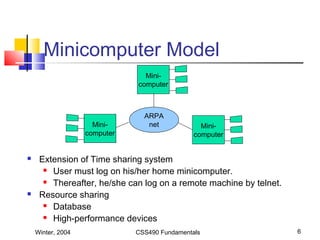
Minicomputer Model
 Extension of Time sharing system
 User must log on his/her home minicomputer.
 Thereafter, he/she can log on a remote machine by telnet.
 Resource sharing
 Database
 High-performance devices
Mini-
computer
Mini-
computer
Mini-
computer
ARPA
net
Winter, 2004 CSS490 Fundamentals 7
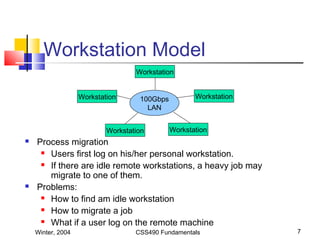
Workstation Model
 Process migration
 Users first log on his/her personal workstation.
 If there are idle remote workstations, a heavy job may
migrate to one of them.
 Problems:
 How to find am idle workstation
 How to migrate a job
 What if a user log on the remote machine
100Gbps
LAN
Workstation
Workstation Workstation
WorkstationWorkstation
Winter, 2004 CSS490 Fundamentals 8
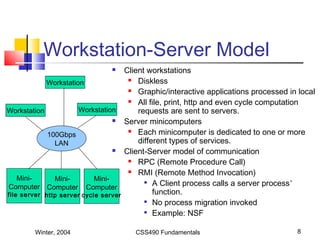
Workstation-Server Model
 Client workstations
 Diskless
 Graphic/interactive applications processed in local
 All file, print, http and even cycle computation
requests are sent to servers.
 Server minicomputers
 Each minicomputer is dedicated to one or more
different types of services.
 Client-Server model of communication
 RPC (Remote Procedure Call)
 RMI (Remote Method Invocation)

A Client process calls a server process’
function.

No process migration invoked

Example: NSF
100Gbps
LAN
Workstation
Workstation Workstation
Mini-
Computer
file server
Mini-
Computer
http server
Mini-
Computer
cycle server
Winter, 2004 CSS490 Fundamentals 9
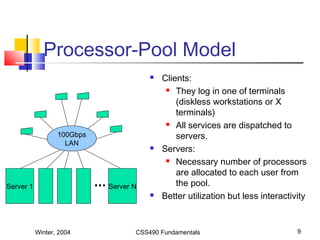
Processor-Pool Model
 Clients:
 They log in one of terminals
(diskless workstations or X
terminals)
 All services are dispatched to
servers.
 Servers:
 Necessary number of processors
are allocated to each user from
the pool.
 Better utilization but less interactivity
Server 1
100Gbps
LAN
Server N
Winter, 2004 CSS490 Fundamentals 10
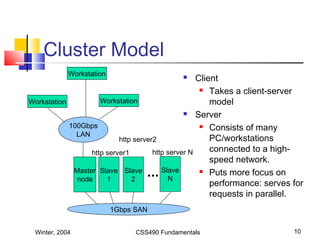
Cluster Model
 Client
 Takes a client-server
model
 Server
 Consists of many
PC/workstations
connected to a high-
speed network.
 Puts more focus on
performance: serves for
requests in parallel.
100Gbps
LAN
Workstation
Workstation Workstation
Master
node
Slave
1
Slave
N
Slave
2
1Gbps SAN
http server1
http server2
http server N
Winter, 2004 CSS490 Fundamentals 11
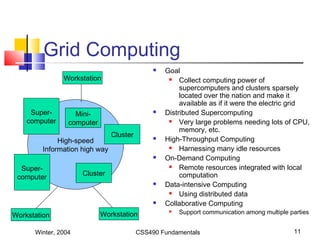
High-speed
Information high way
Grid Computing
 Goal
 Collect computing power of
supercomputers and clusters sparsely
located over the nation and make it
available as if it were the electric grid
 Distributed Supercomputing
 Very large problems needing lots of CPU,
memory, etc.
 High-Throughput Computing
 Harnessing many idle resources
 On-Demand Computing
 Remote resources integrated with local
computation
 Data-intensive Computing
 Using distributed data
 Collaborative Computing
 Support communication among multiple parties
Super-
computer
Cluster
Super-
computer
Cluster
Mini-
computer
Workstation
Workstation Workstation

并行计算与分布式计算的区别

  • 1.
  • 2.
    2 Parallel v.s. Distributed Systems ParallelSystems Distributed Systems Memory Tightly coupled shared memory ( 共享内存 ) UMA, NUMA Distributed memory Message passing, RPC, and/or used of distributed shared memory Control Global clock control SIMD, MIMD No global clock control Synchronization algorithms needed Processor interconnection Order of Tbps 结点间拓扑结构: Bus( 总线型 ), tree( 树型 ), hypercube( 超多面体 ) network Order of Gbps Ethernet(bus), token ring and SCI (ring), myrinet(switching network) Main focus Performance Scientific computing( 科学或工程计 算 ) Performance(cost and scalability) Reliability/availability Information/resource sharing
  • 3.
    UMA & NUMA Winter,2004 CSS490 Fundamentals 3 UMA 内存与结点分离,即内 存被所有结点共享 NUMA 内存在各个结点内部, 每个节点访问自己内部 的内存快,访问其他节 点的内存慢。
  • 4.
    Winter, 2004 CSS490Fundamentals 4 Milestones in Distributed Computing Systems 1945-1950s Loading monitor 1950s-1960s Batch system 1960s Multiprogramming 1960s-1970s Time sharing systems Multics, IBM360 1969-1973 WAN and LAN ARPAnet, Ethernet 1960s-early1980s Minicomputers PDP, VAX Early 1980s Workstations Alto 1980s – present Workstation/Server models Sprite, V-system 1990s Clusters Beowulf Late 1990s Grid computing Globus, Legion
  • 5.
    Winter, 2004 CSS490Fundamentals 5 System Models  Minicomputer model  Workstation model  Workstation-server model  Processor-pool model  Cluster model  Grid computing
  • 6.
    Winter, 2004 CSS490Fundamentals 6 Minicomputer Model  Extension of Time sharing system  User must log on his/her home minicomputer.  Thereafter, he/she can log on a remote machine by telnet.  Resource sharing  Database  High-performance devices Mini- computer Mini- computer Mini- computer ARPA net
  • 7.
    Winter, 2004 CSS490Fundamentals 7 Workstation Model  Process migration  Users first log on his/her personal workstation.  If there are idle remote workstations, a heavy job may migrate to one of them.  Problems:  How to find am idle workstation  How to migrate a job  What if a user log on the remote machine 100Gbps LAN Workstation Workstation Workstation WorkstationWorkstation
  • 8.
    Winter, 2004 CSS490Fundamentals 8 Workstation-Server Model  Client workstations  Diskless  Graphic/interactive applications processed in local  All file, print, http and even cycle computation requests are sent to servers.  Server minicomputers  Each minicomputer is dedicated to one or more different types of services.  Client-Server model of communication  RPC (Remote Procedure Call)  RMI (Remote Method Invocation)  A Client process calls a server process’ function.  No process migration invoked  Example: NSF 100Gbps LAN Workstation Workstation Workstation Mini- Computer file server Mini- Computer http server Mini- Computer cycle server
  • 9.
    Winter, 2004 CSS490Fundamentals 9 Processor-Pool Model  Clients:  They log in one of terminals (diskless workstations or X terminals)  All services are dispatched to servers.  Servers:  Necessary number of processors are allocated to each user from the pool.  Better utilization but less interactivity Server 1 100Gbps LAN Server N
  • 10.
    Winter, 2004 CSS490Fundamentals 10 Cluster Model  Client  Takes a client-server model  Server  Consists of many PC/workstations connected to a high- speed network.  Puts more focus on performance: serves for requests in parallel. 100Gbps LAN Workstation Workstation Workstation Master node Slave 1 Slave N Slave 2 1Gbps SAN http server1 http server2 http server N
  • 11.
    Winter, 2004 CSS490Fundamentals 11 High-speed Information high way Grid Computing  Goal  Collect computing power of supercomputers and clusters sparsely located over the nation and make it available as if it were the electric grid  Distributed Supercomputing  Very large problems needing lots of CPU, memory, etc.  High-Throughput Computing  Harnessing many idle resources  On-Demand Computing  Remote resources integrated with local computation  Data-intensive Computing  Using distributed data  Collaborative Computing  Support communication among multiple parties Super- computer Cluster Super- computer Cluster Mini- computer Workstation Workstation Workstation

Editor's Notes

  • #3 并行机:并行计算需要在并行机上进行,而并行机并不是传统的机器,而是由一个或多个结点 ( 结点是并行机的最小单位,每个节点可以有多个核 ) 组成,且结点之间通过互联网络(并不是互联网)相互连通。 并行计算和分布式计算的区别是: (1) 并行计算需要在一个并行机上运行且并行机只能处于一个位置,而分布式计算可以使用全世界的电脑(一个在上海,一个在美国)。 (2) 并行计算是 共享内存 的( 统一地址编码 ),而分布式计算的内存是私有的,是通过 消息传递 进行通信,某个电脑不能访问另一个电脑的内存。 (3) 并行计算有 global clock ,而分布式计算只有 local clock 。 并行计算的目的:为了更快地进行大规模科学或工程计算。
  • #4 UMA(Unified Memory Access model) :均匀内存访问模型。 NUMA ( Non Unified Memory Access model): 非均匀内存访问模型。