Parallel and Distributed Computing
Chapter 1: Introduction to Parallel Computing
Muhammad Haroon
mr.harunahmad2014@gmail.com
Cell# +92300-7327761
Department of Computer Science
Hitec University Taxila
Cantt
Pakistan 1
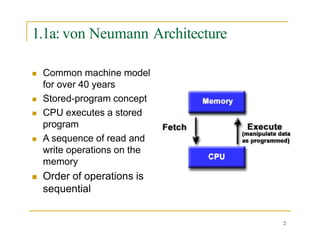
1.1a: von Neumann Architecture
 Common machine model
for over 40 years
 Stored-program concept
 CPU executes a stored
program
 A sequence of read and
write operations on the
memory
 Order of operations is
sequential
2
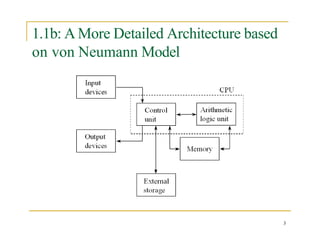
1.1b: A More Detailed Architecture based
on von Neumann Model
3
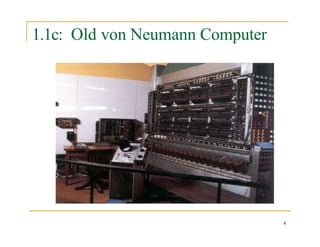
1.1c: Old von Neumann Computer
4
1.1d: CISC von Neumann Computer

 CISC stands for Complex Instruction Set
Computer with a single bus system
Harvard (RISC) architecture utilizes two
buses, a separate data bus and an address
bus
 RISC stands for Reduced Instruction Set
Computer
 They are SISD machines – Single Instruction
Stream on Single Data Stream
5
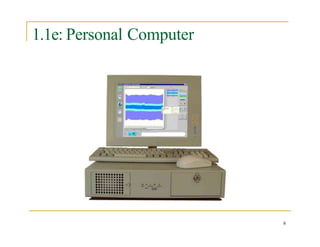
1.1e: Personal Computer
6
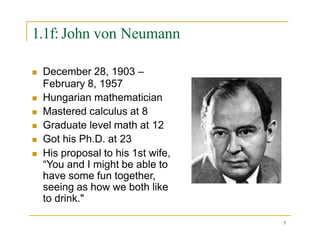
1.1f: John von Neumann
 December 28, 1903 –
February 8, 1957
 Hungarian mathematician
 Mastered calculus at 8
 Graduate level math at 12
 Got his Ph.D. at 23
 His proposal to his 1st wife,
“You and I might be able to
have some fun together,
seeing as how we both like
to drink."
7
1.2a: Motivations for Parallel Computing

 Fundamental limits on single processor
speed
 Disparity between CPU & memory
speeds
 Distributed data communications
 Need for very large scale computing
platforms
8
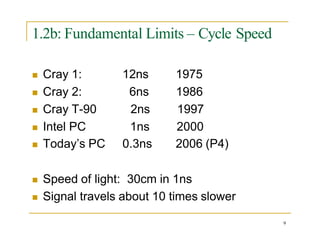
1.2b: Fundamental Limits – Cycle Speed
 Cray 1: 12ns 1975
 Cray 2: 6ns 1986
 Cray T-90 2ns 1997
 Intel PC 1ns 2000
 Today’s PC 0.3ns 2006 (P4)
 Speed of light: 30cm in 1ns
 Signal travels about 10 times slower
9
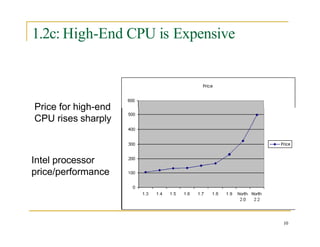
1.2c: High-End CPU is Expensive
Price for high-end
CPU rises sharply
Intel processor
price/performance
10
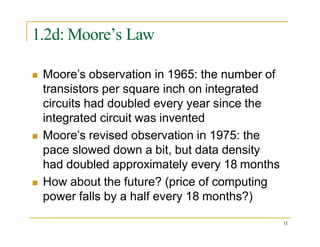
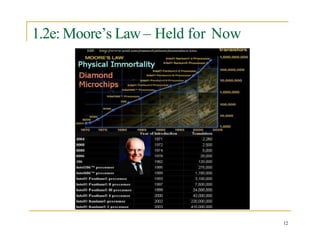
1.2d: Moore’s Law
 Moore’s observation in 1965: the number of
transistors per square inch on integrated
circuits had doubled every year since the
integrated circuit was invented
 Moore’s revised observation in 1975: the
pace slowed down a bit, but data density
had doubled approximately every 18 months
 How about the future? (price of computing
power falls by a half every 18 months?)
11
1.2e: Moore’s Law – Held for Now
12
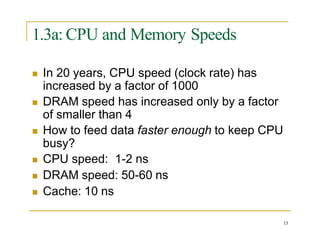
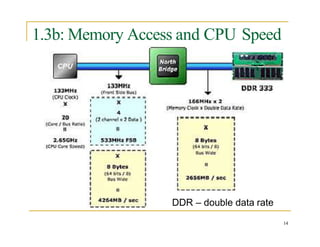
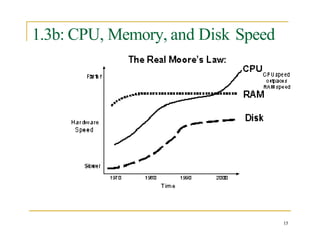
1.3a: CPU and Memory Speeds
 In 20 years, CPU speed (clock rate) has
increased by a factor of 1000
 DRAM speed has increased only by a factor
of smaller than 4
 How to feed data faster enough to keep CPU
busy?
 CPU speed: 1-2 ns
 DRAM speed: 50-60 ns
 Cache: 10 ns
13
1.3b: Memory Access and CPU Speed
DDR – double data rate
14
1.3b: CPU, Memory, and Disk Speed
15
1.3c: Possible Solutions

 A hierarchy of successively fast memory
devices (multilevel caches)
 Location of data reference
 Efficient programming can be an issue
 Parallel systems may provide
1.) larger aggregate cache
2.) higher aggregate bandwidth to the
memory system
16
1.4a: Distributed Data Communications

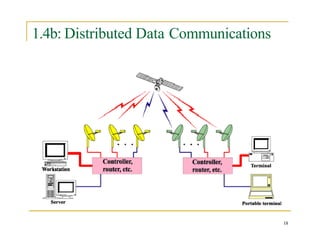
 Data may be collected and stored at different
locations
 It is expensive to bring them to a central
location for processing
 Many computing assignments many be
inherently parallel
 Privacy issues in data mining and other large
scale commercial database manipulations
17
1.4b: Distributed Data Communications
18
1.5a: Why Use Parallel Computing

 Save time – wall clock time – many
processors work together
Solve larger problems – larger than one
processor’s CPU and memory can handle
 Provide concurrency – do multiple things at
the same time: online access to databases,
search engine
Google’s 4,000 PC servers are one of the
largest clusters in the world
19
1.5b: Other Reasons for Parallel
Computing
 Taking advantages of non-local resources –
using computing resources on a wide area
network, or even internet (grid computing)
 Cost savings – using multiple “cheap”
computing resources instead of a high-end
CPU
 Overcoming memory constraints – for large
problems, using memories of multiple
computers may overcome the memory
constraint obstacle
20
1.6a: Need for Large Scale Modeling
 Weather forecasting
 Ocean modeling
 Oil reservoir simulations
 Car and airplane manufacture
 Semiconductor simulation
 Pollution tracking
 Large commercial databases
 Aerospace (NASA microgravity modeling)
21
1.6b: Semiconductor Simulation
 Before 1975, an engineer had to make several runs
through the fabrication line until a successful
device was fabricated
 Device dimensions shrink below 0.1 micro-meter
 A fabrication line costs 1.0 billion dollars to build
 A design must be thoroughly verified before it is
committed to silicon
 A realistic simulation for one diffusion process may
take days or months to run on a workstation
 Chip price drops quickly after entering the market
22
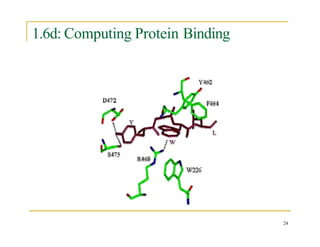
1.6c: Drug Design
 Most drugs work by binding to a specific site,
called a receptor, on a protein
 A central problem is to find molecules
(ligands) with high binding affinity
 Need to accurately and efficiently estimate
electrostatic forces in molecular and atomic
interactions
 Calculate drug-protein binding energies from
quantum mechanics, statistical mechanics
and simulation techniques
23
1.6d: Computing Protein Binding
24
1.7: Issues in Parallel Computing
 Design of parallel computers
 Design of efficient parallel algorithms
 Methods for evaluating parallel algorithms
 Parallel computer languages
 Parallel programming tools
 Portable parallel programs
 Automatic programming of parallel computers
 Education of parallel computing philosophy
25
1.8 Eclipse Parallel Tools Platform
 A standard, portable parallel integrated
development environment that supports a
wide range of parallel architectures and run
time systems (IBM)
 A scalable parallel debugger
 Support for the integration of a wide range of
parallel tools
 An environment that simplifies the end-user
interaction with parallel systems
26
1.9 Message Passing Interface (MPI)
 We will use MPI on UK supercomputers
 Message Passing Interface can also be
downloaded from an online website
 Parallel computing can be simulated on your
own computers
 UK can provide distributed computing
services for research purposes, for free
27
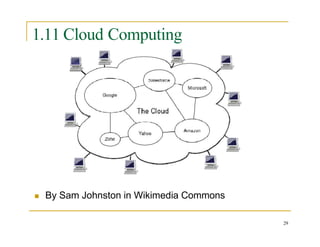
1.10 Cloud Computing
 Cloud Computing is a style of computing in which
dynamically scalable and often virtualized resources are
provided over the Internet
 Users need not have knowledge of, expertise in, or
control over the technology infrastructure in the “cloud”
that support them
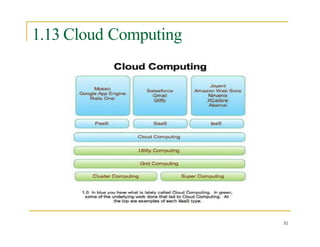
 Compared to: Grid Computing (cluster of networked,
loosely coupled computers)
 Utility Computing (packaging of computing resources as
a metered service)
 and Autonomic Computing (computer systems capable
of self-management)
28
1.11 Cloud Computing
 By Sam Johnston in Wikimedia Commons
29
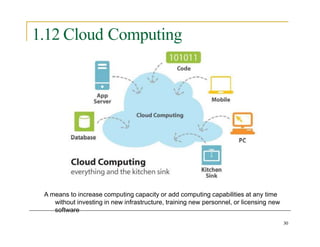
1.12 Cloud Computing
A means to increase computing capacity or add computing capabilities at any time
without investing in new infrastructure, training new personnel, or licensing new
software
30
1.13 Cloud Computing
31

Lecture 04 Chapter 1 - Introduction to Parallel Computing

  • 1.
    Parallel and DistributedComputing Chapter 1: Introduction to Parallel Computing Muhammad Haroon mr.harunahmad2014@gmail.com Cell# +92300-7327761 Department of Computer Science Hitec University Taxila Cantt Pakistan 1
  • 2.
    1.1a: von NeumannArchitecture  Common machine model for over 40 years  Stored-program concept  CPU executes a stored program  A sequence of read and write operations on the memory  Order of operations is sequential 2
  • 3.
    1.1b: A MoreDetailed Architecture based on von Neumann Model 3
  • 4.
    1.1c: Old vonNeumann Computer 4
  • 5.
    1.1d: CISC vonNeumann Computer   CISC stands for Complex Instruction Set Computer with a single bus system Harvard (RISC) architecture utilizes two buses, a separate data bus and an address bus  RISC stands for Reduced Instruction Set Computer  They are SISD machines – Single Instruction Stream on Single Data Stream 5
  • 6.
  • 7.
    1.1f: John vonNeumann  December 28, 1903 – February 8, 1957  Hungarian mathematician  Mastered calculus at 8  Graduate level math at 12  Got his Ph.D. at 23  His proposal to his 1st wife, “You and I might be able to have some fun together, seeing as how we both like to drink." 7
  • 8.
    1.2a: Motivations forParallel Computing   Fundamental limits on single processor speed  Disparity between CPU & memory speeds  Distributed data communications  Need for very large scale computing platforms 8
  • 9.
    1.2b: Fundamental Limits– Cycle Speed  Cray 1: 12ns 1975  Cray 2: 6ns 1986  Cray T-90 2ns 1997  Intel PC 1ns 2000  Today’s PC 0.3ns 2006 (P4)  Speed of light: 30cm in 1ns  Signal travels about 10 times slower 9
  • 10.
    1.2c: High-End CPUis Expensive Price for high-end CPU rises sharply Intel processor price/performance 10
  • 11.
    1.2d: Moore’s Law Moore’s observation in 1965: the number of transistors per square inch on integrated circuits had doubled every year since the integrated circuit was invented  Moore’s revised observation in 1975: the pace slowed down a bit, but data density had doubled approximately every 18 months  How about the future? (price of computing power falls by a half every 18 months?) 11
  • 12.
    1.2e: Moore’s Law– Held for Now 12
  • 13.
    1.3a: CPU andMemory Speeds  In 20 years, CPU speed (clock rate) has increased by a factor of 1000  DRAM speed has increased only by a factor of smaller than 4  How to feed data faster enough to keep CPU busy?  CPU speed: 1-2 ns  DRAM speed: 50-60 ns  Cache: 10 ns 13
  • 14.
    1.3b: Memory Accessand CPU Speed DDR – double data rate 14
  • 15.
    1.3b: CPU, Memory,and Disk Speed 15
  • 16.
    1.3c: Possible Solutions  A hierarchy of successively fast memory devices (multilevel caches)  Location of data reference  Efficient programming can be an issue  Parallel systems may provide 1.) larger aggregate cache 2.) higher aggregate bandwidth to the memory system 16
  • 17.
    1.4a: Distributed DataCommunications   Data may be collected and stored at different locations  It is expensive to bring them to a central location for processing  Many computing assignments many be inherently parallel  Privacy issues in data mining and other large scale commercial database manipulations 17
  • 18.
    1.4b: Distributed DataCommunications 18
  • 19.
    1.5a: Why UseParallel Computing   Save time – wall clock time – many processors work together Solve larger problems – larger than one processor’s CPU and memory can handle  Provide concurrency – do multiple things at the same time: online access to databases, search engine Google’s 4,000 PC servers are one of the largest clusters in the world 19
  • 20.
    1.5b: Other Reasonsfor Parallel Computing  Taking advantages of non-local resources – using computing resources on a wide area network, or even internet (grid computing)  Cost savings – using multiple “cheap” computing resources instead of a high-end CPU  Overcoming memory constraints – for large problems, using memories of multiple computers may overcome the memory constraint obstacle 20
  • 21.
    1.6a: Need forLarge Scale Modeling  Weather forecasting  Ocean modeling  Oil reservoir simulations  Car and airplane manufacture  Semiconductor simulation  Pollution tracking  Large commercial databases  Aerospace (NASA microgravity modeling) 21
  • 22.
    1.6b: Semiconductor Simulation Before 1975, an engineer had to make several runs through the fabrication line until a successful device was fabricated  Device dimensions shrink below 0.1 micro-meter  A fabrication line costs 1.0 billion dollars to build  A design must be thoroughly verified before it is committed to silicon  A realistic simulation for one diffusion process may take days or months to run on a workstation  Chip price drops quickly after entering the market 22
  • 23.
    1.6c: Drug Design Most drugs work by binding to a specific site, called a receptor, on a protein  A central problem is to find molecules (ligands) with high binding affinity  Need to accurately and efficiently estimate electrostatic forces in molecular and atomic interactions  Calculate drug-protein binding energies from quantum mechanics, statistical mechanics and simulation techniques 23
  • 24.
  • 25.
    1.7: Issues inParallel Computing  Design of parallel computers  Design of efficient parallel algorithms  Methods for evaluating parallel algorithms  Parallel computer languages  Parallel programming tools  Portable parallel programs  Automatic programming of parallel computers  Education of parallel computing philosophy 25
  • 26.
    1.8 Eclipse ParallelTools Platform  A standard, portable parallel integrated development environment that supports a wide range of parallel architectures and run time systems (IBM)  A scalable parallel debugger  Support for the integration of a wide range of parallel tools  An environment that simplifies the end-user interaction with parallel systems 26
  • 27.
    1.9 Message PassingInterface (MPI)  We will use MPI on UK supercomputers  Message Passing Interface can also be downloaded from an online website  Parallel computing can be simulated on your own computers  UK can provide distributed computing services for research purposes, for free 27
  • 28.
    1.10 Cloud Computing Cloud Computing is a style of computing in which dynamically scalable and often virtualized resources are provided over the Internet  Users need not have knowledge of, expertise in, or control over the technology infrastructure in the “cloud” that support them  Compared to: Grid Computing (cluster of networked, loosely coupled computers)  Utility Computing (packaging of computing resources as a metered service)  and Autonomic Computing (computer systems capable of self-management) 28
  • 29.
    1.11 Cloud Computing By Sam Johnston in Wikimedia Commons 29
  • 30.
    1.12 Cloud Computing Ameans to increase computing capacity or add computing capabilities at any time without investing in new infrastructure, training new personnel, or licensing new software 30
  • 31.