COMPUTING
PARADIGMS
Different Computing Paradigms:
 High Performance Computing
 Parallel Computing
 Distributed Computing
 Cluster Computing
 Grid Computing
 Cloud Computing
 Bio Computing
 Mobile Computing
 Quantum Computing
 Optical Computing
 Nano Computing
High Performance Computing:
 It is the use of parallel processing for running advanced
application programs efficiently, relatives, and quickly. The
term applies especially is a system that function above a
teraflop (1012
) (floating opm per second).
 The term High-performance computing is occasionally used as
a synonym for supercomputing. Although technically a
supercomputer is a system that performs at or near currently
highest operational rate for computers. Some supercomputers
work at more than a petaflop (1012
) floating points opm per
second. The most common HPC system all scientific engineers
& academic institutions. Some Government agencies
particularly military are also relying on HPC for complex
applications.
High Performance Computers:
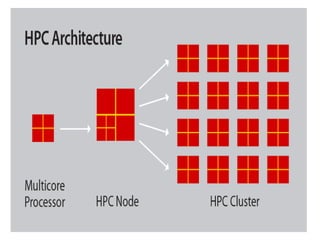
 Processors, memory, disks, and OS are elements of high-performance
computers of interest to small & medium size businesses today are really
clusters of computers. Each individual computer in a commonly
configured small cluster has between one and four processors and today
‘s processors typically are from 2 to 4 crores, HPC people often referred
to individual computers in a cluster as nodes. A cluster of interest to a
small business could have as few as 4 nodes on 16 crores. Common
cluster size in many businesses is between 16 & 64 crores or from 64 to
256 crores. The main reason to use this is that in its individual node can
work together to solve a problem larger than any one computer can
easily solve. These nodes are so connected that they can communicate
with each other in order to produce some meaningful work.
 There are two popular HPC’s software i. e, Linux, and windows. Most of
installations are in Linux because of its supercomputer but one can use it
with his / her requirements.
Importance of High performance Computing
 It is used for scientific discoveries, game-changing innovations,
and to improve quality of life.
 It is a foundation for scientific & industrial advancements.
 It is used in technologies like IoT, AI, 3D imaging evolves &
amount of data that is used by organization is increasing
exponentially to increase ability of a computer, we use High-
performance computer.
 HPC is used to solve complex modeling problems in a spectrum
of disciplines. It includes AI, Nuclear Physics, Climate Modelling,
etc.
 HPC is applied to business uses as well as data warehouses &
transaction processing.
Need of High performance Computing:
 It will complete a time-consuming operation in less time.
 It will complete an operation under a light deadline and perform a high
numbers of operations per second.
 It is fast computing, we can compute in parallel over lot of computation
elements CPU, GPU, etc. It set up very fast network to connect between
elements.
Need of ever increasing Performance :
 Climate modeling
 Drug discovery
 Data Analysis
 Protein folding
 Energy research
Main Components:
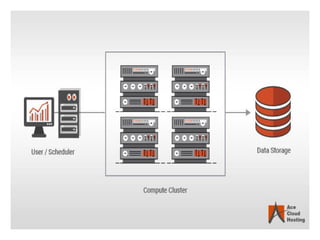
 User Computers cluster Data storage
→ →
 In HPC architecture computer servers must be
Connected together in a cluster.
Programs & algorithms are run simultaneously on
server in cluster.
Cluster is networked to data storage to capture
output. Together this achieve a complete set of
meaningful work.
Parallel Computing:
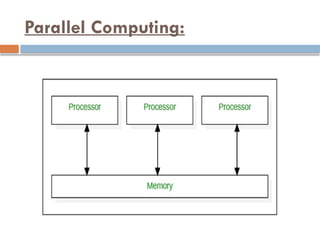
 Parallel computing is also one of the facets of HPC. Here, a set of
processors work cooperatively to solve a computational problem.
These processor machines or CPUs are mostly of homogeneous
type. Therefore, this definition is the same as that of HPC and is
broad enough to include supercomputers that have hundreds or
thousands of processors interconnected with other resources. One
can distinguish between conventional (also known as serial or
sequential or Von Neumann) computers and parallel computers in
the way the applications are executed.
In serial or sequential computers, the following apply:
 It runs on a single computer/processor machine having a single
CPU.
 A problem is broken down into a discrete series of instructions.
 Instructions are executed one after another.
Parallel Computing:
In parallel computing, since there is simultaneous use
of multiple processor machines, the following apply:
 It is run using multiple processors (multiple CPUs).
 A problem is broken down into discrete parts that can
be solved concurrently.
 Each part is further broken down into a series of
instructions.
 Instructions from each part are executed simultaneously
on different processors.
 An overall control/coordination mechanism is employed.
Parallel Computing:
Distributed Computing:
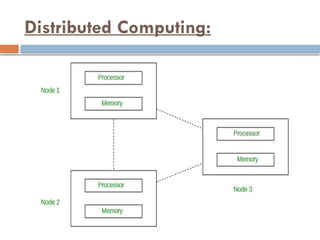
 Distributed computing is also a computing system that consists
of multiple computers or processor machines connected
through a network, which can be homogeneous or
heterogeneous, but run as a single system. The connectivity
can be such that the CPUs in a distributed system can be
physically close together and connected by a local network,
or they can be geographically distant and connected by a
wide area network. The heterogeneity in a distributed system
supports any number of possible configurations in the
processor machines, such as mainframes, PCs, workstations,
and minicomputers. The goal of distributed computing is to
make such a network work as a single computer.
Distributed Computing:
 Distributed computing systems are advantageous
over centralized systems, because there is a support
for the following characteristic features:
1. Scalability: It is the ability of the system to be easily
expanded by adding more machines as needed, and
vice versa, without affecting the existing setup.
2. Redundancy or replication: Here, several machines can
provide the same services, so that even if one is
unavailable (or failed), work does not stop because
other similar computing supports will be available.
Distributed Computing:
Cluster Computing:
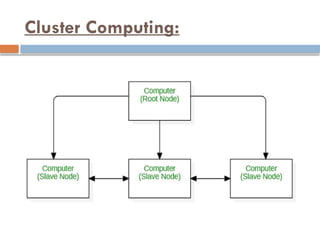
 A cluster computing system consists of a set of the same or
similar type of processor machines connected using a
dedicated network infrastructure. All processor machines
share resources such as a common home directory and have a
software such as a message passing interface (MPI)
implementation installed to allow programs to be run across
all nodes simultaneously. This is also a kind of HPC category.
The individual computers in a cluster can be referred to as
nodes. The reason to realize a cluster as HPC is due to the fact
that the individual nodes can work together to solve a problem
larger than any computer can easily solve. And, the nodes need
to communicate with one another in order to work cooperatively
and meaningfully together to solve the problem in hand.
Cluster Computing:
 If we have processor machines of heterogeneous
types in a cluster, heterogeneous kind of clusters
become a subtype and still mostly are in the
experimental or research stage.
Cluster Computing:
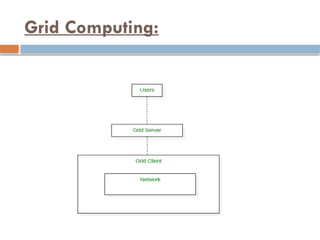
Grid Computing:
 The computing resources in most of the organizations are
underutilized but are necessary for certain operations. The idea
of grid computing is to make use of such non-utilized computing
power by the needy organizations, and thereby the return on
investment (ROI) on computing investments can be increased
 Thus, grid computing is a network of computing or processor
machines managed with a kind of software such as middleware,
in order to access and use the resources remotely. The managing
activity of grid resources through the middleware is called grid
services. Grid services provide access control, security, access to
data including digital libraries and databases, and access to large-
scale interactive and long-term storage facilities.
Grid Computing:
E
le
ctrica l Pow
e
r Gri d a nd Grid Co m
pu tin g
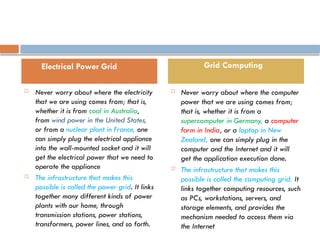
 Never worry about where the electricity
that we are using comes from; that is,
whether it is from coal in Australia,
from wind power in the United States,
or from a nuclear plant in France, one
can simply plug the electrical appliance
into the wall-mounted socket and it will
get the electrical power that we need to
operate the appliance
 The infrastructure that makes this
possible is called the power grid. It links
together many different kinds of power
plants with our home, through
transmission stations, power stations,
transformers, power lines, and so forth.
 Never worry about where the computer
power that we are using comes from;
that is, whether it is from a
supercomputer in Germany, a computer
farm in India, or a laptop in New
Zealand, one can simply plug in the
computer and the Internet and it will
get the application execution done.
 The infrastructure that makes this
possible is called the computing grid. It
links together computing resources, such
as PCs, workstations, servers, and
storage elements, and provides the
mechanism needed to access them via
the Internet
Electrical Power Grid Grid Computing
Electrical Power Grid and Grid Computing
 The power grid is pervasive:
electricity is available essentially
everywhere, and one can simply
access it through a standard wall-
mounted socket.
 The power grid is a utility: we ask for
electricity and we get it. We also pay
for what we get
 The grid is also pervasive in the sense that
the remote computing resources would be
accessible from different platforms,
including laptops and mobile phones, and
one can simply access the grid computing
power through the web browser
 The grid is also pervasive in the sense that
the remote computing resources would be
accessible from different platforms,
including laptops and mobile phones, and
one can simply access the grid computing
power through the web browser
Electrical Power Grid Grid Computing
Grid Computing:
Grid computing is more popular due to the following reasons:
 Its ability to make use of unused computing power, and thus, it is
a cost-effective solution (reducing investments, only recurring
costs)
 As a way to solve problems in line with any HPC-based
application
 Enables heterogeneous resources of computers to work
cooperatively and collaboratively to solve a scientific problem
Researchers associate the term grid to the way electricity is
distributed in municipal areas for the common man. In this
context, the difference between electrical power grid and grid
computing is worth noting.
Cloud Computing:
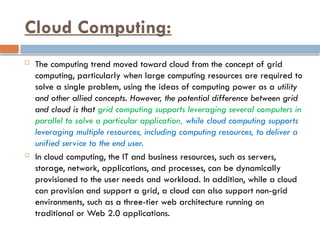
 The computing trend moved toward cloud from the concept of grid
computing, particularly when large computing resources are required to
solve a single problem, using the ideas of computing power as a utility
and other allied concepts. However, the potential difference between grid
and cloud is that grid computing supports leveraging several computers in
parallel to solve a particular application, while cloud computing supports
leveraging multiple resources, including computing resources, to deliver a
unified service to the end user.
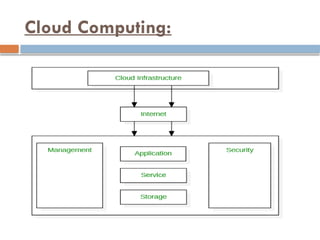
 In cloud computing, the IT and business resources, such as servers,
storage, network, applications, and processes, can be dynamically
provisioned to the user needs and workload. In addition, while a cloud
can provision and support a grid, a cloud can also support non-grid
environments, such as a three-tier web architecture running on
traditional or Web 2.0 applications.
Cloud Computing:
Bio computing:
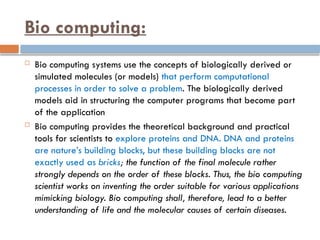
 Bio computing systems use the concepts of biologically derived or
simulated molecules (or models) that perform computational
processes in order to solve a problem. The biologically derived
models aid in structuring the computer programs that become part
of the application
 Bio computing provides the theoretical background and practical
tools for scientists to explore proteins and DNA. DNA and proteins
are nature’s building blocks, but these building blocks are not
exactly used as bricks; the function of the final molecule rather
strongly depends on the order of these blocks. Thus, the bio computing
scientist works on inventing the order suitable for various applications
mimicking biology. Bio computing shall, therefore, lead to a better
understanding of life and the molecular causes of certain diseases.
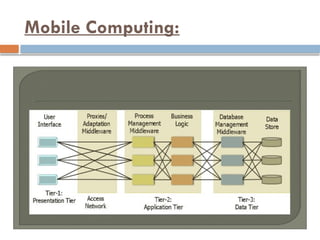
Mobile Computing:
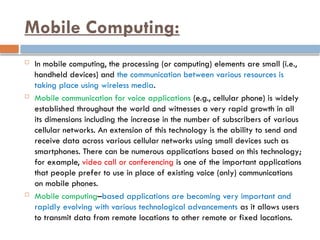
 In mobile computing, the processing (or computing) elements are small (i.e.,
handheld devices) and the communication between various resources is
taking place using wireless media.
 Mobile communication for voice applications (e.g., cellular phone) is widely
established throughout the world and witnesses a very rapid growth in all
its dimensions including the increase in the number of subscribers of various
cellular networks. An extension of this technology is the ability to send and
receive data across various cellular networks using small devices such as
smartphones. There can be numerous applications based on this technology;
for example, video call or conferencing is one of the important applications
that people prefer to use in place of existing voice (only) communications
on mobile phones.
 Mobile computing–based applications are becoming very important and
rapidly evolving with various technological advancements as it allows users
to transmit data from remote locations to other remote or fixed locations.
Mobile Computing:
Quantum Computing:
 Manufacturers of computing systems say that there is a limit for
cramming more and more transistors into smaller and smaller
spaces of integrated circuits (ICs) and thereby doubling the
processing power about every 18 months. This problem will
have to be overcome by a new quantum computing–based
solution, wherein the dependence is on quantum information, the
rules that govern the subatomic world. Quantum computers are
millions of times faster than even our most powerful
supercomputers today. Since quantum computing works differently
on the most fundamental level than the current technology, and
although there are working prototypes, these systems have not so
far proved to be alternatives to today’s silicon-based machines.
Optical Computing:
 Optical computing system uses the photons in visible light
or infrared beams, rather than electric current, to perform
digital computations. An electric current flows at only
about 10% of the speed of light. This limits the rate at
which data can be exchanged over long distances and is
one of the factors that led to the evolution of optical
fiber. By applying some of the advantages of visible
and/or IR networks at the device and component scale, a
computer can be developed that can perform operations
10 or more times faster than a conventional electronic
computer.
Nano computing:
 Nanocomputing refers to computing systems that are constructed
from nanoscale components. The silicon transistors in traditional
computers may be replaced by transistors based on carbon
nanotubes.
 The successful realization of nanocomputers relates to the scale
and integration of these nanotubes or components. The issues of
scale relate to the dimensions of the components; they are, at
most, a few nanometers in at least two dimensions. The issues of
integration of the components are twofold: first, the manufacture
of complex arbitrary patterns may be economically infeasible,
and second, nanocomputers may include massive quantities of
devices. Researchers are working on all these issues to bring
nanocomputing a reality.

UNIT-1-PARADIGMS.pptx cloud computing cc

  • 1.
  • 2.
    Different Computing Paradigms: High Performance Computing  Parallel Computing  Distributed Computing  Cluster Computing  Grid Computing  Cloud Computing  Bio Computing  Mobile Computing  Quantum Computing  Optical Computing  Nano Computing
  • 3.
    High Performance Computing: It is the use of parallel processing for running advanced application programs efficiently, relatives, and quickly. The term applies especially is a system that function above a teraflop (1012 ) (floating opm per second).  The term High-performance computing is occasionally used as a synonym for supercomputing. Although technically a supercomputer is a system that performs at or near currently highest operational rate for computers. Some supercomputers work at more than a petaflop (1012 ) floating points opm per second. The most common HPC system all scientific engineers & academic institutions. Some Government agencies particularly military are also relying on HPC for complex applications.
  • 4.
    High Performance Computers: Processors, memory, disks, and OS are elements of high-performance computers of interest to small & medium size businesses today are really clusters of computers. Each individual computer in a commonly configured small cluster has between one and four processors and today ‘s processors typically are from 2 to 4 crores, HPC people often referred to individual computers in a cluster as nodes. A cluster of interest to a small business could have as few as 4 nodes on 16 crores. Common cluster size in many businesses is between 16 & 64 crores or from 64 to 256 crores. The main reason to use this is that in its individual node can work together to solve a problem larger than any one computer can easily solve. These nodes are so connected that they can communicate with each other in order to produce some meaningful work.  There are two popular HPC’s software i. e, Linux, and windows. Most of installations are in Linux because of its supercomputer but one can use it with his / her requirements.
  • 5.
    Importance of Highperformance Computing  It is used for scientific discoveries, game-changing innovations, and to improve quality of life.  It is a foundation for scientific & industrial advancements.  It is used in technologies like IoT, AI, 3D imaging evolves & amount of data that is used by organization is increasing exponentially to increase ability of a computer, we use High- performance computer.  HPC is used to solve complex modeling problems in a spectrum of disciplines. It includes AI, Nuclear Physics, Climate Modelling, etc.  HPC is applied to business uses as well as data warehouses & transaction processing.
  • 6.
    Need of Highperformance Computing:  It will complete a time-consuming operation in less time.  It will complete an operation under a light deadline and perform a high numbers of operations per second.  It is fast computing, we can compute in parallel over lot of computation elements CPU, GPU, etc. It set up very fast network to connect between elements. Need of ever increasing Performance :  Climate modeling  Drug discovery  Data Analysis  Protein folding  Energy research
  • 7.
    Main Components:  UserComputers cluster Data storage → →  In HPC architecture computer servers must be Connected together in a cluster. Programs & algorithms are run simultaneously on server in cluster. Cluster is networked to data storage to capture output. Together this achieve a complete set of meaningful work.
  • 10.
    Parallel Computing:  Parallelcomputing is also one of the facets of HPC. Here, a set of processors work cooperatively to solve a computational problem. These processor machines or CPUs are mostly of homogeneous type. Therefore, this definition is the same as that of HPC and is broad enough to include supercomputers that have hundreds or thousands of processors interconnected with other resources. One can distinguish between conventional (also known as serial or sequential or Von Neumann) computers and parallel computers in the way the applications are executed. In serial or sequential computers, the following apply:  It runs on a single computer/processor machine having a single CPU.  A problem is broken down into a discrete series of instructions.  Instructions are executed one after another.
  • 11.
    Parallel Computing: In parallelcomputing, since there is simultaneous use of multiple processor machines, the following apply:  It is run using multiple processors (multiple CPUs).  A problem is broken down into discrete parts that can be solved concurrently.  Each part is further broken down into a series of instructions.  Instructions from each part are executed simultaneously on different processors.  An overall control/coordination mechanism is employed.
  • 12.
  • 13.
    Distributed Computing:  Distributedcomputing is also a computing system that consists of multiple computers or processor machines connected through a network, which can be homogeneous or heterogeneous, but run as a single system. The connectivity can be such that the CPUs in a distributed system can be physically close together and connected by a local network, or they can be geographically distant and connected by a wide area network. The heterogeneity in a distributed system supports any number of possible configurations in the processor machines, such as mainframes, PCs, workstations, and minicomputers. The goal of distributed computing is to make such a network work as a single computer.
  • 14.
    Distributed Computing:  Distributedcomputing systems are advantageous over centralized systems, because there is a support for the following characteristic features: 1. Scalability: It is the ability of the system to be easily expanded by adding more machines as needed, and vice versa, without affecting the existing setup. 2. Redundancy or replication: Here, several machines can provide the same services, so that even if one is unavailable (or failed), work does not stop because other similar computing supports will be available.
  • 15.
  • 16.
    Cluster Computing:  Acluster computing system consists of a set of the same or similar type of processor machines connected using a dedicated network infrastructure. All processor machines share resources such as a common home directory and have a software such as a message passing interface (MPI) implementation installed to allow programs to be run across all nodes simultaneously. This is also a kind of HPC category. The individual computers in a cluster can be referred to as nodes. The reason to realize a cluster as HPC is due to the fact that the individual nodes can work together to solve a problem larger than any computer can easily solve. And, the nodes need to communicate with one another in order to work cooperatively and meaningfully together to solve the problem in hand.
  • 17.
    Cluster Computing:  Ifwe have processor machines of heterogeneous types in a cluster, heterogeneous kind of clusters become a subtype and still mostly are in the experimental or research stage.
  • 18.
  • 19.
    Grid Computing:  Thecomputing resources in most of the organizations are underutilized but are necessary for certain operations. The idea of grid computing is to make use of such non-utilized computing power by the needy organizations, and thereby the return on investment (ROI) on computing investments can be increased  Thus, grid computing is a network of computing or processor machines managed with a kind of software such as middleware, in order to access and use the resources remotely. The managing activity of grid resources through the middleware is called grid services. Grid services provide access control, security, access to data including digital libraries and databases, and access to large- scale interactive and long-term storage facilities.
  • 20.
  • 21.
    E le ctrica l Pow e rGri d a nd Grid Co m pu tin g  Never worry about where the electricity that we are using comes from; that is, whether it is from coal in Australia, from wind power in the United States, or from a nuclear plant in France, one can simply plug the electrical appliance into the wall-mounted socket and it will get the electrical power that we need to operate the appliance  The infrastructure that makes this possible is called the power grid. It links together many different kinds of power plants with our home, through transmission stations, power stations, transformers, power lines, and so forth.  Never worry about where the computer power that we are using comes from; that is, whether it is from a supercomputer in Germany, a computer farm in India, or a laptop in New Zealand, one can simply plug in the computer and the Internet and it will get the application execution done.  The infrastructure that makes this possible is called the computing grid. It links together computing resources, such as PCs, workstations, servers, and storage elements, and provides the mechanism needed to access them via the Internet Electrical Power Grid Grid Computing
  • 22.
    Electrical Power Gridand Grid Computing  The power grid is pervasive: electricity is available essentially everywhere, and one can simply access it through a standard wall- mounted socket.  The power grid is a utility: we ask for electricity and we get it. We also pay for what we get  The grid is also pervasive in the sense that the remote computing resources would be accessible from different platforms, including laptops and mobile phones, and one can simply access the grid computing power through the web browser  The grid is also pervasive in the sense that the remote computing resources would be accessible from different platforms, including laptops and mobile phones, and one can simply access the grid computing power through the web browser Electrical Power Grid Grid Computing
  • 23.
    Grid Computing: Grid computingis more popular due to the following reasons:  Its ability to make use of unused computing power, and thus, it is a cost-effective solution (reducing investments, only recurring costs)  As a way to solve problems in line with any HPC-based application  Enables heterogeneous resources of computers to work cooperatively and collaboratively to solve a scientific problem Researchers associate the term grid to the way electricity is distributed in municipal areas for the common man. In this context, the difference between electrical power grid and grid computing is worth noting.
  • 24.
    Cloud Computing:  Thecomputing trend moved toward cloud from the concept of grid computing, particularly when large computing resources are required to solve a single problem, using the ideas of computing power as a utility and other allied concepts. However, the potential difference between grid and cloud is that grid computing supports leveraging several computers in parallel to solve a particular application, while cloud computing supports leveraging multiple resources, including computing resources, to deliver a unified service to the end user.  In cloud computing, the IT and business resources, such as servers, storage, network, applications, and processes, can be dynamically provisioned to the user needs and workload. In addition, while a cloud can provision and support a grid, a cloud can also support non-grid environments, such as a three-tier web architecture running on traditional or Web 2.0 applications.
  • 25.
  • 26.
    Bio computing:  Biocomputing systems use the concepts of biologically derived or simulated molecules (or models) that perform computational processes in order to solve a problem. The biologically derived models aid in structuring the computer programs that become part of the application  Bio computing provides the theoretical background and practical tools for scientists to explore proteins and DNA. DNA and proteins are nature’s building blocks, but these building blocks are not exactly used as bricks; the function of the final molecule rather strongly depends on the order of these blocks. Thus, the bio computing scientist works on inventing the order suitable for various applications mimicking biology. Bio computing shall, therefore, lead to a better understanding of life and the molecular causes of certain diseases.
  • 27.
    Mobile Computing:  Inmobile computing, the processing (or computing) elements are small (i.e., handheld devices) and the communication between various resources is taking place using wireless media.  Mobile communication for voice applications (e.g., cellular phone) is widely established throughout the world and witnesses a very rapid growth in all its dimensions including the increase in the number of subscribers of various cellular networks. An extension of this technology is the ability to send and receive data across various cellular networks using small devices such as smartphones. There can be numerous applications based on this technology; for example, video call or conferencing is one of the important applications that people prefer to use in place of existing voice (only) communications on mobile phones.  Mobile computing–based applications are becoming very important and rapidly evolving with various technological advancements as it allows users to transmit data from remote locations to other remote or fixed locations.
  • 28.
  • 29.
    Quantum Computing:  Manufacturersof computing systems say that there is a limit for cramming more and more transistors into smaller and smaller spaces of integrated circuits (ICs) and thereby doubling the processing power about every 18 months. This problem will have to be overcome by a new quantum computing–based solution, wherein the dependence is on quantum information, the rules that govern the subatomic world. Quantum computers are millions of times faster than even our most powerful supercomputers today. Since quantum computing works differently on the most fundamental level than the current technology, and although there are working prototypes, these systems have not so far proved to be alternatives to today’s silicon-based machines.
  • 30.
    Optical Computing:  Opticalcomputing system uses the photons in visible light or infrared beams, rather than electric current, to perform digital computations. An electric current flows at only about 10% of the speed of light. This limits the rate at which data can be exchanged over long distances and is one of the factors that led to the evolution of optical fiber. By applying some of the advantages of visible and/or IR networks at the device and component scale, a computer can be developed that can perform operations 10 or more times faster than a conventional electronic computer.
  • 31.
    Nano computing:  Nanocomputingrefers to computing systems that are constructed from nanoscale components. The silicon transistors in traditional computers may be replaced by transistors based on carbon nanotubes.  The successful realization of nanocomputers relates to the scale and integration of these nanotubes or components. The issues of scale relate to the dimensions of the components; they are, at most, a few nanometers in at least two dimensions. The issues of integration of the components are twofold: first, the manufacture of complex arbitrary patterns may be economically infeasible, and second, nanocomputers may include massive quantities of devices. Researchers are working on all these issues to bring nanocomputing a reality.