DR.K.C PATRO
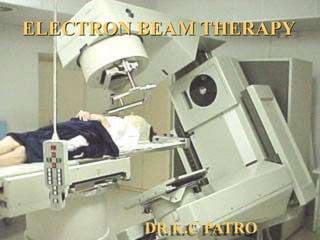
ELECTRON BEAM THERAPY
DEFINITION
It is a type of particulate beam
radiation therapy used for the
treatment of Superficial tumors
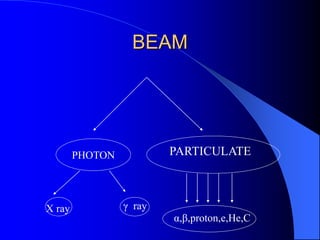
BEAM
PHOTON PARTICULATE
X ray γ ray
α,β,proton,e,He,C
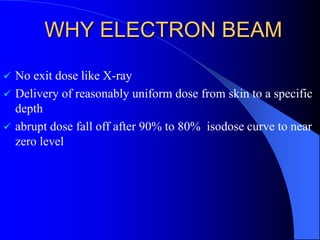
WHY ELECTRON BEAM
 No exit dose like X-ray
 Delivery of reasonably uniform dose from skin to a specific
depth
 abrupt dose fall off after 90% to 80% isodose curve to near
zero level
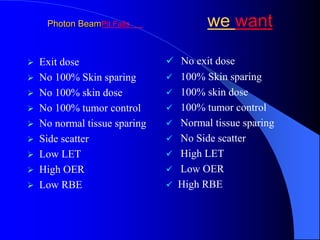
Photon BeamPit Falls we want
 Exit dose
 No 100% Skin sparing
 No 100% skin dose
 No 100% tumor control
 No normal tissue sparing
 Side scatter
 Low LET
 High OER
 Low RBE
 No exit dose
 100% Skin sparing
 100% skin dose
 100% tumor control
 Normal tissue sparing
 No Side scatter
 High LET
 Low OER
 High RBE
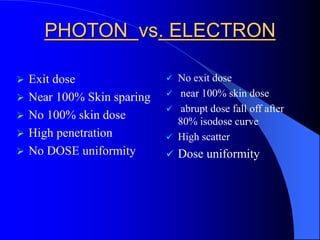
PHOTON vs. ELECTRON
 Exit dose
 Near 100% Skin sparing
 No 100% skin dose
 High penetration
 No DOSE uniformity
 No exit dose
 near 100% skin dose
 abrupt dose fall off after
80% isodose curve
 High scatter
 Dose uniformity
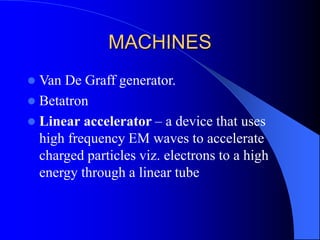
MACHINES
 Van De Graff generator.
 Betatron
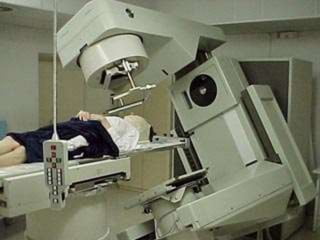
 Linear accelerator – a device that uses
high frequency EM waves to accelerate
charged particles viz. electrons to a high
energy through a linear tube
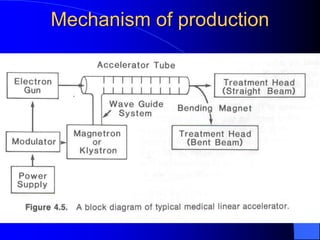
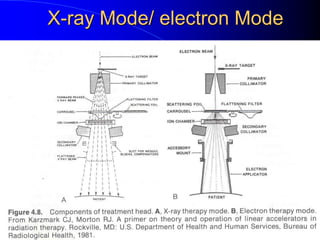
Mechanism of production
X-ray Mode/ electron Mode
Parts of treatment head
1. Primary Collimator
2. Scattering foil
3. Flattening filter
4. Ionization chamber
5. Secondary collimator
6. Tertiary collimator ( trimmer , electron
cone, auxiliary collimator )
SCATTERING FOIL
1. The scattering foils are made up of high
dense material interposed in electron beam
2. Different scattering foils are used for
different e- energy
3. The electron beam edges can be sharply
defined only if the collimator extended
towards the skin of the pt by attachment of
trimmers/applicators
4. The electron beam trimmers are optimally
designed to give uniform fluency
ELECTRON BEAM FROM
MACHINE TO PATIENT
 The energetic electron beam emerging from
accelerators is pencil beam.it is not suitable for
treatment
 Hence the beam has to be spread to a larger area
for treatment.
 Spread can be done by- electromagnetic scattering
device or scattering foil
 To further spreading electron applicator is used
Mechanism of interaction of electron with matter
 Inelastic collision with atomic electron
 Inelastic collision with nuclei
 elastic collision with atomic electron
 elastic collision with nuclei
Fundamental questions before EBT
 Indication of EBT
 Goal of EBT
 Planned Treatment Volume
 Planned Treatment dose
 Planned Treatment Technique
Indications
 Treating skin cancers.
 Chest wall irradiation in Ca breast.
 Boosting to neck node after 45 Gy.
 Total skin irradiation in mycosis fungoides.
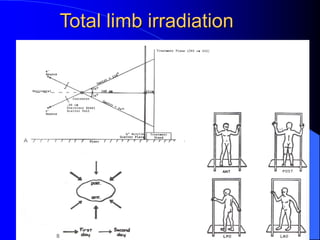
 Total limb irradiation
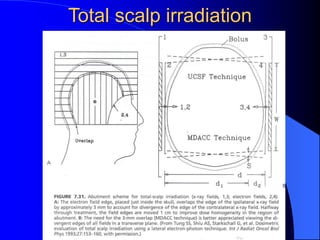
 Total scalp irradiation
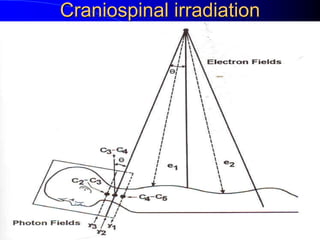
 Craniospinal irradiation
 Intracavitary irradiation
Dosimetry
 Measured by pencil beam algorithm
 Accurate in water at standard and extended
SSD
 Correctly predicts changes in Penumbra
 Predict changes in dose in oblique incidence
or irregular surfaces
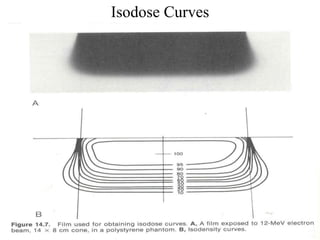
Isodose Curves
Isodose curve characteristic
 Rapid dose falloff below 80% isodose
 Bulging towards bottom
 Ballooning towards edge
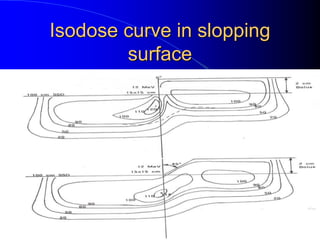
Isodose curve in slopping
surface
Determination of absorbed dose-
 Calorimeter
 TLD
 Solid state diode
 Ionization chamber
Depth dose characteristic/isodose
characteristic
 There is a abrupt fall of doses beyond 90% to
80% of isodose curve
 80% or 90% isodose curve is taken as standard
dose for prescription
 Depth (cm)of 90% isodose=E(Mev)/4
 Depth (cm)of 80% isodose=E(Mev)/3
 Electron beam penetrates a finite depth with clear
cut range,the photon beam in other hand proceeds
infinite range.
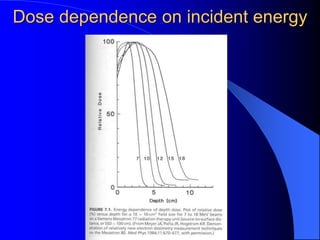
Dose dependence on incident energy
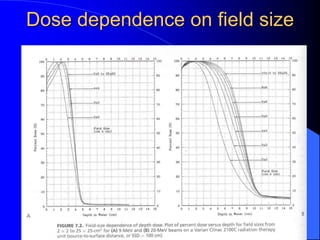
Dose dependence on field size
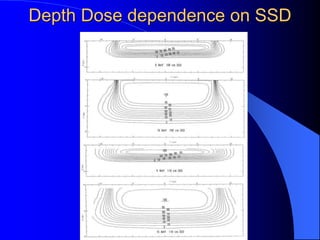
Depth Dose dependence on SSD
dmax
 Maximum dose is not on skin
 It is somehow away from skin
 It is due to electronic equilibrium
 6Mev-10mm
 9Mev-15mm
 12Mev-19mm
Approximation
Range of depth
 Roughly E/2
 E=energy
 E.g –for 6Mev range is 6/2=3cm
Surface dose in 10x10 cm field
 For 5mev=74%
 10mev=82%
 16mev=93%
 25mev=96%
 It depends upon energy,field size and
thickness of scattering foil
Energy range
 6-20 Mev
6,9,12,15,18,20 mev
Selection of energy
Ep0(MeV) = 3.3 x R90 (cm) [R90 exceeds max
depth of PTV]
Ep0(MeV) = 2 x Rp [Rp is the practical range
of electrons ]
Ideal condition for EBT
 Electron beam incidence normal to flat
surface
 Underlying homogenous soft tissue
(provide uniform dose in penumbra from
surface to R90 after which there is rapid
dose fall off)
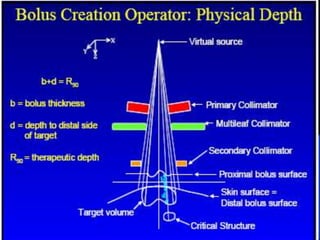
USE OF BOLUS
 To flatten out irregular surface
 Reduce the penetration of electrons in part of the field
 Increase the surface dose
 To act as a missing tissue compensator
 Thickness of bolus required increases as the surface dose
increases e.g
– 6-10mev=1cm
– 10-15mev=0.5cm
– >15mev=no bolus
BOLUS MATERIAL
 Paraffin wax,polysterene,lucite,superstoff,superflab
 Flexible bolus that confirms to surface is desirable
 Large air gap between the absorber and the surface
would result in scattering of e- outside the field and
reduction in dose that may not be easily predictable
unless specially measured for this condition
MLC vs. BLOCK
 No MLC
 Wooden MLC
 Wax MLC
 Customized block
BLOCKING MATERIAL
 Usually Cerroband
 Cerroband-Pb+Bi+Sn+Cu
 Melting point=
 Customized block
 Thickness of block required to use as block
=E/2 e.g for 6mev=6/2=3cm
Monitor unit
CGy/MU
Decelerators
 A plate of low atomic wt. material such as
lucite and polysterene is sometimes used to
reduce the energy of electron beam known
as decelerators
 It must be placed in close contact with
patient surface with bolus
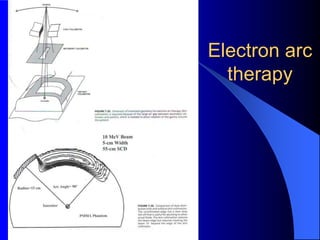
Electron arc
therapy
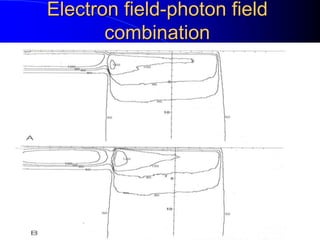
Electron field-photon field
combination
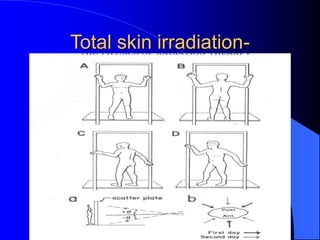
Total skin irradiation-
Total scalp irradiation
Craniospinal irradiation
Total limb irradiation
ELECTRON BEAM RADIOTHERAPY

ELECTRON BEAM RADIOTHERAPY

  • 1.
  • 2.
    DEFINITION It is atype of particulate beam radiation therapy used for the treatment of Superficial tumors
  • 3.
    BEAM PHOTON PARTICULATE X rayγ ray α,β,proton,e,He,C
  • 4.
    WHY ELECTRON BEAM No exit dose like X-ray  Delivery of reasonably uniform dose from skin to a specific depth  abrupt dose fall off after 90% to 80% isodose curve to near zero level
  • 5.
    Photon BeamPit Fallswe want  Exit dose  No 100% Skin sparing  No 100% skin dose  No 100% tumor control  No normal tissue sparing  Side scatter  Low LET  High OER  Low RBE  No exit dose  100% Skin sparing  100% skin dose  100% tumor control  Normal tissue sparing  No Side scatter  High LET  Low OER  High RBE
  • 6.
    PHOTON vs. ELECTRON Exit dose  Near 100% Skin sparing  No 100% skin dose  High penetration  No DOSE uniformity  No exit dose  near 100% skin dose  abrupt dose fall off after 80% isodose curve  High scatter  Dose uniformity
  • 7.
    MACHINES  Van DeGraff generator.  Betatron  Linear accelerator – a device that uses high frequency EM waves to accelerate charged particles viz. electrons to a high energy through a linear tube
  • 9.
  • 10.
  • 11.
    Parts of treatmenthead 1. Primary Collimator 2. Scattering foil 3. Flattening filter 4. Ionization chamber 5. Secondary collimator 6. Tertiary collimator ( trimmer , electron cone, auxiliary collimator )
  • 12.
    SCATTERING FOIL 1. Thescattering foils are made up of high dense material interposed in electron beam 2. Different scattering foils are used for different e- energy 3. The electron beam edges can be sharply defined only if the collimator extended towards the skin of the pt by attachment of trimmers/applicators 4. The electron beam trimmers are optimally designed to give uniform fluency
  • 13.
    ELECTRON BEAM FROM MACHINETO PATIENT  The energetic electron beam emerging from accelerators is pencil beam.it is not suitable for treatment  Hence the beam has to be spread to a larger area for treatment.  Spread can be done by- electromagnetic scattering device or scattering foil  To further spreading electron applicator is used
  • 14.
    Mechanism of interactionof electron with matter  Inelastic collision with atomic electron  Inelastic collision with nuclei  elastic collision with atomic electron  elastic collision with nuclei
  • 15.
    Fundamental questions beforeEBT  Indication of EBT  Goal of EBT  Planned Treatment Volume  Planned Treatment dose  Planned Treatment Technique
  • 16.
    Indications  Treating skincancers.  Chest wall irradiation in Ca breast.  Boosting to neck node after 45 Gy.  Total skin irradiation in mycosis fungoides.  Total limb irradiation  Total scalp irradiation  Craniospinal irradiation  Intracavitary irradiation
  • 17.
    Dosimetry  Measured bypencil beam algorithm  Accurate in water at standard and extended SSD  Correctly predicts changes in Penumbra  Predict changes in dose in oblique incidence or irregular surfaces
  • 18.
  • 19.
    Isodose curve characteristic Rapid dose falloff below 80% isodose  Bulging towards bottom  Ballooning towards edge
  • 20.
    Isodose curve inslopping surface
  • 21.
    Determination of absorbeddose-  Calorimeter  TLD  Solid state diode  Ionization chamber
  • 22.
    Depth dose characteristic/isodose characteristic There is a abrupt fall of doses beyond 90% to 80% of isodose curve  80% or 90% isodose curve is taken as standard dose for prescription  Depth (cm)of 90% isodose=E(Mev)/4  Depth (cm)of 80% isodose=E(Mev)/3  Electron beam penetrates a finite depth with clear cut range,the photon beam in other hand proceeds infinite range.
  • 23.
    Dose dependence onincident energy
  • 24.
  • 25.
  • 26.
    dmax  Maximum doseis not on skin  It is somehow away from skin  It is due to electronic equilibrium  6Mev-10mm  9Mev-15mm  12Mev-19mm Approximation
  • 27.
    Range of depth Roughly E/2  E=energy  E.g –for 6Mev range is 6/2=3cm
  • 28.
    Surface dose in10x10 cm field  For 5mev=74%  10mev=82%  16mev=93%  25mev=96%  It depends upon energy,field size and thickness of scattering foil
  • 29.
    Energy range  6-20Mev 6,9,12,15,18,20 mev
  • 30.
    Selection of energy Ep0(MeV)= 3.3 x R90 (cm) [R90 exceeds max depth of PTV] Ep0(MeV) = 2 x Rp [Rp is the practical range of electrons ]
  • 31.
    Ideal condition forEBT  Electron beam incidence normal to flat surface  Underlying homogenous soft tissue (provide uniform dose in penumbra from surface to R90 after which there is rapid dose fall off)
  • 32.
    USE OF BOLUS To flatten out irregular surface  Reduce the penetration of electrons in part of the field  Increase the surface dose  To act as a missing tissue compensator  Thickness of bolus required increases as the surface dose increases e.g – 6-10mev=1cm – 10-15mev=0.5cm – >15mev=no bolus
  • 33.
    BOLUS MATERIAL  Paraffinwax,polysterene,lucite,superstoff,superflab  Flexible bolus that confirms to surface is desirable  Large air gap between the absorber and the surface would result in scattering of e- outside the field and reduction in dose that may not be easily predictable unless specially measured for this condition
  • 36.
    MLC vs. BLOCK No MLC  Wooden MLC  Wax MLC  Customized block
  • 37.
    BLOCKING MATERIAL  UsuallyCerroband  Cerroband-Pb+Bi+Sn+Cu  Melting point=  Customized block  Thickness of block required to use as block =E/2 e.g for 6mev=6/2=3cm
  • 38.
  • 39.
    Decelerators  A plateof low atomic wt. material such as lucite and polysterene is sometimes used to reduce the energy of electron beam known as decelerators  It must be placed in close contact with patient surface with bolus
  • 40.
  • 41.
  • 42.
  • 43.
  • 44.
  • 45.