Spreadsheet and It’s
purpose
Michael Reneau
Adopted from Log on to IT CSEC
Chapter 13
Objectives
At the end of this lesson you will be able to:
 Define a spreadsheet.
 Give examples of where spreadsheets can be used.
 Identify the elements of the Excel application window.
 State what is meant by a row, column, cell, label, value, formula.
 Navigate to specified locations within a spreadsheet.
Chapter 13: Lesson Plan 1
Definition of a spreadsheet
An electronic spreadsheet is a program which
organises information into rows and columns so
that it can be operated on easily.
It enables you to store not only numerical data
but also formulae to carry out operations on the
numerical data.
Where can spreadsheets be used?
Some examples of where spreadsheets can
be used include:
• Statistics – e.g. finding averages
• Budgeting
• Stock-keeping in a supermarket
• Payrolls
• Keeping accounts in a club
• Preparing end-of-term school reports.
Excel 2003 versus Excel 2007
Elements of an Excel 2003 window
Title bar - This displays the name of the program, as
well as the name of the current workbook, if it has been
saved.
Menu bar - A horizontal bar usually seen at the top of a
worksheet with key words that represent menus (e.g.
File, Edit, View, Insert).
Vertical/Horizontal scroll bars - These are used to
scroll the Workbook window vertically/horizontally
through a worksheet.
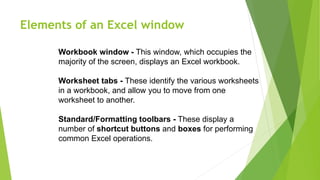
Elements of an Excel window
Workbook window - This window, which occupies the
majority of the screen, displays an Excel workbook.
Worksheet tabs - These identify the various worksheets
in a workbook, and allow you to move from one
worksheet to another.
Standard/Formatting toolbars - These display a
number of shortcut buttons and boxes for performing
common Excel operations.
Spreadsheet basics
Rows - These run from left to right across the window and their
position is designated by a number.
Columns - These run from top to bottom of the window and their
position is designated by a letter.
Cells - These are formed by the intersection of a row and a
column. Each cell in the spreadsheet is identified by a cell
reference (cell address), which is formed by combining the
column position and the row position.
Types of information that can be
entered into a cell
Three types of information can be entered into a
cell.
These are:
• Labels (text)
• Values (number)
• Formulae.
Moving around a spreadsheet
Up one cell up-arrow key
Down one cell down-arrow key, Enter key
Right one cell right-arrow key, Tab
Left one cell left-arrow key, Shift + Tab
Up one screen Page Up
Down one screen Page Down
Left one screen Shift + Tab
To a designated cell F5 key
First cell in a row Home

Spreadsheet Purposes

  • 1.
    Spreadsheet and It’s purpose MichaelReneau Adopted from Log on to IT CSEC Chapter 13
  • 2.
    Objectives At the endof this lesson you will be able to:  Define a spreadsheet.  Give examples of where spreadsheets can be used.  Identify the elements of the Excel application window.  State what is meant by a row, column, cell, label, value, formula.  Navigate to specified locations within a spreadsheet. Chapter 13: Lesson Plan 1
  • 3.
    Definition of aspreadsheet An electronic spreadsheet is a program which organises information into rows and columns so that it can be operated on easily. It enables you to store not only numerical data but also formulae to carry out operations on the numerical data.
  • 4.
    Where can spreadsheetsbe used? Some examples of where spreadsheets can be used include: • Statistics – e.g. finding averages • Budgeting • Stock-keeping in a supermarket • Payrolls • Keeping accounts in a club • Preparing end-of-term school reports.
  • 5.
  • 6.
    Elements of anExcel 2003 window Title bar - This displays the name of the program, as well as the name of the current workbook, if it has been saved. Menu bar - A horizontal bar usually seen at the top of a worksheet with key words that represent menus (e.g. File, Edit, View, Insert). Vertical/Horizontal scroll bars - These are used to scroll the Workbook window vertically/horizontally through a worksheet.
  • 7.
    Elements of anExcel window Workbook window - This window, which occupies the majority of the screen, displays an Excel workbook. Worksheet tabs - These identify the various worksheets in a workbook, and allow you to move from one worksheet to another. Standard/Formatting toolbars - These display a number of shortcut buttons and boxes for performing common Excel operations.
  • 8.
    Spreadsheet basics Rows -These run from left to right across the window and their position is designated by a number. Columns - These run from top to bottom of the window and their position is designated by a letter. Cells - These are formed by the intersection of a row and a column. Each cell in the spreadsheet is identified by a cell reference (cell address), which is formed by combining the column position and the row position.
  • 9.
    Types of informationthat can be entered into a cell Three types of information can be entered into a cell. These are: • Labels (text) • Values (number) • Formulae.
  • 10.
    Moving around aspreadsheet Up one cell up-arrow key Down one cell down-arrow key, Enter key Right one cell right-arrow key, Tab Left one cell left-arrow key, Shift + Tab Up one screen Page Up Down one screen Page Down Left one screen Shift + Tab To a designated cell F5 key First cell in a row Home