1 ©The McGraw-Hill Companies,
Software Project
Management
4th Edition
Managing people
and organizing
teams
Chapter 11
(part one)
2 ©The McGraw-Hill Companies,
Main topics
• What is organizational behaviour?
• Models of motivation – focus on the
individual
• Team building – focus on the team
• Leadership – focus on the relationship
between the project leader and the
team
3 ©The McGraw-Hill Companies,
Before organizational
behaviour
• Frederick Taylor (1856-1915) ‘the father
of scientific management’
• Focus:
– To select the best people for the job;
– To instruct them in the best methods;
– To give financial incentives in the form of
piece work
• One problem: ‘group norms’
4 ©The McGraw-Hill Companies,
Hawthorne effect
• 1920’s – series of experiments at the
Hawthorne Plant of Western Electric,
Chicago
• Found that simply showing an interest
in a group increased productivity
• Theory X: there is a need for coercion,
direction, and control of people at work
• Theory Y: work is as natural as rest or
play
5 ©The McGraw-Hill Companies,
Assumptions of OB
approach to management
• Are management skills based on innate skills
and characteristics? E.g ‘the born leader’? If
so, why do organizations spend so much time
and money on leadership training e.g
Sandhurst?
• OB tries to provide advice based on
observations – ‘when X is the case Y is likely
to happen’
6 ©The McGraw-Hill Companies,
Innate characteristics
• 1968 study – difference of 1:25 in time taken
by different programmers to code program
• Other research found experience better than
maths skills as a guide to software skills
• Some research suggested software
developers less sociable than other workers
• Later surveys have found no significant social
differences between ICT workers and others
7 ©The McGraw-Hill Companies,
Motivation
• Motivation and application can often
make up for shortfalls in innate skills
• Taylor’s approach - financial incentives
• Abraham Maslow (1908-1970)
– motivations vary from individual to
individual
– hierarchy of needs – as lower ones fulfilled,
higher ones emerge
– Lowest level – food, shelter
– Highest level – self-actualization
8 ©The McGraw-Hill Companies,
Herzberg
Herzberg suggested two sets of factors
affected job satisfaction
1. Hygiene or maintenance factors –
make you dissatisfied if they are not
right e.g. pay, working conditions
2. Motivators – make you feel the job is
worthwhile e.g. a sense of
achievement
9 ©The McGraw-Hill Companies,
Vroom
Vroom and colleagues identified three
influences on motivation
1. Expectancy – the belief that working
harder leads to better performance
2. Instrumentality – the belief that better
performance will be rewarded
3. Perceived value of the reward
10 ©The McGraw-Hill Companies,
Oldham-Hackman job
characteristics
Identified the following characteristics of a
job which make it more ‘meaningful’
• Skill variety
• Task identity
• Task significance
Two other factors contributed to
satisfaction:
• Autonomy
• Feedback
11 ©The McGraw-Hill Companies,
Methods to improve job
satisfaction
• Set specific goals
• Provide feedback on the progress
towards meeting those goals
• Consider job redesign
– Job enlargement
– Job enrichment
12 ©The McGraw-Hill Companies,
Becoming a team
Five basic stages of development:
1. Forming
2. Storming
3. Norming
4. Peforming
5. Adjourning
Classification associated with Tuckman
and Jensen
13 ©The McGraw-Hill Companies,
Balanced teams
• Meredith Belbin studied the
performance of top executives carrying
out group work at the Hendon
Management Centre
• Tried putting the ‘best’ people together
in ‘Apollo’ teams – almost invariably did
badly
• Identified the need for a balance of
skills and management roles in a
successful team
14 ©The McGraw-Hill Companies,
Management team roles
• The co-ordinator – good at chairing
meetings
• The ‘plant’ – an idea generator
• The monitor-evaluator – good at
evaluating ideas
• The shaper – helps direct team’s efforts
• The team worker – skilled at creating a
good working environment
15 ©The McGraw-Hill Companies,
Belbin management roles -
continued
• The resource investigator – adept at
finding resources, including information
• The completer-finisher – concerned with
getting tasks completed
• The implementer – a good team player
who is willing to undertake less
attractive tasks if they are needed for
team success
• The specialist – the ‘techie’ who likes to
acquire knowledge for its own sake
16 ©The McGraw-Hill Companies,
Influence of task type 1
Some tasks are better carried out
collectively while other tasks are better
delegated to individuals
• Additive tasks – the effort of each
participant is summed
• Compensatory tasks – the judgements
of individual group members are
summed – errors of some compensated
for by judgements of others
17 ©The McGraw-Hill Companies,
Influence of task type 2
• Disjunctive tasks – there is only one
correct answer – someone must:
– Come up with right answer
– Persuade the other that they are right
• Conjunctive – the task is only finished
when all components have been
completed
18 ©The McGraw-Hill Companies,
‘Social loafing’
• Tendency for some team participants to
‘coast’ and let others do the work
• Also tendency not to assist other team
members who have problems
• Suggested counter-measures:
– Make individual contributions identifiable
– Consciously involve group members
( ‘loafer’ could in fact just be shy!)
– Reward ‘team players’
19 ©The McGraw-Hill Companies,
Barriers to good team
decisions
• Inter-personal conflicts – see earlier
section on team formation
• Conflicts tend to be a dampened by
emergence of group norms – shared
group opinions and attitudes
• Risky shift – people in groups are more
likely to make risky decisions than they
would as individuals
20 ©The McGraw-Hill Companies,
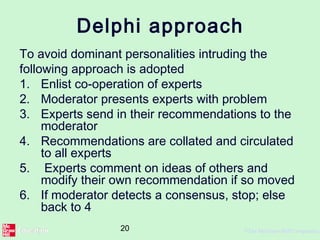
Delphi approach
To avoid dominant personalities intruding the
following approach is adopted
1. Enlist co-operation of experts
2. Moderator presents experts with problem
3. Experts send in their recommendations to the
moderator
4. Recommendations are collated and circulated
to all experts
5. Experts comment on ideas of others and
modify their own recommendation if so moved
6. If moderator detects a consensus, stop; else
back to 4
21 ©The McGraw-Hill Companies,
Leadership: types of authority
Position power
• Coercive power – able to threaten
punishment
• Connection power – have access to
those who do have power
• Legitimate power – based on a person’s
title conferring a special status
• Reward power – able to reward those
who comply
22 ©The McGraw-Hill Companies,
Leadership: types of power
Personal power
• Expert power: holder can carry out
specialist tasks that are in demand
• Information power: holder has access to
needed information
• Referent power: based on personal
attractiveness or charisma
23 ©The McGraw-Hill Companies,
Leadership styles
decision-making
autocrat democrat
implementation
directive
permissive
24 ©The McGraw-Hill Companies,
Leadership styles
• Task orientation – focus on the work in hand
• People orientation – focus on relationships
• Where there is uncertainty about the way job
is to be done or staff are inexperienced they
welcome task oriented supervision
• Uncertainty is reduced – people orientation
more important
• Risk that with reduction of uncertainty,
managers have time on their hands and
become more task oriented (interfering)

Managing people and organizing teams

  • 1.
    1 ©The McGraw-HillCompanies, Software Project Management 4th Edition Managing people and organizing teams Chapter 11 (part one)
  • 2.
    2 ©The McGraw-HillCompanies, Main topics • What is organizational behaviour? • Models of motivation – focus on the individual • Team building – focus on the team • Leadership – focus on the relationship between the project leader and the team
  • 3.
    3 ©The McGraw-HillCompanies, Before organizational behaviour • Frederick Taylor (1856-1915) ‘the father of scientific management’ • Focus: – To select the best people for the job; – To instruct them in the best methods; – To give financial incentives in the form of piece work • One problem: ‘group norms’
  • 4.
    4 ©The McGraw-HillCompanies, Hawthorne effect • 1920’s – series of experiments at the Hawthorne Plant of Western Electric, Chicago • Found that simply showing an interest in a group increased productivity • Theory X: there is a need for coercion, direction, and control of people at work • Theory Y: work is as natural as rest or play
  • 5.
    5 ©The McGraw-HillCompanies, Assumptions of OB approach to management • Are management skills based on innate skills and characteristics? E.g ‘the born leader’? If so, why do organizations spend so much time and money on leadership training e.g Sandhurst? • OB tries to provide advice based on observations – ‘when X is the case Y is likely to happen’
  • 6.
    6 ©The McGraw-HillCompanies, Innate characteristics • 1968 study – difference of 1:25 in time taken by different programmers to code program • Other research found experience better than maths skills as a guide to software skills • Some research suggested software developers less sociable than other workers • Later surveys have found no significant social differences between ICT workers and others
  • 7.
    7 ©The McGraw-HillCompanies, Motivation • Motivation and application can often make up for shortfalls in innate skills • Taylor’s approach - financial incentives • Abraham Maslow (1908-1970) – motivations vary from individual to individual – hierarchy of needs – as lower ones fulfilled, higher ones emerge – Lowest level – food, shelter – Highest level – self-actualization
  • 8.
    8 ©The McGraw-HillCompanies, Herzberg Herzberg suggested two sets of factors affected job satisfaction 1. Hygiene or maintenance factors – make you dissatisfied if they are not right e.g. pay, working conditions 2. Motivators – make you feel the job is worthwhile e.g. a sense of achievement
  • 9.
    9 ©The McGraw-HillCompanies, Vroom Vroom and colleagues identified three influences on motivation 1. Expectancy – the belief that working harder leads to better performance 2. Instrumentality – the belief that better performance will be rewarded 3. Perceived value of the reward
  • 10.
    10 ©The McGraw-HillCompanies, Oldham-Hackman job characteristics Identified the following characteristics of a job which make it more ‘meaningful’ • Skill variety • Task identity • Task significance Two other factors contributed to satisfaction: • Autonomy • Feedback
  • 11.
    11 ©The McGraw-HillCompanies, Methods to improve job satisfaction • Set specific goals • Provide feedback on the progress towards meeting those goals • Consider job redesign – Job enlargement – Job enrichment
  • 12.
    12 ©The McGraw-HillCompanies, Becoming a team Five basic stages of development: 1. Forming 2. Storming 3. Norming 4. Peforming 5. Adjourning Classification associated with Tuckman and Jensen
  • 13.
    13 ©The McGraw-HillCompanies, Balanced teams • Meredith Belbin studied the performance of top executives carrying out group work at the Hendon Management Centre • Tried putting the ‘best’ people together in ‘Apollo’ teams – almost invariably did badly • Identified the need for a balance of skills and management roles in a successful team
  • 14.
    14 ©The McGraw-HillCompanies, Management team roles • The co-ordinator – good at chairing meetings • The ‘plant’ – an idea generator • The monitor-evaluator – good at evaluating ideas • The shaper – helps direct team’s efforts • The team worker – skilled at creating a good working environment
  • 15.
    15 ©The McGraw-HillCompanies, Belbin management roles - continued • The resource investigator – adept at finding resources, including information • The completer-finisher – concerned with getting tasks completed • The implementer – a good team player who is willing to undertake less attractive tasks if they are needed for team success • The specialist – the ‘techie’ who likes to acquire knowledge for its own sake
  • 16.
    16 ©The McGraw-HillCompanies, Influence of task type 1 Some tasks are better carried out collectively while other tasks are better delegated to individuals • Additive tasks – the effort of each participant is summed • Compensatory tasks – the judgements of individual group members are summed – errors of some compensated for by judgements of others
  • 17.
    17 ©The McGraw-HillCompanies, Influence of task type 2 • Disjunctive tasks – there is only one correct answer – someone must: – Come up with right answer – Persuade the other that they are right • Conjunctive – the task is only finished when all components have been completed
  • 18.
    18 ©The McGraw-HillCompanies, ‘Social loafing’ • Tendency for some team participants to ‘coast’ and let others do the work • Also tendency not to assist other team members who have problems • Suggested counter-measures: – Make individual contributions identifiable – Consciously involve group members ( ‘loafer’ could in fact just be shy!) – Reward ‘team players’
  • 19.
    19 ©The McGraw-HillCompanies, Barriers to good team decisions • Inter-personal conflicts – see earlier section on team formation • Conflicts tend to be a dampened by emergence of group norms – shared group opinions and attitudes • Risky shift – people in groups are more likely to make risky decisions than they would as individuals
  • 20.
    20 ©The McGraw-HillCompanies, Delphi approach To avoid dominant personalities intruding the following approach is adopted 1. Enlist co-operation of experts 2. Moderator presents experts with problem 3. Experts send in their recommendations to the moderator 4. Recommendations are collated and circulated to all experts 5. Experts comment on ideas of others and modify their own recommendation if so moved 6. If moderator detects a consensus, stop; else back to 4
  • 21.
    21 ©The McGraw-HillCompanies, Leadership: types of authority Position power • Coercive power – able to threaten punishment • Connection power – have access to those who do have power • Legitimate power – based on a person’s title conferring a special status • Reward power – able to reward those who comply
  • 22.
    22 ©The McGraw-HillCompanies, Leadership: types of power Personal power • Expert power: holder can carry out specialist tasks that are in demand • Information power: holder has access to needed information • Referent power: based on personal attractiveness or charisma
  • 23.
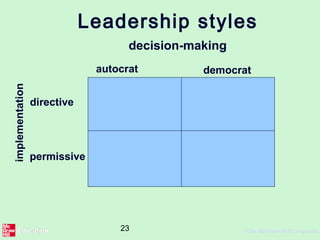
    23 ©The McGraw-HillCompanies, Leadership styles decision-making autocrat democrat implementation directive permissive
  • 24.
    24 ©The McGraw-HillCompanies, Leadership styles • Task orientation – focus on the work in hand • People orientation – focus on relationships • Where there is uncertainty about the way job is to be done or staff are inexperienced they welcome task oriented supervision • Uncertainty is reduced – people orientation more important • Risk that with reduction of uncertainty, managers have time on their hands and become more task oriented (interfering)

Editor's Notes

  • #2 This talk provides an overview of the basic steps needed to produce a project plan. The framework provided should allow students to identify where some of the particular issues discussed in other chapters are applied to the planning process. As the focus is on project planning, techniques to do with project control are not explicitly described. However, in practice, one element of project planning will be to decide what project control procedures need to be in place.
  • #4 Much of the work of Taylor was in factories and mines, working with manual workers. The ‘instruction in best methods’ involved breaking down a manual task into its component activities, identifying the best way of carrying out those activities and then teaching the workers to copy the approved method. This can be seen as treating the workers as little better than automatons – but it is also the way the sporting coaches often work! The individual workers were encouraged to maximize output by paying them piece-rates e.g. by the units processed. One difficulty with this is that workers learn that increasing output can in fact lead to the piece-rate being adjusted in a downward direction. Maximizing output can also be physically and mentally exhausting. Groups of workers therefore tend to converge on an agreed output rate which does not require a constant 100% effort.
  • #5 The Hawthorne experiments investigated the effect of various factors such as improved lightning on productivity. It was found that the productivity of the control group (whose working conditions such as lighting were not changed) increased – the fact that someone singled them out for observation improved their motivation. Donald McGregor Theory X and Theory Y management approaches. Sections 11.2 and 11.3 of the textbook touch on these issues in a little more depth.
  • #6 ‘When X is the case Y is likely to happen’ – this is often based on trying to measure variables seen as being related to X and Y and then attempting to establish some statistical relationship between them. Some academic researchers do not really approve of this, and prefer a more interpretivist approach.
  • #7 There is some evidence that there is a very wide variation in software development skills – going back many years. Some research found that computer people had fewer social needs than other professionals. Later research has not found any significant difference – this may be because the ‘ICT profession’ has become broader in scope.
  • #8 Maslow’s model implies that people will be motivated by different things at different times. Also that people always feel dissatisfied, but the focus of the dissatisfaction changes over time. This and other aspects of motivation are discussed in Section 11.6 of the text Exercises 11.2 and 11.3 are designed to get students to think a little about the implications of the Taylor and Maslow models of motivation.
  • #9 Exercise 11.4 illustrates the approach that Herzberg and associates used to gather data about motivational factors.
  • #10 Note: if any of the factors has a zero value, then motivation will be zero. Example from the text book: expectancy – trying to use a compiler to compile software code; the code has a bug which causes a compilation error regardless of what you do. In this case motivation will collapse. Instrumentality – you are working on removing a fault from a software tool used by a client; you find that the client has given up using the tool and has acquired a different one to do the job. Low perceived value of reward: a reward that everyone gets is less highly regarded than one which only outstanding people get. Getting a first is more valuable if only 5% of students get a first compared to where 90% get a first!
  • #11 Skill variety – number of different skills the job holder has the opportunity to exercise Task identity – the degree to which your work and its results are associated with you Task significance – the degree to which your job has an influence on others Two other factors contributed to satisfaction: Autonomy – the freedom that you have about the way that you do the job; Feedback – the information you get back about the results of your work. Software developers will tend to be associated with their code – task identity; analyst programmers will have a to use a wider range of skills than lower level programmers – more skill variety. If you have direct contact with the end-users of your software you are likely to be more aware of the results of your work – task significance, and more likely to get feedback on it.
  • #12 Job enlargement – widening the range of tasks carried out by a worker Job enrichment – delegating some management roles to the worker e.g for re-ordering raw materials.
  • #13 The members of the group get to know one another and try to set up some ground rules about behaviour Storming – conflicts arise as various members of the group try to exert leadership and the group’s methods of working are established Norming – conflicts are largely settled and a feeling of group identity emerges Performing – the emphasis is now on the tasks at hand Adjourning – the group disbands One way of attempting to accelerate this process is through team-building exercises. This is covered in Section 11.9 of the text book.
  • #14 R. Meredith Belbin Management Teams: Why they succeed or fail (2nd edition) Elsevier 2003 contains a self-assessment questionnaire which identifies the role a person to which a person is best suited.
  • #16 The ‘specialist’ was added by Belbin in 1996. A person can have elements of more than one of the types, but usually one or two predominate. According to Belbin about 30% cannot be classified under any heading at all. Problems can occur if, for example, you have two or more shapers and no effective co-ordinator – there are likely to be clashes that are difficult to resolve.
  • #17 An example of an additive task is clearing snow – in practice there might be some diseconomies of scale if there were too many people involved Compensatory tasks – using groups of developers to estimate the development effort needed to develop new software components
  • #18 Software development would tend to be conjunctive – all the components have to be completed before the system as a whole is deemed to be complete
  • #21 The Delphi approach was originally developed by the RAND Corporation in the late 1960s. The development of email clearly makes the application of the method much easier to organize.
  • #22 Section 11.11 discusses these concepts.
  • #23 Exercise 11.7 should help student familiarize themselves with these concepts
  • #24 Directive autocrat: makes decisions alone: close supervision of implementation Permissive autocrat: makes decisions alone: subordinates have latitude in implementation Directive democrat: makes decisions participatively: close supervision of implementation Permissive democrat: makes decisions participatively: subordinates have latitude in implementation
  • #25 Essentially staff want hands-on management when they need guidance. Once the know the job they want to be left to get on with it!