What is SPI? 
SPI implies that elements of an effective software process can be defined in an effective manner an existing 
organizational approach to software development and a meaningful strategy for improvement can be 
defined. 
The SPI strategy transforms the existing approach to software development into something that is more 
focused, more repeatable, and more reliable 
SPI implies a defined software process, an organizational approach, and a strategy for 
improvement
Approaches to SPI 
• a set of characteristics that must be present if an effective software process is 
to be achieved 
• a method for assessing whether those characteristics are present 
• a mechanism for summarizing the results of any assessment, and 
• a strategy for assisting a software organization in implementing those 
process characteristics that have been found to be weak or missing. 
• An SPI framework assesses the “maturity” of an organization’s software 
process and provides a qualitative indication of a maturity level.
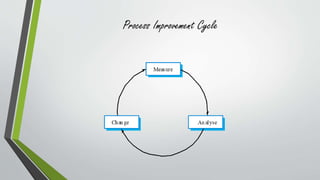
Process Improvement Cycle
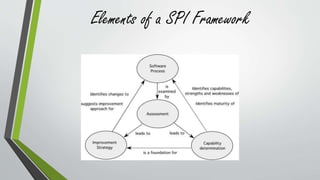
Elements of a SPI Framework
Other SPI Frameworks 
SPICE 
Bootstrap 
PSP and TSP 
Tick IT
Constituencies 
Quality certifiers 
Quality(Process) --> Quality(Product) 
Formalists: process modeling languages 
Tool advocates 
Practitioners: little formal process modeling 
Reformers: organizational change 
Ideologists: particular SP for specific organization
Maturity Models 
A maturity model is applied within the context of an SPI 
framework. 
The intent of the maturity model is to provide an overall 
indication of the “process maturity” exhibited by a software 
organization. 
an indication of the quality of the software process, the 
degree to which practitioner’s understand and apply the 
process, 
the general state of software engineering practice.
Four levels of Immaturity 
Schorsch suggests four levels of immaturity 
Level 0: Negligent– failure to allow processes 
Level 1: Obstructive– counterproductive processes are imposed 
Level 2: Contemptuous– disregard for good software engineering 
Level 3: Undermining– total neglect of own charter
Is SPI for Everyone? 
Can a small company initiate SPI activities and do it 
successfully? 
Answer: INDEED, they can as it is a good practice. 
It should come as no surprise that small organizations are 
more informal, apply fewer standard practices, and tend to 
be self-organizing.
The SPI Process—I 
Five activities 
Assessment and Gap Analysis 
Assessment examines a wide range of actions and tasks that will lead to a high 
quality process. 
Consistency. Are important activities, actions and tasks applied consistently 
across all software projects and by all software teams? 
Sophistication. Are management and technical actions performed with a level 
of sophistication that implies a thorough understanding of best practice? 
Acceptance. Is the software process and software engineering practice widely 
accepted by management and technical staff? 
Commitment. Has management committed the resources required to achieve 
consistency, sophistication and acceptance? 
Gap analysis—The difference between local application and best practice represents 
a “gap” that offers opportunities for improvement.
The SPI Process—II 
Education and Training 
Three types of education and training should be conducted: 
1. Generic concepts and methods. 
2. Specific technology and tools. 
3. Business communication and quality-related topics.
The SPI Process—III 
Selection and Justification 
choose the process model that best fits your 
organization, its stakeholders, and the software that 
you build decide on the set of framework activities 
that will be applied, the major work products that will 
be produced and the quality assurance checkpoints 
that will enable your team to assess progress 
develop a work breakdown for each framework 
activity defining the task set that would be applied for 
a typical project 
Once a choice is made, time and money must be 
expended to install it within an organization and these 
resource expenditures should be justified.
The SPI Process—IV 
Installation/Migration 
Scacchi [Sca00] states that “SPR is concerned with 
identification, application, and refinement of new 
ways to dramatically improve and transform software 
processes.” 
three different process models are considered: 
the existing (“as-is”) process, 
a transitional (“here-to-there”) process, and 
the target (“to be”) process.
The SPI Process—V 
Evaluation 
assesses the degree to which changes have been 
instantiated and adopted, 
the degree to which such changes result in better 
software quality or other tangible process benefits, 
and 
the overall status of the process and the 
organizational culture as SPI activities proceed 
From a qualitative point of view, past management 
and practitioner attitudes about the software process 
can be compared to attitudes polled after installation 
of process changes.
Risk Management for SPI 
In general, the following categories can be identified for SPI risk factors: 
o budget and cost 
o content and deliverables culture 
o maintenance of SPI deliverables 
o mission and goals 
o organizational management and organizational stability 
o process stakeholders 
o schedule for SPI development 
o SPI development environment and process 
o SPI project management and SPI staff
Critical Success Factors 
The top five CSFs are : 
Management commitment and support 
Staff involvement 
Process integration and understanding 
A customized SPI strategy 
A customized SPI strategy
The CMMI model 
An integrated capability model that includes software and systems engineering capability assessment. 
The model has two instantiations 
Staged where the model is expressed in terms of capability levels; 
Continuous where a capability rating is computed.
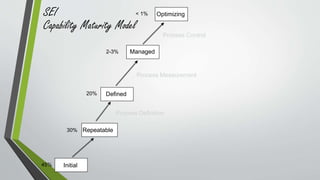
SEI 
Capability Maturity Model 
Initial 
Optimizing 
Managed 
Defined 
Repeatable 
Process Control 
Process Measurement 
Process Definition 
Basic Management Control 
45% 
30% 
< 1% 
20% 
2-3%
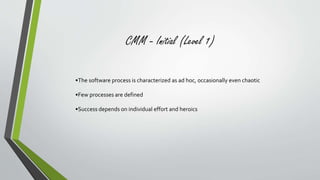
CMM - Initial (Level 1) 
•The software process is characterized as ad hoc, occasionally even chaotic 
•Few processes are defined 
•Success depends on individual effort and heroics
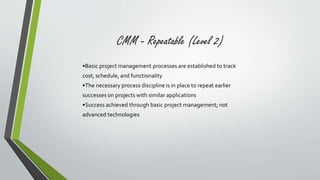
CMM - Repeatable (Level 2) 
•Basic project management processes are established to track 
cost, schedule, and functionality 
•The necessary process discipline is in place to repeat earlier 
successes on projects with similar applications 
•Success achieved through basic project management; not 
advanced technologies
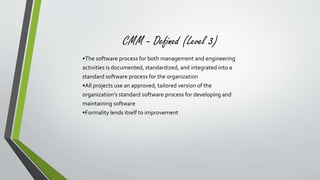
CMM - Defined (Level 3) 
•The software process for both management and engineering 
activities is documented, standardized, and integrated into a 
standard software process for the organization 
•All projects use an approved, tailored version of the 
organization’s standard software process for developing and 
maintaining software 
•Formality lends itself to improvement
CMM - Managed (Level 4) 
•Detailed measures of the software process and product 
quality are collected 
•Both the software process and products are quantitatively 
understood and controlled 
•A software metrics program is in use
Summary Regarding SPI 
• SPI is an ongoing effort; your process will evolve over time. 
• You need to invest in, and support, SPI efforts for them to be successful. 
• The goal of SPI is to ensure that your organization can define, implement, and 
evolve one or more appropriate processes to help you meet your IT goals. 
• There are many proven software processes; one or more of them will likely help 
you to meet your needs. 
• Your software process must be tailored to reflect your organization's strengths, 
weaknesses, culture, and business needs.

software process improvement

  • 1.
    What is SPI? SPI implies that elements of an effective software process can be defined in an effective manner an existing organizational approach to software development and a meaningful strategy for improvement can be defined. The SPI strategy transforms the existing approach to software development into something that is more focused, more repeatable, and more reliable SPI implies a defined software process, an organizational approach, and a strategy for improvement
  • 2.
    Approaches to SPI • a set of characteristics that must be present if an effective software process is to be achieved • a method for assessing whether those characteristics are present • a mechanism for summarizing the results of any assessment, and • a strategy for assisting a software organization in implementing those process characteristics that have been found to be weak or missing. • An SPI framework assesses the “maturity” of an organization’s software process and provides a qualitative indication of a maturity level.
  • 3.
  • 4.
    Elements of aSPI Framework
  • 5.
    Other SPI Frameworks SPICE Bootstrap PSP and TSP Tick IT
  • 6.
    Constituencies Quality certifiers Quality(Process) --> Quality(Product) Formalists: process modeling languages Tool advocates Practitioners: little formal process modeling Reformers: organizational change Ideologists: particular SP for specific organization
  • 7.
    Maturity Models Amaturity model is applied within the context of an SPI framework. The intent of the maturity model is to provide an overall indication of the “process maturity” exhibited by a software organization. an indication of the quality of the software process, the degree to which practitioner’s understand and apply the process, the general state of software engineering practice.
  • 8.
    Four levels ofImmaturity Schorsch suggests four levels of immaturity Level 0: Negligent– failure to allow processes Level 1: Obstructive– counterproductive processes are imposed Level 2: Contemptuous– disregard for good software engineering Level 3: Undermining– total neglect of own charter
  • 9.
    Is SPI forEveryone? Can a small company initiate SPI activities and do it successfully? Answer: INDEED, they can as it is a good practice. It should come as no surprise that small organizations are more informal, apply fewer standard practices, and tend to be self-organizing.
  • 10.
    The SPI Process—I Five activities Assessment and Gap Analysis Assessment examines a wide range of actions and tasks that will lead to a high quality process. Consistency. Are important activities, actions and tasks applied consistently across all software projects and by all software teams? Sophistication. Are management and technical actions performed with a level of sophistication that implies a thorough understanding of best practice? Acceptance. Is the software process and software engineering practice widely accepted by management and technical staff? Commitment. Has management committed the resources required to achieve consistency, sophistication and acceptance? Gap analysis—The difference between local application and best practice represents a “gap” that offers opportunities for improvement.
  • 11.
    The SPI Process—II Education and Training Three types of education and training should be conducted: 1. Generic concepts and methods. 2. Specific technology and tools. 3. Business communication and quality-related topics.
  • 12.
    The SPI Process—III Selection and Justification choose the process model that best fits your organization, its stakeholders, and the software that you build decide on the set of framework activities that will be applied, the major work products that will be produced and the quality assurance checkpoints that will enable your team to assess progress develop a work breakdown for each framework activity defining the task set that would be applied for a typical project Once a choice is made, time and money must be expended to install it within an organization and these resource expenditures should be justified.
  • 13.
    The SPI Process—IV Installation/Migration Scacchi [Sca00] states that “SPR is concerned with identification, application, and refinement of new ways to dramatically improve and transform software processes.” three different process models are considered: the existing (“as-is”) process, a transitional (“here-to-there”) process, and the target (“to be”) process.
  • 14.
    The SPI Process—V Evaluation assesses the degree to which changes have been instantiated and adopted, the degree to which such changes result in better software quality or other tangible process benefits, and the overall status of the process and the organizational culture as SPI activities proceed From a qualitative point of view, past management and practitioner attitudes about the software process can be compared to attitudes polled after installation of process changes.
  • 15.
    Risk Management forSPI In general, the following categories can be identified for SPI risk factors: o budget and cost o content and deliverables culture o maintenance of SPI deliverables o mission and goals o organizational management and organizational stability o process stakeholders o schedule for SPI development o SPI development environment and process o SPI project management and SPI staff
  • 16.
    Critical Success Factors The top five CSFs are : Management commitment and support Staff involvement Process integration and understanding A customized SPI strategy A customized SPI strategy
  • 17.
    The CMMI model An integrated capability model that includes software and systems engineering capability assessment. The model has two instantiations Staged where the model is expressed in terms of capability levels; Continuous where a capability rating is computed.
  • 18.
    SEI Capability MaturityModel Initial Optimizing Managed Defined Repeatable Process Control Process Measurement Process Definition Basic Management Control 45% 30% < 1% 20% 2-3%
  • 19.
    CMM - Initial(Level 1) •The software process is characterized as ad hoc, occasionally even chaotic •Few processes are defined •Success depends on individual effort and heroics
  • 20.
    CMM - Repeatable(Level 2) •Basic project management processes are established to track cost, schedule, and functionality •The necessary process discipline is in place to repeat earlier successes on projects with similar applications •Success achieved through basic project management; not advanced technologies
  • 21.
    CMM - Defined(Level 3) •The software process for both management and engineering activities is documented, standardized, and integrated into a standard software process for the organization •All projects use an approved, tailored version of the organization’s standard software process for developing and maintaining software •Formality lends itself to improvement
  • 22.
    CMM - Managed(Level 4) •Detailed measures of the software process and product quality are collected •Both the software process and products are quantitatively understood and controlled •A software metrics program is in use
  • 23.
    Summary Regarding SPI • SPI is an ongoing effort; your process will evolve over time. • You need to invest in, and support, SPI efforts for them to be successful. • The goal of SPI is to ensure that your organization can define, implement, and evolve one or more appropriate processes to help you meet your IT goals. • There are many proven software processes; one or more of them will likely help you to meet your needs. • Your software process must be tailored to reflect your organization's strengths, weaknesses, culture, and business needs.