IJRET: International Journal of Research in Engineering and Technology eISSN: 2319-1163 | pISSN: 2321-7308
__________________________________________________________________________________________
Volume: 02 Issue: 12 | Dec-2013, Available @ http://www.ijret.org 756
SPLIT BLOCK DOMINATION IN GRAPHS
M .H. Muddebihal1
, Shabbir Ahmed2
, P. Shekanna 3
1
Professor and Chairman, Department of Mathematics, Gulbarga University, Gulbarga-585106
2
Retired Professor, Department of Mathematics, Gulbarga University, Gulbarga-585106
3
Asst. Professor, R Y M Engineering College, Bellary-583 104
mhmuddebihal@yahoo.co.in, shabirshahir@yahoo.co.in, shaikshavali71@gmail.com
Abstract
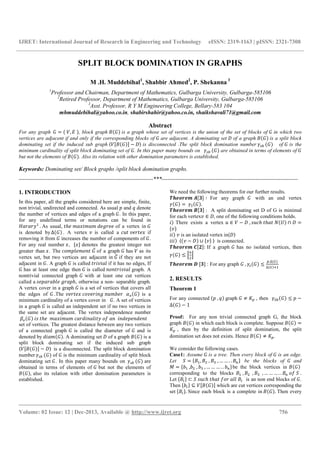
For any graph = , , block graph is a graph whose set of vertices is the union of the set of blocks of in which two
vertices are adjacent if and only if the corresponding blocks of are adjacent. A dominating set of a graph is a split block
dominating set if the induced sub graph 〈 − 〉 is disconnected .The split block domination number of is the
minimum cardinality of split block dominating set of . In this paper many bounds on are obtained in terms of elements of
but not the elements of . Also its relation with other domination parameters is established.
Keywords: Dominating set/ Block graphs /split block domination graphs.
----------------------------------------------------------------------***-----------------------------------------------------------------------
1. INTRODUCTION
In this paper, all the graphs considered here are simple, finite,
non trivial, undirected and connected. As usual and denote
the number of vertices and edges of a graph . In this paper,
for any undefined terms or notations can be found in
. As usual, ℎ ! " # of a vertex in
is denoted by∆ . A vertex % is called a &! % if
removing it from increases the number of components of .
For any real number , ' ( denotes the greatest integer not
greater than . The &) * + ̅ of a graph has as its
vertex set, but two vertices are adjacent in ̅ if they are not
adjacent in . A graph is called % * if it has no edges, If
has at least one edge then is called +)+ % * graph. A
nontrivial connected graph with at least one cut vertices
called a - .* # ℎ, otherwise a non- separable graph.
A vertex cover in a graph is a set of vertices that covers all
the edges of .The % &)% +# +! . /0 is a
minimum cardinality of a vertex cover in . A set of vertices
in a graph is called an independent set if no two vertices in
the same set are adjacent. The vertex independence number
10 - ℎ ! & " + * )2 + +" +" +
set of vertices. The greatest distance between any two vertices
of a connected graph is called the diameter of and is
denoted by " . A dominating set of a graph is a
split block dominating set if the induced sub graph
〈 − 〉 is a disconnected. The split block domination
number of is the minimum cardinality of split block
dominating set . In this paper many bounds on are
obtained in terms of elements of but not the elements of
, also its relation with other domination parameters is
established.
We need the following theorems for our further results.
3456758 9 : ∶ For any graph with an end vertex
= < .
3456758 = : : A split dominating set D of G is minimal
for each vertex% ∈ , one of the following conditions holds.
? There exists a vertex ! ∈ − , -!&ℎ ℎ @ A ∩ =
C%D
? % is an isolated vertex in〈 〉
? 〈 % − ∪ C%D 〉 is connected.
3456758 F G : If a graph has no isolated vertices, then
≤ J
K
L
M
3456758 N : : For any graph , ≤
O.∆ P
∆ P Q
2. RESULTS
Theorem 1
For any connected , graph ≠ SO , then < ≤ −
∆ − 1
Proof: For any non trivial connected graph G, the block
graph in which each block is complete. Suppose =
SO , then by the definition of split domination, the split
domination set does not exists. Hence ≠ SO.
We consider the following cases.
Case1: Assume is a tree. Then every block of is an edge.
Let U = C , L , V , … … . . ? KD? be the blocks of and
X = C. ,?.L , .V , … … … . . ?.KDbe the block vertices in
corresponding to the blocks , L , V , … … … . . K )2 U .
Let C YD ⊂ U -!&ℎ ℎ 2) ** Y is an non end blocks of .
Then C.YD ⊆ which are cut vertices corresponding the
set C YD. Since each block is a complete in . Then every
IJRET: International Journal of Research in Engineering and Technology eISSN: 2319-1163 | pISSN: 2321-7308
__________________________________________________________________________________________
Volume: 02 Issue: 12 | Dec-2013, Available @ http://www.ijret.org 757
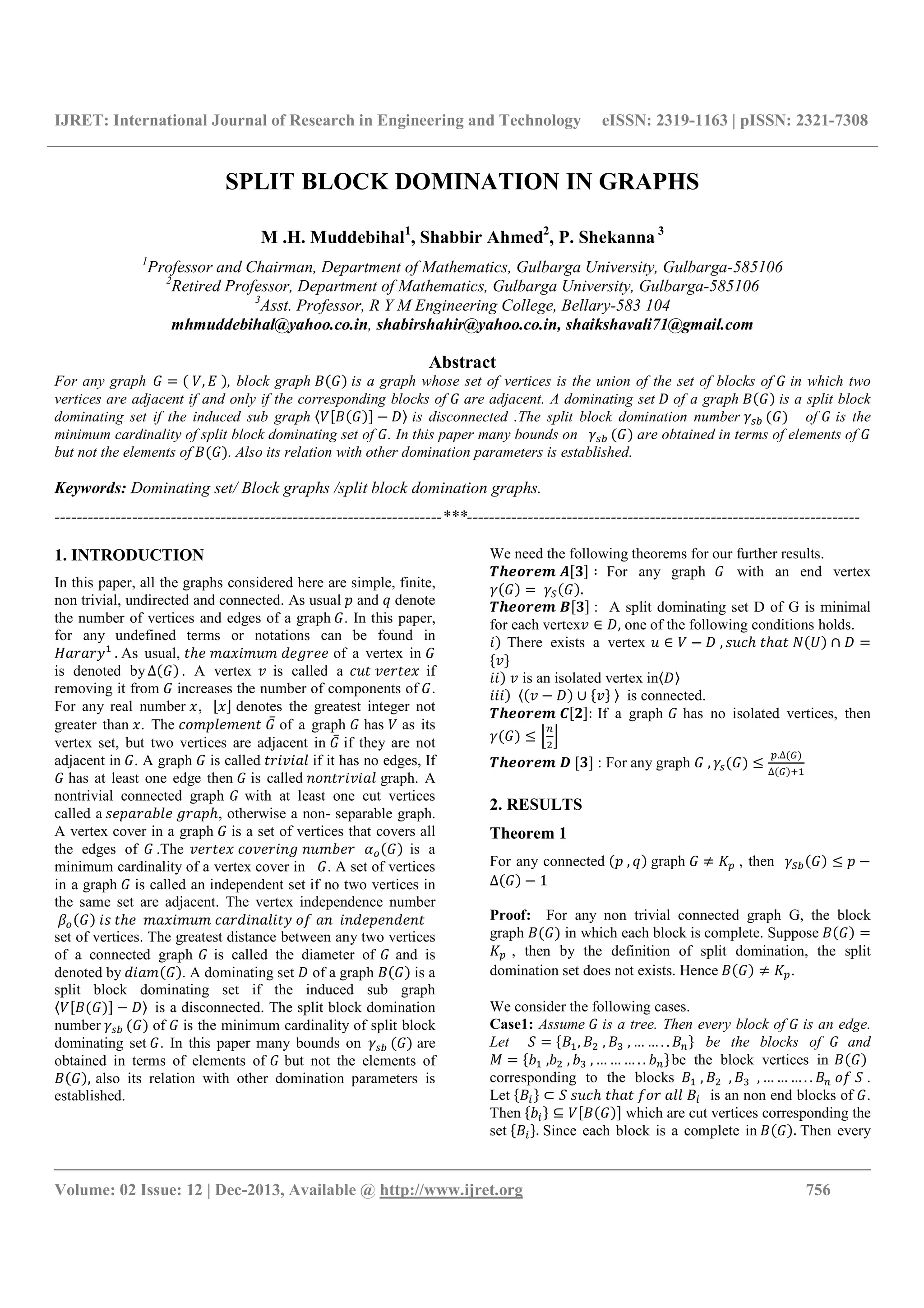
vertex of − C.YD	 is adjacent to atleast one vertex of
C.YD. Clearly|.Y|	 . Also each .Y is a cut vertex, which
also gives |.Y| 	 . Since for a tree ] 1 each
block in tree ^ is an edge then		_ K 	] 1	.
Hence _ ∆ 1 ` |.Y|	a & 	# % -		_ ∆ 1 `
bcd5	G ∶ Suppose is not a tree. Then there exists atleast one
block which is not an edge. Let	 	, L, V, … … … K be the
blocks of and . , .L, .V, … … … .K	 be the corresponding
block vertices in 	 . Let C.YD ⊆ in which
∀	.Y which is adjacent to at least one vertex of
C.YD.But every vertex of .Y is a cut vertex in .Since each
block of is a complete graph. The set C.YD gives a
minimal split dominating set in . Hence |.Y| gives a split
domination number in . Since _ ∆ 1 `
|.Y|	 +	 I _ ∆ 1 as required.
Theorem 2
For any graph G with + .*)&f-	, R Sg then
			 I + 2
ijkkl ∶ Suppose is a complete graph, then by definition
split domination does not exists in .	Hence	 R SO.
Suppose 	be any graph with U C , L, V, … … … KD be
the blocks of and X C. , .L, .V, … … … .KD the block
vertices in 	 corresponding to the blocks
, L, V, … … … K	)2	U.
Let C , L	, V	, … … . . ? YD? be the set of all non end
blocks in , 3 I I +	 which generates a set 	X
C. 	,?.L	, .V	, … … … . . ?.YD	 +	 , ∀	.Y	 +	 are cut vertices.
Now we consider X ⊆ X ,	-!& 	 	 X gives
a disconnected block graph and every vertex of
X are adjacent to at least one vertex of X .Hence X is a
minimal split dominating set of .
In , | +	| and ∀	%Y ∈ X are at a distance at
most two which gives | | 2 ` nX n.
Hence		 I + 2		.
Theorem 3
If 	 +	+ 2 ` where + is the number
of blocks of but the converse of the above need not be true.
_ ))2 ∶ Suppose then by theorem 2
I + 2.Since , ∴ + 2 ` . The
following graphs show that the converse of the above is true.
. . , 2	+ 2 ` 	 +	
Total number of blocks in	 , + 7	, 2, 2.
But the converse of the above theorem is not always true. This
can be shown by the following graph.
Total number of blocks in 	, + 5, 2	, 1	
therefore, even though + 2 ` 	,			 	 R .
Theorem 4
For any graph 	 , R SO	,	 +		 I
g∆ P
LQ∆ P	
.
ijkkl ∶ We consider only those graphs which are not
SO	 . let 	be a - 	)2	 using theorem
it follows that for each vertex % ∈ 	there exist a vertex
! ∈ . such that % is adjacent to !. Since each
block in is a complete, this implies that is
a dominating set of .
Thus
I | |	, I
_ 	, - +& 		. 	 ) 	 I
g.∆P
Q∆ P
		
a & 	# % -		 I
g.∆ P
LQ∆ P
Theorem 5
For any graph 	, R SO	, +		 I /r 		a 	/r	
is a vertex covering number.
ijkkl ∶ Suppose 	 is a complete graph. By defination,
split domination does not exists in . Hence R SO.	
Let ^	be a maximum independent set of vertices in 	,
then ^ has atleast two vertices and every vertex in ^ is
adjacent to some vertex in
^	. ^ -	 * -	 	 ^	 is a split
IJRET: International Journal of Research in Engineering and Technology eISSN: 2319-1163 | pISSN: 2321-7308
__________________________________________________________________________________________
Volume: 02 Issue: 12 | Dec-2013, Available @ http://www.ijret.org 758
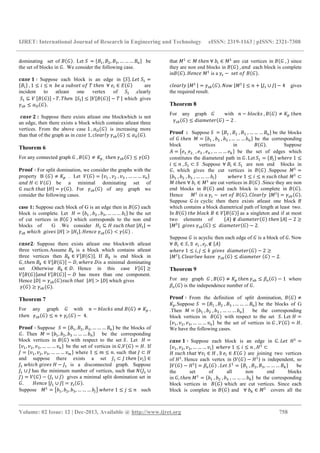
dominating set of . Let U = C ?, L, V, … … … ? KD be
the set of blocks in . We consider the following case.
bcd5 s ∶ Suppose each block is an edge in CUD. t U =
C YD , 1 ≤ ≤ + . -!.- )2 ^ ℎ + ∀ Y ∈ are
incident to atleast one vertex of U .clearly
U ⊆ – ^. ^ℎ + |U | ≤ | − ^ | which gives
≤ /r .
bcd5 G : Suppose there exists atleast one blockwhich is not
an edge, then there exists a block which contains atleast three
vertices. From the above case 1 , /r is increasing more
than that of the graph as in & - 1, &* * ≤ /v .
Theorem 6
For any connected graph , ≠ SO , ℎ + ≤
ijkkl ∶ For split domination, we consider the graphs with the
property B ≠ SO . Let = C% , %L , %V , … … … %KD
+" ⊂ be a minimal dominating set of
-!&ℎ ℎ | | = . For of any graph we
consider the following cases.
case 1: Suppose each block of G is an edge then in each
block is complete. Let = C. , .L , .V, … … … .YD be the set
of cut vertices in which corresponds to the non end
blocks of G .We consider ⊆ -!&ℎ ℎ | | =
aℎ &ℎ # % - | | > | |. +& < .
bcd5G: Suppose there exists atleast one blockwith atleast
three vertices.Assume y is a block which contains atleast
three vertices then y ∈ . If y is end block in
, ℎ + y ∈ − , aℎ is a minimal dominating
set .Otherwise y ∈ . Hence in this case ≥
+" − has more than one component.
Hence | | = -!&ℎ ℎ | | > | | which gives
≥ .
Theorem 7
For any graph with + − .*)&f- +" ≠ SO ,
ℎ + ≤ + + − 4.
ijkkl ∶ Suppose U = C ?, L, V, … … … ? KD be the blocks of
. Then X = C. ?, .L, .V … … … ?.KD be the corresponding
block vertices in with respect to the set U. Let =
C% , %L, %V, … … … ?%KD ?be the set of vertices in , = . If
{ = C% ?, %L, %V, … … … ?%|D where 1 ≤ ≤ +. such that { ⊂
and suppose there exists a set { ⊂ { ℎ + C%YD ∈
{ aℎ &ℎ # % - − { is a disconnected graph. Suppose
{ ∪ { has the minimum number of vertices, such that @ { ∪
{ = − { ∪ { gives a minimal split domination set in
. +& |{ ∪ {| = .
Suppose X = }. , .L, .V, … … … ?.~•? aℎ 1 ≤ € ≤ + such
that X ⊂ X ℎ + ∀ .Y ∈ X are cut vertices in , since
they are non end blocks in , +" each block is complete
in . +& X is a − - )2 .
&* * |X | = . @)a |X | ≤ + + |{ ∪ {| − 4 gives
the required result.
Theorem 8
For any graph with + − .*)&f- , ≠ SO ℎ +
≤ " − 2 .
ijkkl : Suppose U = C , L , V , … … … KD be the blocks
of ℎ + X = C. , .L , .V , … … … .KD be the corresponding
block vertices in . Suppose
• = } ,
? L , , V , ‚ , … … … ? yD be the set of edges which
constitutes the diameteral path in . Let U = C YD aℎ 1 ≤
≤ + , U ⊂ U .Suppose ∀ Y ∈ U are non end blocks in
, which gives the cut vertices in .Suppose X =
C. , .L , .V , … … … .YD aℎ 1 ≤ ≤ + -!&ℎ ℎ X ⊂
X ℎ + ∀ .Y ∈ X are cut vertices in .Since they are non
end blocks in and each block is complete in .
Hence X - − - )2 . ƒ* * |X | = .
Suppose - cyclic then there exists atleast one block
which contains a block diametrical path of length at least two.
In ℎ .*)&f ∈ as a singleton and if at most
two elements of C•D ∉ " ℎ + |•| − 2 ≥
|X | # % - ≤ " − 2.
Suppose is acyclic then each edge of is a block of . Now
∀ Y ∈ U, ∃ Y , ~, ∉ C•D
aℎ 1 ≤ , € ≤ f # % - " − 2 ≥
|X |. ƒ* *a ℎ % ≤ " − 2.
Theorem 9
For any graph , ≠ SO ℎ + ≤ 10 − 1 where
10 is the independence number of .
ijkkl ∶ From the definition of split domination, ≠
SO.Suppose U = C , L , V , … … … KD be the blocks of G
.Then X = C. , .L , .V , … … … .KD be the corresponding
block vertices in with respect to the set U. Let =
C% , %L, %V, … … … %KD be the set of vertices in , = .
We have the following cases.
bcd5 s ∶ Suppose each block is an edge in . t =
C% , %L, %V, … … … %YD aℎ 1 ≤ ≤ + , ⊂
-!&ℎ ℎ ∀%Y ∈ , ∃ Y ∈ are joining two vertices
of . Hence each vertex in 〈 ? − ? 〉 is independent, so
| − | = 10 . t U = C , L, V, … … … yD be
the set of all non end blocks
in , ℎ + X = C. , .L , .V , … … … .yD be the corresponding
block vertices in which are cut vertices. Since each
block is complete in and ∀ .y ∈ X covers all the
IJRET: International Journal of Research in Engineering and Technology eISSN: 2319-1163 | pISSN: 2321-7308
__________________________________________________________________________________________
Volume: 02 Issue: 12 | Dec-2013, Available @ http://www.ijret.org 759
vertices belongs to the corresponding blocks which are
complete. Clearly |X | aℎ &ℎ # % - ≤
10 − 1.
bcd5 G: Suppose has atleast one block which is not an edge.
Assume there exists a block Y which is not an edge. Then Y
contains atleast two independent vertices. From & - 1 for this
graph | 0| will be more. In , .Y ∈ is a vertex
Y ↔ .Y . Again from the above case .Y ∈ X . If .Y is the
non end block in ℎ + .Y ∈ X , otherwise .Y ∉
X ℎ +& |X | = . Now one can easily verify that
≤ 10 − 1.
Theorem 10
For any graph , ≠ SO , ℎ + + ≤ _ − 1
_ ))2 ∶ Suppose is a complete graph, by definition,
Split domination does not exists in . Hence ≠
SO. Suppose U = C , L, V , … … … KD be the blocks
of . ^ℎ + X = C. , .L , .V , … … … .KD be the corresponding
block vertices in . Let = C% , %L , %V, … … … %KD be the
set of vertices in . { = C% , %L , %V , … … … %YD , aℎ 1 ≤
≤ + -!&ℎ ℎ { ⊂ , ∀ %Y ∈ { Which covers all the vertices
of with minimal cardinality .Hence { is a minimal
dominating set of +" | { | = . Let
U = C YD aℎ 1 ≤ ≤ + , U ⊂ U +" ∀ Y ∈ U are non
end blocks in G.Then we have X ⊂ X which correspondes
to the elements of U such that X forms a minimal
dominating set of . Since each element of X is a cut
vertex ,then |X | = . ‡! ℎ X ∪ { ≤ _ − 1
which gives + ≤ _ − 1.
Theorem 11
For any graph , ≠ Sg then ≤ J
g
L
M
ijkkl ∶ To prove the lower bound for , the graph
≠ SO . Let U = C , L, V , … … … KD be the blocks in
and X = C. , .L , .V , … … … .KD be the corresponding block
vertices in with respect to the set U . Let =
C% , %L , %V, … … … %KD be the set of vertices in such that
= . Let be a connected and assume that is the set
of all end vertices adjacent to a vertex %, where | | = . Then
the induced subgraph = 〈 − ∪ C%D 〉 has no isolates
and by Theorem ƒ ≤ J
gˆ‰ˆ
L
M , If p is even, say
= 2f, then S = ≤ 1 + J
LŠˆ‰ˆ
L
M then there exist at
most one end vertex adjacent to each % ∈ such that ≤ 1 -
! ". If p is odd, say = 2f + 1, ℎ + S = ≤
1 + J
LyQ ˆ‰ˆ
L
M and deduce that ≤ 2. Assume in this case (n
is odd), that ‹ is the set of vertices that are adjacent to exactly
two end vertices, where |‹| = |X | aℎ X ⊂ X note that
each vertex of ‹ is in any minimal dominating set of
. t be the sub graph formed removing ‹ and all
end vertices that are adjacent to vertices in ‹. The set Œ of
isolates of is dominated in
. ‹ . ^ℎ # ℎ − Œ is isolate free and has
atmost 2f + 1 − 3 % & -. Then − Œ ≤
J
LŠQ ˆV•
L
M.A dominating set of − Œ together with ‹
denotes .
+& S = ≤ + J
LyQ ˆV•
L
M , ≤ 1 on the above
said two cases, we have |X | ≤
Ž P
L
aℎ &ℎ # % - ≤ J
g
L
M
Theorem 12
For any connected graph with + − .*)&f- ≠ SO ℎ +
̅ ≤ + − 2 .
ijkkl ∶ Let be a connected graph with
+ ≥ 3 .*)&f-. ^ℎ + ℎ +! . )2 .*)&f- )2 ̅ is less
than or equal to + and hence ̅ ≤ and
from ^ℎ ) 2 ̅ ≤ + − 2.
Theorem 13
For any graph , ≠ SO, a ℎ ≥ 4 % &- +" ̅
has no isolates then ̅ ≤ _ − 3.
ijkkl ∶ Let be a graph with _ ≥ 4 % & - +" ̅ has
no isolates. Then the number of blocks of ̅ is less than or
equal to _ − 3 . Hence ̅ ≤ _ − 3.
Theorem 14
‡) + # ℎ , ≠ SO , ℎ +
+ ̅ ≤ 2 + − 2
. ̅ ≤ + − 2 L
.
ijkkl ∶ From ^ℎ ) 2 +" ^ℎ ) 12 the above
result follows
REFERENCES:
[1]. Harary.F, Graph Theory, Addition-Wesley, reading mass,
(1969)
[2]. T.W.Haynes, Stephen T.Hedetniemi, Peter J.Slater,
Fundamentals of domination in graphs, Marcel Dekker, Inc,
Newyork, pp 41-49 (1998)
[3]. V.R.Kulli, Theory of domination in graphs, vishwa
international publications, Gulbarga, India. pp 111-118 (2010)

Split block domination in graphs

  • 1.
    IJRET: International Journalof Research in Engineering and Technology eISSN: 2319-1163 | pISSN: 2321-7308 __________________________________________________________________________________________ Volume: 02 Issue: 12 | Dec-2013, Available @ http://www.ijret.org 756 SPLIT BLOCK DOMINATION IN GRAPHS M .H. Muddebihal1 , Shabbir Ahmed2 , P. Shekanna 3 1 Professor and Chairman, Department of Mathematics, Gulbarga University, Gulbarga-585106 2 Retired Professor, Department of Mathematics, Gulbarga University, Gulbarga-585106 3 Asst. Professor, R Y M Engineering College, Bellary-583 104 mhmuddebihal@yahoo.co.in, shabirshahir@yahoo.co.in, shaikshavali71@gmail.com Abstract For any graph = , , block graph is a graph whose set of vertices is the union of the set of blocks of in which two vertices are adjacent if and only if the corresponding blocks of are adjacent. A dominating set of a graph is a split block dominating set if the induced sub graph 〈 − 〉 is disconnected .The split block domination number of is the minimum cardinality of split block dominating set of . In this paper many bounds on are obtained in terms of elements of but not the elements of . Also its relation with other domination parameters is established. Keywords: Dominating set/ Block graphs /split block domination graphs. ----------------------------------------------------------------------***----------------------------------------------------------------------- 1. INTRODUCTION In this paper, all the graphs considered here are simple, finite, non trivial, undirected and connected. As usual and denote the number of vertices and edges of a graph . In this paper, for any undefined terms or notations can be found in . As usual, ℎ ! " # of a vertex in is denoted by∆ . A vertex % is called a &! % if removing it from increases the number of components of . For any real number , ' ( denotes the greatest integer not greater than . The &) * + ̅ of a graph has as its vertex set, but two vertices are adjacent in ̅ if they are not adjacent in . A graph is called % * if it has no edges, If has at least one edge then is called +)+ % * graph. A nontrivial connected graph with at least one cut vertices called a - .* # ℎ, otherwise a non- separable graph. A vertex cover in a graph is a set of vertices that covers all the edges of .The % &)% +# +! . /0 is a minimum cardinality of a vertex cover in . A set of vertices in a graph is called an independent set if no two vertices in the same set are adjacent. The vertex independence number 10 - ℎ ! & " + * )2 + +" +" + set of vertices. The greatest distance between any two vertices of a connected graph is called the diameter of and is denoted by " . A dominating set of a graph is a split block dominating set if the induced sub graph 〈 − 〉 is a disconnected. The split block domination number of is the minimum cardinality of split block dominating set . In this paper many bounds on are obtained in terms of elements of but not the elements of , also its relation with other domination parameters is established. We need the following theorems for our further results. 3456758 9 : ∶ For any graph with an end vertex = < . 3456758 = : : A split dominating set D of G is minimal for each vertex% ∈ , one of the following conditions holds. ? There exists a vertex ! ∈ − , -!&ℎ ℎ @ A ∩ = C%D ? % is an isolated vertex in〈 〉 ? 〈 % − ∪ C%D 〉 is connected. 3456758 F G : If a graph has no isolated vertices, then ≤ J K L M 3456758 N : : For any graph , ≤ O.∆ P ∆ P Q 2. RESULTS Theorem 1 For any connected , graph ≠ SO , then < ≤ − ∆ − 1 Proof: For any non trivial connected graph G, the block graph in which each block is complete. Suppose = SO , then by the definition of split domination, the split domination set does not exists. Hence ≠ SO. We consider the following cases. Case1: Assume is a tree. Then every block of is an edge. Let U = C , L , V , … … . . ? KD? be the blocks of and X = C. ,?.L , .V , … … … . . ?.KDbe the block vertices in corresponding to the blocks , L , V , … … … . . K )2 U . Let C YD ⊂ U -!&ℎ ℎ 2) ** Y is an non end blocks of . Then C.YD ⊆ which are cut vertices corresponding the set C YD. Since each block is a complete in . Then every
  • 2.
    IJRET: International Journalof Research in Engineering and Technology eISSN: 2319-1163 | pISSN: 2321-7308 __________________________________________________________________________________________ Volume: 02 Issue: 12 | Dec-2013, Available @ http://www.ijret.org 757 vertex of − C.YD is adjacent to atleast one vertex of C.YD. Clearly|.Y| . Also each .Y is a cut vertex, which also gives |.Y| . Since for a tree ] 1 each block in tree ^ is an edge then _ K ] 1 . Hence _ ∆ 1 ` |.Y| a & # % - _ ∆ 1 ` bcd5 G ∶ Suppose is not a tree. Then there exists atleast one block which is not an edge. Let , L, V, … … … K be the blocks of and . , .L, .V, … … … .K be the corresponding block vertices in . Let C.YD ⊆ in which ∀ .Y which is adjacent to at least one vertex of C.YD.But every vertex of .Y is a cut vertex in .Since each block of is a complete graph. The set C.YD gives a minimal split dominating set in . Hence |.Y| gives a split domination number in . Since _ ∆ 1 ` |.Y| + I _ ∆ 1 as required. Theorem 2 For any graph G with + .*)&f- , R Sg then I + 2 ijkkl ∶ Suppose is a complete graph, then by definition split domination does not exists in . Hence R SO. Suppose be any graph with U C , L, V, … … … KD be the blocks of and X C. , .L, .V, … … … .KD the block vertices in corresponding to the blocks , L, V, … … … K )2 U. Let C , L , V , … … . . ? YD? be the set of all non end blocks in , 3 I I + which generates a set X C. ,?.L , .V , … … … . . ?.YD + , ∀ .Y + are cut vertices. Now we consider X ⊆ X , -!& X gives a disconnected block graph and every vertex of X are adjacent to at least one vertex of X .Hence X is a minimal split dominating set of . In , | + | and ∀ %Y ∈ X are at a distance at most two which gives | | 2 ` nX n. Hence I + 2 . Theorem 3 If + + 2 ` where + is the number of blocks of but the converse of the above need not be true. _ ))2 ∶ Suppose then by theorem 2 I + 2.Since , ∴ + 2 ` . The following graphs show that the converse of the above is true. . . , 2 + 2 ` + Total number of blocks in , + 7 , 2, 2. But the converse of the above theorem is not always true. This can be shown by the following graph. Total number of blocks in , + 5, 2 , 1 therefore, even though + 2 ` , R . Theorem 4 For any graph , R SO , + I g∆ P LQ∆ P . ijkkl ∶ We consider only those graphs which are not SO . let be a - )2 using theorem it follows that for each vertex % ∈ there exist a vertex ! ∈ . such that % is adjacent to !. Since each block in is a complete, this implies that is a dominating set of . Thus I | | , I _ , - +& . ) I g.∆P Q∆ P a & # % - I g.∆ P LQ∆ P Theorem 5 For any graph , R SO , + I /r a /r is a vertex covering number. ijkkl ∶ Suppose is a complete graph. By defination, split domination does not exists in . Hence R SO. Let ^ be a maximum independent set of vertices in , then ^ has atleast two vertices and every vertex in ^ is adjacent to some vertex in ^ . ^ - * - ^ is a split
  • 3.
    IJRET: International Journalof Research in Engineering and Technology eISSN: 2319-1163 | pISSN: 2321-7308 __________________________________________________________________________________________ Volume: 02 Issue: 12 | Dec-2013, Available @ http://www.ijret.org 758 dominating set of . Let U = C ?, L, V, … … … ? KD be the set of blocks in . We consider the following case. bcd5 s ∶ Suppose each block is an edge in CUD. t U = C YD , 1 ≤ ≤ + . -!.- )2 ^ ℎ + ∀ Y ∈ are incident to atleast one vertex of U .clearly U ⊆ – ^. ^ℎ + |U | ≤ | − ^ | which gives ≤ /r . bcd5 G : Suppose there exists atleast one blockwhich is not an edge, then there exists a block which contains atleast three vertices. From the above case 1 , /r is increasing more than that of the graph as in & - 1, &* * ≤ /v . Theorem 6 For any connected graph , ≠ SO , ℎ + ≤ ijkkl ∶ For split domination, we consider the graphs with the property B ≠ SO . Let = C% , %L , %V , … … … %KD +" ⊂ be a minimal dominating set of -!&ℎ ℎ | | = . For of any graph we consider the following cases. case 1: Suppose each block of G is an edge then in each block is complete. Let = C. , .L , .V, … … … .YD be the set of cut vertices in which corresponds to the non end blocks of G .We consider ⊆ -!&ℎ ℎ | | = aℎ &ℎ # % - | | > | |. +& < . bcd5G: Suppose there exists atleast one blockwith atleast three vertices.Assume y is a block which contains atleast three vertices then y ∈ . If y is end block in , ℎ + y ∈ − , aℎ is a minimal dominating set .Otherwise y ∈ . Hence in this case ≥ +" − has more than one component. Hence | | = -!&ℎ ℎ | | > | | which gives ≥ . Theorem 7 For any graph with + − .*)&f- +" ≠ SO , ℎ + ≤ + + − 4. ijkkl ∶ Suppose U = C ?, L, V, … … … ? KD be the blocks of . Then X = C. ?, .L, .V … … … ?.KD be the corresponding block vertices in with respect to the set U. Let = C% , %L, %V, … … … ?%KD ?be the set of vertices in , = . If { = C% ?, %L, %V, … … … ?%|D where 1 ≤ ≤ +. such that { ⊂ and suppose there exists a set { ⊂ { ℎ + C%YD ∈ { aℎ &ℎ # % - − { is a disconnected graph. Suppose { ∪ { has the minimum number of vertices, such that @ { ∪ { = − { ∪ { gives a minimal split domination set in . +& |{ ∪ {| = . Suppose X = }. , .L, .V, … … … ?.~•? aℎ 1 ≤ € ≤ + such that X ⊂ X ℎ + ∀ .Y ∈ X are cut vertices in , since they are non end blocks in , +" each block is complete in . +& X is a − - )2 . &* * |X | = . @)a |X | ≤ + + |{ ∪ {| − 4 gives the required result. Theorem 8 For any graph with + − .*)&f- , ≠ SO ℎ + ≤ " − 2 . ijkkl : Suppose U = C , L , V , … … … KD be the blocks of ℎ + X = C. , .L , .V , … … … .KD be the corresponding block vertices in . Suppose • = } , ? L , , V , ‚ , … … … ? yD be the set of edges which constitutes the diameteral path in . Let U = C YD aℎ 1 ≤ ≤ + , U ⊂ U .Suppose ∀ Y ∈ U are non end blocks in , which gives the cut vertices in .Suppose X = C. , .L , .V , … … … .YD aℎ 1 ≤ ≤ + -!&ℎ ℎ X ⊂ X ℎ + ∀ .Y ∈ X are cut vertices in .Since they are non end blocks in and each block is complete in . Hence X - − - )2 . ƒ* * |X | = . Suppose - cyclic then there exists atleast one block which contains a block diametrical path of length at least two. In ℎ .*)&f ∈ as a singleton and if at most two elements of C•D ∉ " ℎ + |•| − 2 ≥ |X | # % - ≤ " − 2. Suppose is acyclic then each edge of is a block of . Now ∀ Y ∈ U, ∃ Y , ~, ∉ C•D aℎ 1 ≤ , € ≤ f # % - " − 2 ≥ |X |. ƒ* *a ℎ % ≤ " − 2. Theorem 9 For any graph , ≠ SO ℎ + ≤ 10 − 1 where 10 is the independence number of . ijkkl ∶ From the definition of split domination, ≠ SO.Suppose U = C , L , V , … … … KD be the blocks of G .Then X = C. , .L , .V , … … … .KD be the corresponding block vertices in with respect to the set U. Let = C% , %L, %V, … … … %KD be the set of vertices in , = . We have the following cases. bcd5 s ∶ Suppose each block is an edge in . t = C% , %L, %V, … … … %YD aℎ 1 ≤ ≤ + , ⊂ -!&ℎ ℎ ∀%Y ∈ , ∃ Y ∈ are joining two vertices of . Hence each vertex in 〈 ? − ? 〉 is independent, so | − | = 10 . t U = C , L, V, … … … yD be the set of all non end blocks in , ℎ + X = C. , .L , .V , … … … .yD be the corresponding block vertices in which are cut vertices. Since each block is complete in and ∀ .y ∈ X covers all the
  • 4.
    IJRET: International Journalof Research in Engineering and Technology eISSN: 2319-1163 | pISSN: 2321-7308 __________________________________________________________________________________________ Volume: 02 Issue: 12 | Dec-2013, Available @ http://www.ijret.org 759 vertices belongs to the corresponding blocks which are complete. Clearly |X | aℎ &ℎ # % - ≤ 10 − 1. bcd5 G: Suppose has atleast one block which is not an edge. Assume there exists a block Y which is not an edge. Then Y contains atleast two independent vertices. From & - 1 for this graph | 0| will be more. In , .Y ∈ is a vertex Y ↔ .Y . Again from the above case .Y ∈ X . If .Y is the non end block in ℎ + .Y ∈ X , otherwise .Y ∉ X ℎ +& |X | = . Now one can easily verify that ≤ 10 − 1. Theorem 10 For any graph , ≠ SO , ℎ + + ≤ _ − 1 _ ))2 ∶ Suppose is a complete graph, by definition, Split domination does not exists in . Hence ≠ SO. Suppose U = C , L, V , … … … KD be the blocks of . ^ℎ + X = C. , .L , .V , … … … .KD be the corresponding block vertices in . Let = C% , %L , %V, … … … %KD be the set of vertices in . { = C% , %L , %V , … … … %YD , aℎ 1 ≤ ≤ + -!&ℎ ℎ { ⊂ , ∀ %Y ∈ { Which covers all the vertices of with minimal cardinality .Hence { is a minimal dominating set of +" | { | = . Let U = C YD aℎ 1 ≤ ≤ + , U ⊂ U +" ∀ Y ∈ U are non end blocks in G.Then we have X ⊂ X which correspondes to the elements of U such that X forms a minimal dominating set of . Since each element of X is a cut vertex ,then |X | = . ‡! ℎ X ∪ { ≤ _ − 1 which gives + ≤ _ − 1. Theorem 11 For any graph , ≠ Sg then ≤ J g L M ijkkl ∶ To prove the lower bound for , the graph ≠ SO . Let U = C , L, V , … … … KD be the blocks in and X = C. , .L , .V , … … … .KD be the corresponding block vertices in with respect to the set U . Let = C% , %L , %V, … … … %KD be the set of vertices in such that = . Let be a connected and assume that is the set of all end vertices adjacent to a vertex %, where | | = . Then the induced subgraph = 〈 − ∪ C%D 〉 has no isolates and by Theorem ƒ ≤ J gˆ‰ˆ L M , If p is even, say = 2f, then S = ≤ 1 + J LŠˆ‰ˆ L M then there exist at most one end vertex adjacent to each % ∈ such that ≤ 1 - ! ". If p is odd, say = 2f + 1, ℎ + S = ≤ 1 + J LyQ ˆ‰ˆ L M and deduce that ≤ 2. Assume in this case (n is odd), that ‹ is the set of vertices that are adjacent to exactly two end vertices, where |‹| = |X | aℎ X ⊂ X note that each vertex of ‹ is in any minimal dominating set of . t be the sub graph formed removing ‹ and all end vertices that are adjacent to vertices in ‹. The set Œ of isolates of is dominated in . ‹ . ^ℎ # ℎ − Œ is isolate free and has atmost 2f + 1 − 3 % & -. Then − Œ ≤ J LŠQ ˆV• L M.A dominating set of − Œ together with ‹ denotes . +& S = ≤ + J LyQ ˆV• L M , ≤ 1 on the above said two cases, we have |X | ≤ Ž P L aℎ &ℎ # % - ≤ J g L M Theorem 12 For any connected graph with + − .*)&f- ≠ SO ℎ + ̅ ≤ + − 2 . ijkkl ∶ Let be a connected graph with + ≥ 3 .*)&f-. ^ℎ + ℎ +! . )2 .*)&f- )2 ̅ is less than or equal to + and hence ̅ ≤ and from ^ℎ ) 2 ̅ ≤ + − 2. Theorem 13 For any graph , ≠ SO, a ℎ ≥ 4 % &- +" ̅ has no isolates then ̅ ≤ _ − 3. ijkkl ∶ Let be a graph with _ ≥ 4 % & - +" ̅ has no isolates. Then the number of blocks of ̅ is less than or equal to _ − 3 . Hence ̅ ≤ _ − 3. Theorem 14 ‡) + # ℎ , ≠ SO , ℎ + + ̅ ≤ 2 + − 2 . ̅ ≤ + − 2 L . ijkkl ∶ From ^ℎ ) 2 +" ^ℎ ) 12 the above result follows REFERENCES: [1]. Harary.F, Graph Theory, Addition-Wesley, reading mass, (1969) [2]. T.W.Haynes, Stephen T.Hedetniemi, Peter J.Slater, Fundamentals of domination in graphs, Marcel Dekker, Inc, Newyork, pp 41-49 (1998) [3]. V.R.Kulli, Theory of domination in graphs, vishwa international publications, Gulbarga, India. pp 111-118 (2010)