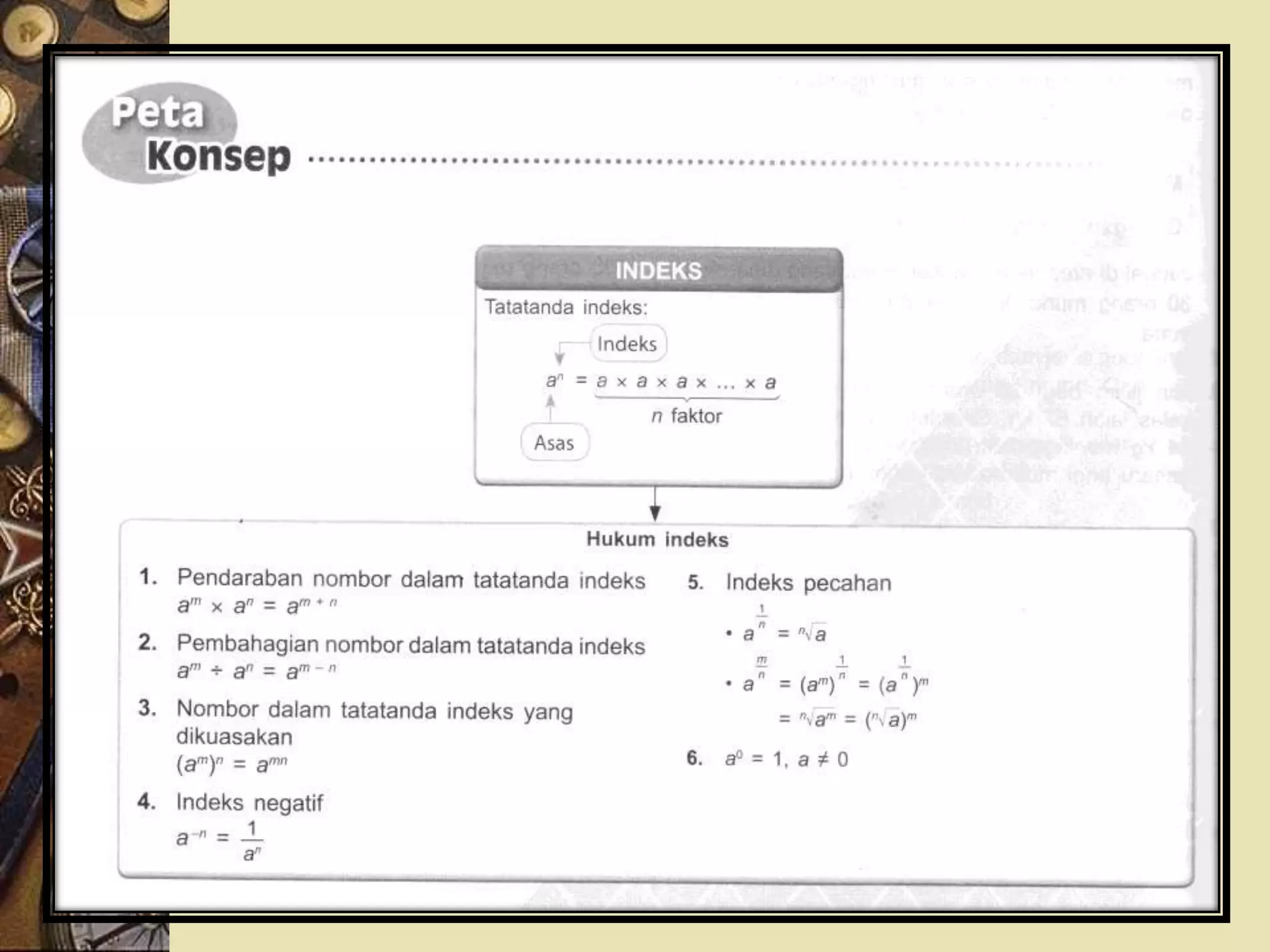
What Is An Index Number.
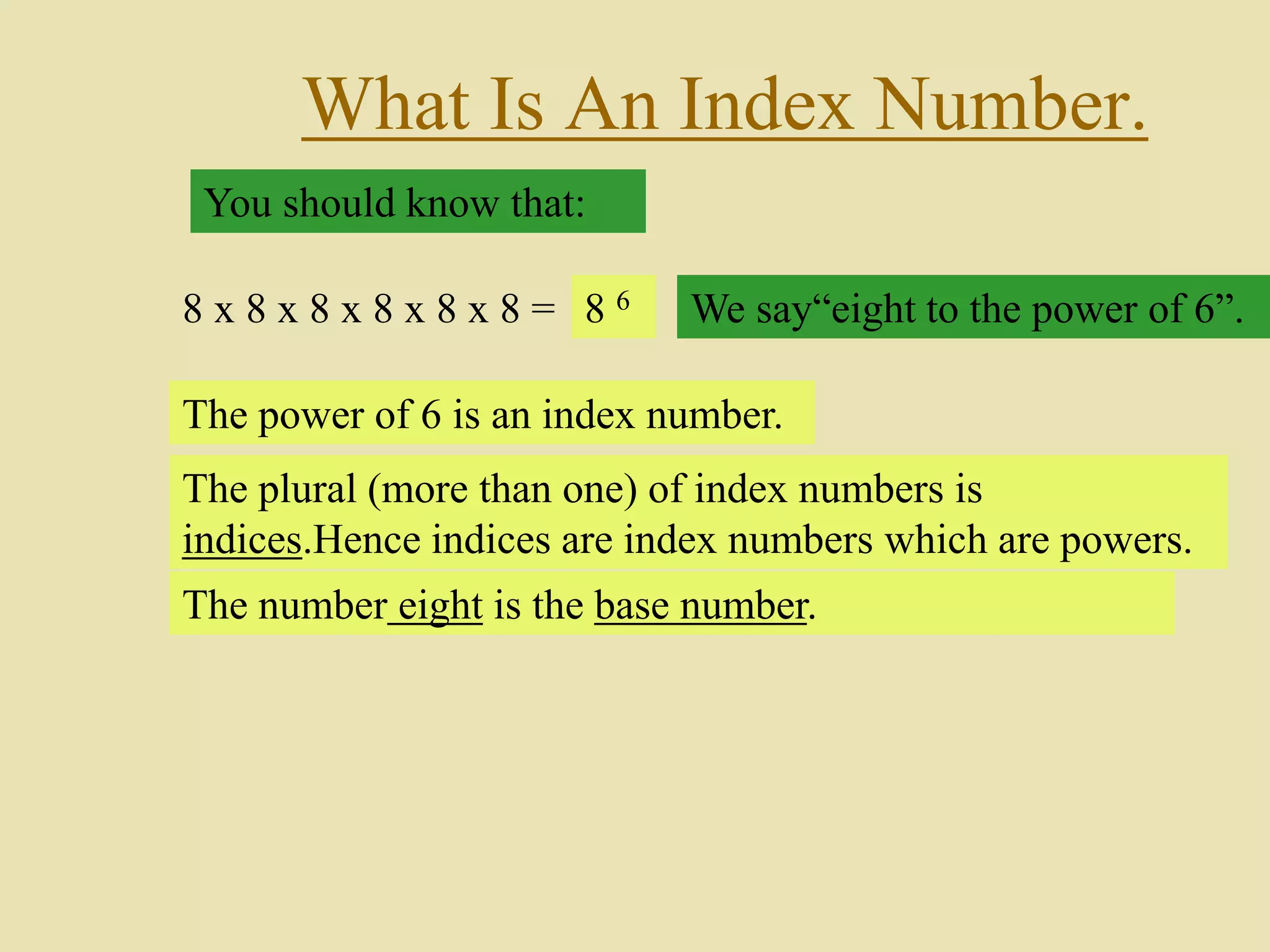
You should know that:
8 x 8 x 8 x 8 x 8 x 8 = 8 6 We say“eight to the power of 6”.
The power of 6 is an index number.
The plural (more than one) of index numbers is
indices.Hence indices are index numbers which are powers.
The number eight is the base number.
Multiplication Of Indices.
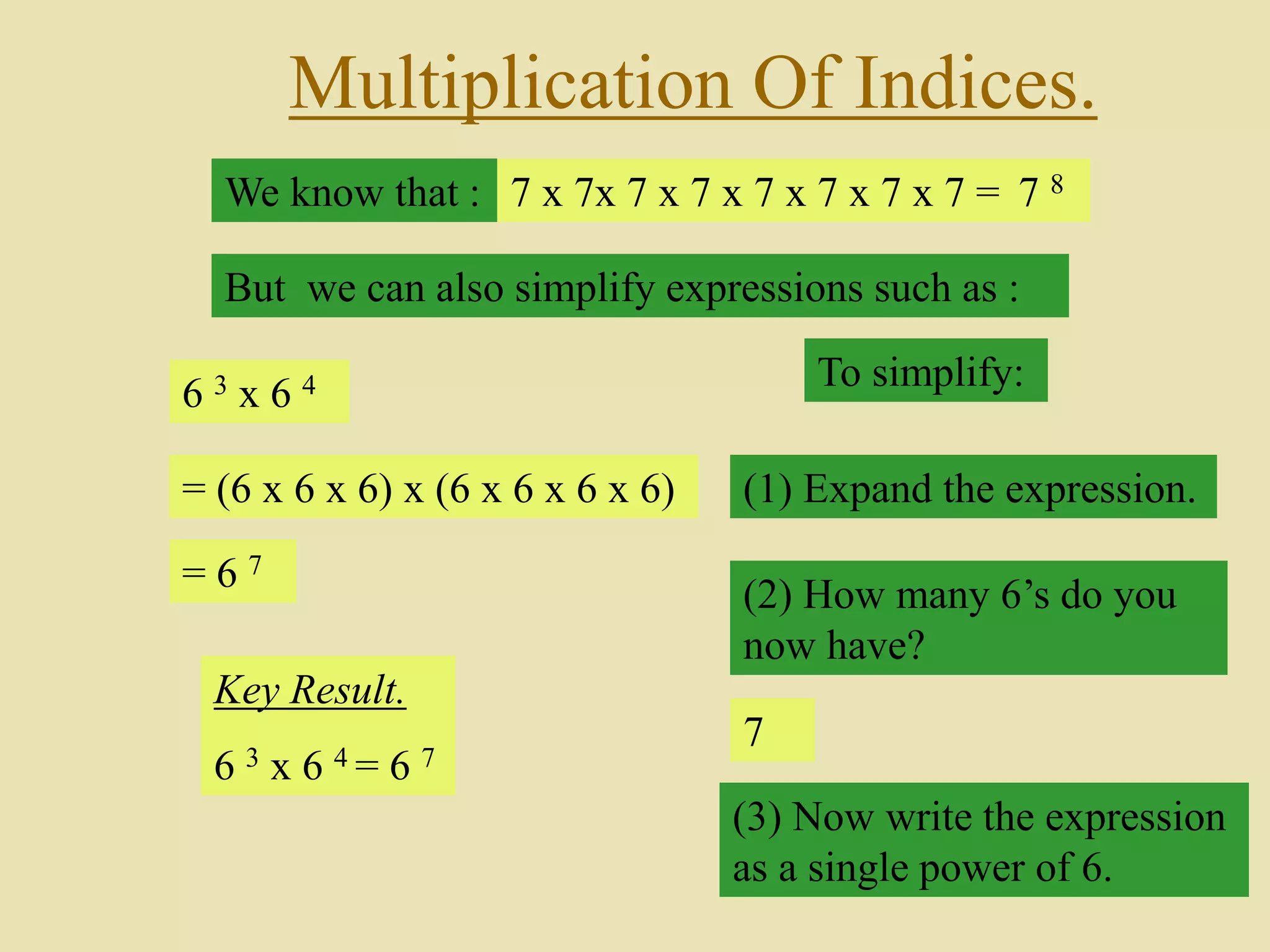
We know that : 7 x 7x 7 x 7 x 7 x 7 x 7 x 7 = 7 8
But we can also simplify expressions such as :
6 3 x 6 4 To simplify:
(1) Expand the expression.= (6 x 6 x 6) x (6 x 6 x 6 x 6)
(2) How many 6’s do you
now have?
7
(3) Now write the expression
as a single power of 6.
= 6 7
Key Result.
6 3 x 6 4 = 6 7
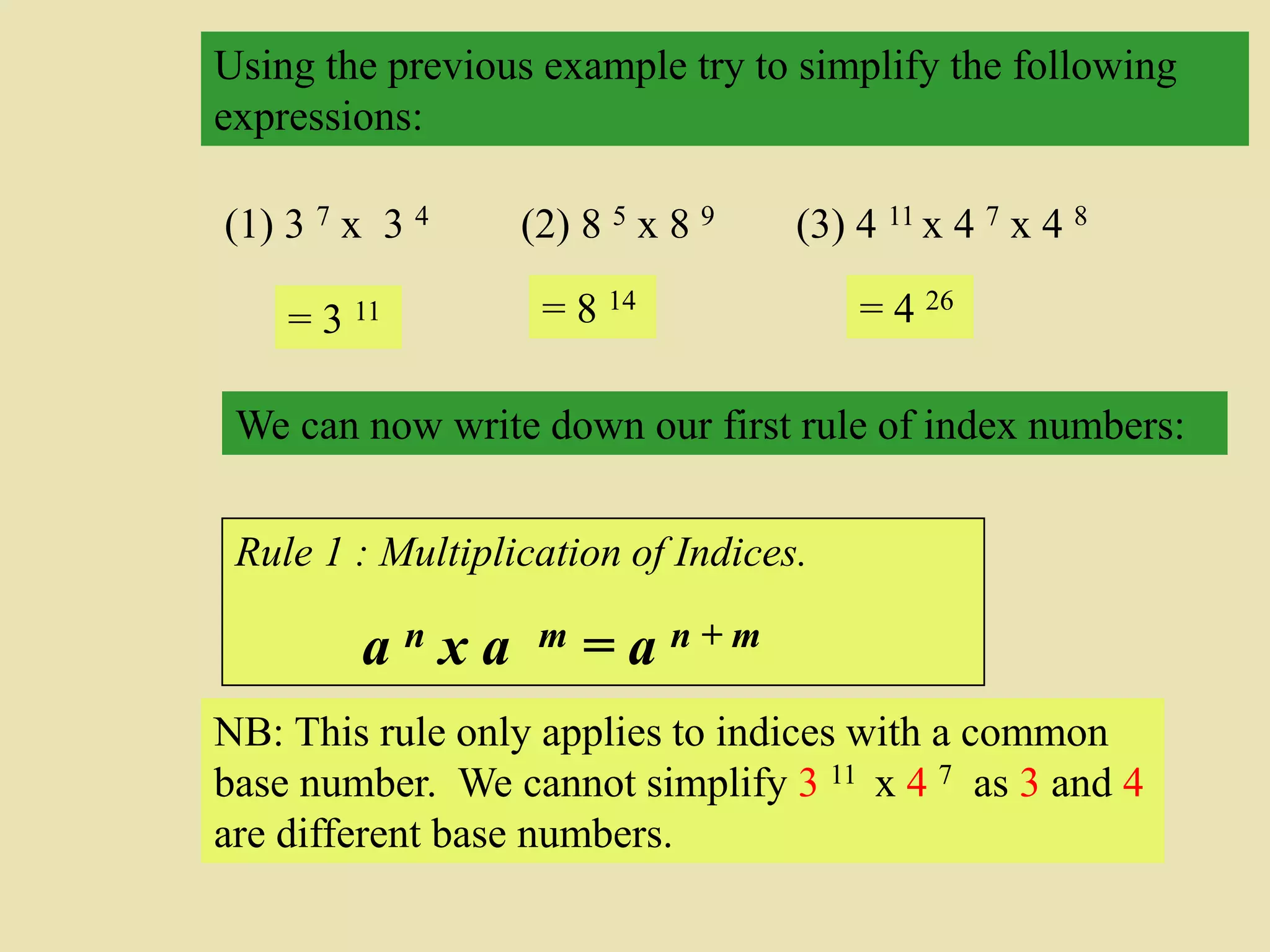
Using the previous example try to simplify the following
expressions:
(1) 3 7 x 3 4
= 3 11
(2) 8 5 x 8 9
= 8 14
(3) 4 11 x 4 7 x 4 8
= 4 26
We can now write down our first rule of index numbers:
Rule 1 : Multiplication of Indices.
a n x a m = a n + m
NB: This rule only applies to indices with a common
base number. We cannot simplify 3 11 x 4 7 as 3 and 4
are different base numbers.
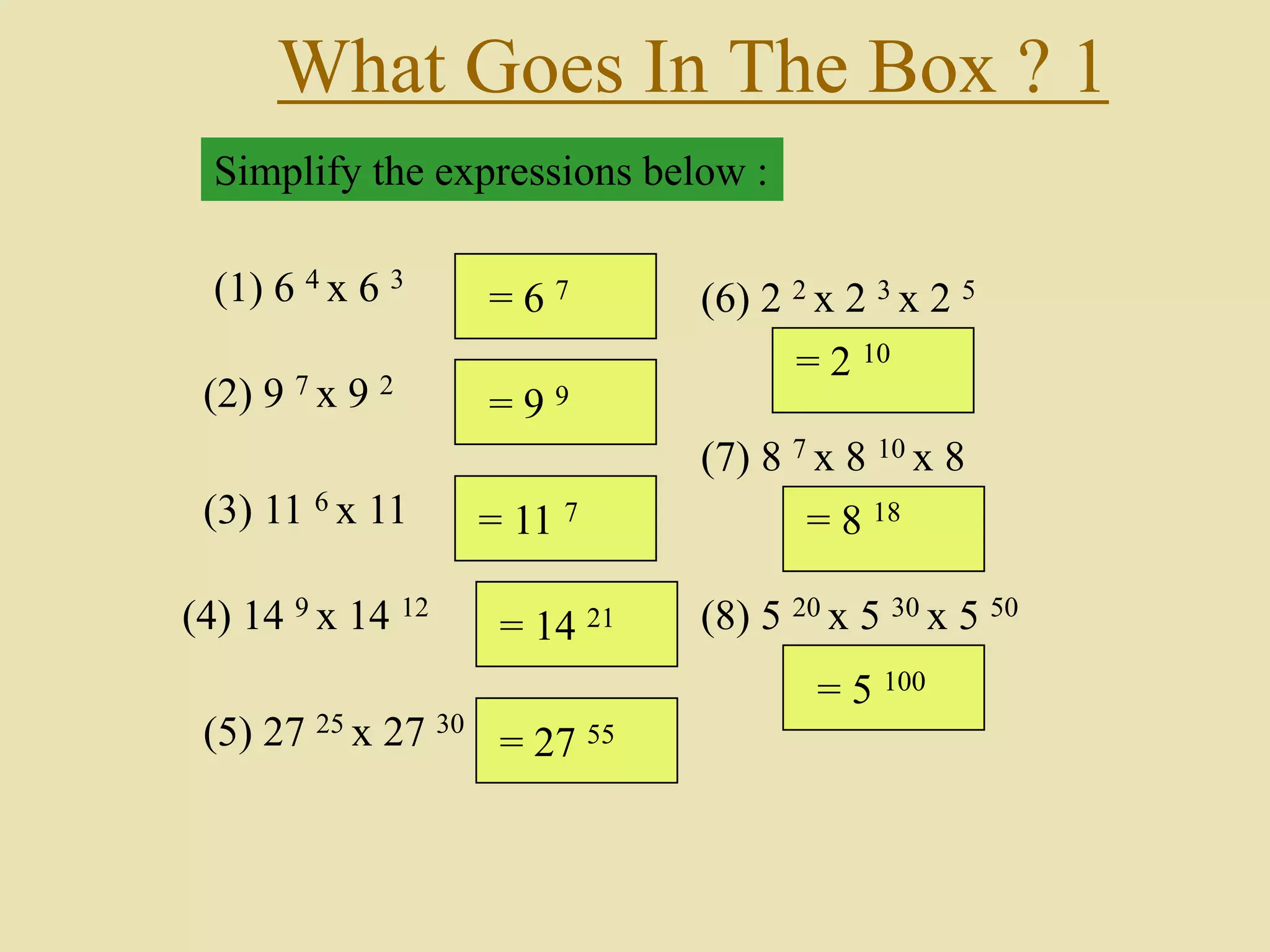
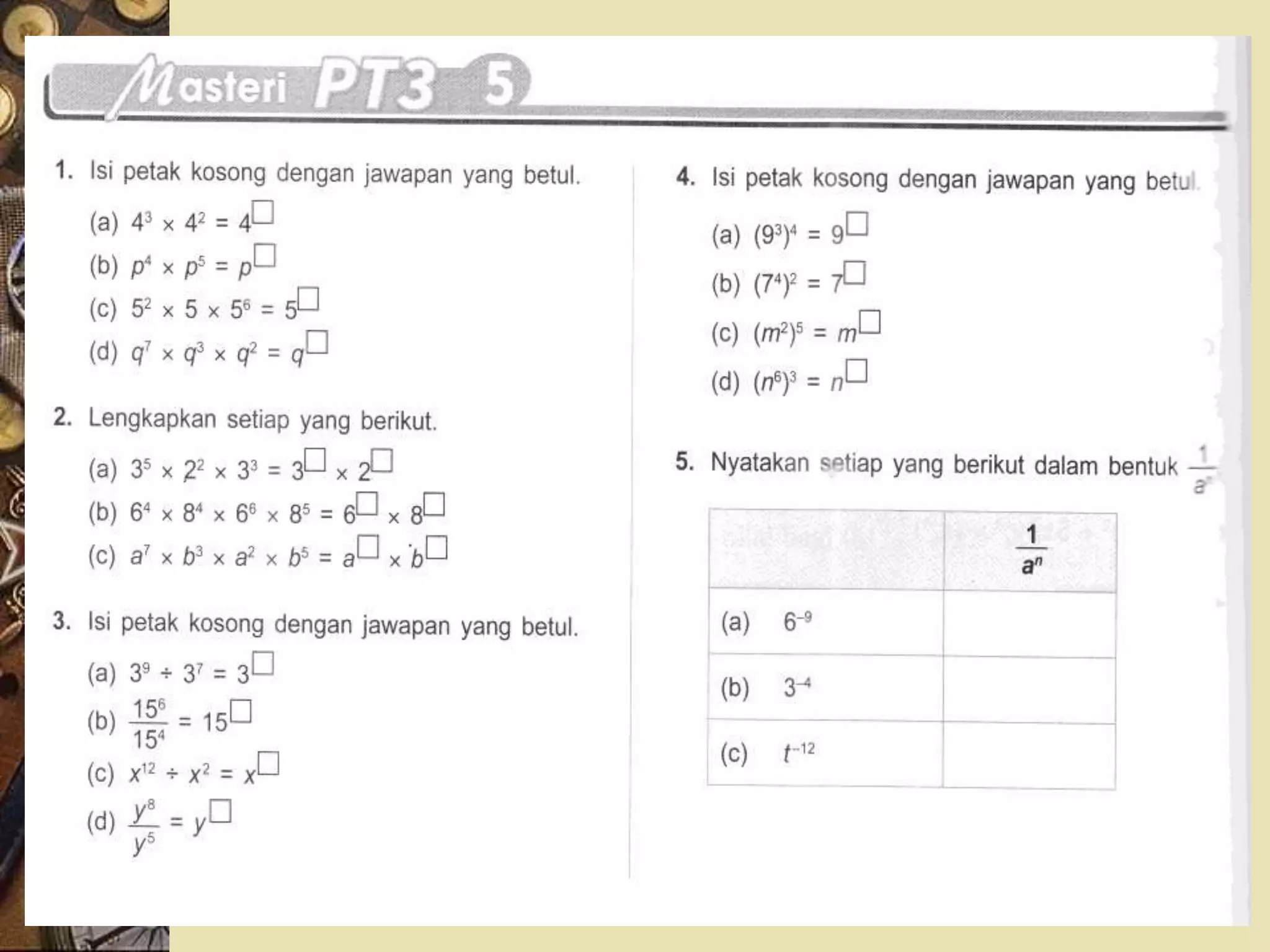
What Goes In The Box ? 1
Simplify the expressions below :
(1) 6 4 x 6 3
(2) 9 7 x 9 2
(3) 11 6 x 11
(4) 14 9 x 14 12
(5) 27 25 x 27 30
(6) 2 2 x 2 3 x 2 5
(7) 8 7 x 8 10 x 8
(8) 5 20 x 5 30 x 5 50
= 6 7
= 9 9
= 11 7
= 14 21
= 27 55
= 2 10
= 8 18
= 5 100
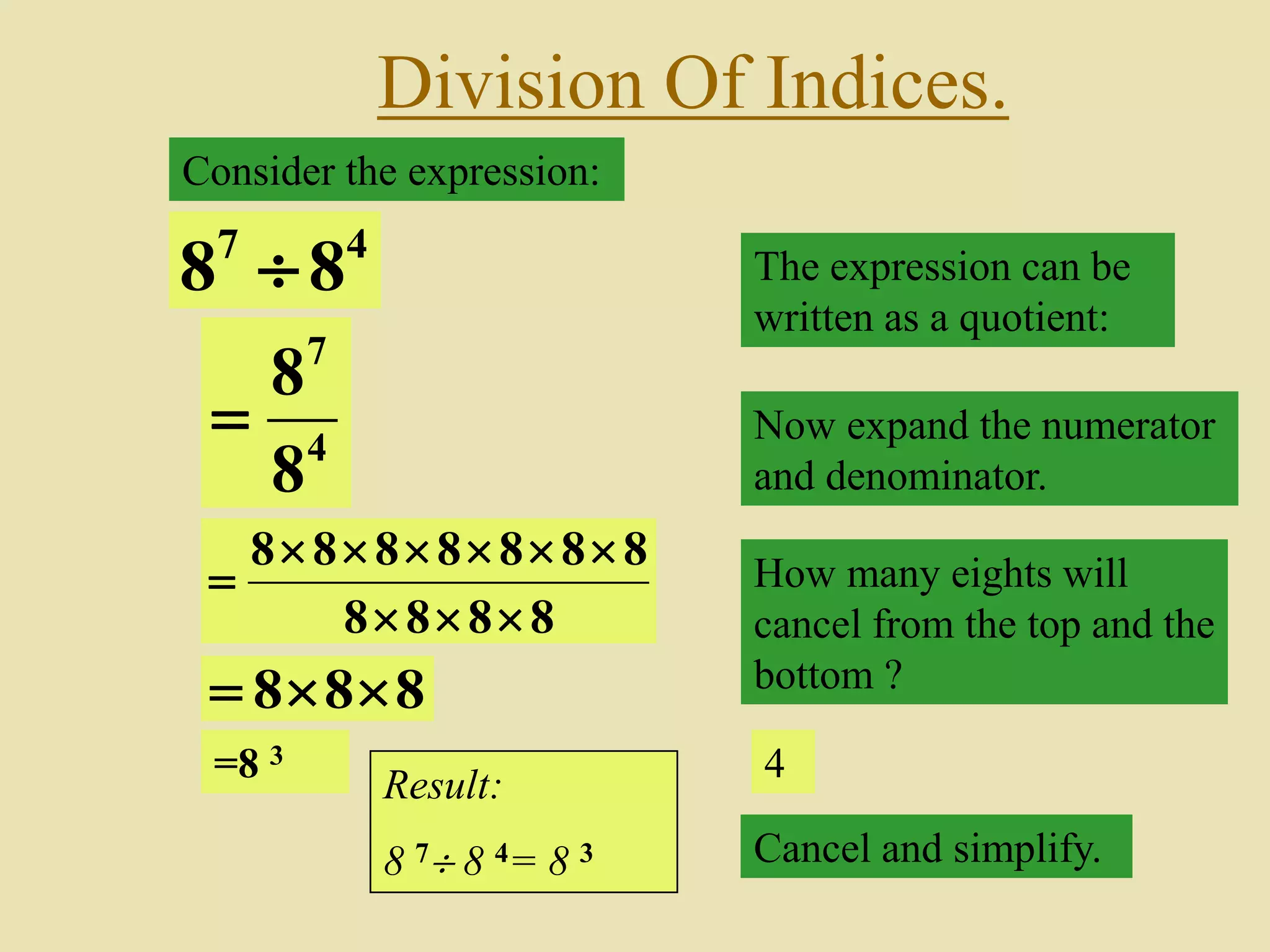
Division Of Indices.
Consider the expression:
47
88  The expression can be
written as a quotient:
4
7
8
8
 Now expand the numerator
and denominator.
8888
8888888


 How many eights will
cancel from the top and the
bottom ?
4
Cancel and simplify.
888 
=8 3
Result:
8 7 8 4= 8 3
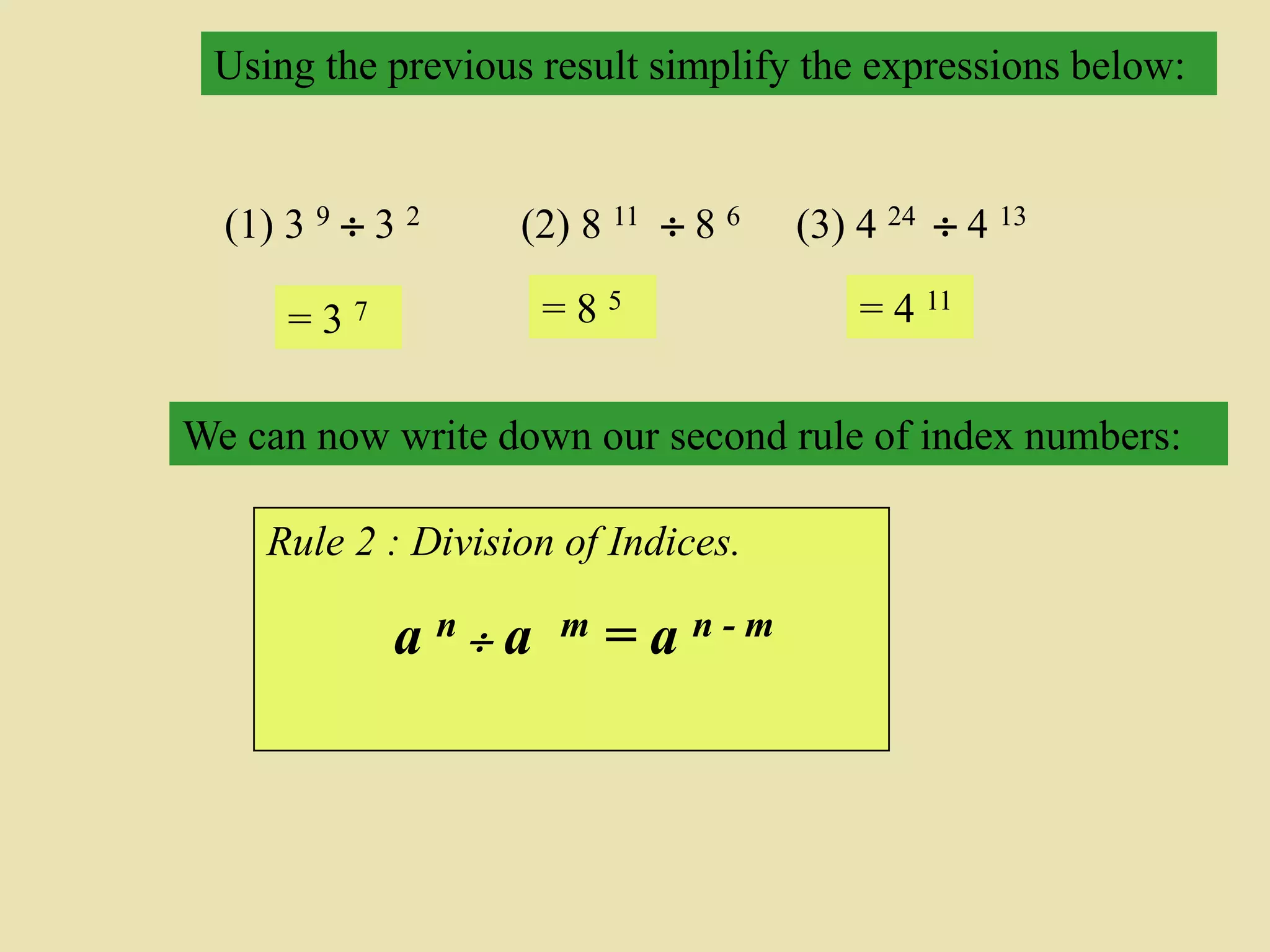
Using the previous result simplify the expressions below:
(1) 3 9  3 2
= 3 7
(2) 8 11  8 6
= 8 5
(3) 4 24  4 13
= 4 11
Rule 2 : Division of Indices.
a n  a m = a n - m
We can now write down our second rule of index numbers:
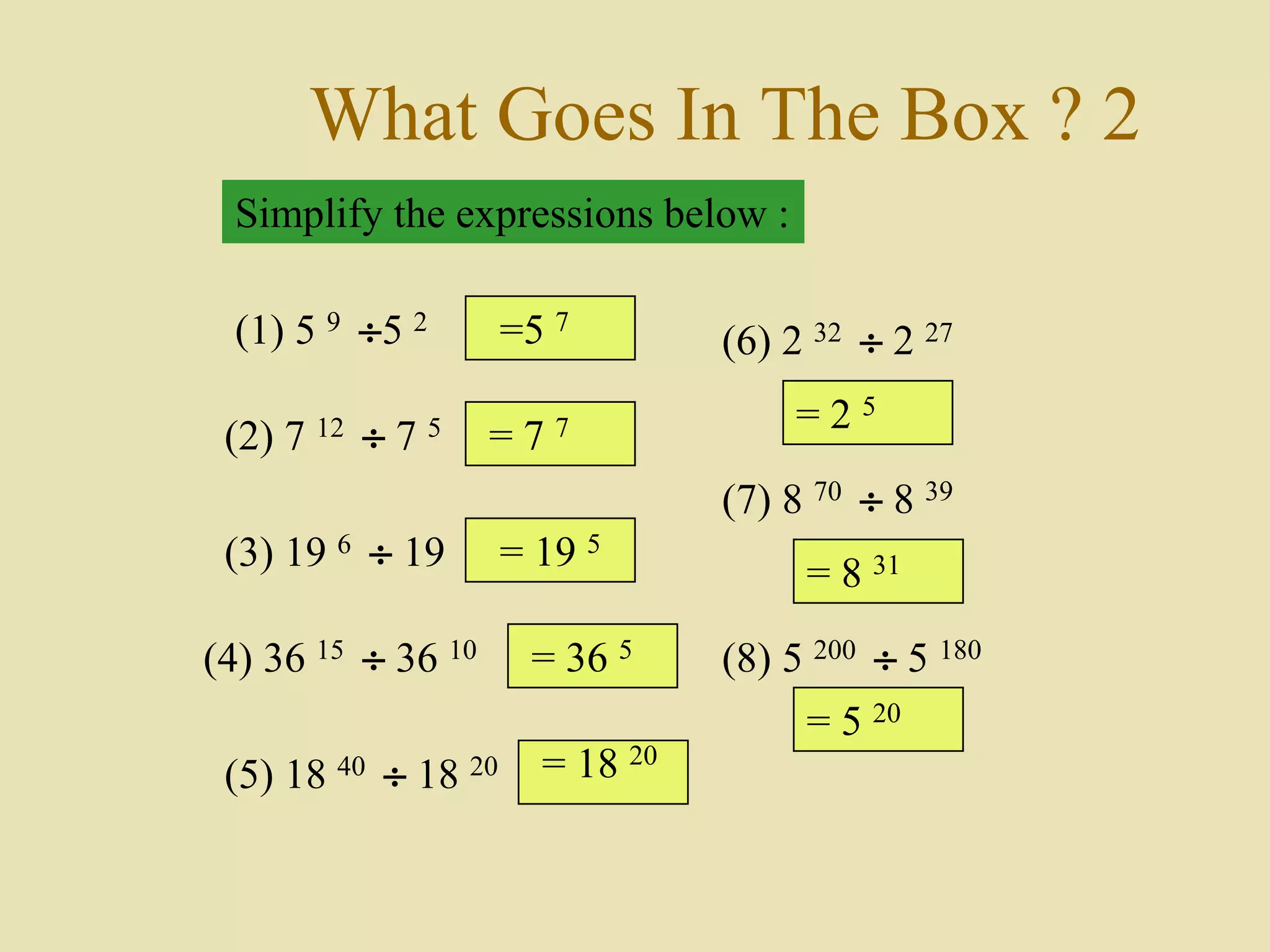
What Goes In The Box ? 2
Simplify the expressions below :
(1) 5 9 5 2
(2) 7 12  7 5
(3) 19 6  19
(4) 36 15  36 10
(5) 18 40  18 20
(6) 2 32  2 27
(7) 8 70  8 39
(8) 5 200  5 180
=5 7
= 7 7
= 19 5
= 36 5
= 18 20
= 2 5
= 8 31
= 5 20
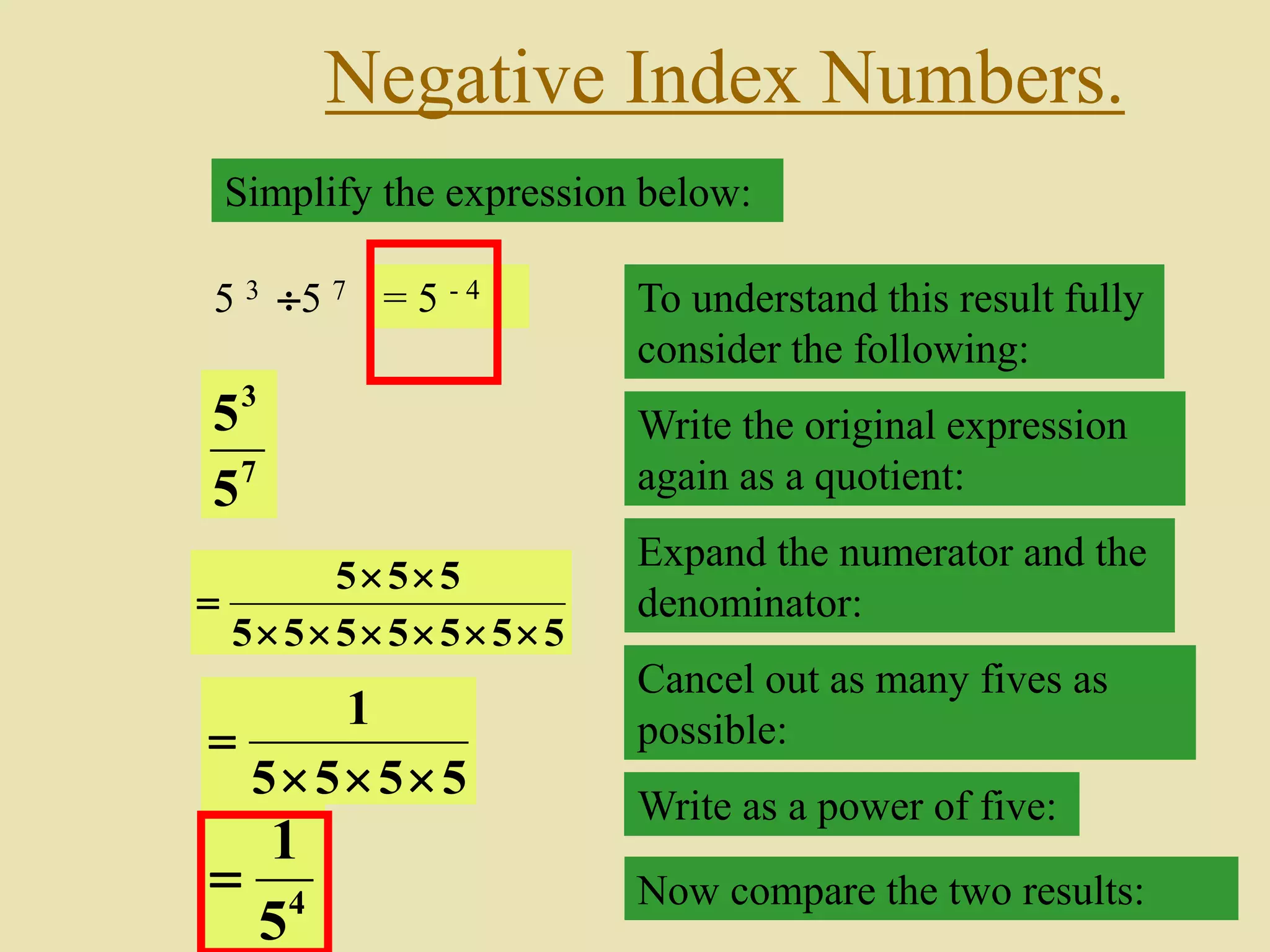
Negative Index Numbers.
Simplify the expression below:
5 3 5 7 = 5 - 4 To understand this result fully
consider the following:
Write the original expression
again as a quotient:
Expand the numerator and the
denominator:
5555555
555



7
3
5
5
Cancel out as many fives as
possible:
5555
1


Write as a power of five:
Now compare the two results:4
5
1

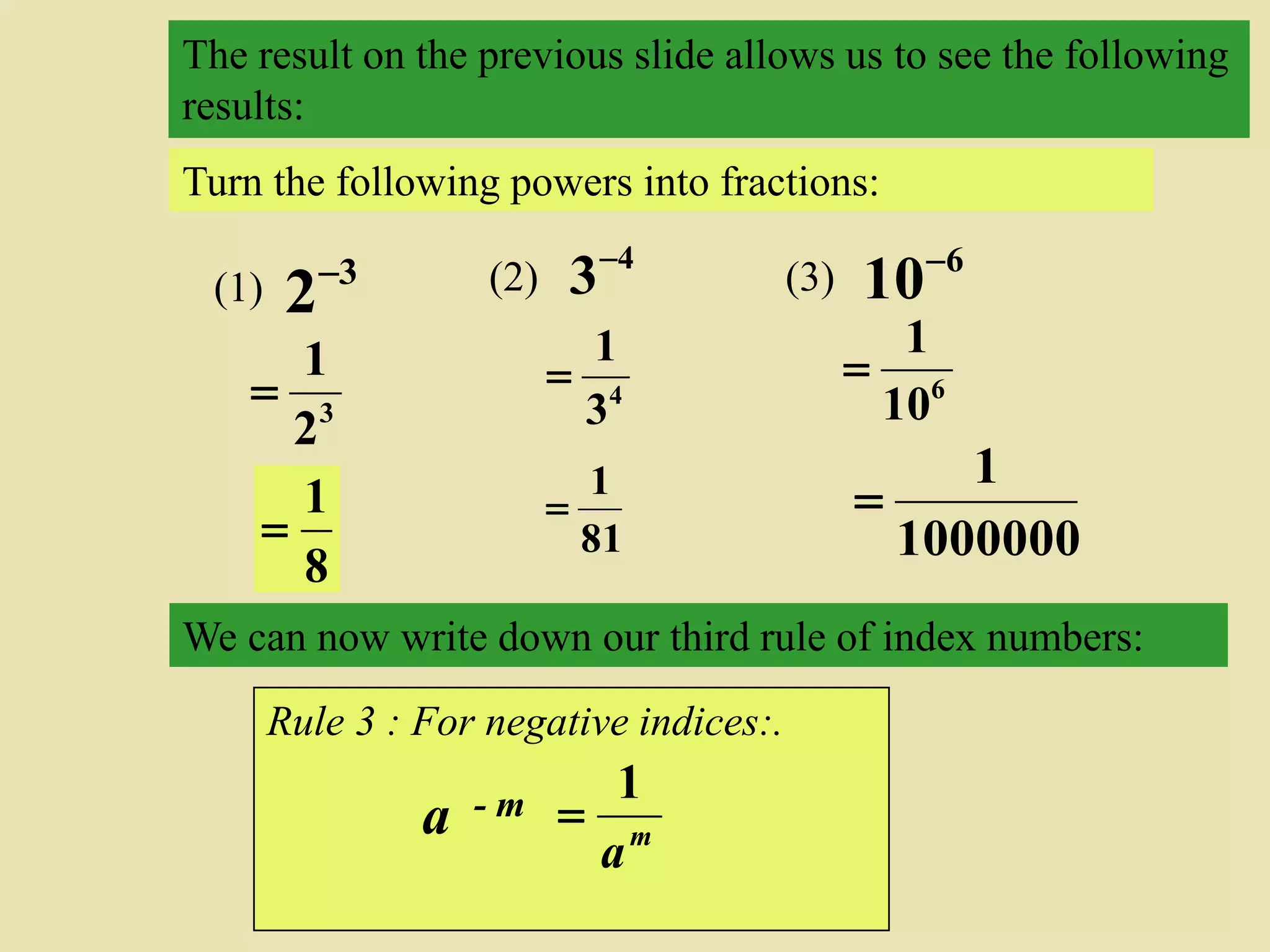
The result on the previous slide allows us to see the following
results:
Turn the following powers into fractions:
(1) 3
2
3
2
1

8
1

(2)
4
3
4
3
1

81
1

(3) 6
10
6
10
1

1000000
1

We can now write down our third rule of index numbers:
Rule 3 : For negative indices:.
a - m
m
a
1

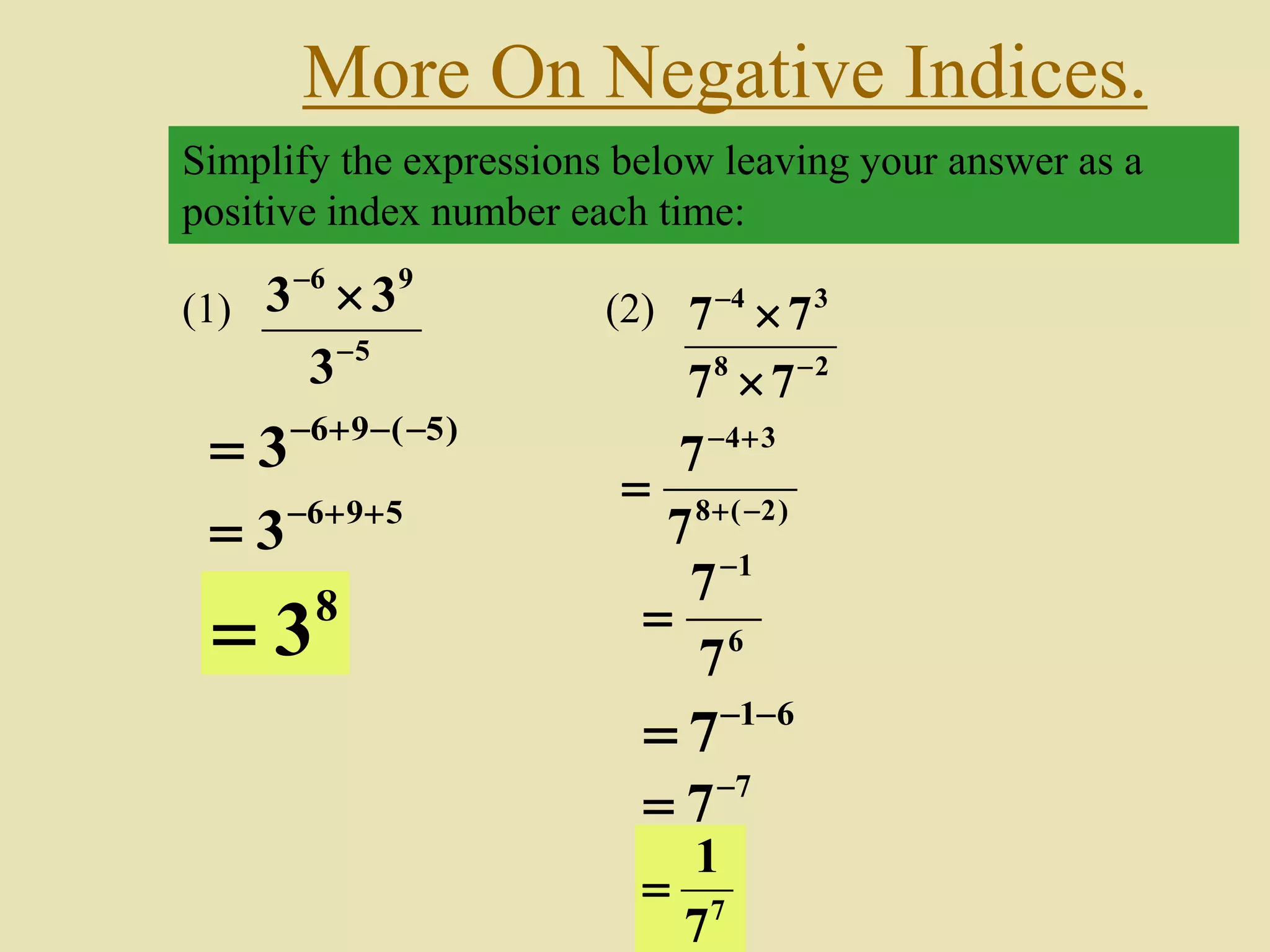
More On Negative Indices.
Simplify the expressions below leaving your answer as a
positive index number each time:
(1)
5
96
3
33



)5(96
3 

596
3 

8
3
(2)
28
34
77
77




)2(8
34
7
7



6
1
7
7

61
7 

7
7

7
7
1

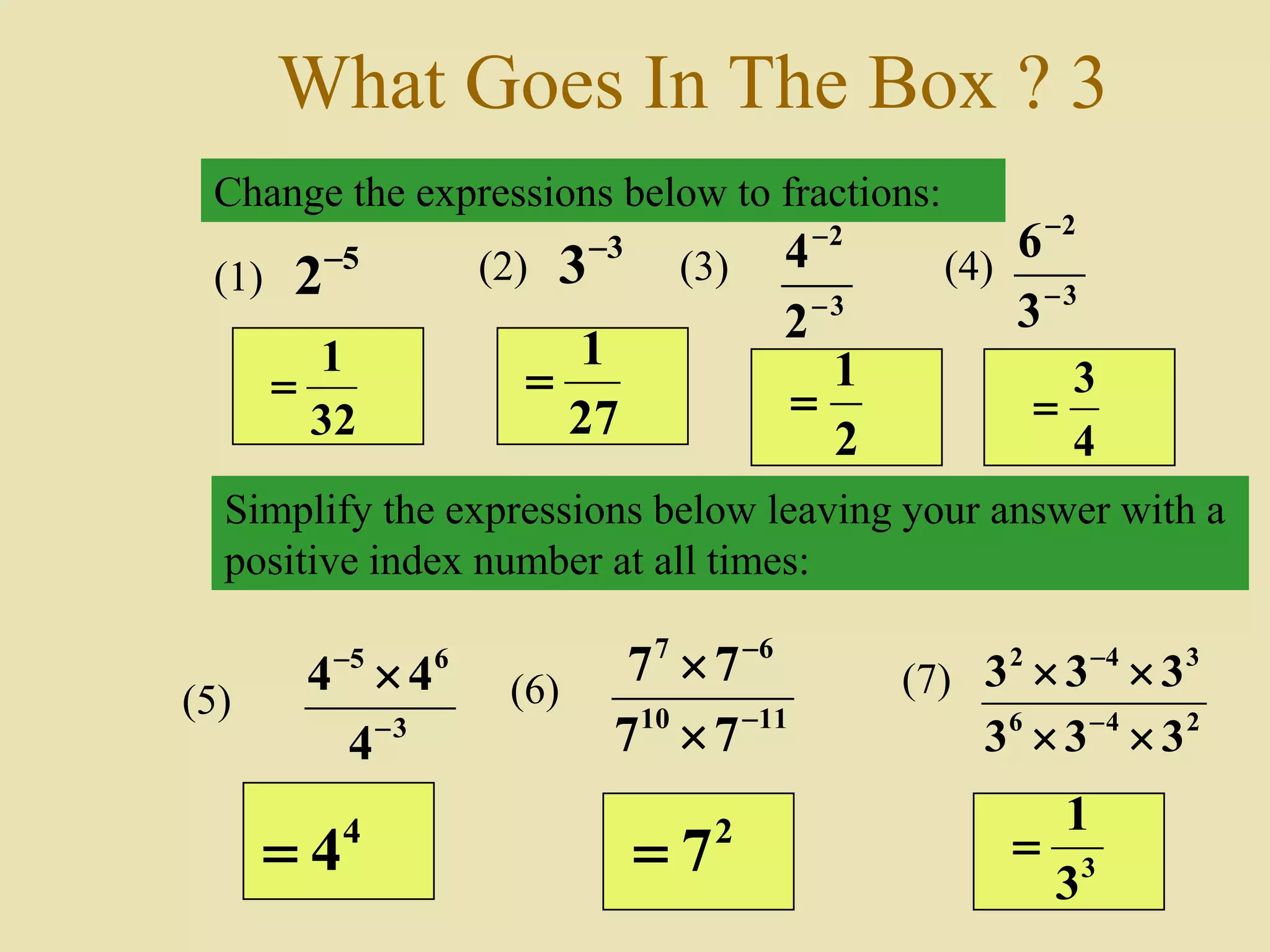
What Goes In The Box ? 3
Change the expressions below to fractions:
Simplify the expressions below leaving your answer with a
positive index number at all times:
(1)
5
2 (2)
3
3
3
2
2
4


(3) (4)
3
2
3
6


3
65
4
44


(5) 1110
67
77
77



(6) (7)
246
342
333
333




32
1

27
1

2
1

4
3

4
4 2
7 3
3
1

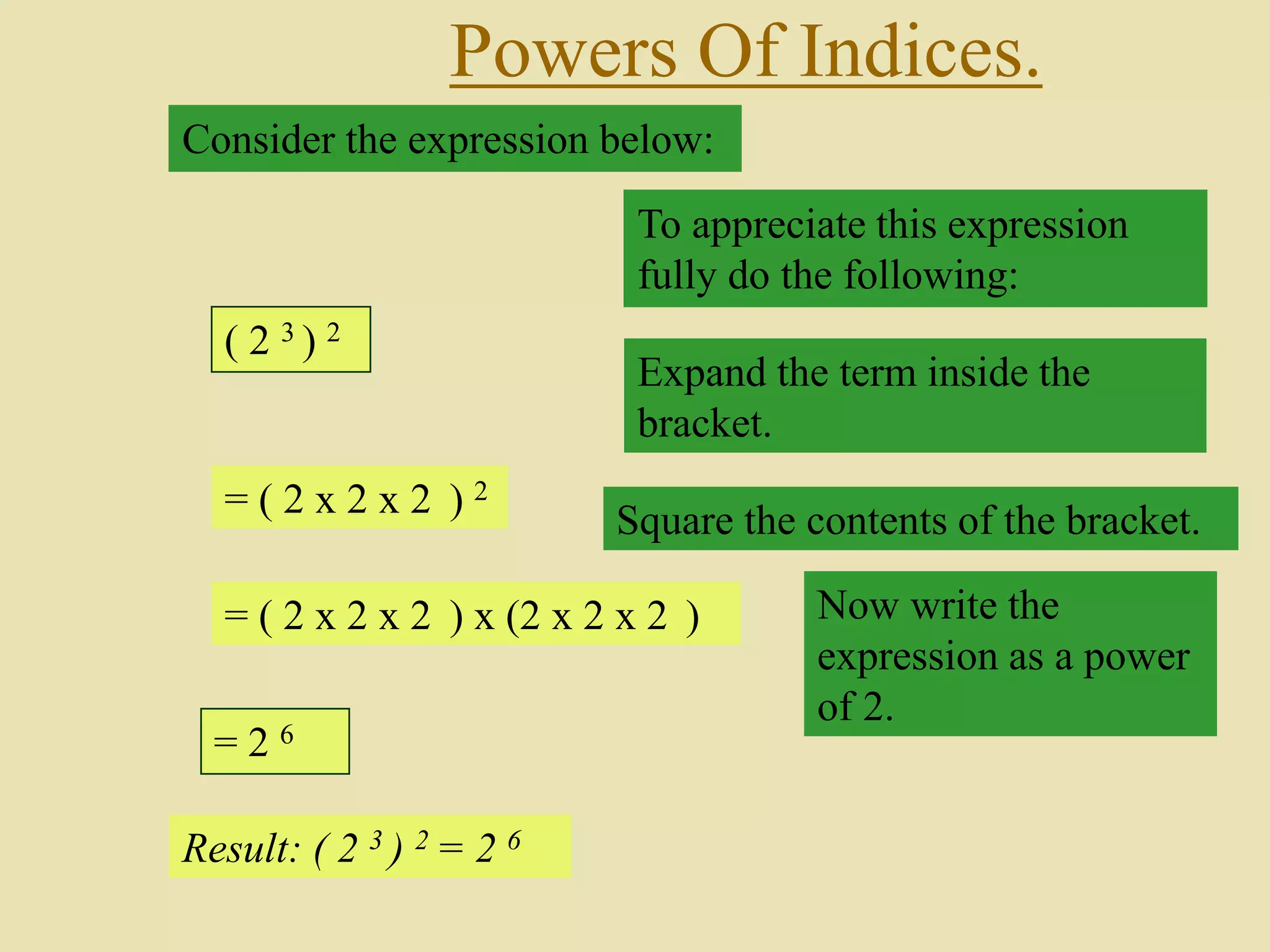
Powers Of Indices.
Consider the expression below:
( 2 3 ) 2
To appreciate this expression
fully do the following:
Expand the term inside the
bracket.
= ( 2 x 2 x 2 ) 2
Square the contents of the bracket.
= ( 2 x 2 x 2 ) x (2 x 2 x 2 ) Now write the
expression as a power
of 2.
= 2 6
Result: ( 2 3 ) 2 = 2 6
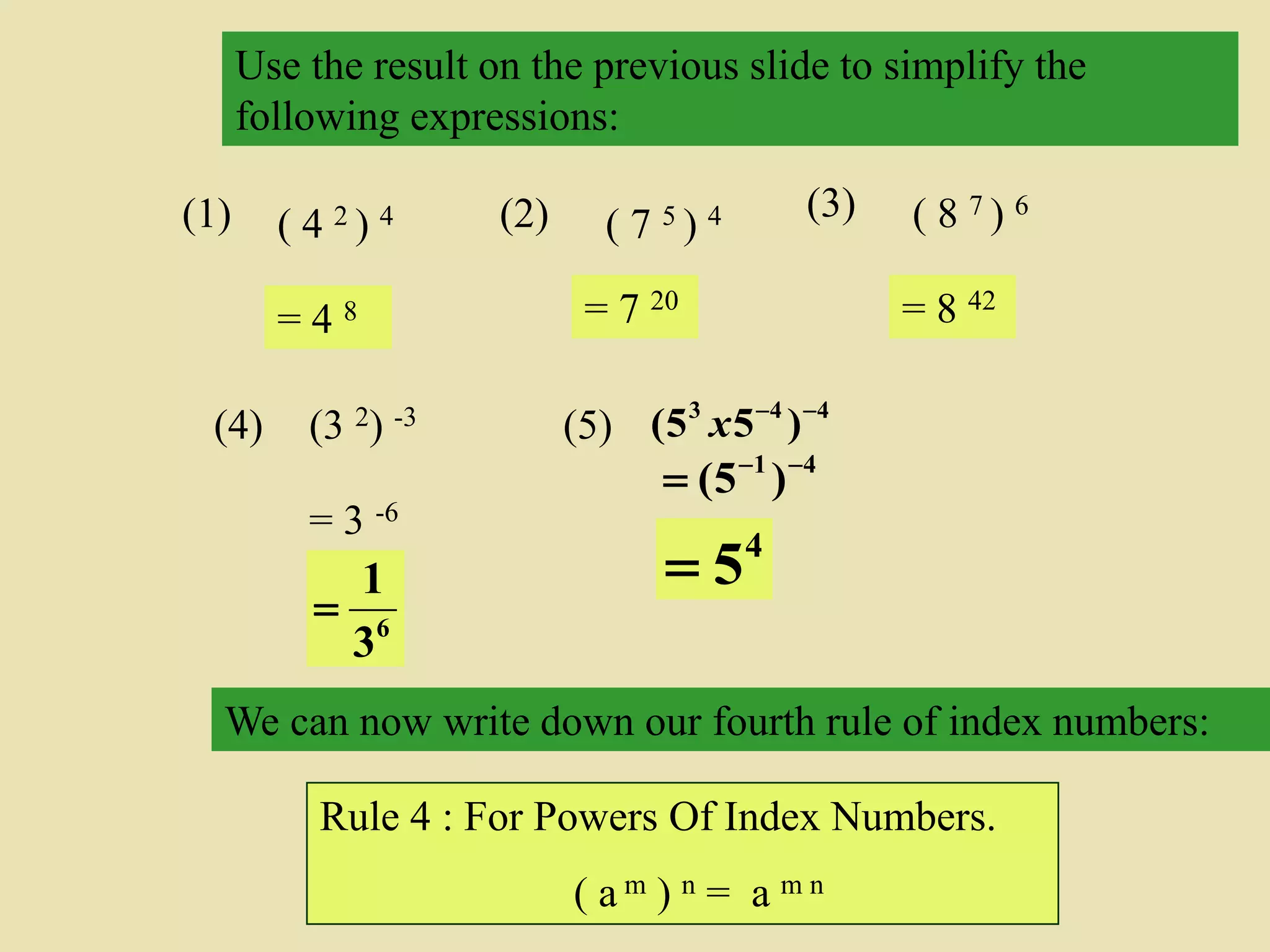
Use the result on the previous slide to simplify the
following expressions:
(1) ( 4 2 ) 4 (2) ( 7 5 ) 4 (3) ( 8 7 ) 6
= 4 8 = 7 20 = 8 42
We can now write down our fourth rule of index numbers:
Rule 4 : For Powers Of Index Numbers.
( a m ) n = a m n
(4) (3 2) -3
= 3 -6
6
3
1

41
)5( 

(5) 443
)55( 
x
4
5
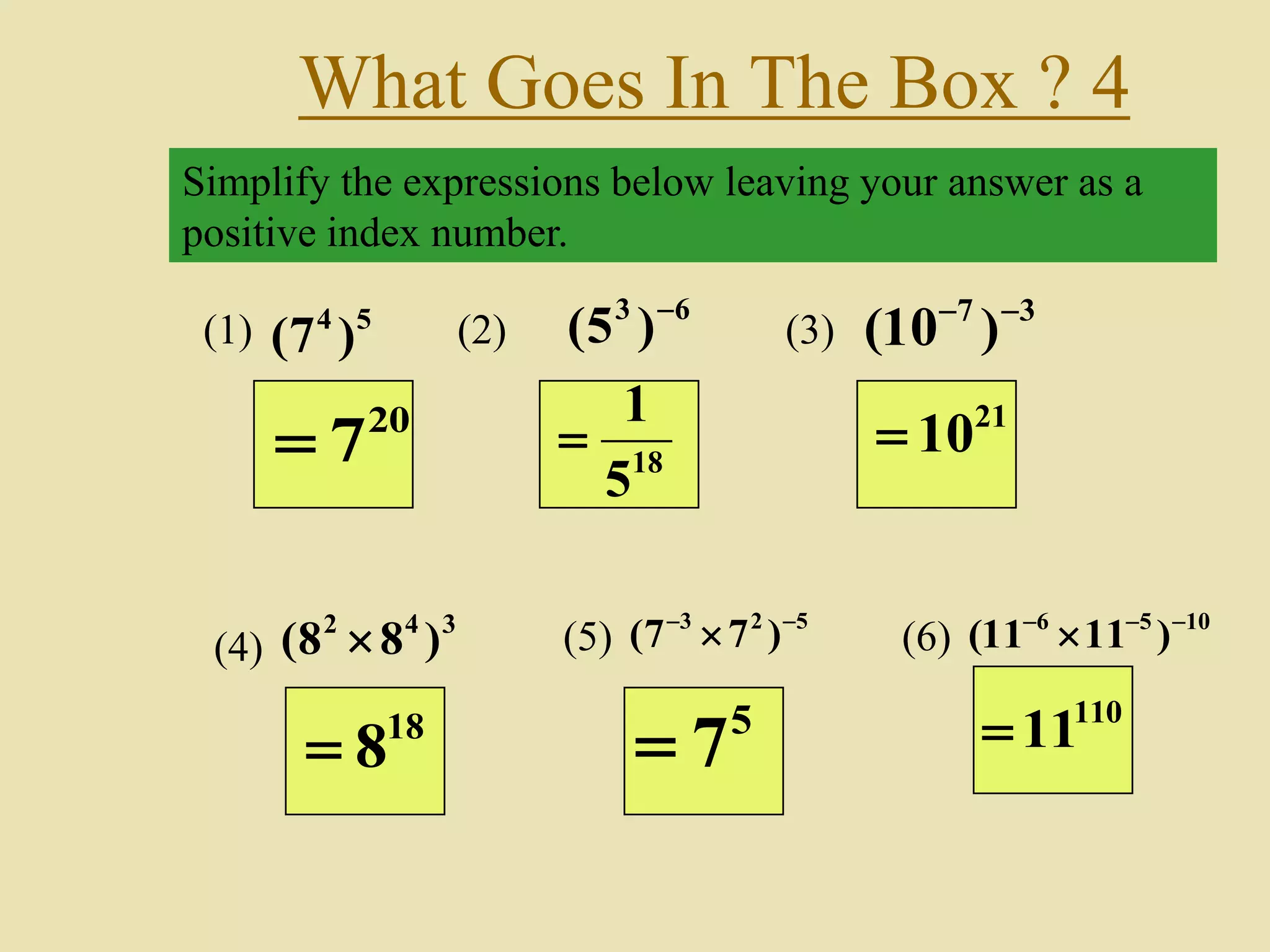
What Goes In The Box ? 4
Simplify the expressions below leaving your answer as a
positive index number.
(1) 54
)7(
63
)5( 
(2) (3)
37
)10( 
(4)
342
)88(  (5)
523
)77( 
 (6)
1056
)1111( 

20
7 18
5
1

21
10
18
8
5
7
110
11
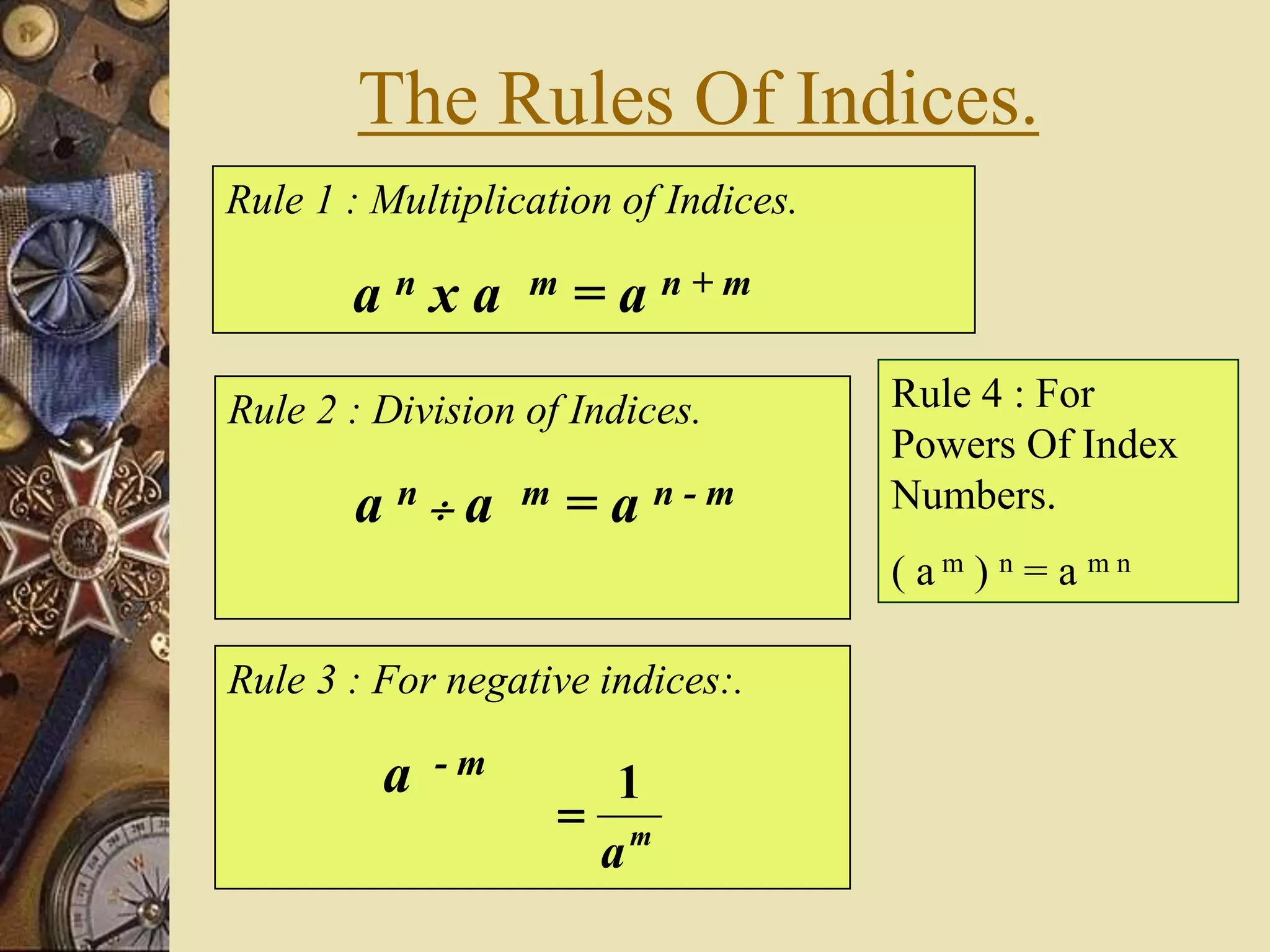
The Rules Of Indices.
Rule 4 : For
Powers Of Index
Numbers.
( a m ) n = a m n
Rule 1 : Multiplication of Indices.
a n x a m = a n + m
Rule 2 : Division of Indices.
a n  a m = a n - m
Rule 3 : For negative indices:.
a - m
m
a
1

Applying The Rules With Fractions.
We are now going to look at the rules of indices again but
use them with fractions that are obtained from the roots of
numbers.
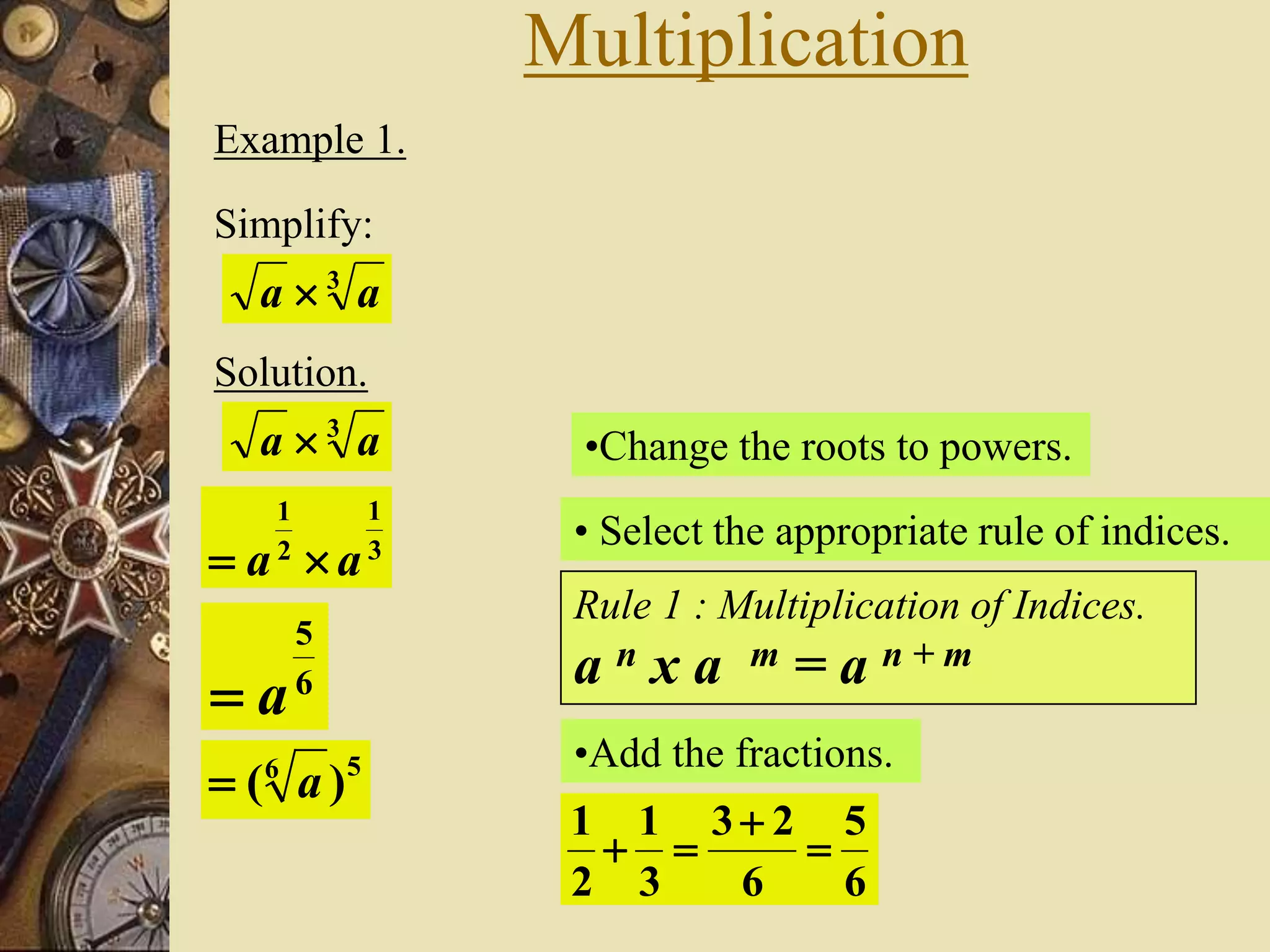
Multiplication
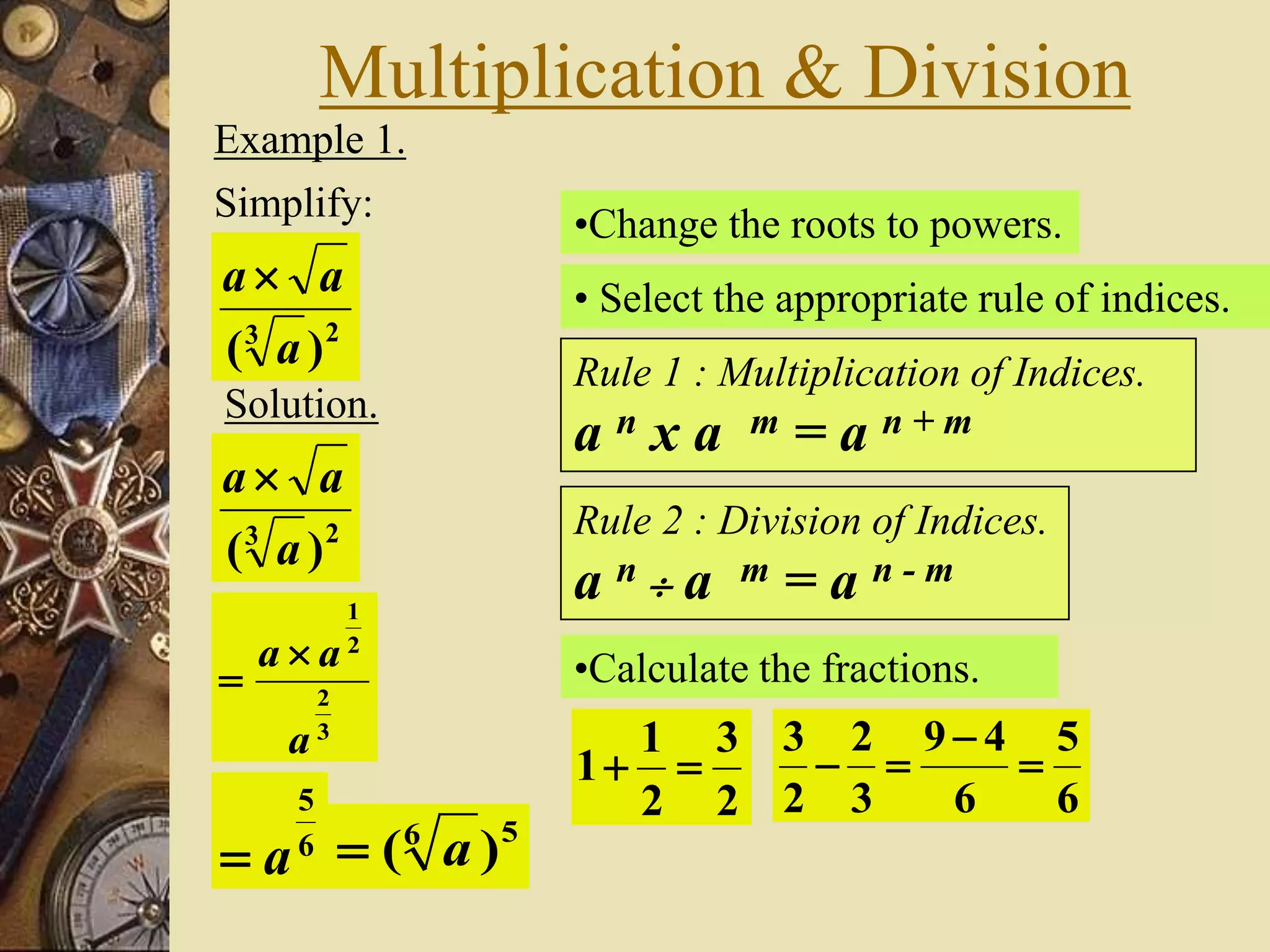
Example 1.
Simplify:
3
aa 
Solution.
3
aa  •Change the roots to powers.
3
1
2
1
aa 
• Select the appropriate rule of indices.
Rule 1 : Multiplication of Indices.
a n x a m = a n + m
•Add the fractions.
6
5
6
23
3
1
2
1



6
5
a
56
)( a
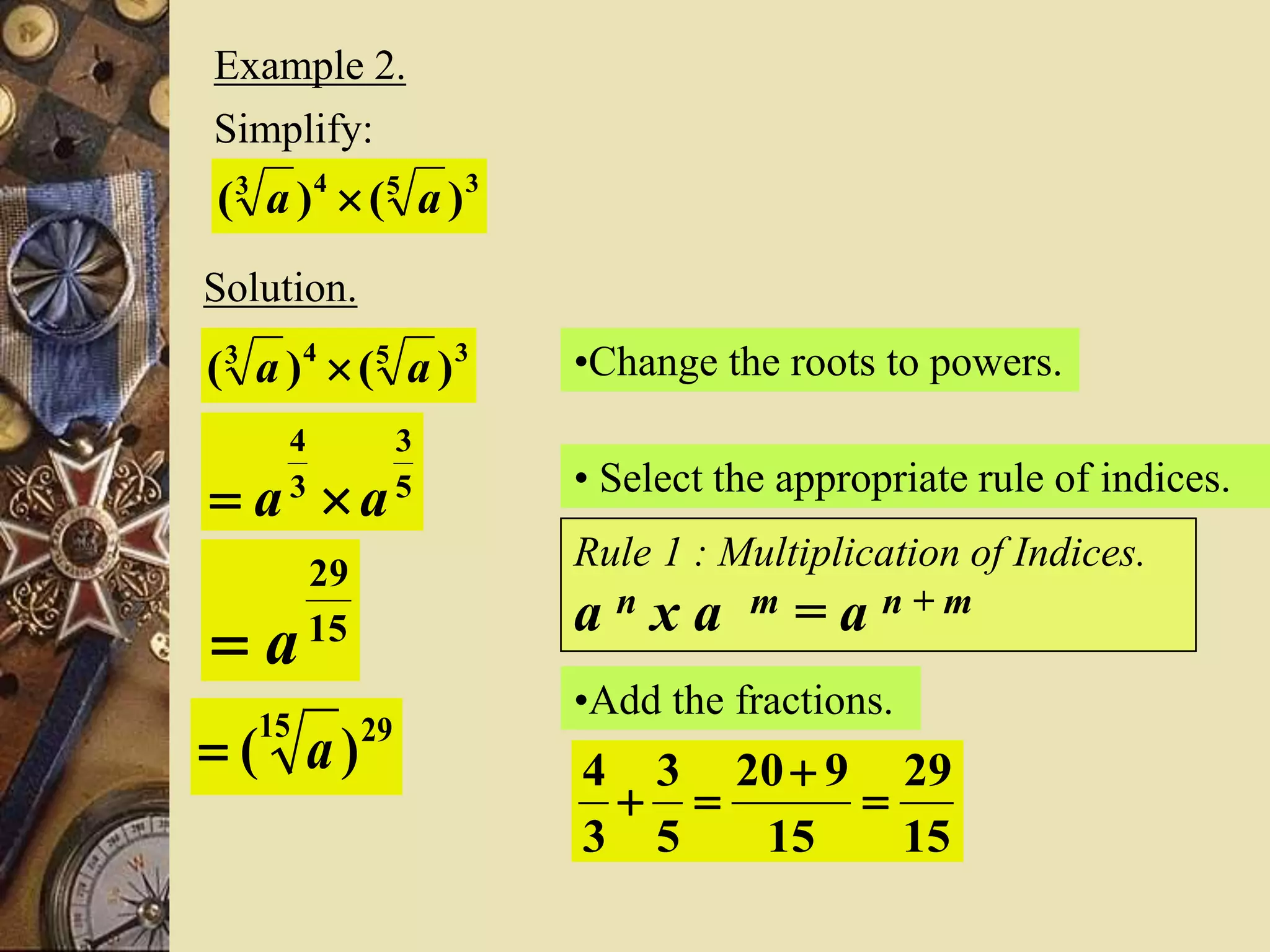
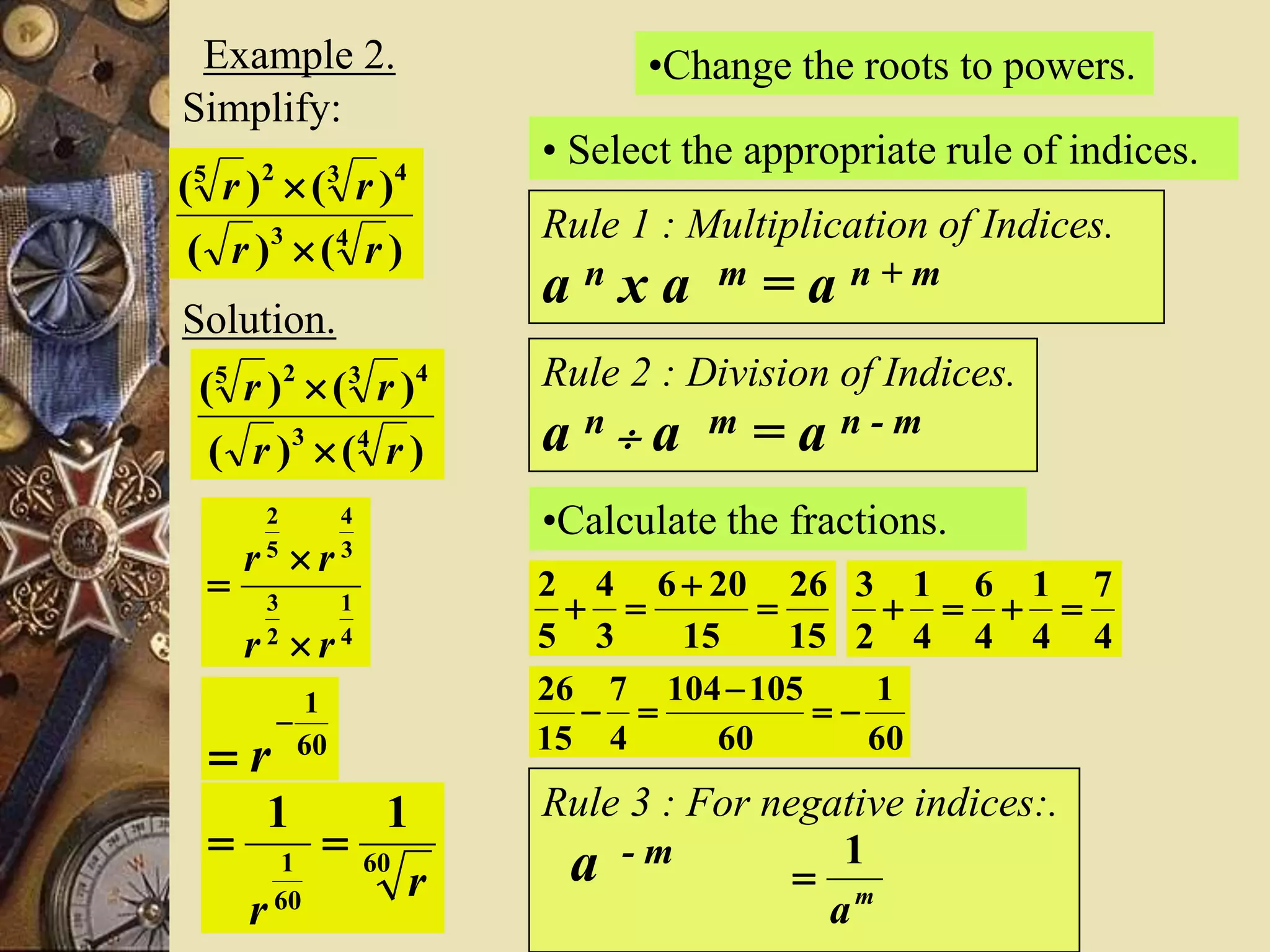
Example 2.
Simplify:
3543
)()( aa 
Solution.
•Change the roots to powers.3543
)()( aa 
5
3
3
4
aa  • Select the appropriate rule of indices.
Rule 1 : Multiplication of Indices.
a n x a m = a n + m
•Add the fractions.
15
29
15
920
5
3
3
4



15
29
a
2915
)( a
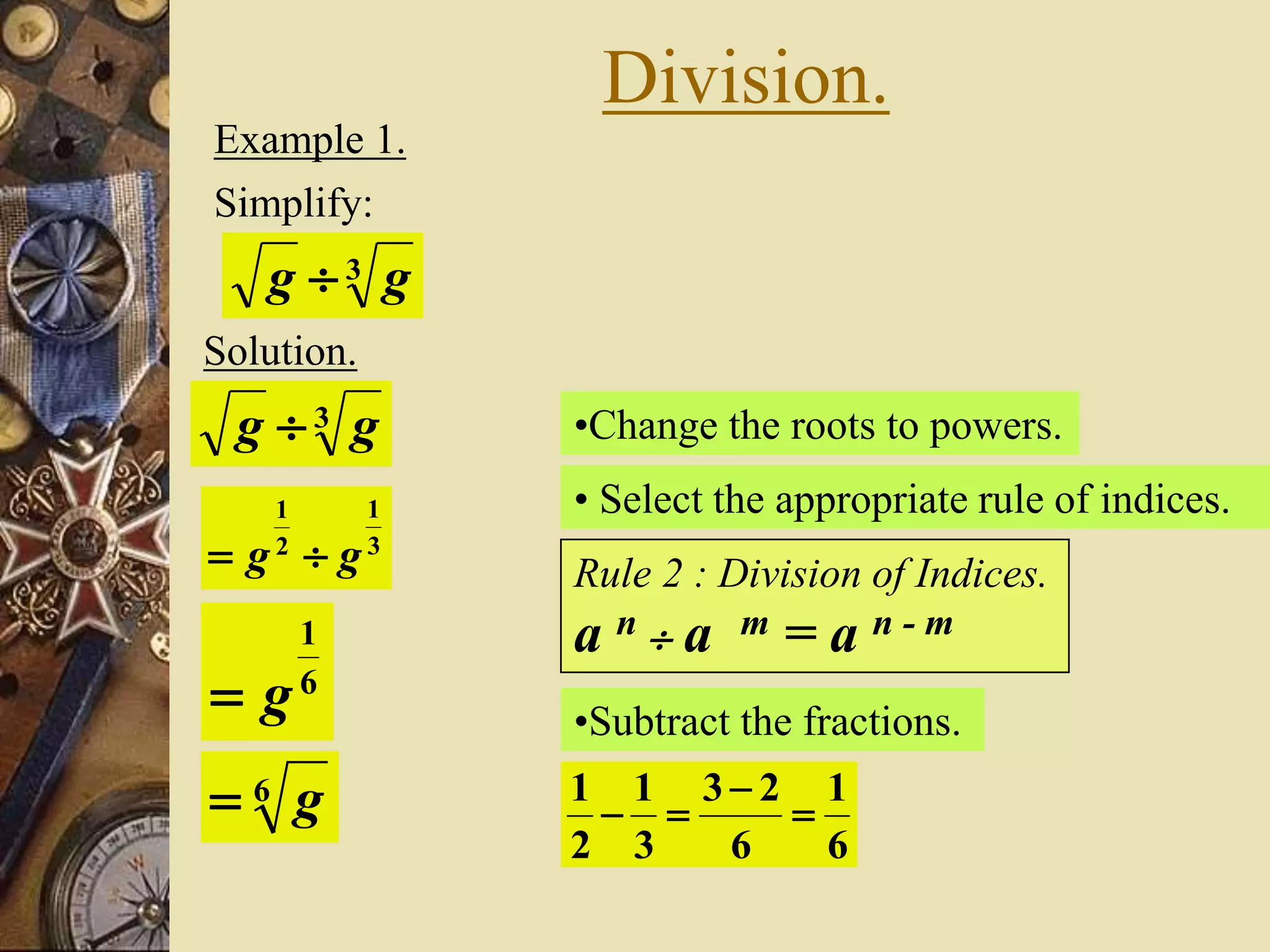
Division.
Example 1.
Simplify:
3 gg 
Solution.
•Change the roots to powers.3 gg 
3
1
2
1
gg 
• Select the appropriate rule of indices.
Rule 2 : Division of Indices.
a n  a m = a n - m
•Subtract the fractions.
6
1
6
23
3
1
2
1



6
1
g
6 g
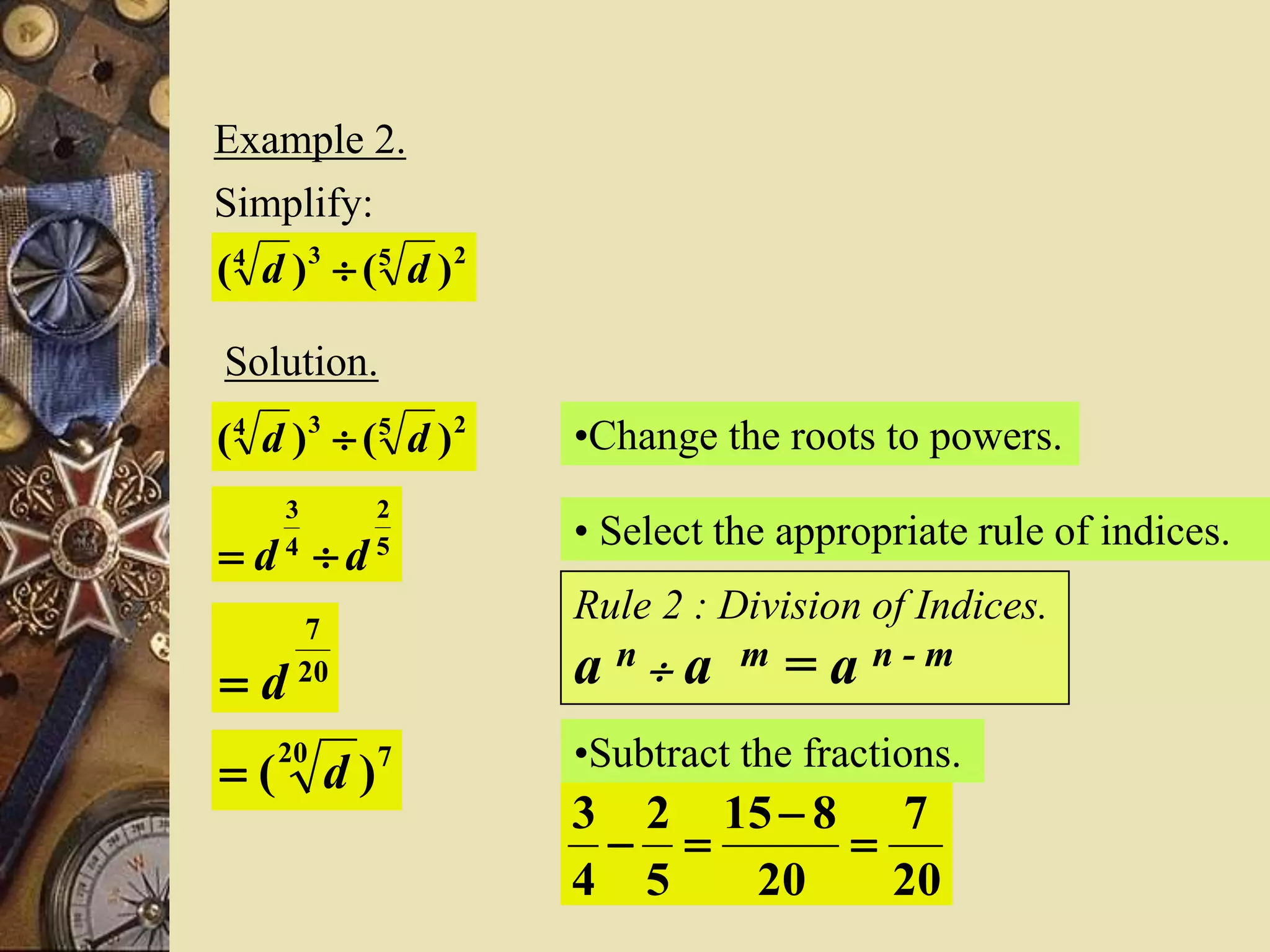
Example 2.
Simplify:
2534
)()( dd 
Solution.
2534
)()( dd  •Change the roots to powers.
5
2
4
3
dd 
• Select the appropriate rule of indices.
Rule 2 : Division of Indices.
a n  a m = a n - m
•Subtract the fractions.
20
7
20
815
5
2
4
3



20
7
d
720
)( d
Multiplication & Division
Example 1.
Simplify:
23
)( a
aa
Solution.
23
)( a
aa
•Change the roots to powers.
3
2
2
1
a
aa 

• Select the appropriate rule of indices.
Rule 1 : Multiplication of Indices.
a n x a m = a n + m
Rule 2 : Division of Indices.
a n  a m = a n - m
•Calculate the fractions.
2
3
2
1
1 
6
5
6
49
3
2
2
3



6
5
a
56
)( a
Example 2.
Simplify:
)()(
)()(
43
4325
rr
rr


Solution.
)()(
)()(
43
4325
rr
rr


•Change the roots to powers.
4
1
2
3
3
4
5
2
rr
rr



• Select the appropriate rule of indices.
Rule 1 : Multiplication of Indices.
a n x a m = a n + m
Rule 2 : Division of Indices.
a n  a m = a n - m
•Calculate the fractions.
15
26
15
206
3
4
5
2



4
7
4
1
4
6
4
1
2
3

60
1
60
105104
4
7
15
26



60
1

 r
Rule 3 : For negative indices:.
a - m
m
a
1
60
60
1
11
r
r

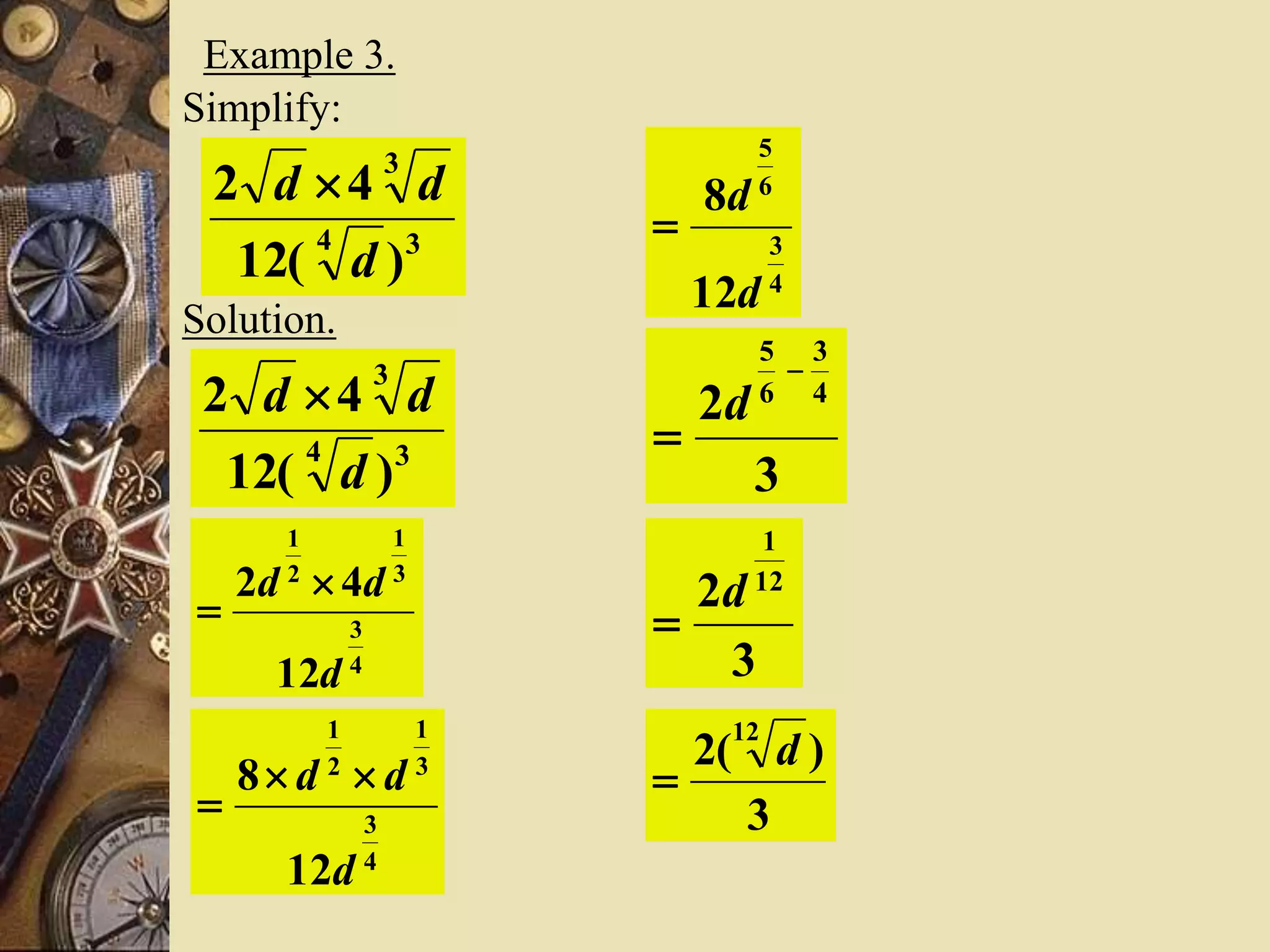
Example 3.
Simplify:
34
3
)(12
42
d
dd 
Solution.
34
3
)(12
42
d
dd 
4
3
3
1
2
1
12
42
d
dd 

4
3
3
1
2
1
12
8
d
dd 

4
3
6
5
12
8
d
d

3
2 4
3
6
5


d
3
2 12
1
d

3
)(2
12
d

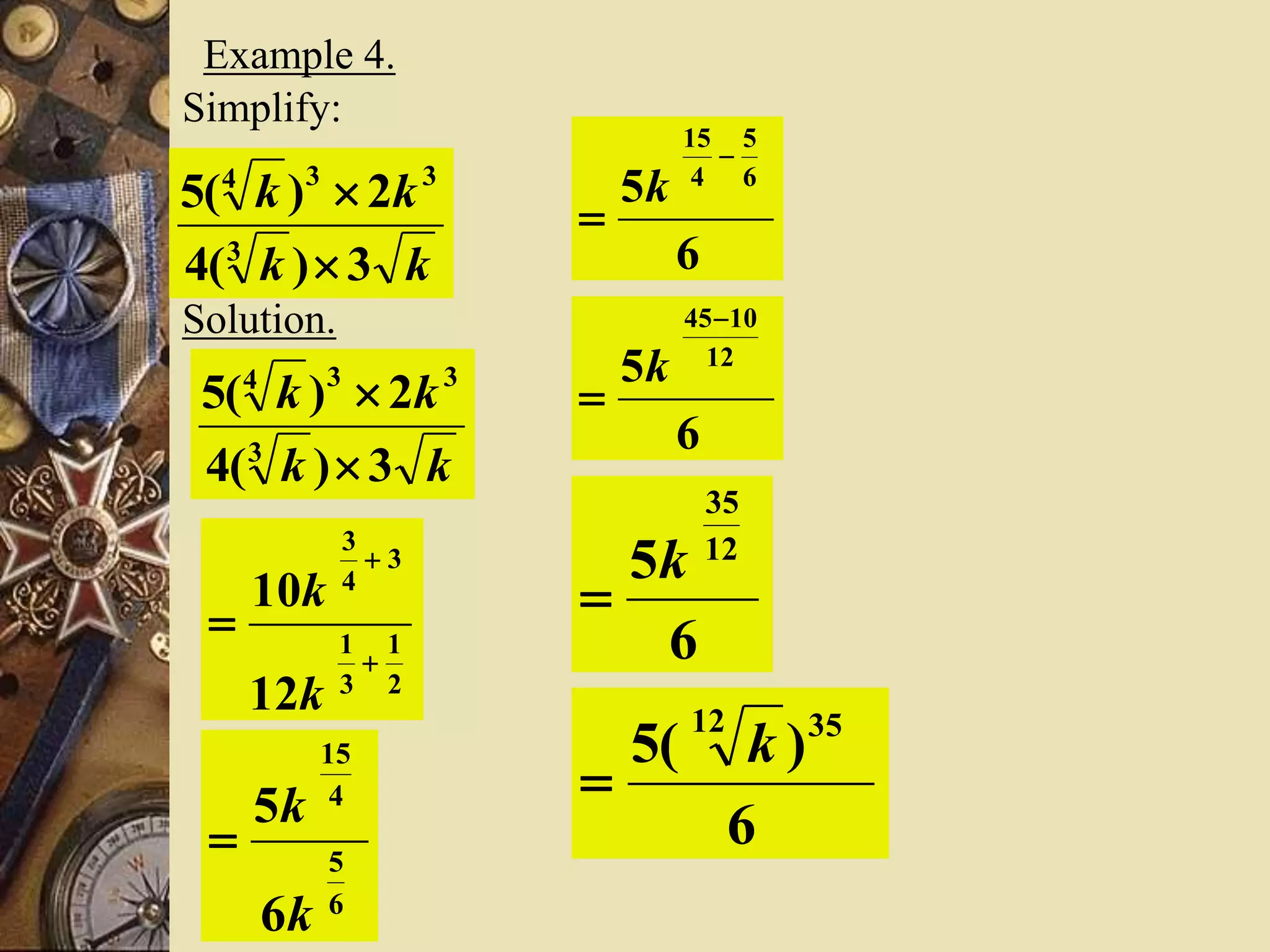
Example 4.
Simplify:
kk
kk
3)(4
2)(5
3
334


Solution.
kk
kk
3)(4
2)(5
3
334


2
1
3
1
3
4
3
12
10



k
k
6
5
4
15
6
5
k
k

6
5 6
5
4
15


k
6
5 12
1045

k
6
5 12
35
k

6
)(5 3512
k

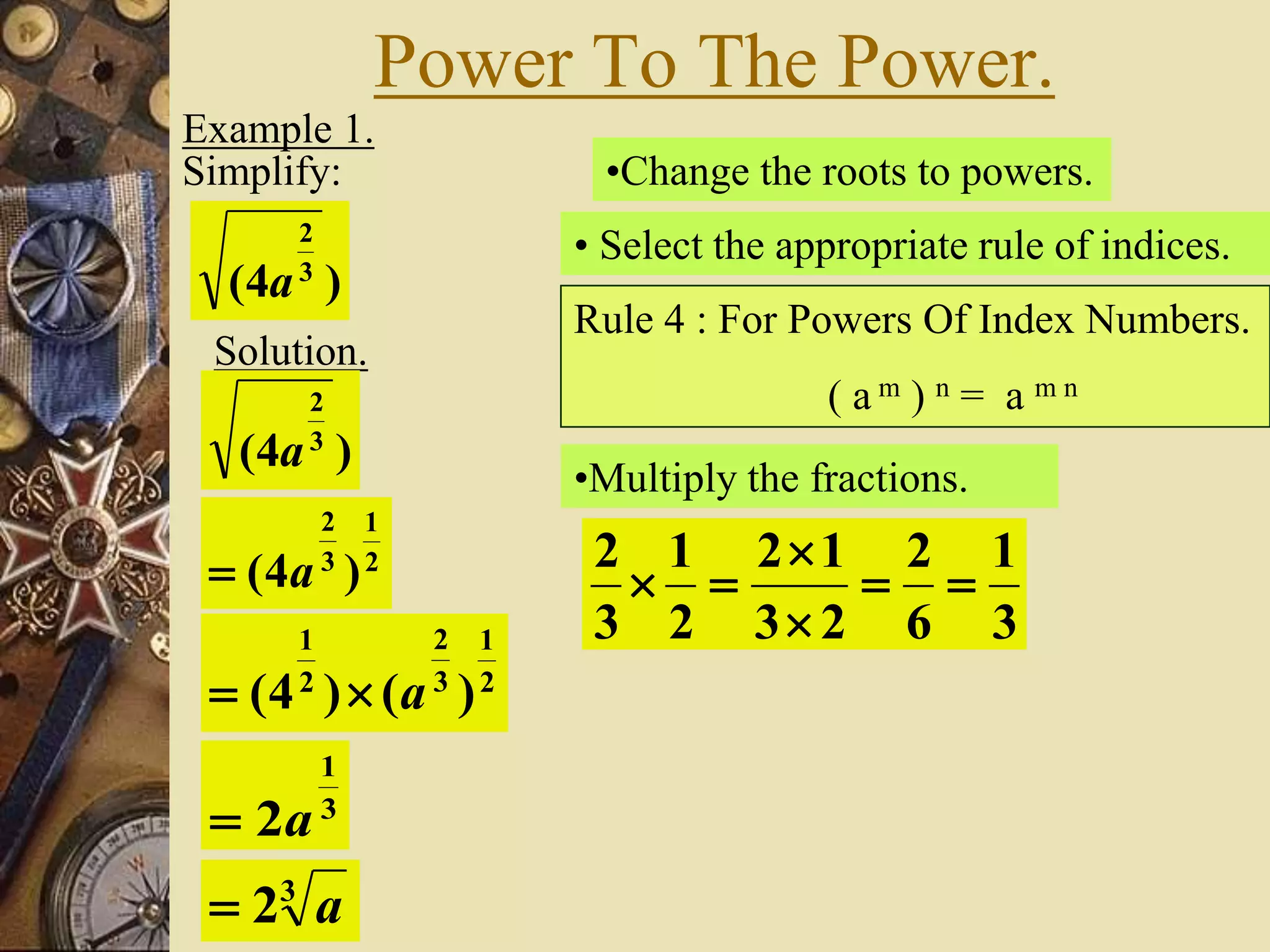
Power To The Power.
Example 1.
Simplify:
)4( 3
2
a
Solution.
)4( 3
2
a
•Change the roots to powers.
2
1
3
2
)4( a
• Select the appropriate rule of indices.
Rule 4 : For Powers Of Index Numbers.
( a m ) n = a m n
2
1
3
2
2
1
)()4( a
•Multiply the fractions.
3
1
6
2
23
12
2
1
3
2




3
1
2a
3
2 a
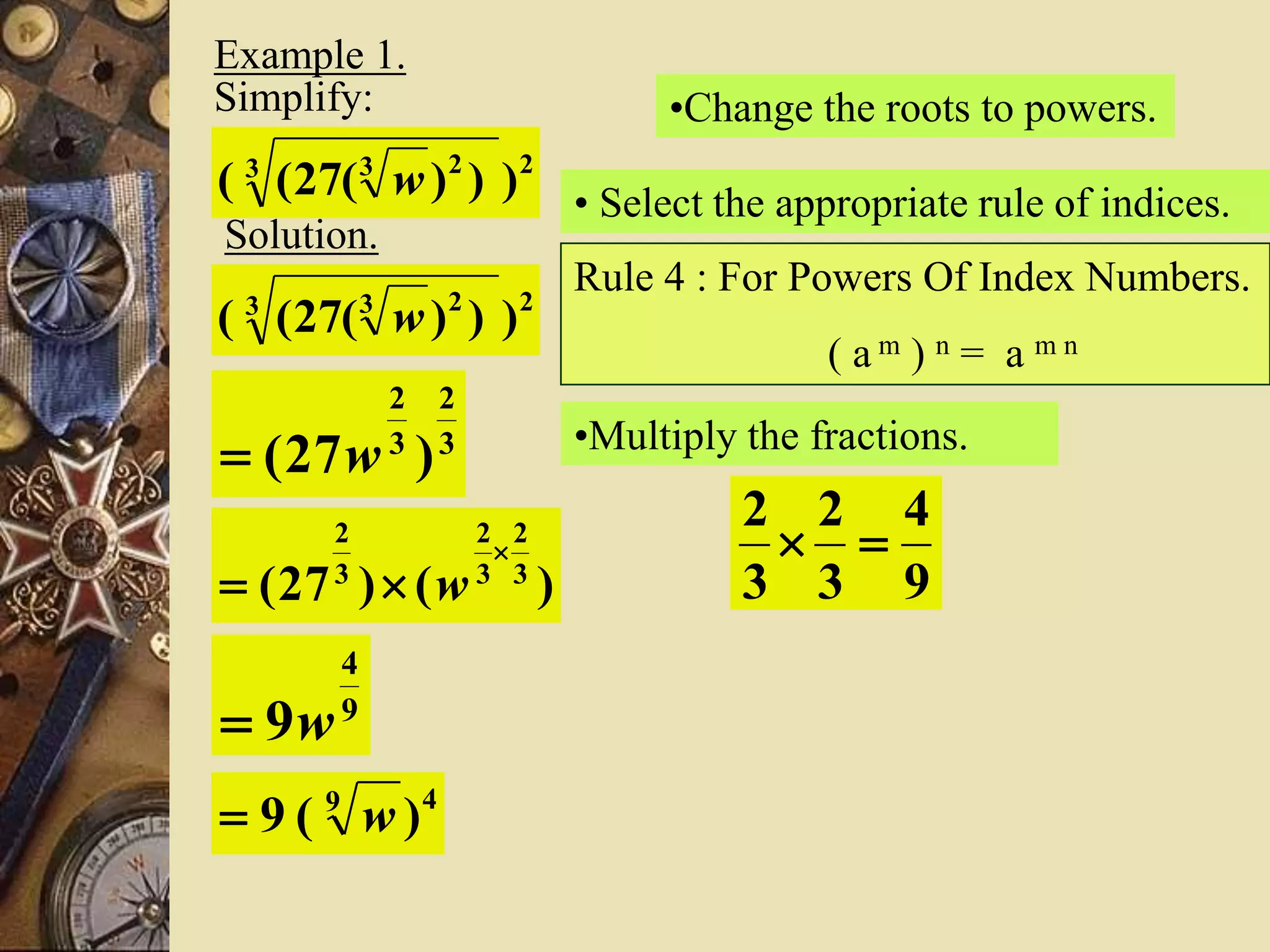
Example 1.
Simplify:
23 23
)))(27(( w
Solution.
23 23
)))(27(( w
•Change the roots to powers.
3
2
3
2
)27( w
• Select the appropriate rule of indices.
Rule 4 : For Powers Of Index Numbers.
( a m ) n = a m n
)()27( 3
2
3
2
3
2

 w
•Multiply the fractions.
9
4
3
2
3
2

9
4
9w
49
)(9 w
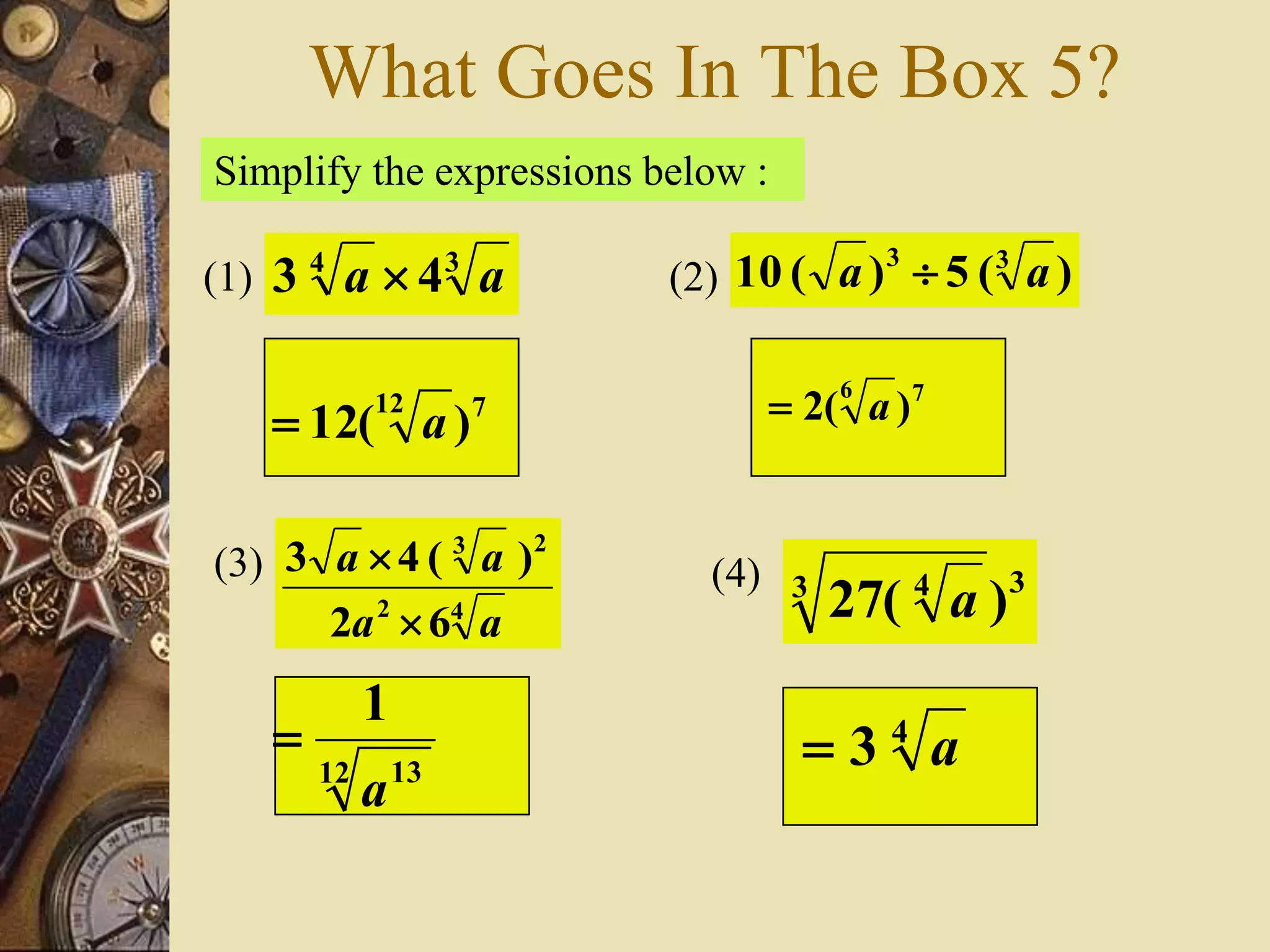
What Goes In The Box 5?
Simplify the expressions below :
34
43 aa (1) (2) )(5)(10 33
aa 
(3)
42
23
62
)(43
aa
aa


712
)(12 a
76
)(2 a
12 13
1
a

(4) 33 4
)(27 a
4
3 a
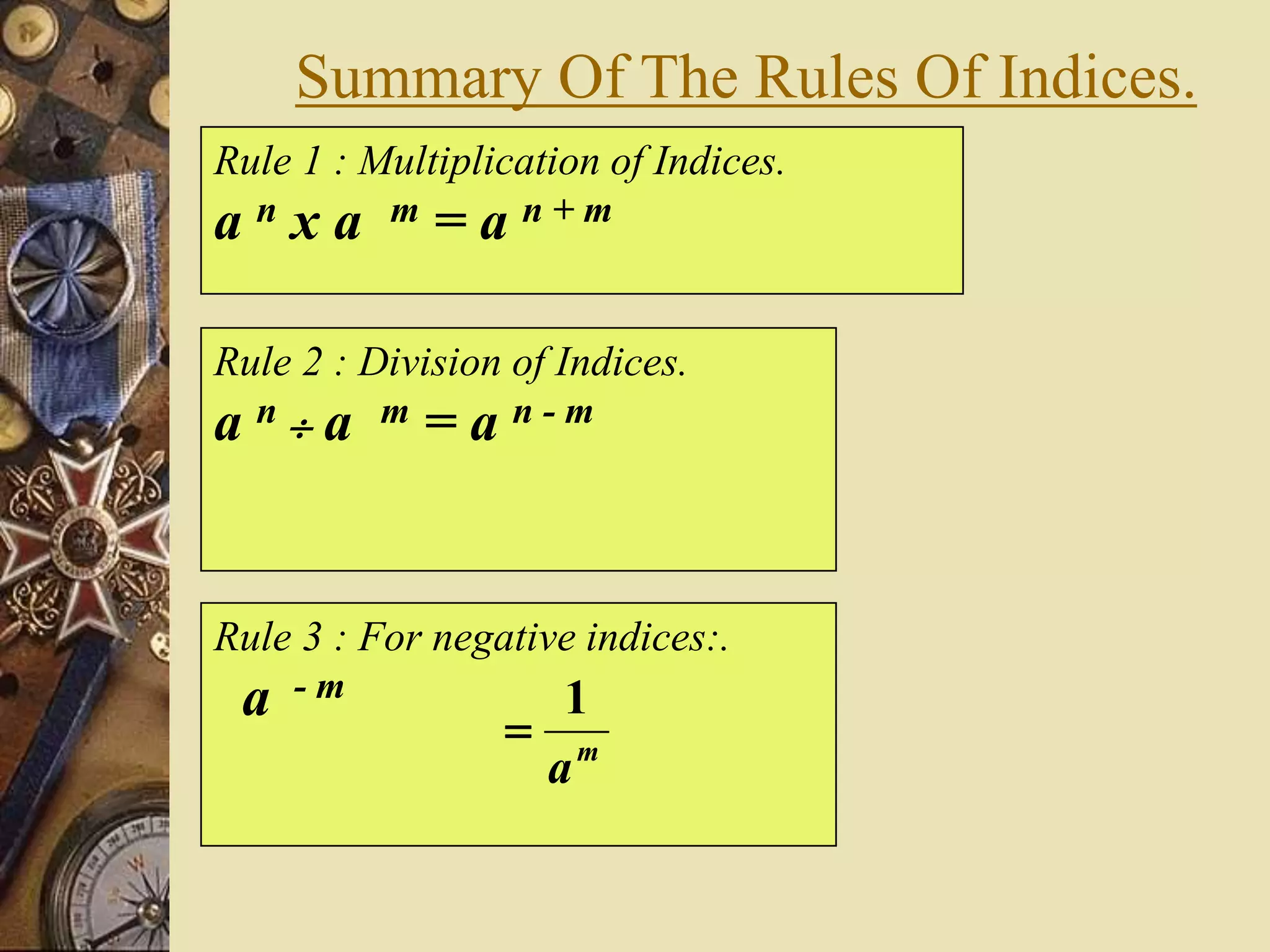
Summary Of The Rules Of Indices.
Rule 1 : Multiplication of Indices.
a n x a m = a n + m
Rule 2 : Division of Indices.
a n  a m = a n - m
Rule 3 : For negative indices:.
a - m
m
a
1

Rule 4 : For Powers Of Index Numbers.
( a m ) n = a m n
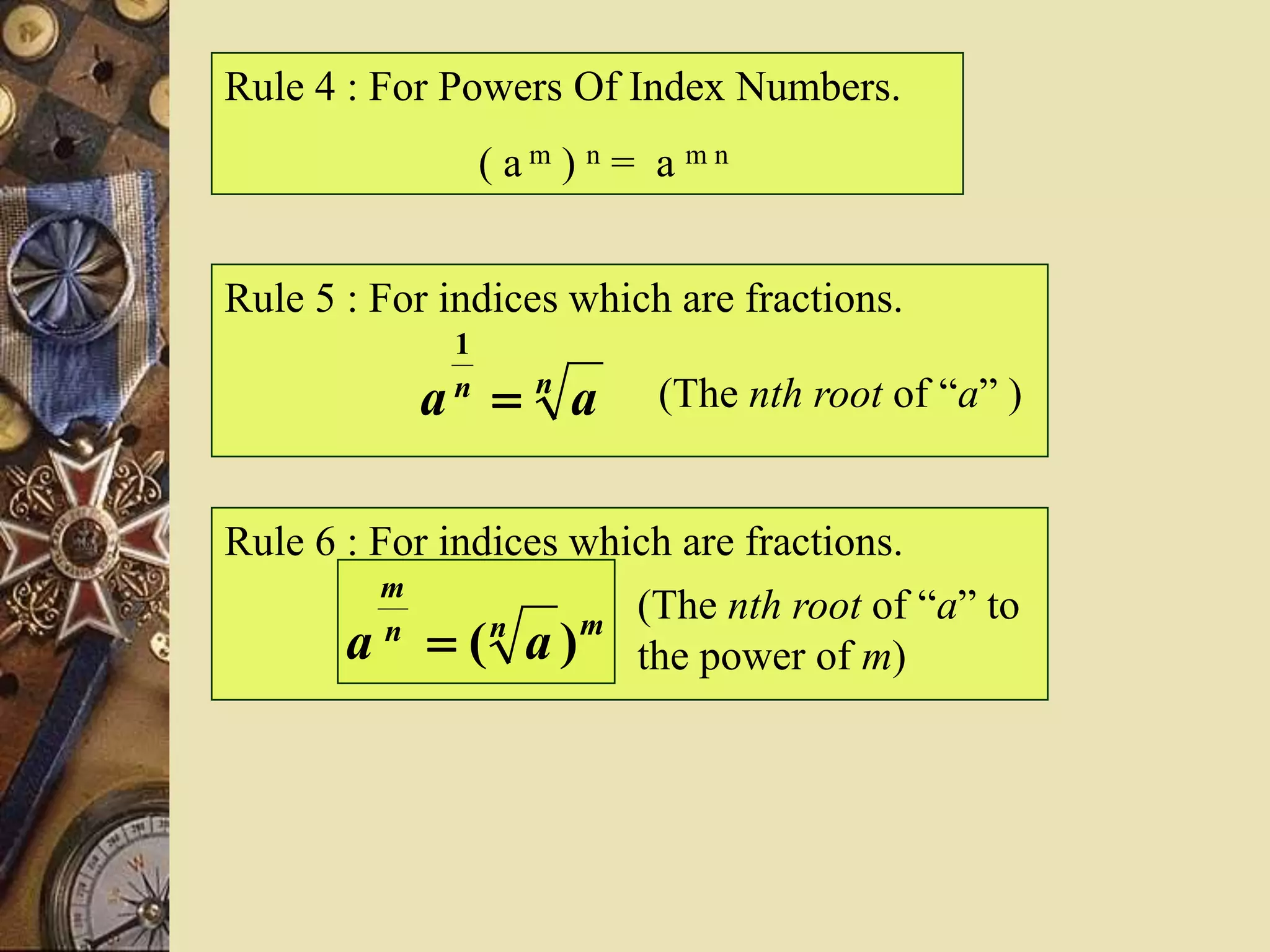
Rule 5 : For indices which are fractions.
nn
aa 
1
(The nth root of “a” )
Rule 6 : For indices which are fractions.
(The nth root of “a” to
the power of m)
mnn
m
aa )(
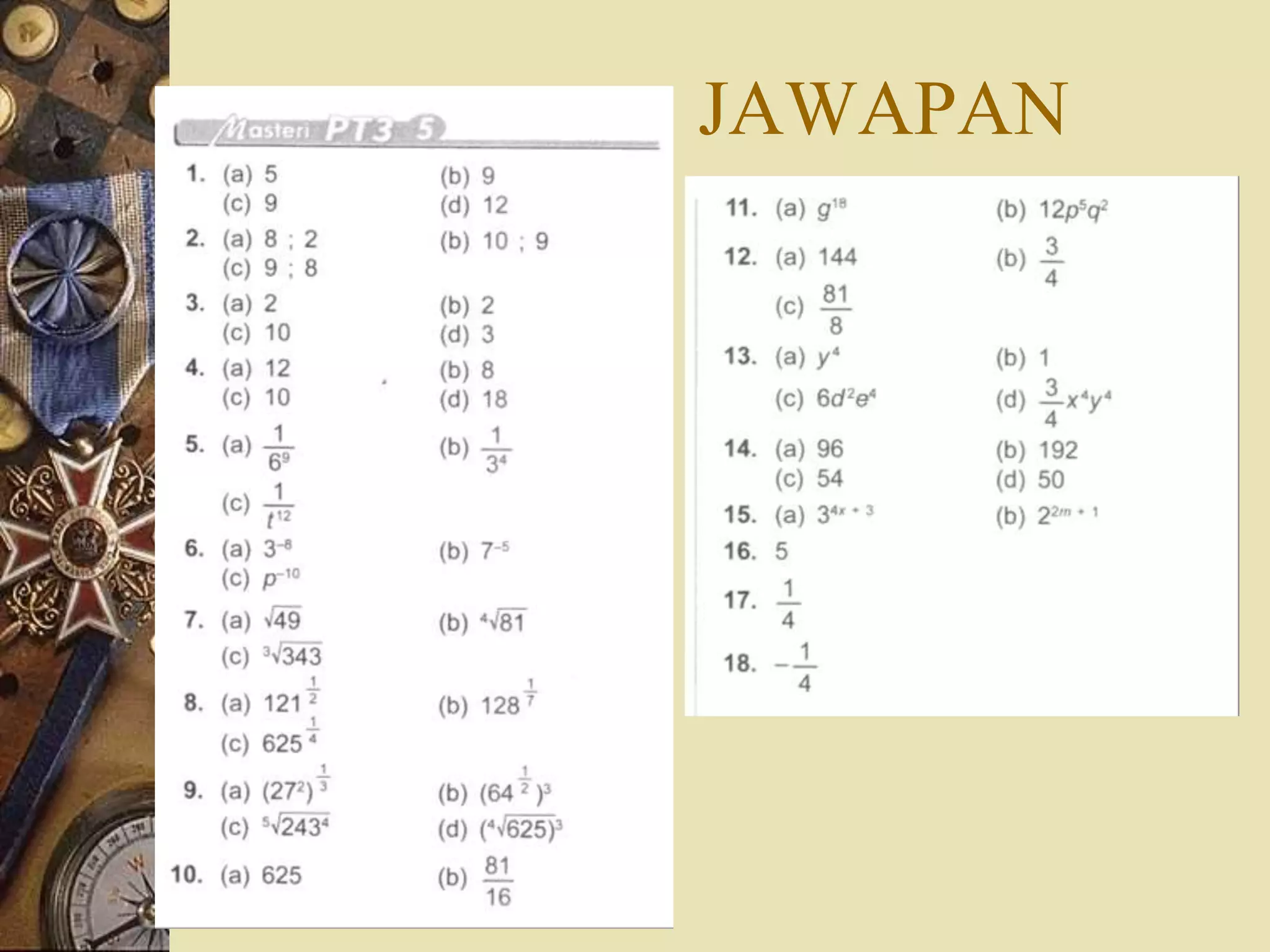
JAWAPAN

The rules of indices

  • 1.
    What Is AnIndex Number. You should know that: 8 x 8 x 8 x 8 x 8 x 8 = 8 6 We say“eight to the power of 6”. The power of 6 is an index number. The plural (more than one) of index numbers is indices.Hence indices are index numbers which are powers. The number eight is the base number.
  • 2.
    Multiplication Of Indices. Weknow that : 7 x 7x 7 x 7 x 7 x 7 x 7 x 7 = 7 8 But we can also simplify expressions such as : 6 3 x 6 4 To simplify: (1) Expand the expression.= (6 x 6 x 6) x (6 x 6 x 6 x 6) (2) How many 6’s do you now have? 7 (3) Now write the expression as a single power of 6. = 6 7 Key Result. 6 3 x 6 4 = 6 7
  • 3.
    Using the previousexample try to simplify the following expressions: (1) 3 7 x 3 4 = 3 11 (2) 8 5 x 8 9 = 8 14 (3) 4 11 x 4 7 x 4 8 = 4 26 We can now write down our first rule of index numbers: Rule 1 : Multiplication of Indices. a n x a m = a n + m NB: This rule only applies to indices with a common base number. We cannot simplify 3 11 x 4 7 as 3 and 4 are different base numbers.
  • 4.
    What Goes InThe Box ? 1 Simplify the expressions below : (1) 6 4 x 6 3 (2) 9 7 x 9 2 (3) 11 6 x 11 (4) 14 9 x 14 12 (5) 27 25 x 27 30 (6) 2 2 x 2 3 x 2 5 (7) 8 7 x 8 10 x 8 (8) 5 20 x 5 30 x 5 50 = 6 7 = 9 9 = 11 7 = 14 21 = 27 55 = 2 10 = 8 18 = 5 100
  • 5.
    Division Of Indices. Considerthe expression: 47 88  The expression can be written as a quotient: 4 7 8 8  Now expand the numerator and denominator. 8888 8888888    How many eights will cancel from the top and the bottom ? 4 Cancel and simplify. 888  =8 3 Result: 8 7 8 4= 8 3
  • 6.
    Using the previousresult simplify the expressions below: (1) 3 9  3 2 = 3 7 (2) 8 11  8 6 = 8 5 (3) 4 24  4 13 = 4 11 Rule 2 : Division of Indices. a n  a m = a n - m We can now write down our second rule of index numbers:
  • 7.
    What Goes InThe Box ? 2 Simplify the expressions below : (1) 5 9 5 2 (2) 7 12  7 5 (3) 19 6  19 (4) 36 15  36 10 (5) 18 40  18 20 (6) 2 32  2 27 (7) 8 70  8 39 (8) 5 200  5 180 =5 7 = 7 7 = 19 5 = 36 5 = 18 20 = 2 5 = 8 31 = 5 20
  • 8.
    Negative Index Numbers. Simplifythe expression below: 5 3 5 7 = 5 - 4 To understand this result fully consider the following: Write the original expression again as a quotient: Expand the numerator and the denominator: 5555555 555    7 3 5 5 Cancel out as many fives as possible: 5555 1   Write as a power of five: Now compare the two results:4 5 1 
  • 9.
    The result onthe previous slide allows us to see the following results: Turn the following powers into fractions: (1) 3 2 3 2 1  8 1  (2) 4 3 4 3 1  81 1  (3) 6 10 6 10 1  1000000 1  We can now write down our third rule of index numbers: Rule 3 : For negative indices:. a - m m a 1 
  • 10.
    More On NegativeIndices. Simplify the expressions below leaving your answer as a positive index number each time: (1) 5 96 3 33    )5(96 3   596 3   8 3 (2) 28 34 77 77     )2(8 34 7 7    6 1 7 7  61 7   7 7  7 7 1 
  • 11.
    What Goes InThe Box ? 3 Change the expressions below to fractions: Simplify the expressions below leaving your answer with a positive index number at all times: (1) 5 2 (2) 3 3 3 2 2 4   (3) (4) 3 2 3 6   3 65 4 44   (5) 1110 67 77 77    (6) (7) 246 342 333 333     32 1  27 1  2 1  4 3  4 4 2 7 3 3 1 
  • 12.
    Powers Of Indices. Considerthe expression below: ( 2 3 ) 2 To appreciate this expression fully do the following: Expand the term inside the bracket. = ( 2 x 2 x 2 ) 2 Square the contents of the bracket. = ( 2 x 2 x 2 ) x (2 x 2 x 2 ) Now write the expression as a power of 2. = 2 6 Result: ( 2 3 ) 2 = 2 6
  • 13.
    Use the resulton the previous slide to simplify the following expressions: (1) ( 4 2 ) 4 (2) ( 7 5 ) 4 (3) ( 8 7 ) 6 = 4 8 = 7 20 = 8 42 We can now write down our fourth rule of index numbers: Rule 4 : For Powers Of Index Numbers. ( a m ) n = a m n (4) (3 2) -3 = 3 -6 6 3 1  41 )5(   (5) 443 )55(  x 4 5
  • 14.
    What Goes InThe Box ? 4 Simplify the expressions below leaving your answer as a positive index number. (1) 54 )7( 63 )5(  (2) (3) 37 )10(  (4) 342 )88(  (5) 523 )77(   (6) 1056 )1111(   20 7 18 5 1  21 10 18 8 5 7 110 11
  • 15.
    The Rules OfIndices. Rule 4 : For Powers Of Index Numbers. ( a m ) n = a m n Rule 1 : Multiplication of Indices. a n x a m = a n + m Rule 2 : Division of Indices. a n  a m = a n - m Rule 3 : For negative indices:. a - m m a 1 
  • 16.
    Applying The RulesWith Fractions. We are now going to look at the rules of indices again but use them with fractions that are obtained from the roots of numbers.
  • 17.
    Multiplication Example 1. Simplify: 3 aa  Solution. 3 aa •Change the roots to powers. 3 1 2 1 aa  • Select the appropriate rule of indices. Rule 1 : Multiplication of Indices. a n x a m = a n + m •Add the fractions. 6 5 6 23 3 1 2 1    6 5 a 56 )( a
  • 18.
    Example 2. Simplify: 3543 )()( aa Solution. •Change the roots to powers.3543 )()( aa  5 3 3 4 aa  • Select the appropriate rule of indices. Rule 1 : Multiplication of Indices. a n x a m = a n + m •Add the fractions. 15 29 15 920 5 3 3 4    15 29 a 2915 )( a
  • 19.
    Division. Example 1. Simplify: 3 gg Solution. •Change the roots to powers.3 gg  3 1 2 1 gg  • Select the appropriate rule of indices. Rule 2 : Division of Indices. a n  a m = a n - m •Subtract the fractions. 6 1 6 23 3 1 2 1    6 1 g 6 g
  • 20.
    Example 2. Simplify: 2534 )()( dd Solution. 2534 )()( dd  •Change the roots to powers. 5 2 4 3 dd  • Select the appropriate rule of indices. Rule 2 : Division of Indices. a n  a m = a n - m •Subtract the fractions. 20 7 20 815 5 2 4 3    20 7 d 720 )( d
  • 21.
    Multiplication & Division Example1. Simplify: 23 )( a aa Solution. 23 )( a aa •Change the roots to powers. 3 2 2 1 a aa   • Select the appropriate rule of indices. Rule 1 : Multiplication of Indices. a n x a m = a n + m Rule 2 : Division of Indices. a n  a m = a n - m •Calculate the fractions. 2 3 2 1 1  6 5 6 49 3 2 2 3    6 5 a 56 )( a
  • 22.
    Example 2. Simplify: )()( )()( 43 4325 rr rr   Solution. )()( )()( 43 4325 rr rr   •Change theroots to powers. 4 1 2 3 3 4 5 2 rr rr    • Select the appropriate rule of indices. Rule 1 : Multiplication of Indices. a n x a m = a n + m Rule 2 : Division of Indices. a n  a m = a n - m •Calculate the fractions. 15 26 15 206 3 4 5 2    4 7 4 1 4 6 4 1 2 3  60 1 60 105104 4 7 15 26    60 1   r Rule 3 : For negative indices:. a - m m a 1 60 60 1 11 r r 
  • 23.
    Example 3. Simplify: 34 3 )(12 42 d dd  Solution. 34 3 )(12 42 d dd 4 3 3 1 2 1 12 42 d dd   4 3 3 1 2 1 12 8 d dd   4 3 6 5 12 8 d d  3 2 4 3 6 5   d 3 2 12 1 d  3 )(2 12 d 
  • 24.
  • 25.
    Power To ThePower. Example 1. Simplify: )4( 3 2 a Solution. )4( 3 2 a •Change the roots to powers. 2 1 3 2 )4( a • Select the appropriate rule of indices. Rule 4 : For Powers Of Index Numbers. ( a m ) n = a m n 2 1 3 2 2 1 )()4( a •Multiply the fractions. 3 1 6 2 23 12 2 1 3 2     3 1 2a 3 2 a
  • 26.
    Example 1. Simplify: 23 23 )))(27((w Solution. 23 23 )))(27(( w •Change the roots to powers. 3 2 3 2 )27( w • Select the appropriate rule of indices. Rule 4 : For Powers Of Index Numbers. ( a m ) n = a m n )()27( 3 2 3 2 3 2   w •Multiply the fractions. 9 4 3 2 3 2  9 4 9w 49 )(9 w
  • 27.
    What Goes InThe Box 5? Simplify the expressions below : 34 43 aa (1) (2) )(5)(10 33 aa  (3) 42 23 62 )(43 aa aa   712 )(12 a 76 )(2 a 12 13 1 a  (4) 33 4 )(27 a 4 3 a
  • 28.
    Summary Of TheRules Of Indices. Rule 1 : Multiplication of Indices. a n x a m = a n + m Rule 2 : Division of Indices. a n  a m = a n - m Rule 3 : For negative indices:. a - m m a 1 
  • 29.
    Rule 4 :For Powers Of Index Numbers. ( a m ) n = a m n Rule 5 : For indices which are fractions. nn aa  1 (The nth root of “a” ) Rule 6 : For indices which are fractions. (The nth root of “a” to the power of m) mnn m aa )(
  • 36.