Natarajan Meghanathan, et al. (Eds): SIPM, FCST, ITCA, WSE, ACSIT, CS & IT 06, pp. 471–478, 2012.
© CS & IT-CSCP 2012 DOI : 10.5121/csit.2012.2346
COMPUTING WIENER INDEX OF FIBONACCI
WEIGHTED TREES
K. R. Udaya Kumar Reddy1
and Ranjana S. Chakrasali2
1, 2
Department of Computer Science and Engineering, BNM Institute of
Technology, Bangalore-560070, Karnataka, India
{krudaykumar@yahoo.com, ranjanagirish@gmail.com}
ABSTRACT
Given a simple connected undirected graph ‫ܩ‬ = ሺܸ, ‫ܧ‬ሻ with |ܸ| = ݊ and |‫|ܧ‬ = ݉, the Wiener
index ܹሺ‫ܩ‬ሻ of ‫ܩ‬ is defined as half the sum of the distances of the form ݀ሺ‫,ݑ‬ ‫ݒ‬ሻ between all
pairs of vertices u, v of ‫ܩ‬ . If ሺ‫,ܩ‬ ‫ݓ‬ாሻ is an edge-weighted graph, then the Wiener
index ܹሺ‫,ܩ‬ ‫ݓ‬ாሻof ሺ‫,ܩ‬ ‫ݓ‬ாሻ is defined as the usual Wiener index but the distances is now
computed in ሺ‫,ܩ‬ ‫ݓ‬ாሻ. The paper proposes a new algorithm for computing the Wiener index of a
Fibonacci weighted trees with Fibonacci branching in place of the available naive algorithm for
the same. It is found that the time complexity of the algorithm is logarithmic.
KEYWORDS
Algorithms, Distance in graphs, Fibonacci weighted tree, Wiener index.
1. INTRODUCTION
Let ‫ܩ‬ = ሺܸሺ‫ܩ‬ሻ, ‫ܧ‬ሺ‫ܩ‬ሻሻ be a connected unweighted undirected graph without self-loops and
multiple edges. Let |ܸሺ‫ܩ‬ሻ| = ݊ and |‫ܧ‬ሺ‫ܩ‬ሻ| = ݉.
The Wiener index ܹሺ‫ܩ‬ሻ of ‫ܩ‬ is defined as half the sum of the distances between all pairs of
vertices of a graph ‫.ܩ‬ Wiener index is a distance based graph invariant which is one of the most
popular topological indices in mathematical chemistry. It is named after the chemist Harold
Wiener, who first introduced it in 1947 to study chemical properties of alkanes. It is not
recognized that there are good correlations between ܹሺ‫ܩ‬ሻ and physico-chemical properties of the
organic compound from which ‫ܩ‬ is derived, especially when ‫ܩ‬ is a tree. Wiener index have been
studied quite extensively in both the mathematical and chemical literature. For chemical
applications of Wiener index, see [7, 9]. The Wiener index is also studied to investigate a related
quantity the average distance (defined as 2ܹሺ‫ܩ‬ሻ/݊ሺ݊ − 1ሻሻof a graph, which is frequently done
in pure mathematics [3].
In this paper we are concerned with a tree called Fibonacci weighted tree with Fibonacci
branching. Let η = 1 + F1 + F2 + F3 +∏ ‫ܨ‬௜ +ସ
௜ୀଵ …. + ∏ ‫ܨ‬௜
௞
௜ୀଵ be the number of vertices in ܶ௞,
where ‫ܨ‬௜ = i-th Fibonacci number. One way to compute the Wiener index of Fibonacci weighted
tree with Fibonacci branching is to compute the distances between all pairs of vertices of a graph.
It is known [2] that the straightforward approach for solving the distances on a weighted graph
between all pairs of vertices of ‫ܩ‬ is to run Floyd-Warshall algorithm which takes a time O(n3
);
thus for Fibonacci weighted tree with Fibonacci branching of order k with η vertices, such an
algorithm can compute the Wiener index in time O(η3
) and requires as an input a description of
Fibonacci weighted tree with Fibonacci branching of order k, e.g., an adjacency matrix. In this
note, we propose a new algorithm for computing the Wiener index of Fibonacci weighted tree
472 Computer Science & Information Technology ( CS & IT )
with Fibonacci branching in time O(log η), assuming that the input is only the order k of the
Fibonacci weighted tree with Fibonacci branching.
2. PRELIMINARIES
The Wiener index ܹሺ‫ܩ‬ሻ of ‫ܩ‬ is defined as
ܹሺ‫ܩ‬ሻ =
1
2
෍ ෍ ݀ሺ‫,ݑ‬ ‫ݒ‬ሻ
௩ ∈௏ሺீሻ
,
௨∊௏ሺீሻ
ሺ1ሻ
where ݀ሺ‫,ݑ‬ ‫ݒ‬ሻ denotes the distance (the number of edges on a shortest path between u and v
between u, v in ‫.ܩ‬
Wiener index ܹሺ‫ܩ‬ሻ comes under different names such as sum of all distances [5, 10], total status
[1], gross status [6], graph distance [4], and transmission [8]. A related quantity is the average
distance µሺ‫ܩ‬ሻ defined as
µሺ‫ܩ‬ሻ =
2ܹሺ‫ܩ‬ሻ
݊ሺ݊ − 1ሻ
.
Let ‫ݓ‬ሺ݅, ݆ሻ denote the edge weight on the edge {i, j}. Then
‫ݓ‬ሺ݅, ݆ሻ = ൜
‫݃݅݁ݓ‬ℎ‫ݐ‬ ‫݂݋‬ ݁݀݃݁ ሺ݅, ݆ሻ ݂݅ ሺ݅, ݆ሻ ∈ ‫ܧ‬ሺ‫ܩ‬ሻ,
+∞ ݂݅ ሺ݅, ݆ሻ ∈ ‫ܧ‬ሺ‫ܩ‬ሻ.
Consider an edge-weighted graph ‫ܩ‬ with weight function ‫ݓ‬ா : ‫ܧ‬ሺ‫ܩ‬ሻ R+
denoted as ሺ‫,ܩ‬ ‫ݓ‬ாሻ.
Then the weight of a path is the sum of the weights of its edges on that path. A shortest path
between two vertices u and v is a path of minimum weight. The shortest-path distance
݀ሺீ,௪ಶሻሺ‫,ݑ‬ ‫ݒ‬ሻ (or simply ݀ሺ‫,ݑ‬ ‫ݒ‬ሻ) is the sum of the weights of the edges along the shortest path
connecting u and v. For ‫ݑ‬ ∈ ܸሺ‫ܩ‬ሻ and H ⊆ ܸሺ‫ܩ‬ሻ, let ݀ାሺ‫,ݑ‬ ‫ܪ‬ሻ = ∑ ݀ሺ‫,ݑ‬ ‫ݒ‬ሻ௩∈ு . The Wiener
index ܹሺ‫,ܩ‬ ‫ݓ‬ாሻ of ሺ‫,ܩ‬ ‫ݓ‬ாሻ is defined as the usual Wiener index, that is, ܹ ሺ‫,ܩ‬ ‫ݓ‬ாሻ =
ଵ
ଶ
∑ ∑ ݀ሺ‫,ݑ‬ ‫ݒ‬ሻ௩∈௏ሺீሻ௨∈௩ሺீሻ where ݀ሺ‫,ݑ‬ ‫ݒ‬ሻ is now computed in ሺ‫,ܩ‬ ‫ݓ‬ாሻ. Clearly if all the edges
have weight one, then ܹሺ‫,ܩ‬ ‫ݓ‬ாሻ = ܹሺ‫ܩ‬ሻ. In the sequel, for notational convenience we assume
that ܹሺܶሻ = ܹሺܶ, ‫ݓ‬ாሻ.
It is well known that the Fibonacci numbers are defined recursively as follows: (i) The Fibonacci
numbers ‫ܨ‬଴ = 0 and ‫ܨ‬ଵ = 1, and (ii) For k ≥ 2, the Fibonacci number ‫ܨ‬௞ = ‫ܨ‬௞ିଵ + ‫ܨ‬௞ିଶ.
We define Fibonacci weighted path ܲ௙೙
of order n, as a path on n + 1 vertices, where the
consecutive edges are assigned weights ‫ܨ‬ଵ, . . . ,‫ܨ‬௡ starting from an edge incident on a pendent
vertex.
Let k be a positive integer. The Fibonacci weighted tree with Fibonacci branching ܶ௞ of order k,
is defined recursively in the following way:
i. ܶଵ = ሺܸଵ, ‫ܧ‬ଵሻis a rooted tree, where ܸଵ = ሼ‫ݒ‬ଵ
଴
, ‫ݒ‬ଵ
ଵሽ and ‫ܧ‬ଵ = ሼሺ‫ݒ‬ଵ
଴
, ‫ݒ‬ଵ
ଵ
ሻሽ, with ‫ݓ‬ሺ‫ݒ‬ଵ
଴
, ‫ݒ‬ଵ
ଵሻ =
‫ܨ‬ଵ.
ii. ܶଶ = ሺܸଵ ∪ ܸଶ, ‫ܧ‬ଵ ∪ ‫ܧ‬ଶሻ is a rooted tree, where V2 = ሼ‫ݒ‬ଵ
ଶሽ and ‫ܧ‬ଶ = ሼሺ‫ݒ‬ଵ
ଵ
, ‫ݒ‬ଵ
ଶ
ሻሽ , with
‫ݓ‬ሺ‫ݒ‬ଵ
଴
, ‫ݒ‬ଵ
ଵሻ = ‫ܨ‬ଵ and wሺ‫ݒ‬ଵ
ଵ
, ‫ݒ‬ଵ
ଶሻ = ‫ܨ‬ଶ .
iii. For k ≥ 3, the rooted tree ܶ௞ is constructed as follows:
Let p = ∏ ‫ܨ‬௜
௞ିଶ
௜ୀଵ , ‫ݍ‬ = ‫ܨ݌‬௞ିଵ and ‫ݎ‬ = ‫ܨݍ‬௞. Let V = (V1 ∪ ...∪ Vk-1) and E = (E1 ∪… ∪ Ek-1),
where Vk-1 = {‫ݒ‬ଵ
௞ିଵ
, … , ‫ݒ‬௤
௞ିଵ
} and Ek-1 = { (‫ݒ‬௜
௞ିଶ
, ‫ݒ‬௝
௞ିଵ
) : 1 ≤ i ≤ p, 1 ≤ j ≤ q and (i-
1)Fk-1 + 1 ≤ j ≤ iFk-1}. If ܶ௞ିଵ = ሺܸ, ‫ܧ‬ሻ is a rooted tree, then ܶ௞ = ሺܸ ∪ ܸ௞, ‫ܧ‬ ∪ ‫ܧ‬௞ሻ,
where Vk = {‫ݒ‬ଵ
௞
, . . . . , ‫ݒ‬௥
௞ } and Ek = { (‫ݒ‬௜
௞ିଵ
, ‫ݒ‬௝
௞
): 1 ≤ i ≤ q, 1 ≤ j ≤ r and (i-1)Fk+ 1 ≤ j ≤
iFk } and ∀ (u, v) ∊ Ek , w(u, v) = Fk .
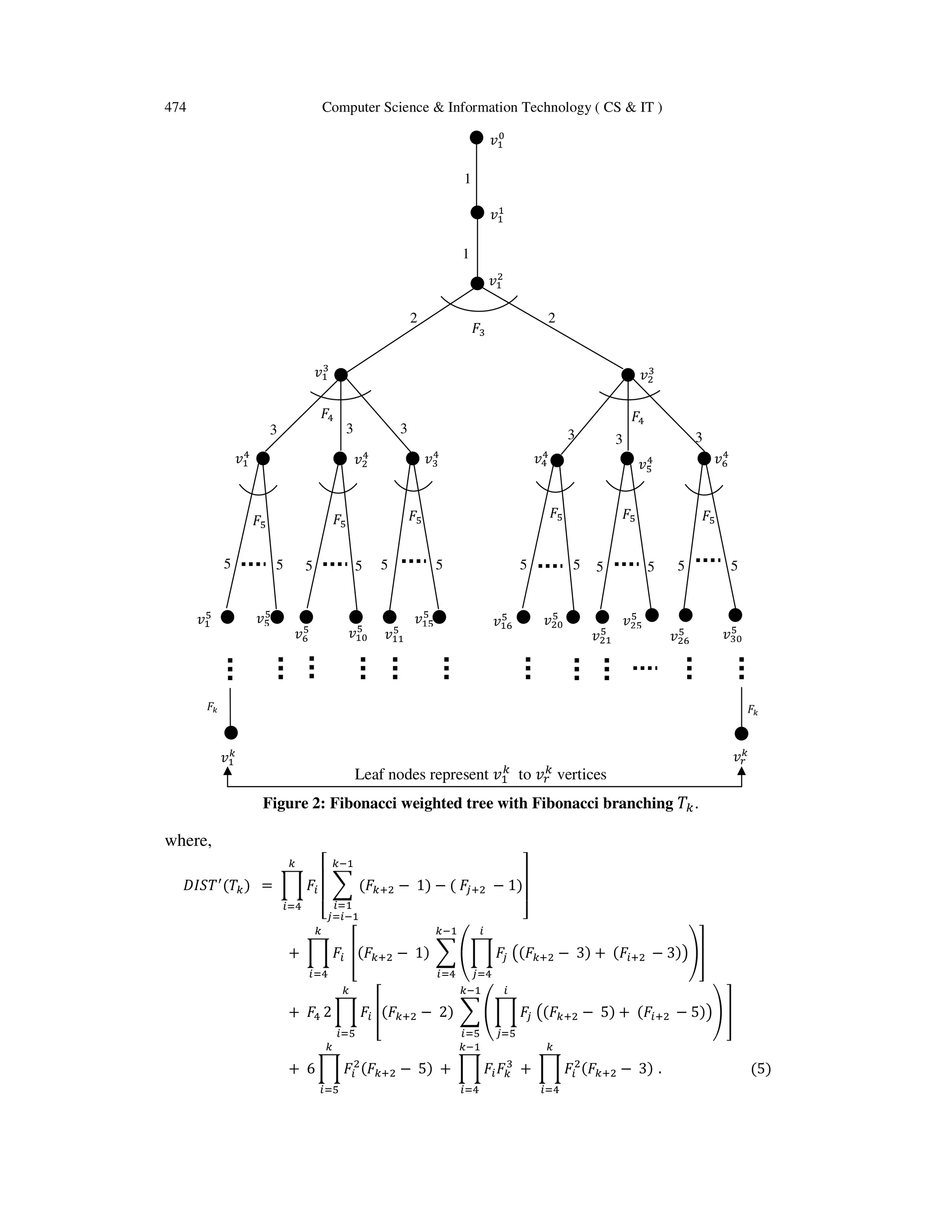
Figure 1 shows the Fibonacci weighted trees with Fibonacci branching ܶଵ through ܶସ.
Computer Science & Information Technology ( CS & IT ) 473
ܶଵ
ܶଶ
ܶଷ
ܶସ
Figure 1: Fibonacci weighted trees with Fibonacci branching ܶଵ through ܶସ.
3. COMPUTING WIENER INDEX OF FIBONACCI WEIGHTED TREES WITH
FIBONACCI BRANCHING
We begin with the following lemma which gives a closed-form expression for ܹሺܲ௙೙
ሻ .
Lemma 1:
Let ܲ௙೙
be a Fibonacci weighted path with n + 1 vertices. Then for n ≥ 2, the Wiener index
ܹሺܲ௙೙
ሻ is given by
ܹ൫ܲ௙೙
൯ = ݊ሺ‫ܨ‬௡ାସ + 2ሻ − 2‫ܨ‬௡ାହ + 10 . ሺ2ሻ
Proof. From the Fibonacci weighted path ܲ௙೙
, it is clear that
ܹ൫ܲ௙೙
൯ = ܹ൫ܲ௙೙షభ
൯ + ෍ ݆
௡
௝ୀଵ
‫ܨ‬௝ . ሺ3ሻ
with initial condition ܹ൫ܲ௙భ
൯ = 1. Equation (3) can be simplified to
ܹ൫ܲ௙೙
൯ = ܹ൫ܲ௙೙షభ
൯ + ݊‫ܨ‬௡ାଶ + 2 − ‫ܨ‬௡ାଷ . ሺ4ሻ
Simplifying (4) gives the desired expression for ܹሺܲ௙೙
ሻ as given in (2).
Lemma 2:
Let ‫ݎ‬ = ∏ ‫ܨ‬௜
௞
௜ୀଵ and Z = { ‫ݒ‬௜
௞
| 1 ≤ ݅ ≤ ‫ݎ‬ }. For 1 ≤ ݆ ≤ r, let ܺଵ,௝ିଵ = ‫ݒ‬ଵ
௞
, … ‫ݒ‬௝ିଵ
௞
and
ܻ = ܸ(ܶ௞) ܺଵ,௝ିଵ. For a positive integer k ≥ 5, let ܶ௞ be the Fibonacci weighted tree with
Fibonacci branching of order k. Then ‫ܶ(ܶܵܫܦ‬௞) is given by
‫ܶ(ܶܵܫܦ‬௞) = ෍ ݀ା
൫‫ݒ‬௝
௞
, ܻ൯ = 2‫ܶܵܫܦ‬ᇱ
(ܶ௞
௩ೕ
ೖ
∊ ௓
)
r r r r
1
1
22
1
1
1
11
111
1
22
1
1
474 Computer Science & Information Technology ( CS & IT )
Leaf nodes represent ‫ݒ‬ଵ
௞
to ‫ݒ‬௥
௞
vertices
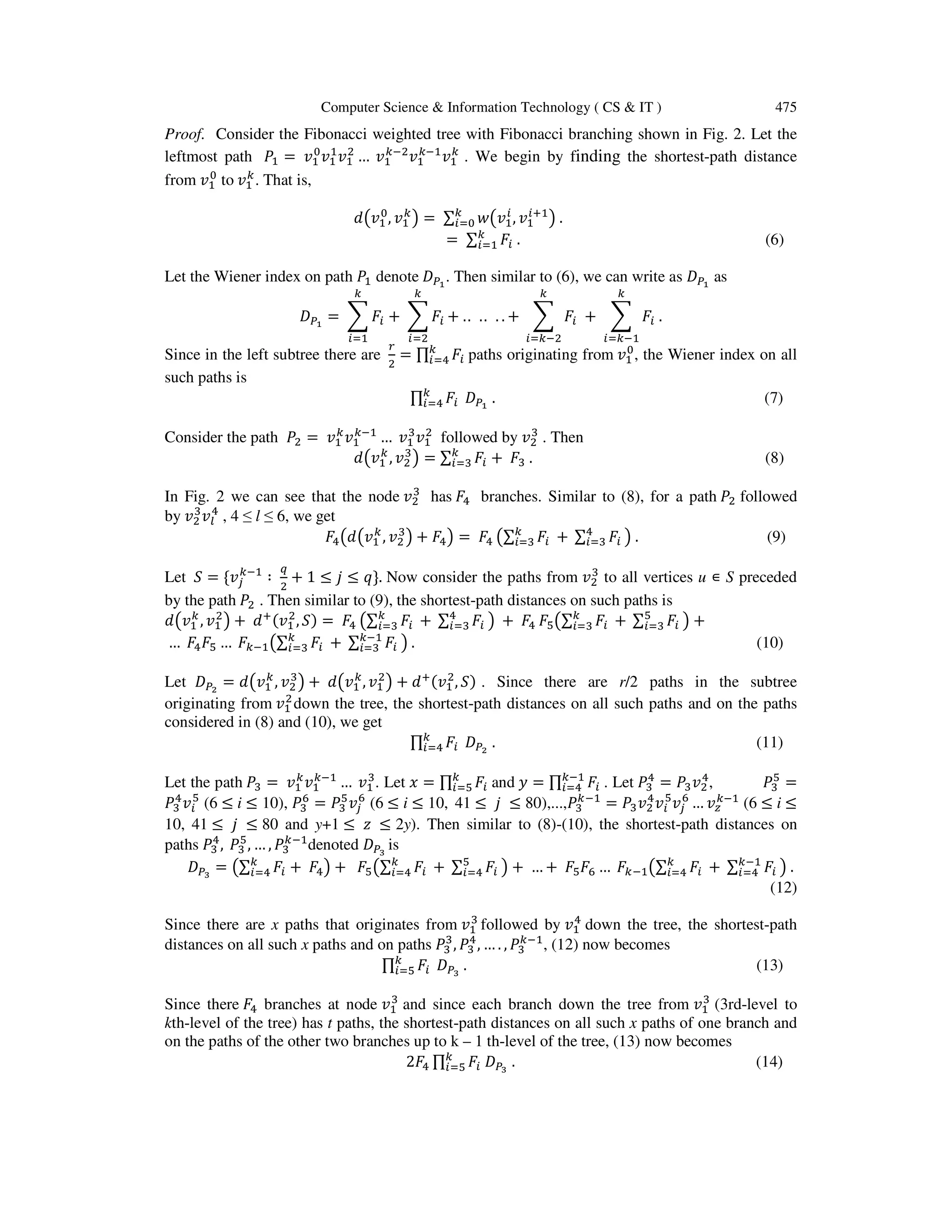
Figure 2: Fibonacci weighted tree with Fibonacci branching ܶ௞.
where,
‫ܶܵܫܦ‬ᇱ
(ܶ௞) = ෑ ‫ܨ‬௜
௞
௜ୀସ
‫ۏ‬
‫ێ‬
‫ێ‬
‫ۍ‬
෍ (‫ܨ‬௞ାଶ
௞ିଵ
௜ୀଵ
௝ୀ௜ିଵ
− 1) − ( ‫ܨ‬௝ାଶ − 1)
‫ے‬
‫ۑ‬
‫ۑ‬
‫ې‬
+ ෑ ‫ܨ‬௜
௞
௜ୀସ
቎(‫ܨ‬௞ାଶ − 1) ෍ ቌෑ‫ܨ‬௝ ൫(‫ܨ‬௞ାଶ − 3) + (‫ܨ‬௜ାଶ − 3)൯
௜
௝ୀସ
ቍ
௞ିଵ
௜ୀସ
቏
+ ‫ܨ‬ସ 2 ෑ ‫ܨ‬௜
௞
௜ୀହ
቎(‫ܨ‬௞ାଶ − 2) ෍ ቌෑ ‫ܨ‬௝ ൫(‫ܨ‬௞ାଶ − 5) + (‫ܨ‬௜ାଶ − 5)൯
௜
௝ୀହ
ቍ
௞ିଵ
௜ୀହ
቏
+ 6 ෑ ‫ܨ‬௜
ଶ
(‫ܨ‬௞ାଶ − 5) + ෑ ‫ܨ‬௜‫ܨ‬௞
ଷ
+ ෑ ‫ܨ‬௜
ଶ
(‫ܨ‬௞ାଶ − 3)
௞
௜ୀସ
௞ିଵ
௜ୀସ
௞
௜ୀହ
. (5)
‫ݒ‬ଵ
ଶ
‫ݒ‬ଵ଺
ହ
‫ݒ‬ଷ଴
ହ
‫ݒ‬ଶ଺
ହ
‫ݒ‬ଶଵ
ହ
‫ݒ‬ଶହ
ହ
‫ݒ‬ଶ଴
ହ‫ݒ‬ଵ
ହ ‫ݒ‬ଵହ
ହ
‫ݒ‬ଵଵ
ହ
‫ݒ‬଺
ହ ‫ݒ‬ଵ଴
ହ
‫ݒ‬ହ
ହ
‫ݒ‬ହ
ସ
‫ܨ‬ହ ‫ܨ‬ହ
555555555555
‫ݒ‬ସ
ସ
‫ݒ‬଺
ସ
‫ݒ‬ଵ
ସ
‫ݒ‬ଷ
ସ
‫ݒ‬ଶ
ସ
‫ܨ‬ହ‫ܨ‬ହ‫ܨ‬ହ‫ܨ‬ହ
‫ܨ‬௞
‫ܨ‬௞
‫ݒ‬ଵ
௞ ‫ݒ‬௥
௞
3333 3
‫ܨ‬ସ
‫ܨ‬ସ
3
1
‫ݒ‬ଵ
ଵ
‫ݒ‬ଵ
଴
2 2
1
‫ݒ‬ଶ
ଷ‫ݒ‬ଵ
ଷ
‫ܨ‬ଷ
Computer Science & Information Technology ( CS & IT ) 475
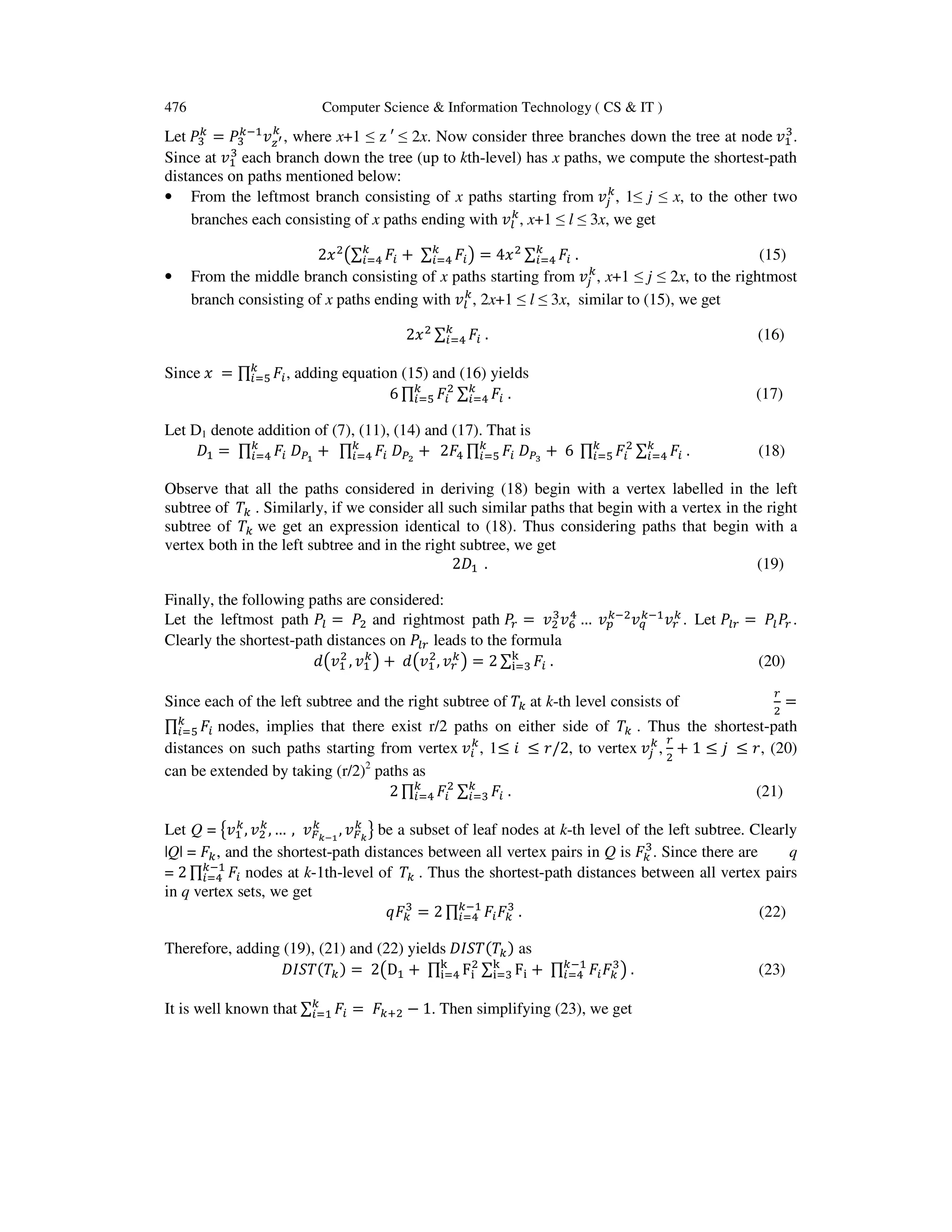
Proof. Consider the Fibonacci weighted tree with Fibonacci branching shown in Fig. 2. Let the
leftmost path ܲଵ = ‫ݒ‬ଵ
଴
‫ݒ‬ଵ
ଵ
‫ݒ‬ଵ
ଶ
… ‫ݒ‬ଵ
௞ିଶ
‫ݒ‬ଵ
௞ିଵ
‫ݒ‬ଵ
௞
. We begin by finding the shortest-path distance
from ‫ݒ‬ଵ
଴
to ‫ݒ‬ଵ
௞
. That is,
݀൫‫ݒ‬ଵ
଴
, ‫ݒ‬ଵ
௞
൯ = ∑ ‫ݓ‬൫‫ݒ‬ଵ
௜
, ‫ݒ‬ଵ
௜ାଵ
൯ .௞
௜ୀ଴
= ∑ ‫ܨ‬௜
௞
௜ୀଵ . (6)
Let the Wiener index on path ܲଵ denote ‫ܦ‬௉భ
. Then similar to (6), we can write as ‫ܦ‬௉భ
as
‫ܦ‬௉భ
= ෍ ‫ܨ‬௜
௞
௜ୀଵ
+ ෍ ‫ܨ‬௜
௞
௜ୀଶ
+ .. .. . . + ෍ ‫ܨ‬௜
௞
௜ୀ௞ିଶ
+ ෍ ‫ܨ‬௜ .
௞
௜ୀ௞ିଵ
Since in the left subtree there are
௥
ଶ
= ∏ ‫ܨ‬௜
௞
௜ୀସ paths originating from ‫ݒ‬ଵ
଴
, the Wiener index on all
such paths is
∏ ‫ܨ‬௜
௞
௜ୀସ ‫ܦ‬௉భ
. (7)
Consider the path ܲଶ = ‫ݒ‬ଵ
௞
‫ݒ‬ଵ
௞ିଵ
… ‫ݒ‬ଵ
ଷ
‫ݒ‬ଵ
ଶ
followed by ‫ݒ‬ଶ
ଷ
. Then
݀൫‫ݒ‬ଵ
௞
, ‫ݒ‬ଶ
ଷ
൯ = ∑ ‫ܨ‬௜
௞
௜ୀଷ + ‫ܨ‬ଷ . (8)
In Fig. 2 we can see that the node ‫ݒ‬ଶ
ଷ
has ‫ܨ‬ସ branches. Similar to (8), for a path ܲଶ followed
by ‫ݒ‬ଶ
ଷ
‫ݒ‬௟
ସ
, 4 ≤ l ≤ 6, we get
‫ܨ‬ସ൫݀൫‫ݒ‬ଵ
௞
, ‫ݒ‬ଶ
ଷ
൯ + ‫ܨ‬ସ൯ = ‫ܨ‬ସ ൫∑ ‫ܨ‬௜ +௞
௜ୀଷ ∑ ‫ܨ‬௜
ସ
௜ୀଷ ൯ . (9)
Let ܵ = {‫ݒ‬௝
௞ିଵ
∶
௤
ଶ
+ 1 ≤ ݆ ≤ ‫.}ݍ‬ Now consider the paths from ‫ݒ‬ଶ
ଷ
to all vertices u ∊ S preceded
by the path ܲଶ . Then similar to (9), the shortest-path distances on such paths is
݀൫‫ݒ‬ଵ
௞
, ‫ݒ‬ଵ
ଶ
൯ + ݀ା(‫ݒ‬ଵ
ଶ
, ܵ) = ‫ܨ‬ସ ൫∑ ‫ܨ‬௜ +௞
௜ୀଷ ∑ ‫ܨ‬௜
ସ
௜ୀଷ ൯ + ‫ܨ‬ସ ‫ܨ‬ହ൫∑ ‫ܨ‬௜ +௞
௜ୀଷ ∑ ‫ܨ‬௜
ହ
௜ୀଷ ൯ +
… ‫ܨ‬ସ‫ܨ‬ହ … ‫ܨ‬௞ିଵ൫∑ ‫ܨ‬௜ +௞
௜ୀଷ ∑ ‫ܨ‬௜
௞ିଵ
௜ୀଷ ൯ . (10)
Let ‫ܦ‬௉మ
= ݀൫‫ݒ‬ଵ
௞
, ‫ݒ‬ଶ
ଷ
൯ + ݀൫‫ݒ‬ଵ
௞
, ‫ݒ‬ଵ
ଶ
൯ + ݀ା(‫ݒ‬ଵ
ଶ
, ܵ) . Since there are r/2 paths in the subtree
originating from ‫ݒ‬ଵ
ଶ
down the tree, the shortest-path distances on all such paths and on the paths
considered in (8) and (10), we get
∏ ‫ܨ‬௜
௞
௜ୀସ ‫ܦ‬௉మ
. (11)
Let the path ܲଷ = ‫ݒ‬ଵ
௞
‫ݒ‬ଵ
௞ିଵ
… ‫ݒ‬ଵ
ଷ
. Let ‫ݔ‬ = ∏ ‫ܨ‬௜
௞
௜ୀହ and ‫ݕ‬ = ∏ ‫ܨ‬௜
௞ିଵ
௜ୀସ . Let ܲଷ
ସ
= ܲଷ‫ݒ‬ଶ
ସ
, ܲଷ
ହ
=
ܲଷ
ସ
‫ݒ‬௜
ହ
(6 ≤ i ≤ 10), ܲଷ
଺
= ܲଷ
ହ
‫ݒ‬௝
଺
(6 ≤ i ≤ 10, 41 ≤ ݆ ≤ 80),...,ܲଷ
௞ିଵ
= ܲଷ‫ݒ‬ଶ
ସ
‫ݒ‬௜
ହ
‫ݒ‬௝
଺
… ‫ݒ‬௭
௞ିଵ
(6 ≤ i ≤
10, 41 ≤ ݆ ≤ 80 and y+1 ≤ ‫ݖ‬ ≤ 2y). Then similar to (8)-(10), the shortest-path distances on
paths ܲଷ
ସ
, ܲଷ
ହ
, … , ܲଷ
௞ିଵ
denoted ‫ܦ‬௉య
is
‫ܦ‬௉య
= ൫∑ ‫ܨ‬௜
௞
௜ୀସ + ‫ܨ‬ସ൯ + ‫ܨ‬ହ൫∑ ‫ܨ‬௜ +௞
௜ୀସ ∑ ‫ܨ‬௜
ହ
௜ୀସ ൯ + … + ‫ܨ‬ହ‫ܨ‬଺ … ‫ܨ‬௞ିଵ൫∑ ‫ܨ‬௜ +௞
௜ୀସ ∑ ‫ܨ‬௜
௞ିଵ
௜ୀସ ൯ .
(12)
Since there are x paths that originates from ‫ݒ‬ଵ
ଷ
followed by ‫ݒ‬ଵ
ସ
down the tree, the shortest-path
distances on all such x paths and on paths ܲଷ
ଷ
, ܲଷ
ସ
, … . , ܲଷ
௞ିଵ
, (12) now becomes
∏ ‫ܨ‬௜
௞
௜ୀହ ‫ܦ‬௉య
. (13)
Since there ‫ܨ‬ସ branches at node ‫ݒ‬ଵ
ଷ
and since each branch down the tree from ‫ݒ‬ଵ
ଷ
(3rd-level to
kth-level of the tree) has t paths, the shortest-path distances on all such x paths of one branch and
on the paths of the other two branches up to k – 1 th-level of the tree, (13) now becomes
2‫ܨ‬ସ ∏ ‫ܨ‬௜ ‫ܦ‬௉య
௞
௜ୀହ . (14)
476 Computer Science & Information Technology ( CS & IT )
Let ܲଷ
௞
= ܲଷ
௞ିଵ
‫ݒ‬௭ᇲ
௞
, where x+1 ≤ z ′ ≤ 2x. Now consider three branches down the tree at node ‫ݒ‬ଵ
ଷ
.
Since at ‫ݒ‬ଵ
ଷ
each branch down the tree (up to kth-level) has x paths, we compute the shortest-path
distances on paths mentioned below:
• From the leftmost branch consisting of x paths starting from ‫ݒ‬௝
௞
, 1≤ j ≤ x, to the other two
branches each consisting of x paths ending with ‫ݒ‬௟
௞
, x+1 ≤ l ≤ 3x, we get
2‫ݔ‬ଶ
൫∑ ‫ܨ‬௜
௞
௜ୀସ + ∑ ‫ܨ‬௜
௞
௜ୀସ ൯ = 4‫ݔ‬ଶ ∑ ‫ܨ‬௜
௞
௜ୀସ . (15)
• From the middle branch consisting of x paths starting from ‫ݒ‬௝
௞
, x+1 ≤ j ≤ 2x, to the rightmost
branch consisting of x paths ending with ‫ݒ‬௟
௞
, 2x+1 ≤ l ≤ 3x, similar to (15), we get
2‫ݔ‬ଶ ∑ ‫ܨ‬௜ .௞
௜ୀସ (16)
Since ‫ݔ‬ = ∏ ‫ܨ‬௜
௞
௜ୀହ , adding equation (15) and (16) yields
6 ∏ ‫ܨ‬௜
ଶ
∑ ‫ܨ‬௜
௞
௜ୀସ
௞
௜ୀହ . (17)
Let D1 denote addition of (7), (11), (14) and (17). That is
‫ܦ‬ଵ = ∏ ‫ܨ‬௜ ‫ܦ‬௉భ
+௞
௜ୀସ ∏ ‫ܨ‬௜ ‫ܦ‬௉మ
+௞
௜ୀସ 2‫ܨ‬ସ ∏ ‫ܨ‬௜ ‫ܦ‬௉య
+ 6௞
௜ୀହ ∏ ‫ܨ‬௜
ଶ௞
௜ୀହ ∑ ‫ܨ‬௜
௞
௜ୀସ . (18)
Observe that all the paths considered in deriving (18) begin with a vertex labelled in the left
subtree of ܶ௞ . Similarly, if we consider all such similar paths that begin with a vertex in the right
subtree of ܶ௞ we get an expression identical to (18). Thus considering paths that begin with a
vertex both in the left subtree and in the right subtree, we get
2‫ܦ‬ଵ . (19)
Finally, the following paths are considered:
Let the leftmost path ܲ௟ = ܲଶ and rightmost path ܲ௥ = ‫ݒ‬ଶ
ଷ
‫ݒ‬଺
ସ
… ‫ݒ‬௣
௞ିଶ‫ݒ‬௤
௞ିଵ‫ݒ‬௥
௞ . Let ܲ௟௥ = ܲ௟ܲ௥ .
Clearly the shortest-path distances on ܲ௟௥ leads to the formula
݀൫‫ݒ‬ଵ
ଶ
, ‫ݒ‬ଵ
௞
൯ + ݀൫‫ݒ‬ଵ
ଶ
, ‫ݒ‬௥
௞
൯ = 2 ∑ ‫ܨ‬௜
୩
୧ୀଷ . (20)
Since each of the left subtree and the right subtree of ܶ௞ at k-th level consists of
௥
ଶ
=
∏ ‫ܨ‬௜
௞
௜ୀହ nodes, implies that there exist r/2 paths on either side of ܶ௞ . Thus the shortest-path
distances on such paths starting from vertex ‫ݒ‬௜
௞
, 1≤ ݅ ≤ ‫,2/ݎ‬ to vertex ‫ݒ‬௝
௞
,
௥
ଶ
+ 1 ≤ ݆ ≤ ‫,ݎ‬ (20)
can be extended by taking (r/2)2
paths as
2 ∏ ‫ܨ‬௜
ଶ
∑ ‫ܨ‬௜
௞
௜ୀଷ
௞
௜ୀସ . (21)
Let Q = ൛‫ݒ‬ଵ
௞
, ‫ݒ‬ଶ
௞
, … , ‫ݒ‬ிೖషభ
௞
, ‫ݒ‬ிೖ
௞
ൟ be a subset of leaf nodes at k-th level of the left subtree. Clearly
|Q| = ‫ܨ‬௞, and the shortest-path distances between all vertex pairs in Q is ‫ܨ‬௞
ଷ
. Since there are q
= 2 ∏ ‫ܨ‬௜
௞ିଵ
௜ୀସ nodes at k-1th-level of ܶ௞ . Thus the shortest-path distances between all vertex pairs
in q vertex sets, we get
‫ܨݍ‬௞
ଷ
= 2 ∏ ‫ܨ‬௜‫ܨ‬௞
ଷ௞ିଵ
௜ୀସ . (22)
Therefore, adding (19), (21) and (22) yields ‫ܶ(ܶܵܫܦ‬௞) as
‫ܶ(ܶܵܫܦ‬௞) = 2൫Dଵ + ∏ F୧
ଶ୩
୧ୀସ ∑ F୧
୩
୧ୀଷ + ∏ ‫ܨ‬௜‫ܨ‬௞
ଷ௞ିଵ
௜ୀସ ൯ . (23)
It is well known that ∑ ‫ܨ‬௜
௞
௜ୀଵ = ‫ܨ‬௞ାଶ − 1. Then simplifying (23), we get
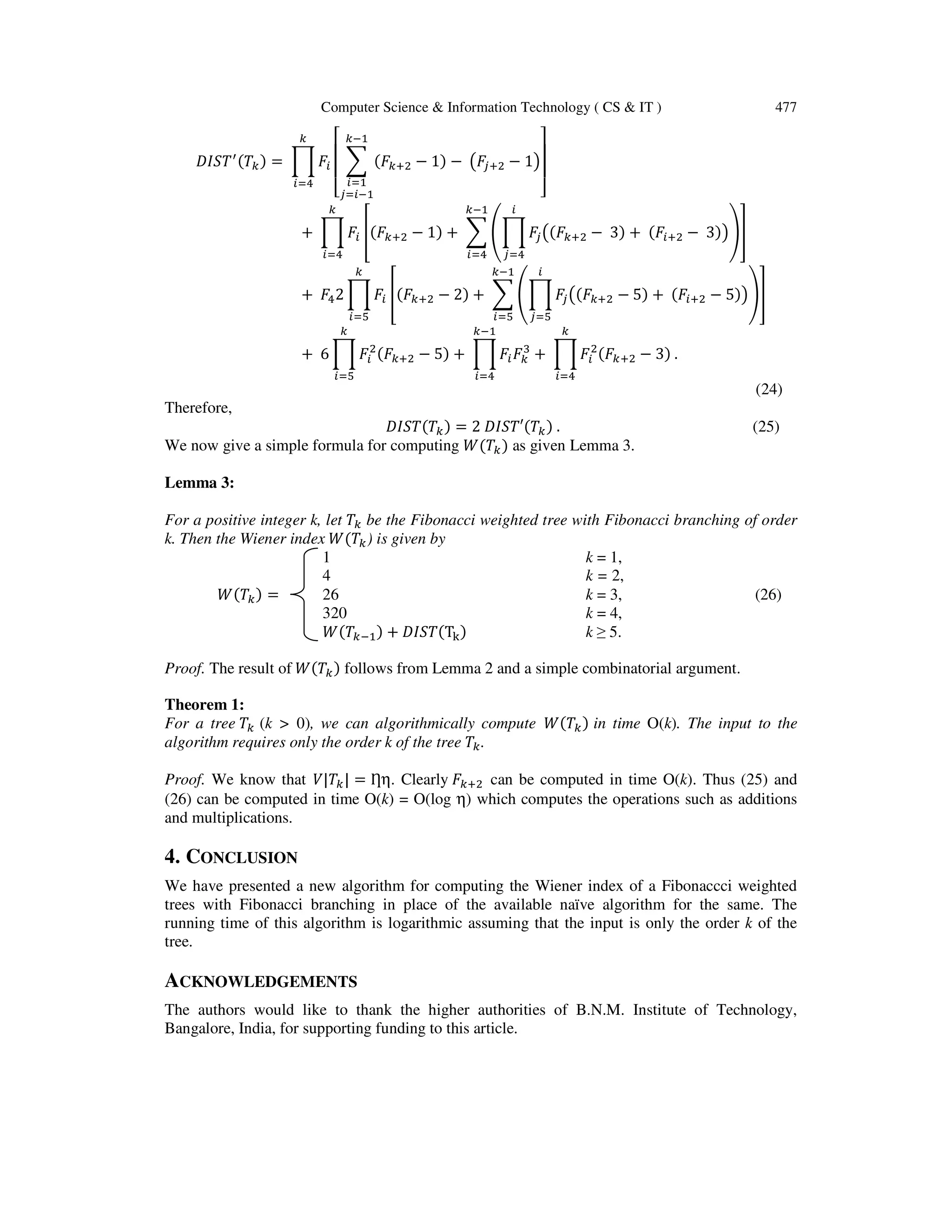
Computer Science & Information Technology ( CS & IT ) 477
‫ܶܵܫܦ‬ᇱ(ܶ௞) = ෑ ‫ܨ‬௜
௞
௜ୀସ
‫ۏ‬
‫ێ‬
‫ێ‬
‫ۍ‬
෍ (‫ܨ‬௞ାଶ − 1) − ൫‫ܨ‬௝ାଶ − 1൯
௞ିଵ
௜ୀଵ
௝ୀ௜ିଵ ‫ے‬
‫ۑ‬
‫ۑ‬
‫ې‬
+ ෑ ‫ܨ‬௜
௞
௜ୀସ
቎(‫ܨ‬௞ାଶ − 1) + ෍ ቌෑ ‫ܨ‬௝൫(‫ܨ‬௞ାଶ − 3) + (‫ܨ‬௜ାଶ − 3)൯
௜
௝ୀସ
ቍ
௞ିଵ
௜ୀସ
቏
+ ‫ܨ‬ସ2 ෑ ‫ܨ‬௜ ቎(‫ܨ‬௞ାଶ − 2) + ෍ ቌෑ ‫ܨ‬௝൫(‫ܨ‬௞ାଶ − 5) + (‫ܨ‬௜ାଶ − 5)൯
௜
௝ୀହ
ቍ
௞ିଵ
௜ୀହ
቏
௞
௜ୀହ
+ 6 ෑ ‫ܨ‬௜
ଶ
(‫ܨ‬௞ାଶ − 5) + ෑ ‫ܨ‬௜‫ܨ‬௞
ଷ
+ ෑ‫ܨ‬௜
ଶ
(‫ܨ‬௞ାଶ − 3) .
௞
௜ୀସ
௞ିଵ
௜ୀସ
௞
௜ୀହ
(24)
Therefore,
‫ܶ(ܶܵܫܦ‬௞) = 2 ‫ܶ(′ܶܵܫܦ‬௞) . (25)
We now give a simple formula for computing ܹ(ܶ௞) as given Lemma 3.
Lemma 3:
For a positive integer k, let ܶ௞ be the Fibonacci weighted tree with Fibonacci branching of order
k. Then the Wiener index ܹ(ܶ௞) is given by
1 k = 1,
4 k = 2,
ܹ(ܶ௞) = 26 k = 3, (26)
320 k = 4,
ܹ(ܶ௞ିଵ) + ‫(ܶܵܫܦ‬T୩) k ≥ 5.
Proof. The result of ܹ(ܶ௞) follows from Lemma 2 and a simple combinatorial argument.
Theorem 1:
For a tree ܶ௞ (k > 0), we can algorithmically compute ܹ(ܶ௞) in time O(k). The input to the
algorithm requires only the order k of the tree ܶ௞.
Proof. We know that ܸ|ܶ௞| = Ƞη. Clearly ‫ܨ‬௞ାଶ can be computed in time O(k). Thus (25) and
(26) can be computed in time O(k) = O(log η) which computes the operations such as additions
and multiplications.
4. CONCLUSION
We have presented a new algorithm for computing the Wiener index of a Fibonaccci weighted
trees with Fibonacci branching in place of the available naïve algorithm for the same. The
running time of this algorithm is logarithmic assuming that the input is only the order k of the
tree.
ACKNOWLEDGEMENTS
The authors would like to thank the higher authorities of B.N.M. Institute of Technology,
Bangalore, India, for supporting funding to this article.
478 Computer Science & Information Technology ( CS & IT )
REFERENCES
[1] F. Buckley and F. Harary, (1990) “Distance in Graphs” (Addison-Wesley, Redwood, Vol. 42.
[2] T. H. Cormen, C.E. Leiserson, R.L. Rivest, and C. Stein, (2001) Introduction to Algorithms, McGraw-
Hill, 2nd
edition.
[3] P. Dankelmann, S. Mukwembi, and H. C. Swart, (2009) “Average distance and vertex connectivity”, J.
Graph Theory, Vol. 62(2), pp 157-177.
[4] R.C. Entringer, D.E. Jackson and D. A. Snyder, (1976) “Distance in graphs”, Czech. Math. J., Vol. 26,
pp 283-296.
[5] I. Gutman, (1988) “On distances in some bipartite graphs”, Publ. Inst. Math., (Beograd), Vol. 43, pp 3-
8.
[6] F. Harary, (1959) “Status and contrastatus”, Sociometry, Vol. 22, pp 23-43.
[7] S. Klavzar, and I. Gutman, (1997) “Wiener number of vertex-weighted graphs and chemical
applications”, Discrete Appl. Math., Vol. 80, pp 73-81.
[8] J. Plesnik, (1984) “On the sum of distances in graphs or digraph”, J. Graph Theory, Vol. 8, pp 1-21.
[9] S.G. Wagner, H. Wang, and G. Yu, (2009) “Molecular Graphs and the Inverse Wiener Index Problem”,
Discrete Appl. Math., Vol. 157, pp 1544-1554.
[10] Y. N. Yeh and I. Gutman, (1994) “On the sum of all distances in composite graphs”, Discrete Math.,
Vol. 135, pp 359-365.
AUTHORS
K. R. Udaya Kumar Reddy completed his Diploma in Computer Science and Engineering from
Siddaganga Polytechnic, Tumkur, Bangalore University in 1993. In 1998 he completed his Bachelor of
Engineering in Computer Science and Engineering from Golden Valley Institute of Technology (now Dr.
TTIT), K.G.F, Bangalore University, India. In 2004 he completed his Master of Engineering in Computer
Science and Engineering from University Visvesvaraya College of Engineering, Bangalore, India. In 2012,
he completed his Ph.D in the area of Graph Algorithms in Computer Science and Engineering, National
Institute of Technology, Trichy, India (formerly Regional Engineering College). He held various positions
at B.N.M. Institute of Technology, Bangalore, India, before joining Ph.D course and is currently a
Professor at B.N.M. Institute of Technology, Bangalore, India. His fields of interests are Algorithmic graph
theory and Theory of computation.
Ranjana S. Chakrasali received her graduation in Computer Science & Engineering from Tontadarya
College of Engineering, Gadag, Visvesvaraya Technological University (VTU), Belgaum, India in 2002.
Thereafter entered into teaching profession as a Lecturer and worked for 6 years. Currently pursuing post
graduate at BNM Institute of Technology, Bangalore, India, affiliated to VTU. Her areas of interests are
Graph Theory, Computer Graphics and Computer Networks.

COMPUTING WIENER INDEX OF FIBONACCI WEIGHTED TREES

  • 1.
    Natarajan Meghanathan, etal. (Eds): SIPM, FCST, ITCA, WSE, ACSIT, CS & IT 06, pp. 471–478, 2012. © CS & IT-CSCP 2012 DOI : 10.5121/csit.2012.2346 COMPUTING WIENER INDEX OF FIBONACCI WEIGHTED TREES K. R. Udaya Kumar Reddy1 and Ranjana S. Chakrasali2 1, 2 Department of Computer Science and Engineering, BNM Institute of Technology, Bangalore-560070, Karnataka, India {krudaykumar@yahoo.com, ranjanagirish@gmail.com} ABSTRACT Given a simple connected undirected graph ‫ܩ‬ = ሺܸ, ‫ܧ‬ሻ with |ܸ| = ݊ and |‫|ܧ‬ = ݉, the Wiener index ܹሺ‫ܩ‬ሻ of ‫ܩ‬ is defined as half the sum of the distances of the form ݀ሺ‫,ݑ‬ ‫ݒ‬ሻ between all pairs of vertices u, v of ‫ܩ‬ . If ሺ‫,ܩ‬ ‫ݓ‬ாሻ is an edge-weighted graph, then the Wiener index ܹሺ‫,ܩ‬ ‫ݓ‬ாሻof ሺ‫,ܩ‬ ‫ݓ‬ாሻ is defined as the usual Wiener index but the distances is now computed in ሺ‫,ܩ‬ ‫ݓ‬ாሻ. The paper proposes a new algorithm for computing the Wiener index of a Fibonacci weighted trees with Fibonacci branching in place of the available naive algorithm for the same. It is found that the time complexity of the algorithm is logarithmic. KEYWORDS Algorithms, Distance in graphs, Fibonacci weighted tree, Wiener index. 1. INTRODUCTION Let ‫ܩ‬ = ሺܸሺ‫ܩ‬ሻ, ‫ܧ‬ሺ‫ܩ‬ሻሻ be a connected unweighted undirected graph without self-loops and multiple edges. Let |ܸሺ‫ܩ‬ሻ| = ݊ and |‫ܧ‬ሺ‫ܩ‬ሻ| = ݉. The Wiener index ܹሺ‫ܩ‬ሻ of ‫ܩ‬ is defined as half the sum of the distances between all pairs of vertices of a graph ‫.ܩ‬ Wiener index is a distance based graph invariant which is one of the most popular topological indices in mathematical chemistry. It is named after the chemist Harold Wiener, who first introduced it in 1947 to study chemical properties of alkanes. It is not recognized that there are good correlations between ܹሺ‫ܩ‬ሻ and physico-chemical properties of the organic compound from which ‫ܩ‬ is derived, especially when ‫ܩ‬ is a tree. Wiener index have been studied quite extensively in both the mathematical and chemical literature. For chemical applications of Wiener index, see [7, 9]. The Wiener index is also studied to investigate a related quantity the average distance (defined as 2ܹሺ‫ܩ‬ሻ/݊ሺ݊ − 1ሻሻof a graph, which is frequently done in pure mathematics [3]. In this paper we are concerned with a tree called Fibonacci weighted tree with Fibonacci branching. Let η = 1 + F1 + F2 + F3 +∏ ‫ܨ‬௜ +ସ ௜ୀଵ …. + ∏ ‫ܨ‬௜ ௞ ௜ୀଵ be the number of vertices in ܶ௞, where ‫ܨ‬௜ = i-th Fibonacci number. One way to compute the Wiener index of Fibonacci weighted tree with Fibonacci branching is to compute the distances between all pairs of vertices of a graph. It is known [2] that the straightforward approach for solving the distances on a weighted graph between all pairs of vertices of ‫ܩ‬ is to run Floyd-Warshall algorithm which takes a time O(n3 ); thus for Fibonacci weighted tree with Fibonacci branching of order k with η vertices, such an algorithm can compute the Wiener index in time O(η3 ) and requires as an input a description of Fibonacci weighted tree with Fibonacci branching of order k, e.g., an adjacency matrix. In this note, we propose a new algorithm for computing the Wiener index of Fibonacci weighted tree
  • 2.
    472 Computer Science& Information Technology ( CS & IT ) with Fibonacci branching in time O(log η), assuming that the input is only the order k of the Fibonacci weighted tree with Fibonacci branching. 2. PRELIMINARIES The Wiener index ܹሺ‫ܩ‬ሻ of ‫ܩ‬ is defined as ܹሺ‫ܩ‬ሻ = 1 2 ෍ ෍ ݀ሺ‫,ݑ‬ ‫ݒ‬ሻ ௩ ∈௏ሺீሻ , ௨∊௏ሺீሻ ሺ1ሻ where ݀ሺ‫,ݑ‬ ‫ݒ‬ሻ denotes the distance (the number of edges on a shortest path between u and v between u, v in ‫.ܩ‬ Wiener index ܹሺ‫ܩ‬ሻ comes under different names such as sum of all distances [5, 10], total status [1], gross status [6], graph distance [4], and transmission [8]. A related quantity is the average distance µሺ‫ܩ‬ሻ defined as µሺ‫ܩ‬ሻ = 2ܹሺ‫ܩ‬ሻ ݊ሺ݊ − 1ሻ . Let ‫ݓ‬ሺ݅, ݆ሻ denote the edge weight on the edge {i, j}. Then ‫ݓ‬ሺ݅, ݆ሻ = ൜ ‫݃݅݁ݓ‬ℎ‫ݐ‬ ‫݂݋‬ ݁݀݃݁ ሺ݅, ݆ሻ ݂݅ ሺ݅, ݆ሻ ∈ ‫ܧ‬ሺ‫ܩ‬ሻ, +∞ ݂݅ ሺ݅, ݆ሻ ∈ ‫ܧ‬ሺ‫ܩ‬ሻ. Consider an edge-weighted graph ‫ܩ‬ with weight function ‫ݓ‬ா : ‫ܧ‬ሺ‫ܩ‬ሻ R+ denoted as ሺ‫,ܩ‬ ‫ݓ‬ாሻ. Then the weight of a path is the sum of the weights of its edges on that path. A shortest path between two vertices u and v is a path of minimum weight. The shortest-path distance ݀ሺீ,௪ಶሻሺ‫,ݑ‬ ‫ݒ‬ሻ (or simply ݀ሺ‫,ݑ‬ ‫ݒ‬ሻ) is the sum of the weights of the edges along the shortest path connecting u and v. For ‫ݑ‬ ∈ ܸሺ‫ܩ‬ሻ and H ⊆ ܸሺ‫ܩ‬ሻ, let ݀ାሺ‫,ݑ‬ ‫ܪ‬ሻ = ∑ ݀ሺ‫,ݑ‬ ‫ݒ‬ሻ௩∈ு . The Wiener index ܹሺ‫,ܩ‬ ‫ݓ‬ாሻ of ሺ‫,ܩ‬ ‫ݓ‬ாሻ is defined as the usual Wiener index, that is, ܹ ሺ‫,ܩ‬ ‫ݓ‬ாሻ = ଵ ଶ ∑ ∑ ݀ሺ‫,ݑ‬ ‫ݒ‬ሻ௩∈௏ሺீሻ௨∈௩ሺீሻ where ݀ሺ‫,ݑ‬ ‫ݒ‬ሻ is now computed in ሺ‫,ܩ‬ ‫ݓ‬ாሻ. Clearly if all the edges have weight one, then ܹሺ‫,ܩ‬ ‫ݓ‬ாሻ = ܹሺ‫ܩ‬ሻ. In the sequel, for notational convenience we assume that ܹሺܶሻ = ܹሺܶ, ‫ݓ‬ாሻ. It is well known that the Fibonacci numbers are defined recursively as follows: (i) The Fibonacci numbers ‫ܨ‬଴ = 0 and ‫ܨ‬ଵ = 1, and (ii) For k ≥ 2, the Fibonacci number ‫ܨ‬௞ = ‫ܨ‬௞ିଵ + ‫ܨ‬௞ିଶ. We define Fibonacci weighted path ܲ௙೙ of order n, as a path on n + 1 vertices, where the consecutive edges are assigned weights ‫ܨ‬ଵ, . . . ,‫ܨ‬௡ starting from an edge incident on a pendent vertex. Let k be a positive integer. The Fibonacci weighted tree with Fibonacci branching ܶ௞ of order k, is defined recursively in the following way: i. ܶଵ = ሺܸଵ, ‫ܧ‬ଵሻis a rooted tree, where ܸଵ = ሼ‫ݒ‬ଵ ଴ , ‫ݒ‬ଵ ଵሽ and ‫ܧ‬ଵ = ሼሺ‫ݒ‬ଵ ଴ , ‫ݒ‬ଵ ଵ ሻሽ, with ‫ݓ‬ሺ‫ݒ‬ଵ ଴ , ‫ݒ‬ଵ ଵሻ = ‫ܨ‬ଵ. ii. ܶଶ = ሺܸଵ ∪ ܸଶ, ‫ܧ‬ଵ ∪ ‫ܧ‬ଶሻ is a rooted tree, where V2 = ሼ‫ݒ‬ଵ ଶሽ and ‫ܧ‬ଶ = ሼሺ‫ݒ‬ଵ ଵ , ‫ݒ‬ଵ ଶ ሻሽ , with ‫ݓ‬ሺ‫ݒ‬ଵ ଴ , ‫ݒ‬ଵ ଵሻ = ‫ܨ‬ଵ and wሺ‫ݒ‬ଵ ଵ , ‫ݒ‬ଵ ଶሻ = ‫ܨ‬ଶ . iii. For k ≥ 3, the rooted tree ܶ௞ is constructed as follows: Let p = ∏ ‫ܨ‬௜ ௞ିଶ ௜ୀଵ , ‫ݍ‬ = ‫ܨ݌‬௞ିଵ and ‫ݎ‬ = ‫ܨݍ‬௞. Let V = (V1 ∪ ...∪ Vk-1) and E = (E1 ∪… ∪ Ek-1), where Vk-1 = {‫ݒ‬ଵ ௞ିଵ , … , ‫ݒ‬௤ ௞ିଵ } and Ek-1 = { (‫ݒ‬௜ ௞ିଶ , ‫ݒ‬௝ ௞ିଵ ) : 1 ≤ i ≤ p, 1 ≤ j ≤ q and (i- 1)Fk-1 + 1 ≤ j ≤ iFk-1}. If ܶ௞ିଵ = ሺܸ, ‫ܧ‬ሻ is a rooted tree, then ܶ௞ = ሺܸ ∪ ܸ௞, ‫ܧ‬ ∪ ‫ܧ‬௞ሻ, where Vk = {‫ݒ‬ଵ ௞ , . . . . , ‫ݒ‬௥ ௞ } and Ek = { (‫ݒ‬௜ ௞ିଵ , ‫ݒ‬௝ ௞ ): 1 ≤ i ≤ q, 1 ≤ j ≤ r and (i-1)Fk+ 1 ≤ j ≤ iFk } and ∀ (u, v) ∊ Ek , w(u, v) = Fk . Figure 1 shows the Fibonacci weighted trees with Fibonacci branching ܶଵ through ܶସ.
  • 3.
    Computer Science &Information Technology ( CS & IT ) 473 ܶଵ ܶଶ ܶଷ ܶସ Figure 1: Fibonacci weighted trees with Fibonacci branching ܶଵ through ܶସ. 3. COMPUTING WIENER INDEX OF FIBONACCI WEIGHTED TREES WITH FIBONACCI BRANCHING We begin with the following lemma which gives a closed-form expression for ܹሺܲ௙೙ ሻ . Lemma 1: Let ܲ௙೙ be a Fibonacci weighted path with n + 1 vertices. Then for n ≥ 2, the Wiener index ܹሺܲ௙೙ ሻ is given by ܹ൫ܲ௙೙ ൯ = ݊ሺ‫ܨ‬௡ାସ + 2ሻ − 2‫ܨ‬௡ାହ + 10 . ሺ2ሻ Proof. From the Fibonacci weighted path ܲ௙೙ , it is clear that ܹ൫ܲ௙೙ ൯ = ܹ൫ܲ௙೙షభ ൯ + ෍ ݆ ௡ ௝ୀଵ ‫ܨ‬௝ . ሺ3ሻ with initial condition ܹ൫ܲ௙భ ൯ = 1. Equation (3) can be simplified to ܹ൫ܲ௙೙ ൯ = ܹ൫ܲ௙೙షభ ൯ + ݊‫ܨ‬௡ାଶ + 2 − ‫ܨ‬௡ାଷ . ሺ4ሻ Simplifying (4) gives the desired expression for ܹሺܲ௙೙ ሻ as given in (2). Lemma 2: Let ‫ݎ‬ = ∏ ‫ܨ‬௜ ௞ ௜ୀଵ and Z = { ‫ݒ‬௜ ௞ | 1 ≤ ݅ ≤ ‫ݎ‬ }. For 1 ≤ ݆ ≤ r, let ܺଵ,௝ିଵ = ‫ݒ‬ଵ ௞ , … ‫ݒ‬௝ିଵ ௞ and ܻ = ܸ(ܶ௞) ܺଵ,௝ିଵ. For a positive integer k ≥ 5, let ܶ௞ be the Fibonacci weighted tree with Fibonacci branching of order k. Then ‫ܶ(ܶܵܫܦ‬௞) is given by ‫ܶ(ܶܵܫܦ‬௞) = ෍ ݀ା ൫‫ݒ‬௝ ௞ , ܻ൯ = 2‫ܶܵܫܦ‬ᇱ (ܶ௞ ௩ೕ ೖ ∊ ௓ ) r r r r 1 1 22 1 1 1 11 111 1 22 1 1
  • 4.
    474 Computer Science& Information Technology ( CS & IT ) Leaf nodes represent ‫ݒ‬ଵ ௞ to ‫ݒ‬௥ ௞ vertices Figure 2: Fibonacci weighted tree with Fibonacci branching ܶ௞. where, ‫ܶܵܫܦ‬ᇱ (ܶ௞) = ෑ ‫ܨ‬௜ ௞ ௜ୀସ ‫ۏ‬ ‫ێ‬ ‫ێ‬ ‫ۍ‬ ෍ (‫ܨ‬௞ାଶ ௞ିଵ ௜ୀଵ ௝ୀ௜ିଵ − 1) − ( ‫ܨ‬௝ାଶ − 1) ‫ے‬ ‫ۑ‬ ‫ۑ‬ ‫ې‬ + ෑ ‫ܨ‬௜ ௞ ௜ୀସ ቎(‫ܨ‬௞ାଶ − 1) ෍ ቌෑ‫ܨ‬௝ ൫(‫ܨ‬௞ାଶ − 3) + (‫ܨ‬௜ାଶ − 3)൯ ௜ ௝ୀସ ቍ ௞ିଵ ௜ୀସ ቏ + ‫ܨ‬ସ 2 ෑ ‫ܨ‬௜ ௞ ௜ୀହ ቎(‫ܨ‬௞ାଶ − 2) ෍ ቌෑ ‫ܨ‬௝ ൫(‫ܨ‬௞ାଶ − 5) + (‫ܨ‬௜ାଶ − 5)൯ ௜ ௝ୀହ ቍ ௞ିଵ ௜ୀହ ቏ + 6 ෑ ‫ܨ‬௜ ଶ (‫ܨ‬௞ାଶ − 5) + ෑ ‫ܨ‬௜‫ܨ‬௞ ଷ + ෑ ‫ܨ‬௜ ଶ (‫ܨ‬௞ାଶ − 3) ௞ ௜ୀସ ௞ିଵ ௜ୀସ ௞ ௜ୀହ . (5) ‫ݒ‬ଵ ଶ ‫ݒ‬ଵ଺ ହ ‫ݒ‬ଷ଴ ହ ‫ݒ‬ଶ଺ ହ ‫ݒ‬ଶଵ ହ ‫ݒ‬ଶହ ହ ‫ݒ‬ଶ଴ ହ‫ݒ‬ଵ ହ ‫ݒ‬ଵହ ହ ‫ݒ‬ଵଵ ହ ‫ݒ‬଺ ହ ‫ݒ‬ଵ଴ ହ ‫ݒ‬ହ ହ ‫ݒ‬ହ ସ ‫ܨ‬ହ ‫ܨ‬ହ 555555555555 ‫ݒ‬ସ ସ ‫ݒ‬଺ ସ ‫ݒ‬ଵ ସ ‫ݒ‬ଷ ସ ‫ݒ‬ଶ ସ ‫ܨ‬ହ‫ܨ‬ହ‫ܨ‬ହ‫ܨ‬ହ ‫ܨ‬௞ ‫ܨ‬௞ ‫ݒ‬ଵ ௞ ‫ݒ‬௥ ௞ 3333 3 ‫ܨ‬ସ ‫ܨ‬ସ 3 1 ‫ݒ‬ଵ ଵ ‫ݒ‬ଵ ଴ 2 2 1 ‫ݒ‬ଶ ଷ‫ݒ‬ଵ ଷ ‫ܨ‬ଷ
  • 5.
    Computer Science &Information Technology ( CS & IT ) 475 Proof. Consider the Fibonacci weighted tree with Fibonacci branching shown in Fig. 2. Let the leftmost path ܲଵ = ‫ݒ‬ଵ ଴ ‫ݒ‬ଵ ଵ ‫ݒ‬ଵ ଶ … ‫ݒ‬ଵ ௞ିଶ ‫ݒ‬ଵ ௞ିଵ ‫ݒ‬ଵ ௞ . We begin by finding the shortest-path distance from ‫ݒ‬ଵ ଴ to ‫ݒ‬ଵ ௞ . That is, ݀൫‫ݒ‬ଵ ଴ , ‫ݒ‬ଵ ௞ ൯ = ∑ ‫ݓ‬൫‫ݒ‬ଵ ௜ , ‫ݒ‬ଵ ௜ାଵ ൯ .௞ ௜ୀ଴ = ∑ ‫ܨ‬௜ ௞ ௜ୀଵ . (6) Let the Wiener index on path ܲଵ denote ‫ܦ‬௉భ . Then similar to (6), we can write as ‫ܦ‬௉భ as ‫ܦ‬௉భ = ෍ ‫ܨ‬௜ ௞ ௜ୀଵ + ෍ ‫ܨ‬௜ ௞ ௜ୀଶ + .. .. . . + ෍ ‫ܨ‬௜ ௞ ௜ୀ௞ିଶ + ෍ ‫ܨ‬௜ . ௞ ௜ୀ௞ିଵ Since in the left subtree there are ௥ ଶ = ∏ ‫ܨ‬௜ ௞ ௜ୀସ paths originating from ‫ݒ‬ଵ ଴ , the Wiener index on all such paths is ∏ ‫ܨ‬௜ ௞ ௜ୀସ ‫ܦ‬௉భ . (7) Consider the path ܲଶ = ‫ݒ‬ଵ ௞ ‫ݒ‬ଵ ௞ିଵ … ‫ݒ‬ଵ ଷ ‫ݒ‬ଵ ଶ followed by ‫ݒ‬ଶ ଷ . Then ݀൫‫ݒ‬ଵ ௞ , ‫ݒ‬ଶ ଷ ൯ = ∑ ‫ܨ‬௜ ௞ ௜ୀଷ + ‫ܨ‬ଷ . (8) In Fig. 2 we can see that the node ‫ݒ‬ଶ ଷ has ‫ܨ‬ସ branches. Similar to (8), for a path ܲଶ followed by ‫ݒ‬ଶ ଷ ‫ݒ‬௟ ସ , 4 ≤ l ≤ 6, we get ‫ܨ‬ସ൫݀൫‫ݒ‬ଵ ௞ , ‫ݒ‬ଶ ଷ ൯ + ‫ܨ‬ସ൯ = ‫ܨ‬ସ ൫∑ ‫ܨ‬௜ +௞ ௜ୀଷ ∑ ‫ܨ‬௜ ସ ௜ୀଷ ൯ . (9) Let ܵ = {‫ݒ‬௝ ௞ିଵ ∶ ௤ ଶ + 1 ≤ ݆ ≤ ‫.}ݍ‬ Now consider the paths from ‫ݒ‬ଶ ଷ to all vertices u ∊ S preceded by the path ܲଶ . Then similar to (9), the shortest-path distances on such paths is ݀൫‫ݒ‬ଵ ௞ , ‫ݒ‬ଵ ଶ ൯ + ݀ା(‫ݒ‬ଵ ଶ , ܵ) = ‫ܨ‬ସ ൫∑ ‫ܨ‬௜ +௞ ௜ୀଷ ∑ ‫ܨ‬௜ ସ ௜ୀଷ ൯ + ‫ܨ‬ସ ‫ܨ‬ହ൫∑ ‫ܨ‬௜ +௞ ௜ୀଷ ∑ ‫ܨ‬௜ ହ ௜ୀଷ ൯ + … ‫ܨ‬ସ‫ܨ‬ହ … ‫ܨ‬௞ିଵ൫∑ ‫ܨ‬௜ +௞ ௜ୀଷ ∑ ‫ܨ‬௜ ௞ିଵ ௜ୀଷ ൯ . (10) Let ‫ܦ‬௉మ = ݀൫‫ݒ‬ଵ ௞ , ‫ݒ‬ଶ ଷ ൯ + ݀൫‫ݒ‬ଵ ௞ , ‫ݒ‬ଵ ଶ ൯ + ݀ା(‫ݒ‬ଵ ଶ , ܵ) . Since there are r/2 paths in the subtree originating from ‫ݒ‬ଵ ଶ down the tree, the shortest-path distances on all such paths and on the paths considered in (8) and (10), we get ∏ ‫ܨ‬௜ ௞ ௜ୀସ ‫ܦ‬௉మ . (11) Let the path ܲଷ = ‫ݒ‬ଵ ௞ ‫ݒ‬ଵ ௞ିଵ … ‫ݒ‬ଵ ଷ . Let ‫ݔ‬ = ∏ ‫ܨ‬௜ ௞ ௜ୀହ and ‫ݕ‬ = ∏ ‫ܨ‬௜ ௞ିଵ ௜ୀସ . Let ܲଷ ସ = ܲଷ‫ݒ‬ଶ ସ , ܲଷ ହ = ܲଷ ସ ‫ݒ‬௜ ହ (6 ≤ i ≤ 10), ܲଷ ଺ = ܲଷ ହ ‫ݒ‬௝ ଺ (6 ≤ i ≤ 10, 41 ≤ ݆ ≤ 80),...,ܲଷ ௞ିଵ = ܲଷ‫ݒ‬ଶ ସ ‫ݒ‬௜ ହ ‫ݒ‬௝ ଺ … ‫ݒ‬௭ ௞ିଵ (6 ≤ i ≤ 10, 41 ≤ ݆ ≤ 80 and y+1 ≤ ‫ݖ‬ ≤ 2y). Then similar to (8)-(10), the shortest-path distances on paths ܲଷ ସ , ܲଷ ହ , … , ܲଷ ௞ିଵ denoted ‫ܦ‬௉య is ‫ܦ‬௉య = ൫∑ ‫ܨ‬௜ ௞ ௜ୀସ + ‫ܨ‬ସ൯ + ‫ܨ‬ହ൫∑ ‫ܨ‬௜ +௞ ௜ୀସ ∑ ‫ܨ‬௜ ହ ௜ୀସ ൯ + … + ‫ܨ‬ହ‫ܨ‬଺ … ‫ܨ‬௞ିଵ൫∑ ‫ܨ‬௜ +௞ ௜ୀସ ∑ ‫ܨ‬௜ ௞ିଵ ௜ୀସ ൯ . (12) Since there are x paths that originates from ‫ݒ‬ଵ ଷ followed by ‫ݒ‬ଵ ସ down the tree, the shortest-path distances on all such x paths and on paths ܲଷ ଷ , ܲଷ ସ , … . , ܲଷ ௞ିଵ , (12) now becomes ∏ ‫ܨ‬௜ ௞ ௜ୀହ ‫ܦ‬௉య . (13) Since there ‫ܨ‬ସ branches at node ‫ݒ‬ଵ ଷ and since each branch down the tree from ‫ݒ‬ଵ ଷ (3rd-level to kth-level of the tree) has t paths, the shortest-path distances on all such x paths of one branch and on the paths of the other two branches up to k – 1 th-level of the tree, (13) now becomes 2‫ܨ‬ସ ∏ ‫ܨ‬௜ ‫ܦ‬௉య ௞ ௜ୀହ . (14)
  • 6.
    476 Computer Science& Information Technology ( CS & IT ) Let ܲଷ ௞ = ܲଷ ௞ିଵ ‫ݒ‬௭ᇲ ௞ , where x+1 ≤ z ′ ≤ 2x. Now consider three branches down the tree at node ‫ݒ‬ଵ ଷ . Since at ‫ݒ‬ଵ ଷ each branch down the tree (up to kth-level) has x paths, we compute the shortest-path distances on paths mentioned below: • From the leftmost branch consisting of x paths starting from ‫ݒ‬௝ ௞ , 1≤ j ≤ x, to the other two branches each consisting of x paths ending with ‫ݒ‬௟ ௞ , x+1 ≤ l ≤ 3x, we get 2‫ݔ‬ଶ ൫∑ ‫ܨ‬௜ ௞ ௜ୀସ + ∑ ‫ܨ‬௜ ௞ ௜ୀସ ൯ = 4‫ݔ‬ଶ ∑ ‫ܨ‬௜ ௞ ௜ୀସ . (15) • From the middle branch consisting of x paths starting from ‫ݒ‬௝ ௞ , x+1 ≤ j ≤ 2x, to the rightmost branch consisting of x paths ending with ‫ݒ‬௟ ௞ , 2x+1 ≤ l ≤ 3x, similar to (15), we get 2‫ݔ‬ଶ ∑ ‫ܨ‬௜ .௞ ௜ୀସ (16) Since ‫ݔ‬ = ∏ ‫ܨ‬௜ ௞ ௜ୀହ , adding equation (15) and (16) yields 6 ∏ ‫ܨ‬௜ ଶ ∑ ‫ܨ‬௜ ௞ ௜ୀସ ௞ ௜ୀହ . (17) Let D1 denote addition of (7), (11), (14) and (17). That is ‫ܦ‬ଵ = ∏ ‫ܨ‬௜ ‫ܦ‬௉భ +௞ ௜ୀସ ∏ ‫ܨ‬௜ ‫ܦ‬௉మ +௞ ௜ୀସ 2‫ܨ‬ସ ∏ ‫ܨ‬௜ ‫ܦ‬௉య + 6௞ ௜ୀହ ∏ ‫ܨ‬௜ ଶ௞ ௜ୀହ ∑ ‫ܨ‬௜ ௞ ௜ୀସ . (18) Observe that all the paths considered in deriving (18) begin with a vertex labelled in the left subtree of ܶ௞ . Similarly, if we consider all such similar paths that begin with a vertex in the right subtree of ܶ௞ we get an expression identical to (18). Thus considering paths that begin with a vertex both in the left subtree and in the right subtree, we get 2‫ܦ‬ଵ . (19) Finally, the following paths are considered: Let the leftmost path ܲ௟ = ܲଶ and rightmost path ܲ௥ = ‫ݒ‬ଶ ଷ ‫ݒ‬଺ ସ … ‫ݒ‬௣ ௞ିଶ‫ݒ‬௤ ௞ିଵ‫ݒ‬௥ ௞ . Let ܲ௟௥ = ܲ௟ܲ௥ . Clearly the shortest-path distances on ܲ௟௥ leads to the formula ݀൫‫ݒ‬ଵ ଶ , ‫ݒ‬ଵ ௞ ൯ + ݀൫‫ݒ‬ଵ ଶ , ‫ݒ‬௥ ௞ ൯ = 2 ∑ ‫ܨ‬௜ ୩ ୧ୀଷ . (20) Since each of the left subtree and the right subtree of ܶ௞ at k-th level consists of ௥ ଶ = ∏ ‫ܨ‬௜ ௞ ௜ୀହ nodes, implies that there exist r/2 paths on either side of ܶ௞ . Thus the shortest-path distances on such paths starting from vertex ‫ݒ‬௜ ௞ , 1≤ ݅ ≤ ‫,2/ݎ‬ to vertex ‫ݒ‬௝ ௞ , ௥ ଶ + 1 ≤ ݆ ≤ ‫,ݎ‬ (20) can be extended by taking (r/2)2 paths as 2 ∏ ‫ܨ‬௜ ଶ ∑ ‫ܨ‬௜ ௞ ௜ୀଷ ௞ ௜ୀସ . (21) Let Q = ൛‫ݒ‬ଵ ௞ , ‫ݒ‬ଶ ௞ , … , ‫ݒ‬ிೖషభ ௞ , ‫ݒ‬ிೖ ௞ ൟ be a subset of leaf nodes at k-th level of the left subtree. Clearly |Q| = ‫ܨ‬௞, and the shortest-path distances between all vertex pairs in Q is ‫ܨ‬௞ ଷ . Since there are q = 2 ∏ ‫ܨ‬௜ ௞ିଵ ௜ୀସ nodes at k-1th-level of ܶ௞ . Thus the shortest-path distances between all vertex pairs in q vertex sets, we get ‫ܨݍ‬௞ ଷ = 2 ∏ ‫ܨ‬௜‫ܨ‬௞ ଷ௞ିଵ ௜ୀସ . (22) Therefore, adding (19), (21) and (22) yields ‫ܶ(ܶܵܫܦ‬௞) as ‫ܶ(ܶܵܫܦ‬௞) = 2൫Dଵ + ∏ F୧ ଶ୩ ୧ୀସ ∑ F୧ ୩ ୧ୀଷ + ∏ ‫ܨ‬௜‫ܨ‬௞ ଷ௞ିଵ ௜ୀସ ൯ . (23) It is well known that ∑ ‫ܨ‬௜ ௞ ௜ୀଵ = ‫ܨ‬௞ାଶ − 1. Then simplifying (23), we get
  • 7.
    Computer Science &Information Technology ( CS & IT ) 477 ‫ܶܵܫܦ‬ᇱ(ܶ௞) = ෑ ‫ܨ‬௜ ௞ ௜ୀସ ‫ۏ‬ ‫ێ‬ ‫ێ‬ ‫ۍ‬ ෍ (‫ܨ‬௞ାଶ − 1) − ൫‫ܨ‬௝ାଶ − 1൯ ௞ିଵ ௜ୀଵ ௝ୀ௜ିଵ ‫ے‬ ‫ۑ‬ ‫ۑ‬ ‫ې‬ + ෑ ‫ܨ‬௜ ௞ ௜ୀସ ቎(‫ܨ‬௞ାଶ − 1) + ෍ ቌෑ ‫ܨ‬௝൫(‫ܨ‬௞ାଶ − 3) + (‫ܨ‬௜ାଶ − 3)൯ ௜ ௝ୀସ ቍ ௞ିଵ ௜ୀସ ቏ + ‫ܨ‬ସ2 ෑ ‫ܨ‬௜ ቎(‫ܨ‬௞ାଶ − 2) + ෍ ቌෑ ‫ܨ‬௝൫(‫ܨ‬௞ାଶ − 5) + (‫ܨ‬௜ାଶ − 5)൯ ௜ ௝ୀହ ቍ ௞ିଵ ௜ୀହ ቏ ௞ ௜ୀହ + 6 ෑ ‫ܨ‬௜ ଶ (‫ܨ‬௞ାଶ − 5) + ෑ ‫ܨ‬௜‫ܨ‬௞ ଷ + ෑ‫ܨ‬௜ ଶ (‫ܨ‬௞ାଶ − 3) . ௞ ௜ୀସ ௞ିଵ ௜ୀସ ௞ ௜ୀହ (24) Therefore, ‫ܶ(ܶܵܫܦ‬௞) = 2 ‫ܶ(′ܶܵܫܦ‬௞) . (25) We now give a simple formula for computing ܹ(ܶ௞) as given Lemma 3. Lemma 3: For a positive integer k, let ܶ௞ be the Fibonacci weighted tree with Fibonacci branching of order k. Then the Wiener index ܹ(ܶ௞) is given by 1 k = 1, 4 k = 2, ܹ(ܶ௞) = 26 k = 3, (26) 320 k = 4, ܹ(ܶ௞ିଵ) + ‫(ܶܵܫܦ‬T୩) k ≥ 5. Proof. The result of ܹ(ܶ௞) follows from Lemma 2 and a simple combinatorial argument. Theorem 1: For a tree ܶ௞ (k > 0), we can algorithmically compute ܹ(ܶ௞) in time O(k). The input to the algorithm requires only the order k of the tree ܶ௞. Proof. We know that ܸ|ܶ௞| = Ƞη. Clearly ‫ܨ‬௞ାଶ can be computed in time O(k). Thus (25) and (26) can be computed in time O(k) = O(log η) which computes the operations such as additions and multiplications. 4. CONCLUSION We have presented a new algorithm for computing the Wiener index of a Fibonaccci weighted trees with Fibonacci branching in place of the available naïve algorithm for the same. The running time of this algorithm is logarithmic assuming that the input is only the order k of the tree. ACKNOWLEDGEMENTS The authors would like to thank the higher authorities of B.N.M. Institute of Technology, Bangalore, India, for supporting funding to this article.
  • 8.
    478 Computer Science& Information Technology ( CS & IT ) REFERENCES [1] F. Buckley and F. Harary, (1990) “Distance in Graphs” (Addison-Wesley, Redwood, Vol. 42. [2] T. H. Cormen, C.E. Leiserson, R.L. Rivest, and C. Stein, (2001) Introduction to Algorithms, McGraw- Hill, 2nd edition. [3] P. Dankelmann, S. Mukwembi, and H. C. Swart, (2009) “Average distance and vertex connectivity”, J. Graph Theory, Vol. 62(2), pp 157-177. [4] R.C. Entringer, D.E. Jackson and D. A. Snyder, (1976) “Distance in graphs”, Czech. Math. J., Vol. 26, pp 283-296. [5] I. Gutman, (1988) “On distances in some bipartite graphs”, Publ. Inst. Math., (Beograd), Vol. 43, pp 3- 8. [6] F. Harary, (1959) “Status and contrastatus”, Sociometry, Vol. 22, pp 23-43. [7] S. Klavzar, and I. Gutman, (1997) “Wiener number of vertex-weighted graphs and chemical applications”, Discrete Appl. Math., Vol. 80, pp 73-81. [8] J. Plesnik, (1984) “On the sum of distances in graphs or digraph”, J. Graph Theory, Vol. 8, pp 1-21. [9] S.G. Wagner, H. Wang, and G. Yu, (2009) “Molecular Graphs and the Inverse Wiener Index Problem”, Discrete Appl. Math., Vol. 157, pp 1544-1554. [10] Y. N. Yeh and I. Gutman, (1994) “On the sum of all distances in composite graphs”, Discrete Math., Vol. 135, pp 359-365. AUTHORS K. R. Udaya Kumar Reddy completed his Diploma in Computer Science and Engineering from Siddaganga Polytechnic, Tumkur, Bangalore University in 1993. In 1998 he completed his Bachelor of Engineering in Computer Science and Engineering from Golden Valley Institute of Technology (now Dr. TTIT), K.G.F, Bangalore University, India. In 2004 he completed his Master of Engineering in Computer Science and Engineering from University Visvesvaraya College of Engineering, Bangalore, India. In 2012, he completed his Ph.D in the area of Graph Algorithms in Computer Science and Engineering, National Institute of Technology, Trichy, India (formerly Regional Engineering College). He held various positions at B.N.M. Institute of Technology, Bangalore, India, before joining Ph.D course and is currently a Professor at B.N.M. Institute of Technology, Bangalore, India. His fields of interests are Algorithmic graph theory and Theory of computation. Ranjana S. Chakrasali received her graduation in Computer Science & Engineering from Tontadarya College of Engineering, Gadag, Visvesvaraya Technological University (VTU), Belgaum, India in 2002. Thereafter entered into teaching profession as a Lecturer and worked for 6 years. Currently pursuing post graduate at BNM Institute of Technology, Bangalore, India, affiliated to VTU. Her areas of interests are Graph Theory, Computer Graphics and Computer Networks.