IJRET: International Journal of Research in Engineering and Technology eISSN: 2319-1163 | pISSN: 2321-7308
_______________________________________________________________________________________
Volume: 03 Issue: 05 | May-2014, Available @ http://www.ijret.org 784
RESTRAINED LICT DOMINATION IN GRAPHS
M.H. Muddebihal1
, Kalshetti Swati.M2
1
Professor and Chairman, Department of P.G. Studies and Research in Mathematics Gulbarga University, Gulbarga,
Karnataka, India.
2
Assistant Professor, Department of Mathematics, Godutai Engineering College for Women, Gulbarga, Karnataka,
India.
Abstract
A set  rD V n G    is a restrained dominating set of  n G , where every vertex in rD)]G(n[V  is adjacent to a vertex
in rD as well as another vertex in )]G(n[V rD .
The restrained domination number of lict graph  n G , denoted by  rn G , is the minimum cardinality of a restrained
dominating set of  n G . In this paper, we study its exact values for some standard graphs we obtained. Also its relation with
other parameters is investigated.
Subject classification number: AMS-O5C69, 05C70
Keywords: Lict Graph / Line Graph / Restrained domination / Dominating set / Edge domination
--------------------------------------------------------------------***------------------------------------------------------------------
1. INTRODUCTION
In this paper, all the graphs considered here are simple,
finite, non-trivial, undirected and connected. As usual p
and q denote, the number of vertices and edges of a graph
G . In this paper, for any undefined terms or notations can
be found in Harary [4].
As usual, the maximum degree of a vertex in G is denoted
by  G .
The degree of an edge e uv of G is defined as
deg deg deg 2e u v   and     GG  is the
minimum(maximum) degree among the edges of G .
For any real number x , x   denotes the smallest integer
not less than x and x   denotes the greatest integer not
greater than x . The complement G of a graph G has V as
its vertex set, but two vertices are adjacent in G if they are
not adjacent in G .
A vertex (edge) cover in a graph G is a set of vertices that
covers all the edges (vertices) of G . The vertex (edge)
covering number  0 G (  1 G ) is a minimum
cardinality of a vertex (edge) cover in G . The vertex (edge)
independence number     GG 10  is the maximum
cardinality of independent set of vertices (edges) in G .
The greatest distance between any two vertices of a
connected graph G is called the diameter of G and is
denoted by  diam G .
We begin by recalling some standard definition from
domination theory.
A set D of a graph  ,G V E is a dominating set if
every vertex in V D is adjacent to some vertex in D .
The domination number  G of G is the minimum
cardinality of a minimal dominating set in G . The study of
domination in graphs was begun by Ore [7] and Berge [1].
A set  D V L G    is said to be dominating set of
 L G if every vertex not in D is adjacent to a vertex in
D .The domination number of G is denoted by
 L G    is the minimum cardinality of dominating set in
G .
A set F of edges in a graph G is called an edge
dominating set of G if every edge in E F where E is
IJRET: International Journal of Research in Engineering and Technology eISSN: 2319-1163 | pISSN: 2321-7308
_______________________________________________________________________________________
Volume: 03 Issue: 05 | May-2014, Available @ http://www.ijret.org 785
the set of edges in G is adjacent to atleast one edge in F .
The edge domination number  '
G of a graph G is the
minimum cardinality of an edge dominating set of G . The
concept of edge domination number in graphs were studied
by Gupta [3] and S.Mitchell and S.T.Hedetineim [6].
Analogously, we define restained domination number in lict
graph as follows.
A dominating set rD of lict graph is a restained dominating
set, if every vertex not in rD is adjacent in rD and to a
vertex in rV D .The restrained domination number of lict
graph  n G ,denoted by  rn G is the minimum
cardinality of a restrained dominating set of  n G .The
concept of restrained domination in graphs was introduced
by Domke et al [2].
In this paper, many bounds on  rn G were obtained and
expressed in terms of vertices, edges of G but not the
elements of  n G . Also we establish restained domination
number of a lict graph  n G and express the results with
other different domination parameters of G .
2. RESULTS
We need the following Theorems to establish our further
results.
Theorem A [5]: For any connected  ,p q graph G ,
 
  1
q
G
G

 
   
  
.
Theorem B [5]: If G is a graph with no isolated vertex,
then    G q G   .
Initially we begin with restrained domination number of lict
graph of some standard graphs, which are straight forward
in the following Theorem.
2.1 Theorem 1:
(i) For any cycle pC with 3p  vertices,
  2 .
3
rn p
p
C p
 
    
(ii) For any path pP with 2p  vertices,
 2 1rn nP k  
 2rn nP k  , When 2,3,4,5,........n  …..
Then 1,2,3,4,...........k  ..
(iii) For any star 1, pK with 2p  vertices,
 1, 1.rn pK 
(iv) For any wheel pW with 4p  vertices,
  3
1
3
rn p
p
W
 
    
.
(v) For any complete bipartite graph 1 2,p pK with
1 2, 2p p  vertices,
   1 2, 1 2min ,rn p pK p p  .
(vi) For any complete graph pK with 3p vertices ,
 prn K = 



2
p
.
In the following Theorem, we establish the upper bound for
 rn T in term of vertices of the G .
2.2 Theorem 2
For any tree T with 2p  vertices and m end vertices
 rn T p m   . Equality holds if 1, pT K with
2p  vertices.
Proof: If   3diam G  , then the result is obvious. Let
  3diam T  and  1 1 2 3, , ,........., nV v v v v be the set
of all end vertices in T with 1V m .Further
 qe..,,.........e,e,eE 321 and
 ic...,,.........c,c,cC 321 be the set of edges and
cutvertices in G . In  Gn ,       GCGEGnV 
and in G ie incicident with jc , ij 1 forms a
complete induced subgraph as a block in  Gn , such that
the number of blocks in   CGn  . Let
   GEe.....,,.........e,e,e j 321 which are non end
edges of G forms cutvertices
IJRET: International Journal of Research in Engineering and Technology eISSN: 2319-1163 | pISSN: 2321-7308
_______________________________________________________________________________________
Volume: 03 Issue: 05 | May-2014, Available @ http://www.ijret.org 786
   jc.....,,.........c,c,cGC 321 in  Gn . Let
CC 1 be a restrained dominating set in  Gn , such that
 GC rn1 . For any non trivial tree qp  and
mpC 1 which gives   mpTrn  .
Further equality holds if p,KT 1 then   11  pp, KKn
and   .mpK p,rn 1
The following corollaries are immediate from the above
Theorem.
Corollory 1: For any connected  ,p q graph G ,
       0 0rn G G G G      . Equality holds if
G is isomorphic to 4C or 5C .
Corollory 2: For any connected  ,p q graph G ,
       1 1rn G G G G      . Equality holds if G
is isomorphic to 4C or 5C .
2.3 Theorem 3
For any connected  ,p q graph G with 2p  vertices ,
 
2
rn
p
G
 
   
. Equality holds if G is 4C or 5C or 8C
or pK if p is even.
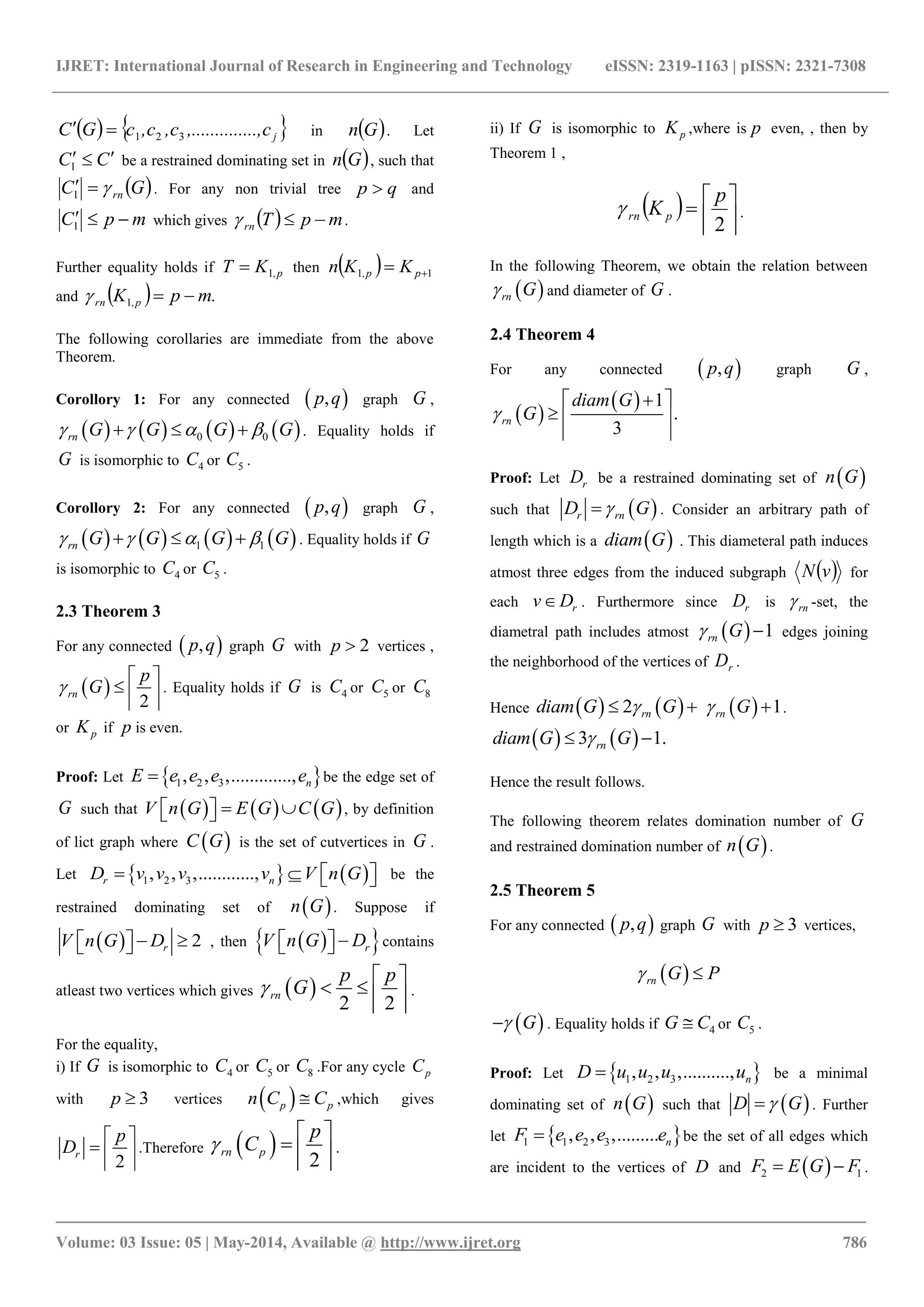
Proof: Let  1 2 3, , ,............., nE e e e e be the edge set of
G such that      V n G E G C G    , by definition
of lict graph where  C G is the set of cutvertices in G .
Let    1 2 3, , ,............,r nD v v v v V n G     be the
restrained dominating set of  n G . Suppose if
  2rV n G D    , then   rV n G D   contains
atleast two vertices which gives  
2 2
rn
p p
G
 
    
.
For the equality,
i) If G is isomorphic to 4C or 5C or 8C .For any cycle pC
with 3p  vertices  p pn C C ,which gives
2
r
p
D
 
   
.Therefore   2
rn p
p
C
 
   
.
ii) If G is isomorphic to pK ,where is p even, , then by
Theorem 1 ,
  




2
p
K prn .
In the following Theorem, we obtain the relation between
 rn G and diameter of G .
2.4 Theorem 4
For any connected  ,p q graph G ,
 
  1
.
3
rn
diam G
G
 
  
 
Proof: Let rD be a restrained dominating set of  n G
such that  r rnD G . Consider an arbitrary path of
length which is a  diam G . This diameteral path induces
atmost three edges from the induced subgraph  vN for
each rv D . Furthermore since rD is rn -set, the
diametral path includes atmost   1rn G  edges joining
the neighborhood of the vertices of rD .
Hence    2 rndiam G G    1rn G  .
   3 1.rndiam G G 
Hence the result follows.
The following theorem relates domination number of G
and restrained domination number of  n G .
2.5 Theorem 5
For any connected  ,p q graph G with 3p  vertices,
 rn G P 
 G . Equality holds if 4G C or 5C .
Proof: Let  1 2 3, , ,.........., nD u u u u be a minimal
dominating set of  n G such that  D G . Further
let  1 1 2 3, , ,......... nF e e e e be the set of all edges which
are incident to the vertices of D and  2 1F E G F  .
IJRET: International Journal of Research in Engineering and Technology eISSN: 2319-1163 | pISSN: 2321-7308
_______________________________________________________________________________________
Volume: 03 Issue: 05 | May-2014, Available @ http://www.ijret.org 787
Let  1 2 3, , ,............, nC c c c c be the cutvertex set of G
. By definition of lict graph ,
     V n G E G C G    and 1F   V n G   .Let
 1 1 2 3, , ,....... kI e e e e ;1 k i  ,where 1 1I F and
2 2I F .Since each induced subgraph which is complete in
 n G may contain atleast one vertex of either 1F or 2F .
Then  1 2I I forms a minimal restrained dominating set
in  n G such that  1 2 r rnI I D G   .Clearly
1 2D I I p   .Thus it follows that
   rnG G p   .
For equality,
If pG C for p  4 or 5 , then by definition of Lict
graph  p pn C C .Then in this case
2
r
p
D D  .
Clearly it follows that    rn G G p   .
In [5] , they related )G(' with line domination of G . In
the following theorem we establish our result with edge
dominationof G .
2.6 Theorem 6
For any non-trivial connected  ,p q graph G ,
   .GGrn  
Proof: Let  n, e,........,e,eeE 321 be the edge set of G
and  nc,......,c,c,cC 321 be the set of cutvertices in
G ,      V n G E G C G    . Let
 1 2 3, , ,..........., nF e e e e ;
ie , where 1 i n  be the minimal edge dominating set
of G , such that  F G .
Since     GnVGE  every edge ie F ; ie ;
1 i n  forms a dominating set in  n G .Suppose
   1F E G F V n G     , we consider
 1 1 2 3, , ,..............., nI e e e e ;
1 k i  , where 1I F and 2 1I F . Since each
induced subgraph which is complete in  n G may contain
atleast one vertex of either F or 1F . Then 1 2I I forms
a minimal restrained dominating set in  n G .Clearly it
follows that 1 2F I I  in  n G . Hence
   rnG G   .
In the next Theorem, we obtain the relation between
domination number of G and restrained domination
number of  n G in terms of vertices and diameter of G .
2.7 Theorem 7
For any connected  ,p q graph G with 2p  vertices,
 rn G p  
   G diam G  .
Proof: Let  1 2 3, , ,......., nV v v v v be the set of vertices
in G . Suppose there exists two vertices  ,u v V G such
that dist  ,u v =  diam G .Let
 pv,........,v,v,vD 321 ; 1 p n  be a minimal
dominating set in  n G . Now we consider
 1 2 3, , ,......., nF e e e e ;  F E G and
 ie V n G     ,1 i n  in  n G .The  V n G   =
   E G C G ,where  C G is the set of cutvertices in
G .Suppose 1 1,F C are the subsets of F and C .Then  a
set      1 1J V n G F C     such that J has no
isolates .Clearly  1 1 rnF C G  .Let  ,u v V G ,
   ,d u v diam G , then
   1 1F C diam G p D    .Hence
   rn G diam G    p G which implies
     rn G p G diam G    .
The following Theorem, relates restrained domination
number of  n G in terms of vertices and  G .
2.8 Theorem 8
For any connected  ,p q graph G ,
   rn G p G   .Equality holds if G is 3P or pC
IJRET: International Journal of Research in Engineering and Technology eISSN: 2319-1163 | pISSN: 2321-7308
_______________________________________________________________________________________
Volume: 03 Issue: 05 | May-2014, Available @ http://www.ijret.org 788
 3 5p  or 1, pK  2p  or 1 2,p pK with
1 2, 2p p  .
Proof: We consider the following cases.
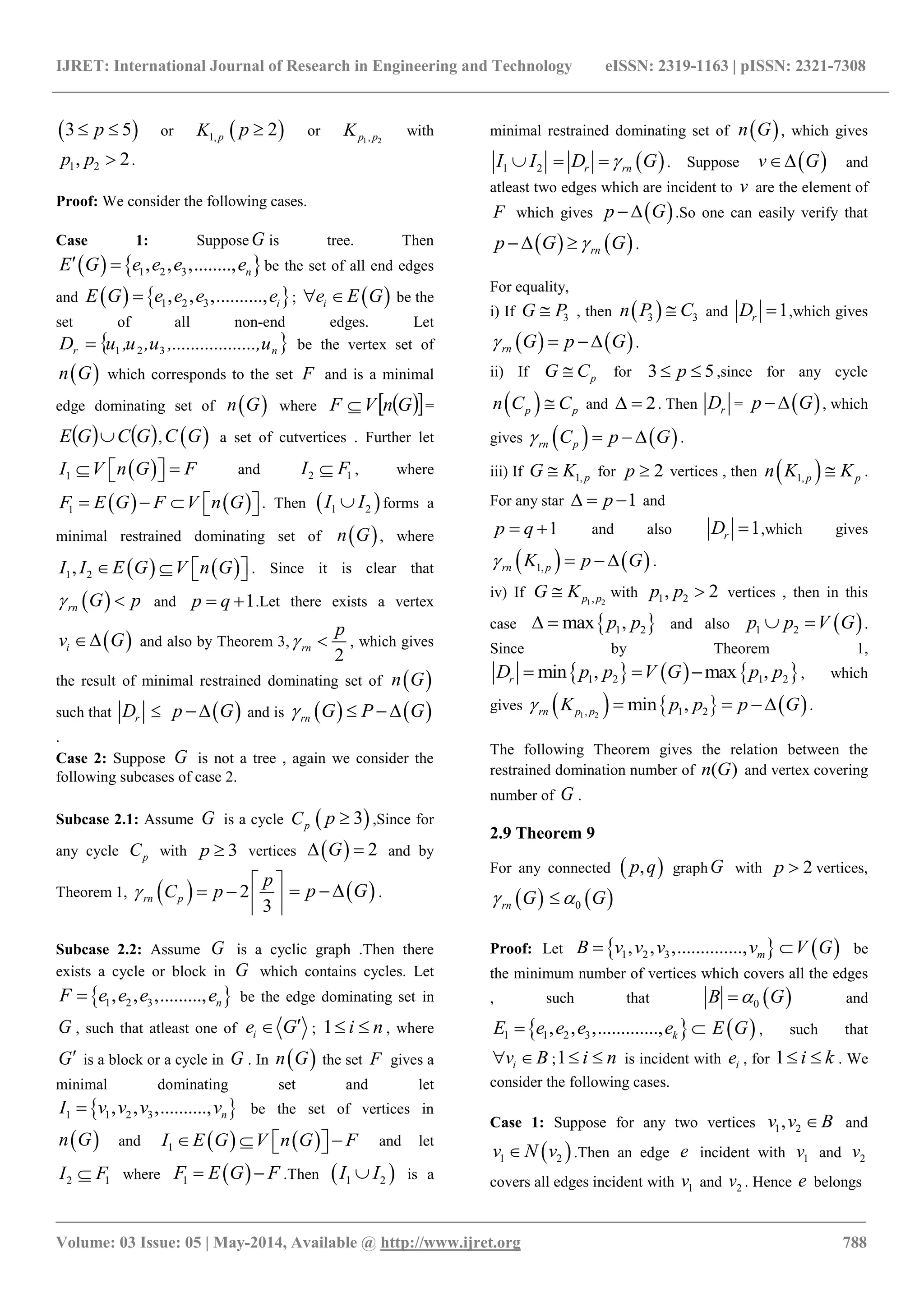
Case 1: Suppose G is tree. Then
   1 2 3, , ,........, nE G e e e e  be the set of all end edges
and    1 2 3, , ,.........., iE G e e e e ;  ie E G  be the
set of all non-end edges. Let
 nr u.........,,.........u,u,uD 321 be the vertex set of
 n G which corresponds to the set F and is a minimal
edge dominating set of  n G where   GnVF  =
   GCGE  ,  C G a set of cutvertices . Further let
 1I V n G F    and 2 1I F , where
   1F E G F V n G     . Then  1 2I I forms a
minimal restrained dominating set of  n G , where
   1 2,I I E G V n G     . Since it is clear that
 rn G p  and 1p q  .Let there exists a vertex
 iv G and also by Theorem 3,
2
rn
p
  , which gives
the result of minimal restrained dominating set of  n G
such that rD   p G  and is    rn G P G  
.
Case 2: Suppose G is not a tree , again we consider the
following subcases of case 2.
Subcase 2.1: Assume G is a cycle pC  3p  ,Since for
any cycle pC with 3p  vertices   2G  and by
Theorem 1,   2
3
rn p
p
C p
 
    
 p G  .
Subcase 2.2: Assume G is a cyclic graph .Then there
exists a cycle or block in G which contains cycles. Let
 1 2 3, , ,........., nF e e e e be the edge dominating set in
G , such that atleast one of ie G ; 1 i n  , where
G is a block or a cycle in G . In  n G the set F gives a
minimal dominating set and let
 1 1 2 3, , ,.........., nI v v v v be the set of vertices in
 n G and    1I E G V n G F     and let
2 1I F where  1F E G F  .Then  1 2I I is a
minimal restrained dominating set of  n G , which gives
1 2I I  r rnD G  . Suppose  v G and
atleast two edges which are incident to v are the element of
F which gives  p G  .So one can easily verify that
   rnp G G  .
For equality,
i) If 3G P , then  3 3n P C and 1rD  ,which gives
   rn G p G   .
ii) If pG C for 3 5p  ,since for any cycle
 p pn C C and 2  . Then rD =  p G  , which
gives    rn pC p G   .
iii) If 1, pG K for 2p  vertices , then  1, p pn K K .
For any star 1p   and
1p q  and also 1rD  ,which gives
   1,rn pK p G    .
iv) If 1 2,p pG K with 1 2, 2p p  vertices , then in this
case  1 2max ,p p  and also  1 2p p V G  .
Since by Theorem 1,
     1 2 1 2min , max ,rD p p V G p p   , which
gives      1 2, 1 2min ,rn p pK p p p G    .
The following Theorem gives the relation between the
restrained domination number of ( )n G and vertex covering
number of G .
2.9 Theorem 9
For any connected  ,p q graphG with 2p  vertices,
 rn G  0 G
Proof: Let  1 2 3, , ,.............., mB v v v v  V G be
the minimum number of vertices which covers all the edges
, such that  0B G and
 1 1 2 3, , ,............., kE e e e e   E G , such that
iv B  ;1 i n  is incident with ie , for 1 i k  . We
consider the following cases.
Case 1: Suppose for any two vertices 1 2,v v B and
 1 2v N v .Then an edge e incident with 1v and 2v
covers all edges incident with 1v and 2v . Hence e belongs
IJRET: International Journal of Research in Engineering and Technology eISSN: 2319-1163 | pISSN: 2321-7308
_______________________________________________________________________________________
Volume: 03 Issue: 05 | May-2014, Available @ http://www.ijret.org 789
to rn - set of G . Further for any vertex iv B covering
the edge 1i
e E incident with a cutvertex cv of G , ie
belongs to the rn  set of G . Thus
   .GBGrn 0 
Case 2: Suppose for any two vertices 1 2,v v B and
 2v N v .Then 1 2 1,e e E covers all the edges incident
with 1v and 2v . Since B consist of the vertices which
covers the edges that are incident all the cutvertices of G ,
the corresponding edges in 1E covers the cutvertices of G .
Thus    0rn G B G   .
Next we obtain a bound of restrained lict domination
number in terms of number of edges and maximum edge
degree of G .
2.10 Theorem 10
For any connected  ,p q graph G with 3p  ,
   rn G q G   . Proof: We consider the following
cases.
Case 1 : Suppose G is non-seperable. Using Theorem 6
and Theorem B , the result follows.
Case 2 : Suppose G is seperable. Let e be an edge with
degree  and let M be a set of edges adjacent to e in G
.
Then  E G M covers all the edges and all the
cutvertices of G .But some of the  ie s E G M   , for
1 i n  forms a minimal restrained dominating set in
 n G .
Then    rn G E G M   , which gives
   rn G q G   .
The following Theorem relates the domination number of
 L G and and restrained domination number of  n G .
2.11 Theorem 11
For any connected graph G with 2p  vertices,
   rn G q L G     
Proof: Let  1 2 3, , ,........., nE e e e e be the edge set of
G and  1 2 3, , ,........., nC c c c c be the cutvertex set of
G , then      V n G E G C G    and
   V L G E G   ,by definition. Suppose
   1 2 3, , ,.........., nH u u u u V L G     be the set of
vertices of degree  deg 2,1iu i n   .Then D H 
forms a minimal dominating set of  L G such that
 D L G     . Further let
 1 2 3, , ,........, iH u u u u     ;1 i n  , where H H 
.Then H D  forms a minimal restrained dominating set
in  n G . Since    V L G E G q    and also
   V L G V n G       .Clearly it follows that
D H D q     . Thus    rn G L G q     .
To prove our further result, we give the following two
observations.
Observation 1: For connected  ,p q graph G ,
  2rn G q   .
Proof: Suppose rD is a restrained dominating set of
 n G .Then by definition of restrained domination
  2V n G    . Further by definition of  n G ,
  2rnq G  . Clearly it follows that   2rn G q   .
Observation 2: Suppose rD be any restrained dominating
set of  n G , such that  r rnD G .Then
  deg
i r
r i
v D
V n G D v

     .
Proof: Since every vertex in   rV n G D   is adjacent
to atleast one vertex in   rV n G D   contributes atleast
one to the sum of the degrees of the vertices of rD . Hence
the proof.
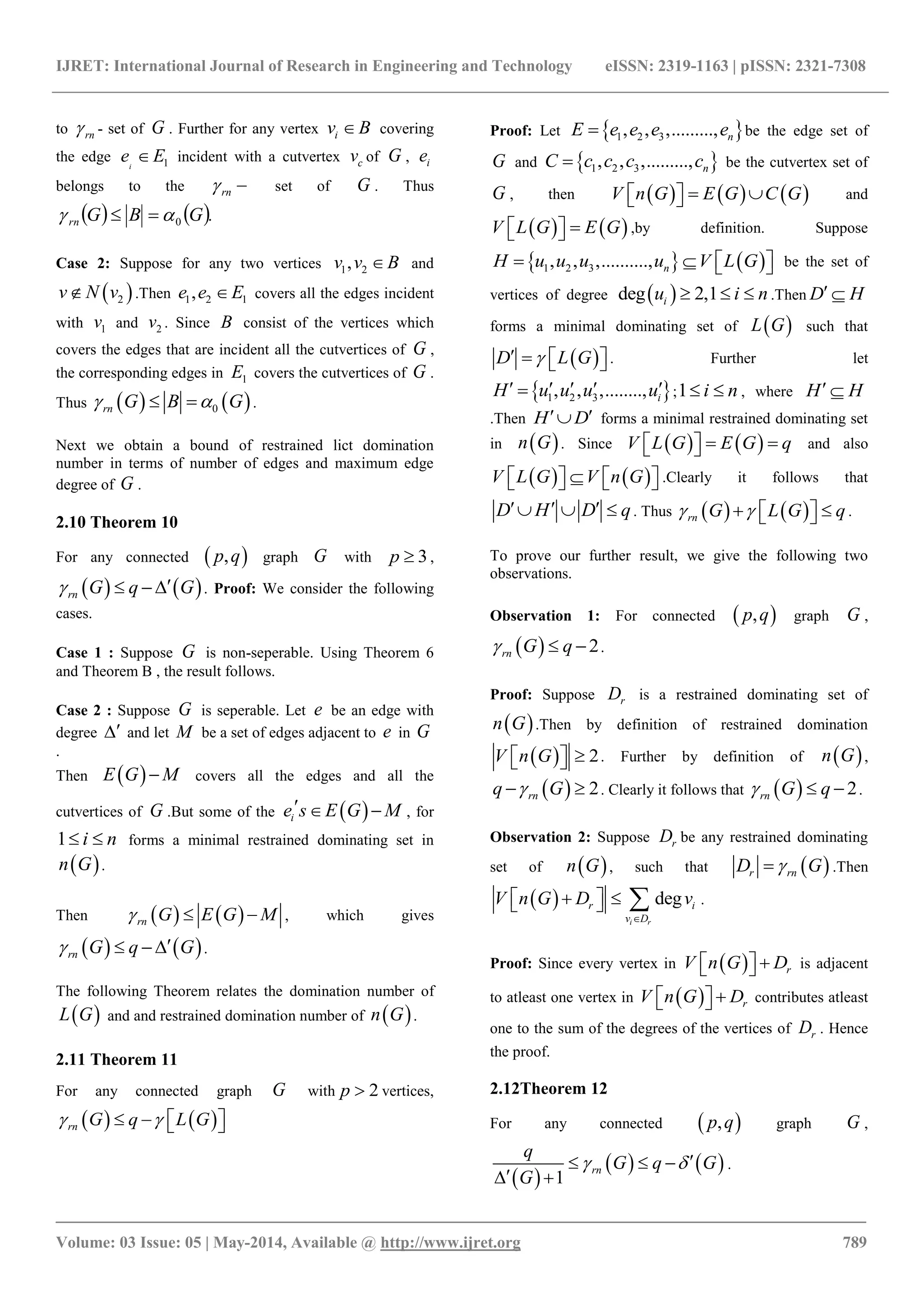
2.12Theorem 12
For any connected  ,p q graph G ,
 
   
1
rn
q
G q G
G
   
 
.
IJRET: International Journal of Research in Engineering and Technology eISSN: 2319-1163 | pISSN: 2321-7308
_______________________________________________________________________________________
Volume: 03 Issue: 05 | May-2014, Available @ http://www.ijret.org 790
Proof: Let  e E G , now without loss of generality , by
definition of lict graph ,  e u V n G     and let rD be
the restrained dominating set of  n G such that
 r rnD G . If   2G  ,then by observation 1,
   2 .rn G q q G     If   2G  , then for
any edge  f N e and by definition of  n G ,
 f w N u  ,       rD V n G N u w     .
Then       1 1rn G q G q G           .
Now for the lower bound we have by observation 2 and the
fact that any edge  e E G and  dege G  , we
have
         deg .
r
rn rn
v D
q G V n G n G v G G 

        
.
Therefore
 
 
1
rn
q
G
G

 
.
2.13Theorem 13
For any non-trivial connected  ,p q graph G ,
 
  1
rn
q
G
G

 
  
  
.
Proof: Using Theorem 6 and Theorem A, the result follows.
Finally we obtain the Nordhous – Gaddum type result.
2.14 Theorem 14
Let G be a connected  ,p q graph such that both G and
G are connected, then
i)     .
2
rn rn
p
G G 
 
    
ii)     3
. .
2
rn rn
p
G G 
 
   
REFERENCES
[1] C.Berge , Theory of graphs and its applications ,
Methuen London (1962).
[2] G.S.Domke , J.H.Hattingh , S.T.Hedetniemi ,
R.C.Lasker and L.R.Markus , Restrained domination
in graphs , Discrete Mathematics, 203, pp.61-69,
(1999).
[3] R.P.Gupta , In :Proof Techniques in Graph Theory,
Academic press, New York, (61- 62), (1969).
[4] F.Harary, Graph theory, Adison Wesley, Reading
Mass (1972).
[5] S.R.Jayaram, Line domination in graphs , Graphs and
Combinatorics, (357-363), 3 (1987).
[6] S.L. Mitchell and S.T. Hedetniemi , Edge domination
in trees . In: Proc.8th
S.E Conf. on Combinatorics ,
Graph Theory and Computing , Utilas Mathematica,
Winnipeg (489-509),19 (1977).
[7] O.Ore, Theory of graphs, Amer.Math.Soc., Colloq
Publ., 38 Providence (1962).

Restrained lict domination in graphs

  • 1.
    IJRET: International Journalof Research in Engineering and Technology eISSN: 2319-1163 | pISSN: 2321-7308 _______________________________________________________________________________________ Volume: 03 Issue: 05 | May-2014, Available @ http://www.ijret.org 784 RESTRAINED LICT DOMINATION IN GRAPHS M.H. Muddebihal1 , Kalshetti Swati.M2 1 Professor and Chairman, Department of P.G. Studies and Research in Mathematics Gulbarga University, Gulbarga, Karnataka, India. 2 Assistant Professor, Department of Mathematics, Godutai Engineering College for Women, Gulbarga, Karnataka, India. Abstract A set  rD V n G    is a restrained dominating set of  n G , where every vertex in rD)]G(n[V  is adjacent to a vertex in rD as well as another vertex in )]G(n[V rD . The restrained domination number of lict graph  n G , denoted by  rn G , is the minimum cardinality of a restrained dominating set of  n G . In this paper, we study its exact values for some standard graphs we obtained. Also its relation with other parameters is investigated. Subject classification number: AMS-O5C69, 05C70 Keywords: Lict Graph / Line Graph / Restrained domination / Dominating set / Edge domination --------------------------------------------------------------------***------------------------------------------------------------------ 1. INTRODUCTION In this paper, all the graphs considered here are simple, finite, non-trivial, undirected and connected. As usual p and q denote, the number of vertices and edges of a graph G . In this paper, for any undefined terms or notations can be found in Harary [4]. As usual, the maximum degree of a vertex in G is denoted by  G . The degree of an edge e uv of G is defined as deg deg deg 2e u v   and     GG  is the minimum(maximum) degree among the edges of G . For any real number x , x   denotes the smallest integer not less than x and x   denotes the greatest integer not greater than x . The complement G of a graph G has V as its vertex set, but two vertices are adjacent in G if they are not adjacent in G . A vertex (edge) cover in a graph G is a set of vertices that covers all the edges (vertices) of G . The vertex (edge) covering number  0 G (  1 G ) is a minimum cardinality of a vertex (edge) cover in G . The vertex (edge) independence number     GG 10  is the maximum cardinality of independent set of vertices (edges) in G . The greatest distance between any two vertices of a connected graph G is called the diameter of G and is denoted by  diam G . We begin by recalling some standard definition from domination theory. A set D of a graph  ,G V E is a dominating set if every vertex in V D is adjacent to some vertex in D . The domination number  G of G is the minimum cardinality of a minimal dominating set in G . The study of domination in graphs was begun by Ore [7] and Berge [1]. A set  D V L G    is said to be dominating set of  L G if every vertex not in D is adjacent to a vertex in D .The domination number of G is denoted by  L G    is the minimum cardinality of dominating set in G . A set F of edges in a graph G is called an edge dominating set of G if every edge in E F where E is
  • 2.
    IJRET: International Journalof Research in Engineering and Technology eISSN: 2319-1163 | pISSN: 2321-7308 _______________________________________________________________________________________ Volume: 03 Issue: 05 | May-2014, Available @ http://www.ijret.org 785 the set of edges in G is adjacent to atleast one edge in F . The edge domination number  ' G of a graph G is the minimum cardinality of an edge dominating set of G . The concept of edge domination number in graphs were studied by Gupta [3] and S.Mitchell and S.T.Hedetineim [6]. Analogously, we define restained domination number in lict graph as follows. A dominating set rD of lict graph is a restained dominating set, if every vertex not in rD is adjacent in rD and to a vertex in rV D .The restrained domination number of lict graph  n G ,denoted by  rn G is the minimum cardinality of a restrained dominating set of  n G .The concept of restrained domination in graphs was introduced by Domke et al [2]. In this paper, many bounds on  rn G were obtained and expressed in terms of vertices, edges of G but not the elements of  n G . Also we establish restained domination number of a lict graph  n G and express the results with other different domination parameters of G . 2. RESULTS We need the following Theorems to establish our further results. Theorem A [5]: For any connected  ,p q graph G ,     1 q G G           . Theorem B [5]: If G is a graph with no isolated vertex, then    G q G   . Initially we begin with restrained domination number of lict graph of some standard graphs, which are straight forward in the following Theorem. 2.1 Theorem 1: (i) For any cycle pC with 3p  vertices,   2 . 3 rn p p C p        (ii) For any path pP with 2p  vertices,  2 1rn nP k    2rn nP k  , When 2,3,4,5,........n  ….. Then 1,2,3,4,...........k  .. (iii) For any star 1, pK with 2p  vertices,  1, 1.rn pK  (iv) For any wheel pW with 4p  vertices,   3 1 3 rn p p W        . (v) For any complete bipartite graph 1 2,p pK with 1 2, 2p p  vertices,    1 2, 1 2min ,rn p pK p p  . (vi) For any complete graph pK with 3p vertices ,  prn K =     2 p . In the following Theorem, we establish the upper bound for  rn T in term of vertices of the G . 2.2 Theorem 2 For any tree T with 2p  vertices and m end vertices  rn T p m   . Equality holds if 1, pT K with 2p  vertices. Proof: If   3diam G  , then the result is obvious. Let   3diam T  and  1 1 2 3, , ,........., nV v v v v be the set of all end vertices in T with 1V m .Further  qe..,,.........e,e,eE 321 and  ic...,,.........c,c,cC 321 be the set of edges and cutvertices in G . In  Gn ,       GCGEGnV  and in G ie incicident with jc , ij 1 forms a complete induced subgraph as a block in  Gn , such that the number of blocks in   CGn  . Let    GEe.....,,.........e,e,e j 321 which are non end edges of G forms cutvertices
  • 3.
    IJRET: International Journalof Research in Engineering and Technology eISSN: 2319-1163 | pISSN: 2321-7308 _______________________________________________________________________________________ Volume: 03 Issue: 05 | May-2014, Available @ http://www.ijret.org 786    jc.....,,.........c,c,cGC 321 in  Gn . Let CC 1 be a restrained dominating set in  Gn , such that  GC rn1 . For any non trivial tree qp  and mpC 1 which gives   mpTrn  . Further equality holds if p,KT 1 then   11  pp, KKn and   .mpK p,rn 1 The following corollaries are immediate from the above Theorem. Corollory 1: For any connected  ,p q graph G ,        0 0rn G G G G      . Equality holds if G is isomorphic to 4C or 5C . Corollory 2: For any connected  ,p q graph G ,        1 1rn G G G G      . Equality holds if G is isomorphic to 4C or 5C . 2.3 Theorem 3 For any connected  ,p q graph G with 2p  vertices ,   2 rn p G       . Equality holds if G is 4C or 5C or 8C or pK if p is even. Proof: Let  1 2 3, , ,............., nE e e e e be the edge set of G such that      V n G E G C G    , by definition of lict graph where  C G is the set of cutvertices in G . Let    1 2 3, , ,............,r nD v v v v V n G     be the restrained dominating set of  n G . Suppose if   2rV n G D    , then   rV n G D   contains atleast two vertices which gives   2 2 rn p p G        . For the equality, i) If G is isomorphic to 4C or 5C or 8C .For any cycle pC with 3p  vertices  p pn C C ,which gives 2 r p D       .Therefore   2 rn p p C       . ii) If G is isomorphic to pK ,where is p even, , then by Theorem 1 ,        2 p K prn . In the following Theorem, we obtain the relation between  rn G and diameter of G . 2.4 Theorem 4 For any connected  ,p q graph G ,     1 . 3 rn diam G G        Proof: Let rD be a restrained dominating set of  n G such that  r rnD G . Consider an arbitrary path of length which is a  diam G . This diameteral path induces atmost three edges from the induced subgraph  vN for each rv D . Furthermore since rD is rn -set, the diametral path includes atmost   1rn G  edges joining the neighborhood of the vertices of rD . Hence    2 rndiam G G    1rn G  .    3 1.rndiam G G  Hence the result follows. The following theorem relates domination number of G and restrained domination number of  n G . 2.5 Theorem 5 For any connected  ,p q graph G with 3p  vertices,  rn G P   G . Equality holds if 4G C or 5C . Proof: Let  1 2 3, , ,.........., nD u u u u be a minimal dominating set of  n G such that  D G . Further let  1 1 2 3, , ,......... nF e e e e be the set of all edges which are incident to the vertices of D and  2 1F E G F  .
  • 4.
    IJRET: International Journalof Research in Engineering and Technology eISSN: 2319-1163 | pISSN: 2321-7308 _______________________________________________________________________________________ Volume: 03 Issue: 05 | May-2014, Available @ http://www.ijret.org 787 Let  1 2 3, , ,............, nC c c c c be the cutvertex set of G . By definition of lict graph ,      V n G E G C G    and 1F   V n G   .Let  1 1 2 3, , ,....... kI e e e e ;1 k i  ,where 1 1I F and 2 2I F .Since each induced subgraph which is complete in  n G may contain atleast one vertex of either 1F or 2F . Then  1 2I I forms a minimal restrained dominating set in  n G such that  1 2 r rnI I D G   .Clearly 1 2D I I p   .Thus it follows that    rnG G p   . For equality, If pG C for p  4 or 5 , then by definition of Lict graph  p pn C C .Then in this case 2 r p D D  . Clearly it follows that    rn G G p   . In [5] , they related )G(' with line domination of G . In the following theorem we establish our result with edge dominationof G . 2.6 Theorem 6 For any non-trivial connected  ,p q graph G ,    .GGrn   Proof: Let  n, e,........,e,eeE 321 be the edge set of G and  nc,......,c,c,cC 321 be the set of cutvertices in G ,      V n G E G C G    . Let  1 2 3, , ,..........., nF e e e e ; ie , where 1 i n  be the minimal edge dominating set of G , such that  F G . Since     GnVGE  every edge ie F ; ie ; 1 i n  forms a dominating set in  n G .Suppose    1F E G F V n G     , we consider  1 1 2 3, , ,..............., nI e e e e ; 1 k i  , where 1I F and 2 1I F . Since each induced subgraph which is complete in  n G may contain atleast one vertex of either F or 1F . Then 1 2I I forms a minimal restrained dominating set in  n G .Clearly it follows that 1 2F I I  in  n G . Hence    rnG G   . In the next Theorem, we obtain the relation between domination number of G and restrained domination number of  n G in terms of vertices and diameter of G . 2.7 Theorem 7 For any connected  ,p q graph G with 2p  vertices,  rn G p      G diam G  . Proof: Let  1 2 3, , ,......., nV v v v v be the set of vertices in G . Suppose there exists two vertices  ,u v V G such that dist  ,u v =  diam G .Let  pv,........,v,v,vD 321 ; 1 p n  be a minimal dominating set in  n G . Now we consider  1 2 3, , ,......., nF e e e e ;  F E G and  ie V n G     ,1 i n  in  n G .The  V n G   =    E G C G ,where  C G is the set of cutvertices in G .Suppose 1 1,F C are the subsets of F and C .Then  a set      1 1J V n G F C     such that J has no isolates .Clearly  1 1 rnF C G  .Let  ,u v V G ,    ,d u v diam G , then    1 1F C diam G p D    .Hence    rn G diam G    p G which implies      rn G p G diam G    . The following Theorem, relates restrained domination number of  n G in terms of vertices and  G . 2.8 Theorem 8 For any connected  ,p q graph G ,    rn G p G   .Equality holds if G is 3P or pC
  • 5.
    IJRET: International Journalof Research in Engineering and Technology eISSN: 2319-1163 | pISSN: 2321-7308 _______________________________________________________________________________________ Volume: 03 Issue: 05 | May-2014, Available @ http://www.ijret.org 788  3 5p  or 1, pK  2p  or 1 2,p pK with 1 2, 2p p  . Proof: We consider the following cases. Case 1: Suppose G is tree. Then    1 2 3, , ,........, nE G e e e e  be the set of all end edges and    1 2 3, , ,.........., iE G e e e e ;  ie E G  be the set of all non-end edges. Let  nr u.........,,.........u,u,uD 321 be the vertex set of  n G which corresponds to the set F and is a minimal edge dominating set of  n G where   GnVF  =    GCGE  ,  C G a set of cutvertices . Further let  1I V n G F    and 2 1I F , where    1F E G F V n G     . Then  1 2I I forms a minimal restrained dominating set of  n G , where    1 2,I I E G V n G     . Since it is clear that  rn G p  and 1p q  .Let there exists a vertex  iv G and also by Theorem 3, 2 rn p   , which gives the result of minimal restrained dominating set of  n G such that rD   p G  and is    rn G P G   . Case 2: Suppose G is not a tree , again we consider the following subcases of case 2. Subcase 2.1: Assume G is a cycle pC  3p  ,Since for any cycle pC with 3p  vertices   2G  and by Theorem 1,   2 3 rn p p C p         p G  . Subcase 2.2: Assume G is a cyclic graph .Then there exists a cycle or block in G which contains cycles. Let  1 2 3, , ,........., nF e e e e be the edge dominating set in G , such that atleast one of ie G ; 1 i n  , where G is a block or a cycle in G . In  n G the set F gives a minimal dominating set and let  1 1 2 3, , ,.........., nI v v v v be the set of vertices in  n G and    1I E G V n G F     and let 2 1I F where  1F E G F  .Then  1 2I I is a minimal restrained dominating set of  n G , which gives 1 2I I  r rnD G  . Suppose  v G and atleast two edges which are incident to v are the element of F which gives  p G  .So one can easily verify that    rnp G G  . For equality, i) If 3G P , then  3 3n P C and 1rD  ,which gives    rn G p G   . ii) If pG C for 3 5p  ,since for any cycle  p pn C C and 2  . Then rD =  p G  , which gives    rn pC p G   . iii) If 1, pG K for 2p  vertices , then  1, p pn K K . For any star 1p   and 1p q  and also 1rD  ,which gives    1,rn pK p G    . iv) If 1 2,p pG K with 1 2, 2p p  vertices , then in this case  1 2max ,p p  and also  1 2p p V G  . Since by Theorem 1,      1 2 1 2min , max ,rD p p V G p p   , which gives      1 2, 1 2min ,rn p pK p p p G    . The following Theorem gives the relation between the restrained domination number of ( )n G and vertex covering number of G . 2.9 Theorem 9 For any connected  ,p q graphG with 2p  vertices,  rn G  0 G Proof: Let  1 2 3, , ,.............., mB v v v v  V G be the minimum number of vertices which covers all the edges , such that  0B G and  1 1 2 3, , ,............., kE e e e e   E G , such that iv B  ;1 i n  is incident with ie , for 1 i k  . We consider the following cases. Case 1: Suppose for any two vertices 1 2,v v B and  1 2v N v .Then an edge e incident with 1v and 2v covers all edges incident with 1v and 2v . Hence e belongs
  • 6.
    IJRET: International Journalof Research in Engineering and Technology eISSN: 2319-1163 | pISSN: 2321-7308 _______________________________________________________________________________________ Volume: 03 Issue: 05 | May-2014, Available @ http://www.ijret.org 789 to rn - set of G . Further for any vertex iv B covering the edge 1i e E incident with a cutvertex cv of G , ie belongs to the rn  set of G . Thus    .GBGrn 0  Case 2: Suppose for any two vertices 1 2,v v B and  2v N v .Then 1 2 1,e e E covers all the edges incident with 1v and 2v . Since B consist of the vertices which covers the edges that are incident all the cutvertices of G , the corresponding edges in 1E covers the cutvertices of G . Thus    0rn G B G   . Next we obtain a bound of restrained lict domination number in terms of number of edges and maximum edge degree of G . 2.10 Theorem 10 For any connected  ,p q graph G with 3p  ,    rn G q G   . Proof: We consider the following cases. Case 1 : Suppose G is non-seperable. Using Theorem 6 and Theorem B , the result follows. Case 2 : Suppose G is seperable. Let e be an edge with degree  and let M be a set of edges adjacent to e in G . Then  E G M covers all the edges and all the cutvertices of G .But some of the  ie s E G M   , for 1 i n  forms a minimal restrained dominating set in  n G . Then    rn G E G M   , which gives    rn G q G   . The following Theorem relates the domination number of  L G and and restrained domination number of  n G . 2.11 Theorem 11 For any connected graph G with 2p  vertices,    rn G q L G      Proof: Let  1 2 3, , ,........., nE e e e e be the edge set of G and  1 2 3, , ,........., nC c c c c be the cutvertex set of G , then      V n G E G C G    and    V L G E G   ,by definition. Suppose    1 2 3, , ,.........., nH u u u u V L G     be the set of vertices of degree  deg 2,1iu i n   .Then D H  forms a minimal dominating set of  L G such that  D L G     . Further let  1 2 3, , ,........, iH u u u u     ;1 i n  , where H H  .Then H D  forms a minimal restrained dominating set in  n G . Since    V L G E G q    and also    V L G V n G       .Clearly it follows that D H D q     . Thus    rn G L G q     . To prove our further result, we give the following two observations. Observation 1: For connected  ,p q graph G ,   2rn G q   . Proof: Suppose rD is a restrained dominating set of  n G .Then by definition of restrained domination   2V n G    . Further by definition of  n G ,   2rnq G  . Clearly it follows that   2rn G q   . Observation 2: Suppose rD be any restrained dominating set of  n G , such that  r rnD G .Then   deg i r r i v D V n G D v       . Proof: Since every vertex in   rV n G D   is adjacent to atleast one vertex in   rV n G D   contributes atleast one to the sum of the degrees of the vertices of rD . Hence the proof. 2.12Theorem 12 For any connected  ,p q graph G ,       1 rn q G q G G       .
  • 7.
    IJRET: International Journalof Research in Engineering and Technology eISSN: 2319-1163 | pISSN: 2321-7308 _______________________________________________________________________________________ Volume: 03 Issue: 05 | May-2014, Available @ http://www.ijret.org 790 Proof: Let  e E G , now without loss of generality , by definition of lict graph ,  e u V n G     and let rD be the restrained dominating set of  n G such that  r rnD G . If   2G  ,then by observation 1,    2 .rn G q q G     If   2G  , then for any edge  f N e and by definition of  n G ,  f w N u  ,       rD V n G N u w     . Then       1 1rn G q G q G           . Now for the lower bound we have by observation 2 and the fact that any edge  e E G and  dege G  , we have          deg . r rn rn v D q G V n G n G v G G            . Therefore     1 rn q G G    . 2.13Theorem 13 For any non-trivial connected  ,p q graph G ,     1 rn q G G          . Proof: Using Theorem 6 and Theorem A, the result follows. Finally we obtain the Nordhous – Gaddum type result. 2.14 Theorem 14 Let G be a connected  ,p q graph such that both G and G are connected, then i)     . 2 rn rn p G G         ii)     3 . . 2 rn rn p G G        REFERENCES [1] C.Berge , Theory of graphs and its applications , Methuen London (1962). [2] G.S.Domke , J.H.Hattingh , S.T.Hedetniemi , R.C.Lasker and L.R.Markus , Restrained domination in graphs , Discrete Mathematics, 203, pp.61-69, (1999). [3] R.P.Gupta , In :Proof Techniques in Graph Theory, Academic press, New York, (61- 62), (1969). [4] F.Harary, Graph theory, Adison Wesley, Reading Mass (1972). [5] S.R.Jayaram, Line domination in graphs , Graphs and Combinatorics, (357-363), 3 (1987). [6] S.L. Mitchell and S.T. Hedetniemi , Edge domination in trees . In: Proc.8th S.E Conf. on Combinatorics , Graph Theory and Computing , Utilas Mathematica, Winnipeg (489-509),19 (1977). [7] O.Ore, Theory of graphs, Amer.Math.Soc., Colloq Publ., 38 Providence (1962).