Department of Orthopaedic
Trauma Medicine
Year 1, Sem. 2
Subject – Biomechanics
Topic – Biomechanics of the
Spinal Orthotics
BY
Mr. Oduor Wafulah
9th November, 2022.
Uses of spinal orthotics:
1) Pain (back pain)
2) Restriction of spinal motion.
3) Postural care and postural correction.
4) Augment other therapies
General classifications of spinal
orthosis
Flexible orthotics:
Or corsets
 They are
constructed out of
strong fabrics or
elastic materials
with a variety of
stiffer supports
 Rigid spinal orthotics
 They are used when
greater control of
motion or posture is
required.
 They are fabricated
from high temperature
thermoplastics or light
weight metals.
 There are wide
varieties with a broad
selection of pads and
coverings.
Therapeutic benefits of spinal orthosis
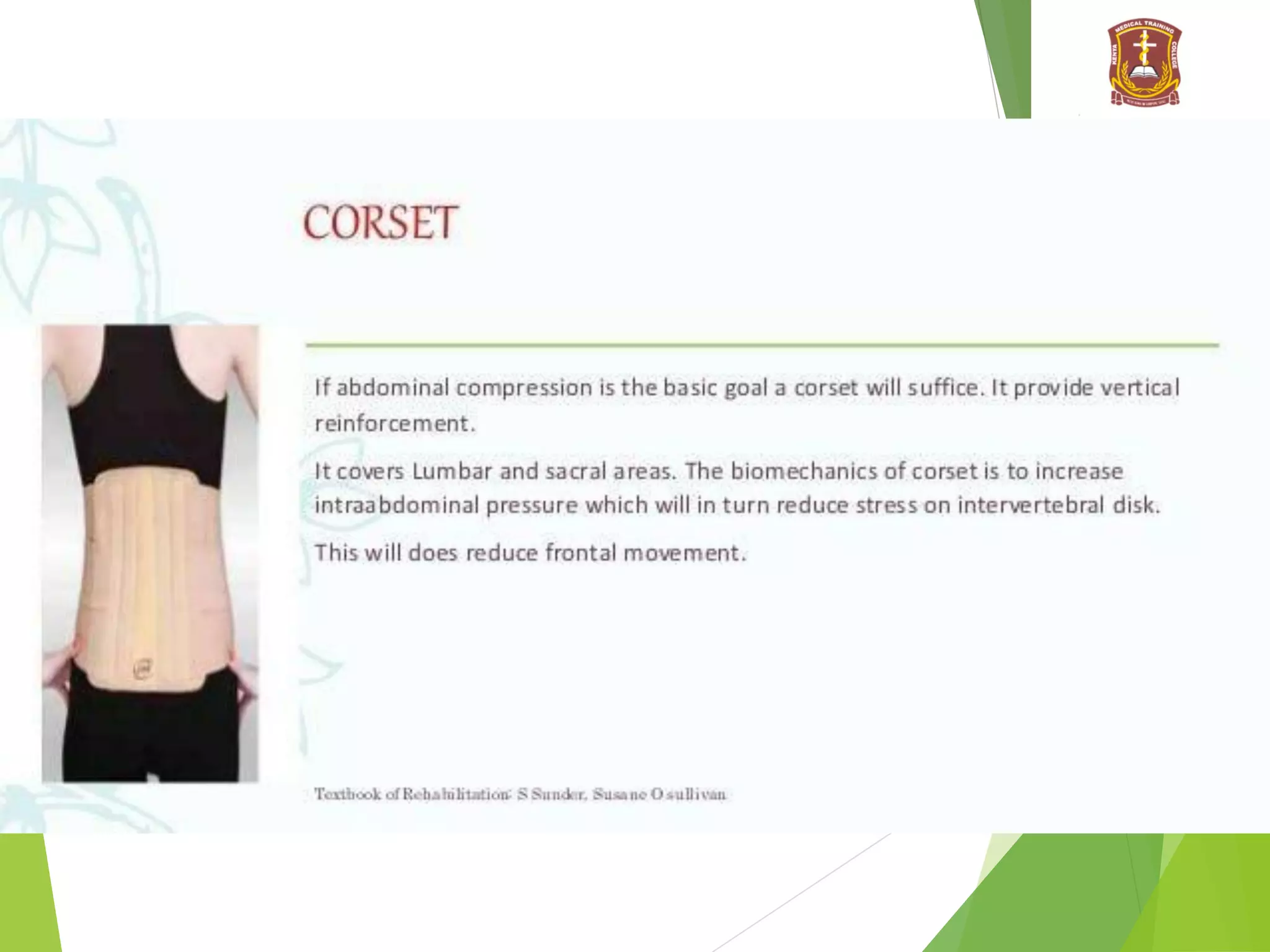
 Intra abdominal pressure:
 They create cylinder effect, exert pressure on the
abdomen, and raise intra-cavitary pressure and reduce
the intra-discal pressure especially during forward
bending.
 Muscle relaxation:
 Support the vertebral column and relaxing the
abdominal and erector spinae muscles
 Decreasing the need for contractile support of the
vertebral column may relax the muscles and reduce
existing pain.
 Restriction of motion:
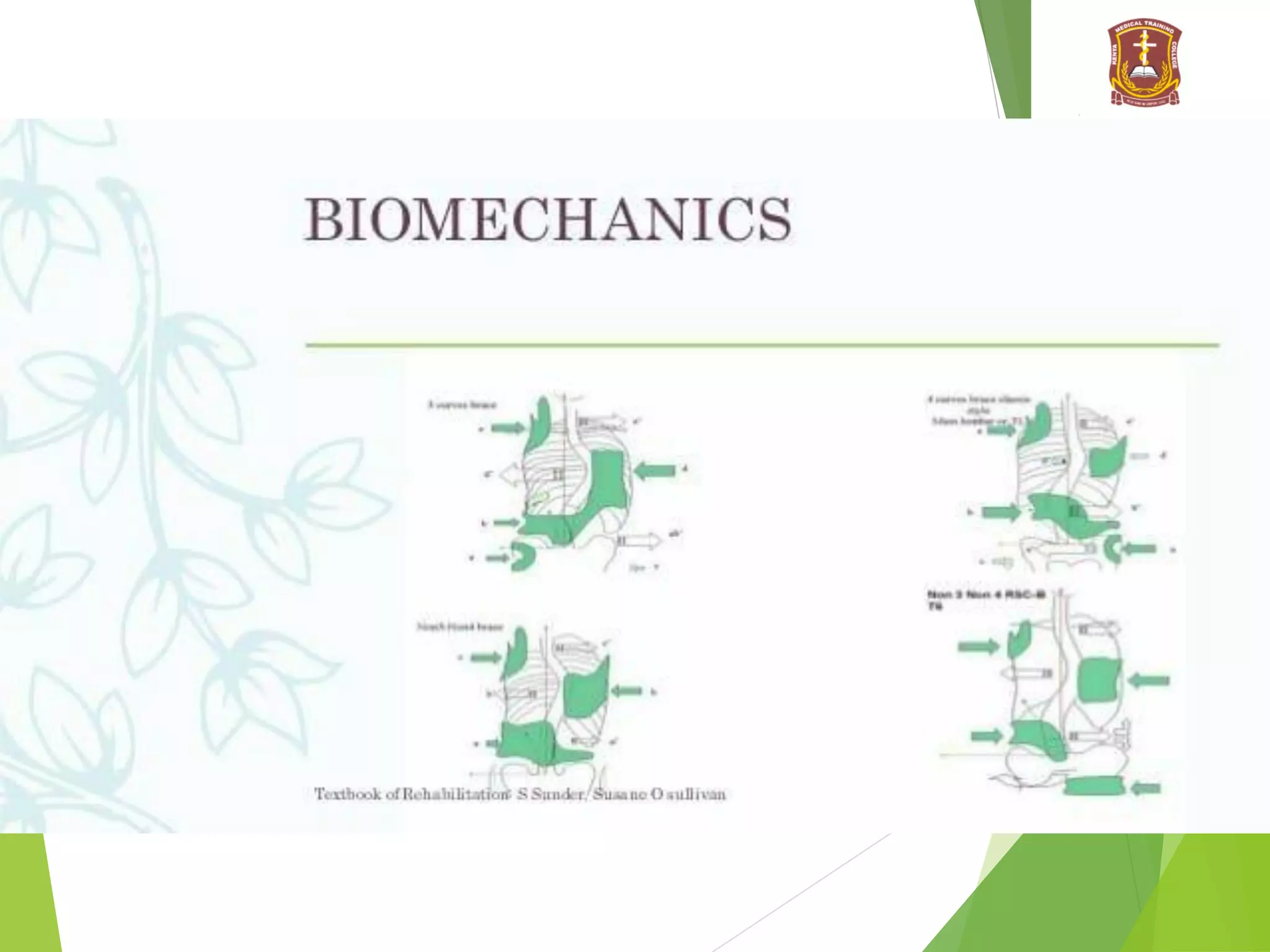
 The primary method employed for motion control
is the three point pressure system.
 A rigid system is used when cervical, thoracic and
lumbosacral motions are sought to be limited to the
greatest possible degree.
 The amount of limitation varies between the
various segments.
 Reduction of motion will reduce pain and spinal
instability and offer constant proprioceptive
feedback, reinforcing positive behaviors.
 Postural realignment:
 ↑intra abdominal pressure, relaxation in
muscle spasm, and restriction of movement
can assist in facilitation of improved posture
and reduce compensatory posture related pain.
 E.g. In case of scoliosis, the use of orthosis
may prevent a spinal progression, stabilize the
curvature and may offer some degree of
posture correction
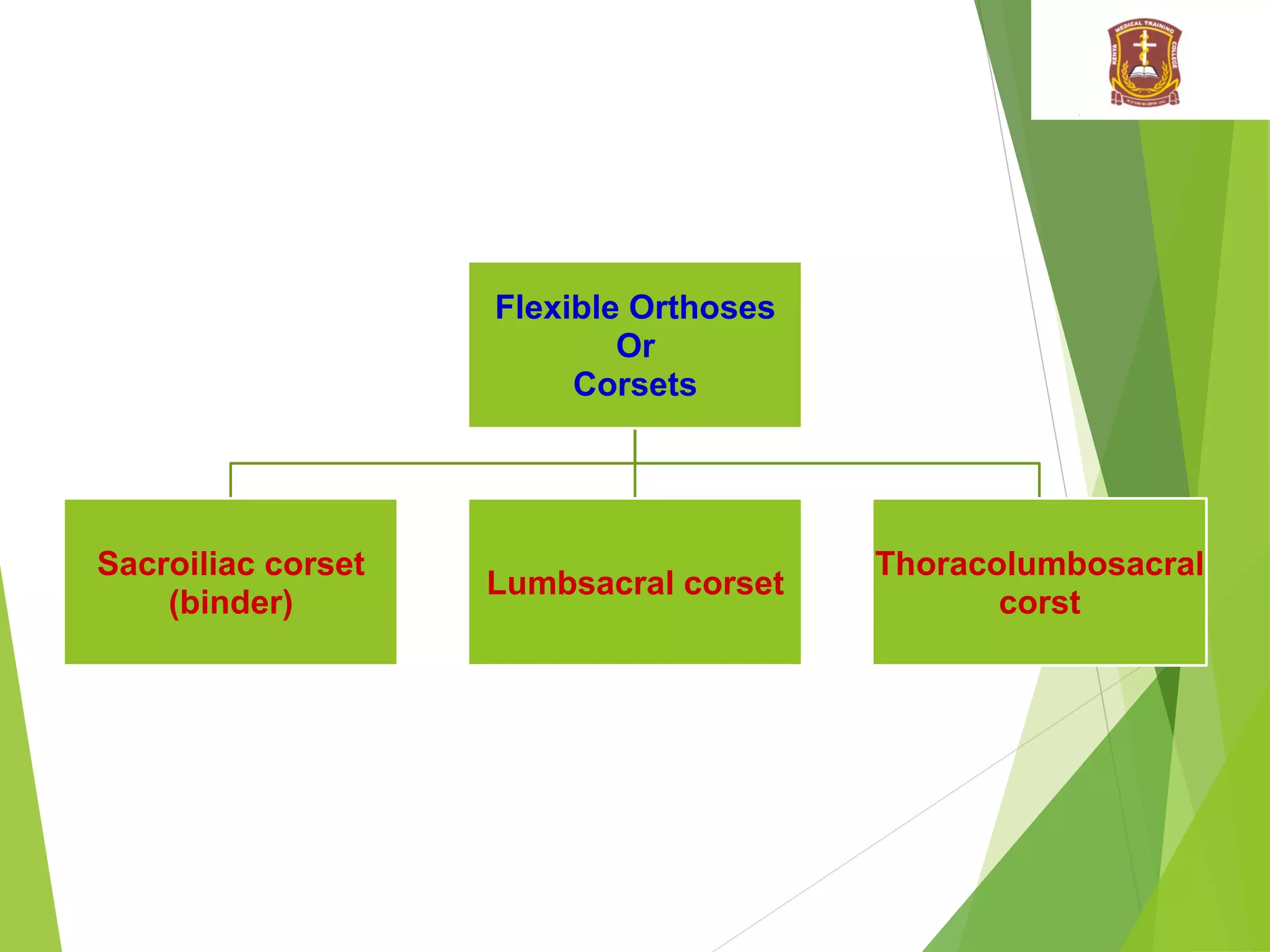
Flexible Orthoses
Or
Corsets
Sacroiliac corset
(binder)
Lumbsacral corset
Thoracolumbosacral
corst
Flexible Orthoses Or Corsets
1) Sacroiliac corset (binder):
 Made from a combination of fabrics, elastic, laces and
velcro offering multiple adjustments
 Encircle the waist from the iliac crest to the greater
trochanter and extending anteriory to the symphysis pubic.
 Provide postural stability and reinforcement.
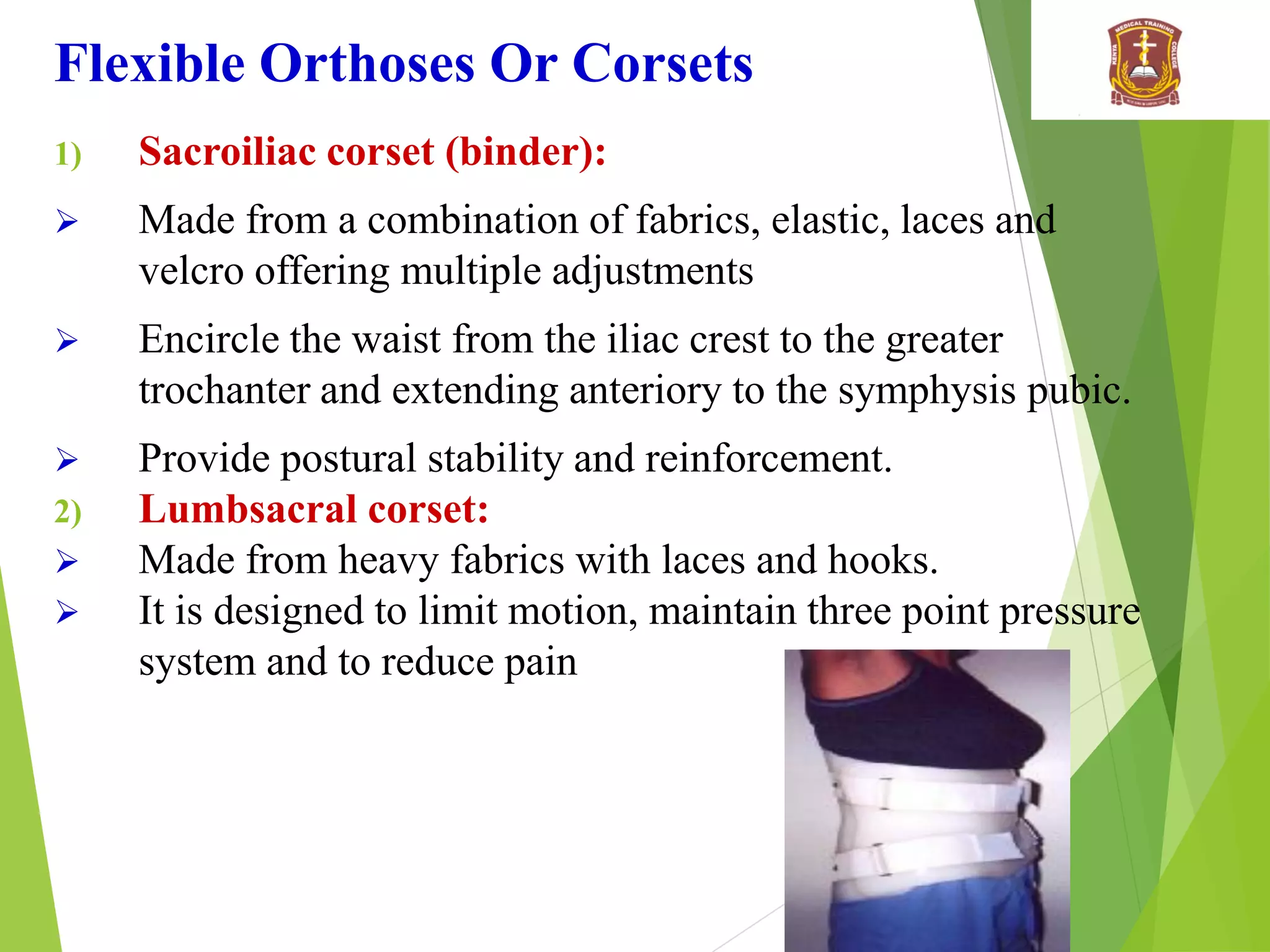
2) Lumbsacral corset:
 Made from heavy fabrics with laces and hooks.
 It is designed to limit motion, maintain three point pressure
system and to reduce pain
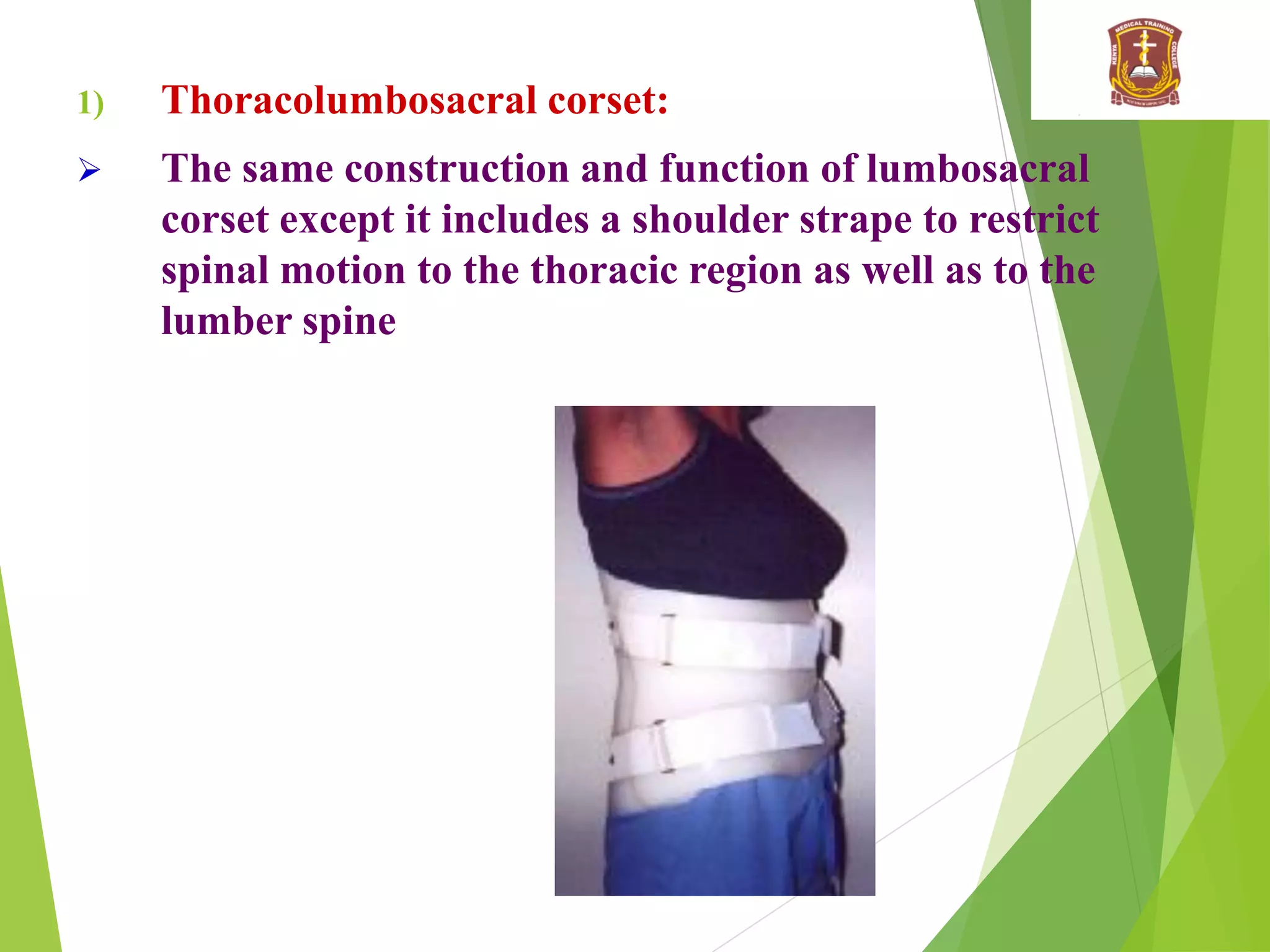
1) Thoracolumbosacral corset:
 The same construction and function of lumbosacral
corset except it includes a shoulder strape to restrict
spinal motion to the thoracic region as well as to the
lumber spine
Rigid Orthoses
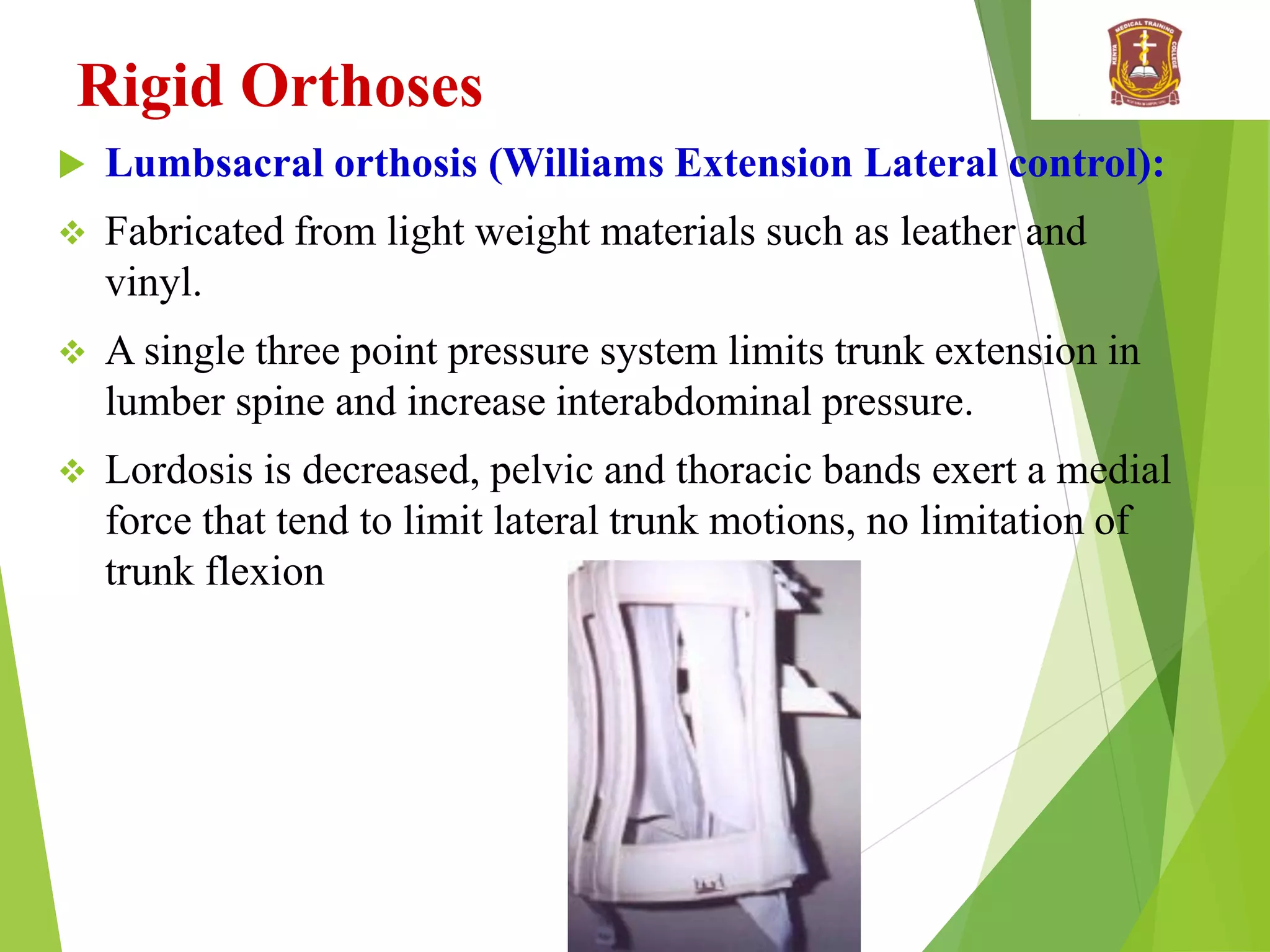
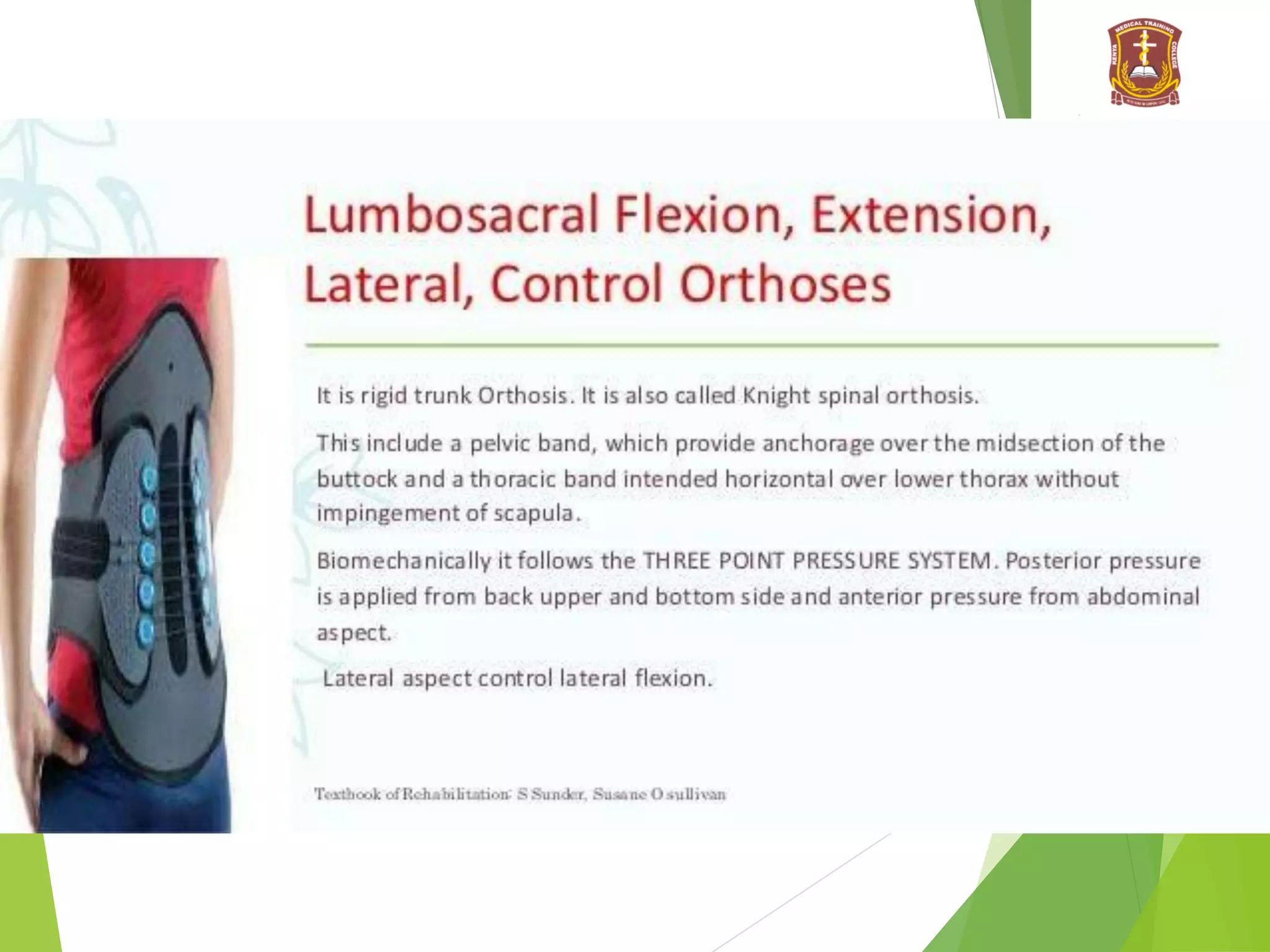
 Lumbsacral orthosis (Williams Extension Lateral control):
 Fabricated from light weight materials such as leather and
vinyl.
 A single three point pressure system limits trunk extension in
lumber spine and increase interabdominal pressure.
 Lordosis is decreased, pelvic and thoracic bands exert a medial
force that tend to limit lateral trunk motions, no limitation of
trunk flexion
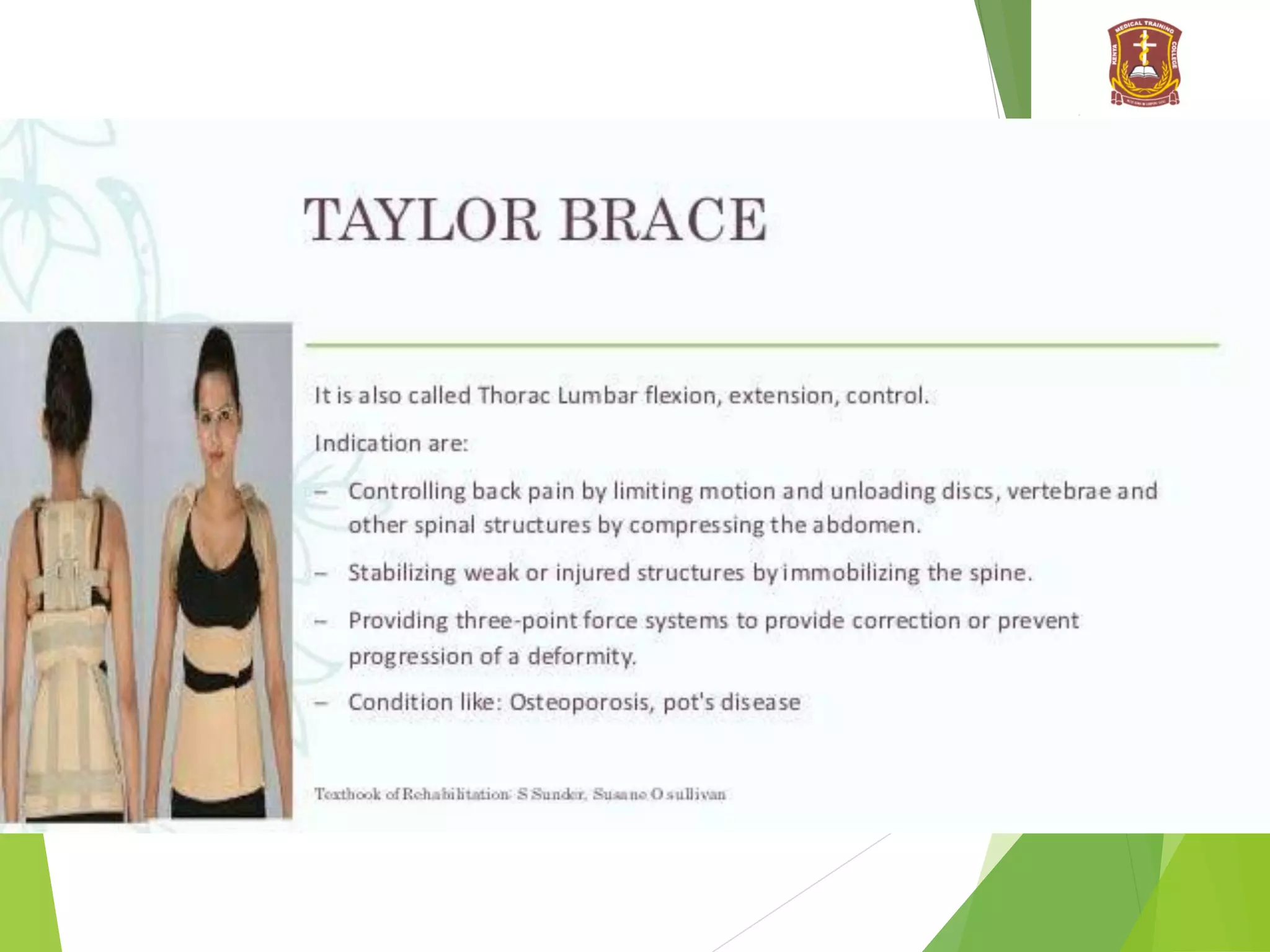
Thoracic lumbsacral orthosis
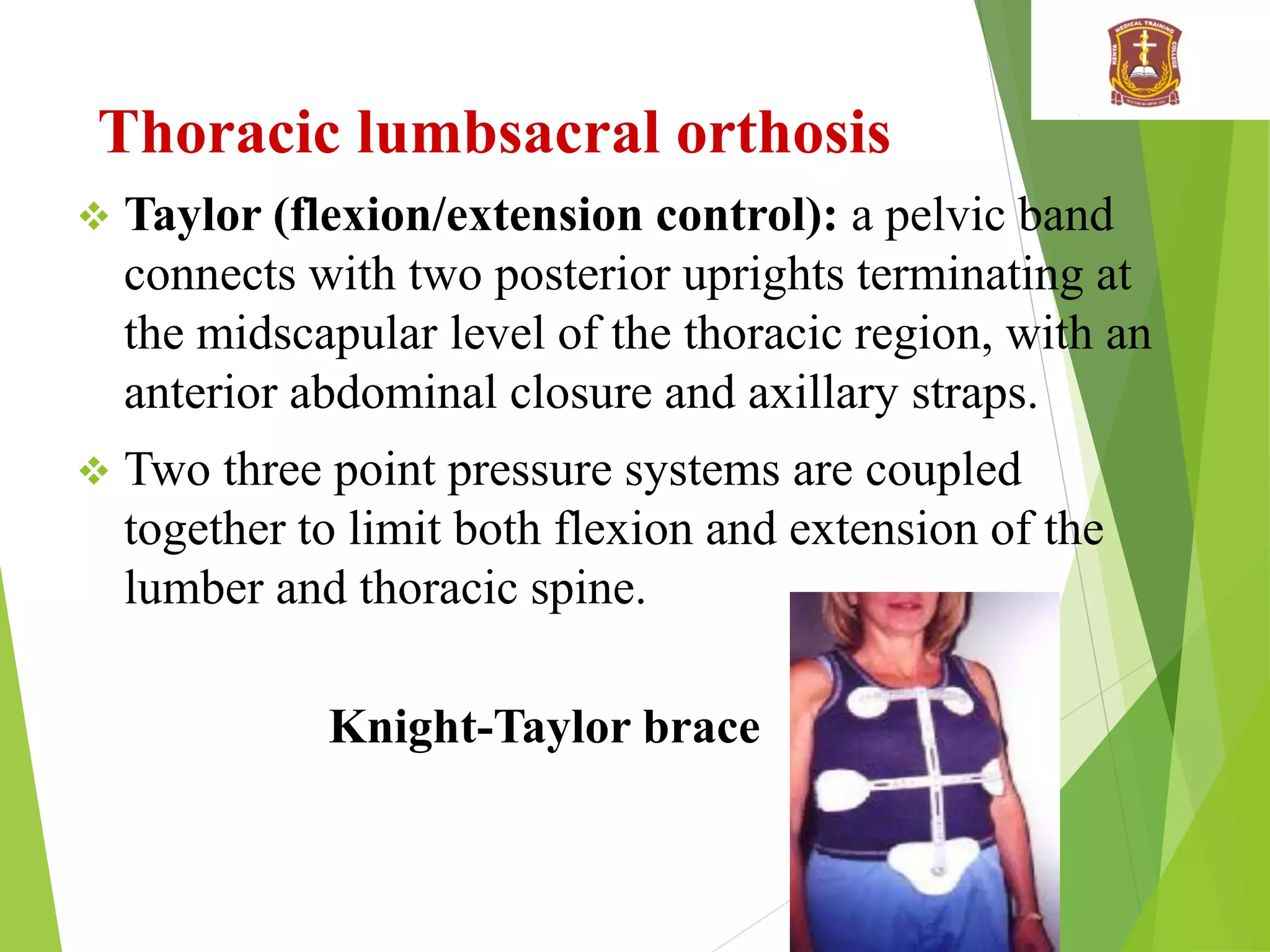
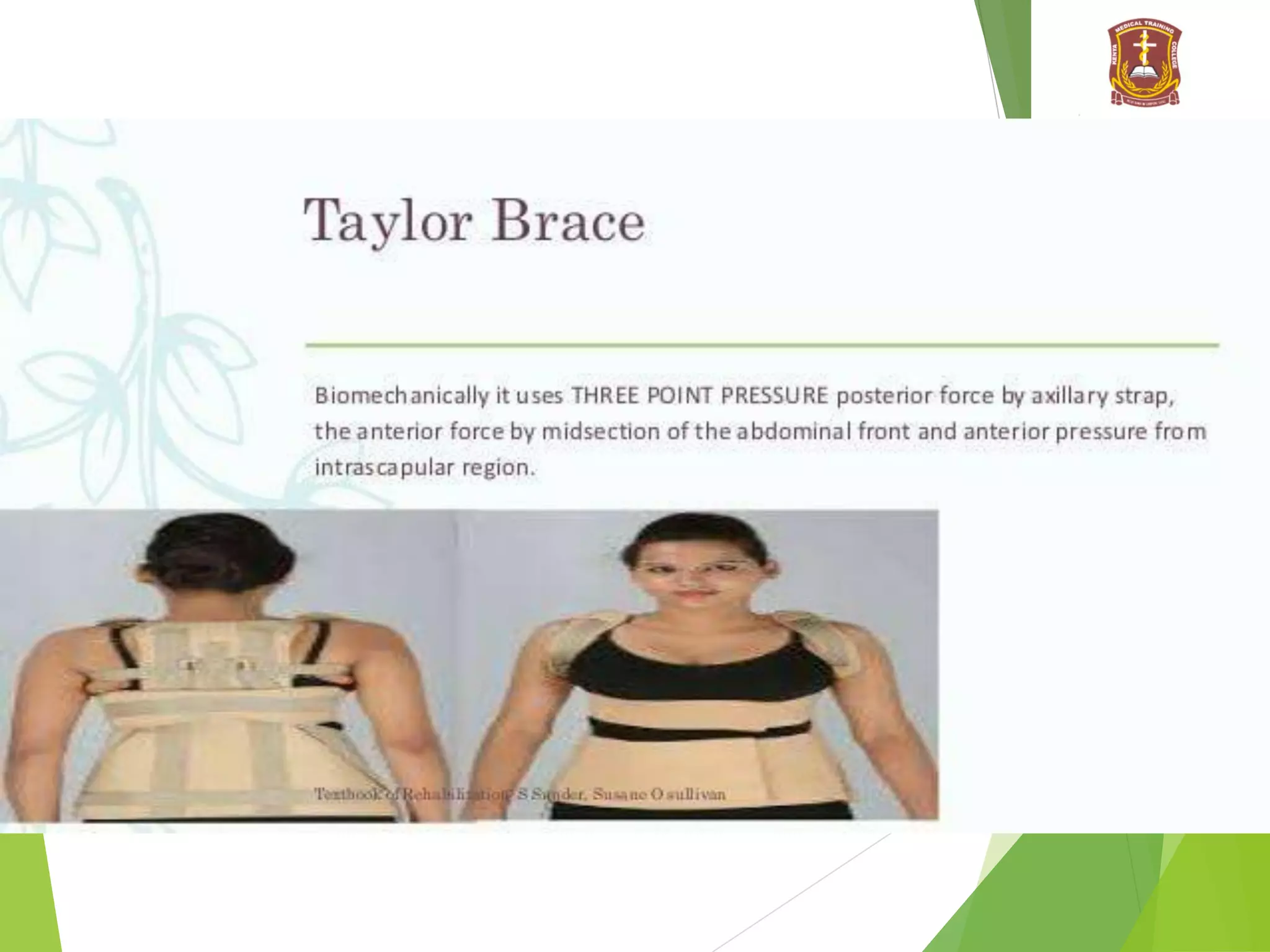
 Taylor (flexion/extension control): a pelvic band
connects with two posterior uprights terminating at
the midscapular level of the thoracic region, with an
anterior abdominal closure and axillary straps.
 Two three point pressure systems are coupled
together to limit both flexion and extension of the
lumber and thoracic spine.
Knight-Taylor brace
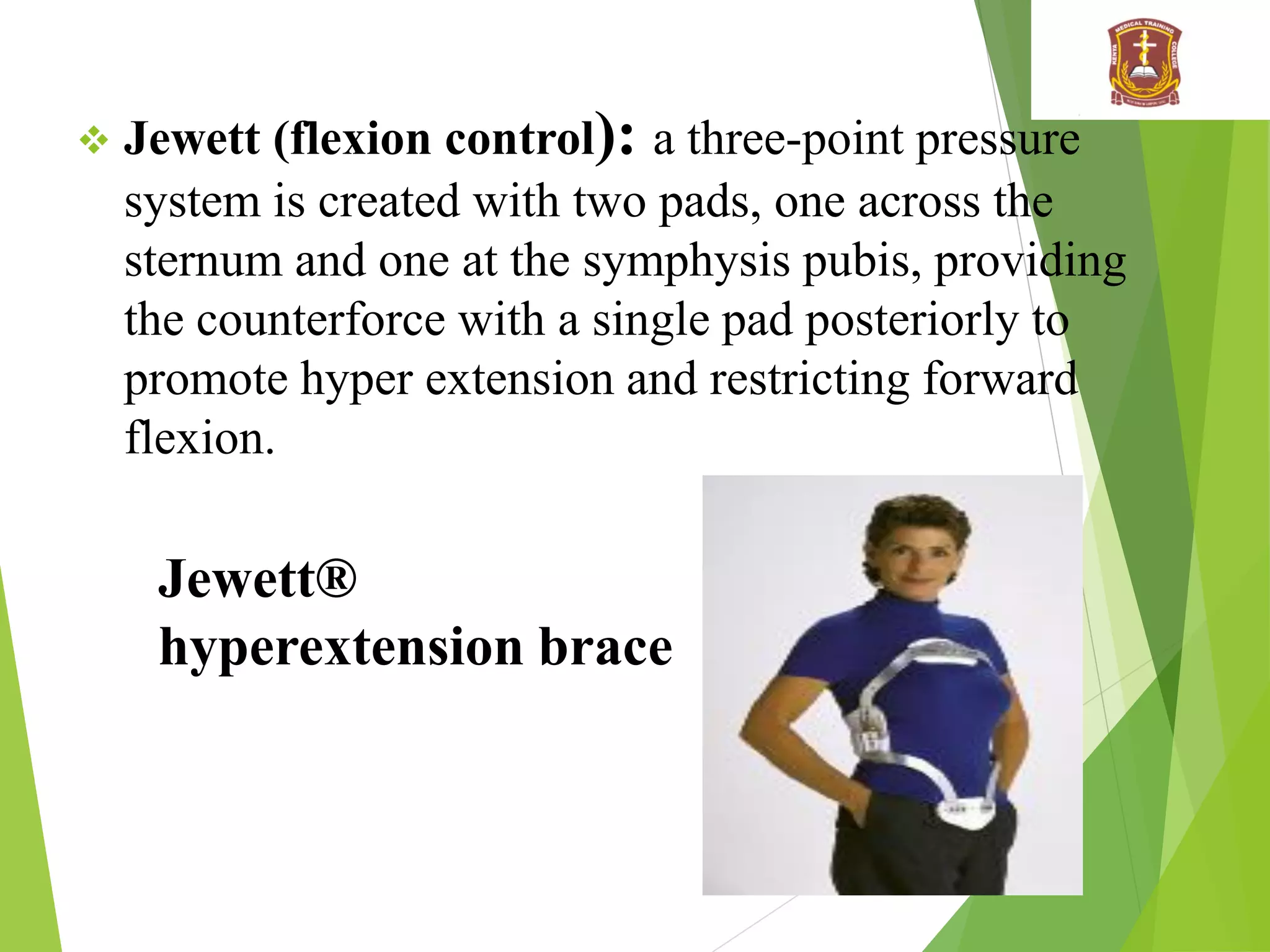
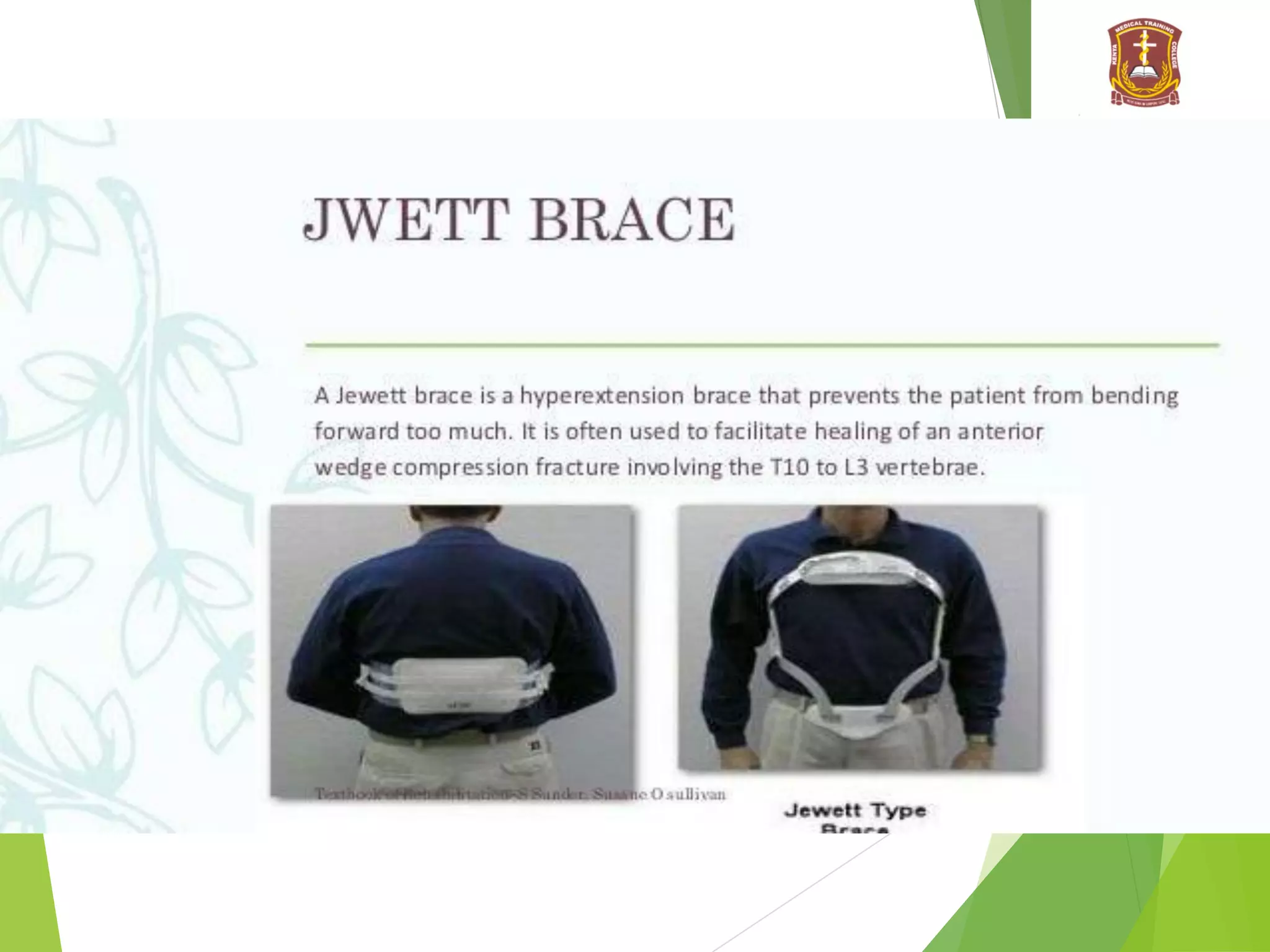
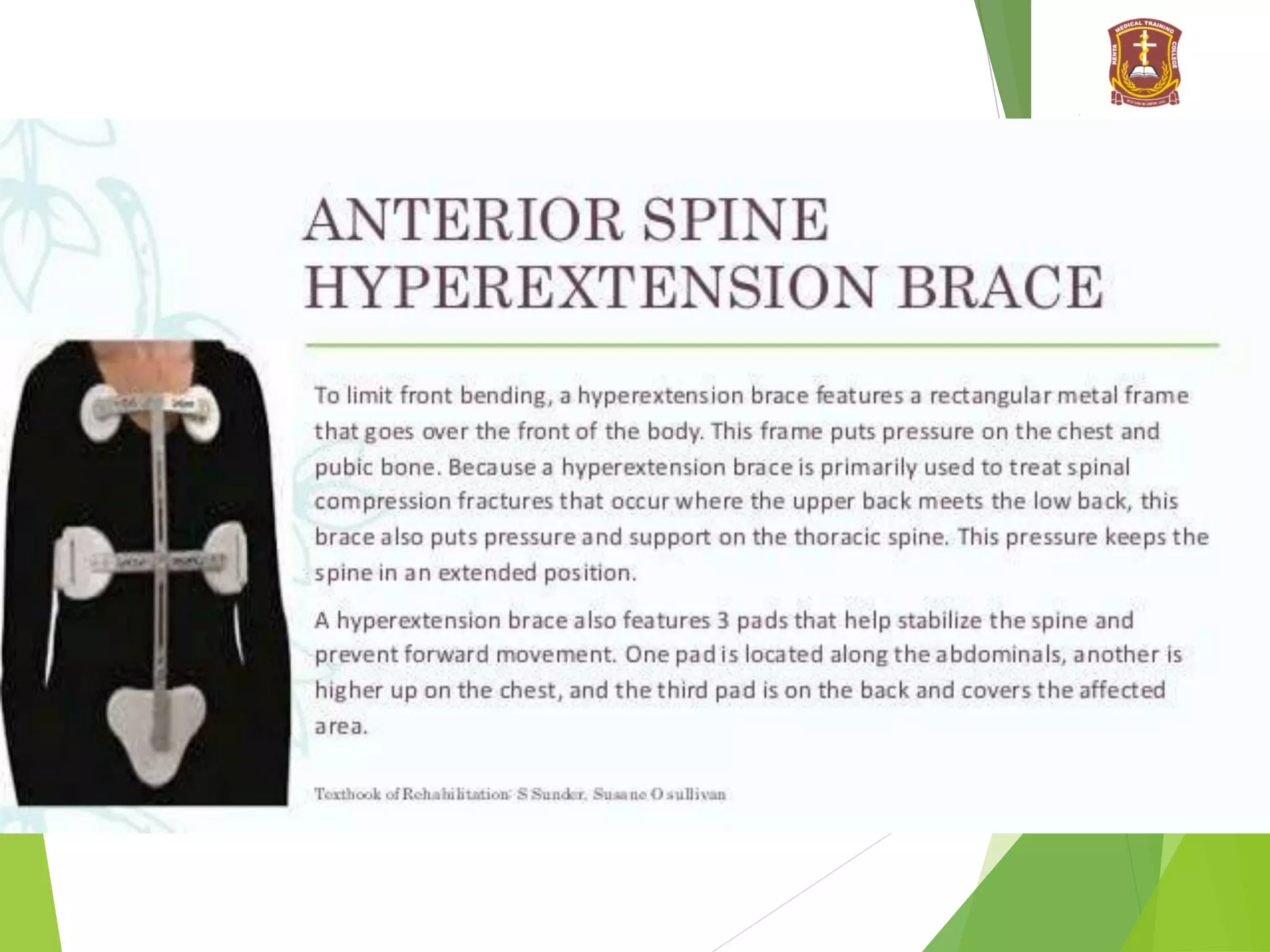
 Jewett (flexion control): a three-point pressure
system is created with two pads, one across the
sternum and one at the symphysis pubis, providing
the counterforce with a single pad posteriorly to
promote hyper extension and restricting forward
flexion.
Jewett®
hyperextension brace
 Plastic body jacket (flexion-extension-lateral –
rotary control):
 It is typically fabricated with high-temperature
copolymer plastics, a well-fitted body jacket will
restrict motion in all planes.
 Anterior and lateral trunk containment elevate
intracavitary pressure, and decrease demands on the
vertebral disks.
 Body jackets are frequently used post surgically or
during an acute trauma.
Cervical Orthoses
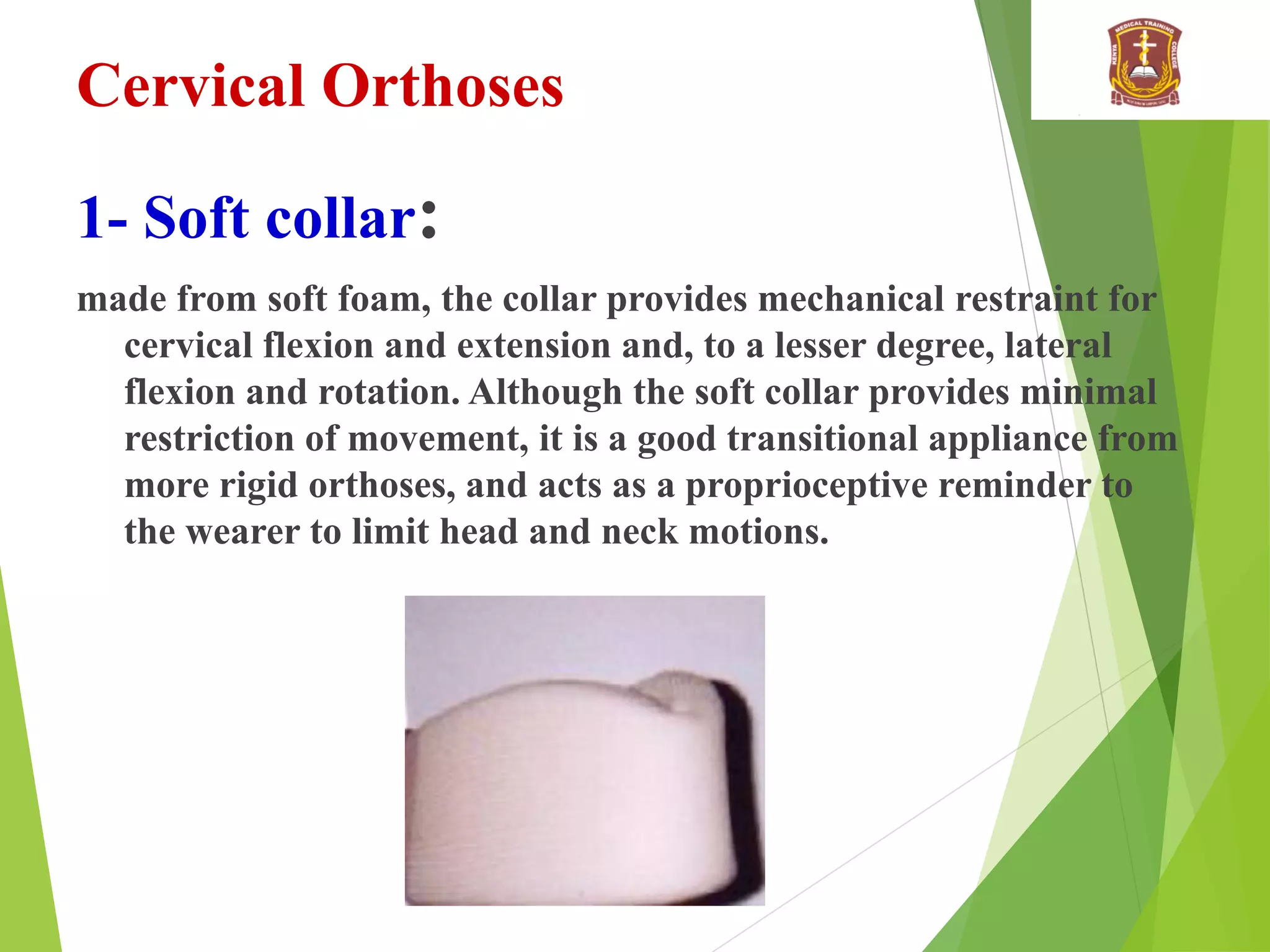
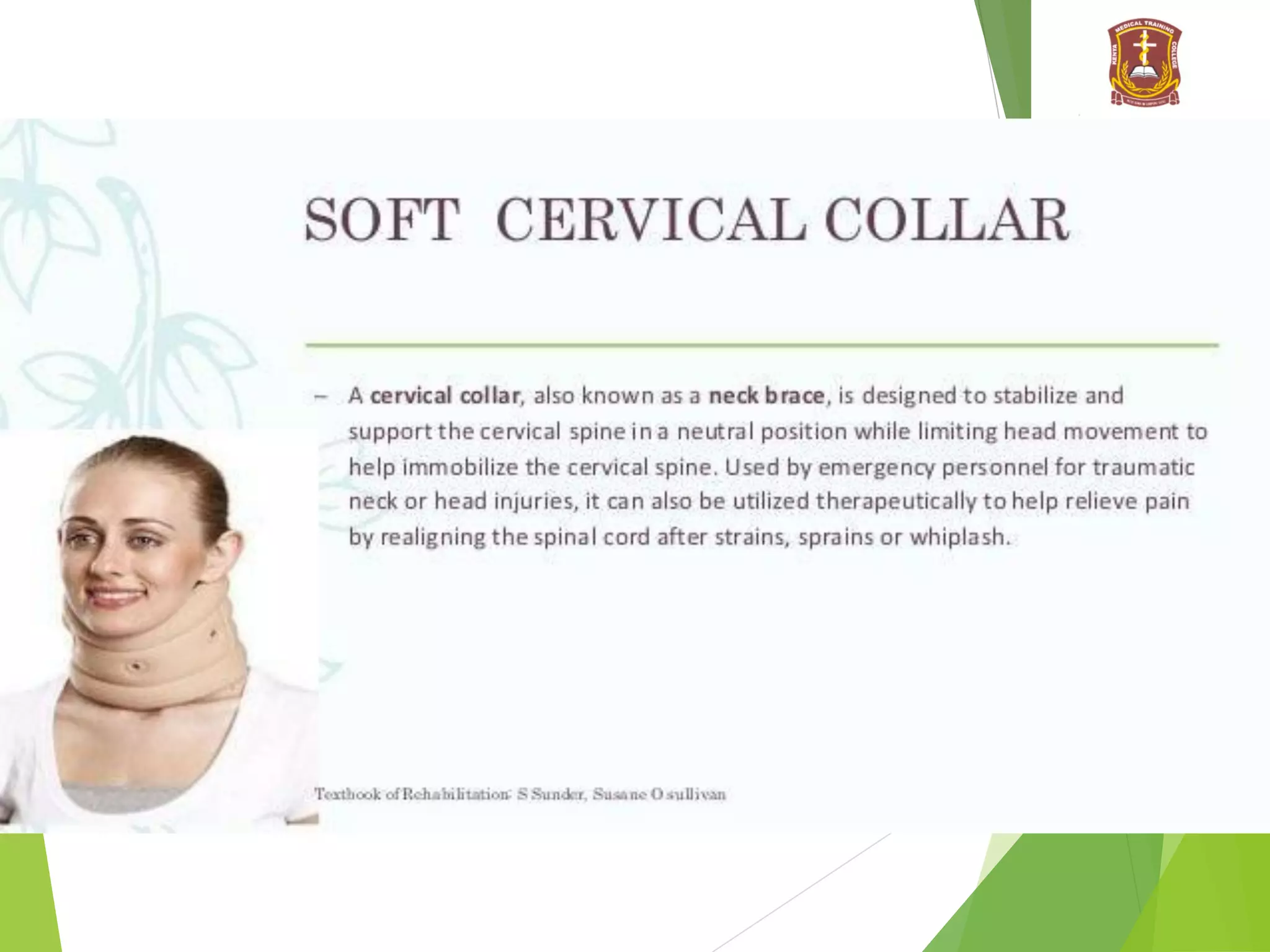
1- Soft collar:
made from soft foam, the collar provides mechanical restraint for
cervical flexion and extension and, to a lesser degree, lateral
flexion and rotation. Although the soft collar provides minimal
restriction of movement, it is a good transitional appliance from
more rigid orthoses, and acts as a proprioceptive reminder to
the wearer to limit head and neck motions.
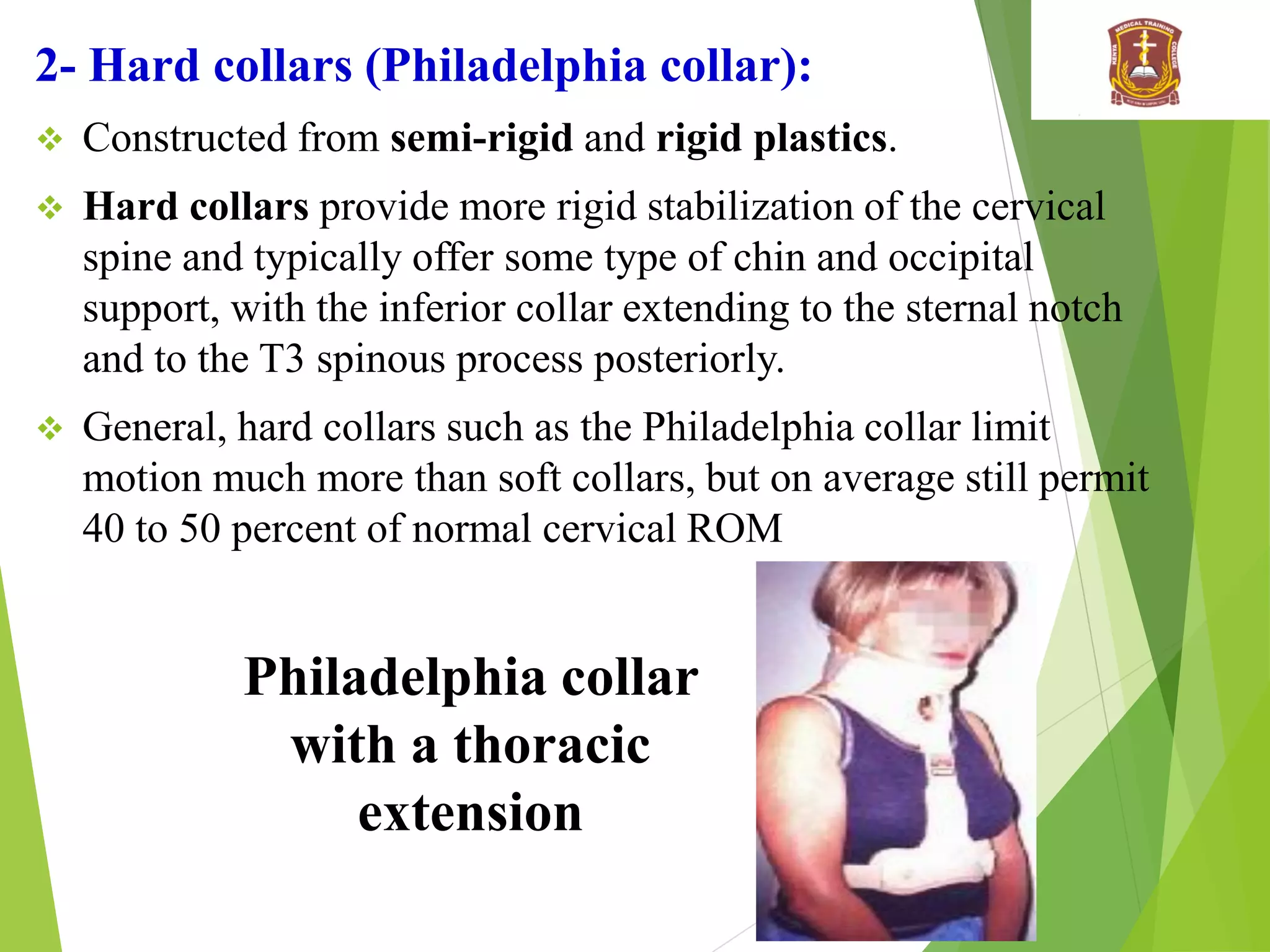
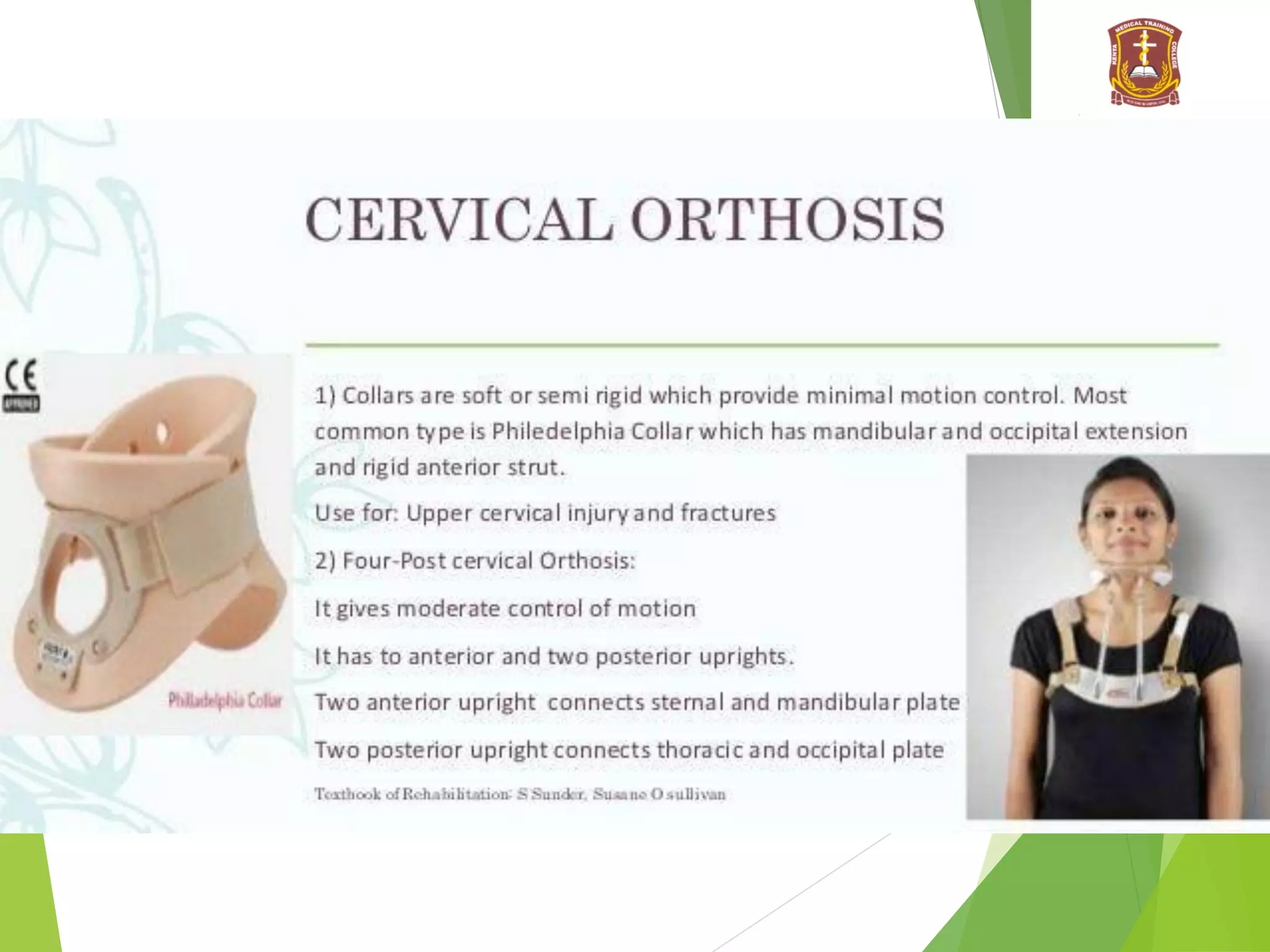
2- Hard collars (Philadelphia collar):
 Constructed from semi-rigid and rigid plastics.
 Hard collars provide more rigid stabilization of the cervical
spine and typically offer some type of chin and occipital
support, with the inferior collar extending to the sternal notch
and to the T3 spinous process posteriorly.
 General, hard collars such as the Philadelphia collar limit
motion much more than soft collars, but on average still permit
40 to 50 percent of normal cervical ROM
Philadelphia collar
with a thoracic
extension
Cervicothoracic Orthoses
3- Sterno-occipital mandibullar immobilizer [SOMI]
 Is one of the most common post surgical appliances
 It consists of a rigid metal frame with a chin and occipital rest
connected to a chest and back plate, with padded shoulder and
trunk straps.
 The added chest and back plates help to reduce cervical
motion by an average of 55 to 75 percent.
Sternooccipital-
mandibular
immobilization
brace
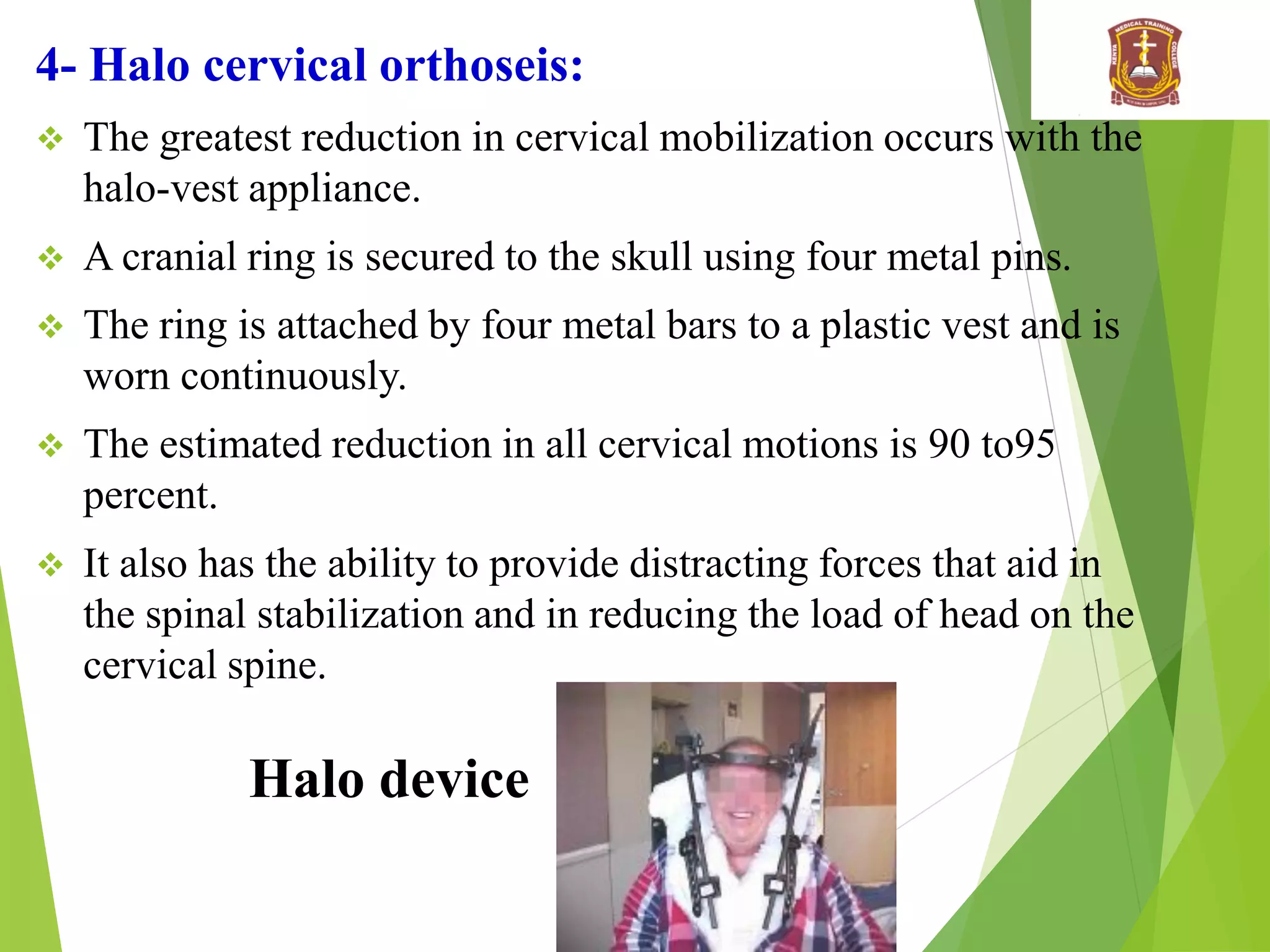
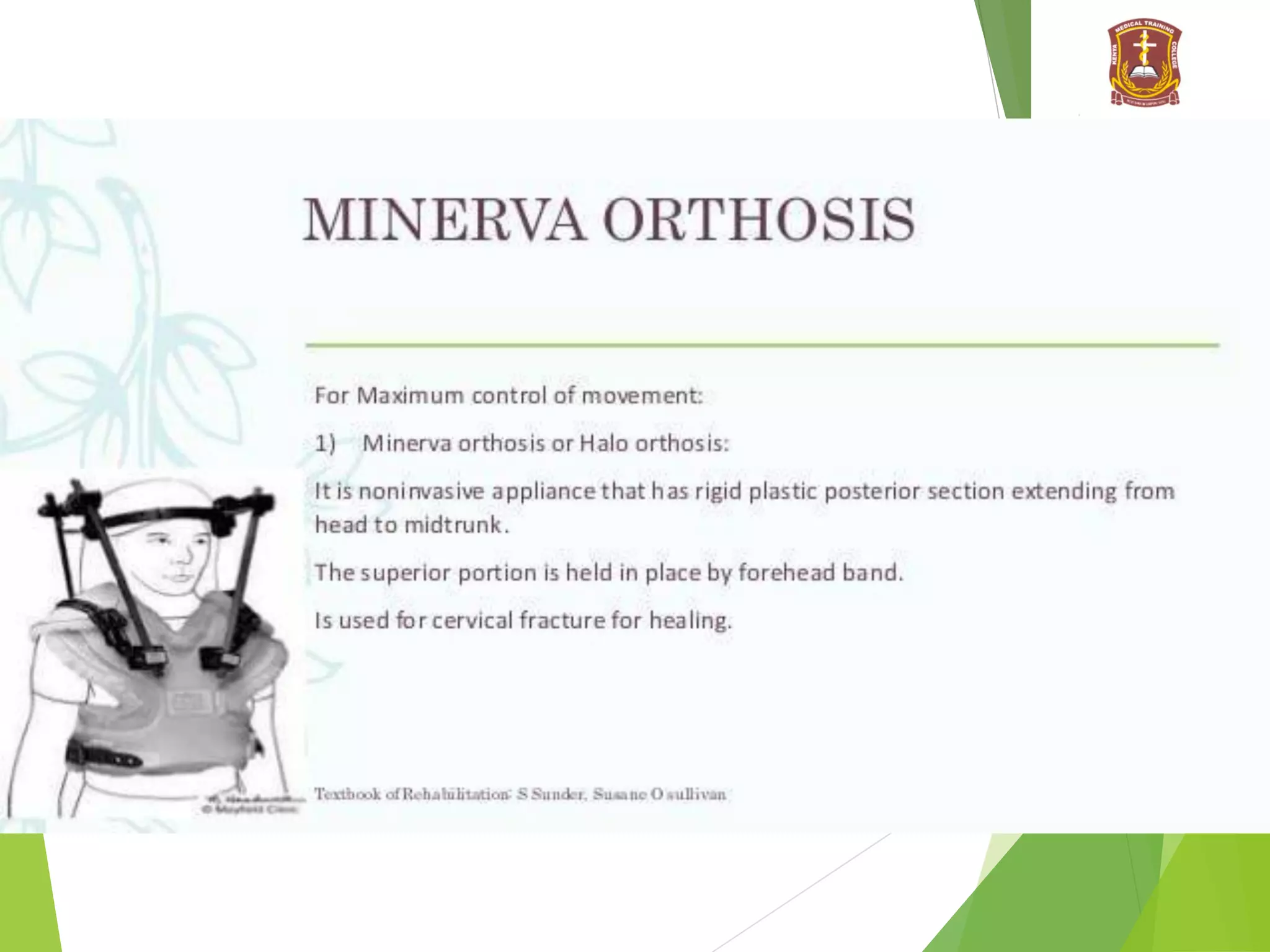
4- Halo cervical orthoseis:
 The greatest reduction in cervical mobilization occurs with the
halo-vest appliance.
 A cranial ring is secured to the skull using four metal pins.
 The ring is attached by four metal bars to a plastic vest and is
worn continuously.
 The estimated reduction in all cervical motions is 90 to95
percent.
 It also has the ability to provide distracting forces that aid in
the spinal stabilization and in reducing the load of head on the
cervical spine.
Halo device
Cervicothoraciclumbosacral
Orthoses
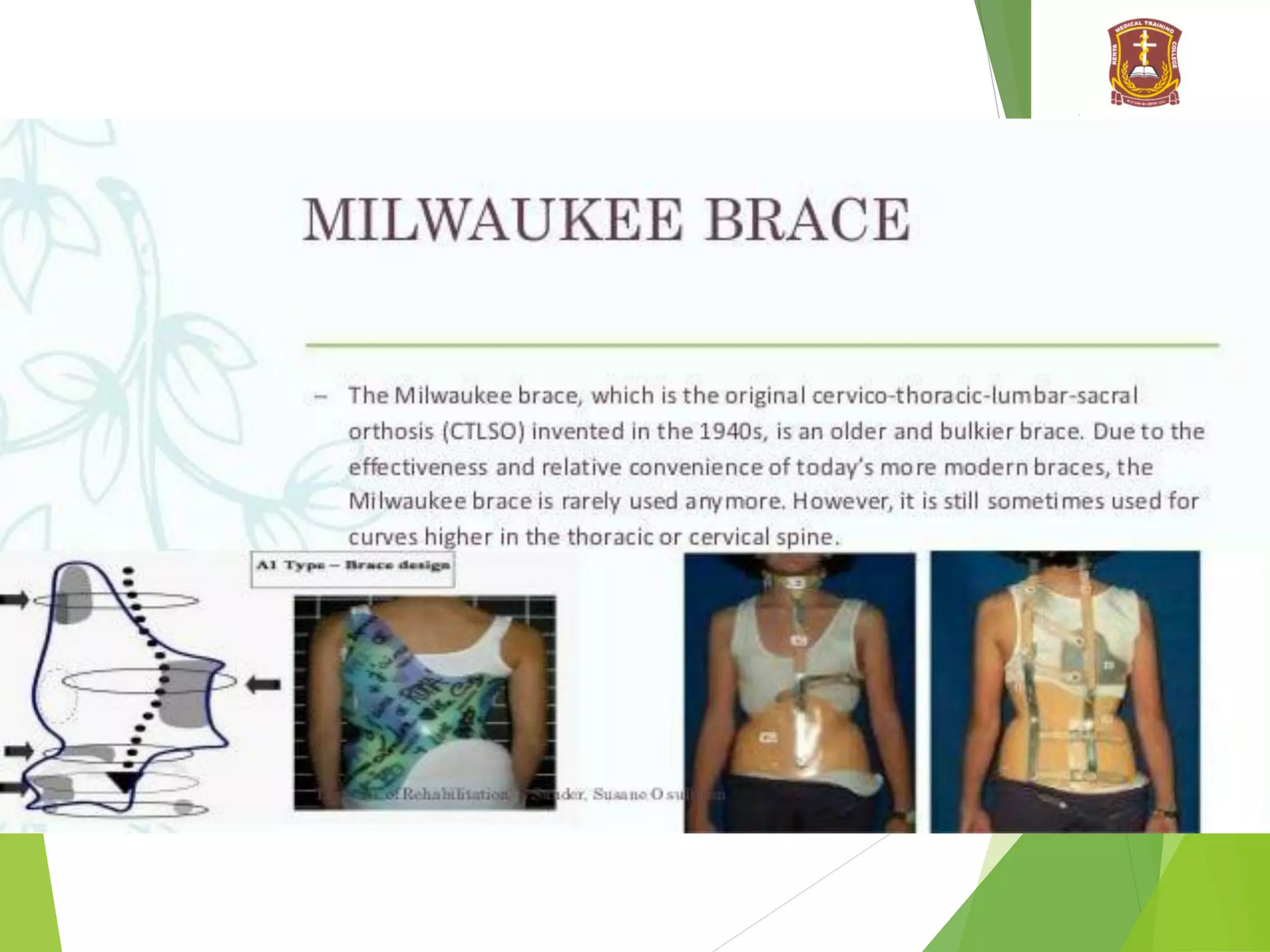
 The CTLSO is the most commonly used for the treatment of scoliosis
and kyphosis. Although a number of designs are used for variety of
clients, The Milwaukee brace is without question the most popular.
 The Milwaukee brace is designed with a neck ring and occipital pad,
connected to four metal upright bars secured to plastic TLSO, which
extends distally, forming a molded pelvic section.
 The advantages of Milwaukee brace:
Each component pelvic, thoracic and cervical can be molded or adjusted
to slow, or even in some cases, correct scoliotic curve. In the case of
idiopathic scoliosis the average 1-year follow up showed an average 20
percent correction for thoracic curves.
 The disadvantage is that the brace must be worn for 12 to 18
months,23 hours a day, with the child being out of the brace only for
exercise or atheletic activity. The psychological issues and poor
acceptance by clients and physicians lead to rejection of scoliotic
bracing, even with the more cosmetic, low-profile
Questions
Spine Orthotics-1.pdf

Spine Orthotics-1.pdf

  • 1.
    Department of Orthopaedic TraumaMedicine Year 1, Sem. 2 Subject – Biomechanics Topic – Biomechanics of the Spinal Orthotics BY Mr. Oduor Wafulah 9th November, 2022.
  • 2.
    Uses of spinalorthotics: 1) Pain (back pain) 2) Restriction of spinal motion. 3) Postural care and postural correction. 4) Augment other therapies
  • 3.
    General classifications ofspinal orthosis Flexible orthotics: Or corsets  They are constructed out of strong fabrics or elastic materials with a variety of stiffer supports  Rigid spinal orthotics  They are used when greater control of motion or posture is required.  They are fabricated from high temperature thermoplastics or light weight metals.  There are wide varieties with a broad selection of pads and coverings.
  • 4.
    Therapeutic benefits ofspinal orthosis  Intra abdominal pressure:  They create cylinder effect, exert pressure on the abdomen, and raise intra-cavitary pressure and reduce the intra-discal pressure especially during forward bending.  Muscle relaxation:  Support the vertebral column and relaxing the abdominal and erector spinae muscles  Decreasing the need for contractile support of the vertebral column may relax the muscles and reduce existing pain.
  • 5.
     Restriction ofmotion:  The primary method employed for motion control is the three point pressure system.  A rigid system is used when cervical, thoracic and lumbosacral motions are sought to be limited to the greatest possible degree.  The amount of limitation varies between the various segments.  Reduction of motion will reduce pain and spinal instability and offer constant proprioceptive feedback, reinforcing positive behaviors.
  • 6.
     Postural realignment: ↑intra abdominal pressure, relaxation in muscle spasm, and restriction of movement can assist in facilitation of improved posture and reduce compensatory posture related pain.  E.g. In case of scoliosis, the use of orthosis may prevent a spinal progression, stabilize the curvature and may offer some degree of posture correction
  • 7.
  • 8.
    Flexible Orthoses OrCorsets 1) Sacroiliac corset (binder):  Made from a combination of fabrics, elastic, laces and velcro offering multiple adjustments  Encircle the waist from the iliac crest to the greater trochanter and extending anteriory to the symphysis pubic.  Provide postural stability and reinforcement. 2) Lumbsacral corset:  Made from heavy fabrics with laces and hooks.  It is designed to limit motion, maintain three point pressure system and to reduce pain
  • 9.
    1) Thoracolumbosacral corset: The same construction and function of lumbosacral corset except it includes a shoulder strape to restrict spinal motion to the thoracic region as well as to the lumber spine
  • 10.
    Rigid Orthoses  Lumbsacralorthosis (Williams Extension Lateral control):  Fabricated from light weight materials such as leather and vinyl.  A single three point pressure system limits trunk extension in lumber spine and increase interabdominal pressure.  Lordosis is decreased, pelvic and thoracic bands exert a medial force that tend to limit lateral trunk motions, no limitation of trunk flexion
  • 11.
    Thoracic lumbsacral orthosis Taylor (flexion/extension control): a pelvic band connects with two posterior uprights terminating at the midscapular level of the thoracic region, with an anterior abdominal closure and axillary straps.  Two three point pressure systems are coupled together to limit both flexion and extension of the lumber and thoracic spine. Knight-Taylor brace
  • 12.
     Jewett (flexioncontrol): a three-point pressure system is created with two pads, one across the sternum and one at the symphysis pubis, providing the counterforce with a single pad posteriorly to promote hyper extension and restricting forward flexion. Jewett® hyperextension brace
  • 13.
     Plastic bodyjacket (flexion-extension-lateral – rotary control):  It is typically fabricated with high-temperature copolymer plastics, a well-fitted body jacket will restrict motion in all planes.  Anterior and lateral trunk containment elevate intracavitary pressure, and decrease demands on the vertebral disks.  Body jackets are frequently used post surgically or during an acute trauma.
  • 15.
    Cervical Orthoses 1- Softcollar: made from soft foam, the collar provides mechanical restraint for cervical flexion and extension and, to a lesser degree, lateral flexion and rotation. Although the soft collar provides minimal restriction of movement, it is a good transitional appliance from more rigid orthoses, and acts as a proprioceptive reminder to the wearer to limit head and neck motions.
  • 17.
    2- Hard collars(Philadelphia collar):  Constructed from semi-rigid and rigid plastics.  Hard collars provide more rigid stabilization of the cervical spine and typically offer some type of chin and occipital support, with the inferior collar extending to the sternal notch and to the T3 spinous process posteriorly.  General, hard collars such as the Philadelphia collar limit motion much more than soft collars, but on average still permit 40 to 50 percent of normal cervical ROM Philadelphia collar with a thoracic extension
  • 18.
    Cervicothoracic Orthoses 3- Sterno-occipitalmandibullar immobilizer [SOMI]  Is one of the most common post surgical appliances  It consists of a rigid metal frame with a chin and occipital rest connected to a chest and back plate, with padded shoulder and trunk straps.  The added chest and back plates help to reduce cervical motion by an average of 55 to 75 percent. Sternooccipital- mandibular immobilization brace
  • 19.
    4- Halo cervicalorthoseis:  The greatest reduction in cervical mobilization occurs with the halo-vest appliance.  A cranial ring is secured to the skull using four metal pins.  The ring is attached by four metal bars to a plastic vest and is worn continuously.  The estimated reduction in all cervical motions is 90 to95 percent.  It also has the ability to provide distracting forces that aid in the spinal stabilization and in reducing the load of head on the cervical spine. Halo device
  • 22.
    Cervicothoraciclumbosacral Orthoses  The CTLSOis the most commonly used for the treatment of scoliosis and kyphosis. Although a number of designs are used for variety of clients, The Milwaukee brace is without question the most popular.  The Milwaukee brace is designed with a neck ring and occipital pad, connected to four metal upright bars secured to plastic TLSO, which extends distally, forming a molded pelvic section.  The advantages of Milwaukee brace: Each component pelvic, thoracic and cervical can be molded or adjusted to slow, or even in some cases, correct scoliotic curve. In the case of idiopathic scoliosis the average 1-year follow up showed an average 20 percent correction for thoracic curves.  The disadvantage is that the brace must be worn for 12 to 18 months,23 hours a day, with the child being out of the brace only for exercise or atheletic activity. The psychological issues and poor acceptance by clients and physicians lead to rejection of scoliotic bracing, even with the more cosmetic, low-profile
  • 37.