Advancements in Upper Extremity
Prostheses
Rajnish Kumar Sharma
Assistant Professor(P&O)
Pandit Deendayal Upadhyaya National Institute for Persons with
Physical Disabilities,
Department of Empowerment of Persons with Disabilities,
Ministry of Social Justice & Empowerment,
Government of India
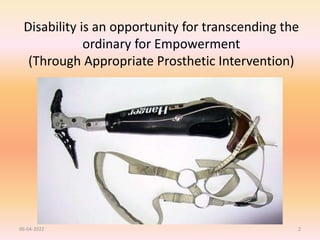
Disability is an opportunity for transcending the
ordinary for Empowerment
(Through Appropriate Prosthetic Intervention)
06-04-2022 2
Canyon
06-04-2022 3
Canyon
• A canyon is a deep, narrow valley with steep
sides. ... The movement of rivers, the
processes of weathering and erosion, and
tectonic activity create canyons.
06-04-2022 4
Canyoneering
• Canyoneering is the exploration of a canyon
from point A to point B using a range of
techniques that include hiking, scrambling,
sliding, stemming, chimneying and
rappelling. Imagine extreme hiking with a
harness, a helmet and appropriate rope
systems.
• Canyoneering is the intimate exploration of
forgotten Earth. It is poetry in movement.
06-04-2022 5
A R Rahman film composer, record
producer, singer and songwriter
06-04-2022 6
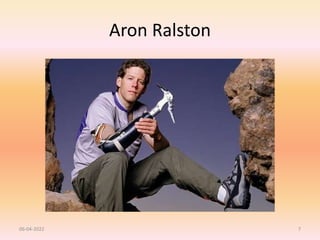
Aron Ralston
06-04-2022 7
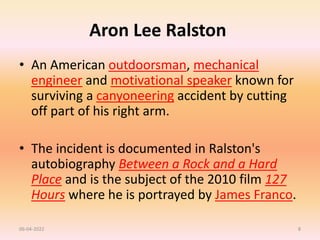
Aron Lee Ralston
• An American outdoorsman, mechanical
engineer and motivational speaker known for
surviving a canyoneering accident by cutting
off part of his right arm.
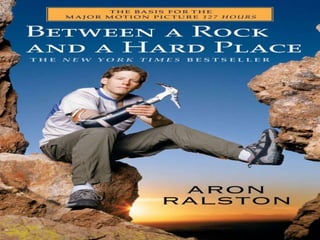
• The incident is documented in Ralston's
autobiography Between a Rock and a Hard
Place and is the subject of the 2010 film 127
Hours where he is portrayed by James Franco.
06-04-2022 8
AR Vs AR
• American mountain climber Aron Ralston,
whose life is the subject of Danny Boyle's
movie '127 Hours', has complimented Indian
composer A.R. Rahman for his music in the
movie.
06-04-2022 9
AR Vs AR
• AR Rahman received a hand-written note
from Ralston, and he has posted a copy of the
note on his social networking accounts on
Facebook and Twitter.
• The note reads, "For A.R, Thank you for
bringing your amazing music to my story - if
only I had your soundtrack in the canyon, I
could've lasted another 127 hours. Best
Wishes, A.R. (Aron Ralston)."
06-04-2022 10
06-04-2022 11
Prosthetics
• Prosthetics refers to the design, fabrication,
and fitting of custom-made artificial limbs or
other types of assistive devices for patients
who have lost limbs as a result of traumatic
injuries, vascular diseases, diabetes, cancer, or
congenital disorders.
06-04-2022 12
Prostheses
• Will restore – as completely as possible – the
function and appearance of a full or partial
missing limb.
• Because of vast differences in human anatomy,
the fabrication of prostheses is an intricate,
custom procedure that requires a high degree of
skill and sophisticated technology.
• The end goal, after all, is to develop a limb that
fits perfectly and gives the patient the utmost
level of comfort and convenience.
06-04-2022 13
UEP
• Developing a prosthetic device, such as an
upper extremity prosthesis, follows a careful
process from start to finish, all based on the
patient’s unique needs.
06-04-2022 14
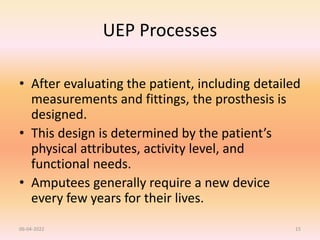
UEP Processes
• After evaluating the patient, including detailed
measurements and fittings, the prosthesis is
designed.
• This design is determined by the patient’s
physical attributes, activity level, and
functional needs.
• Amputees generally require a new device
every few years for their lives.
06-04-2022 15
Advanced Upper Extremity Prostheses
06-04-2022 16
Significant Changes in Technology
• Prosthesis fingers have improved mechanics
and functionality and now have multiple
motors, better batteries, more intelligent
sensors, and more accurate grip strength
when handling something delicate.
Myoelectric / External Power
• A myoelectric upper extremity prosthetic device
is powered by a battery system and is controlled
by electromyography (EMG) signals generated
during muscle contractions received through
electrodes mounted in the socket.
• These signals are sent to a motor in the
prosthetic elbow and/or wrist. A myoelectric
elbow may then bend or straighten, a wrist can
flex, and a hand can open or close.
06-04-2022 17
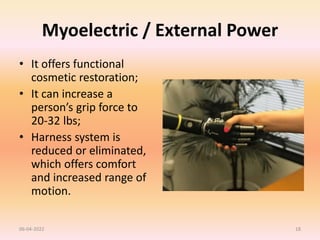
Myoelectric / External Power
• It offers functional
cosmetic restoration;
• It can increase a
person’s grip force to
20-32 lbs;
• Harness system is
reduced or eliminated,
which offers comfort
and increased range of
motion.
06-04-2022 18
Partial Hand and Finger
• Finger and partial-hand amputees are among
the most common type of amputees.
• Recently a variety of options became available
for these prosthetic devices.
• Playing an important role for amputees, these
prostheses offer gripping options and counter-
support when grasping objects.
06-04-2022 19
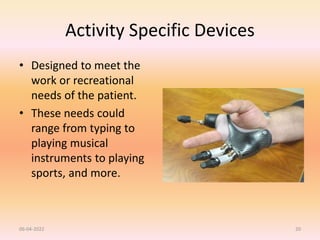
Activity Specific Devices
• Designed to meet the
work or recreational
needs of the patient.
• These needs could
range from typing to
playing musical
instruments to playing
sports, and more.
06-04-2022 20
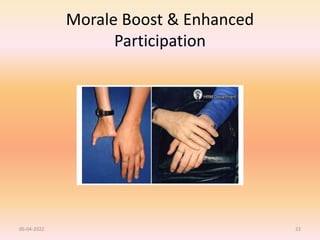
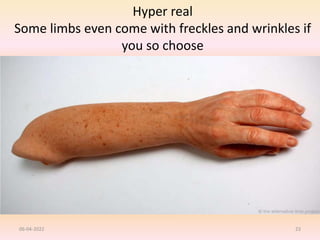
High Realism Silicone Prosthesis
• Designed to be unnoticeable by others.
• Each prosthesis is hand-crafted from high
definition silicone and hand-painted to match the
patient’s original skin tone and appearance.
• Most realistic, aesthetically pleasing, and
functional passive restoration
• Every detail is taken into account during the
painting of the prosthetic device, even accounting
for features such as freckles and hair.
06-04-2022 21
Morale Boost & Enhanced
Participation
06-04-2022 22
Hyper real
Some limbs even come with freckles and wrinkles if
you so choose
06-04-2022 23
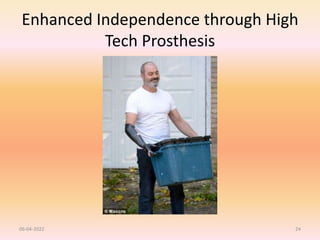
Enhanced Independence through High
Tech Prosthesis
06-04-2022 24
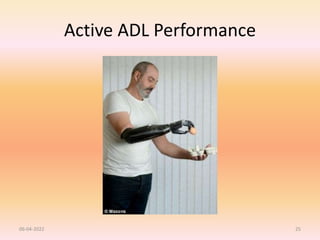
Active ADL Performance
06-04-2022 25
This arm features a laser, magnifying
glass, cigarette lighter and other tools
06-04-2022 26
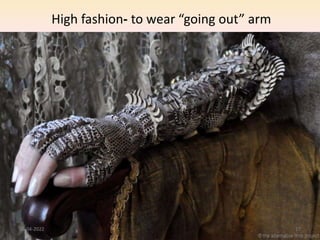
High fashion- to wear “going out” arm
06-04-2022 27
Upper Extremity Prosthesis for Sports
06-04-2022 28
Current Prosthetic Technological
Scenario
• Researchers at Berlin have developed an
artificial hand which uses smart wires that can
tense and flex as its muscles to perform
extremely precise movements.
• Engineers at Saarland University in Germany
enable development of flexible and lightweight
robot hands for industrial applications and novel
prosthetic devices.
06-04-2022 29
IMES
• Amputees can control their bionic prosthetic
limbs with their minds through tiny implanted
myoelectric sensors (IMES) developed by
Icelandic orthopedics company Ossur.
• Surgically implanted tiny sensors in a amputee's
residual muscle tissue.
• That trigger movement in the prosthesis via a
receiver.
06-04-2022 30
Osteo-integration
• Osteo-integration for limbs involves inserting
a metal rod into an arm bone.
• The bone then fuses with the rod in a manner
similar to fracture healing.
• The resulting implant offers numerous
benefits but also introduces some health
risks.
06-04-2022 31
Advantages of Osteo-integration
• increased comfort, especially with the elimination
of socket-related skin problems;
• it’s much easier to attach and detach a
prosthesis;
• greater strength/stability;
• more intuitive use of the prosthesis including a
broader range of motion;
• improved osteo-perception ;
• overall improved quality of life.
06-04-2022 32
Disadvantages of Osteo-integration
• it’s major surgery with a long recovery time;
• it involves significant costs;
• the implant presents a serious risk of deep
infection (up to 41 %);
• bone fractures occur in up to 9 % of the cases;
• implant parts break in up to 31 % of cases;
• the implants end up being removed in up to
roughly 20 % of the cases.
06-04-2022 33
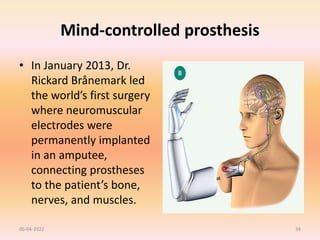
Mind-controlled prosthesis
• In January 2013, Dr.
Rickard Brånemark led
the world’s first surgery
where neuromuscular
electrodes were
permanently implanted
in an amputee,
connecting prostheses
to the patient’s bone,
nerves, and muscles.
06-04-2022 34
The Next Generation Robotic Arm
• Conventional robotic prostheses available
today are attached with a socket and
controlled via electrodes placed on the skin.
• Robotic prostheses can be very advanced, but
such a control system makes them unreliable
and limits their functionality, and patients
commonly reject them as a result. By
connecting the prosthesis directly to bone,
nerves and muscles
06-04-2022 35
Integrum Robotic System
• The Integrum robotic system can provide a
significantly improved user experience.
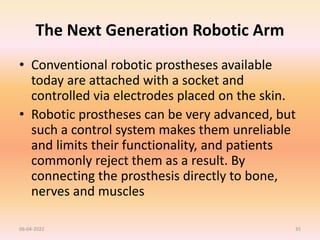
• Unrestricted range of motion
• Precise and reliable prosthetic control
• Direct and intuitive neural sensory feedback
• Stable mechanical attachment
• Reduced phantom limb pain
06-04-2022 36
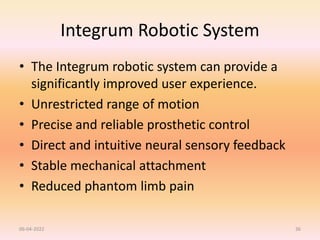
Mind-controlled prosthesis
• The artificial arm is
directly attached to the
skeleton, thus providing
mechanical stability. Then
the human’s biological
control system, that is
nerves and muscles, is
also interfaced via
neuromuscular electrodes
to the prosthesis via
Integrum’s advanced
control system.
06-04-2022 37
Mind-controlled prosthesis
• This creates an intimate union
between the body and the
prosthesis; between biology
and mechatronics.
• The stack connector interfaced
with a pin connector
extending from the central
sealing component, from
which leads extended
intramedullary and then
transcortically to a final
connector located in the soft
tissue. The leads from the
neuromuscular electrodes are
mated to connector.
06-04-2022 38
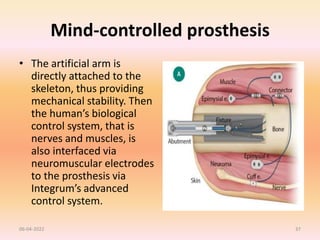
Mind-controlled prosthesis
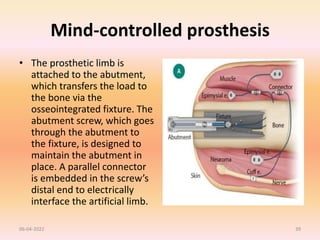
• The prosthetic limb is
attached to the abutment,
which transfers the load to
the bone via the
osseointegrated fixture. The
abutment screw, which goes
through the abutment to
the fixture, is designed to
maintain the abutment in
place. A parallel connector
is embedded in the screw’s
distal end to electrically
interface the artificial limb.
06-04-2022 39
Mind-controlled prosthesis
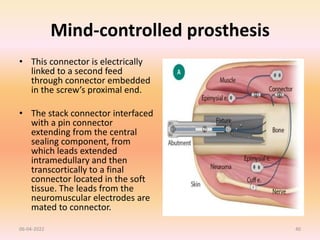
• This connector is electrically
linked to a second feed
through connector embedded
in the screw’s proximal end.
• The stack connector interfaced
with a pin connector
extending from the central
sealing component, from
which leads extended
intramedullary and then
transcortically to a final
connector located in the soft
tissue. The leads from the
neuromuscular electrodes are
mated to connector.
06-04-2022 40
TMR
Targeted Muscle Re-innervation is the surgical
reassignment of nerves to alternative
muscles. It can prevent the formation of
neuromas, decrease phantom pain, and help
improve user control over myoelectric
devices.
06-04-2022 41
TMR
06-04-2022 42
3D scanning and 3D printing
• Prosthetist utilizes 3D scanning and 3D
printing in the production of upper extremity
custom made prostheses.
• This technology enables to make the most
precise fitting prosthetic sockets.
• Scanners enhance experience as a patient
because it eliminate a lengthy casting
procedure of plaster or other wet, casting
products.
06-04-2022 43
3D scanning and 3D printing
• Scanning procedure takes approximately 2-3
minutes and generates a 3 dimensional replica
of limb that is uploaded to software program
for computer-assisted modifications.
• 3D scanning also enables us to track any
changes occurring in limb and make changes
to system with more precision than other
companies that utilize casts and plaster molds.
06-04-2022 44
Advancements
• Incremental improvements in the flexibility,
cushioning, and rotational ability of modern
artificial limbs increase a prosthetic’s comfort
and functionality, allowing prosthetic wearers
to come closer to feeling like they are wearing
a natural limb. And as the quality
of prosthetics increases, prosthetic wearers
are more able to resume activities previously
made difficult by their lack of a natural limb.
06-04-2022 45
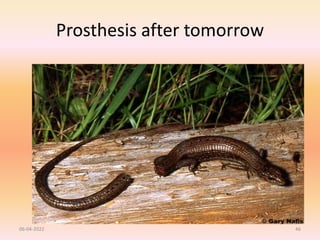
Prosthesis after tomorrow
06-04-2022 46
References
1. https://www.news18.com/news/india/aron-
ralston-praises-rahman-for-127-hours-music-
354222.html
2.https://www.biotechpossibilities.com/technol
ogy/prosthetics
3. https://en.wikipedia.org/wiki/Aron_Ralston
4.https://www.nationalgeographic.org/encyclop
edia/canyon/
06-04-2022 47
References
5. https://www.experiments-in
armwear.com/post/264903956/images-courtesy-
of-aron-ralston-copyright
6. https://www.inmotionprosthetics.com/blog
7. https://www.armdynamics.com/research-and-
technology/prosthetic-technology
8. https://www.researchgate.net/figure/A-
Prosthesis-control-can-be-achieved-through-
motor-commands-generated-through-
EEG_fig1_338317385
06-04-2022 48
Thank you

Advancements in upper extremity prostheses

  • 1.
    Advancements in UpperExtremity Prostheses Rajnish Kumar Sharma Assistant Professor(P&O) Pandit Deendayal Upadhyaya National Institute for Persons with Physical Disabilities, Department of Empowerment of Persons with Disabilities, Ministry of Social Justice & Empowerment, Government of India
  • 2.
    Disability is anopportunity for transcending the ordinary for Empowerment (Through Appropriate Prosthetic Intervention) 06-04-2022 2
  • 3.
  • 4.
    Canyon • A canyonis a deep, narrow valley with steep sides. ... The movement of rivers, the processes of weathering and erosion, and tectonic activity create canyons. 06-04-2022 4
  • 5.
    Canyoneering • Canyoneering isthe exploration of a canyon from point A to point B using a range of techniques that include hiking, scrambling, sliding, stemming, chimneying and rappelling. Imagine extreme hiking with a harness, a helmet and appropriate rope systems. • Canyoneering is the intimate exploration of forgotten Earth. It is poetry in movement. 06-04-2022 5
  • 6.
    A R Rahmanfilm composer, record producer, singer and songwriter 06-04-2022 6
  • 7.
  • 8.
    Aron Lee Ralston •An American outdoorsman, mechanical engineer and motivational speaker known for surviving a canyoneering accident by cutting off part of his right arm. • The incident is documented in Ralston's autobiography Between a Rock and a Hard Place and is the subject of the 2010 film 127 Hours where he is portrayed by James Franco. 06-04-2022 8
  • 9.
    AR Vs AR •American mountain climber Aron Ralston, whose life is the subject of Danny Boyle's movie '127 Hours', has complimented Indian composer A.R. Rahman for his music in the movie. 06-04-2022 9
  • 10.
    AR Vs AR •AR Rahman received a hand-written note from Ralston, and he has posted a copy of the note on his social networking accounts on Facebook and Twitter. • The note reads, "For A.R, Thank you for bringing your amazing music to my story - if only I had your soundtrack in the canyon, I could've lasted another 127 hours. Best Wishes, A.R. (Aron Ralston)." 06-04-2022 10
  • 11.
  • 12.
    Prosthetics • Prosthetics refersto the design, fabrication, and fitting of custom-made artificial limbs or other types of assistive devices for patients who have lost limbs as a result of traumatic injuries, vascular diseases, diabetes, cancer, or congenital disorders. 06-04-2022 12
  • 13.
    Prostheses • Will restore– as completely as possible – the function and appearance of a full or partial missing limb. • Because of vast differences in human anatomy, the fabrication of prostheses is an intricate, custom procedure that requires a high degree of skill and sophisticated technology. • The end goal, after all, is to develop a limb that fits perfectly and gives the patient the utmost level of comfort and convenience. 06-04-2022 13
  • 14.
    UEP • Developing aprosthetic device, such as an upper extremity prosthesis, follows a careful process from start to finish, all based on the patient’s unique needs. 06-04-2022 14
  • 15.
    UEP Processes • Afterevaluating the patient, including detailed measurements and fittings, the prosthesis is designed. • This design is determined by the patient’s physical attributes, activity level, and functional needs. • Amputees generally require a new device every few years for their lives. 06-04-2022 15
  • 16.
    Advanced Upper ExtremityProstheses 06-04-2022 16 Significant Changes in Technology • Prosthesis fingers have improved mechanics and functionality and now have multiple motors, better batteries, more intelligent sensors, and more accurate grip strength when handling something delicate.
  • 17.
    Myoelectric / ExternalPower • A myoelectric upper extremity prosthetic device is powered by a battery system and is controlled by electromyography (EMG) signals generated during muscle contractions received through electrodes mounted in the socket. • These signals are sent to a motor in the prosthetic elbow and/or wrist. A myoelectric elbow may then bend or straighten, a wrist can flex, and a hand can open or close. 06-04-2022 17
  • 18.
    Myoelectric / ExternalPower • It offers functional cosmetic restoration; • It can increase a person’s grip force to 20-32 lbs; • Harness system is reduced or eliminated, which offers comfort and increased range of motion. 06-04-2022 18
  • 19.
    Partial Hand andFinger • Finger and partial-hand amputees are among the most common type of amputees. • Recently a variety of options became available for these prosthetic devices. • Playing an important role for amputees, these prostheses offer gripping options and counter- support when grasping objects. 06-04-2022 19
  • 20.
    Activity Specific Devices •Designed to meet the work or recreational needs of the patient. • These needs could range from typing to playing musical instruments to playing sports, and more. 06-04-2022 20
  • 21.
    High Realism SiliconeProsthesis • Designed to be unnoticeable by others. • Each prosthesis is hand-crafted from high definition silicone and hand-painted to match the patient’s original skin tone and appearance. • Most realistic, aesthetically pleasing, and functional passive restoration • Every detail is taken into account during the painting of the prosthetic device, even accounting for features such as freckles and hair. 06-04-2022 21
  • 22.
    Morale Boost &Enhanced Participation 06-04-2022 22
  • 23.
    Hyper real Some limbseven come with freckles and wrinkles if you so choose 06-04-2022 23
  • 24.
    Enhanced Independence throughHigh Tech Prosthesis 06-04-2022 24
  • 25.
  • 26.
    This arm featuresa laser, magnifying glass, cigarette lighter and other tools 06-04-2022 26
  • 27.
    High fashion- towear “going out” arm 06-04-2022 27
  • 28.
    Upper Extremity Prosthesisfor Sports 06-04-2022 28
  • 29.
    Current Prosthetic Technological Scenario •Researchers at Berlin have developed an artificial hand which uses smart wires that can tense and flex as its muscles to perform extremely precise movements. • Engineers at Saarland University in Germany enable development of flexible and lightweight robot hands for industrial applications and novel prosthetic devices. 06-04-2022 29
  • 30.
    IMES • Amputees cancontrol their bionic prosthetic limbs with their minds through tiny implanted myoelectric sensors (IMES) developed by Icelandic orthopedics company Ossur. • Surgically implanted tiny sensors in a amputee's residual muscle tissue. • That trigger movement in the prosthesis via a receiver. 06-04-2022 30
  • 31.
    Osteo-integration • Osteo-integration forlimbs involves inserting a metal rod into an arm bone. • The bone then fuses with the rod in a manner similar to fracture healing. • The resulting implant offers numerous benefits but also introduces some health risks. 06-04-2022 31
  • 32.
    Advantages of Osteo-integration •increased comfort, especially with the elimination of socket-related skin problems; • it’s much easier to attach and detach a prosthesis; • greater strength/stability; • more intuitive use of the prosthesis including a broader range of motion; • improved osteo-perception ; • overall improved quality of life. 06-04-2022 32
  • 33.
    Disadvantages of Osteo-integration •it’s major surgery with a long recovery time; • it involves significant costs; • the implant presents a serious risk of deep infection (up to 41 %); • bone fractures occur in up to 9 % of the cases; • implant parts break in up to 31 % of cases; • the implants end up being removed in up to roughly 20 % of the cases. 06-04-2022 33
  • 34.
    Mind-controlled prosthesis • InJanuary 2013, Dr. Rickard Brånemark led the world’s first surgery where neuromuscular electrodes were permanently implanted in an amputee, connecting prostheses to the patient’s bone, nerves, and muscles. 06-04-2022 34
  • 35.
    The Next GenerationRobotic Arm • Conventional robotic prostheses available today are attached with a socket and controlled via electrodes placed on the skin. • Robotic prostheses can be very advanced, but such a control system makes them unreliable and limits their functionality, and patients commonly reject them as a result. By connecting the prosthesis directly to bone, nerves and muscles 06-04-2022 35
  • 36.
    Integrum Robotic System •The Integrum robotic system can provide a significantly improved user experience. • Unrestricted range of motion • Precise and reliable prosthetic control • Direct and intuitive neural sensory feedback • Stable mechanical attachment • Reduced phantom limb pain 06-04-2022 36
  • 37.
    Mind-controlled prosthesis • Theartificial arm is directly attached to the skeleton, thus providing mechanical stability. Then the human’s biological control system, that is nerves and muscles, is also interfaced via neuromuscular electrodes to the prosthesis via Integrum’s advanced control system. 06-04-2022 37
  • 38.
    Mind-controlled prosthesis • Thiscreates an intimate union between the body and the prosthesis; between biology and mechatronics. • The stack connector interfaced with a pin connector extending from the central sealing component, from which leads extended intramedullary and then transcortically to a final connector located in the soft tissue. The leads from the neuromuscular electrodes are mated to connector. 06-04-2022 38
  • 39.
    Mind-controlled prosthesis • Theprosthetic limb is attached to the abutment, which transfers the load to the bone via the osseointegrated fixture. The abutment screw, which goes through the abutment to the fixture, is designed to maintain the abutment in place. A parallel connector is embedded in the screw’s distal end to electrically interface the artificial limb. 06-04-2022 39
  • 40.
    Mind-controlled prosthesis • Thisconnector is electrically linked to a second feed through connector embedded in the screw’s proximal end. • The stack connector interfaced with a pin connector extending from the central sealing component, from which leads extended intramedullary and then transcortically to a final connector located in the soft tissue. The leads from the neuromuscular electrodes are mated to connector. 06-04-2022 40
  • 41.
    TMR Targeted Muscle Re-innervationis the surgical reassignment of nerves to alternative muscles. It can prevent the formation of neuromas, decrease phantom pain, and help improve user control over myoelectric devices. 06-04-2022 41
  • 42.
  • 43.
    3D scanning and3D printing • Prosthetist utilizes 3D scanning and 3D printing in the production of upper extremity custom made prostheses. • This technology enables to make the most precise fitting prosthetic sockets. • Scanners enhance experience as a patient because it eliminate a lengthy casting procedure of plaster or other wet, casting products. 06-04-2022 43
  • 44.
    3D scanning and3D printing • Scanning procedure takes approximately 2-3 minutes and generates a 3 dimensional replica of limb that is uploaded to software program for computer-assisted modifications. • 3D scanning also enables us to track any changes occurring in limb and make changes to system with more precision than other companies that utilize casts and plaster molds. 06-04-2022 44
  • 45.
    Advancements • Incremental improvementsin the flexibility, cushioning, and rotational ability of modern artificial limbs increase a prosthetic’s comfort and functionality, allowing prosthetic wearers to come closer to feeling like they are wearing a natural limb. And as the quality of prosthetics increases, prosthetic wearers are more able to resume activities previously made difficult by their lack of a natural limb. 06-04-2022 45
  • 46.
  • 47.
  • 48.
    References 5. https://www.experiments-in armwear.com/post/264903956/images-courtesy- of-aron-ralston-copyright 6. https://www.inmotionprosthetics.com/blog 7.https://www.armdynamics.com/research-and- technology/prosthetic-technology 8. https://www.researchgate.net/figure/A- Prosthesis-control-can-be-achieved-through- motor-commands-generated-through- EEG_fig1_338317385 06-04-2022 48
  • 49.