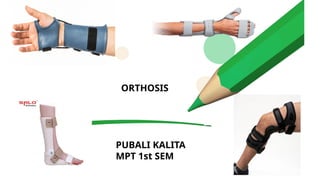
ORTHOSIS
PUBALI KALITA
MPT 1st SEM
An orthosis is generally a customised mechanical device fitted to the body to
maintain it in an anatomical or functional position .
General principles of orthosis ---->
1) correcting the mobile deformity
2) limitation of movement
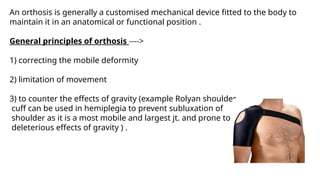
3) to counter the effects of gravity (example Rolyan shoulder
cuff can be used in hemiplegia to prevent subluxation of
shoulder as it is a most mobile and largest jt. and prone to the
deleterious effects of gravity ) .
4) Fixed deformity: If a fixed deformity is accommodated by an
orthosis , it will prevent the progression of deformity
5 ) Adjustability ( Good anatomical fit)
6) Application (donning and doffing)
7) Maintenance and cleaning .
8) Comfort (easy to wear & comfort to use )
9) Utility (must be useful & serve a real purpose)
10) Duration (use only as indicated & for as long as necessary) .
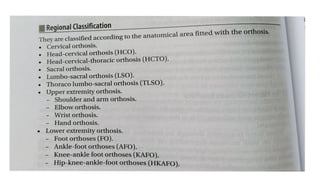
Classification
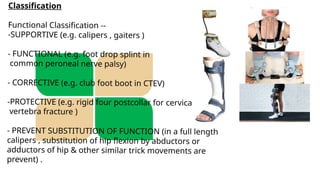
Functional Classification --
-SUPPORTIVE (e.g. calipers , gaiters )
- FUNCTIONAL (e.g. foot drop splint in
common peroneal nerve palsy)
- CORRECTIVE (e.g. club foot boot in CTEV)
-PROTECTIVE (e.g. rigid four postcollar for cervical
vertebra fracture )
- PREVENT SUBSTITUTION OF FUNCTION (in a full length
calipers , substitution of hip flexion by abductors or
adductors of hip & other similar trick movements are
prevent) .
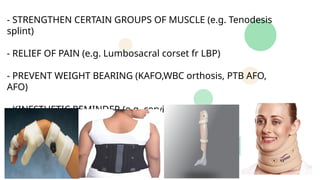
- STRENGTHEN CERTAIN GROUPS OF MUSCLE (e.g. Tenodesis
splint)
- RELIEF OF PAIN (e.g. Lumbosacral corset fr LBP)
- PREVENT WEIGHT BEARING (KAFO,WBC orthosis, PTB AFO,
AFO)
- KINESTHETIC REMINDER (e.g. cervical collar)
BUSINESS BUSINESS
BUSINESS BUSINESS BUSINESS
UPPER LIMB
ORTHOSIS
They are also referred to as splints . They may be static , dynamic, or
tone reducing .
Static splints:
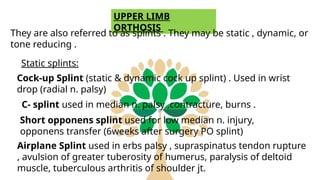
Cock-up Splint (static & dynamic cock up splint) . Used in wrist
drop (radial n. palsy)
C- splint used in median n. palsy ,contracture, burns .
Short opponens splint used for low median n. injury,
opponens transfer (6weeks after surgery PO splint)
Airplane Splint used in erbs palsy , supraspinatus tendon rupture
, avulsion of greater tuberosity of humerus, paralysis of deltoid
muscle, tuberculous arthritis of shoulder jt.
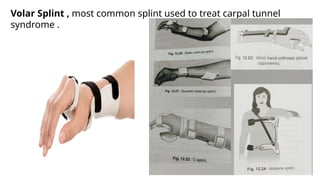
Volar Splint , most common splint used to treat carpal tunnel
syndrome .
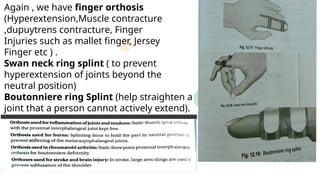
Again , we have finger orthosis
(Hyperextension,Muscle contracture
,dupuytrens contracture, Finger
Injuries such as mallet finger, Jersey
Finger etc ) .
Swan neck ring splint ( to prevent
hyperextension of joints beyond the
neutral position)
Boutonniere ring Splint (help straighten a
joint that a person cannot actively extend).
BUSINESS
BUSINESS
BUSINESS
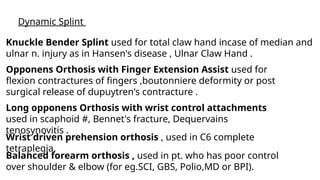
Dynamic Splint
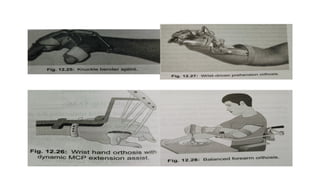
Knuckle Bender Splint used for total claw hand incase of median and
ulnar n. injury as in Hansen's disease , Ulnar Claw Hand .
Opponens Orthosis with Finger Extension Assist used for
flexion contractures of fingers ,boutonniere deformity or post
surgical release of dupuytren's contracture .
Long opponens Orthosis with wrist control attachments
used in scaphoid #, Bennet's fracture, Dequervains
tenosynovitis .
Wrist driven prehension orthosis , used in C6 complete
tetraplegia.
Balanced forearm orthosis , used in pt. who has poor control
over shoulder & elbow (for eg.SCI, GBS, Polio,MD or BPI).
Cervical autosis surround
SPINAL ORTHOSIS
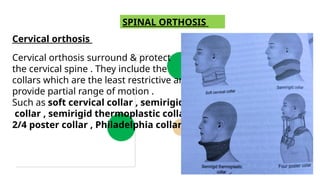
Cervical orthosis
Cervical orthosis surround & protect
the cervical spine . They include the
collars which are the least restrictive and
provide partial range of motion .
Such as soft cervical collar , semirigid
collar , semirigid thermoplastic collar ,
2/4 poster collar , Philadelphia collar.
Conditions used --
Crush injury of cervical spine .
In case of hyper extension injuries of cervical spine .
Whiplash injuries.
Sprains or strains of the neck .
Degenerative diseases of the spine like cervical spondylosis .
#Prescription of the collar should only be done if the neck movement causes
severe pain, giddiness or is otherwise injurious to the anatomical structures.
Long term use is to be discouraged except when there is severe instability or
giddiness.

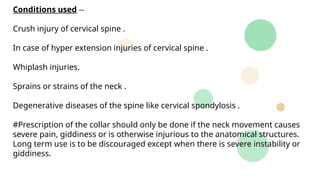
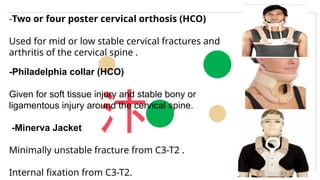
-Two or four poster cervical orthosis (HCO)
Used for mid or low stable cervical fractures and
arthritis of the cervical spine .
-Philadelphia collar (HCO)
Given for soft tissue injury and stable bony or
ligamentous injury around the cervical spine.
-Minerva Jacket
Minimally unstable fracture from C3-T2 .
Internal fixation from C3-T2.
Part 04
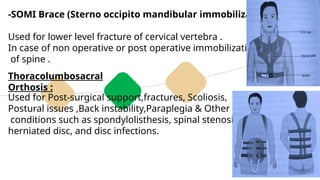
-SOMI Brace (Sterno occipito mandibular immobilization)
Used for lower level fracture of cervical vertebra .
In case of non operative or post operative immobilization
of spine .
Thoracolumbosacral
Orthosis :
Used for Post-surgical support,fractures, Scoliosis,
Postural issues ,Back instability,Paraplegia & Other
conditions such as spondylolisthesis, spinal stenosis,
herniated disc, and disc infections.
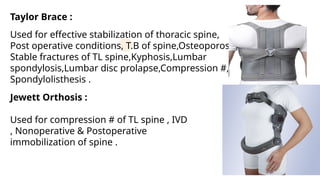
Taylor Brace :
Used for effective stabilization of thoracic spine,
Post operative conditions, T.B of spine,Osteoporosis,
Stable fractures of TL spine,Kyphosis,Lumbar
spondylosis,Lumbar disc prolapse,Compression #,
Spondylolisthesis .
Jewett Orthosis :
Used for compression # of TL spine , IVD
, Nonoperative & Postoperative
immobilization of spine .
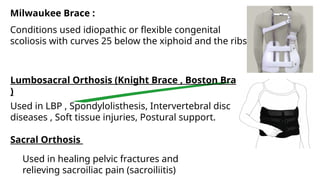
Milwaukee Brace :
Conditions used idiopathic or flexible congenital
scoliosis with curves 25 below the xiphoid and the ribs .
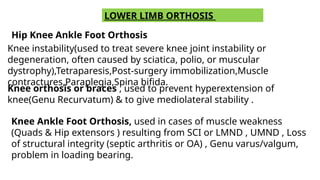
Lumbosacral Orthosis (Knight Brace , Boston Brace
)
Used in LBP , Spondylolisthesis, Intervertebral disc
diseases , Soft tissue injuries, Postural support.
Sacral Orthosis
Used in healing pelvic fractures and
relieving sacroiliac pain (sacroiliitis)
LOWER LIMB ORTHOSIS
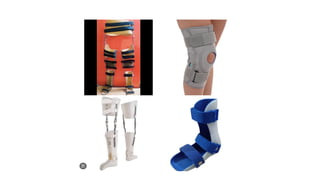
Hip Knee Ankle Foot Orthosis
Knee instability(used to treat severe knee joint instability or
degeneration, often caused by sciatica, polio, or muscular
dystrophy),Tetraparesis,Post-surgery immobilization,Muscle
contractures,Paraplegia,Spina bifida.
Knee orthosis or braces , used to prevent hyperextension of
knee(Genu Recurvatum) & to give mediolateral stability .
Knee Ankle Foot Orthosis, used in cases of muscle weakness
(Quads & Hip extensors ) resulting from SCI or LMND , UMND , Loss
of structural integrity (septic arthritis or OA) , Genu varus/valgum,
problem in loading bearing.
Ankle Foot Orthosis, used in muscle weakness affecting the ankle
and subtalar joint ,prevention or correction of deformities of foot and
ankle ,reduction of inappropriate with bearing forces and in children
with CP to stabilize the foot during his strike and foot flat phase ,
Common peroneal n. palsy .
BIOMECHANICS OF ORTHOSIS
1) Control of rotational moments across a joint .
2) Control of translational forces around a joint.
3) Control of axial forces around a joint.
4) Control of line of action of ground reaction force .
ADVANTAGES & DISADVANTAGES OF
ORTHOSIS
Disadvantages :
1)Loss of skin integrity due to compressive forces
2)weakening of axial muscle
3)increase movement at the end of immobilized
segment
4)physical and psychological dependence.
5)osteopenia
6)Lack of cosmesis
Advantages : 1) Deformity correction
2) Improve function
3) Saves energy
4) Increase endurance
5) It is cheap , effective & convenient.
Orthosis brief note.pptx  (for students)

Orthosis brief note.pptx (for students)

  • 1.
  • 2.
    An orthosis isgenerally a customised mechanical device fitted to the body to maintain it in an anatomical or functional position . General principles of orthosis ----> 1) correcting the mobile deformity 2) limitation of movement 3) to counter the effects of gravity (example Rolyan shoulder cuff can be used in hemiplegia to prevent subluxation of shoulder as it is a most mobile and largest jt. and prone to the deleterious effects of gravity ) .
  • 3.
    4) Fixed deformity:If a fixed deformity is accommodated by an orthosis , it will prevent the progression of deformity 5 ) Adjustability ( Good anatomical fit) 6) Application (donning and doffing) 7) Maintenance and cleaning . 8) Comfort (easy to wear & comfort to use ) 9) Utility (must be useful & serve a real purpose) 10) Duration (use only as indicated & for as long as necessary) .
  • 4.
    Classification Functional Classification -- -SUPPORTIVE(e.g. calipers , gaiters ) - FUNCTIONAL (e.g. foot drop splint in common peroneal nerve palsy) - CORRECTIVE (e.g. club foot boot in CTEV) -PROTECTIVE (e.g. rigid four postcollar for cervical vertebra fracture ) - PREVENT SUBSTITUTION OF FUNCTION (in a full length calipers , substitution of hip flexion by abductors or adductors of hip & other similar trick movements are prevent) .
  • 5.
    - STRENGTHEN CERTAINGROUPS OF MUSCLE (e.g. Tenodesis splint) - RELIEF OF PAIN (e.g. Lumbosacral corset fr LBP) - PREVENT WEIGHT BEARING (KAFO,WBC orthosis, PTB AFO, AFO) - KINESTHETIC REMINDER (e.g. cervical collar)
  • 6.
  • 7.
    UPPER LIMB ORTHOSIS They arealso referred to as splints . They may be static , dynamic, or tone reducing . Static splints: Cock-up Splint (static & dynamic cock up splint) . Used in wrist drop (radial n. palsy) C- splint used in median n. palsy ,contracture, burns . Short opponens splint used for low median n. injury, opponens transfer (6weeks after surgery PO splint) Airplane Splint used in erbs palsy , supraspinatus tendon rupture , avulsion of greater tuberosity of humerus, paralysis of deltoid muscle, tuberculous arthritis of shoulder jt.
  • 8.
    Volar Splint ,most common splint used to treat carpal tunnel syndrome .
  • 9.
    Again , wehave finger orthosis (Hyperextension,Muscle contracture ,dupuytrens contracture, Finger Injuries such as mallet finger, Jersey Finger etc ) . Swan neck ring splint ( to prevent hyperextension of joints beyond the neutral position) Boutonniere ring Splint (help straighten a joint that a person cannot actively extend).
  • 10.
    BUSINESS BUSINESS BUSINESS Dynamic Splint Knuckle BenderSplint used for total claw hand incase of median and ulnar n. injury as in Hansen's disease , Ulnar Claw Hand . Opponens Orthosis with Finger Extension Assist used for flexion contractures of fingers ,boutonniere deformity or post surgical release of dupuytren's contracture . Long opponens Orthosis with wrist control attachments used in scaphoid #, Bennet's fracture, Dequervains tenosynovitis . Wrist driven prehension orthosis , used in C6 complete tetraplegia. Balanced forearm orthosis , used in pt. who has poor control over shoulder & elbow (for eg.SCI, GBS, Polio,MD or BPI).
  • 12.
    Cervical autosis surround SPINALORTHOSIS Cervical orthosis Cervical orthosis surround & protect the cervical spine . They include the collars which are the least restrictive and provide partial range of motion . Such as soft cervical collar , semirigid collar , semirigid thermoplastic collar , 2/4 poster collar , Philadelphia collar.
  • 13.
    Conditions used -- Crushinjury of cervical spine . In case of hyper extension injuries of cervical spine . Whiplash injuries. Sprains or strains of the neck . Degenerative diseases of the spine like cervical spondylosis . #Prescription of the collar should only be done if the neck movement causes severe pain, giddiness or is otherwise injurious to the anatomical structures. Long term use is to be discouraged except when there is severe instability or giddiness.
  • 14.
     -Two or fourposter cervical orthosis (HCO) Used for mid or low stable cervical fractures and arthritis of the cervical spine . -Philadelphia collar (HCO) Given for soft tissue injury and stable bony or ligamentous injury around the cervical spine. -Minerva Jacket Minimally unstable fracture from C3-T2 . Internal fixation from C3-T2.
  • 15.
    Part 04 -SOMI Brace(Sterno occipito mandibular immobilization) Used for lower level fracture of cervical vertebra . In case of non operative or post operative immobilization of spine . Thoracolumbosacral Orthosis : Used for Post-surgical support,fractures, Scoliosis, Postural issues ,Back instability,Paraplegia & Other conditions such as spondylolisthesis, spinal stenosis, herniated disc, and disc infections.
  • 16.
    Taylor Brace : Usedfor effective stabilization of thoracic spine, Post operative conditions, T.B of spine,Osteoporosis, Stable fractures of TL spine,Kyphosis,Lumbar spondylosis,Lumbar disc prolapse,Compression #, Spondylolisthesis . Jewett Orthosis : Used for compression # of TL spine , IVD , Nonoperative & Postoperative immobilization of spine .
  • 17.
    Milwaukee Brace : Conditionsused idiopathic or flexible congenital scoliosis with curves 25 below the xiphoid and the ribs . Lumbosacral Orthosis (Knight Brace , Boston Brace ) Used in LBP , Spondylolisthesis, Intervertebral disc diseases , Soft tissue injuries, Postural support. Sacral Orthosis Used in healing pelvic fractures and relieving sacroiliac pain (sacroiliitis)
  • 18.
    LOWER LIMB ORTHOSIS HipKnee Ankle Foot Orthosis Knee instability(used to treat severe knee joint instability or degeneration, often caused by sciatica, polio, or muscular dystrophy),Tetraparesis,Post-surgery immobilization,Muscle contractures,Paraplegia,Spina bifida. Knee orthosis or braces , used to prevent hyperextension of knee(Genu Recurvatum) & to give mediolateral stability . Knee Ankle Foot Orthosis, used in cases of muscle weakness (Quads & Hip extensors ) resulting from SCI or LMND , UMND , Loss of structural integrity (septic arthritis or OA) , Genu varus/valgum, problem in loading bearing.
  • 19.
    Ankle Foot Orthosis,used in muscle weakness affecting the ankle and subtalar joint ,prevention or correction of deformities of foot and ankle ,reduction of inappropriate with bearing forces and in children with CP to stabilize the foot during his strike and foot flat phase , Common peroneal n. palsy .
  • 21.
    BIOMECHANICS OF ORTHOSIS 1)Control of rotational moments across a joint . 2) Control of translational forces around a joint. 3) Control of axial forces around a joint. 4) Control of line of action of ground reaction force .
  • 22.
    ADVANTAGES & DISADVANTAGESOF ORTHOSIS Disadvantages : 1)Loss of skin integrity due to compressive forces 2)weakening of axial muscle 3)increase movement at the end of immobilized segment 4)physical and psychological dependence. 5)osteopenia 6)Lack of cosmesis Advantages : 1) Deformity correction 2) Improve function 3) Saves energy 4) Increase endurance 5) It is cheap , effective & convenient.