Core Curriculum V5
Radial Head and Neck
Fractures
Thomas Krupko M.D.
Assistant Professor – Orthopaedic Trauma
University of Florida
Core Curriculum V5
Objectives
• Anatomy
• Elbow Instability
• Radial head fractures
• Classification
• Treatment
• Radial neck fractures
• Treatment
• Essex-Lopresti Injuries
Core Curriculum V5
Anatomy
Core Curriculum V5
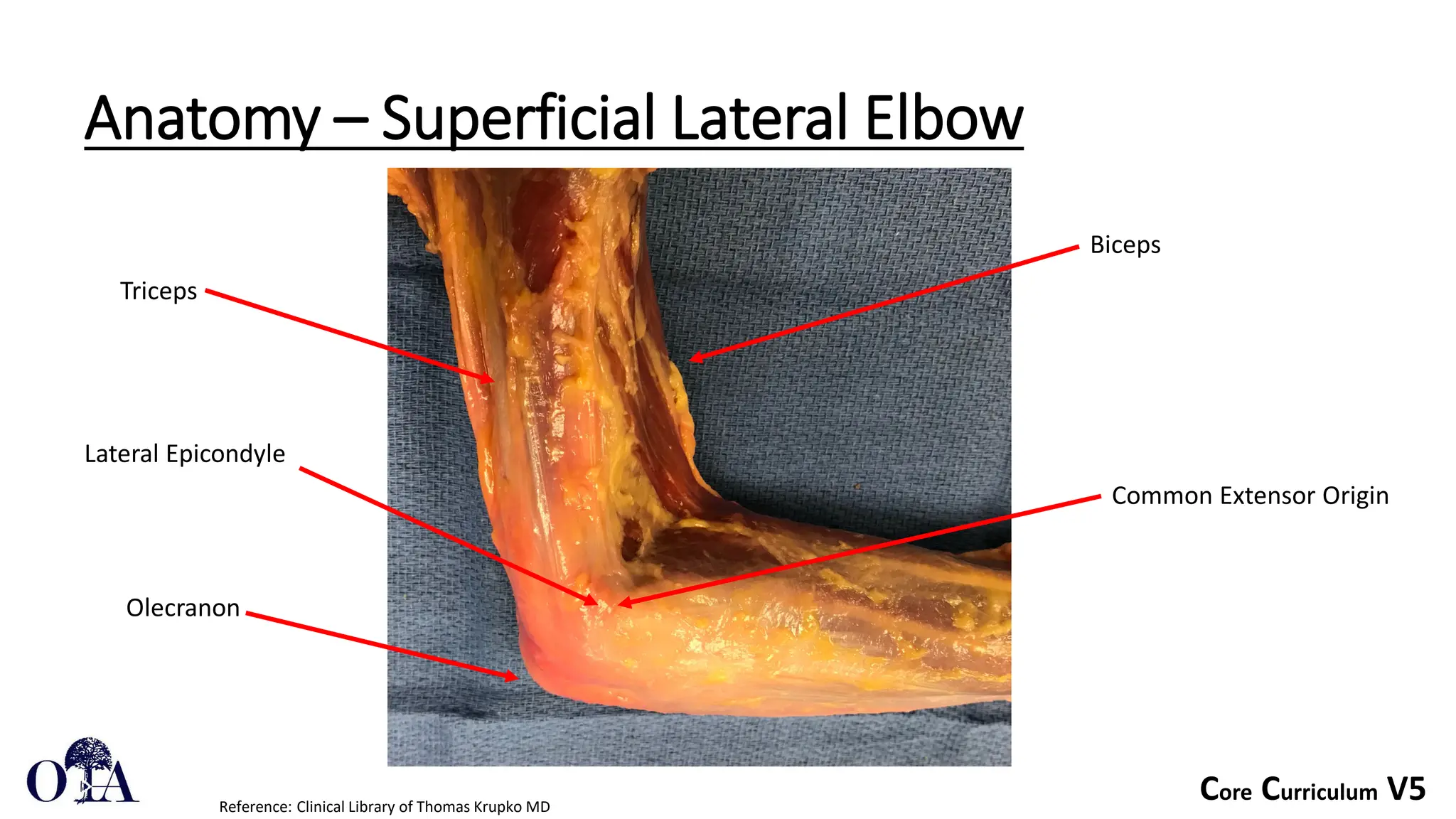
Anatomy – Superficial Lateral Elbow
Reference: Clinical Library of Thomas Krupko MD
Lateral Epicondyle
Triceps
Biceps
Olecranon
Common Extensor Origin
Core Curriculum V5
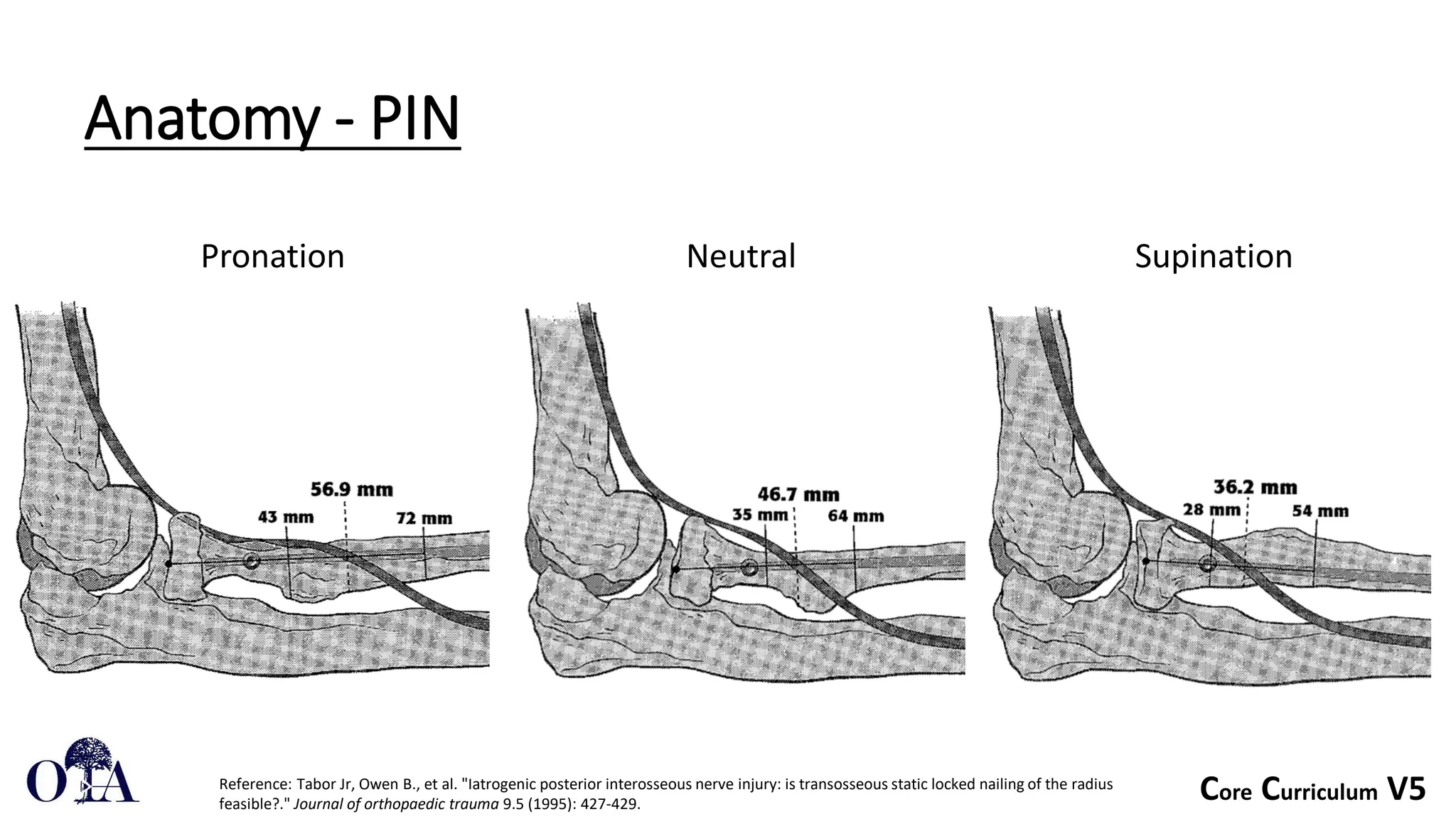
Anatomy - PIN
Pronation Supination
Neutral
Reference: Tabor Jr, Owen B., et al. "Iatrogenic posterior interosseous nerve injury: is transosseous static locked nailing of the radius
feasible?." Journal of orthopaedic trauma 9.5 (1995): 427-429.
Core Curriculum V5
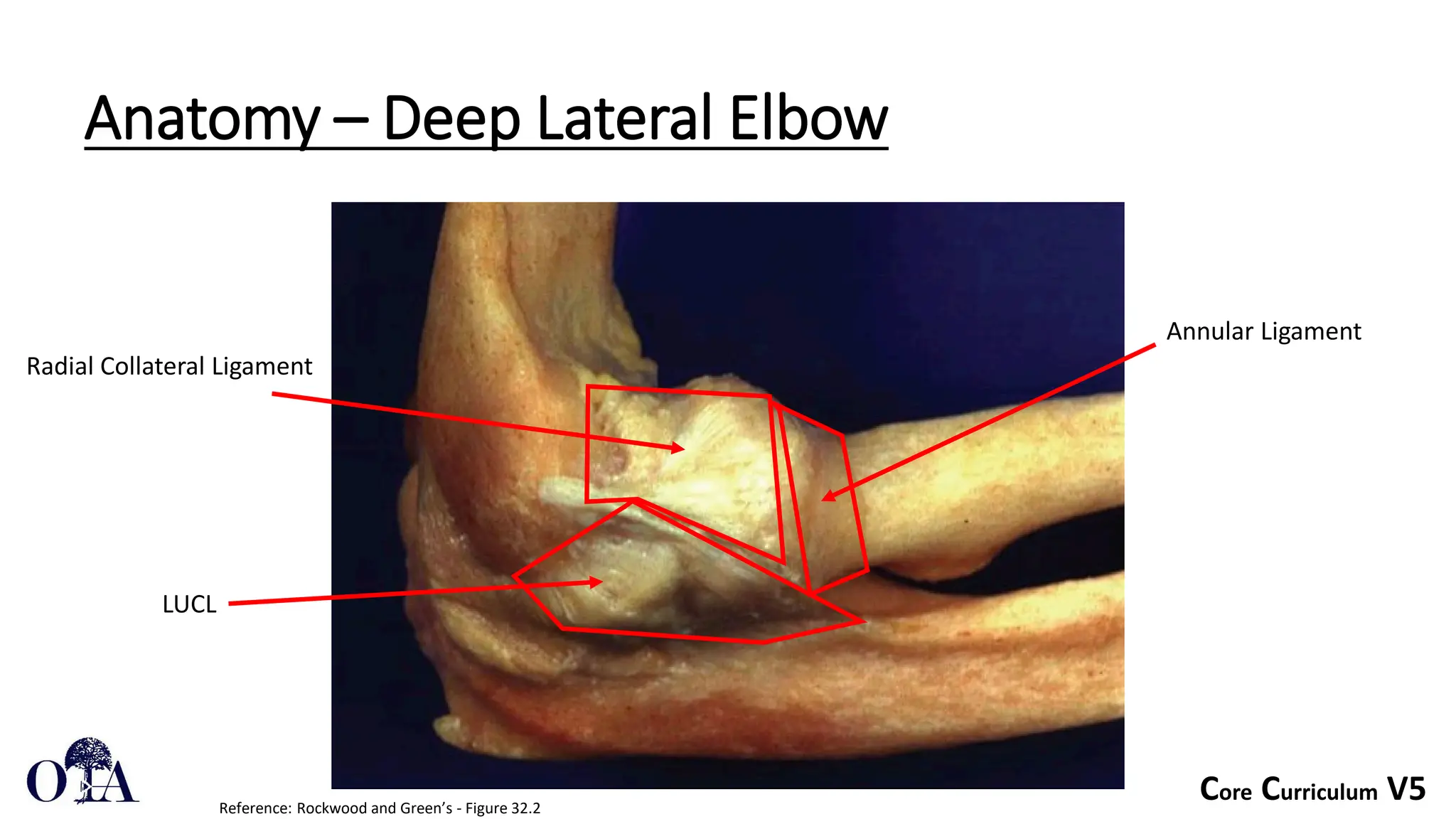
Anatomy – Deep Lateral Elbow
Reference: Rockwood and Green’s - Figure 32.2
Annular Ligament
LUCL
Radial Collateral Ligament
Core Curriculum V5
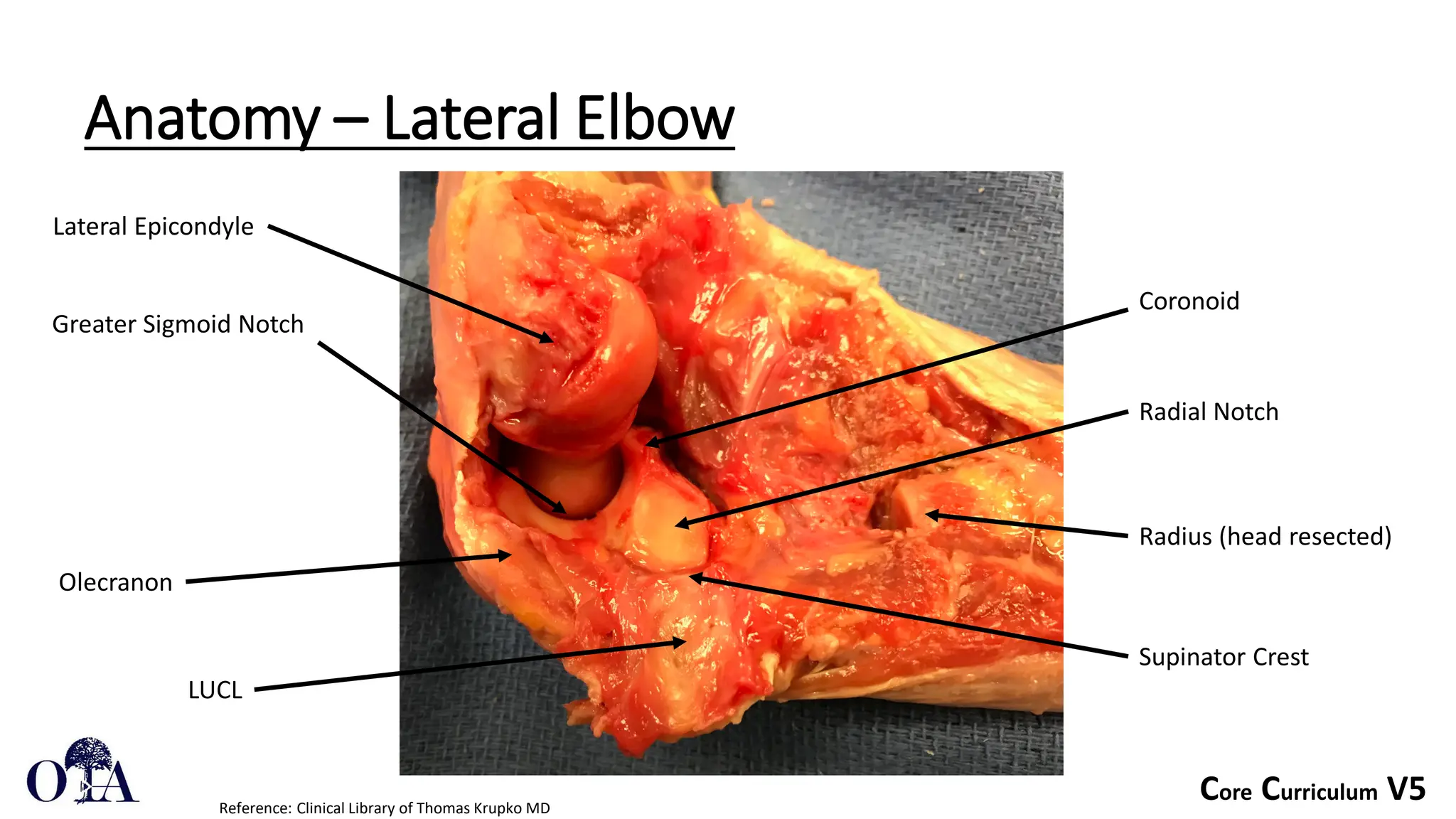
Anatomy – Lateral Elbow
Reference: Clinical Library of Thomas Krupko MD
Lateral Epicondyle
Supinator Crest
Coronoid
Greater Sigmoid Notch
Olecranon
Radial Notch
Radius (head resected)
LUCL
Core Curriculum V5
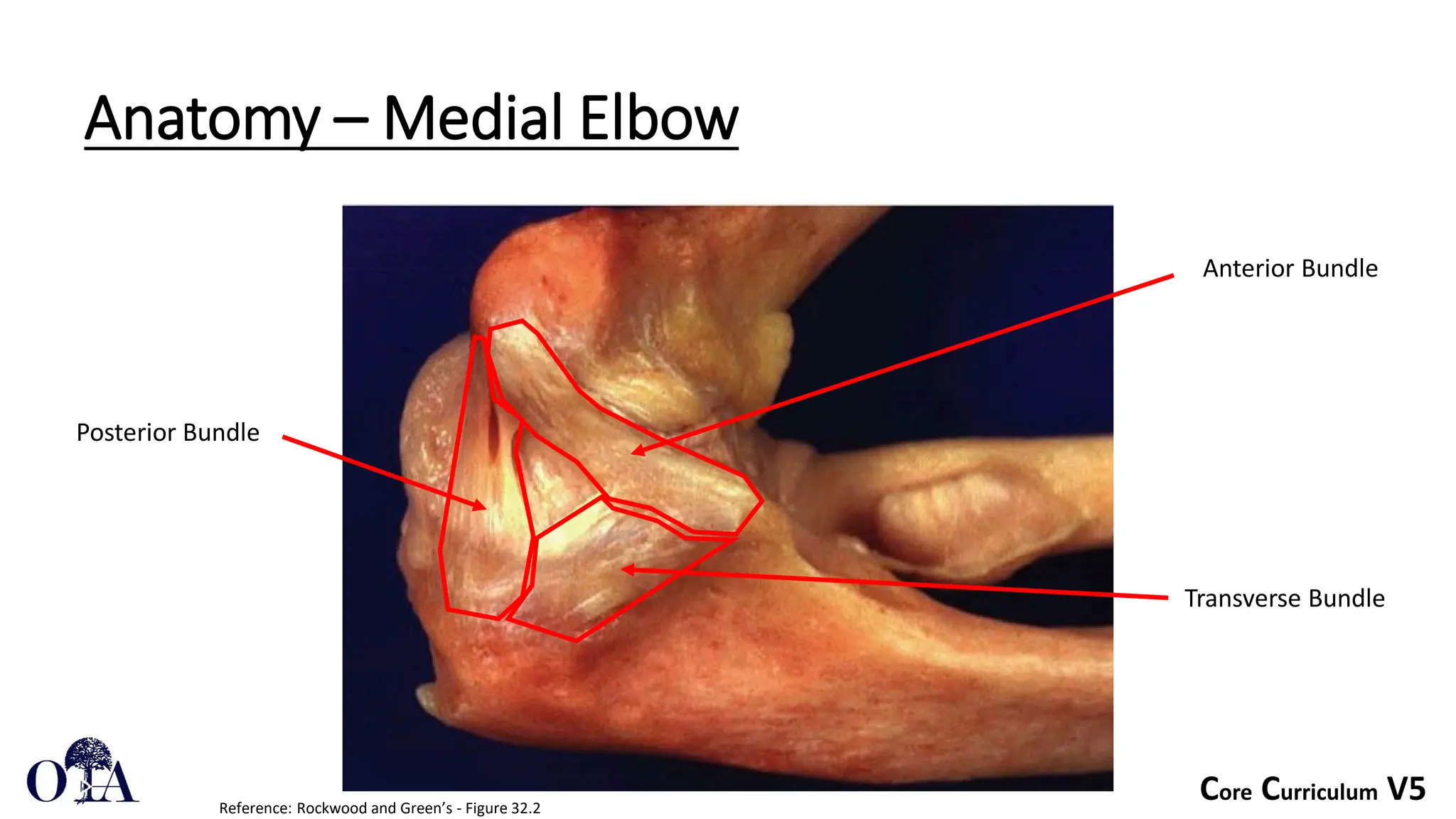
Anatomy – Medial Elbow
Reference: Rockwood and Green’s - Figure 32.2
Anterior Bundle
Transverse Bundle
Posterior Bundle
Core Curriculum V5
Elbow Stability
Core Curriculum V5
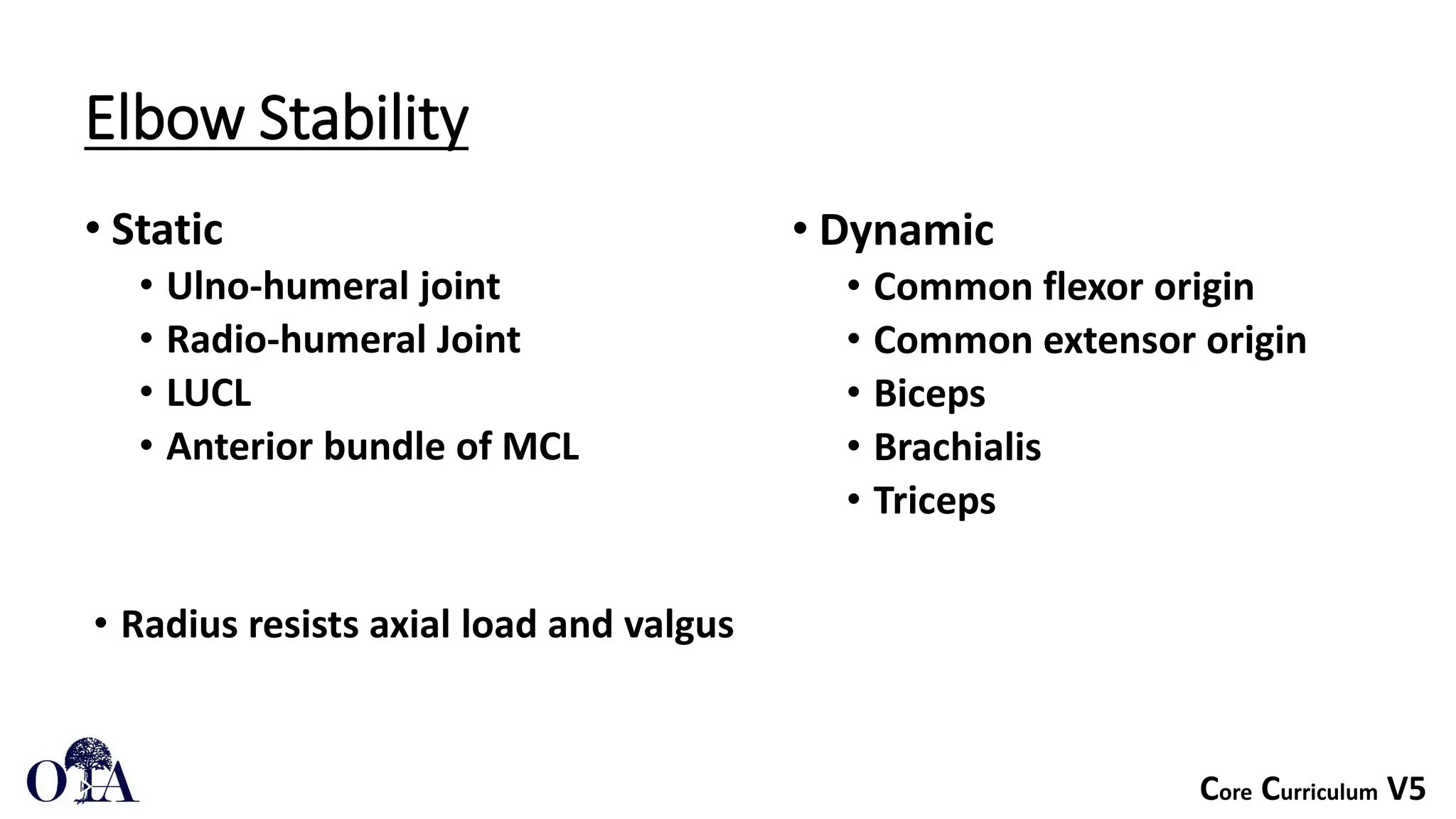
Elbow Stability
• Static
• Ulno-humeral joint
• Radio-humeral Joint
• LUCL
• Anterior bundle of MCL
• Dynamic
• Common flexor origin
• Common extensor origin
• Biceps
• Brachialis
• Triceps
• Radius resists axial load and valgus
Core Curriculum V5
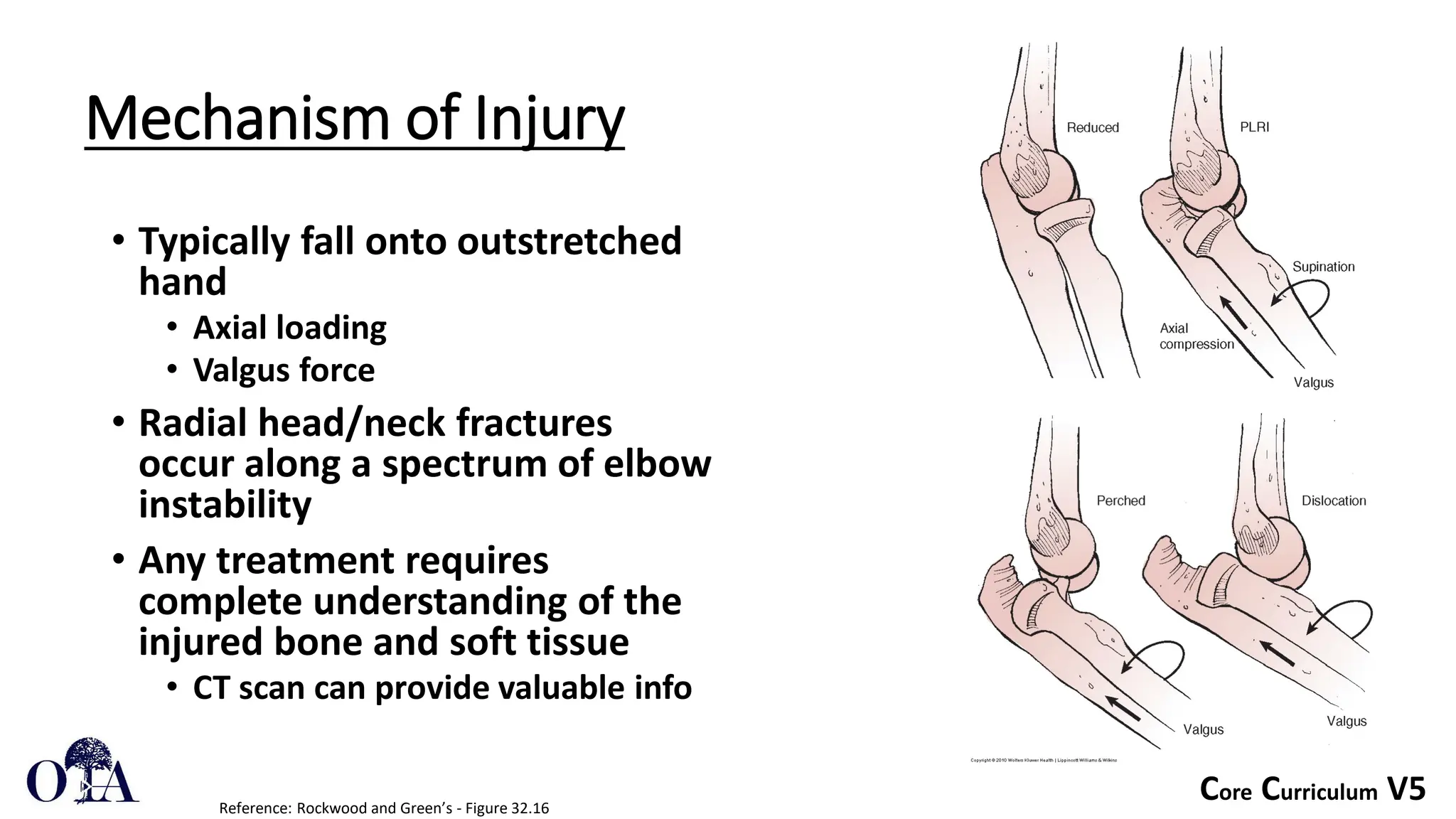
Mechanism of Injury
• Typically fall onto outstretched
hand
• Axial loading
• Valgus force
• Radial head/neck fractures
occur along a spectrum of elbow
instability
• Any treatment requires
complete understanding of the
injured bone and soft tissue
• CT scan can provide valuable info
Reference: Rockwood and Green’s - Figure 32.16
Core Curriculum V5
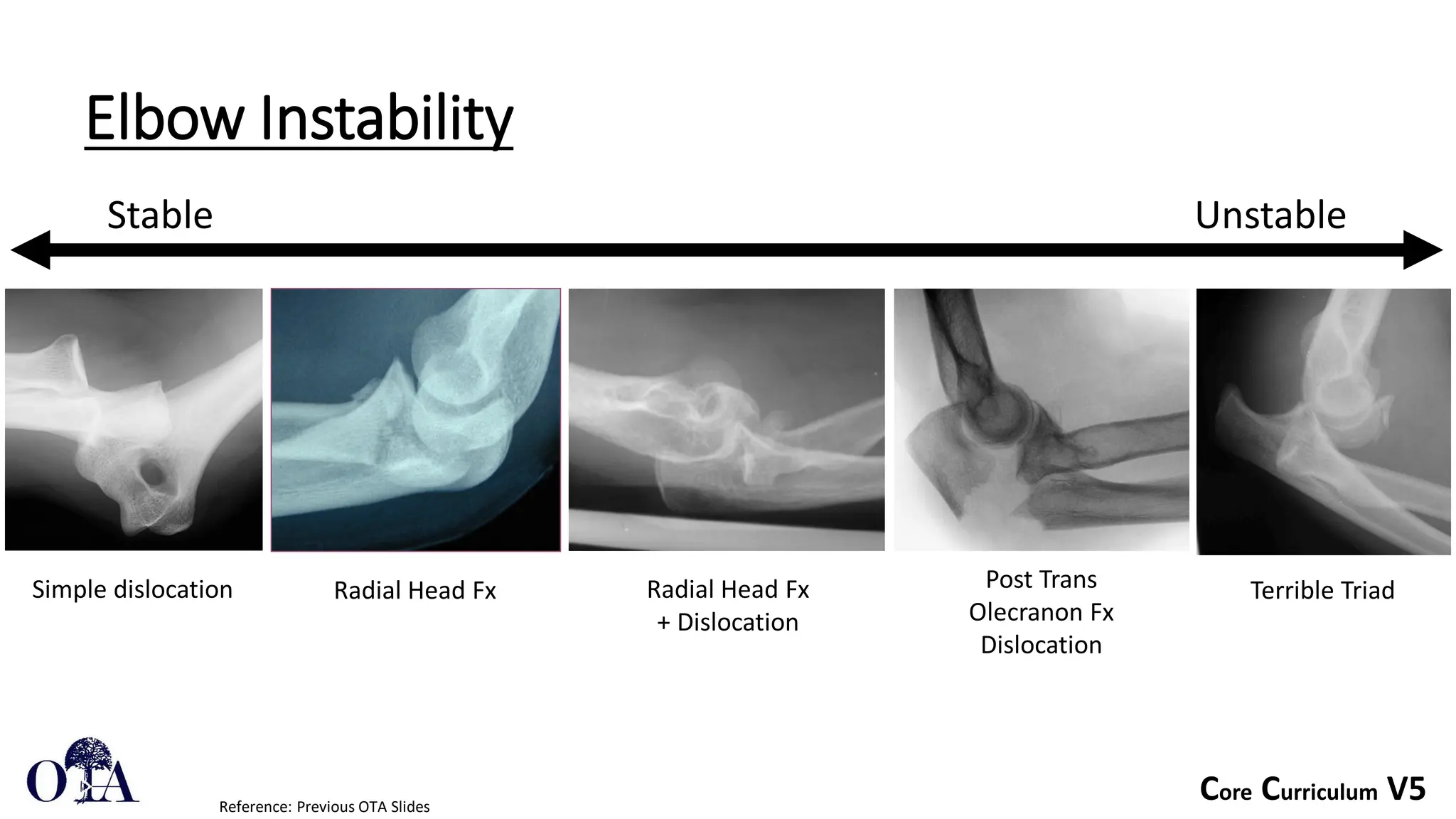
Elbow Instability
Stable Unstable
Simple dislocation Radial Head Fx Radial Head Fx
+ Dislocation
Post Trans
Olecranon Fx
Dislocation
Terrible Triad
Reference: Previous OTA Slides
Core Curriculum V5
Radial Head Fractures
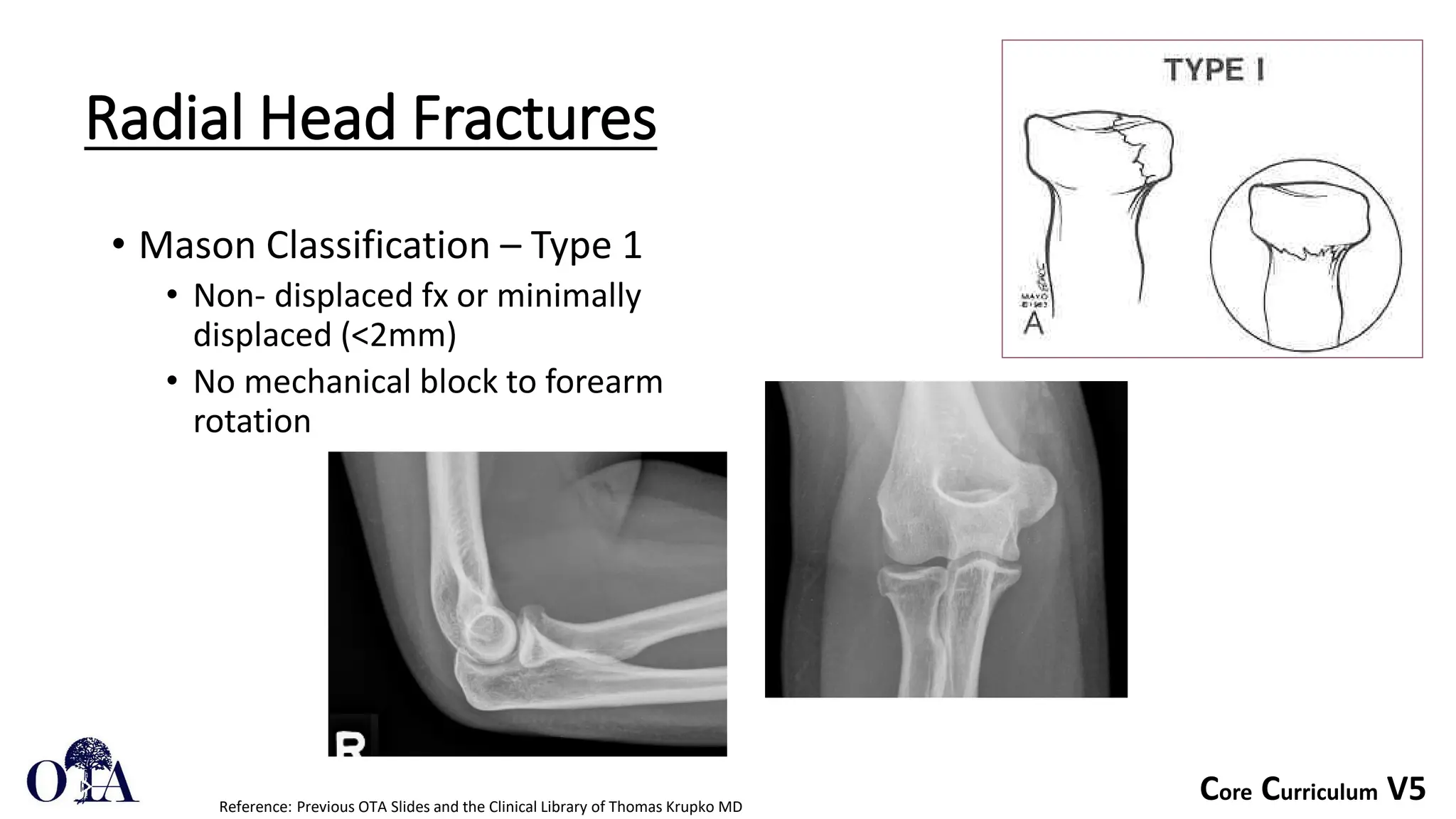
• Mason Classification – Type 1
• Non- displaced fx or minimally
displaced (<2mm)
• No mechanical block to forearm
rotation
Reference: Previous OTA Slides and the Clinical Library of Thomas Krupko MD
Core Curriculum V5
Radial Head Fractures
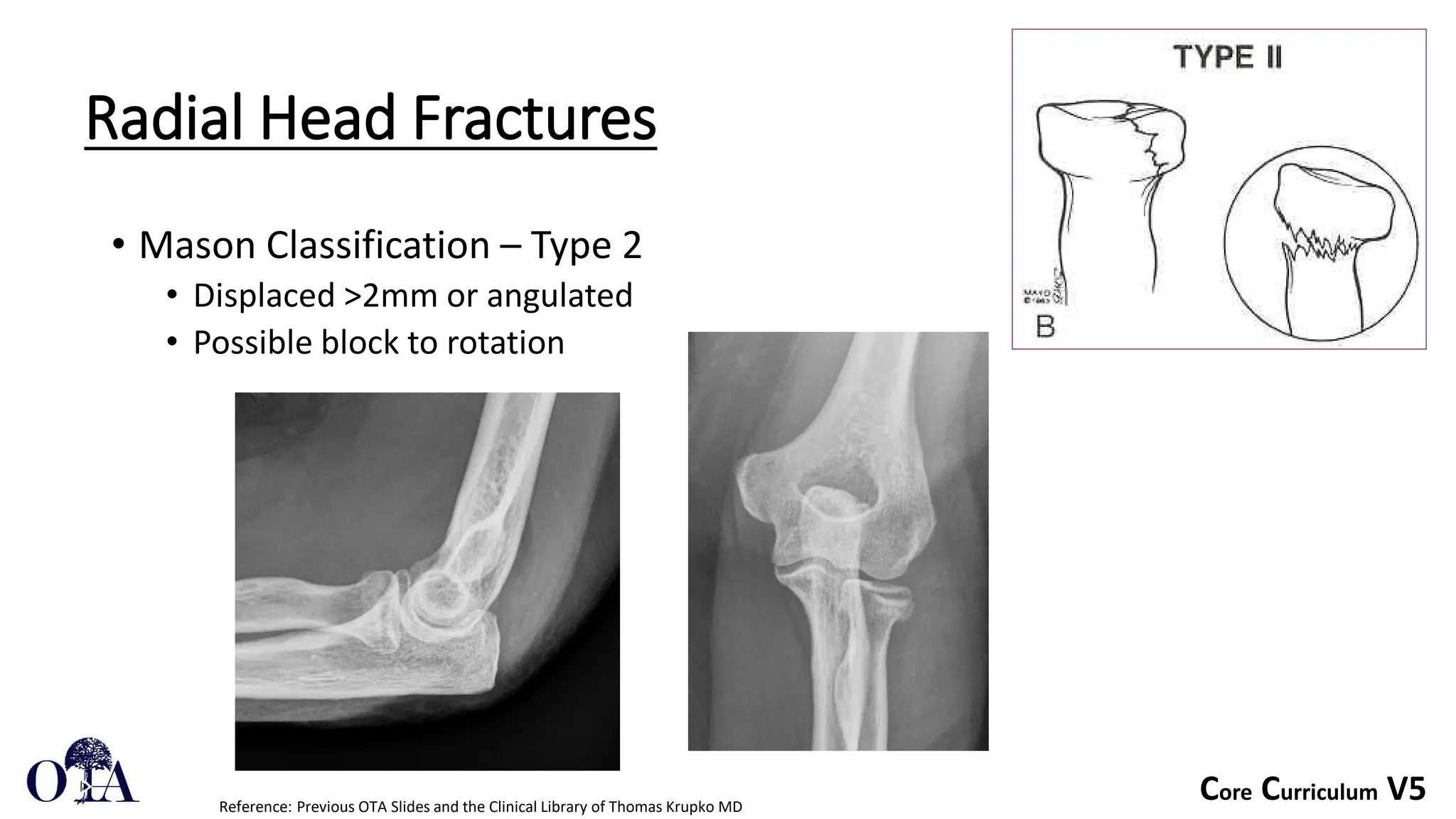
• Mason Classification – Type 2
• Displaced >2mm or angulated
• Possible block to rotation
Reference: Previous OTA Slides and the Clinical Library of Thomas Krupko MD
Core Curriculum V5
Radial Head Fractures
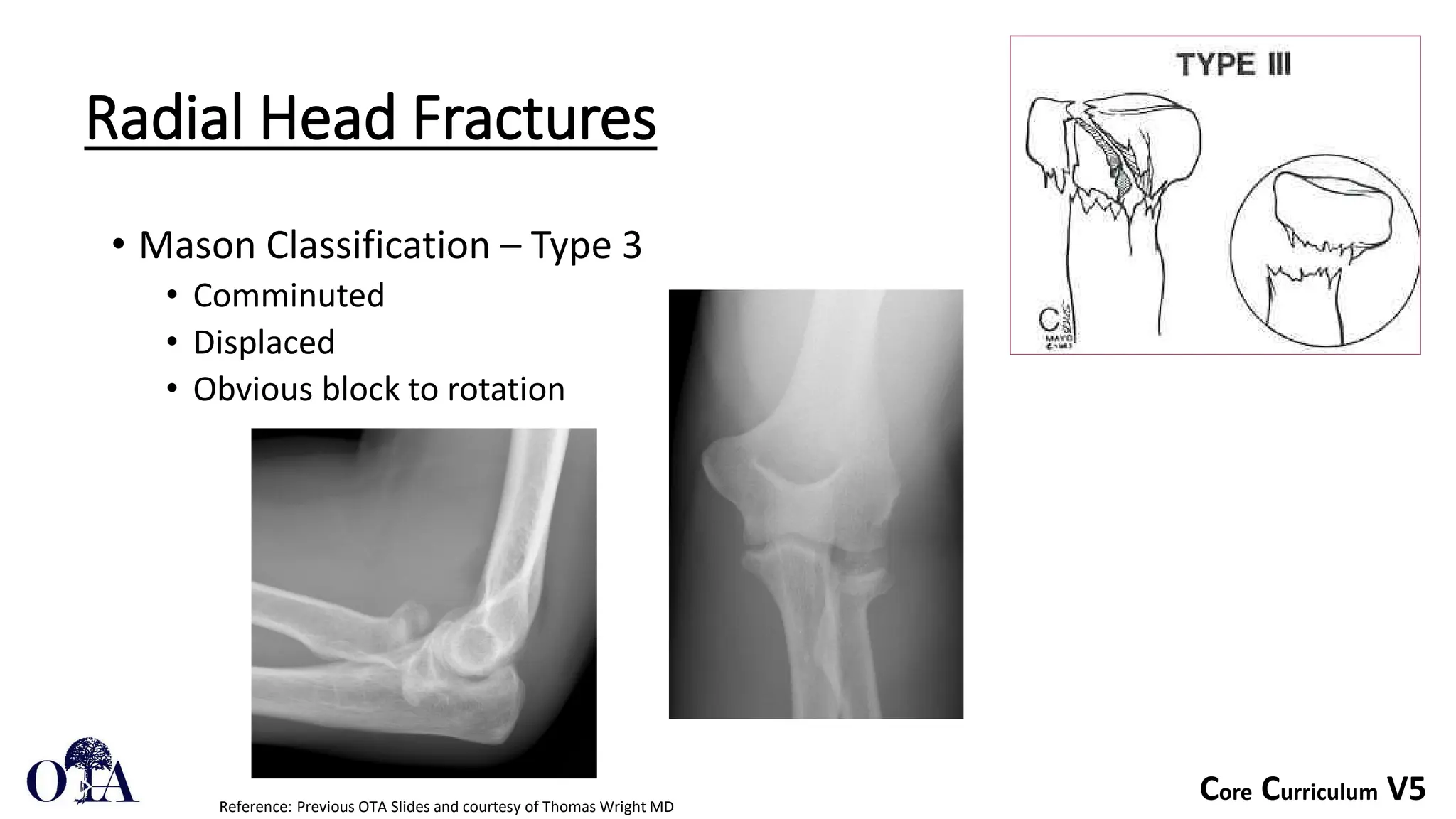
• Mason Classification – Type 3
• Comminuted
• Displaced
• Obvious block to rotation
Reference: Previous OTA Slides and courtesy of Thomas Wright MD
Core Curriculum V5
Radial Head Fractures
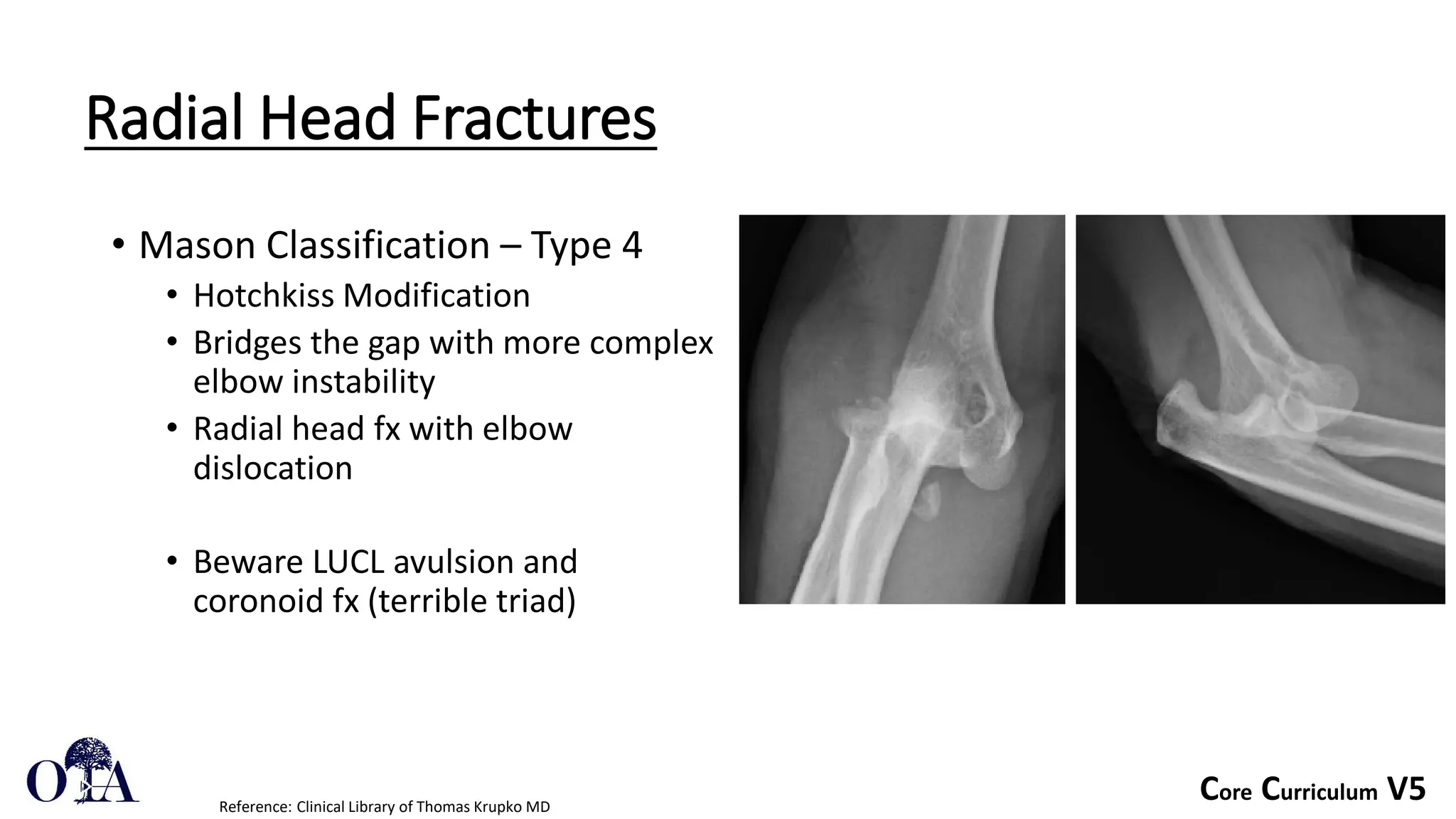
• Mason Classification – Type 4
• Hotchkiss Modification
• Bridges the gap with more complex
elbow instability
• Radial head fx with elbow
dislocation
• Beware LUCL avulsion and
coronoid fx (terrible triad)
Reference: Clinical Library of Thomas Krupko MD
Core Curriculum V5
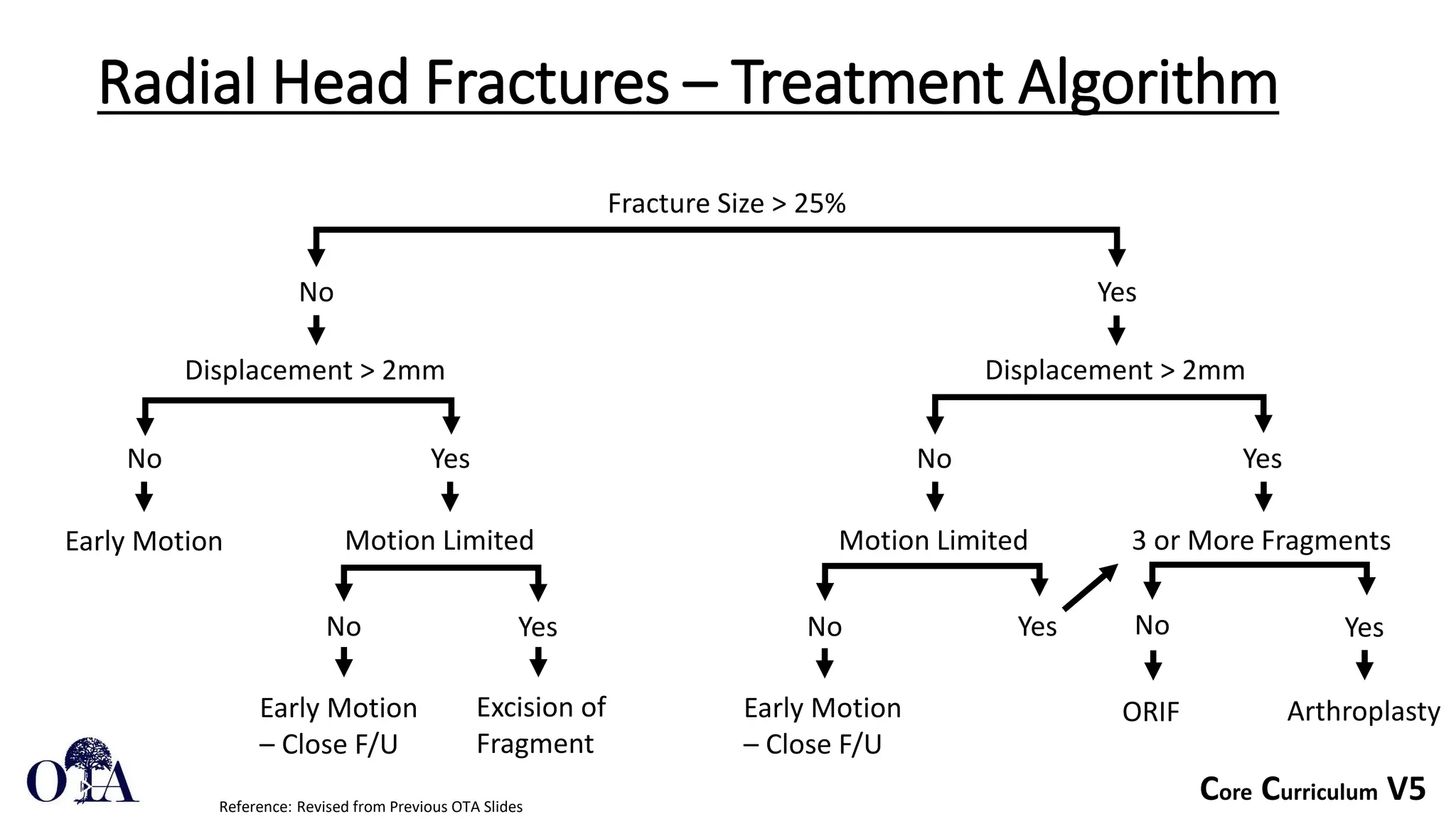
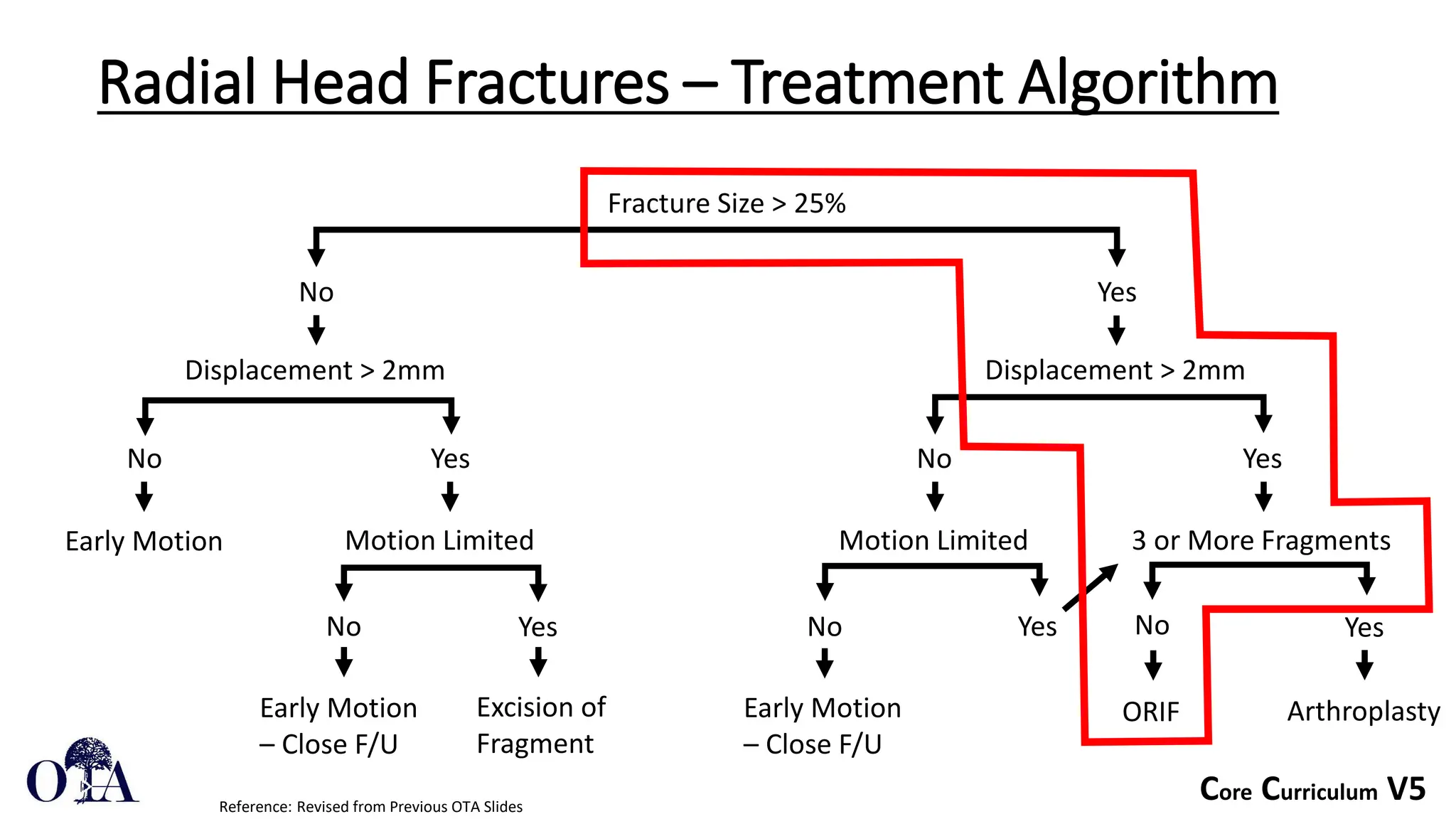
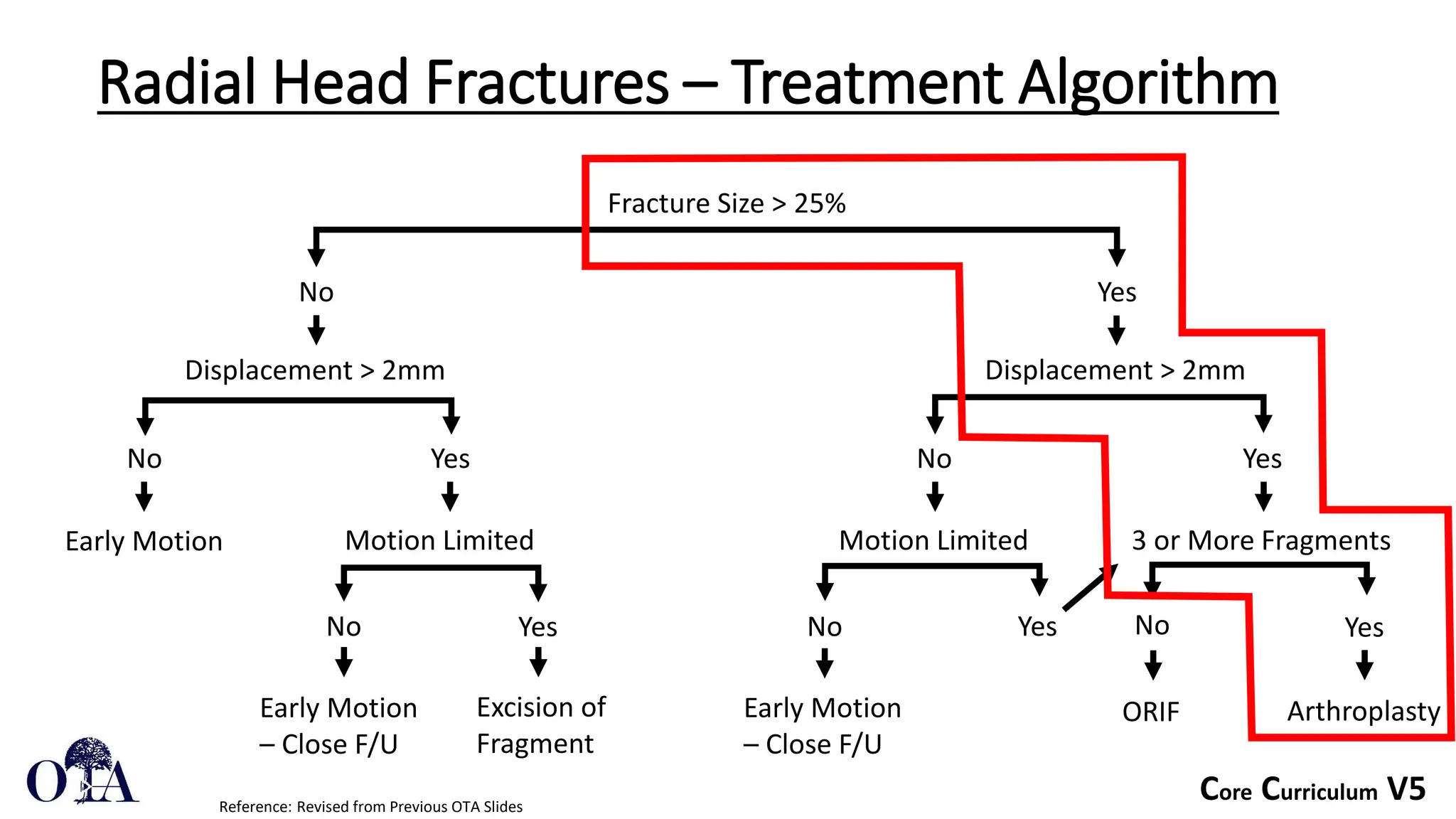
Radial Head Fractures – Treatment Algorithm
Fracture Size > 25%
No Yes
Displacement > 2mm
No Yes
Early Motion
Excision of
Fragment
Motion Limited
Early Motion
– Close F/U
Displacement > 2mm
No Yes
Motion Limited
No Yes
Early Motion
– Close F/U
3 or More Fragments
No Yes
ORIF Arthroplasty
No Yes
Reference: Revised from Previous OTA Slides
Core Curriculum V5
Lateral Elbow – Approaches
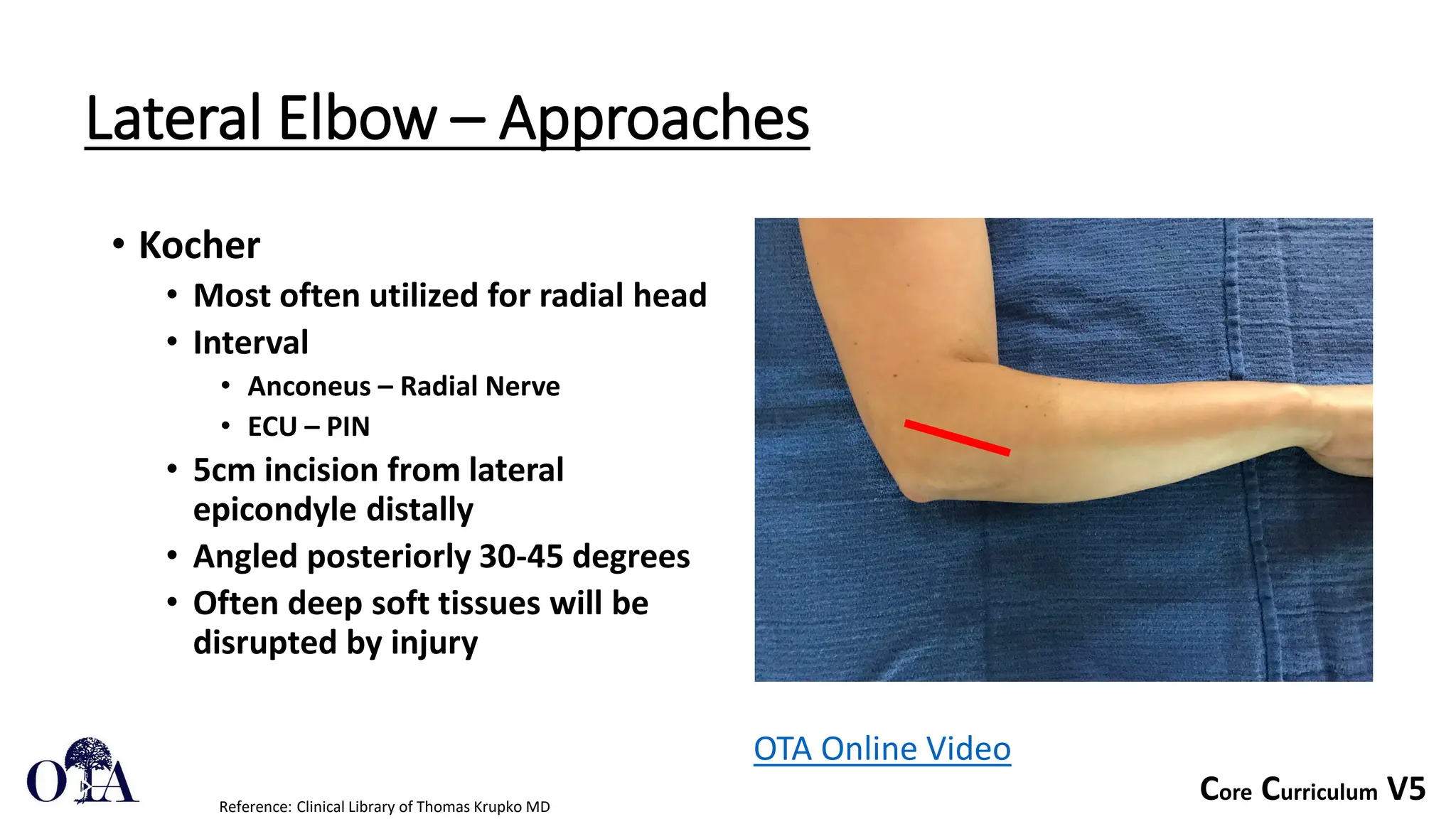
• Kocher
• Most often utilized for radial head
• Interval
• Anconeus – Radial Nerve
• ECU – PIN
• 5cm incision from lateral
epicondyle distally
• Angled posteriorly 30-45 degrees
• Often deep soft tissues will be
disrupted by injury
Reference: Clinical Library of Thomas Krupko MD
OTA Online Video
Core Curriculum V5
Lateral Elbow – Approaches
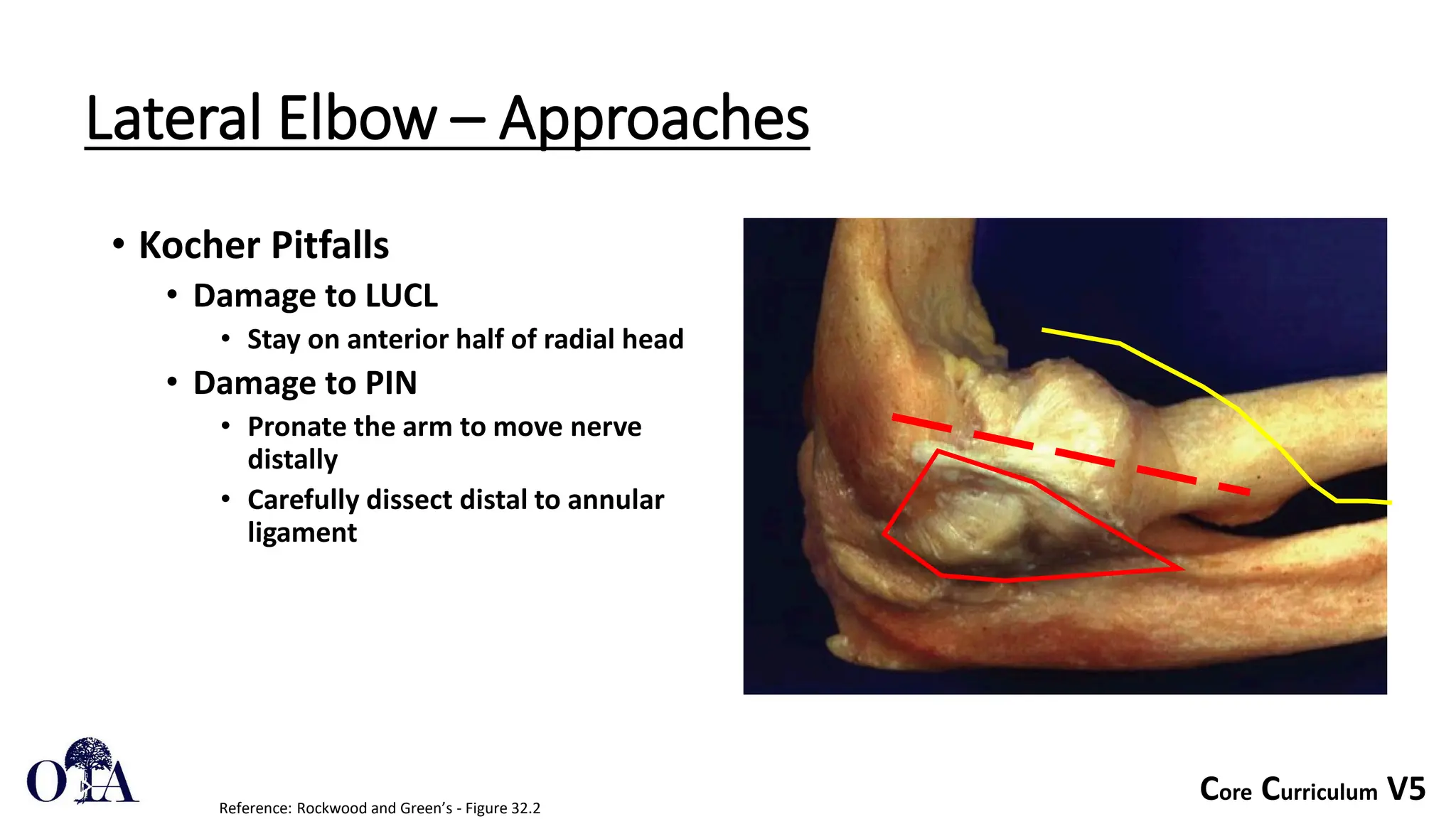
• Kocher Pitfalls
• Damage to LUCL
• Stay on anterior half of radial head
• Damage to PIN
• Pronate the arm to move nerve
distally
• Carefully dissect distal to annular
ligament
Reference: Rockwood and Green’s - Figure 32.2
Core Curriculum V5
Lateral Elbow– Approaches
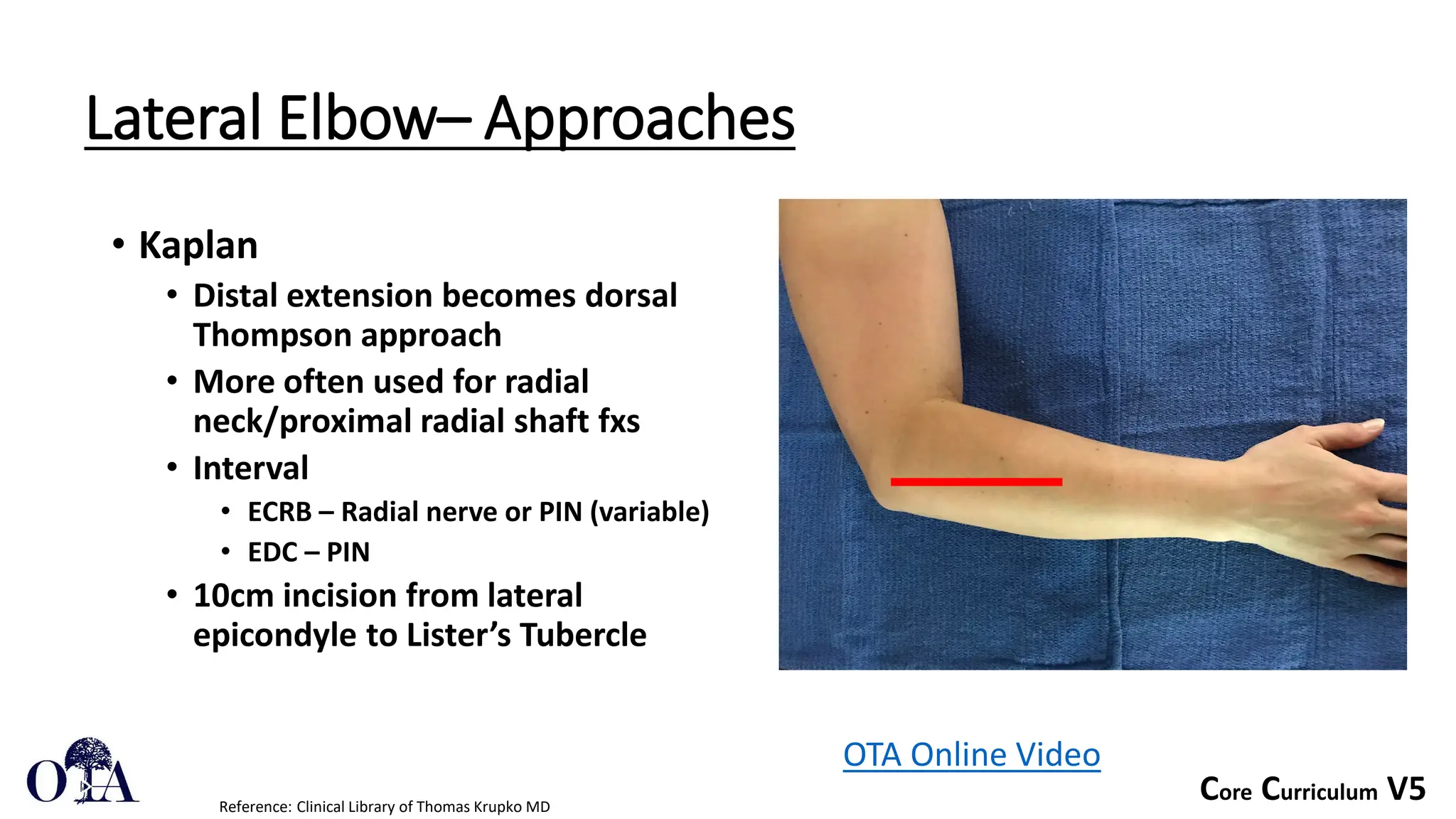
• Kaplan
• Distal extension becomes dorsal
Thompson approach
• More often used for radial
neck/proximal radial shaft fxs
• Interval
• ECRB – Radial nerve or PIN (variable)
• EDC – PIN
• 10cm incision from lateral
epicondyle to Lister’s Tubercle
OTA Online Video
Reference: Clinical Library of Thomas Krupko MD
Core Curriculum V5
Lateral Elbow– Approaches
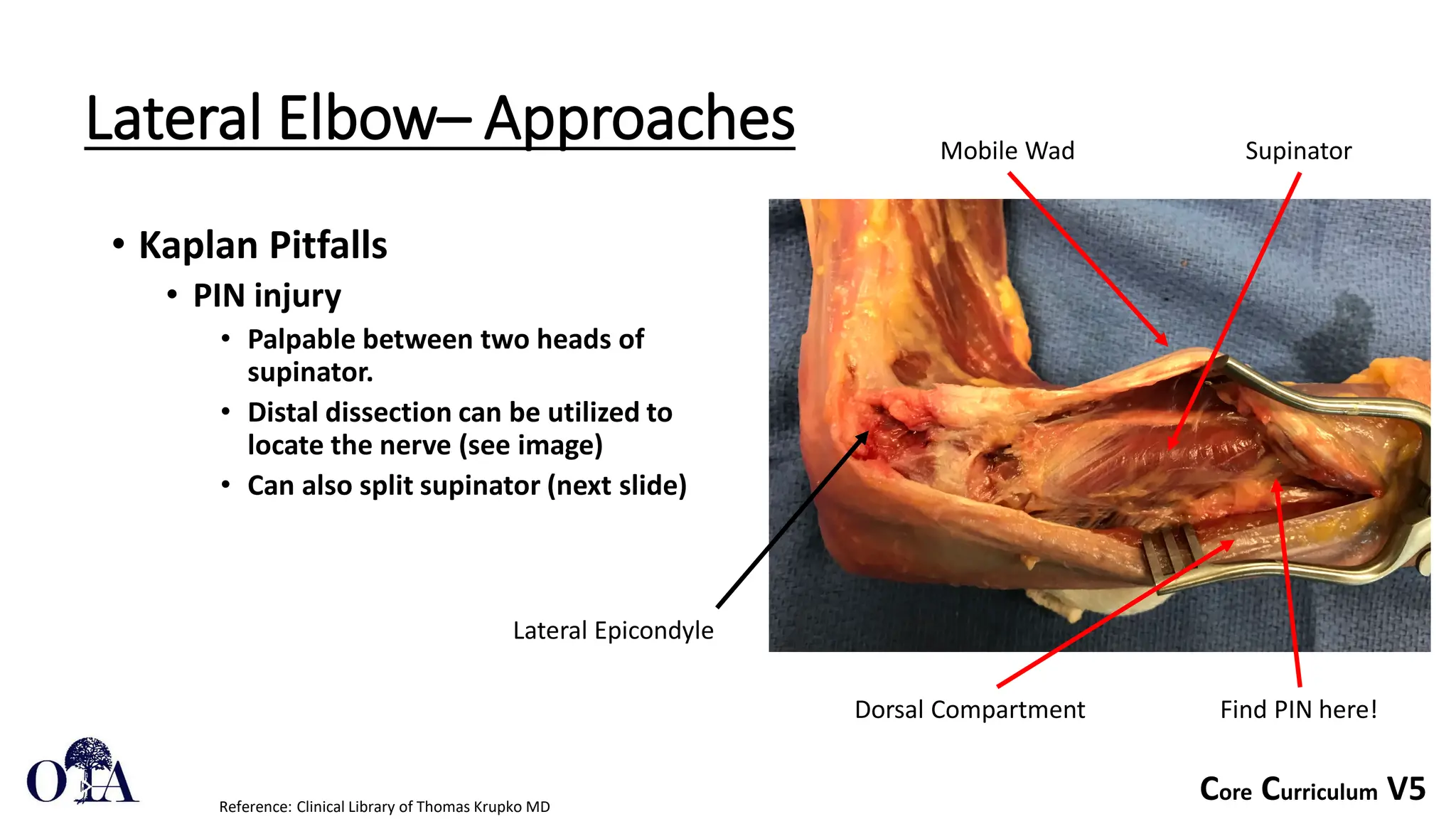
• Kaplan Pitfalls
• PIN injury
• Palpable between two heads of
supinator.
• Distal dissection can be utilized to
locate the nerve (see image)
• Can also split supinator (next slide)
Reference: Clinical Library of Thomas Krupko MD
Lateral Epicondyle
Mobile Wad
Dorsal Compartment
Supinator
Find PIN here!
Core Curriculum V5
Lateral Elbow– Approaches
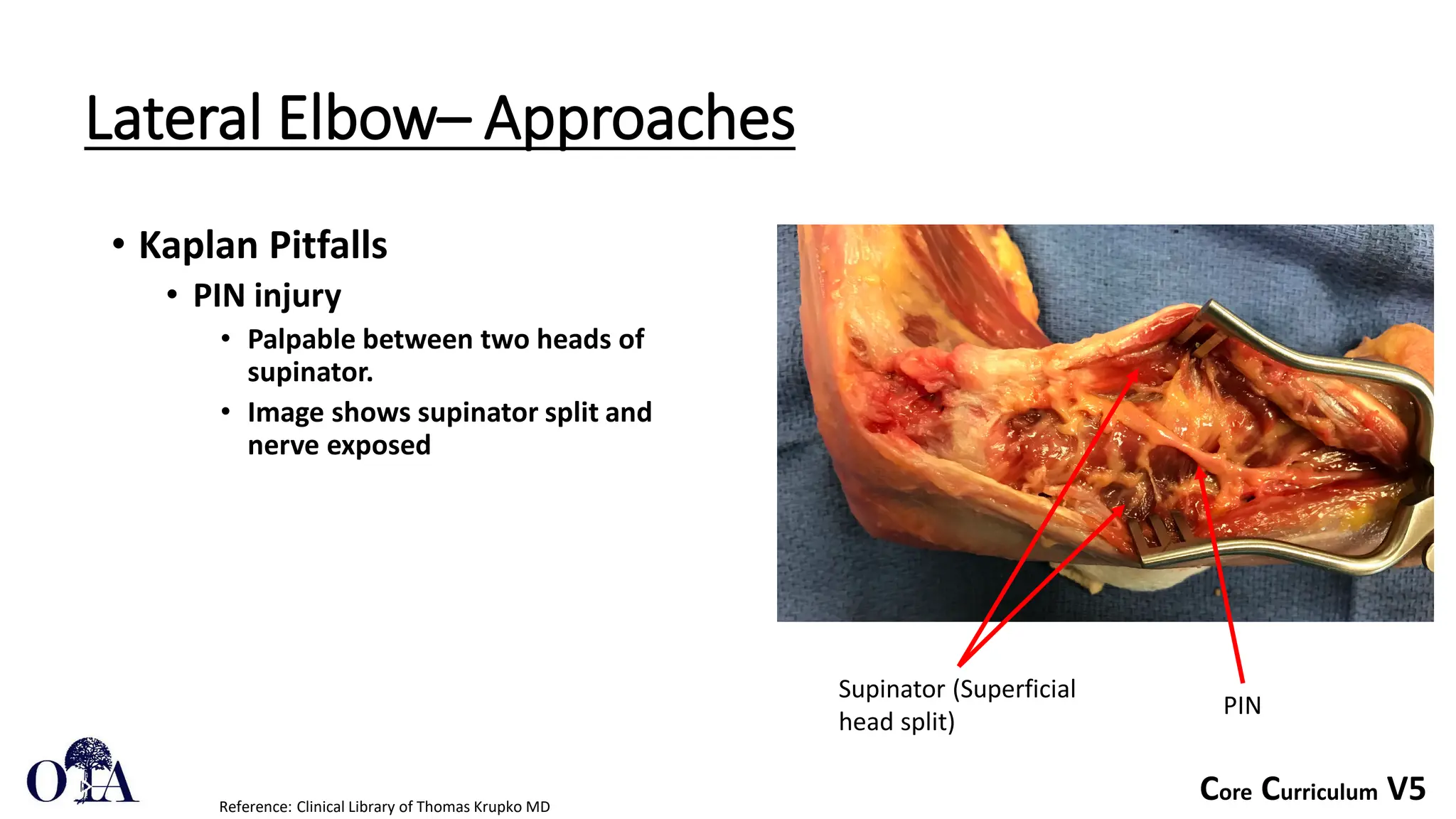
• Kaplan Pitfalls
• PIN injury
• Palpable between two heads of
supinator.
• Image shows supinator split and
nerve exposed
Reference: Clinical Library of Thomas Krupko MD
PIN
Supinator (Superficial
head split)
Core Curriculum V5
Lateral Elbow– Approaches
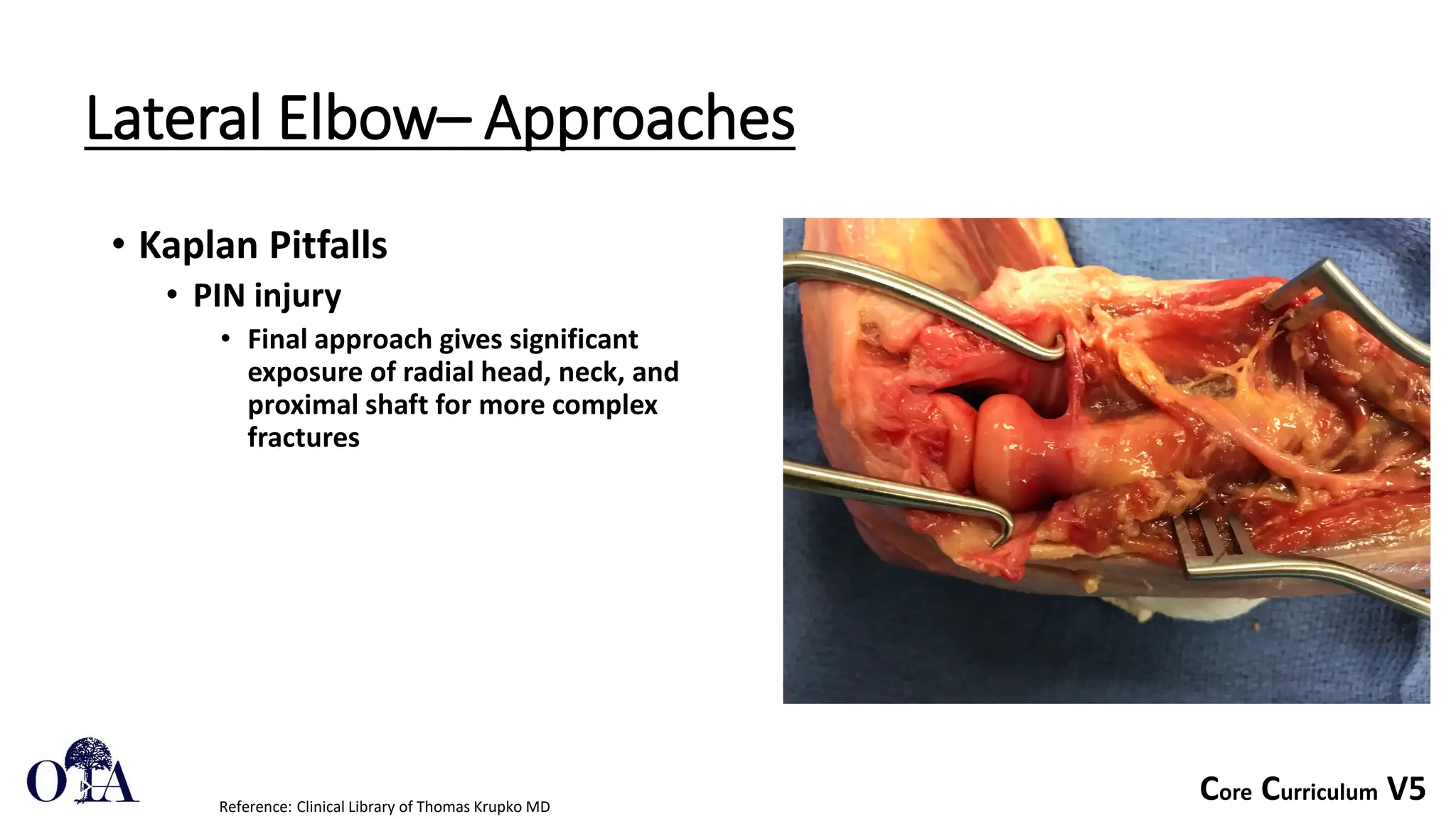
• Kaplan Pitfalls
• PIN injury
• Final approach gives significant
exposure of radial head, neck, and
proximal shaft for more complex
fractures
Reference: Clinical Library of Thomas Krupko MD
Core Curriculum V5
Lateral Elbow – Less Common Approaches
• EDC Split
• Roughly half way between Kocher and Kaplan
• Pros and Cons the same as these approaches
• Modified Boyd
• Posterior approach
• Elevate LUCL from lateral epicondyle
• Can be used for combined olecranon/radial head fxs
• Possible risk of synostosis
• See references for complete technique
Core Curriculum V5
Radial Head Fractures – Treatment Algorithm
Fracture Size > 25%
No Yes
Displacement > 2mm
No Yes
Early Motion
Excision of
Fragment
Motion Limited
Early Motion
– Close F/U
Displacement > 2mm
No Yes
Motion Limited
No Yes
Early Motion
– Close F/U
3 or More Fragments
No Yes
ORIF Arthroplasty
No Yes
Reference: Revised from Previous OTA Slides
Core Curriculum V5
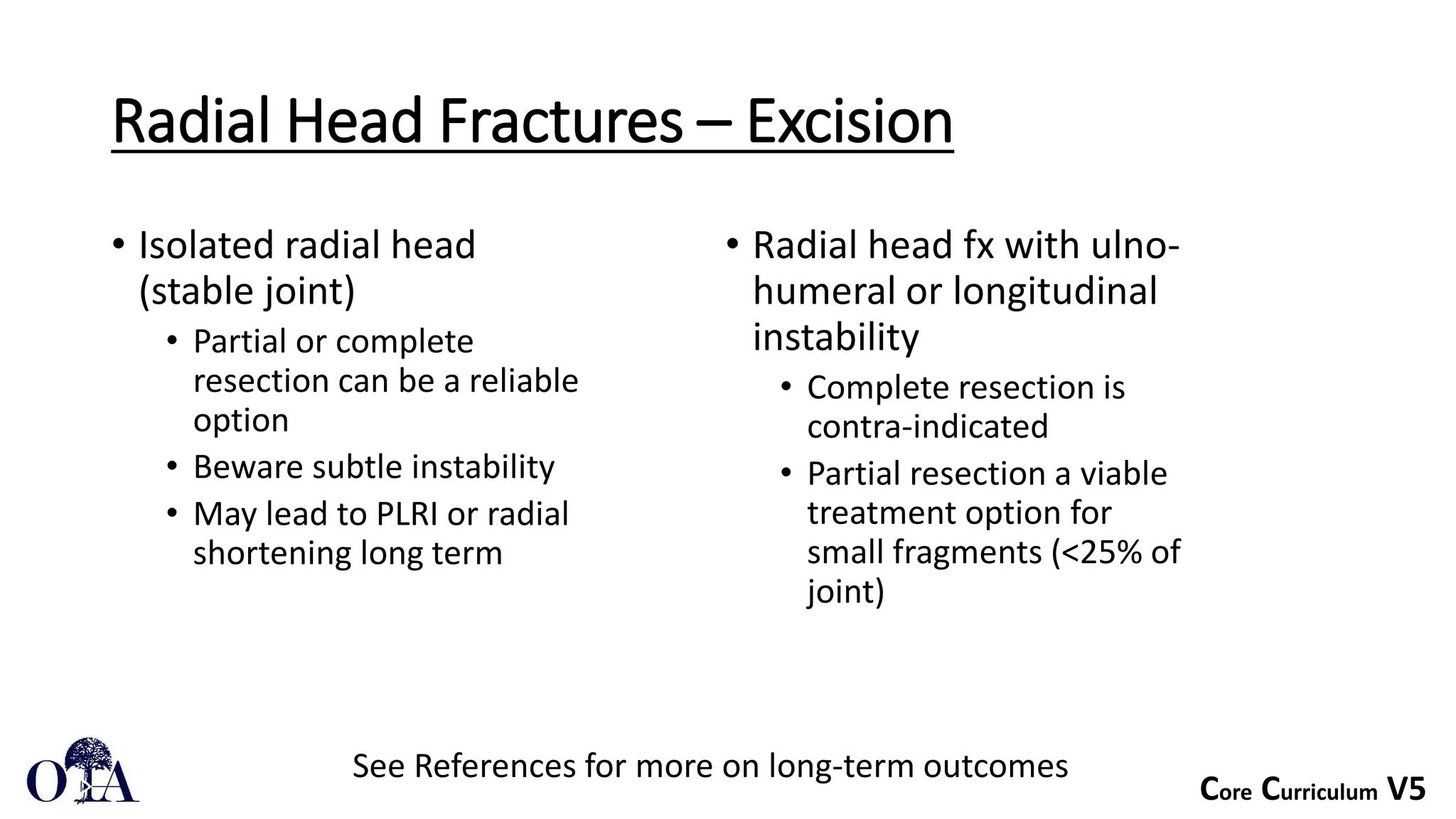
Radial Head Fractures – Excision
• Isolated radial head
(stable joint)
• Partial or complete
resection can be a reliable
option
• Beware subtle instability
• May lead to PLRI or radial
shortening long term
• Radial head fx with ulno-
humeral or longitudinal
instability
• Complete resection is
contra-indicated
• Partial resection a viable
treatment option for
small fragments (<25% of
joint)
See References for more on long-term outcomes
Core Curriculum V5
Radial Head Fractures – Treatment Algorithm
Fracture Size > 25%
No Yes
Displacement > 2mm
No Yes
Early Motion
Excision of
Fragment
Motion Limited
Early Motion
– Close F/U
Displacement > 2mm
No Yes
Motion Limited
No Yes
Early Motion
– Close F/U
3 or More Fragments
No Yes
ORIF Arthroplasty
No Yes
Reference: Revised from Previous OTA Slides
Core Curriculum V5
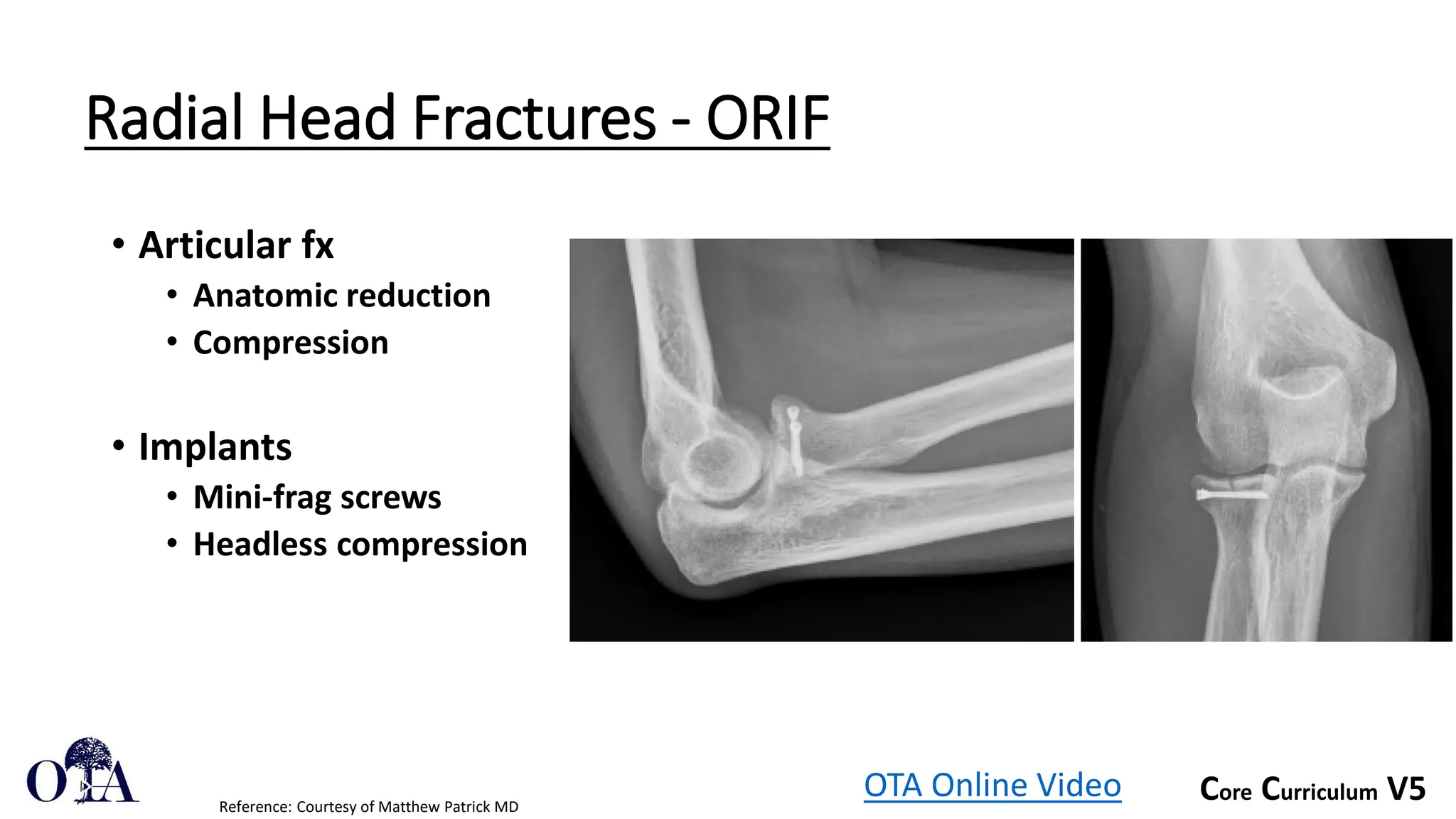
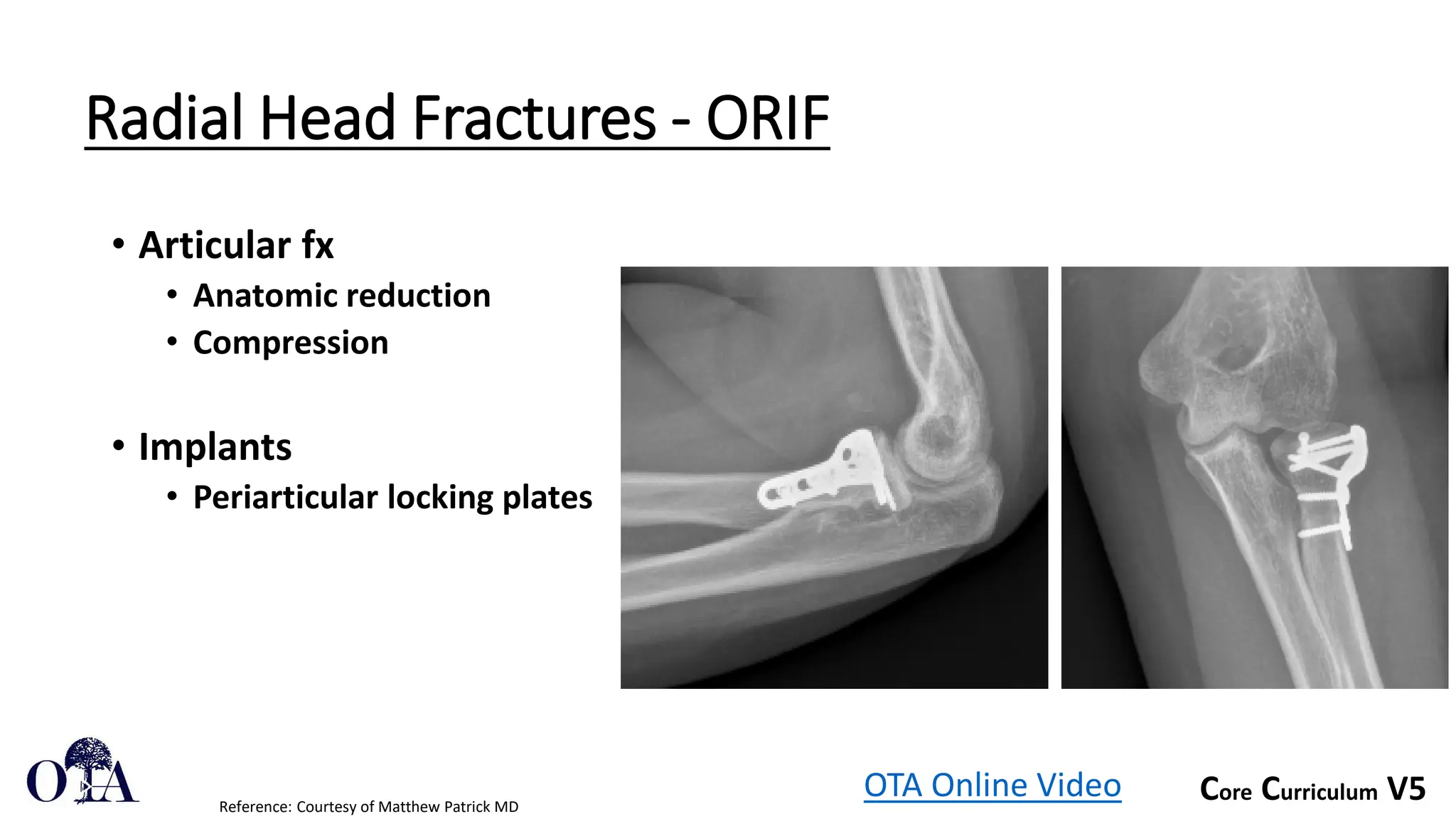
Radial Head Fractures - ORIF
• Articular fx
• Anatomic reduction
• Compression
• Implants
• Mini-frag screws
• Headless compression
OTA Online Video
Reference: Courtesy of Matthew Patrick MD
Core Curriculum V5
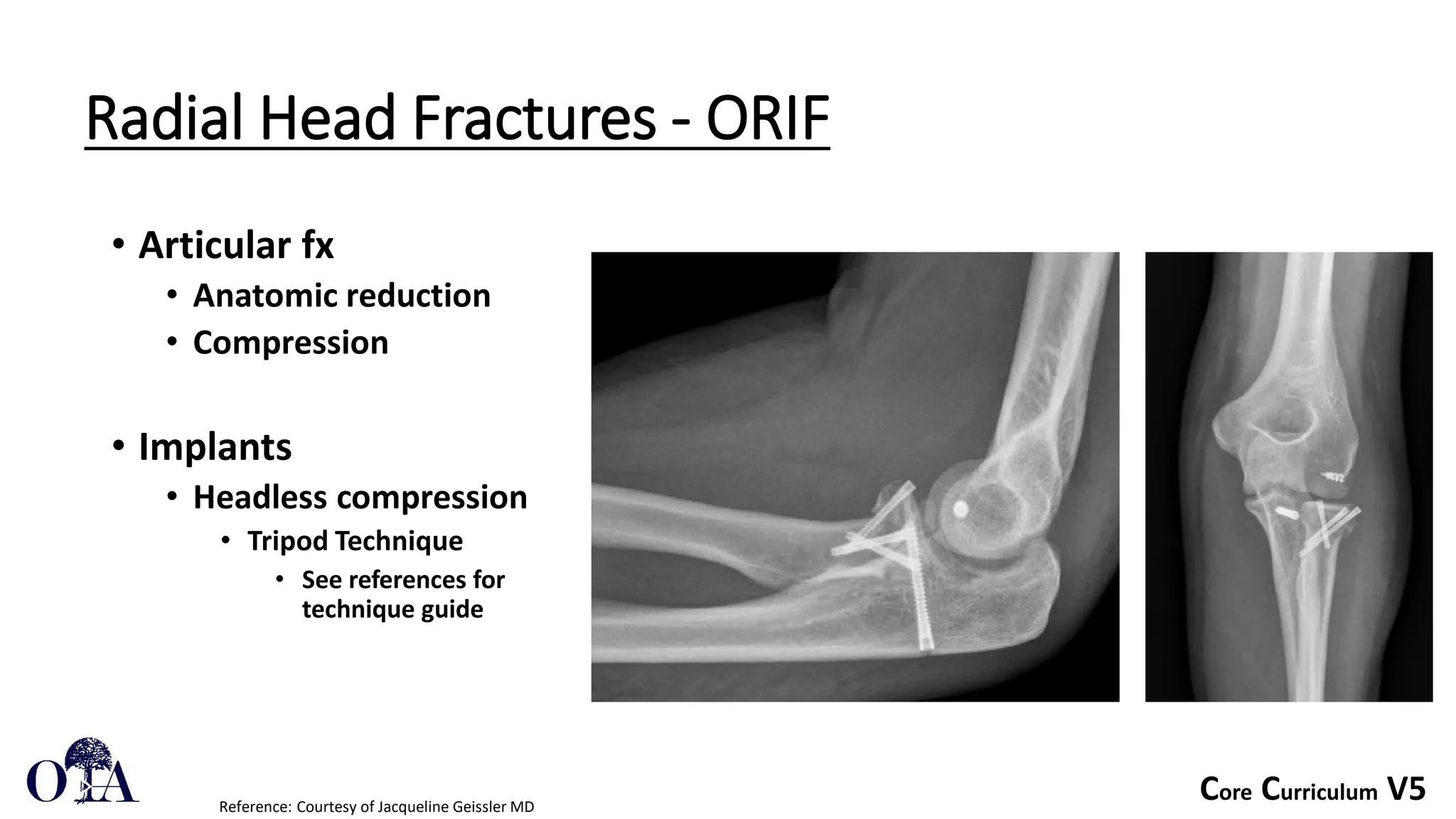
Radial Head Fractures - ORIF
• Articular fx
• Anatomic reduction
• Compression
• Implants
• Headless compression
• Tripod Technique
• See references for
technique guide
Reference: Courtesy of Jacqueline Geissler MD
Core Curriculum V5
Radial Head Fractures - ORIF
• Articular fx
• Anatomic reduction
• Compression
• Implants
• Periarticular locking plates
OTA Online Video
Reference: Courtesy of Matthew Patrick MD
Core Curriculum V5
Radial Head Fractures – Implant Placement
• Care must be taken to keep
implants out of the proximal
radio-ulnar joint
• Block to supination and
pronation
• Safe zone
• 100 degree area
• Between tip of radial styloid and
Lister’s Tubercle
Reference: Previous OTA Slides
Core Curriculum V5
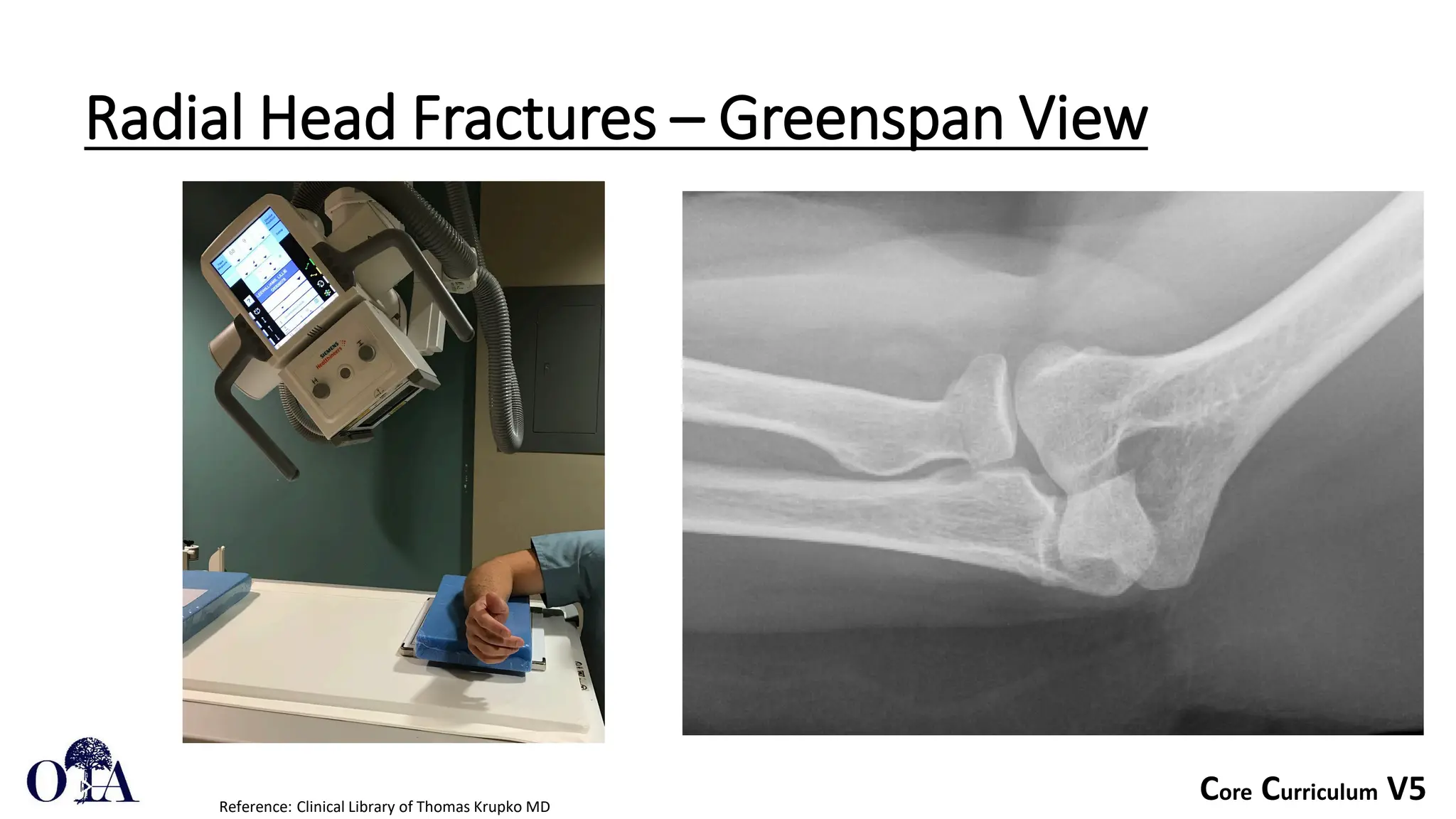
Radial Head Fractures – Greenspan View
Reference: Clinical Library of Thomas Krupko MD
Core Curriculum V5
Radial Head Fractures – Intra-op Greenspan
Reference: Clinical Library of Thomas Krupko MD
Core Curriculum V5
Radial Head Fractures – Treatment Algorithm
Fracture Size > 25%
No Yes
Displacement > 2mm
No Yes
Early Motion
Excision of
Fragment
Motion Limited
Early Motion
– Close F/U
Displacement > 2mm
No Yes
Motion Limited
No Yes
Early Motion
– Close F/U
3 or More Fragments
No Yes
ORIF Arthroplasty
No Yes
Reference: Revised from Previous OTA Slides
Core Curriculum V5
Radial Head Fractures - Replacement
• Head options
• Round
• Easier placement
• Eccentric
• Mimics native anatomy
• More difficult to place
• Bipolar
• Articulates at the head/neck
junction
• Dislocation can occur
• Stem options
• Smooth
• Loose fitting stem
• Allows implant to find proper
alignment
• Porous/Pressfit
• Can loosen causing pain
• Can result in dilatory
remodeling
• Cemented
• Typically used for salvage
OTA Online Video
Core Curriculum V5
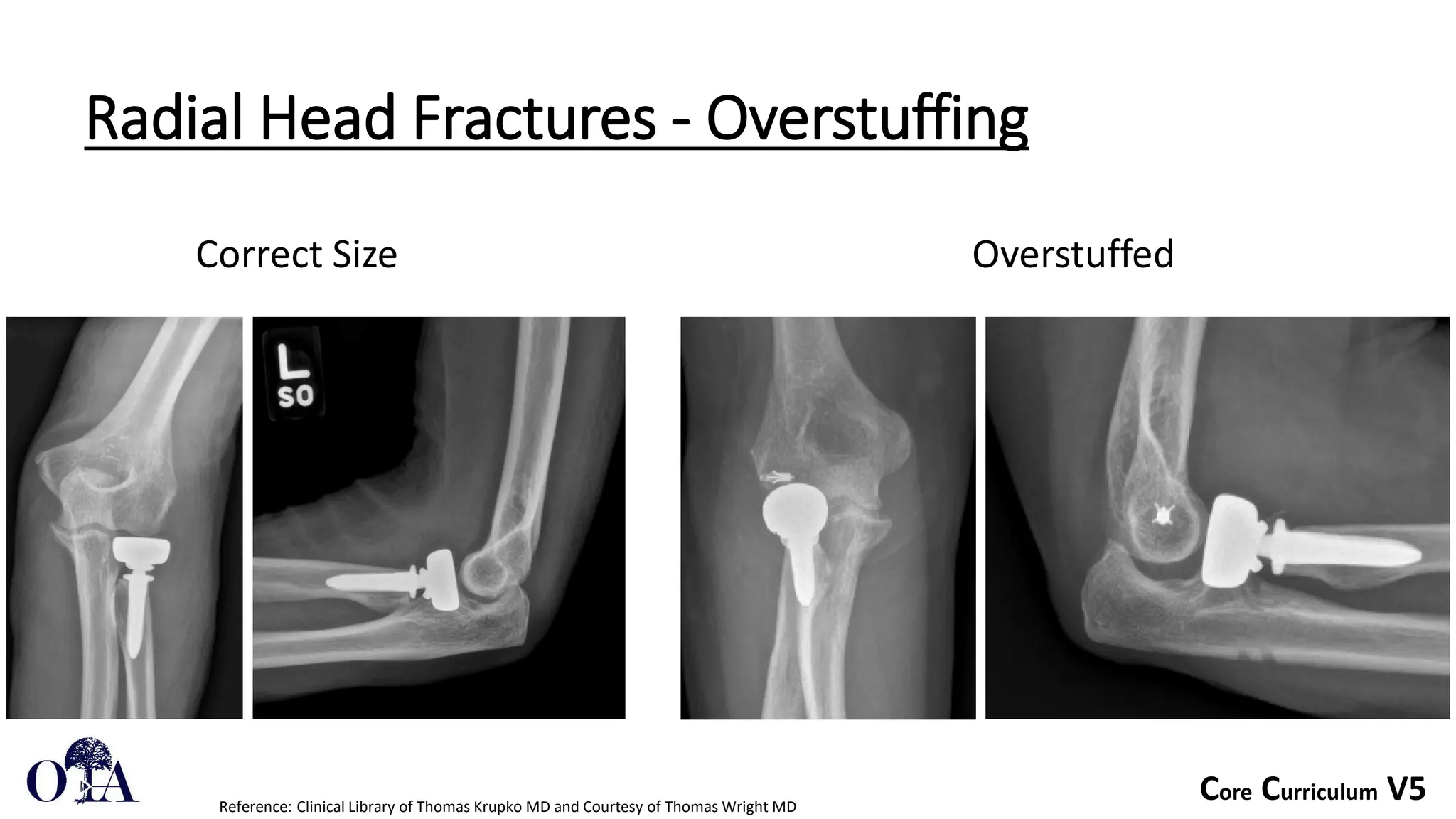
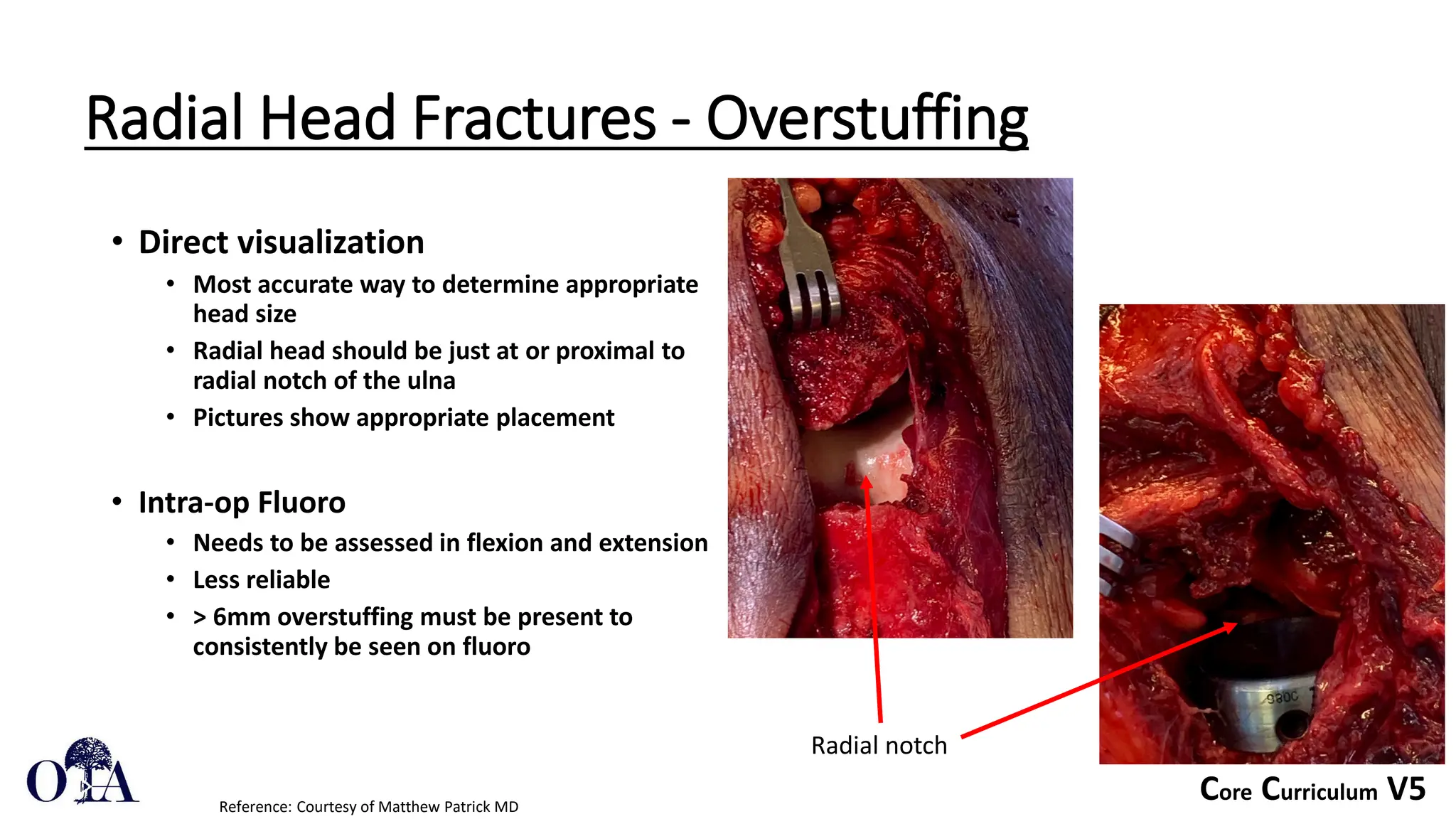
Radial Head Fractures - Overstuffing
• Radial head height typically 0.9mm
proximal to lateral coronoid process
• Only 2mm overstuffing causes 1mm
of ulno-humeral gapping
• Common complication
• Especially in unstable elbows that allow
for the placement of large implants
• Leads to….
• Possible increased rate of capitellar
erosion
• Decreased flexion
• Medial subluxation of the ulna
Reference: Clinical Library of Thomas Krupko MD
Core Curriculum V5
Radial Head Fractures - Overstuffing
Reference: Clinical Library of Thomas Krupko MD and Courtesy of Thomas Wright MD
Correct Size Overstuffed
Core Curriculum V5
Radial Head Fractures - Overstuffing
• Direct visualization
• Most accurate way to determine appropriate
head size
• Radial head should be just at or proximal to
radial notch of the ulna
• Pictures show appropriate placement
• Intra-op Fluoro
• Needs to be assessed in flexion and extension
• Less reliable
• > 6mm overstuffing must be present to
consistently be seen on fluoro
Reference: Courtesy of Matthew Patrick MD
Radial notch
Core Curriculum V5
Radial Head Fractures – Stem Loosening
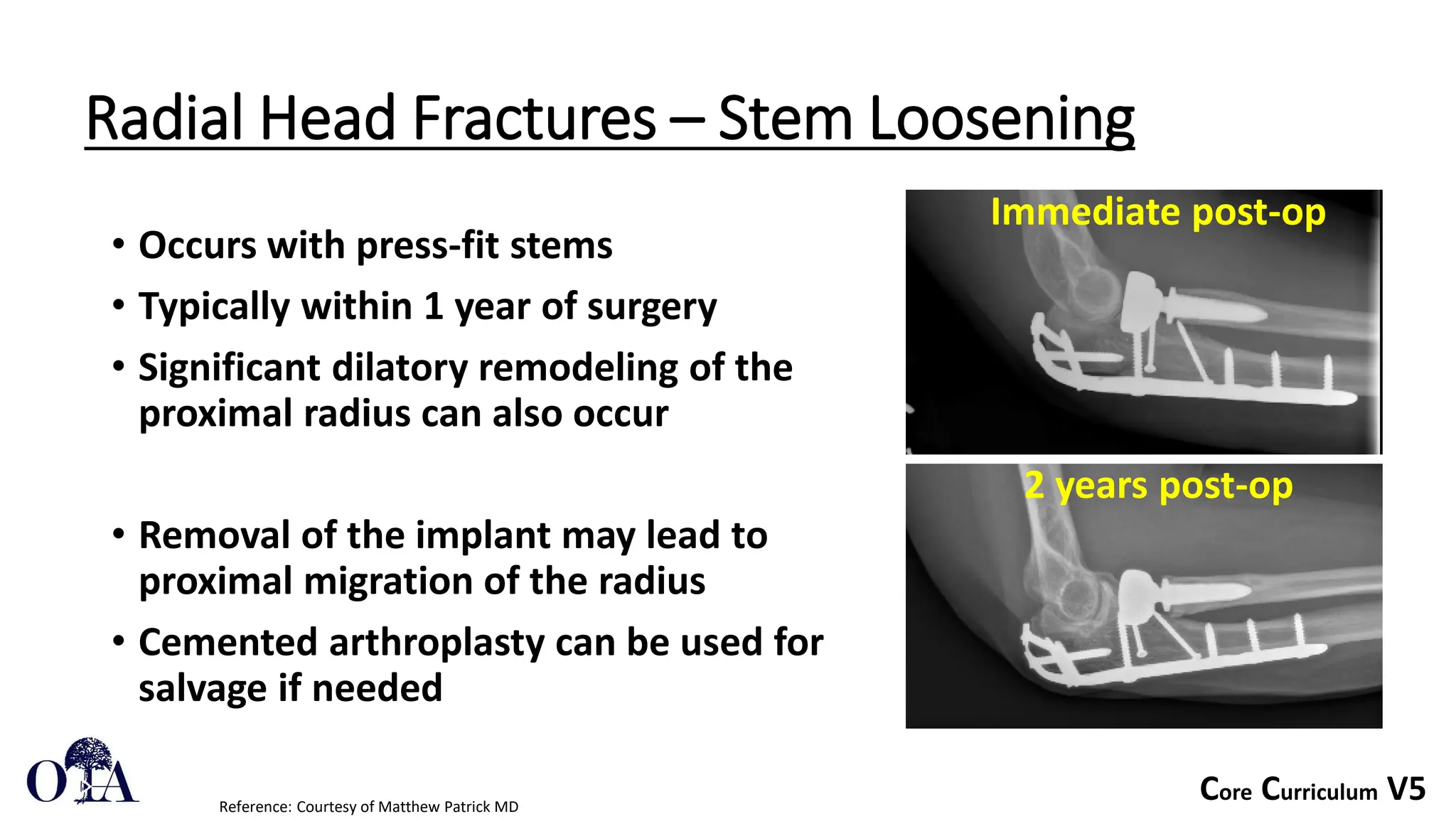
Immediate post-op
2 years post-op
Reference: Courtesy of Matthew Patrick MD
• Occurs with press-fit stems
• Typically within 1 year of surgery
• Significant dilatory remodeling of the
proximal radius can also occur
• Removal of the implant may lead to
proximal migration of the radius
• Cemented arthroplasty can be used for
salvage if needed
Core Curriculum V5
Radial Head Replacement – Outcomes
• Mid to long term outcomes are good to
excellent typically
• Elbow stiffness is most common
complication
• Average approx. 10-135 degrees
• Loss of flex/ext strength of approx. 10%
• Peri-implant lucency common, but rarely
requires revision
• Rate of OA approx 30%
Core Curriculum V5
Radial Neck Fractures
Core Curriculum V5
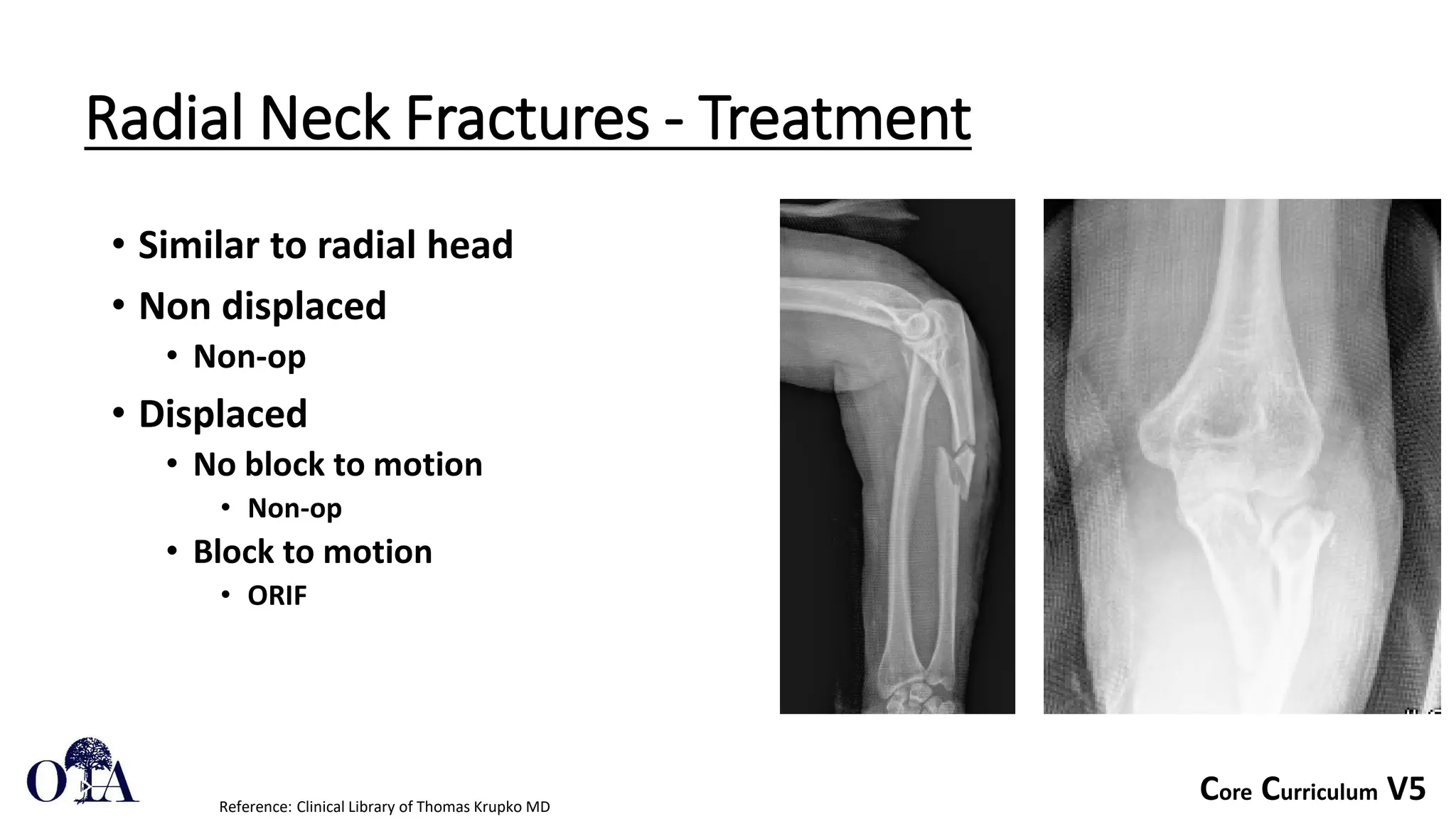
Radial Neck Fractures - Treatment
• Similar to radial head
• Non displaced
• Non-op
• Displaced
• No block to motion
• Non-op
• Block to motion
• ORIF
Reference: Clinical Library of Thomas Krupko MD
Core Curriculum V5
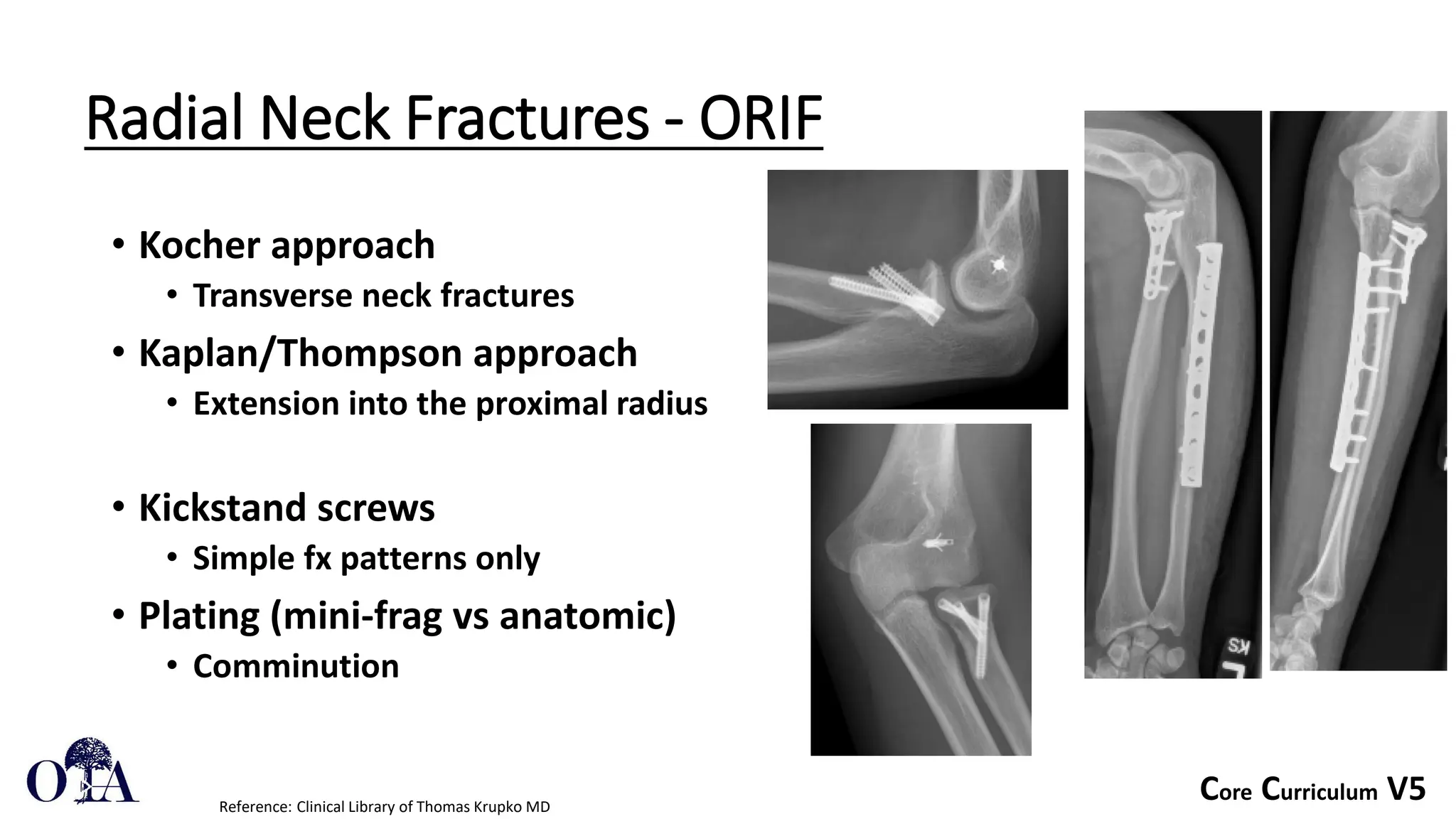
Radial Neck Fractures - ORIF
• Kocher approach
• Transverse neck fractures
• Kaplan/Thompson approach
• Extension into the proximal radius
• Kickstand screws
• Simple fx patterns only
• Plating (mini-frag vs anatomic)
• Comminution
Reference: Clinical Library of Thomas Krupko MD
Core Curriculum V5
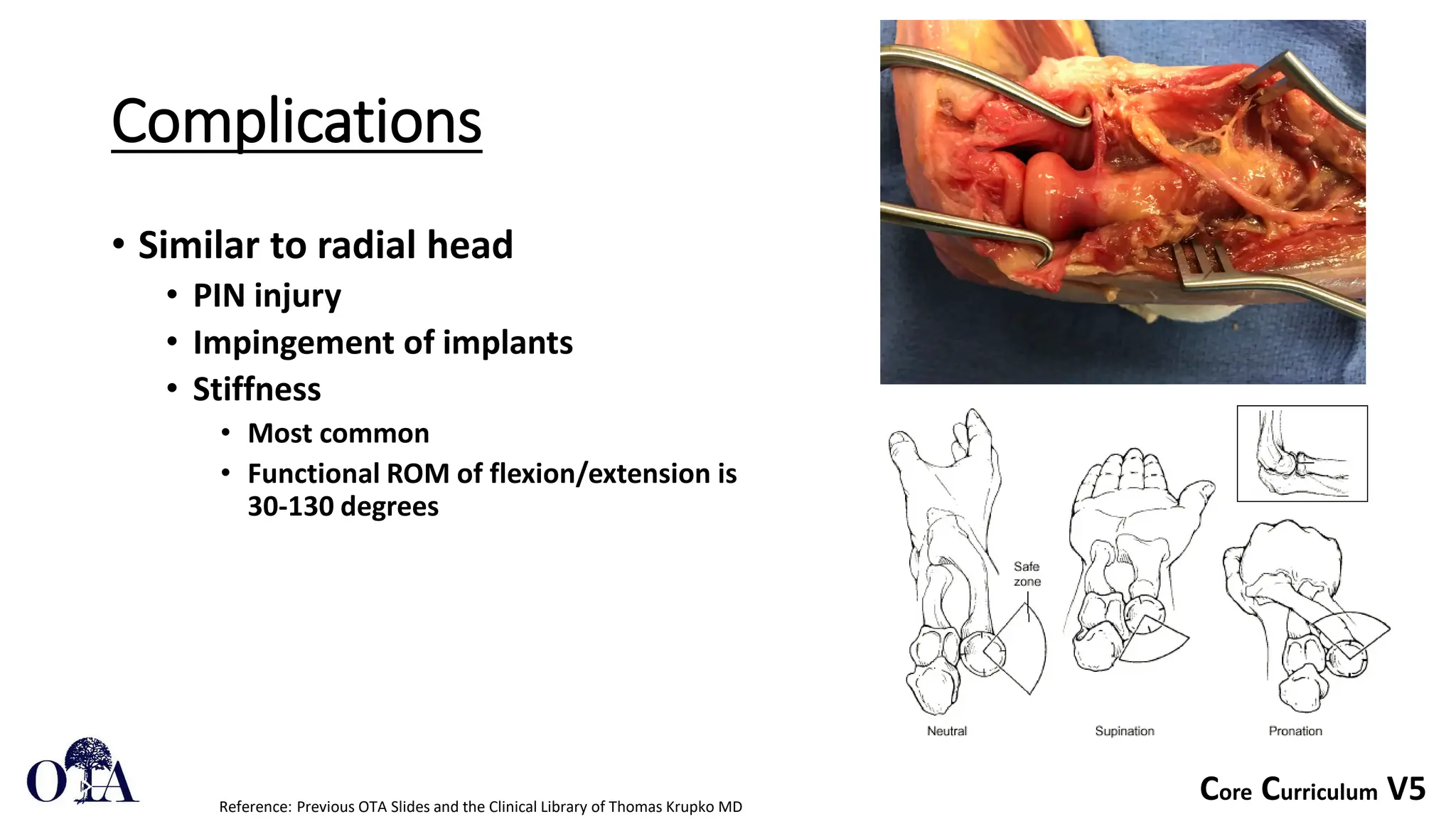
Complications
• Similar to radial head
• PIN injury
• Impingement of implants
• Stiffness
• Most common
• Functional ROM of flexion/extension is
30-130 degrees
Reference: Previous OTA Slides and the Clinical Library of Thomas Krupko MD
Core Curriculum V5
Essex-Lopresti Injuries
Core Curriculum V5
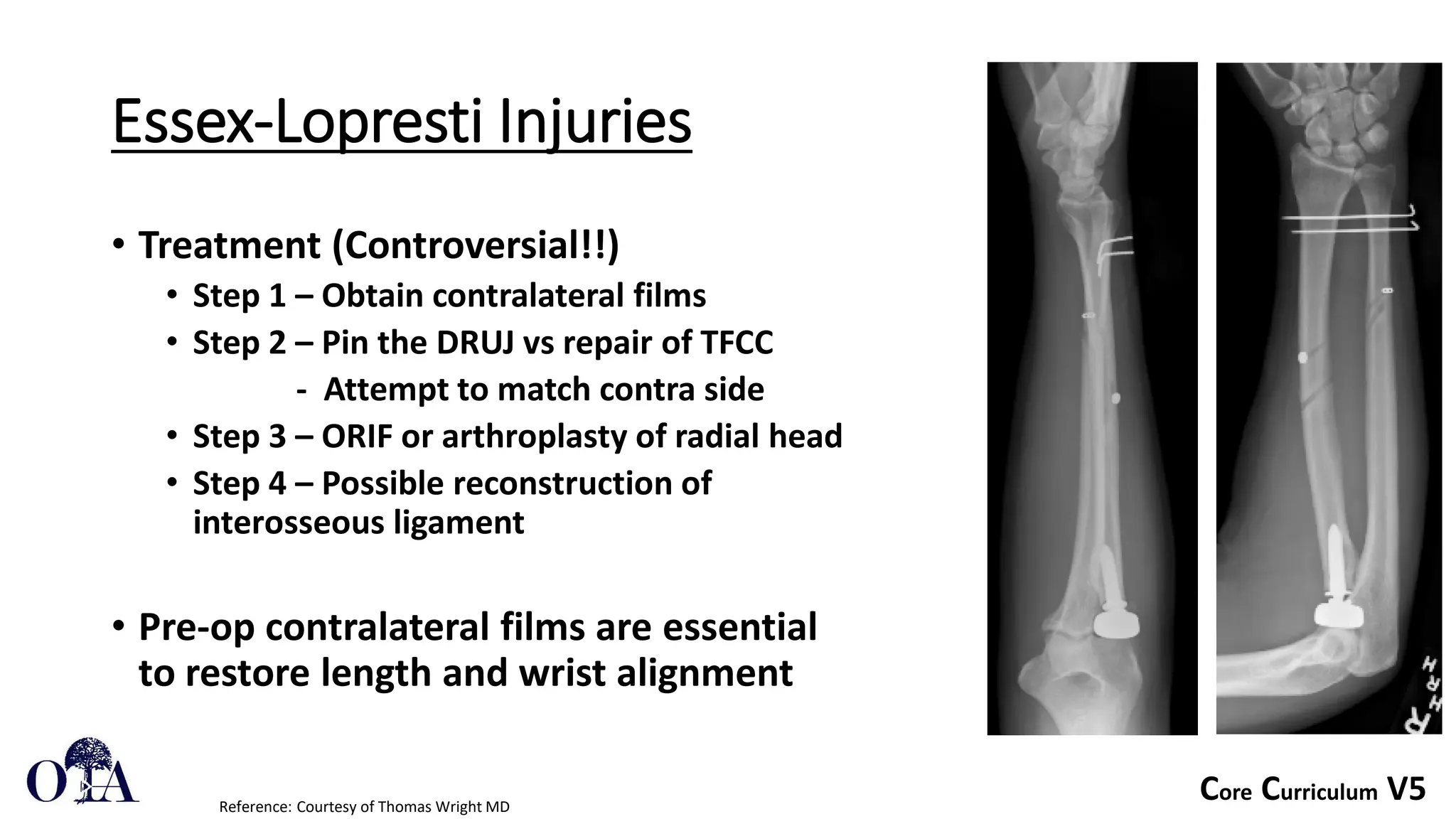
Essex-Lopresti Injuries
Reference: Courtesy of Thomas Wright MD
• Radial head/neck fracture with:
• Interosseous membrane disruption
• DRUJ disruption
• Physical exam
• Palpation of DRUJ for tenderness and
shucking of the joint is critical
• Radiographs
• Be sure to evaluate entire film
• Contralateral films may help in diagnosis
Core Curriculum V5
Essex-Lopresti Injuries
Reference: Courtesy of Thomas Wright MD
• Treatment (Controversial!!)
• Step 1 – Obtain contralateral films
• Step 2 – Pin the DRUJ vs repair of TFCC
- Attempt to match contra side
• Step 3 – ORIF or arthroplasty of radial head
• Step 4 – Possible reconstruction of
interosseous ligament
• Pre-op contralateral films are essential
to restore length and wrist alignment
Core Curriculum V5
Post-op Protocol
Core Curriculum V5
My Post-op Protocol
• For all stabilized fxs and dislocations regardless of fixation
• Initially
• Immobilization for 10-14 days
• Secondarily
• Early ACTIVE range of motion
• Allows dynamic stabilizers to help hold reduction of joint
• Will reduce pseudosubluxations
• Limits elbow stiffness
• Some limit active shoulder abduction if LUCL was repaired
Core Curriculum V5
Summary
• Anatomy
• Lateral elbow ligaments and PIN location are critical
• Elbow Instability
• Make sure that you understand the injury
• Radial head fractures
• Classification (Mason)
• Treatment
• Radial neck fractures
• Treatment
• Essex-Lopresti Injuries
• Don’t miss!
Core Curriculum V5
References
• Acevedo DC, Paxton ES, Kukelyansky I, Abboud J, Ramsey M. Radial head arthroplasty: state of the art. JAAOS-
Journal of the American Academy of Orthopaedic Surgeons. 2014 Oct 1;22(10):633-42.
• Cheung EV, Steinmann SP. Surgical approaches to the elbow. JAAOS-Journal of the American Academy of
Orthopaedic Surgeons. 2009 May 1;17(5):325-33.
• Grassmann JP, Hakimi M, Gehrmann SV, Betsch M, Kröpil P, Wild M, Windolf J, Jungbluth P. The treatment of the
acute Essex-Lopresti injury. The bone & joint journal. 2014 Oct;96(10):1385-91.
• Hildebrand AH, Zhang B, Horner NS, King G, Khan M, Alolabi B. Indications and outcomes of radial head excision: a
systematic review. Shoulder & elbow. 2020 Jun;12(3):193-202.
• Lipman MD, Gause TM, Teran VA, Chhabra AB, Deal DN. Radial head fracture fixation using tripod technique with
headless compression screws. The Journal of hand surgery. 2018 Jun 1;43(6):575-e1.
• Marsh JP, Grewal R, Faber KJ, Drosdowech DS, Athwal GS, King GJ. Radial head fractures treated with modular
metallic radial head replacement: outcomes at a mean follow-up of eight years. JBJS. 2016 Apr 6;98(7):527-35.
• Ring D. Radial head fracture: open reduction–internal fixation or prosthetic replacement. Journal of shoulder and
elbow surgery. 2011 Mar 1;20(2):S107-12.
Core Curriculum V5
References
• Ring D, Quintero J, Jupiter JB. Open reduction and internal fixation of fractures of the radial head. JBJS. 2002
Oct 1;84(10):1811-5.
• Robinson PM, Li MK, Dattani R, Van Rensburg L. The Boyd interval: a modification for use in the management
of elbow trauma. Techniques in hand & upper extremity surgery. 2016 Mar 1;20(1):37-41.
• Smith GR, Hotchkiss RN. Radial head and neck fractures: anatomic guidelines for proper placement of
internal fixation. Journal of shoulder and elbow surgery. 1996 Mar 1;5(2):113-7.
• Soyer AD, Nowotarski PJ, Kelso TB, Mighell MA. Optimal position for plate fixation of complex fractures of the
proximal radius: a cadaver study. Journal of orthopaedic trauma. 1998 May 1;12(4):291-3.
• Tabor JO, Bosse MJ, Sims SH, Kellam JF. Iatrogenic posterior interosseous nerve injury: is transosseous static
locked nailing of the radius feasible?. Journal of orthopaedic trauma. 1995;9(5):427-9.
• Tashjian RZ, Katarincic JA. Complex elbow instability. JAAOS-Journal of the American Academy of
Orthopaedic Surgeons. 2006 May 1;14(5):278-86.
• Tejwani NC, Mehta H. Fractures of the radial head and neck: current concepts in management. JAAOS-
Journal of the American Academy of Orthopaedic Surgeons. 2007 Jul 1;15(7):380-7.

UE 9 Radial Head and Neck Fractures. pdf

  • 1.
    Core Curriculum V5 RadialHead and Neck Fractures Thomas Krupko M.D. Assistant Professor – Orthopaedic Trauma University of Florida
  • 2.
    Core Curriculum V5 Objectives •Anatomy • Elbow Instability • Radial head fractures • Classification • Treatment • Radial neck fractures • Treatment • Essex-Lopresti Injuries
  • 3.
  • 4.
    Core Curriculum V5 Anatomy– Superficial Lateral Elbow Reference: Clinical Library of Thomas Krupko MD Lateral Epicondyle Triceps Biceps Olecranon Common Extensor Origin
  • 5.
    Core Curriculum V5 Anatomy- PIN Pronation Supination Neutral Reference: Tabor Jr, Owen B., et al. "Iatrogenic posterior interosseous nerve injury: is transosseous static locked nailing of the radius feasible?." Journal of orthopaedic trauma 9.5 (1995): 427-429.
  • 6.
    Core Curriculum V5 Anatomy– Deep Lateral Elbow Reference: Rockwood and Green’s - Figure 32.2 Annular Ligament LUCL Radial Collateral Ligament
  • 7.
    Core Curriculum V5 Anatomy– Lateral Elbow Reference: Clinical Library of Thomas Krupko MD Lateral Epicondyle Supinator Crest Coronoid Greater Sigmoid Notch Olecranon Radial Notch Radius (head resected) LUCL
  • 8.
    Core Curriculum V5 Anatomy– Medial Elbow Reference: Rockwood and Green’s - Figure 32.2 Anterior Bundle Transverse Bundle Posterior Bundle
  • 9.
  • 10.
    Core Curriculum V5 ElbowStability • Static • Ulno-humeral joint • Radio-humeral Joint • LUCL • Anterior bundle of MCL • Dynamic • Common flexor origin • Common extensor origin • Biceps • Brachialis • Triceps • Radius resists axial load and valgus
  • 11.
    Core Curriculum V5 Mechanismof Injury • Typically fall onto outstretched hand • Axial loading • Valgus force • Radial head/neck fractures occur along a spectrum of elbow instability • Any treatment requires complete understanding of the injured bone and soft tissue • CT scan can provide valuable info Reference: Rockwood and Green’s - Figure 32.16
  • 12.
    Core Curriculum V5 ElbowInstability Stable Unstable Simple dislocation Radial Head Fx Radial Head Fx + Dislocation Post Trans Olecranon Fx Dislocation Terrible Triad Reference: Previous OTA Slides
  • 13.
    Core Curriculum V5 RadialHead Fractures • Mason Classification – Type 1 • Non- displaced fx or minimally displaced (<2mm) • No mechanical block to forearm rotation Reference: Previous OTA Slides and the Clinical Library of Thomas Krupko MD
  • 14.
    Core Curriculum V5 RadialHead Fractures • Mason Classification – Type 2 • Displaced >2mm or angulated • Possible block to rotation Reference: Previous OTA Slides and the Clinical Library of Thomas Krupko MD
  • 15.
    Core Curriculum V5 RadialHead Fractures • Mason Classification – Type 3 • Comminuted • Displaced • Obvious block to rotation Reference: Previous OTA Slides and courtesy of Thomas Wright MD
  • 16.
    Core Curriculum V5 RadialHead Fractures • Mason Classification – Type 4 • Hotchkiss Modification • Bridges the gap with more complex elbow instability • Radial head fx with elbow dislocation • Beware LUCL avulsion and coronoid fx (terrible triad) Reference: Clinical Library of Thomas Krupko MD
  • 17.
    Core Curriculum V5 RadialHead Fractures – Treatment Algorithm Fracture Size > 25% No Yes Displacement > 2mm No Yes Early Motion Excision of Fragment Motion Limited Early Motion – Close F/U Displacement > 2mm No Yes Motion Limited No Yes Early Motion – Close F/U 3 or More Fragments No Yes ORIF Arthroplasty No Yes Reference: Revised from Previous OTA Slides
  • 18.
    Core Curriculum V5 LateralElbow – Approaches • Kocher • Most often utilized for radial head • Interval • Anconeus – Radial Nerve • ECU – PIN • 5cm incision from lateral epicondyle distally • Angled posteriorly 30-45 degrees • Often deep soft tissues will be disrupted by injury Reference: Clinical Library of Thomas Krupko MD OTA Online Video
  • 19.
    Core Curriculum V5 LateralElbow – Approaches • Kocher Pitfalls • Damage to LUCL • Stay on anterior half of radial head • Damage to PIN • Pronate the arm to move nerve distally • Carefully dissect distal to annular ligament Reference: Rockwood and Green’s - Figure 32.2
  • 20.
    Core Curriculum V5 LateralElbow– Approaches • Kaplan • Distal extension becomes dorsal Thompson approach • More often used for radial neck/proximal radial shaft fxs • Interval • ECRB – Radial nerve or PIN (variable) • EDC – PIN • 10cm incision from lateral epicondyle to Lister’s Tubercle OTA Online Video Reference: Clinical Library of Thomas Krupko MD
  • 21.
    Core Curriculum V5 LateralElbow– Approaches • Kaplan Pitfalls • PIN injury • Palpable between two heads of supinator. • Distal dissection can be utilized to locate the nerve (see image) • Can also split supinator (next slide) Reference: Clinical Library of Thomas Krupko MD Lateral Epicondyle Mobile Wad Dorsal Compartment Supinator Find PIN here!
  • 22.
    Core Curriculum V5 LateralElbow– Approaches • Kaplan Pitfalls • PIN injury • Palpable between two heads of supinator. • Image shows supinator split and nerve exposed Reference: Clinical Library of Thomas Krupko MD PIN Supinator (Superficial head split)
  • 23.
    Core Curriculum V5 LateralElbow– Approaches • Kaplan Pitfalls • PIN injury • Final approach gives significant exposure of radial head, neck, and proximal shaft for more complex fractures Reference: Clinical Library of Thomas Krupko MD
  • 24.
    Core Curriculum V5 LateralElbow – Less Common Approaches • EDC Split • Roughly half way between Kocher and Kaplan • Pros and Cons the same as these approaches • Modified Boyd • Posterior approach • Elevate LUCL from lateral epicondyle • Can be used for combined olecranon/radial head fxs • Possible risk of synostosis • See references for complete technique
  • 25.
    Core Curriculum V5 RadialHead Fractures – Treatment Algorithm Fracture Size > 25% No Yes Displacement > 2mm No Yes Early Motion Excision of Fragment Motion Limited Early Motion – Close F/U Displacement > 2mm No Yes Motion Limited No Yes Early Motion – Close F/U 3 or More Fragments No Yes ORIF Arthroplasty No Yes Reference: Revised from Previous OTA Slides
  • 26.
    Core Curriculum V5 RadialHead Fractures – Excision • Isolated radial head (stable joint) • Partial or complete resection can be a reliable option • Beware subtle instability • May lead to PLRI or radial shortening long term • Radial head fx with ulno- humeral or longitudinal instability • Complete resection is contra-indicated • Partial resection a viable treatment option for small fragments (<25% of joint) See References for more on long-term outcomes
  • 27.
    Core Curriculum V5 RadialHead Fractures – Treatment Algorithm Fracture Size > 25% No Yes Displacement > 2mm No Yes Early Motion Excision of Fragment Motion Limited Early Motion – Close F/U Displacement > 2mm No Yes Motion Limited No Yes Early Motion – Close F/U 3 or More Fragments No Yes ORIF Arthroplasty No Yes Reference: Revised from Previous OTA Slides
  • 28.
    Core Curriculum V5 RadialHead Fractures - ORIF • Articular fx • Anatomic reduction • Compression • Implants • Mini-frag screws • Headless compression OTA Online Video Reference: Courtesy of Matthew Patrick MD
  • 29.
    Core Curriculum V5 RadialHead Fractures - ORIF • Articular fx • Anatomic reduction • Compression • Implants • Headless compression • Tripod Technique • See references for technique guide Reference: Courtesy of Jacqueline Geissler MD
  • 30.
    Core Curriculum V5 RadialHead Fractures - ORIF • Articular fx • Anatomic reduction • Compression • Implants • Periarticular locking plates OTA Online Video Reference: Courtesy of Matthew Patrick MD
  • 31.
    Core Curriculum V5 RadialHead Fractures – Implant Placement • Care must be taken to keep implants out of the proximal radio-ulnar joint • Block to supination and pronation • Safe zone • 100 degree area • Between tip of radial styloid and Lister’s Tubercle Reference: Previous OTA Slides
  • 32.
    Core Curriculum V5 RadialHead Fractures – Greenspan View Reference: Clinical Library of Thomas Krupko MD
  • 33.
    Core Curriculum V5 RadialHead Fractures – Intra-op Greenspan Reference: Clinical Library of Thomas Krupko MD
  • 34.
    Core Curriculum V5 RadialHead Fractures – Treatment Algorithm Fracture Size > 25% No Yes Displacement > 2mm No Yes Early Motion Excision of Fragment Motion Limited Early Motion – Close F/U Displacement > 2mm No Yes Motion Limited No Yes Early Motion – Close F/U 3 or More Fragments No Yes ORIF Arthroplasty No Yes Reference: Revised from Previous OTA Slides
  • 35.
    Core Curriculum V5 RadialHead Fractures - Replacement • Head options • Round • Easier placement • Eccentric • Mimics native anatomy • More difficult to place • Bipolar • Articulates at the head/neck junction • Dislocation can occur • Stem options • Smooth • Loose fitting stem • Allows implant to find proper alignment • Porous/Pressfit • Can loosen causing pain • Can result in dilatory remodeling • Cemented • Typically used for salvage OTA Online Video
  • 36.
    Core Curriculum V5 RadialHead Fractures - Overstuffing • Radial head height typically 0.9mm proximal to lateral coronoid process • Only 2mm overstuffing causes 1mm of ulno-humeral gapping • Common complication • Especially in unstable elbows that allow for the placement of large implants • Leads to…. • Possible increased rate of capitellar erosion • Decreased flexion • Medial subluxation of the ulna Reference: Clinical Library of Thomas Krupko MD
  • 37.
    Core Curriculum V5 RadialHead Fractures - Overstuffing Reference: Clinical Library of Thomas Krupko MD and Courtesy of Thomas Wright MD Correct Size Overstuffed
  • 38.
    Core Curriculum V5 RadialHead Fractures - Overstuffing • Direct visualization • Most accurate way to determine appropriate head size • Radial head should be just at or proximal to radial notch of the ulna • Pictures show appropriate placement • Intra-op Fluoro • Needs to be assessed in flexion and extension • Less reliable • > 6mm overstuffing must be present to consistently be seen on fluoro Reference: Courtesy of Matthew Patrick MD Radial notch
  • 39.
    Core Curriculum V5 RadialHead Fractures – Stem Loosening Immediate post-op 2 years post-op Reference: Courtesy of Matthew Patrick MD • Occurs with press-fit stems • Typically within 1 year of surgery • Significant dilatory remodeling of the proximal radius can also occur • Removal of the implant may lead to proximal migration of the radius • Cemented arthroplasty can be used for salvage if needed
  • 40.
    Core Curriculum V5 RadialHead Replacement – Outcomes • Mid to long term outcomes are good to excellent typically • Elbow stiffness is most common complication • Average approx. 10-135 degrees • Loss of flex/ext strength of approx. 10% • Peri-implant lucency common, but rarely requires revision • Rate of OA approx 30%
  • 41.
  • 42.
    Core Curriculum V5 RadialNeck Fractures - Treatment • Similar to radial head • Non displaced • Non-op • Displaced • No block to motion • Non-op • Block to motion • ORIF Reference: Clinical Library of Thomas Krupko MD
  • 43.
    Core Curriculum V5 RadialNeck Fractures - ORIF • Kocher approach • Transverse neck fractures • Kaplan/Thompson approach • Extension into the proximal radius • Kickstand screws • Simple fx patterns only • Plating (mini-frag vs anatomic) • Comminution Reference: Clinical Library of Thomas Krupko MD
  • 44.
    Core Curriculum V5 Complications •Similar to radial head • PIN injury • Impingement of implants • Stiffness • Most common • Functional ROM of flexion/extension is 30-130 degrees Reference: Previous OTA Slides and the Clinical Library of Thomas Krupko MD
  • 45.
  • 46.
    Core Curriculum V5 Essex-LoprestiInjuries Reference: Courtesy of Thomas Wright MD • Radial head/neck fracture with: • Interosseous membrane disruption • DRUJ disruption • Physical exam • Palpation of DRUJ for tenderness and shucking of the joint is critical • Radiographs • Be sure to evaluate entire film • Contralateral films may help in diagnosis
  • 47.
    Core Curriculum V5 Essex-LoprestiInjuries Reference: Courtesy of Thomas Wright MD • Treatment (Controversial!!) • Step 1 – Obtain contralateral films • Step 2 – Pin the DRUJ vs repair of TFCC - Attempt to match contra side • Step 3 – ORIF or arthroplasty of radial head • Step 4 – Possible reconstruction of interosseous ligament • Pre-op contralateral films are essential to restore length and wrist alignment
  • 48.
  • 49.
    Core Curriculum V5 MyPost-op Protocol • For all stabilized fxs and dislocations regardless of fixation • Initially • Immobilization for 10-14 days • Secondarily • Early ACTIVE range of motion • Allows dynamic stabilizers to help hold reduction of joint • Will reduce pseudosubluxations • Limits elbow stiffness • Some limit active shoulder abduction if LUCL was repaired
  • 50.
    Core Curriculum V5 Summary •Anatomy • Lateral elbow ligaments and PIN location are critical • Elbow Instability • Make sure that you understand the injury • Radial head fractures • Classification (Mason) • Treatment • Radial neck fractures • Treatment • Essex-Lopresti Injuries • Don’t miss!
  • 51.
    Core Curriculum V5 References •Acevedo DC, Paxton ES, Kukelyansky I, Abboud J, Ramsey M. Radial head arthroplasty: state of the art. JAAOS- Journal of the American Academy of Orthopaedic Surgeons. 2014 Oct 1;22(10):633-42. • Cheung EV, Steinmann SP. Surgical approaches to the elbow. JAAOS-Journal of the American Academy of Orthopaedic Surgeons. 2009 May 1;17(5):325-33. • Grassmann JP, Hakimi M, Gehrmann SV, Betsch M, Kröpil P, Wild M, Windolf J, Jungbluth P. The treatment of the acute Essex-Lopresti injury. The bone & joint journal. 2014 Oct;96(10):1385-91. • Hildebrand AH, Zhang B, Horner NS, King G, Khan M, Alolabi B. Indications and outcomes of radial head excision: a systematic review. Shoulder & elbow. 2020 Jun;12(3):193-202. • Lipman MD, Gause TM, Teran VA, Chhabra AB, Deal DN. Radial head fracture fixation using tripod technique with headless compression screws. The Journal of hand surgery. 2018 Jun 1;43(6):575-e1. • Marsh JP, Grewal R, Faber KJ, Drosdowech DS, Athwal GS, King GJ. Radial head fractures treated with modular metallic radial head replacement: outcomes at a mean follow-up of eight years. JBJS. 2016 Apr 6;98(7):527-35. • Ring D. Radial head fracture: open reduction–internal fixation or prosthetic replacement. Journal of shoulder and elbow surgery. 2011 Mar 1;20(2):S107-12.
  • 52.
    Core Curriculum V5 References •Ring D, Quintero J, Jupiter JB. Open reduction and internal fixation of fractures of the radial head. JBJS. 2002 Oct 1;84(10):1811-5. • Robinson PM, Li MK, Dattani R, Van Rensburg L. The Boyd interval: a modification for use in the management of elbow trauma. Techniques in hand & upper extremity surgery. 2016 Mar 1;20(1):37-41. • Smith GR, Hotchkiss RN. Radial head and neck fractures: anatomic guidelines for proper placement of internal fixation. Journal of shoulder and elbow surgery. 1996 Mar 1;5(2):113-7. • Soyer AD, Nowotarski PJ, Kelso TB, Mighell MA. Optimal position for plate fixation of complex fractures of the proximal radius: a cadaver study. Journal of orthopaedic trauma. 1998 May 1;12(4):291-3. • Tabor JO, Bosse MJ, Sims SH, Kellam JF. Iatrogenic posterior interosseous nerve injury: is transosseous static locked nailing of the radius feasible?. Journal of orthopaedic trauma. 1995;9(5):427-9. • Tashjian RZ, Katarincic JA. Complex elbow instability. JAAOS-Journal of the American Academy of Orthopaedic Surgeons. 2006 May 1;14(5):278-86. • Tejwani NC, Mehta H. Fractures of the radial head and neck: current concepts in management. JAAOS- Journal of the American Academy of Orthopaedic Surgeons. 2007 Jul 1;15(7):380-7.