Department of Orthopaedic
Trauma Medicine
Year 1, Sem. 2
Subject – Biomechanics
Topic – Biomechanics of the
Spine & Hip
By
Mr. Oduor Wafulah
11th November, 2021.
Biomechanics of the Spine & Hip
Movements of Spine
Flexion, Rotation, Extension, Abd, Add.
Hip Movements
Elevation, Anterior & Posterior Tilt,
Flexion, Extension, Abd, Add, Hyperext,
Hyperflex
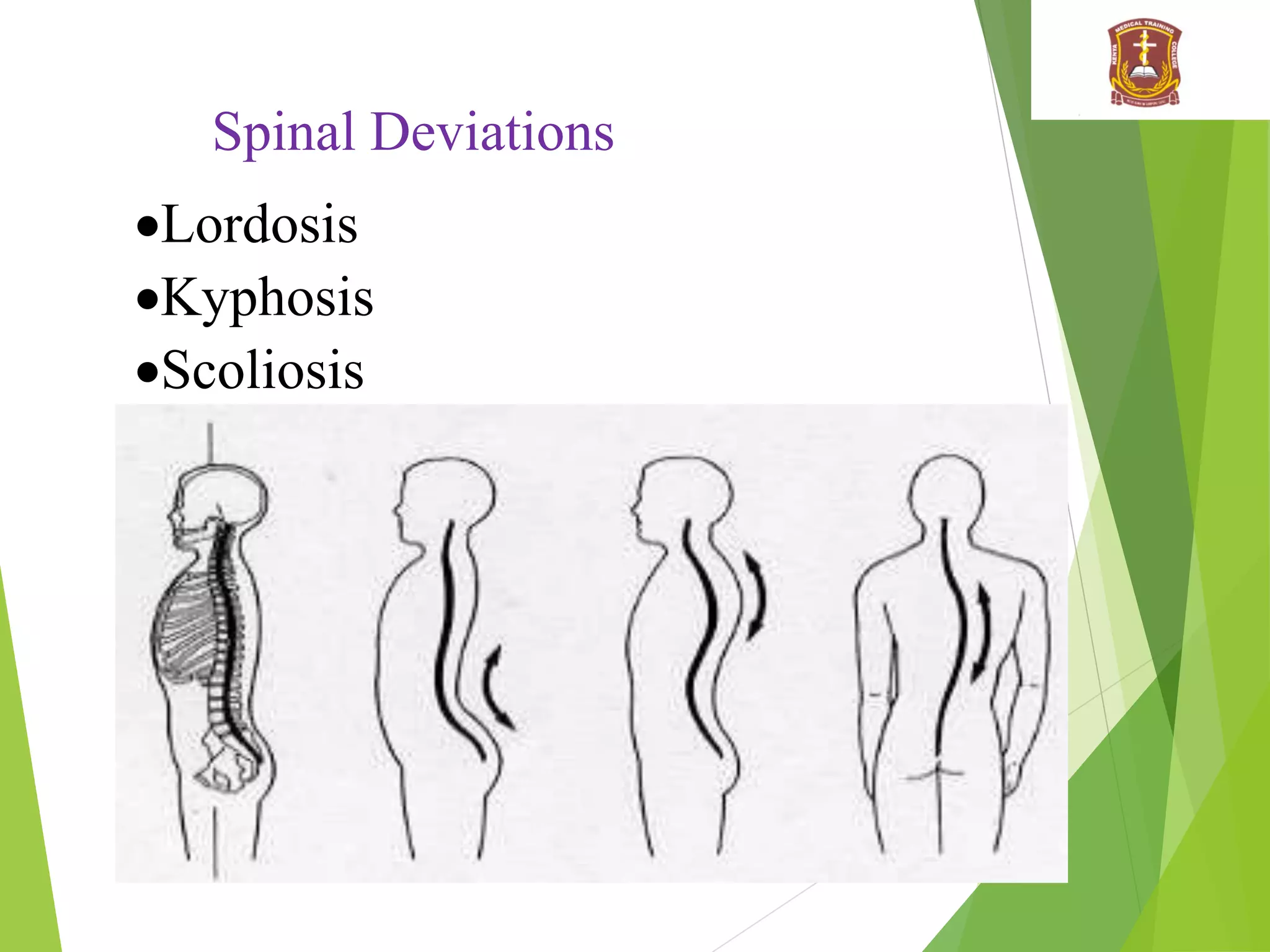
Spinal Deviations
Lordosis
Kyphosis
Scoliosis
Forces Acting on The Spine
Forces Acting On The Spine Include:
Body Weight
Tension In The Spinal Ligaments
Tension In The Surrounding Muscles
Intraabdominal Pressure
The Major Form of Loading on the Spine is:
Axial
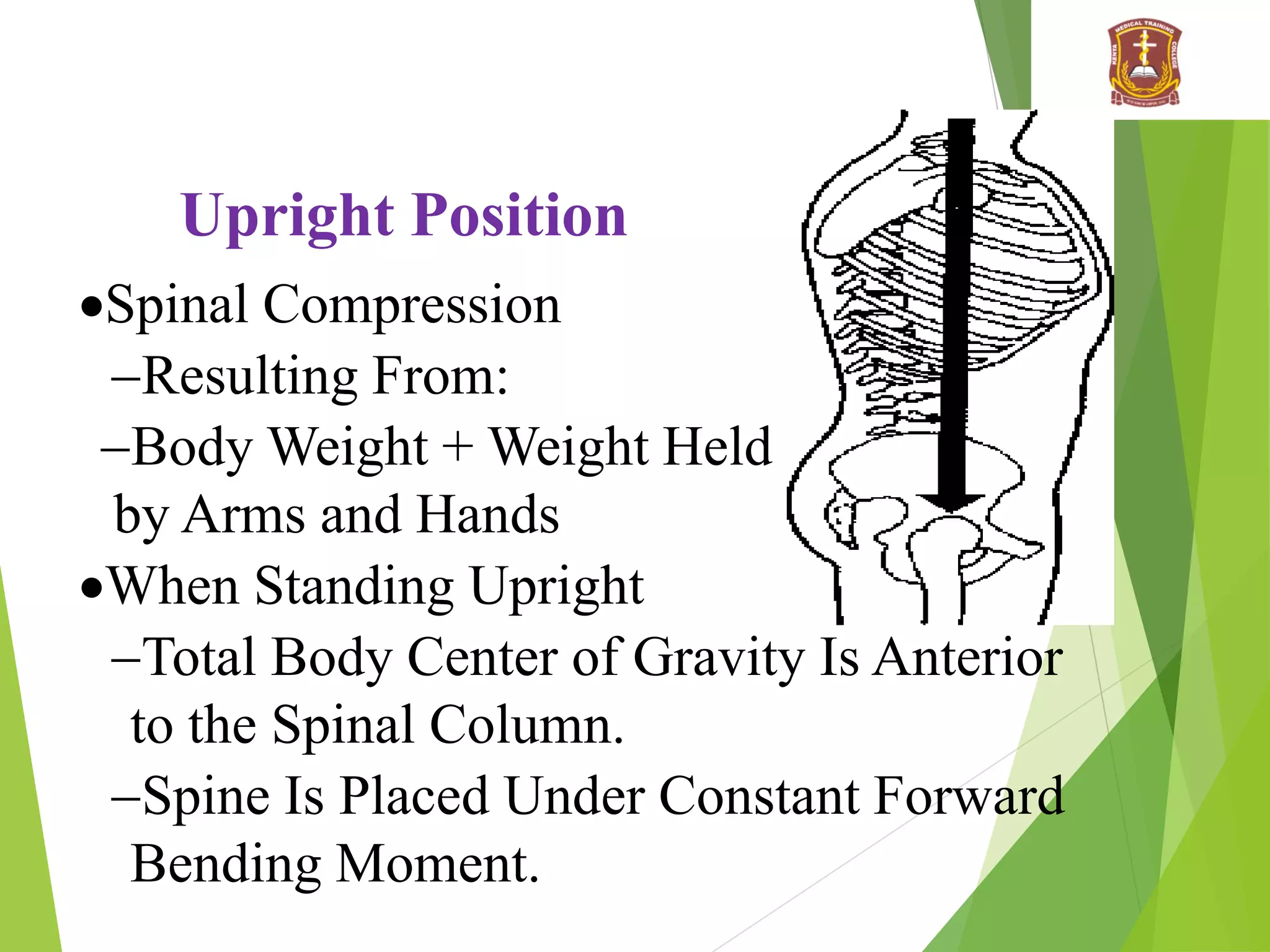
Upright Position
Spinal Compression
Resulting From:
Body Weight + Weight Held
by Arms and Hands
When Standing Upright
Total Body Center of Gravity Is Anterior
to the Spinal Column.
Spine Is Placed Under Constant Forward
Bending Moment.
Torque
Defined: The Rotary Effect of a Force About
An Axis of Rotation, Measured as the
Producer of the Force and the Perpendicular
Distance Between the Force’s Line of Action
And The Axis
To Maintain An Upright Position
– Torque Is Counteracted by Tension in the
Back Extensor Muscles.
Spinal Muscles Role In Lifting
Spinal muscles have small moment arms with
respect to the vertebral joints.
Have to generate large forces to counteract the
torque produced about the spine by body weight
and objects being
Erector Spinae
Muscles
Why Lift With The Legs?
 Back Muscles, With a Moment Arm of Approximately 6 cm,
Must Counter The Torque Produced by the Weights of the Body
Plus Any External Loads.
Question: How Much Torque Is Developed By
The Erector Spinae Muscles With a Fm 6 cm?
 1 lb. = 4.448 Newton’s
 Segment
Head
Trunk
Arms
Box
Weight
13 lbs. (58N)
73.75 lbs.
18.2 lbs. (81N)
24.95 lbs.
Moment Arm
25 cm
(328N) 10 cm
20 cm
(111N) 40 cm
 Torque at L5-S1=
 (328N)(10cm) + (81N)(20cm) +
(58N)(25cm) + (111N)(40cm)
• = ?
 10,790 Ncm
 Force?
 0 = (Fm)(6cm) - 10,790 In static position, sum
 of the torques acting at any point is zero.
 Fm = 1798.33 N or (404.30 lbs.)
Problem for a 135 lb. Person
 How much force must be developed by the erector spinae with a
moment arm of 6 cm. From the L5-S1 joint center to maintain the
body in a lifting position with segment moment arms as Specified?
 Segment Weight Moment Arm
– Head 50 N 22 cm.
– Trunk 280 N 12 cm.
– Arms 65 N 25 cm.
– Box
Lifted
100 N 42 cm.
Torque ?
10,285 Ncm
Fm = 1714 N or (393 lbs. Force)
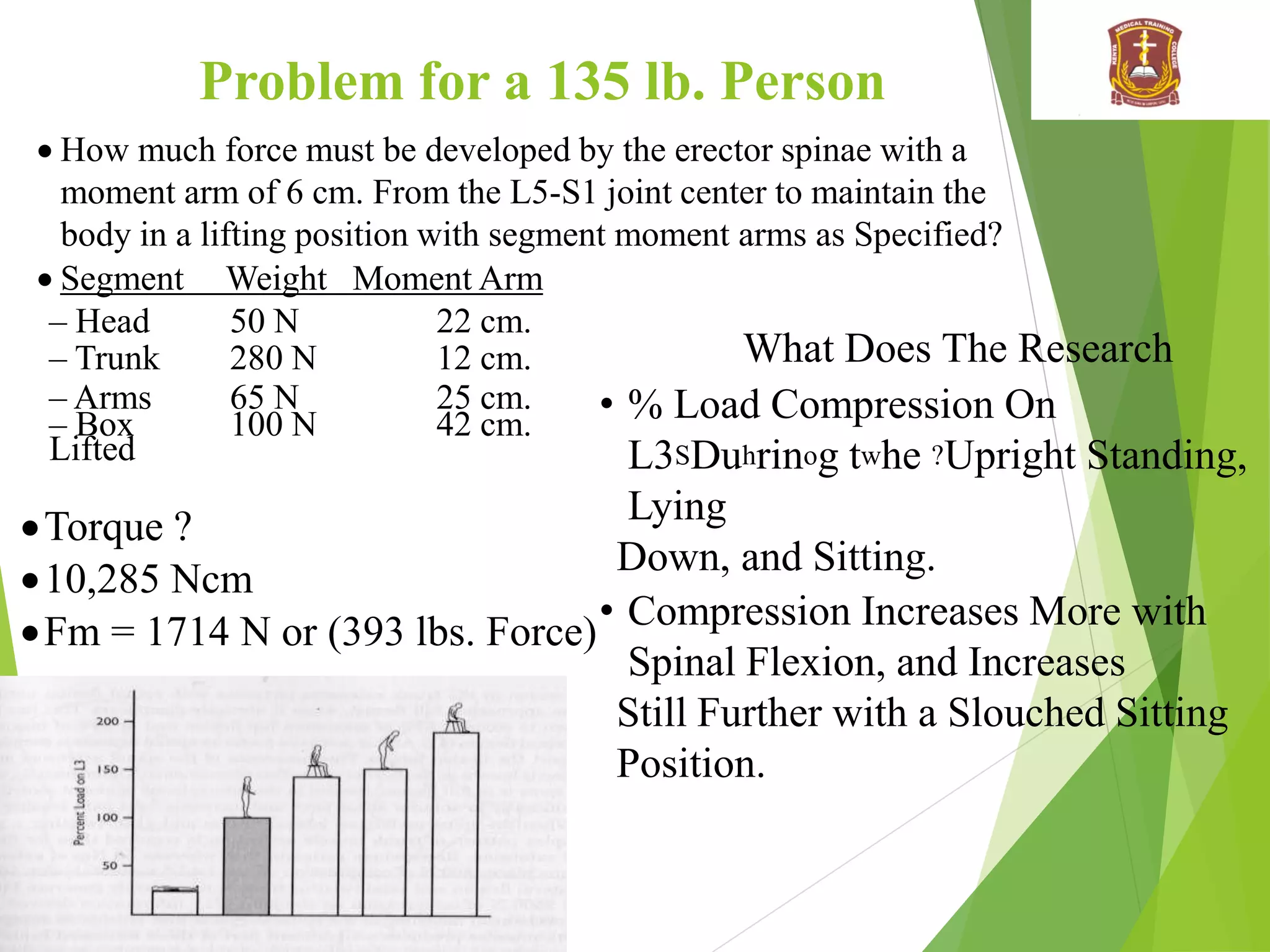
What Does The Research
• % Load Compression On
L3SDuhrinog twhe ?Upright Standing,
Lying
Down, and Sitting.
• Compression Increases More with
Spinal Flexion, and Increases
Still Further with a Slouched Sitting
Position.
Common Injuries Of
The Back
Low Back Pain
Soft Tissue Injuries
Acute Fractures
Stress Fractures
Disc Hernia ions
Whiplash Injuries
Low Back Pain
75%-80% of Americans
Experience Low
Back Pain Sometime During Life.
Second Only to the Common Cold
In Causing Absence In The
Workplace.
Mechanical Stress & Psychosocial.
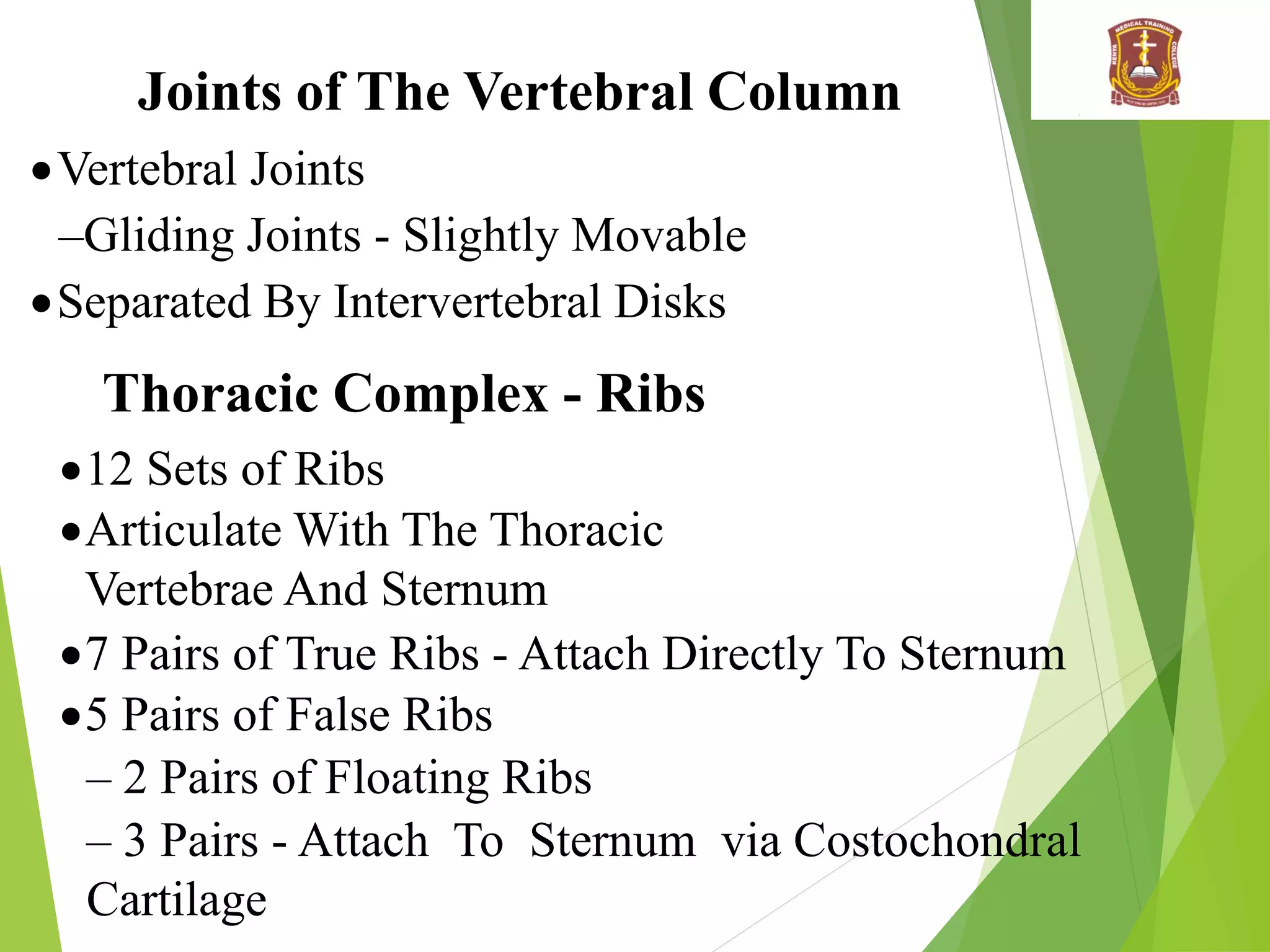
Back, Spinal Column, Neck
Vertebral Column
Ribs & Sternum
SPINAL COLLUMN
7 Cervical Vertebrae
12 Thoracic
5 Lumbar
1 Sacrum - Fused
1 Coccyx - 2 Fused
Joints of The Vertebral Column
Vertebral Joints
–Gliding Joints - Slightly Movable
Separated By Intervertebral Disks
Thoracic Complex - Ribs
12 Sets of Ribs
Articulate With The Thoracic
Vertebrae And Sternum
7 Pairs of True Ribs - Attach Directly To Sternum
5 Pairs of False Ribs
– 2 Pairs of Floating Ribs
– 3 Pairs - Attach To Sternum via Costochondral
Cartilage
Sternum
Manubrium
Body
Xiphoid Process
Muscles Of The Back, Neck &
Abdomen
Deep Posteriors
Abdominals
Vertebral
Superficial Neck Muscles
Prevention of Injuries to Back
Posture - Standing
Hyperlordosis
Kyphosis
Posture – Sitting
– Causing Pain To Lumbo/Sacral Area
Proper Sitting Technique -
Should Not be Done Over Long
Periods of Time
Hips Should Be Flexed
Legs Should Not Be Extended
Back Should Not Be Overly Arched
Proper Sitting Technique -
Should Not be Done Over Long
Periods of Time
Hips Should Be Flexed
Legs Should Not Be Extended
Back Should Not Be Overly Arched
Lifting With Proper Technique
Back Kept Erect
Knees Bent
Weight Close To Body
Strengthening Exercises
Many Back Problems Are Caused By Weak Muscles About
The Hip And Abdominals
Weak Muscles Predispose Back To Hyperlordosis
Incorrect Sit-ups May Cause Hyperlordosis - Caused By
Shortened Iliopsoas
Stretching - Hamstrings - Iliopsoas - Quadriceps
Lumbar Spine Evaluations
Standing Evaluation
Flex Forward - Palpating Spinous Processes &
Transverse Processes
Sitting Alignment
Patellar Reflex - Lumbar 4 Involvement
Achilles Reflex - Sacral 1 Involvement
Lying on Back
Test Abdominals - Rectus Abdominus , Iliopsoas (Hip Flexors)
–(Static W/ Stabilized Thighs - Hip
Flex At 45 Degrees
Straight Leg Raise
– Pain When Testing Unaffected
Side - Possible Herniated Disk
– Pain When Testing Affected Side
-Possible Sciatic Nerve Stretched
Occurring With The Spine
Soft Tissue Trauma - Contusions
Nerve Inflammation Or Compressions - From Disk
Protrusions
Fractures To The Spinous Or Transverse Processes
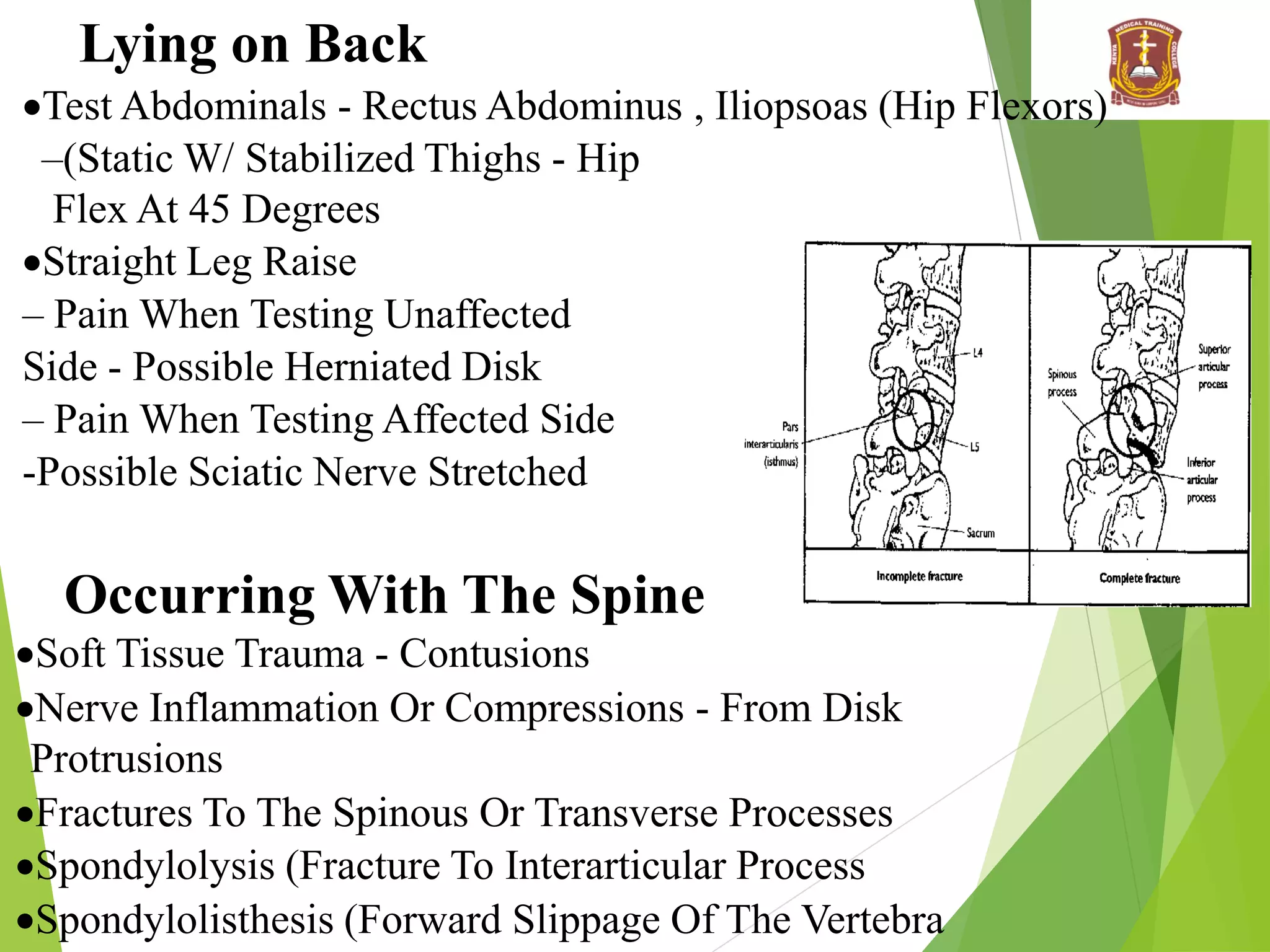
Spondylolysis (Fracture To Interarticular Process
Spondylolisthesis (Forward Slippage Of The Vertebra
Other Problems Occurring With
The Spine (Continued)
Groin Strains
Hip Pointe Rs
Hip Dislocations
Rehabilitation of Back and Hip Injury
Ice Message
Movement To Regain Flexibility &
Range
Strengthening Exercises
Sit Ups & Crunches (Work Oblique's As Well)
Pelvic Tilts - (Flattening Of Back Against Floor)
Hip Lifts - (From Lying On Back Position)
Back Extensions - To 90 Degrees
Psoas & Hamstring Stretch - (Knees To Chest)
Questions
Spine Biomechanics-1.pdf

Spine Biomechanics-1.pdf

  • 1.
    Department of Orthopaedic TraumaMedicine Year 1, Sem. 2 Subject – Biomechanics Topic – Biomechanics of the Spine & Hip By Mr. Oduor Wafulah 11th November, 2021.
  • 2.
    Biomechanics of theSpine & Hip Movements of Spine Flexion, Rotation, Extension, Abd, Add. Hip Movements Elevation, Anterior & Posterior Tilt, Flexion, Extension, Abd, Add, Hyperext, Hyperflex
  • 3.
  • 4.
    Forces Acting onThe Spine Forces Acting On The Spine Include: Body Weight Tension In The Spinal Ligaments Tension In The Surrounding Muscles Intraabdominal Pressure The Major Form of Loading on the Spine is: Axial
  • 5.
    Upright Position Spinal Compression ResultingFrom: Body Weight + Weight Held by Arms and Hands When Standing Upright Total Body Center of Gravity Is Anterior to the Spinal Column. Spine Is Placed Under Constant Forward Bending Moment.
  • 6.
    Torque Defined: The RotaryEffect of a Force About An Axis of Rotation, Measured as the Producer of the Force and the Perpendicular Distance Between the Force’s Line of Action And The Axis To Maintain An Upright Position – Torque Is Counteracted by Tension in the Back Extensor Muscles.
  • 7.
    Spinal Muscles RoleIn Lifting Spinal muscles have small moment arms with respect to the vertebral joints. Have to generate large forces to counteract the torque produced about the spine by body weight and objects being Erector Spinae Muscles
  • 8.
    Why Lift WithThe Legs?  Back Muscles, With a Moment Arm of Approximately 6 cm, Must Counter The Torque Produced by the Weights of the Body Plus Any External Loads. Question: How Much Torque Is Developed By The Erector Spinae Muscles With a Fm 6 cm?  1 lb. = 4.448 Newton’s  Segment Head Trunk Arms Box Weight 13 lbs. (58N) 73.75 lbs. 18.2 lbs. (81N) 24.95 lbs. Moment Arm 25 cm (328N) 10 cm 20 cm (111N) 40 cm  Torque at L5-S1=  (328N)(10cm) + (81N)(20cm) + (58N)(25cm) + (111N)(40cm) • = ?  10,790 Ncm  Force?  0 = (Fm)(6cm) - 10,790 In static position, sum  of the torques acting at any point is zero.  Fm = 1798.33 N or (404.30 lbs.)
  • 9.
    Problem for a135 lb. Person  How much force must be developed by the erector spinae with a moment arm of 6 cm. From the L5-S1 joint center to maintain the body in a lifting position with segment moment arms as Specified?  Segment Weight Moment Arm – Head 50 N 22 cm. – Trunk 280 N 12 cm. – Arms 65 N 25 cm. – Box Lifted 100 N 42 cm. Torque ? 10,285 Ncm Fm = 1714 N or (393 lbs. Force) What Does The Research • % Load Compression On L3SDuhrinog twhe ?Upright Standing, Lying Down, and Sitting. • Compression Increases More with Spinal Flexion, and Increases Still Further with a Slouched Sitting Position.
  • 10.
    Common Injuries Of TheBack Low Back Pain Soft Tissue Injuries Acute Fractures Stress Fractures Disc Hernia ions Whiplash Injuries Low Back Pain 75%-80% of Americans Experience Low Back Pain Sometime During Life. Second Only to the Common Cold In Causing Absence In The Workplace. Mechanical Stress & Psychosocial.
  • 11.
    Back, Spinal Column,Neck Vertebral Column Ribs & Sternum SPINAL COLLUMN 7 Cervical Vertebrae 12 Thoracic 5 Lumbar 1 Sacrum - Fused 1 Coccyx - 2 Fused
  • 12.
    Joints of TheVertebral Column Vertebral Joints –Gliding Joints - Slightly Movable Separated By Intervertebral Disks Thoracic Complex - Ribs 12 Sets of Ribs Articulate With The Thoracic Vertebrae And Sternum 7 Pairs of True Ribs - Attach Directly To Sternum 5 Pairs of False Ribs – 2 Pairs of Floating Ribs – 3 Pairs - Attach To Sternum via Costochondral Cartilage
  • 13.
    Sternum Manubrium Body Xiphoid Process Muscles OfThe Back, Neck & Abdomen Deep Posteriors Abdominals Vertebral Superficial Neck Muscles
  • 14.
    Prevention of Injuriesto Back Posture - Standing Hyperlordosis Kyphosis Posture – Sitting – Causing Pain To Lumbo/Sacral Area Proper Sitting Technique - Should Not be Done Over Long Periods of Time Hips Should Be Flexed Legs Should Not Be Extended Back Should Not Be Overly Arched
  • 15.
    Proper Sitting Technique- Should Not be Done Over Long Periods of Time Hips Should Be Flexed Legs Should Not Be Extended Back Should Not Be Overly Arched Lifting With Proper Technique Back Kept Erect Knees Bent Weight Close To Body
  • 16.
    Strengthening Exercises Many BackProblems Are Caused By Weak Muscles About The Hip And Abdominals Weak Muscles Predispose Back To Hyperlordosis Incorrect Sit-ups May Cause Hyperlordosis - Caused By Shortened Iliopsoas Stretching - Hamstrings - Iliopsoas - Quadriceps Lumbar Spine Evaluations Standing Evaluation Flex Forward - Palpating Spinous Processes & Transverse Processes Sitting Alignment Patellar Reflex - Lumbar 4 Involvement Achilles Reflex - Sacral 1 Involvement
  • 17.
    Lying on Back TestAbdominals - Rectus Abdominus , Iliopsoas (Hip Flexors) –(Static W/ Stabilized Thighs - Hip Flex At 45 Degrees Straight Leg Raise – Pain When Testing Unaffected Side - Possible Herniated Disk – Pain When Testing Affected Side -Possible Sciatic Nerve Stretched Occurring With The Spine Soft Tissue Trauma - Contusions Nerve Inflammation Or Compressions - From Disk Protrusions Fractures To The Spinous Or Transverse Processes Spondylolysis (Fracture To Interarticular Process Spondylolisthesis (Forward Slippage Of The Vertebra
  • 18.
    Other Problems OccurringWith The Spine (Continued) Groin Strains Hip Pointe Rs Hip Dislocations Rehabilitation of Back and Hip Injury Ice Message Movement To Regain Flexibility & Range Strengthening Exercises Sit Ups & Crunches (Work Oblique's As Well) Pelvic Tilts - (Flattening Of Back Against Floor) Hip Lifts - (From Lying On Back Position) Back Extensions - To 90 Degrees Psoas & Hamstring Stretch - (Knees To Chest)
  • 19.