

Postoperative Spinal InfectionSohail Bajammal, MBChB, MSc, FRCS(C), PhD(c)Consultant Orthopaedic Spine Surgeon, Al-Noor Specialist HospitalAssistant Professor, Umm Al-Qura UniversityMakkah, Saudi ArabiaMay 13, 2010
“A surgeon who has no complications is a surgeon who either does not operate or is not truthful.”Herkowitz HN. Foreword. In An HS, Jenis LG (ed): Complications of Spine Surgery: Treatment and Prevention. Lippincott Williams & Wilkins. 2006.
ObjectivesBy the end of the lecture, you will be able toIdentify the incidence & risk factors of postoperative spinal infectionList the preventive measuresDevise a diagnostic planFormulate a treatment plan
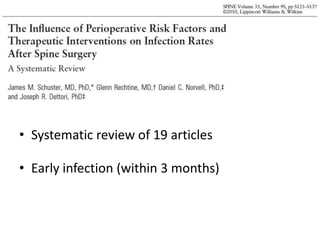
Systematic review of 19 articlesEarly infection (within 3 months)
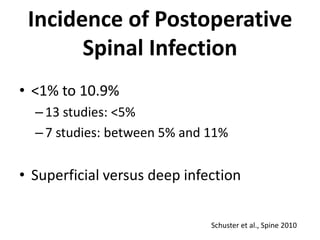
Incidence of Postoperative Spinal Infection<1% to 10.9%13 studies: <5%7 studies: between 5% and 11%Superficial versus deep infectionSchuster et al., Spine 2010
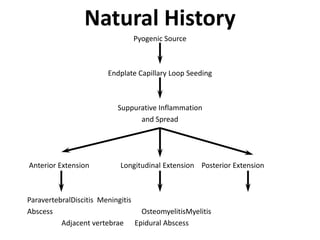
Natural HistoryPyogenic SourceEndplate Capillary Loop SeedingSuppurative Inflammationand Spread Anterior Extension                 Longitudinal Extension    Posterior ExtensionParavertebralDiscitis  MeningitisAbscess                    			          OsteomyelitisMyelitis 		          Adjacent vertebrae      Epidural Abscess
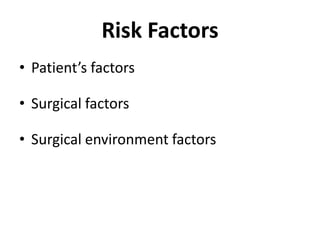
Risk FactorsPatient’s factorsSurgical factorsSurgical environment factors
Patient’s Factors
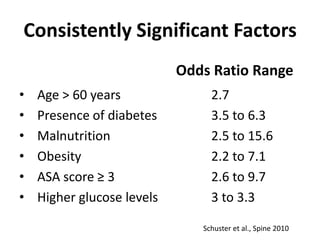
Consistently Significant FactorsOdds Ratio RangeAge > 60 years	Presence of diabetesMalnutritionObesityASA score ≥ 3Higher glucose levels2.73.5 to 6.32.5 to 15.62.2 to 7.12.6 to 9.73 to 3.3Schuster et al., Spine 2010
Not Consistently SignificantGenderSteroid therapySmokingPrevious spine surgerySchuster et al., Spine 2010
Surgical FactorsPosterior approachInstrumentationBone graft harvestBlood loss or blood transfusionDuration of surgeryOperative technique: Soft tissue dissectionForeign bodyDead spaceSoft tissue coverageSchuster et al., Spine 2010
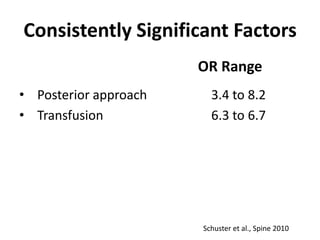
Consistently Significant FactorsOR RangePosterior approach	Transfusion3.4 to 8.26.3 to 6.7Schuster et al., Spine 2010
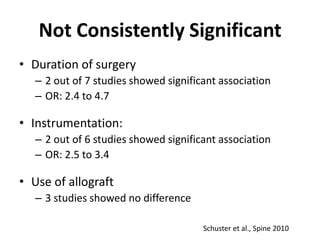
Not Consistently SignificantDuration of surgery2 out of 7 studies showed significant associationOR: 2.4 to 4.7Instrumentation:2 out of 6 studies showed significant associationOR: 2.5 to 3.4 Use of allograft3 studies showed no differenceSchuster et al., Spine 2010
Surgical EnvironmentPreppingDrapingRoom traffic: number, talkingContaminated instrumentsUse of intraoperativefluoroscopySchuster et al., Spine 2010
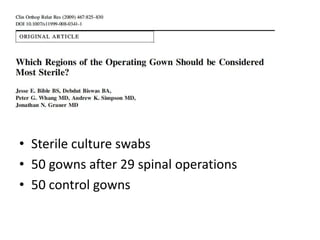
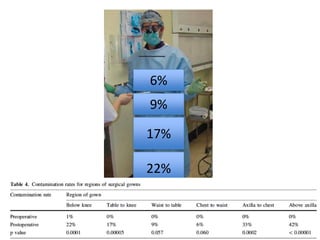
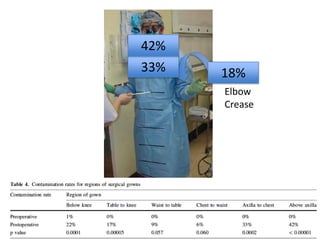
Sterile culture swabs50 gowns after 29 spinal operations50 control gowns
6%9%17%22%
42%33%18%Elbow Crease
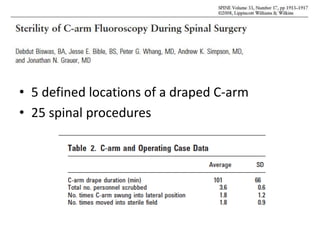
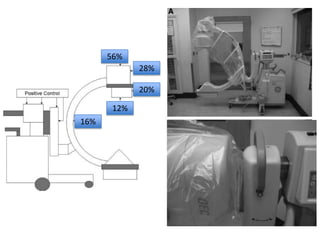
5 defined locations of a draped C-arm25 spinal procedures
56%28%20%12%16%
Prevention
It is easier to stay out of trouble than to get out of trouble
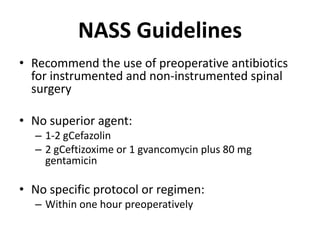
NASS GuidelinesRecommend the use of preoperative antibiotics for instrumented and non-instrumented spinal surgeryNo superior agent:1-2 gCefazolin2 gCeftizoxime or 1 gvancomycin plus 80 mg gentamicinNo specific protocol or regimen:Within one hour preoperatively
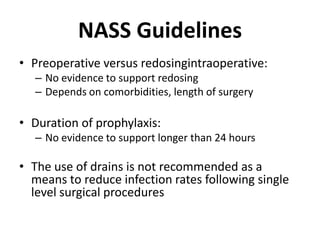
NASS GuidelinesPreoperative versus redosingintraoperative:No evidence to support redosingDepends on comorbidities, length of surgeryDuration of prophylaxis:No evidence to support longer than 24 hoursThe use of drains is not recommended as a means to reduce infection rates following single level surgical procedures
Prep Solution
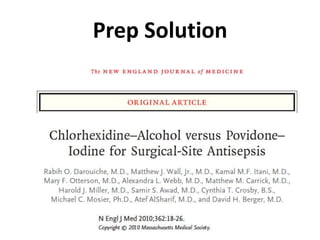
Prep Solution849 patientspreoperatively scrubbed with an applicator that contained 2% chlorhexidinegluconate and 70% isopropyl alcoholORpreoperatively scrubbed and then painted with an aqueous solution of 10% povidone–iodine
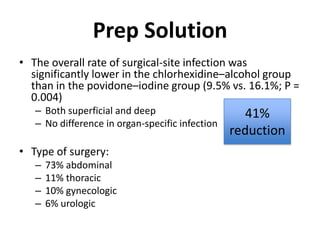
Prep SolutionThe overall rate of surgical-site infection was significantly lower in the chlorhexidine–alcohol group than in the povidone–iodine group (9.5% vs. 16.1%; P = 0.004)Both superficial and deepNo difference in organ-specific infectionType of surgery: 73% abdominal11% thoracic10% gynecologic6% urologic41% reduction
Alcohol-based productsFlammable  risk of fire & chemical burnsEspecially with oxygen source & electrocauteryPrep carefully: Donot use 26-ml applicator for head and neck surgery, do not useon an area smaller than 8.4 in. x 8.4 in., use a smaller applicatorinstead. Do not drape or use ignition source until solutionis completely dry (minimum of 3 minutes on hairless skin, upto 1 hour in hair). Do not allow solution to pool; remove wetmaterials from prep area."
Irrigation SolutionTwo RCTs reported lower infection rates in patients treated with 3.5% Betadine solution compared with saline solution:Cheng et al, Spine 2005Chang et al, Eur Spine J 2006Schuster et al., Spine 2010
Prevention - PreoperativeTreat other infections before starting elective surgeryHair removal: When? How?Glycemic ControlSmoking cessationNutritional status: lymphoctytes counts, albumin
Prevention - IntraoperativeProphylactic antibiotics: When? What? Repeat?Reduce trafficRelease retraction regularlyIrrigate regularlyStrict aseptic technique
Prevention - PostoperativeProphylactic antibiotics: how long?Treat concomitant infectionsMaintain dressing for 48 hours
Diagnosis & Treatment
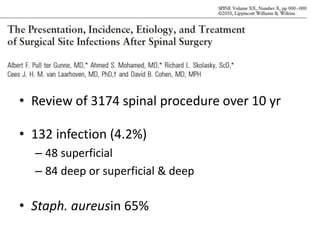
Review of 3174 spinal procedure over 10 yr132 infection (4.2%)48 superficial84 deep or superficial & deepStaph. aureusin 65%
Clinical PresentationFever (26%)Pain (28%)Erythema (19%, less common in deep infection)Swelling WarmthTenderness to palpationWound drainage (68%, most common sign)Neurological signs & symptomsPull terGunne et al, Spine 2010
InvestigationLaboratory:CBCESRCRPBlood cultureImaging:Plain X-raysCT-guided biopsyMRI with contrast: differentiate infection, scar, recurrenceGallium bone scan
InvestigationCBC (WBC):Not reliable, elevated in less than 50%ESR:Normal peak at 2 weeks, return to normal at 6 weeksElevated in 94% of infectionCRP:Normally takes 2 weeks to normalizeElevated in 97% of deep infectionBlood culture: Positive in 30% of vertebral osteomyelitisThelander et al, Spine 1992
Treatment GoalsAppropriate selection of antibiotics & eradicate infectionObtain stable physiological wound closureRestore the mechanical integrity of the spine
Decision MakingSuperficial to the fasciaDeep to the fascia
Superficial InfectionIncision and drainageInspection of fasciaAspiration of superficial and deep compartmentsOral antibiotics (average 2 weeks, follow CRP)Close or secondary intention (wet to dry dressing)Pull terGunne et al, Spine 2010
Deep InfectionOptimal treatment:Wound debridementRemoval of instrumentationIV antibiotics 6-8 weeks, then oral antibiotics 2 weeks (follow CRP)
Deep Infection ControversyInstrumentation: retain, replace primarily, replace delayedWound closure: primary with suction, primary without suction, secondary intention
Deep Infected Spinal InstrumentationRetain if stableWeinstein et al, J Spin Disorders 2000Mok et al, Spine 2009Pull terGunne et al, Spine 2010Remove and replace primarilyPull terGunne et al, Spine 2010Remove and replace later:Bose, Spine J 2003Tsiodras et al, ClinOrthopRelat Res 2006
Deep infection wound managementFollowing debridement:Primary closure:Mok et al, Spine 2009Pull terGunne et al, Spine 2010A second look surgery:Weinstein et al, J Spin Disorders 2000Tsiodraset al, ClinOrthopRelat Res2006
Specific InfectionsMeningitisPsoas AbscessEpidural AbscessPostoperative DiscitisVertebral Osteomyelitis
SummaryConsider patients, surgical & environmental risk factorsPreoperative antibiotics, prep solution & irrigation solutionCRP is the most sensitive markerDeep infection controversy re: retention of hardware & wound closuressbajammal@uqu.edu.sa

Postoperative Spinal Infection

  • 1.
    Postoperative Spinal InfectionSohailBajammal, MBChB, MSc, FRCS(C), PhD(c)Consultant Orthopaedic Spine Surgeon, Al-Noor Specialist HospitalAssistant Professor, Umm Al-Qura UniversityMakkah, Saudi ArabiaMay 13, 2010
  • 2.
    “A surgeon whohas no complications is a surgeon who either does not operate or is not truthful.”Herkowitz HN. Foreword. In An HS, Jenis LG (ed): Complications of Spine Surgery: Treatment and Prevention. Lippincott Williams & Wilkins. 2006.
  • 3.
    ObjectivesBy the endof the lecture, you will be able toIdentify the incidence & risk factors of postoperative spinal infectionList the preventive measuresDevise a diagnostic planFormulate a treatment plan
  • 4.
    Systematic review of19 articlesEarly infection (within 3 months)
  • 5.
    Incidence of PostoperativeSpinal Infection<1% to 10.9%13 studies: <5%7 studies: between 5% and 11%Superficial versus deep infectionSchuster et al., Spine 2010
  • 6.
    Natural HistoryPyogenic SourceEndplateCapillary Loop SeedingSuppurative Inflammationand Spread Anterior Extension Longitudinal Extension Posterior ExtensionParavertebralDiscitis MeningitisAbscess OsteomyelitisMyelitis Adjacent vertebrae Epidural Abscess
  • 7.
    Risk FactorsPatient’s factorsSurgicalfactorsSurgical environment factors
  • 8.
  • 9.
    Consistently Significant FactorsOddsRatio RangeAge > 60 years Presence of diabetesMalnutritionObesityASA score ≥ 3Higher glucose levels2.73.5 to 6.32.5 to 15.62.2 to 7.12.6 to 9.73 to 3.3Schuster et al., Spine 2010
  • 10.
    Not Consistently SignificantGenderSteroidtherapySmokingPrevious spine surgerySchuster et al., Spine 2010
  • 11.
    Surgical FactorsPosterior approachInstrumentationBonegraft harvestBlood loss or blood transfusionDuration of surgeryOperative technique: Soft tissue dissectionForeign bodyDead spaceSoft tissue coverageSchuster et al., Spine 2010
  • 12.
    Consistently Significant FactorsORRangePosterior approach Transfusion3.4 to 8.26.3 to 6.7Schuster et al., Spine 2010
  • 13.
    Not Consistently SignificantDurationof surgery2 out of 7 studies showed significant associationOR: 2.4 to 4.7Instrumentation:2 out of 6 studies showed significant associationOR: 2.5 to 3.4 Use of allograft3 studies showed no differenceSchuster et al., Spine 2010
  • 14.
    Surgical EnvironmentPreppingDrapingRoom traffic:number, talkingContaminated instrumentsUse of intraoperativefluoroscopySchuster et al., Spine 2010
  • 15.
    Sterile culture swabs50gowns after 29 spinal operations50 control gowns
  • 16.
  • 17.
  • 18.
    5 defined locationsof a draped C-arm25 spinal procedures
  • 19.
  • 20.
  • 21.
    It is easierto stay out of trouble than to get out of trouble
  • 23.
    NASS GuidelinesRecommend theuse of preoperative antibiotics for instrumented and non-instrumented spinal surgeryNo superior agent:1-2 gCefazolin2 gCeftizoxime or 1 gvancomycin plus 80 mg gentamicinNo specific protocol or regimen:Within one hour preoperatively
  • 24.
    NASS GuidelinesPreoperative versusredosingintraoperative:No evidence to support redosingDepends on comorbidities, length of surgeryDuration of prophylaxis:No evidence to support longer than 24 hoursThe use of drains is not recommended as a means to reduce infection rates following single level surgical procedures
  • 25.
  • 26.
    Prep Solution849 patientspreoperativelyscrubbed with an applicator that contained 2% chlorhexidinegluconate and 70% isopropyl alcoholORpreoperatively scrubbed and then painted with an aqueous solution of 10% povidone–iodine
  • 27.
    Prep SolutionThe overallrate of surgical-site infection was significantly lower in the chlorhexidine–alcohol group than in the povidone–iodine group (9.5% vs. 16.1%; P = 0.004)Both superficial and deepNo difference in organ-specific infectionType of surgery: 73% abdominal11% thoracic10% gynecologic6% urologic41% reduction
  • 28.
    Alcohol-based productsFlammable risk of fire & chemical burnsEspecially with oxygen source & electrocauteryPrep carefully: Donot use 26-ml applicator for head and neck surgery, do not useon an area smaller than 8.4 in. x 8.4 in., use a smaller applicatorinstead. Do not drape or use ignition source until solutionis completely dry (minimum of 3 minutes on hairless skin, upto 1 hour in hair). Do not allow solution to pool; remove wetmaterials from prep area."
  • 29.
    Irrigation SolutionTwo RCTsreported lower infection rates in patients treated with 3.5% Betadine solution compared with saline solution:Cheng et al, Spine 2005Chang et al, Eur Spine J 2006Schuster et al., Spine 2010
  • 30.
    Prevention - PreoperativeTreatother infections before starting elective surgeryHair removal: When? How?Glycemic ControlSmoking cessationNutritional status: lymphoctytes counts, albumin
  • 31.
    Prevention - IntraoperativeProphylacticantibiotics: When? What? Repeat?Reduce trafficRelease retraction regularlyIrrigate regularlyStrict aseptic technique
  • 32.
    Prevention - PostoperativeProphylacticantibiotics: how long?Treat concomitant infectionsMaintain dressing for 48 hours
  • 33.
  • 34.
    Review of 3174spinal procedure over 10 yr132 infection (4.2%)48 superficial84 deep or superficial & deepStaph. aureusin 65%
  • 35.
    Clinical PresentationFever (26%)Pain(28%)Erythema (19%, less common in deep infection)Swelling WarmthTenderness to palpationWound drainage (68%, most common sign)Neurological signs & symptomsPull terGunne et al, Spine 2010
  • 36.
    InvestigationLaboratory:CBCESRCRPBlood cultureImaging:Plain X-raysCT-guidedbiopsyMRI with contrast: differentiate infection, scar, recurrenceGallium bone scan
  • 37.
    InvestigationCBC (WBC):Not reliable,elevated in less than 50%ESR:Normal peak at 2 weeks, return to normal at 6 weeksElevated in 94% of infectionCRP:Normally takes 2 weeks to normalizeElevated in 97% of deep infectionBlood culture: Positive in 30% of vertebral osteomyelitisThelander et al, Spine 1992
  • 38.
    Treatment GoalsAppropriate selectionof antibiotics & eradicate infectionObtain stable physiological wound closureRestore the mechanical integrity of the spine
  • 39.
    Decision MakingSuperficial tothe fasciaDeep to the fascia
  • 40.
    Superficial InfectionIncision anddrainageInspection of fasciaAspiration of superficial and deep compartmentsOral antibiotics (average 2 weeks, follow CRP)Close or secondary intention (wet to dry dressing)Pull terGunne et al, Spine 2010
  • 41.
    Deep InfectionOptimal treatment:WounddebridementRemoval of instrumentationIV antibiotics 6-8 weeks, then oral antibiotics 2 weeks (follow CRP)
  • 42.
    Deep Infection ControversyInstrumentation:retain, replace primarily, replace delayedWound closure: primary with suction, primary without suction, secondary intention
  • 43.
    Deep Infected SpinalInstrumentationRetain if stableWeinstein et al, J Spin Disorders 2000Mok et al, Spine 2009Pull terGunne et al, Spine 2010Remove and replace primarilyPull terGunne et al, Spine 2010Remove and replace later:Bose, Spine J 2003Tsiodras et al, ClinOrthopRelat Res 2006
  • 44.
    Deep infection woundmanagementFollowing debridement:Primary closure:Mok et al, Spine 2009Pull terGunne et al, Spine 2010A second look surgery:Weinstein et al, J Spin Disorders 2000Tsiodraset al, ClinOrthopRelat Res2006
  • 45.
    Specific InfectionsMeningitisPsoas AbscessEpiduralAbscessPostoperative DiscitisVertebral Osteomyelitis
  • 46.
    SummaryConsider patients, surgical& environmental risk factorsPreoperative antibiotics, prep solution & irrigation solutionCRP is the most sensitive markerDeep infection controversy re: retention of hardware & wound closuressbajammal@uqu.edu.sa