P R E S E N T A T I O N B Y : D R . M A H E N D R A F E F A R
D R . D . Y . P A T I L H O S P I T A L , N A V I M U M B A I
CERVICAL
MYELOPATHY
DEFINITION
• Cervical myelopathy is the manifestation of long-tract
signs resulting from a decrease in the space available for
cervical spinal cord due to progressive multilevel
circumferential compressive disease.
• Any space occupying lesion within the cervical spine with
the potential to compress the spinal cord can cause
cervical myelopathy.
• Cervical spondylosis is the most common cause of
cervical spinal cord dysfunction in individuals older than
55 years.
CERVICAL SPONDYLOSIS
• progressive degerative changes that develop slowly over
time, this alters the spinal bio-mechanisms from the loss
of shock absorption properties of intervertebral discs.
• This leads to secondary changes surrounding structures.
CERVICAL SPONDYLOSIS
• causes main 3 syndromes
1. Cervical radiculopathy( compression and
inflammation of spinal nerve with symptoms that
correspond to the level involved)
2. Cervical myelopathy: cord involvment
3. Axial joint pain( mecanical neck pain, discogenic pain,
facet syndrome, painful instability)
EPIDEMIOLOGY
• Cervical myelopathy is more common in men > women.
• Radio-logically, the condition is present in 13% of men in the third
decade and almost 100% of men over the age of 70.
• In women the disease presents later, with 5% showing radiographic
changes in the fourth decade going up to 96% in women over the age
of 70.
• Changes are more common in patients with RA where 85% of those
with moderate to severe disease will have x-ray changes.
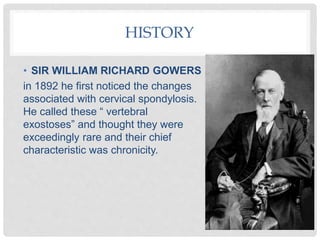
HISTORY
• SIR WILLIAM RICHARD GOWERS
in 1892 he first noticed the changes
associated with cervical spondylosis.
He called these “ vertebral
exostoses” and thought they were
exceedingly rare and their chief
characteristic was chronicity.
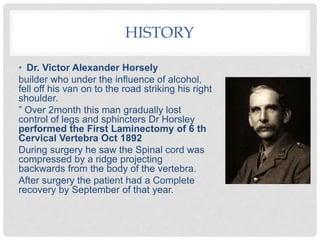
HISTORY
• Dr. Victor Alexander Horsely
builder who under the influence of alcohol,
fell off his van on to the road striking his right
shoulder.
” Over 2month this man gradually lost
control of legs and sphincters Dr Horsley
performed the First Laminectomy of 6 th
Cervical Vertebra Oct 1892
During surgery he saw the Spinal cord was
compressed by a ridge projecting
backwards from the body of the vertebra.
After surgery the patient had a Complete
recovery by September of that year.
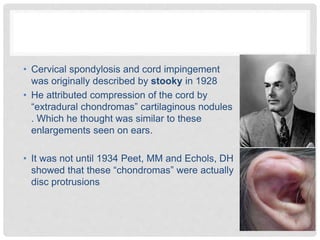
• Cervical spondylosis and cord impingement
was originally described by stooky in 1928
• He attributed compression of the cord by
“extradural chondromas” cartilaginous nodules
. Which he thought was similar to these
enlargements seen on ears.
• It was not until 1934 Peet, MM and Echols, DH
showed that these “chondromas” were actually
disc protrusions
HISTORY
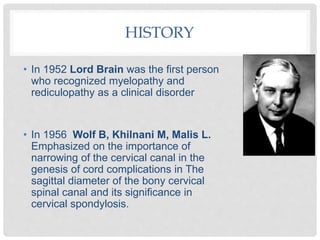
• In 1952 Lord Brain was the first person
who recognized myelopathy and
rediculopathy as a clinical disorder
• In 1956 Wolf B, Khilnani M, Malis L.
Emphasized on the importance of
narrowing of the cervical canal in the
genesis of cord complications in The
sagittal diameter of the bony cervical
spinal canal and its significance in
cervical spondylosis.
ETIOLOGY
1.Congenital
• Myelopathy due to congenital stenosis does not have a
specific underlying lesion. It is caused by a canal diameter
which is narrower from birth.
• It is often not symptomatic until secondary degeneration
further narrows the canal
2. Constitutional Stenoses
• Pure constitutional stenosis rarely is a cause of cervical
myelopathy except in extreme cases of severe stenosis as in
achondroplasia.
• It is more often a predisposing factor.
ETIOLOGY
3. Spondylosis
• CSM is the result of degenerative changes which
develop with age, including ligamentum flavum
hypertrophy or buckling, facet joint hypertrophy, disc
protrusion and posterior spondylotic ridges.
• One or all of these changes contribute to an overall
reduction in canal diameter which may result in cord
compression.
• Spondylolisthesis usually occurs in the lower cervical
spine. It is caused by arthrosis of the facet joints
combined with disc degeneration leading to instability.
4. Disc Herniation
• Discogenic disease may cause myelopathy in the acute
setting as a large central soft disc herniation causing
cord compression. Disc disease is also often seen as
part of the compressive lesion in spondylotic disease
5. Post traumatic myelopathy
• Trauma may induce myelopathy or precipitate
symptoms of an underlying stenosis of the spinal canal.
• Smaller diameter canals have an increased chance of
neurological injury in trauma
ETIOLOGY
6. Ossification of the posterior longitudinal ligament (OPLL)
• This is a common feature in patients with cervical myelopathy with 5%
being affected.
• Ossification usually starts behind the body of C5 and progressively
spreads through the entire cervical spine in contrast to segmental (or
localized) forms, discontinuous or continuous forms.
• The extent is best defined by CT. The pathogenesis of OPLL remains
uncertain: osteogenesis ensues from hypertrophied and hypervascular
ligament when it detaches from the posterior surface of the vertebra by
disc protrusions.
ETIOLOGY
7. Myelopathy due to tumour expansion
• Intraspinal tumours are a relatively uncommon cause of
cervical myelopathy but must always be considered
given the potentially catastrophic consequences of the
diagnosis being missed.
• Tumours may originate in the spinal cord (intramedullary
tumours) or compress from outside (extramedullary
tumours).
• Metastatic deposits are usually slow growing with
gradual onset of symptoms.
ETIOLOGY
8. Other etiologies
• Cervical rheumatoid arthritis affecting especially the
upper cervical spine (atlanto-axial dislocation) and to a
lesser extent the lower cervical spine may present with
the clinical picture of cervical myelopathy .
• Rare neurologic complications which can cause
narrowing of the cervical canal such ankylosing
spondylitis, gouty tophi from the posterior joints and
vertebral ankylosing hyperostosis (Forestier's disease)
or Paget's disease.
ETIOLOGY
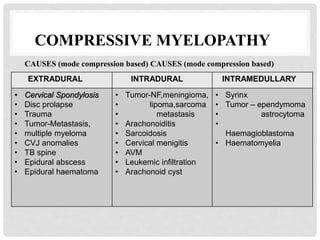
EXTRADURAL INTRADURAL INTRAMEDULLARY
• Cervical Spondylosis
• Disc prolapse
• Trauma
• Tumor-Metastasis,
• multiple myeloma
• CVJ anomalies
• TB spine
• Epidural abscess
• Epidural haematoma
• Tumor-NF,meningioma,
• lipoma,sarcoma
• metastasis
• Arachonoiditis
• Sarcoidosis
• Cervical menigitis
• AVM
• Leukemic infiltration
• Arachonoid cyst
• Syrinx
• Tumor – ependymoma
• astrocytoma
•
Haemagioblastoma
• Haematomyelia
COMPRESSIVE MYELOPATHY
CAUSES (mode compression based) CAUSES (mode compression based)
• One of the most common causes of cervical myelopathy
is Extradural compression of the cord, which can occur
as a result of
# Spinal trauma
# Mass lesions
# Degenerative changes of the
Spine, or other factors
• When cord compression is caused by degenerative
changes it is cervical spondylotic myelopathy (CSM),
which will be the focus
ETIOLOGY
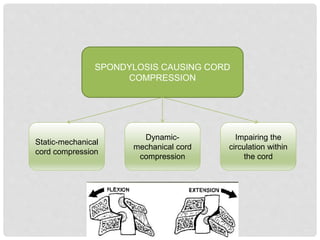
Static-mechanical
cord compression
Dynamic-
mechanical cord
compression
Impairing the
circulation within
the cord
SPONDYLOSIS CAUSING CORD
COMPRESSION
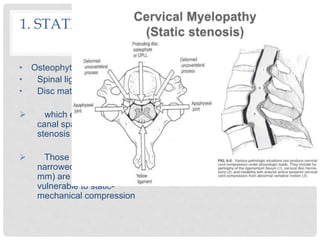
1. STATIC-MECHANICAL COMPRESSION
OF THE CORD
• Osteophytes
• Spinal ligaments
• Disc material
 which encroach upon the
canal space resulting in
stenosis of the canal
 Those with a congenitally
narrowed spinal canal (10-13
mm) are especially
vulnerable to static-
mechanical compression
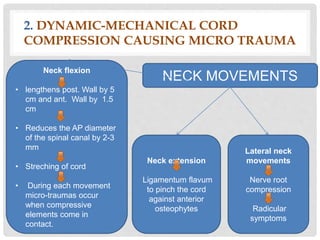
2. DYNAMIC-MECHANICAL CORD
COMPRESSION CAUSING MICRO TRAUMA
Neck flexion
• lengthens post. Wall by 5
cm and ant. Wall by 1.5
cm
• Reduces the AP diameter
of the spinal canal by 2-3
mm
• Streching of cord
• During each movement
micro-traumas occur
when compressive
elements come in
contact.
Neck extension
Ligamentum flavum
to pinch the cord
against anterior
osteophytes
Lateral neck
movements
Nerve root
compression
Radicular
symptoms
NECK MOVEMENTS
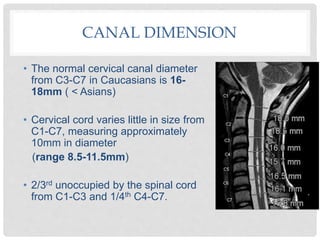
CANAL DIMENSION
• The normal cervical canal diameter
from C3-C7 in Caucasians is 16-
18mm ( < Asians)
• Cervical cord varies little in size from
C1-C7, measuring approximately
10mm in diameter
(range 8.5-11.5mm)
• 2/3rd unoccupied by the spinal cord
from C1-C3 and 1/4th C4-C7.
3. VASCULAR PHENOMENA IMPAIRING THE
CIRCULATION WITHIN THE CORD
• Osteophytes can compress
• the Anterior Spinal Artery or
• a critical medullary feeder, or
• can compress venous drainage
leading to a neuroischemic myelopathy usually affecting
the anterior cord
• Venous stasis stemming from canal stenosis appears to
have an important pathophysiologic role in cervical
myelopathy by causing chronic ischemia and cord
edema.
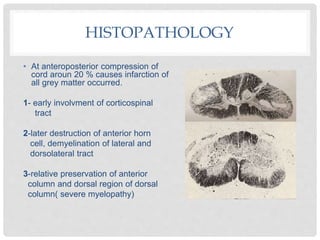
HISTOPATHOLOGY
• At anteroposterior compression of
cord aroun 20 % causes infarction of
all grey matter occurred.
1- early involvment of corticospinal
tract
2-later destruction of anterior horn
cell, demyelination of lateral and
dorsolateral tract
3-relative preservation of anterior
column and dorsal region of dorsal
column( severe myelopathy)
CLINICAL PRESENTATION
• Neck stiffness (early complaint)
• Leg weakness, stiffness (proximal >> distal)
• Gait abnormalities
• Difficulty with fine motor movements and tasks with hands
“Clumsy myelopathic Hands”
• Loss of bladder or bowel sphincter control
• Heavy feeling in the legs
• Poor exercise tolerance
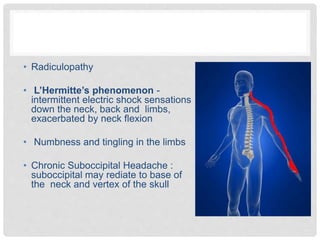
• Radiculopathy
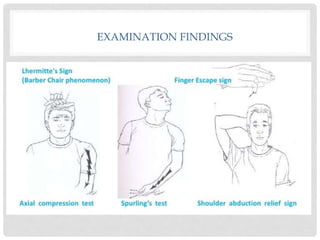
• L’Hermitte’s phenomenon -
intermittent electric shock sensations
down the neck, back and limbs,
exacerbated by neck flexion
• Numbness and tingling in the limbs
• Chronic Suboccipital Headache :
suboccipital may rediate to base of
the neck and vertex of the skull
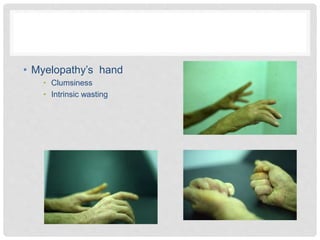
• Myelopathy’s hand
• Clumsiness
• Intrinsic wasting
CLINICAL SIGNS AND SYMPTOMS
• Patients may present with pain, paresthesias, weakness or combination of these
symptoms
• Pain usually is in the cervical region, upper limb, shoulder and/or interscapular
region, Intermittent shoulder pain
• >2/3 patients present with unilateral or bilateral shoulder pain
• 1/3 patients present with headache
• Redicular signs: often non dermatomal
• Rediculopathy, most commonly 6th and 7th roots occurs from C5-6 or C6-7
spondylosis
• More pain proximally in their limbs, while paresthesias dominate distally
EXAMINATION FINDINGS
• Patients present with a number of clinical findings which are predominantly
upper motor neuron signs.
• Weakness is more severe in the upper limbs.
• Gait is usually affected with an ataxic broad based gait. Usually stiff and spastic
• Hypertonia - increased resting muscle tone identified by passive movement.
• Hyperreflexia - exaggerated response to normal physiological reflexes.
• Ankle clonus - forced dorsiflexion at the ankle giving rise to sustained
beats of clonus (more than three beats is considered pathological).
Muscular atrophy:
 Supraspinatus, Infraspinatus, Deltoid, Triceps and the first dorsal interosseus
muscle
 motor weakness, most commonly in the iliopsoas followed by quadriceps
femoris
 Sensory abnormalities: variable pattern
 Loss of vibratory sense or proprioception in the extremities can occur
 Spinothalamic sensory loss may be asymmetric
• Most commonly Sensory symptoms including
• Upper extremity numbness
• Pain, and paresthesias initially,
followed by lower extremity sensory changes
• Motor dysfunction may be unilateral or bilateral depending on the extent and
location of cord damage
EXAMINATION FINDINGS
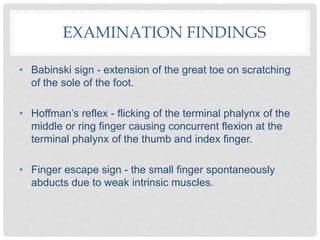
• Babinski sign - extension of the great toe on scratching
of the sole of the foot.
• Hoffman’s reflex - flicking of the terminal phalynx of the
middle or ring finger causing concurrent flexion at the
terminal phalynx of the thumb and index finger.
• Finger escape sign - the small finger spontaneously
abducts due to weak intrinsic muscles.
EXAMINATION FINDINGS
JAPANESE MYELOPATHY SCORE
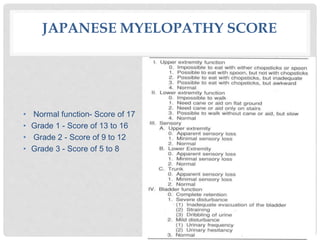
• Normal function- Score of 17
• Grade 1 - Score of 13 to 16
• Grade 2 - Score of 9 to 12
• Grade 3 - Score of 5 to 8
NURICK’S DISABILITY SCALE
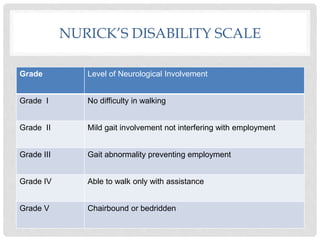
Grade Level of Neurological Involvement
Grade I No difficulty in walking
Grade II Mild gait involvement not interfering with employment
Grade III Gait abnormality preventing employment
Grade IV Able to walk only with assistance
Grade V Chairbound or bedridden
ROLE OF RADIOLOGICAL
INVESTIGATIONS
•The correlation between
radiographic evidence of
spondylotic cord damage and
clinically significant CSM is not
perfect
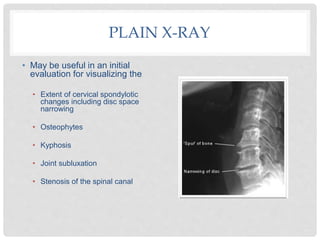
PLAIN X-RAY
• May be useful in an initial
evaluation for visualizing the
• Extent of cervical spondylotic
changes including disc space
narrowing
• Osteophytes
• Kyphosis
• Joint subluxation
• Stenosis of the spinal canal
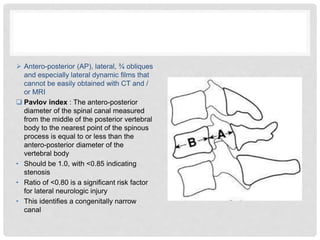
 Antero-posterior (AP), lateral, ¾ obliques
and especially lateral dynamic films that
cannot be easily obtained with CT and /
or MRI
 Pavlov index : The antero-posterior
diameter of the spinal canal measured
from the middle of the posterior vertebral
body to the nearest point of the spinous
process is equal to or less than the
antero-posterior diameter of the
vertebral body
• Should be 1.0, with <0.85 indicating
stenosis
• Ratio of <0.80 is a significant risk factor
for lateral neurologic injury
• This identifies a congenitally narrow
canal
They show the characteristic lesions of cervical
spondylosis predominantly at the C5/C6, C6/C7 and
C4/C5 disc levels, and specify the number of levels
involved. The following are shown:
• Hypertrophy of the articular processes (facets)
• Osteophytes (bone spurs) of the posterior joints,
endplates and unco-vertebral joints
• Pinching of the intervertebral disc
• Ligamentous ossification
CT SPINE
• A CT scan is helpful
in assessing
• Canal stenosis
• May show osteophytes
better than plain
radiography
• Good at defining the
neural foramina
• Useful in diagnosing
Ossification of PLL
• Canal stenosis or narrowing is considered when the
antero-posterior diameter at the site of maximum lesions
(C5/C6 or C6/C7) is less than 12 mm
• On horizontal cuts: discopathies ("soft" or calcified), joint
hypertrophy, facet joint osteoarthritis and ligamentous
calcifications,
• On reconstructed images: the static spinal disorders
(deformities) and degenerative spondylolisthesis.
• CT enables a better appreciation of the components of
the canal stenosis than conventional radiology:
CT SPINE
• Constitutional canal stenosis
• Lesions related to the cervical spondylosis
• "Soft" herniated disc
• Synovial cysts and associated pathology. The ossification of the
posterior longitudinal ligament is easily demonstrated at the posterior
vertebral body from which it is most often separate. Dynamic films are
difficult to do, but cuts can be achieved in extension or flexion by
inserting pillows below the shoulders or under the head. The CT Scan
amongst others allows us to contrast between central cervical canal
stenosis associated with a predominant central cord symptomatology
("sub lesional") and lateral stenosis associated with a predominance of
radicular semiology ("lesional") in the upper limbs.
CT SPINE
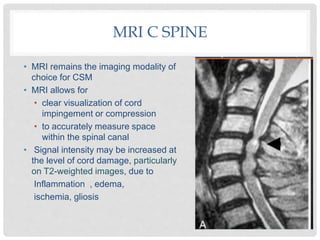
MRI C SPINE
• MRI remains the imaging modality of
choice for CSM
• MRI allows for
• clear visualization of cord
impingement or compression
• to accurately measure space
within the spinal canal
• Signal intensity may be increased at
the level of cord damage, particularly
on T2-weighted images, due to
Inflammation , edema,
ischemia, gliosis
MRI C SPINE
• Signal changes have been shown to be a fairly reliable
indicator of irreversible cord damage
• Diffusion-weighted MR imaging, in particular a technique
known as diffusion tensor imaging(DTI), may enhance
sensitivity for detecting CSM.
• DTI can be able to detect significant cord damage before
the appearance of symptoms it is currently being
evaluated for its potential prognostic value
• MRI can be used to evaluate for non-spondylotic causes
of myelopathy both intrinsic and extrinsic to the cord.
OTHER TESTS
• Electromyography, nerve conduction studies, and motor
and somatosensory evoked potentials have a role in
some cases in differentiating CSM and nerve root
compression from peripheral neuropathies and
myopathies.
• Conduction studies usually normal in CSM usually
slowed in peripheral neuropathies.
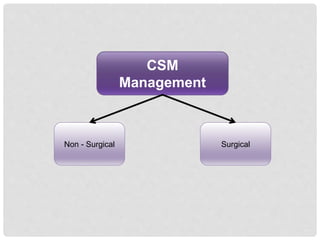
CSM
Management
Non - Surgical Surgical
NON OPERATIVE TREATMENT
• Provides symptomatic relief in patients with CSM
• Should avoid activities that exacerbate symptoms
• Long term cervical immobilization with a cervical collar or
neck brace is commonly used, but little evidence for its
efficacy
• Role of Physiotherapy
NON SURGICAL TREATMENT
• Drugs:
• NSAIDs
• Tricyclic antidepressants
• Muscle relaxants
• Opiods can be used for pain relief
SURGICAL TREATMENT
• Patients who are operated on early (within a year of the
onset of symptoms) have better outcomes than those
who are operated on more than a year after the onset of
symptoms
• Several studies have shown that many patients treated
surgically have good outcomes
Ebersold M et al., J Neurosurg 1995;82(5):745-751
PREDICTORS OF SURGICAL OUTCOMES
• Preoperative signal intensity change pattern of the spinal
cord on radiologic evaluations
• Age at the time of surgery
• Chronicity of the disease
SURGICAL TREATMENT
AIM:
• decompress the spinal cord
• Ablation of painful articulation via fusion
• Stabilization of unstable segments
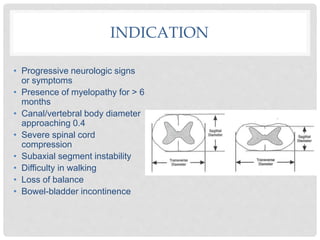
INDICATION
• Progressive neurologic signs
or symptoms
• Presence of myelopathy for > 6
months
• Canal/vertebral body diameter
approaching 0.4
• Severe spinal cord
compression
• Subaxial segment instability
• Difficulty in walking
• Loss of balance
• Bowel-bladder incontinence
PREFERRED APPROACH
1) anterior approach
• Single/ multiple anterior disscectomy with fusion and / or
corpectomy
• Strut fusion techniques with or without the use of anterior
instrumentation
2) Posterior approach
• Single/ multiple level laminectomy,
• Laminoplasty
• Laminectomy + fusion procedures
ADVANTAGES
Anterior approach
• Direct decompression
• Stabilization with
arthrodesis
• Correction of deformity
• Axial lengthening of spinal
column
• Good axial pain relief
Posterior approach
• Less loss of motion
• Not as technically
demanding
• Less bracing needed
• Avoid graft complication
DISADVANTAGES
Anterior approach
• Technically demanding
• Graft complications
( dislodgement,
fracture and severe
settling in to the
cancellous vertebral
body)
• Need for post-operative
bracing limitations
• Loss of motion
• vertebral artery, upper
airway compromise,
dysphagia
Posterior approach
• Indirect decompression
• Pre-operative kyphosis and / or
instability
• Late instability
• Adjacent segment degenration
• Laminectomy- increase risk of post
laminectomy kyphosis, swan-neck
deformity or instability with late
neurology deterioration
• Laminoplasty-techniques decrease
above risk but potential complication
like inadverent closure of the
opened lamina with current stenosis
OPTIONS
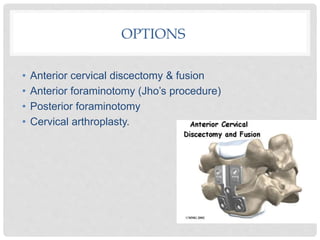
• Anterior cervical discectomy & fusion
• Anterior foraminotomy (Jho’s procedure)
• Posterior foraminotomy
• Cervical arthroplasty.
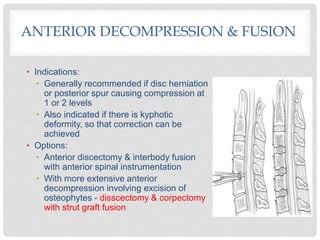
• Indications:
• Generally recommended if disc herniation
or posterior spur causing compression at
1 or 2 levels
• Also indicated if there is kyphotic
deformity, so that correction can be
achieved
• Options:
• Anterior discectomy & interbody fusion
with anterior spinal instrumentation
• With more extensive anterior
decompression involving excision of
osteophytes - disscectomy & corpectomy
with strut graft fusion
ANTERIOR DECOMPRESSION & FUSION
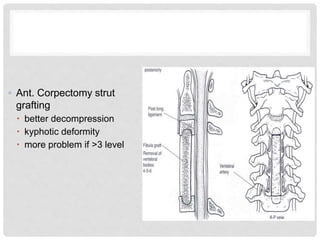
◦ Ant. Corpectomy strut
grafting
 better decompression
 kyphotic deformity
 more problem if >3 level
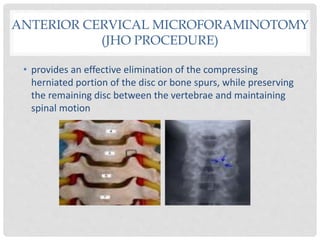
• provides an effective elimination of the compressing
herniated portion of the disc or bone spurs, while preserving
the remaining disc between the vertebrae and maintaining
spinal motion
ANTERIOR CERVICAL MICROFORAMINOTOMY
(JHO PROCEDURE)
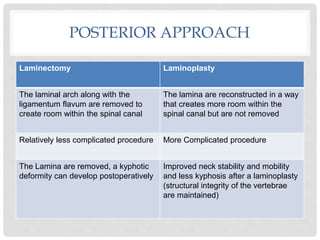
POSTERIOR APPROACH
Laminectomy Laminoplasty
The laminal arch along with the
ligamentum flavum are removed to
create room within the spinal canal
The lamina are reconstructed in a way
that creates more room within the
spinal canal but are not removed
Relatively less complicated procedure More Complicated procedure
The Lamina are removed, a kyphotic
deformity can develop postoperatively
Improved neck stability and mobility
and less kyphosis after a laminoplasty
(structural integrity of the vertebrae
are maintained)
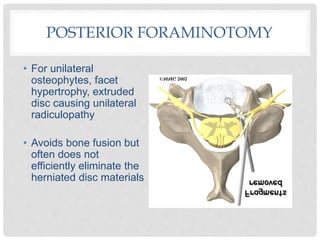
POSTERIOR FORAMINOTOMY
• For unilateral
osteophytes, facet
hypertrophy, extruded
disc causing unilateral
radiculopathy
• Avoids bone fusion but
often does not
efficiently eliminate the
herniated disc materials
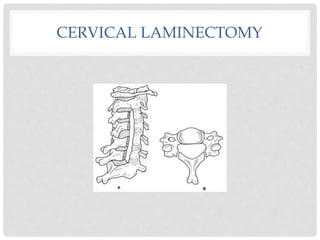
CERVICAL LAMINECTOMY
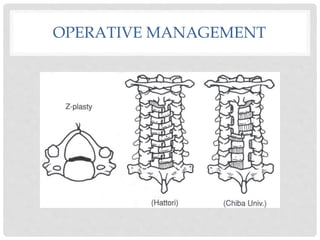
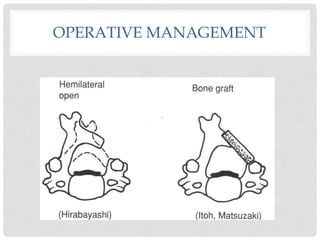
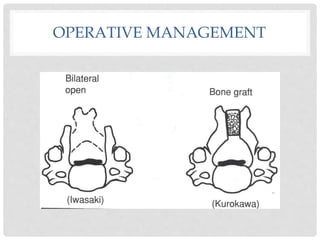
OPERATIVE MANAGEMENT
Cervical myelopathy

Cervical myelopathy

  • 1.
    P R ES E N T A T I O N B Y : D R . M A H E N D R A F E F A R D R . D . Y . P A T I L H O S P I T A L , N A V I M U M B A I CERVICAL MYELOPATHY
  • 2.
    DEFINITION • Cervical myelopathyis the manifestation of long-tract signs resulting from a decrease in the space available for cervical spinal cord due to progressive multilevel circumferential compressive disease. • Any space occupying lesion within the cervical spine with the potential to compress the spinal cord can cause cervical myelopathy. • Cervical spondylosis is the most common cause of cervical spinal cord dysfunction in individuals older than 55 years.
  • 3.
    CERVICAL SPONDYLOSIS • progressivedegerative changes that develop slowly over time, this alters the spinal bio-mechanisms from the loss of shock absorption properties of intervertebral discs. • This leads to secondary changes surrounding structures.
  • 4.
    CERVICAL SPONDYLOSIS • causesmain 3 syndromes 1. Cervical radiculopathy( compression and inflammation of spinal nerve with symptoms that correspond to the level involved) 2. Cervical myelopathy: cord involvment 3. Axial joint pain( mecanical neck pain, discogenic pain, facet syndrome, painful instability)
  • 5.
    EPIDEMIOLOGY • Cervical myelopathyis more common in men > women. • Radio-logically, the condition is present in 13% of men in the third decade and almost 100% of men over the age of 70. • In women the disease presents later, with 5% showing radiographic changes in the fourth decade going up to 96% in women over the age of 70. • Changes are more common in patients with RA where 85% of those with moderate to severe disease will have x-ray changes.
  • 6.
    HISTORY • SIR WILLIAMRICHARD GOWERS in 1892 he first noticed the changes associated with cervical spondylosis. He called these “ vertebral exostoses” and thought they were exceedingly rare and their chief characteristic was chronicity.
  • 7.
    HISTORY • Dr. VictorAlexander Horsely builder who under the influence of alcohol, fell off his van on to the road striking his right shoulder. ” Over 2month this man gradually lost control of legs and sphincters Dr Horsley performed the First Laminectomy of 6 th Cervical Vertebra Oct 1892 During surgery he saw the Spinal cord was compressed by a ridge projecting backwards from the body of the vertebra. After surgery the patient had a Complete recovery by September of that year.
  • 8.
    • Cervical spondylosisand cord impingement was originally described by stooky in 1928 • He attributed compression of the cord by “extradural chondromas” cartilaginous nodules . Which he thought was similar to these enlargements seen on ears. • It was not until 1934 Peet, MM and Echols, DH showed that these “chondromas” were actually disc protrusions
  • 9.
    HISTORY • In 1952Lord Brain was the first person who recognized myelopathy and rediculopathy as a clinical disorder • In 1956 Wolf B, Khilnani M, Malis L. Emphasized on the importance of narrowing of the cervical canal in the genesis of cord complications in The sagittal diameter of the bony cervical spinal canal and its significance in cervical spondylosis.
  • 10.
    ETIOLOGY 1.Congenital • Myelopathy dueto congenital stenosis does not have a specific underlying lesion. It is caused by a canal diameter which is narrower from birth. • It is often not symptomatic until secondary degeneration further narrows the canal 2. Constitutional Stenoses • Pure constitutional stenosis rarely is a cause of cervical myelopathy except in extreme cases of severe stenosis as in achondroplasia. • It is more often a predisposing factor.
  • 11.
    ETIOLOGY 3. Spondylosis • CSMis the result of degenerative changes which develop with age, including ligamentum flavum hypertrophy or buckling, facet joint hypertrophy, disc protrusion and posterior spondylotic ridges. • One or all of these changes contribute to an overall reduction in canal diameter which may result in cord compression. • Spondylolisthesis usually occurs in the lower cervical spine. It is caused by arthrosis of the facet joints combined with disc degeneration leading to instability.
  • 12.
    4. Disc Herniation •Discogenic disease may cause myelopathy in the acute setting as a large central soft disc herniation causing cord compression. Disc disease is also often seen as part of the compressive lesion in spondylotic disease 5. Post traumatic myelopathy • Trauma may induce myelopathy or precipitate symptoms of an underlying stenosis of the spinal canal. • Smaller diameter canals have an increased chance of neurological injury in trauma ETIOLOGY
  • 13.
    6. Ossification ofthe posterior longitudinal ligament (OPLL) • This is a common feature in patients with cervical myelopathy with 5% being affected. • Ossification usually starts behind the body of C5 and progressively spreads through the entire cervical spine in contrast to segmental (or localized) forms, discontinuous or continuous forms. • The extent is best defined by CT. The pathogenesis of OPLL remains uncertain: osteogenesis ensues from hypertrophied and hypervascular ligament when it detaches from the posterior surface of the vertebra by disc protrusions. ETIOLOGY
  • 14.
    7. Myelopathy dueto tumour expansion • Intraspinal tumours are a relatively uncommon cause of cervical myelopathy but must always be considered given the potentially catastrophic consequences of the diagnosis being missed. • Tumours may originate in the spinal cord (intramedullary tumours) or compress from outside (extramedullary tumours). • Metastatic deposits are usually slow growing with gradual onset of symptoms. ETIOLOGY
  • 15.
    8. Other etiologies •Cervical rheumatoid arthritis affecting especially the upper cervical spine (atlanto-axial dislocation) and to a lesser extent the lower cervical spine may present with the clinical picture of cervical myelopathy . • Rare neurologic complications which can cause narrowing of the cervical canal such ankylosing spondylitis, gouty tophi from the posterior joints and vertebral ankylosing hyperostosis (Forestier's disease) or Paget's disease. ETIOLOGY
  • 16.
    EXTRADURAL INTRADURAL INTRAMEDULLARY •Cervical Spondylosis • Disc prolapse • Trauma • Tumor-Metastasis, • multiple myeloma • CVJ anomalies • TB spine • Epidural abscess • Epidural haematoma • Tumor-NF,meningioma, • lipoma,sarcoma • metastasis • Arachonoiditis • Sarcoidosis • Cervical menigitis • AVM • Leukemic infiltration • Arachonoid cyst • Syrinx • Tumor – ependymoma • astrocytoma • Haemagioblastoma • Haematomyelia COMPRESSIVE MYELOPATHY CAUSES (mode compression based) CAUSES (mode compression based)
  • 17.
    • One ofthe most common causes of cervical myelopathy is Extradural compression of the cord, which can occur as a result of # Spinal trauma # Mass lesions # Degenerative changes of the Spine, or other factors • When cord compression is caused by degenerative changes it is cervical spondylotic myelopathy (CSM), which will be the focus ETIOLOGY
  • 18.
    Static-mechanical cord compression Dynamic- mechanical cord compression Impairingthe circulation within the cord SPONDYLOSIS CAUSING CORD COMPRESSION
  • 19.
    1. STATIC-MECHANICAL COMPRESSION OFTHE CORD • Osteophytes • Spinal ligaments • Disc material  which encroach upon the canal space resulting in stenosis of the canal  Those with a congenitally narrowed spinal canal (10-13 mm) are especially vulnerable to static- mechanical compression
  • 20.
    2. DYNAMIC-MECHANICAL CORD COMPRESSIONCAUSING MICRO TRAUMA Neck flexion • lengthens post. Wall by 5 cm and ant. Wall by 1.5 cm • Reduces the AP diameter of the spinal canal by 2-3 mm • Streching of cord • During each movement micro-traumas occur when compressive elements come in contact. Neck extension Ligamentum flavum to pinch the cord against anterior osteophytes Lateral neck movements Nerve root compression Radicular symptoms NECK MOVEMENTS
  • 21.
    CANAL DIMENSION • Thenormal cervical canal diameter from C3-C7 in Caucasians is 16- 18mm ( < Asians) • Cervical cord varies little in size from C1-C7, measuring approximately 10mm in diameter (range 8.5-11.5mm) • 2/3rd unoccupied by the spinal cord from C1-C3 and 1/4th C4-C7.
  • 22.
    3. VASCULAR PHENOMENAIMPAIRING THE CIRCULATION WITHIN THE CORD • Osteophytes can compress • the Anterior Spinal Artery or • a critical medullary feeder, or • can compress venous drainage leading to a neuroischemic myelopathy usually affecting the anterior cord • Venous stasis stemming from canal stenosis appears to have an important pathophysiologic role in cervical myelopathy by causing chronic ischemia and cord edema.
  • 23.
    HISTOPATHOLOGY • At anteroposteriorcompression of cord aroun 20 % causes infarction of all grey matter occurred. 1- early involvment of corticospinal tract 2-later destruction of anterior horn cell, demyelination of lateral and dorsolateral tract 3-relative preservation of anterior column and dorsal region of dorsal column( severe myelopathy)
  • 24.
    CLINICAL PRESENTATION • Neckstiffness (early complaint) • Leg weakness, stiffness (proximal >> distal) • Gait abnormalities • Difficulty with fine motor movements and tasks with hands “Clumsy myelopathic Hands” • Loss of bladder or bowel sphincter control • Heavy feeling in the legs • Poor exercise tolerance
  • 25.
    • Radiculopathy • L’Hermitte’sphenomenon - intermittent electric shock sensations down the neck, back and limbs, exacerbated by neck flexion • Numbness and tingling in the limbs • Chronic Suboccipital Headache : suboccipital may rediate to base of the neck and vertex of the skull
  • 26.
    • Myelopathy’s hand •Clumsiness • Intrinsic wasting
  • 27.
    CLINICAL SIGNS ANDSYMPTOMS • Patients may present with pain, paresthesias, weakness or combination of these symptoms • Pain usually is in the cervical region, upper limb, shoulder and/or interscapular region, Intermittent shoulder pain • >2/3 patients present with unilateral or bilateral shoulder pain • 1/3 patients present with headache • Redicular signs: often non dermatomal • Rediculopathy, most commonly 6th and 7th roots occurs from C5-6 or C6-7 spondylosis • More pain proximally in their limbs, while paresthesias dominate distally
  • 28.
    EXAMINATION FINDINGS • Patientspresent with a number of clinical findings which are predominantly upper motor neuron signs. • Weakness is more severe in the upper limbs. • Gait is usually affected with an ataxic broad based gait. Usually stiff and spastic • Hypertonia - increased resting muscle tone identified by passive movement. • Hyperreflexia - exaggerated response to normal physiological reflexes. • Ankle clonus - forced dorsiflexion at the ankle giving rise to sustained beats of clonus (more than three beats is considered pathological).
  • 29.
    Muscular atrophy:  Supraspinatus,Infraspinatus, Deltoid, Triceps and the first dorsal interosseus muscle  motor weakness, most commonly in the iliopsoas followed by quadriceps femoris  Sensory abnormalities: variable pattern  Loss of vibratory sense or proprioception in the extremities can occur  Spinothalamic sensory loss may be asymmetric • Most commonly Sensory symptoms including • Upper extremity numbness • Pain, and paresthesias initially, followed by lower extremity sensory changes • Motor dysfunction may be unilateral or bilateral depending on the extent and location of cord damage EXAMINATION FINDINGS
  • 30.
    • Babinski sign- extension of the great toe on scratching of the sole of the foot. • Hoffman’s reflex - flicking of the terminal phalynx of the middle or ring finger causing concurrent flexion at the terminal phalynx of the thumb and index finger. • Finger escape sign - the small finger spontaneously abducts due to weak intrinsic muscles. EXAMINATION FINDINGS
  • 31.
  • 32.
    JAPANESE MYELOPATHY SCORE •Normal function- Score of 17 • Grade 1 - Score of 13 to 16 • Grade 2 - Score of 9 to 12 • Grade 3 - Score of 5 to 8
  • 33.
    NURICK’S DISABILITY SCALE GradeLevel of Neurological Involvement Grade I No difficulty in walking Grade II Mild gait involvement not interfering with employment Grade III Gait abnormality preventing employment Grade IV Able to walk only with assistance Grade V Chairbound or bedridden
  • 34.
    ROLE OF RADIOLOGICAL INVESTIGATIONS •Thecorrelation between radiographic evidence of spondylotic cord damage and clinically significant CSM is not perfect
  • 35.
    PLAIN X-RAY • Maybe useful in an initial evaluation for visualizing the • Extent of cervical spondylotic changes including disc space narrowing • Osteophytes • Kyphosis • Joint subluxation • Stenosis of the spinal canal
  • 36.
     Antero-posterior (AP),lateral, ¾ obliques and especially lateral dynamic films that cannot be easily obtained with CT and / or MRI  Pavlov index : The antero-posterior diameter of the spinal canal measured from the middle of the posterior vertebral body to the nearest point of the spinous process is equal to or less than the antero-posterior diameter of the vertebral body • Should be 1.0, with <0.85 indicating stenosis • Ratio of <0.80 is a significant risk factor for lateral neurologic injury • This identifies a congenitally narrow canal
  • 37.
    They show thecharacteristic lesions of cervical spondylosis predominantly at the C5/C6, C6/C7 and C4/C5 disc levels, and specify the number of levels involved. The following are shown: • Hypertrophy of the articular processes (facets) • Osteophytes (bone spurs) of the posterior joints, endplates and unco-vertebral joints • Pinching of the intervertebral disc • Ligamentous ossification
  • 38.
    CT SPINE • ACT scan is helpful in assessing • Canal stenosis • May show osteophytes better than plain radiography • Good at defining the neural foramina • Useful in diagnosing Ossification of PLL
  • 39.
    • Canal stenosisor narrowing is considered when the antero-posterior diameter at the site of maximum lesions (C5/C6 or C6/C7) is less than 12 mm • On horizontal cuts: discopathies ("soft" or calcified), joint hypertrophy, facet joint osteoarthritis and ligamentous calcifications, • On reconstructed images: the static spinal disorders (deformities) and degenerative spondylolisthesis. • CT enables a better appreciation of the components of the canal stenosis than conventional radiology: CT SPINE
  • 40.
    • Constitutional canalstenosis • Lesions related to the cervical spondylosis • "Soft" herniated disc • Synovial cysts and associated pathology. The ossification of the posterior longitudinal ligament is easily demonstrated at the posterior vertebral body from which it is most often separate. Dynamic films are difficult to do, but cuts can be achieved in extension or flexion by inserting pillows below the shoulders or under the head. The CT Scan amongst others allows us to contrast between central cervical canal stenosis associated with a predominant central cord symptomatology ("sub lesional") and lateral stenosis associated with a predominance of radicular semiology ("lesional") in the upper limbs. CT SPINE
  • 41.
    MRI C SPINE •MRI remains the imaging modality of choice for CSM • MRI allows for • clear visualization of cord impingement or compression • to accurately measure space within the spinal canal • Signal intensity may be increased at the level of cord damage, particularly on T2-weighted images, due to Inflammation , edema, ischemia, gliosis
  • 42.
    MRI C SPINE •Signal changes have been shown to be a fairly reliable indicator of irreversible cord damage • Diffusion-weighted MR imaging, in particular a technique known as diffusion tensor imaging(DTI), may enhance sensitivity for detecting CSM. • DTI can be able to detect significant cord damage before the appearance of symptoms it is currently being evaluated for its potential prognostic value • MRI can be used to evaluate for non-spondylotic causes of myelopathy both intrinsic and extrinsic to the cord.
  • 43.
    OTHER TESTS • Electromyography,nerve conduction studies, and motor and somatosensory evoked potentials have a role in some cases in differentiating CSM and nerve root compression from peripheral neuropathies and myopathies. • Conduction studies usually normal in CSM usually slowed in peripheral neuropathies.
  • 44.
  • 45.
    NON OPERATIVE TREATMENT •Provides symptomatic relief in patients with CSM • Should avoid activities that exacerbate symptoms • Long term cervical immobilization with a cervical collar or neck brace is commonly used, but little evidence for its efficacy • Role of Physiotherapy
  • 46.
    NON SURGICAL TREATMENT •Drugs: • NSAIDs • Tricyclic antidepressants • Muscle relaxants • Opiods can be used for pain relief
  • 47.
    SURGICAL TREATMENT • Patientswho are operated on early (within a year of the onset of symptoms) have better outcomes than those who are operated on more than a year after the onset of symptoms • Several studies have shown that many patients treated surgically have good outcomes Ebersold M et al., J Neurosurg 1995;82(5):745-751
  • 48.
    PREDICTORS OF SURGICALOUTCOMES • Preoperative signal intensity change pattern of the spinal cord on radiologic evaluations • Age at the time of surgery • Chronicity of the disease
  • 49.
    SURGICAL TREATMENT AIM: • decompressthe spinal cord • Ablation of painful articulation via fusion • Stabilization of unstable segments
  • 50.
    INDICATION • Progressive neurologicsigns or symptoms • Presence of myelopathy for > 6 months • Canal/vertebral body diameter approaching 0.4 • Severe spinal cord compression • Subaxial segment instability • Difficulty in walking • Loss of balance • Bowel-bladder incontinence
  • 51.
    PREFERRED APPROACH 1) anteriorapproach • Single/ multiple anterior disscectomy with fusion and / or corpectomy • Strut fusion techniques with or without the use of anterior instrumentation 2) Posterior approach • Single/ multiple level laminectomy, • Laminoplasty • Laminectomy + fusion procedures
  • 52.
    ADVANTAGES Anterior approach • Directdecompression • Stabilization with arthrodesis • Correction of deformity • Axial lengthening of spinal column • Good axial pain relief Posterior approach • Less loss of motion • Not as technically demanding • Less bracing needed • Avoid graft complication
  • 53.
    DISADVANTAGES Anterior approach • Technicallydemanding • Graft complications ( dislodgement, fracture and severe settling in to the cancellous vertebral body) • Need for post-operative bracing limitations • Loss of motion • vertebral artery, upper airway compromise, dysphagia Posterior approach • Indirect decompression • Pre-operative kyphosis and / or instability • Late instability • Adjacent segment degenration • Laminectomy- increase risk of post laminectomy kyphosis, swan-neck deformity or instability with late neurology deterioration • Laminoplasty-techniques decrease above risk but potential complication like inadverent closure of the opened lamina with current stenosis
  • 54.
    OPTIONS • Anterior cervicaldiscectomy & fusion • Anterior foraminotomy (Jho’s procedure) • Posterior foraminotomy • Cervical arthroplasty.
  • 55.
    • Indications: • Generallyrecommended if disc herniation or posterior spur causing compression at 1 or 2 levels • Also indicated if there is kyphotic deformity, so that correction can be achieved • Options: • Anterior discectomy & interbody fusion with anterior spinal instrumentation • With more extensive anterior decompression involving excision of osteophytes - disscectomy & corpectomy with strut graft fusion ANTERIOR DECOMPRESSION & FUSION
  • 56.
    ◦ Ant. Corpectomystrut grafting  better decompression  kyphotic deformity  more problem if >3 level
  • 57.
    • provides aneffective elimination of the compressing herniated portion of the disc or bone spurs, while preserving the remaining disc between the vertebrae and maintaining spinal motion ANTERIOR CERVICAL MICROFORAMINOTOMY (JHO PROCEDURE)
  • 58.
    POSTERIOR APPROACH Laminectomy Laminoplasty Thelaminal arch along with the ligamentum flavum are removed to create room within the spinal canal The lamina are reconstructed in a way that creates more room within the spinal canal but are not removed Relatively less complicated procedure More Complicated procedure The Lamina are removed, a kyphotic deformity can develop postoperatively Improved neck stability and mobility and less kyphosis after a laminoplasty (structural integrity of the vertebrae are maintained)
  • 59.
    POSTERIOR FORAMINOTOMY • Forunilateral osteophytes, facet hypertrophy, extruded disc causing unilateral radiculopathy • Avoids bone fusion but often does not efficiently eliminate the herniated disc materials
  • 60.
  • 61.
  • 62.
  • 63.

Editor's Notes

  • #6 When patients with cervical myelopathy present in the third or fourth decade of life it is usually secondary to congenital stenosis. If it presents later in life, degenerative spondylosis is usually the underlying cause. Patients who have a congenitally narrow canal are predisposed to the effects of spondylotic changes earlier, as there is less space on canal to accommodate the compressing lesions