Spina Bifida Thomas B. King, M. Ed. Hospital Education Program VCU Health Care System
Definition of Spina Bifida (SB) Spina Bifida is a disorder involving incomplete development of the brain, spinal cord, and/or their protective coverings
Other defined considerations Failure of the fetus’s spine to “close” properly during the first month of pregnancy May be surgically repaired shortly after birth, but the nerve damage is permanent Nerve damage results in varying degrees of paralysis to lower extremities National Institute of Neurological Disorders and Stroke


Causes Occurs in utero No known cause It is believed that folic acid deficiency plays a role
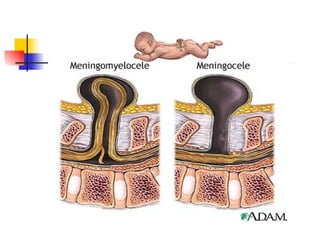
Levels of severity or types of SB Myelomeningocele – the severest form, the spinal cord and the protective covering protrude Meningocele – only the menignes protrude Occulta – mildest form in which one or more vertebrae are malformed
Associated difficulties Paraplegia Hydrocephalus Sexual dysfunction Skeletal deformities Bowel and bladder incontinence Cognitive impairmement
 
Incidence Myelomeningocele is relatively common and affects about 1 in 2000 live births The incidence of all SB is estimated to be around 1 -2 per 1000

Spina Bifida

  • 1.
    Spina Bifida ThomasB. King, M. Ed. Hospital Education Program VCU Health Care System
  • 2.
    Definition of SpinaBifida (SB) Spina Bifida is a disorder involving incomplete development of the brain, spinal cord, and/or their protective coverings
  • 3.
    Other defined considerationsFailure of the fetus’s spine to “close” properly during the first month of pregnancy May be surgically repaired shortly after birth, but the nerve damage is permanent Nerve damage results in varying degrees of paralysis to lower extremities National Institute of Neurological Disorders and Stroke
  • 4.
  • 5.
  • 6.
  • 7.
    Causes Occurs inutero No known cause It is believed that folic acid deficiency plays a role
  • 8.
    Levels of severityor types of SB Myelomeningocele – the severest form, the spinal cord and the protective covering protrude Meningocele – only the menignes protrude Occulta – mildest form in which one or more vertebrae are malformed
  • 9.
    Associated difficulties ParaplegiaHydrocephalus Sexual dysfunction Skeletal deformities Bowel and bladder incontinence Cognitive impairmement
  • 10.
  • 11.
    Incidence Myelomeningocele isrelatively common and affects about 1 in 2000 live births The incidence of all SB is estimated to be around 1 -2 per 1000