



SPEF Format
So, this has been due for long time. May be
because of tight tape out deadlines, this very
important piece of Physical Design flow just got
missed. And I am sure, like me, many might be
curious to know what is the IEEE SPEF format,
what does various attributes of SPEF file
represent, etc...
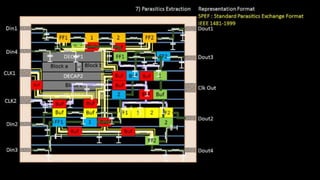
So, here you go. Finally got time to
make video on IEEE SPEF format. Let's nail
this down, with below example design, which I
have been using on Udemy
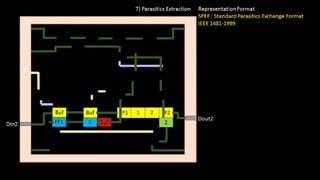
We will take a piece of the circuit and write the
SPEF file for a piece of input port and net
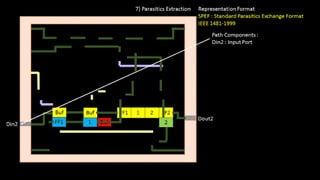
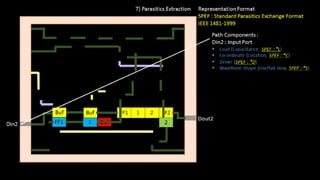
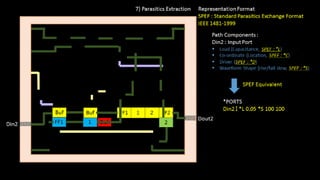
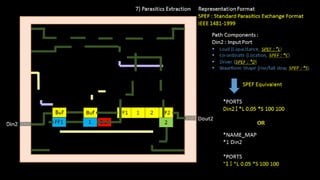
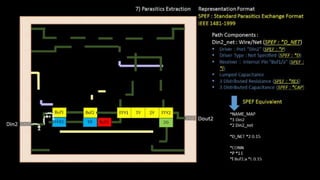
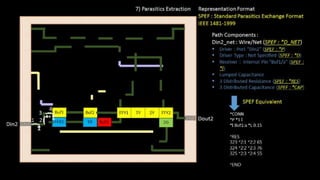
Let's write down the path components of Input
port Din2 in SPEF format, which will also be a
part of large SPEF file
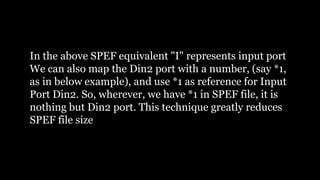
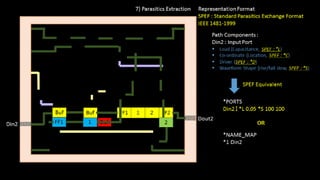
In the above SPEF equivalent "I" represents input port
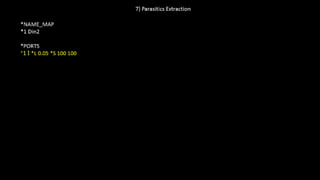
We can also map the Din2 port with a number, (say *1,
as in below example), and use *1 as reference for Input
Port Din2. So, wherever, we have *1 in SPEF file, it is
nothing but Din2 port. This technique greatly reduces
SPEF file size
This becomes one part of the SPEF file
Further, we will extract the net
connected to Din2 (shown below) and
write a SPEF format of the same
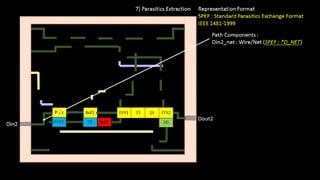
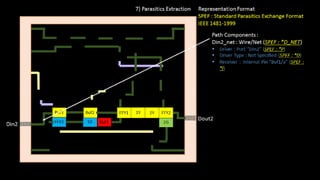
Let's move on with identifying the
path components of net connected to
Din2 port shown below
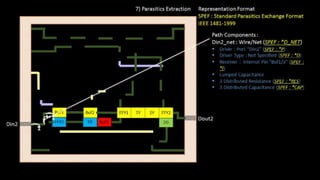
For now, let's have a distributed RC network representation of
the net (shown below). We do have another way of
representing RC network in reduced format. I will come back
to that in a moment
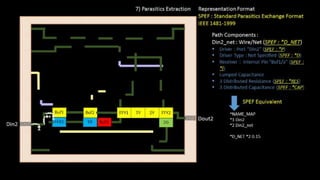
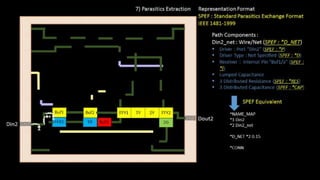
Now that we know the components of Din2_net, lets write
down the SPEF equivalent of this net. Firstly, we will map the
name "Din2_net" as "*2" and use "*2" hence forth, to refer to
Din2_net.
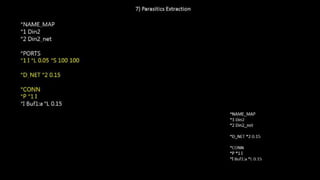
We will come back to how do we calculate the load value of
"0.15". *D_NET denotes "distributed net". If we had used a
reduced format of the nets, with only single value of resistance
and capacitance, it would had been called as "*R_NET".
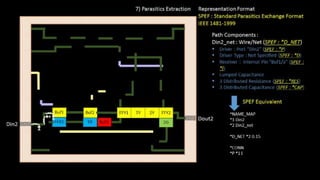
Now lets write down the connectivity information of
"Din2_net" or "*2". *CONN section defines connectivity of *2
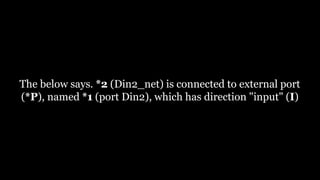
The below says. *2 (Din2_net) is connected to external port
(*P), named *1 (port Din2), which has direction "input" (I)
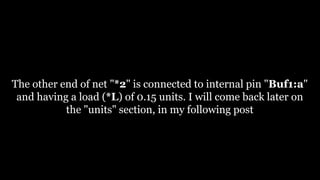
The other end of net "*2" is connected to internal pin "Buf1:a"
and having a load (*L) of 0.15 units. I will come back later on
the "units" section, in my following post
This becomes a part of the SPEF file, so lets put it in a file, that
we were maintaining from last post
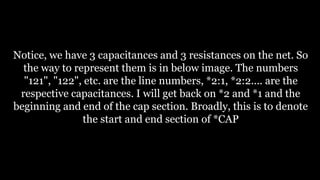
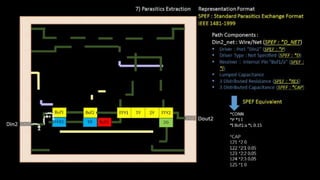
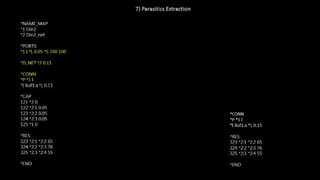
Notice, we have 3 capacitances and 3 resistances on the net. So
the way to represent them is in below image. The numbers
"121", "122", etc. are the line numbers, *2:1, *2:2.... are the
respective capacitances. I will get back on *2 and *1 and the
beginning and end of the cap section. Broadly, this is to denote
the start and end section of *CAP
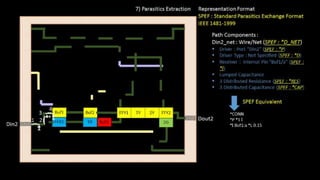
Now, we have 4 nodes, and within a pair of node, we have a
resistance, like below
With the introduction of nodes, the representation of
resistance has now become fairly simple, like below
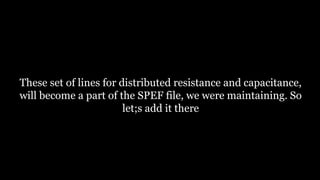
These set of lines for distributed resistance and capacitance,
will become a part of the SPEF file, we were maintaining. So
let;s add it there
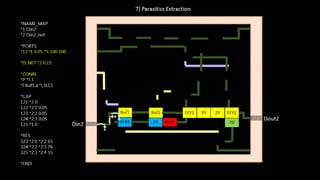
These couple of lines (about 20), now represents a small net
and a port. Just imagine, how many lines it will be to extract
parasitics for the complete circuit, below. Its HUGE. I think,
now we nail the reason for having *NAME_MAP. The SPEF file
size greatly reduces, by name mapping. A 10 character net or
port name can be reduced to a 2~3 character net name and can
be referred and reused in the whole SPEF file. These people are
really Smart :)
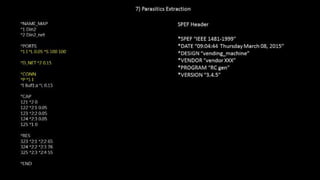
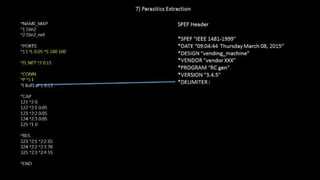
Remember, I had mentioned, I will get back on units. So here
we go. We have a header file that defines all of the them.
Firstly, the design name, vendor name, version, etc.
Then, the delimiter. Usually, in any report, we see, it as "/". In
SPEF you can have your own delimiter, by defining something
like below
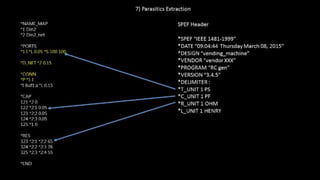
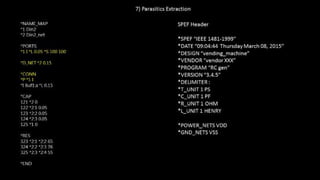
And the units, and power nets
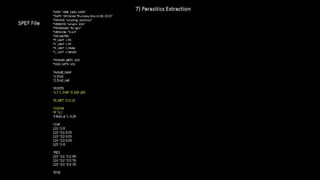
Below is the SPEF file, for one net and one port
So, next time, when you look at the SPEF, just make sure to
open it, and see, if what we discussed in all SPEF format posts,
does make sense.
And, In Lady Windemere's Fan, Oscar Wilde had Lord
Darlington quip that a cynic was 'a man who knows the
price of everything and the value of nothing.'
Let's value SPEF files :)
For more, please refer to below courses
Circuit design & SPICE simulations
https://www.udemy.com/vlsi-academy-circuit-design/?couponCode=forSlideshare
Physical design flow
https://www.udemy.com/vlsi-academy-physical-design-flow/?couponCode=forSlideshare
Clock tree synthesis
https://www.udemy.com/vlsi-academy-clock-tree-synthesis/?couponCode=forSlideshare
Signal integrity
https://www.udemy.com/vlsi-academy-crosstalk/?couponCode=forSlideshare
VLSI – Essential concepts and detailed interview guide
https://www.udemy.com/vlsi-academy/?couponCode=forSlideshare
THANK YOU

SPEF format

  • 1.
  • 2.
    So, this hasbeen due for long time. May be because of tight tape out deadlines, this very important piece of Physical Design flow just got missed. And I am sure, like me, many might be curious to know what is the IEEE SPEF format, what does various attributes of SPEF file represent, etc...
  • 3.
    So, here yougo. Finally got time to make video on IEEE SPEF format. Let's nail this down, with below example design, which I have been using on Udemy
  • 5.
    We will takea piece of the circuit and write the SPEF file for a piece of input port and net
  • 7.
    Let's write downthe path components of Input port Din2 in SPEF format, which will also be a part of large SPEF file
  • 11.
    In the aboveSPEF equivalent "I" represents input port We can also map the Din2 port with a number, (say *1, as in below example), and use *1 as reference for Input Port Din2. So, wherever, we have *1 in SPEF file, it is nothing but Din2 port. This technique greatly reduces SPEF file size
  • 14.
    This becomes onepart of the SPEF file
  • 16.
    Further, we willextract the net connected to Din2 (shown below) and write a SPEF format of the same
  • 18.
    Let's move onwith identifying the path components of net connected to Din2 port shown below
  • 20.
    For now, let'shave a distributed RC network representation of the net (shown below). We do have another way of representing RC network in reduced format. I will come back to that in a moment
  • 22.
    Now that weknow the components of Din2_net, lets write down the SPEF equivalent of this net. Firstly, we will map the name "Din2_net" as "*2" and use "*2" hence forth, to refer to Din2_net.
  • 24.
    We will comeback to how do we calculate the load value of "0.15". *D_NET denotes "distributed net". If we had used a reduced format of the nets, with only single value of resistance and capacitance, it would had been called as "*R_NET". Now lets write down the connectivity information of "Din2_net" or "*2". *CONN section defines connectivity of *2
  • 26.
    The below says.*2 (Din2_net) is connected to external port (*P), named *1 (port Din2), which has direction "input" (I)
  • 28.
    The other endof net "*2" is connected to internal pin "Buf1:a" and having a load (*L) of 0.15 units. I will come back later on the "units" section, in my following post
  • 30.
    This becomes apart of the SPEF file, so lets put it in a file, that we were maintaining from last post
  • 32.
    Notice, we have3 capacitances and 3 resistances on the net. So the way to represent them is in below image. The numbers "121", "122", etc. are the line numbers, *2:1, *2:2.... are the respective capacitances. I will get back on *2 and *1 and the beginning and end of the cap section. Broadly, this is to denote the start and end section of *CAP
  • 34.
    Now, we have4 nodes, and within a pair of node, we have a resistance, like below
  • 36.
    With the introductionof nodes, the representation of resistance has now become fairly simple, like below
  • 38.
    These set oflines for distributed resistance and capacitance, will become a part of the SPEF file, we were maintaining. So let;s add it there
  • 40.
    These couple oflines (about 20), now represents a small net and a port. Just imagine, how many lines it will be to extract parasitics for the complete circuit, below. Its HUGE. I think, now we nail the reason for having *NAME_MAP. The SPEF file size greatly reduces, by name mapping. A 10 character net or port name can be reduced to a 2~3 character net name and can be referred and reused in the whole SPEF file. These people are really Smart :)
  • 42.
    Remember, I hadmentioned, I will get back on units. So here we go. We have a header file that defines all of the them. Firstly, the design name, vendor name, version, etc.
  • 44.
    Then, the delimiter.Usually, in any report, we see, it as "/". In SPEF you can have your own delimiter, by defining something like below
  • 46.
    And the units,and power nets
  • 49.
    Below is theSPEF file, for one net and one port
  • 51.
    So, next time,when you look at the SPEF, just make sure to open it, and see, if what we discussed in all SPEF format posts, does make sense. And, In Lady Windemere's Fan, Oscar Wilde had Lord Darlington quip that a cynic was 'a man who knows the price of everything and the value of nothing.' Let's value SPEF files :)
  • 52.
    For more, pleaserefer to below courses Circuit design & SPICE simulations https://www.udemy.com/vlsi-academy-circuit-design/?couponCode=forSlideshare Physical design flow https://www.udemy.com/vlsi-academy-physical-design-flow/?couponCode=forSlideshare Clock tree synthesis https://www.udemy.com/vlsi-academy-clock-tree-synthesis/?couponCode=forSlideshare Signal integrity https://www.udemy.com/vlsi-academy-crosstalk/?couponCode=forSlideshare VLSI – Essential concepts and detailed interview guide https://www.udemy.com/vlsi-academy/?couponCode=forSlideshare
  • 53.