Adjacency Pair Language and Social Interaction
Adjacency Pair An example of turn-talking (pragmatics) Composed of two utterances by two speakers, one after the other The speaking of the 1 st  utterance (the 1 st  part, the 1 st  turn) Provokes a responding utterance (the 2 nd  part, the 2 nd  turn)
Pragmatics Subfield of linguistics which studies the ways in which context contributes to meaning. Being able to understand what is transmitted. Comes only through experience. “ You have a green light.” It could mean you are holding a green light bulb. Or that you have a green light to drive your car. Or indicates that you can go ahead with the project Or that your body has a green glow.
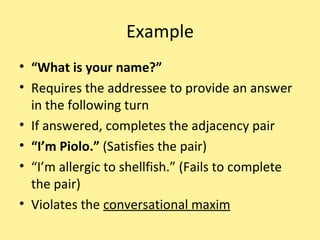
Example “ What is your name?” Requires the addressee to provide an answer in the following turn If answered, completes the adjacency pair “ I’m Piolo.”  (Satisfies the pair) “ I’m allergic to shellfish.” (Fails to complete the pair) Violates the  conversational maxim
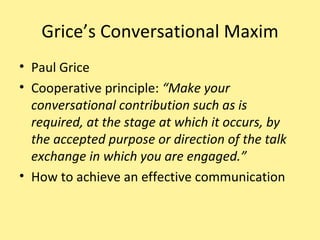
Grice’s Conversational Maxim Paul Grice Cooperative principle:  “Make your conversational contribution such as is required, at the stage at which it occurs, by the accepted purpose or direction of the talk exchange in which you are engaged.” How to achieve an effective communication
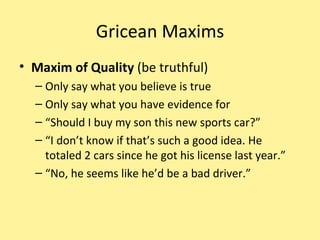
Gricean Maxims Maxim of Quality  (be truthful) Only say what you believe is true Only say what you have evidence for “ Should I buy my son this new sports car?” “ I don’t know if that’s such a good idea. He totaled 2 cars since he got his license last year.” “ No, he seems like he’d be a bad driver.”
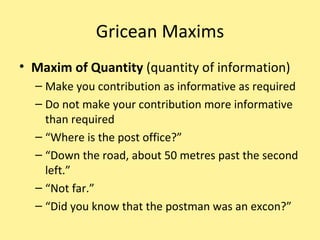
Gricean Maxims Maxim of Quantity  (quantity of information) Make you contribution as informative as required Do not make your contribution more informative than required “ Where is the post office?” “ Down the road, about 50 metres past the second left.” “ Not far.” “ Did you know that the postman was an excon?”
Gricean Maxims Maxim of Relation  (relevance) Make your contribution relevant to the interaction. Indicate any way that it is not. “ How are you doing in school?” “ Not too well, actually. I’m failing two of my classes.” “ What fine weather we’re having lately!”
Gricean Maxims Maxim of Manner  (be clear) Avoid unnecessary prolixity Avoid ambiguity. Be brief. Be orderly. “ What did you think of that movie? “ I liked the creative storyline. The ending was really a surprise!” It was interestingly done, sir.
Examples of  Pairs Greeting—greeting “ Heya!”—”Oh, hi!” Offer—acceptance/rejection “ Would you like to visit the museum with me this evening?”—”I’d love to!” Request—acceptance/rejection “ Is it OK if I borrow this book”—”I’d rather you didn’t, it’s due back at the library tomorrow.”
Examples of Pairs Question—answer “ What does this big red button do?”—”It causes two-thirds of the universe to explode.” Complaint—excuse/remedy “ It’s awfully cold in here.”—”Oh, sorry, I’ll close the window.” Degreeting—degreeting “ See you!”—”Yeah, see you later!”
Degreeting Refers to the conversational procedure by which two participants of a conversation agree to discontinue the conversation. Greeting engages one. Thus, it was named so. “ I’ll see you later then.” Yeah ok, see yah!” “ Bye.”
Thank You!

Adjacency pair

  • 1.
    Adjacency Pair Languageand Social Interaction
  • 2.
    Adjacency Pair Anexample of turn-talking (pragmatics) Composed of two utterances by two speakers, one after the other The speaking of the 1 st utterance (the 1 st part, the 1 st turn) Provokes a responding utterance (the 2 nd part, the 2 nd turn)
  • 3.
    Pragmatics Subfield oflinguistics which studies the ways in which context contributes to meaning. Being able to understand what is transmitted. Comes only through experience. “ You have a green light.” It could mean you are holding a green light bulb. Or that you have a green light to drive your car. Or indicates that you can go ahead with the project Or that your body has a green glow.
  • 4.
    Example “ Whatis your name?” Requires the addressee to provide an answer in the following turn If answered, completes the adjacency pair “ I’m Piolo.” (Satisfies the pair) “ I’m allergic to shellfish.” (Fails to complete the pair) Violates the conversational maxim
  • 5.
    Grice’s Conversational MaximPaul Grice Cooperative principle: “Make your conversational contribution such as is required, at the stage at which it occurs, by the accepted purpose or direction of the talk exchange in which you are engaged.” How to achieve an effective communication
  • 6.
    Gricean Maxims Maximof Quality (be truthful) Only say what you believe is true Only say what you have evidence for “ Should I buy my son this new sports car?” “ I don’t know if that’s such a good idea. He totaled 2 cars since he got his license last year.” “ No, he seems like he’d be a bad driver.”
  • 7.
    Gricean Maxims Maximof Quantity (quantity of information) Make you contribution as informative as required Do not make your contribution more informative than required “ Where is the post office?” “ Down the road, about 50 metres past the second left.” “ Not far.” “ Did you know that the postman was an excon?”
  • 8.
    Gricean Maxims Maximof Relation (relevance) Make your contribution relevant to the interaction. Indicate any way that it is not. “ How are you doing in school?” “ Not too well, actually. I’m failing two of my classes.” “ What fine weather we’re having lately!”
  • 9.
    Gricean Maxims Maximof Manner (be clear) Avoid unnecessary prolixity Avoid ambiguity. Be brief. Be orderly. “ What did you think of that movie? “ I liked the creative storyline. The ending was really a surprise!” It was interestingly done, sir.
  • 10.
    Examples of Pairs Greeting—greeting “ Heya!”—”Oh, hi!” Offer—acceptance/rejection “ Would you like to visit the museum with me this evening?”—”I’d love to!” Request—acceptance/rejection “ Is it OK if I borrow this book”—”I’d rather you didn’t, it’s due back at the library tomorrow.”
  • 11.
    Examples of PairsQuestion—answer “ What does this big red button do?”—”It causes two-thirds of the universe to explode.” Complaint—excuse/remedy “ It’s awfully cold in here.”—”Oh, sorry, I’ll close the window.” Degreeting—degreeting “ See you!”—”Yeah, see you later!”
  • 12.
    Degreeting Refers tothe conversational procedure by which two participants of a conversation agree to discontinue the conversation. Greeting engages one. Thus, it was named so. “ I’ll see you later then.” Yeah ok, see yah!” “ Bye.”
  • 13.